Low-Complex Environmental Sound Recognition Algorithms for Power-Aware
Wireless Sensor Networks
September 2012
A thesis submitted in partial fulfilment of the requirements for the degree of Doctor of Philosophy in Engineering
Keio University
Graduate School of Science and Technology School of Integrated Design Engineering
Zhan, Yi
Abstract
The past decade witnessed rapid development in the basic Internet, communications theories and in some newly emerging technologies, such as wireless sensor networks (WSNs), wearable sensing and computation. With the rapid development of these technologies, understanding individual’s activities, social interaction, and group dynamics of a certain society becomes possible and plays an important role for creation a ubiquitous information society around us. This will inevitably enrich our life’s content and improve our society’s efficiency.
Environmental background sound is a rich information source for identifying individual and social behaviors. Therefore, many power-aware wearable devices in the WSNs system with sound recognition function are widely used to trace and understand human activities. Design of these sound recognition algorithms has two major challenges: limited computation resources and a strict power consumption requirement. These motivate us to develop a new method for recognizing environmental background sounds upon our power-aware wearable sensor node. Therefore, we address to develop a new and low-complex sound recognition algorithm which can achieve high recognition accuracy while still meeting the wearable sensor’s power requirement in the dissertation.
In Chapter 1, the motivation and challenge of this study are introduced. Related work is also surveyed.
In Chapter 2, hardware architecture of the power-aware wearable senor node for detection and software-level sound recognition flow are introduced. Upon this resource limited platform, the assumptions and special constrains of this research are discussed. Basic approaches to tradeoff the system’s accuracy and power consumption problem are proposed.
In Chapter 3, the experimental setup and process are presented. Comprehensively considering the accuracy and power consumption as the proposed sound recognition algorithms’
performance evaluation criteria is also discussed.
In Chapter 4, sound feature extraction Mel-frequency cepstral coefficients (MFCC) and
vector quantization (VQ) classification Linde-Buzo-Gray (LBG) algorithm is applied for
- II -
recognizing the environmental background sounds. Applying this algorithm to 20 typical daily activity sounds, average recognition accuracy of 93.8% can be achieved. In this algorithm, how the three parameters (i.e., Mel filters number, frame-to-frame overlap and LBG codebook cluster number) affect the system’s calculation burden and accuracy is also investigated. Based on the performance evaluation method in Chapter 3, the comprehensive performance of proposed MFCC+LBG algorithm is evaluated.
In Chapter 5, a new low-complex sound feature extraction Haar-like filtering with hidden Markov model (HMM) classification algorithm is proposed and applied to recognize the environmental sounds. Average recognition accuracy 96.3% of 20 typical daily activity sounds by the proposed algorithm can be achieved, which outperforms normal personal hearing capacity 82% accuracy. At the same time, it also satisfies the amount of calculation cost decided by the wearable sensor node’s energy resource. Through experimental comparison, the proposed method outperforms other normally utilized sound recognition algorithms as the recognition accuracy and calculation cost two evaluation parameters concerned.
In Chapter 6, summary of this study is concluded. Overview of the future work is also
mentioned.
Acknowledgement
First and foremost, I would like to express my sincere gratitude to my advisor Professor Tadahiro Kuroda for his kind support, encouragement and patience during my Ph.D study.
His passion, dedication, and dexterity towards the research and work are a good example, which activates me to keep on going forward in and out of school.
I would also like to deliver my appreciation to Prof. Yoshimistu Aoki, Prof. Nobuhiko Nakano, and Prof. Hideo Saito for their time, valuable comments, helpful discussion on my thesis and effort to serving on my thesis committee.
I wish to thank the Japanese Government (Monbukagakusho: MEXT) for providing me a precious opportunity and generous support to pursue my graduate study at Keio University. I would also like to show my sincere acknowledgement to Prof. Tadahiro Kuroda and Prof.
Zhihua Wang of Tsinghua University for their strong recommendations for this opportunity.
I would like to appreciate my team mates - Shun Miura and Jun Nishimura for giving me a lot of help during the study. My gratitude should also deliver to Dr. Kazuo Yano and Dr. Nobuo Sato of Central Research Laboratory, Hitachi, Ltd. for their helpful discussion, encouragement, and generous support at the initial stage of this research.
I am also deeply thankful to all the lab members. Experience of studying these years with them in Kuroda Laboratory is a wealth for me, and this precious memory is to bear in my mind forever. Especial thanks should be given to Noriyuki Miura, Yasumoto Tomita, Takayuki Shibasaki, Shun Miura, Mari Inoue, Yuxiang Yuan, Vishal Kulkarni, Yanfei Chen, Hitoshi Kikuchi, Yoichi Yoshida, Xiaolei Zhu, Andrzej Radecki, Tsutomu Takeya, Mitsuko Saito, Yasuhiro Take, Takayuki Abe, Wataru Mizuhara for their kind help and pleasant companion with me in and outside school. I would like to thank Tsunaaki Shidei, Chika Wada, Ritsuko Mukai, and Chika Kijima for various experimental and academic issues.
Staying with the special research professors Won-Joo Yun, Lan Nan, Hayun Chung is also a pleasant and thankful period of time.
Friends gave me tremendous help, constructive suggestions and encouragement during the
doctoral study. Studying and living with them widen my knowledge scope and enrich my life,
- IV -
I would like to thank them and cherish this precious friendship. I also owe a special appreciation to Ms. Lijiang Niu for her kind encouragement.
I would like to thank Prof. Keqian Zhang, Prof. Lian Gong, and Prof. Zhibin Pan for teaching me basic knowledge, giving me cordial help and encouragement during my growth and study.
I am also blessed with a family full of love, dedication, and trust. I would like to express the gratitude to my beloved parents and sister. This work could not have been completed without their everlasting and dedicated cultivation, trust and love.
Keio University, Yokohama, Japan
August 8
th, 2012
Yi Zhan
Contents
Abstract...I Acknowledgement... III Contents ... V List of Figures... VIII List of Tables ... X
Chapter 1 Introduction ... 1
1.1 Research Motivation... 2
1.2 Wireless Sensor Networks and Front-End Wearable Sensors ... 3
1.2.1 Introduction of Wireless Sensor Networks ... 3
1.2.2 An Application Example of the WSNs System ... 4
1.2.3 Front-End Wearable Sensor Node in the WSNs System ... 6
1.2.4 Unique Constrains and Challenges... 9
1.3 Environment Background Sound Detection for Activity Recognition... 10
1.3.1 Low-Level Activity Recognition... 10
1.3.2 Why Applies Sound as the Detection Media?... 12
1.3.3 Application Domains ... 14
1.4 Related Work... 15
1.4.1 Environmental Background Sound Recognition... 15
1.4.2 Audio-Context Recognition on Hardware Platforms... 16
1.4.3 Tradeoffs of the Sound-Context Recognition on Wearable Platform ... 18
1.5 Research Objects and Contributions... 20
1.6 Thesis Organization... 22
Chapter 2 Our System Study ... 24
2.1 Our Hardware and Software System ... 25
2.1.1 Hardware Platform and Specifications of Our Wearable Sensor ... 25
2.1.1.1 Hardware Schematic Diagram... 25
2.1.1.2 Why MCU? DSP, FPGA, and MCU Comparison ... 27
2.1.1.3 Hardware Specification ... 28
2.1.2 Recognition Flow in Software Aspect... 29
2.2 Assumptions and Constraints of This Research ... 30
2.2.1 Placement of the Wearable Sensor ... 30
- VI -
2.2.2 Dominant and Single-Content Sounds ... 31
2.2.3 Local Processing ... 32
2.2.4 Length of Processing Unit: One Second ... 34
2.3 Basic Approaches and Principles of Our Solution ... 35
2.4 Chapter Summary... 36
Chapter 3 Experiment Setup and System’s Performance Evaluation... 37
3.1 Experimental Setup ... 38
3.1.1 Test Environmental Sounds ... 38
3.1.2 Experimental Data Collection and Data Sets ... 39
3.1.3 Recognition Flow ... 40
3.2 Evaluation Approach: System’s Accuracy and Power Consumption... 42
3.2.1 Recognition Accuracy... 42
3.2.2 Power Consideration and Evaluation ... 44
3.2.2.1 Algorithm’s Evaluation in Power Consumption Aspect ... 44
3.2.2.2 Power Consideration in Previous Sound Recognition Algorithms .. 47
3.2.3 Our Evaluation Approach ... 48
3.3 Chapter Summary... 51
Chapter 4 Mel-Scale Feature with LBG Classification for Environmental Sound Recognition ... 52
4.1 Introduction and Related Work... 53
4.2 Sound Recognition Algorithm’s Flow... 55
4.2.1 Why Mel-Scale?... 56
4.2.2 Feature Extraction – MFCC Flow ... 58
4.2.3 Why MFCC Can Have Less Overlap? ... 61
4.2.4 Classification – LBG Algorithm... 62
4.3 Experimental Process and Consideration of Some Parameters ... 64
4.3.1 Experimental Setup and Details... 64
4.3.2 Recognition Flow ... 64
4.3.3 Consideration of Some Parameter Values... 66
4.4 Experimental Results and Discussion... 67
4.4.1 Recognition Accuracy (Mel-filter Number, Frame Overlap) ... 68
4.4.2 Calculation Cost (Mel-filter Number, Frame Overlap) ... 69
4.4.3 Experimental Results ... 71
4.4.4 Performance Comparison and Whole System’s Evaluation... 73
4.5 Chapter Summary... 76
Chapter 5 Low-Complex Haar-Like Feature with HMM Classification for Environmental Sound Recognition ... 77
5.1 Introduction and Related Work... 78
5.2 Implementation of Sound Recognition by the Haar+HMM Algorithm ... 82
5.2.1 Why Employ Haar-like Sound Feature with HMM Classification? ... 82
5.2.2 Haar-like Sound Feature Extraction ... 84
5.2.3 Off-Line Training for the Haar-like Filters Group... 88
5.2.4 HMM Classification... 89
5.3 Experimental Process and Consideration of Some Parameters ... 91
5.3.1 Experimental Setup and Details... 91
5.3.2 Recognition Flow ... 92
5.4 Experimental Results and Discussion... 93
5.4.1 Parameters Tuning and Recognition Accuracy Rate ... 93
5.4.2 Comparison of Different Sound Features’ Performance ... 95
5.4.3 Performance Comparison of Different Classifiers ... 97
5.4.4 Performance Comparison of Whole System ... 99
5.5 Chapter Summary... 101
Chapter 6 Conclusions ... 102
6.1 Conclusions ... 103
6.2 Scope of Future Work ... 105
Bibliography ... 107
List of Abbreviations ... 120
- VIII -
List of Figures
Figure 1.1 An Example of Habitat Monitoring – “Great Duck Island” Project by Employing
WSNs Technology. ... 5
Figure 1.2 MIT Media Lab’s “Sociometer” Which Can Detect the Carrier’s Physical Information and Notify Wearer’s Location and Proximity. ... 7
Figure 1.3 Our Wearable Sensor Node Embedded Sound, Acceleration, IR Sensor in Size of Worker’s ID Card (3.86 inch × 2.87 inch × 0.35 inch)... 8
Figure 1.4 Main Components of a Wearable Sensor Node... 9
Figure 1.5 Flowchart of This Dissertation. ... 23
Figure 2.1 Wearable Sensor Recharging on a Charging Pad (a) and Inner Hardware Prototype (b)... 25
Figure 2.2 Schematic Diagram of the Front-End Wearable Sensor Node... 26
Figure 2.3 Sound Recognition Flow. ... 30
Figure 2.4 Energy Assignment to the Three Main Blocks inside the Front-End Sensor Node – Rene. (Ref. [72_L. Doherty])... 33
Figure 3.1 Sound Matching and Recognition Flow... 41
Figure 3.2 Our Sound Recognition Performance Evaluation Approach – Average Accuracy and Power Benchmarks. ... 51
Figure 4.1 Sound Recognition Flow with the MFCC+LBG Algorithm. ... 56
Figure 4.2 Relationship of the Frequency f and Mel Frequency Mel (f)... 57
Figure 4.3 MFCC Algorithm Flow. ... 58
Figure 4.4 Mel Domain Diagram of Two Sounds - Train Start and Train Running (1.5-second length)... 60
Figure 4.5 An Experimental Waveform That Explains Less Overlap in Sound Process Is
Available. ... 61
Figure 4.6 Average Recognition Accuracy as a Function of the Template Length and LBG
Codebook Cluster Number k. ... 67
Figure 4.7 Multiplication and Addition Calculation Cost as a Function of the LBG Codebook Cluster Number k. ... 67
Figure 4.8 Accuracy Rate in Function of Mel-filter Number and Frame Overlap. ... 69
Figure 4.9 Calculation Cost of Multiplication and Addition in Function of the Mel-filter Number and Frame Overlap. ... 70
Figure 4.10 Comparison of Optimized B, Referenced A and C’s Accuracy and Calculation Cost... 72
Figure 4.11 Accuracy Comparison of the MFCC+LBG, MFCC+DTW, and MFCC+GMM Algorithms... 73
Figure 4.12 Performance Comparisons of MFCC+LBG, MFCC+DTW, and MFCC+GMM Algorithms... 75
Figure 5.1 Sound Recognition Flow with the Haar+HMM Algorithm. ... 82
Figure 5.2 One-Dimension (1-D) Haar-like Filter h
filter(j)... 84
Figure 5.3 One-Dimension (1-D) Haar-like Filtering for One Frame’s Sound Signal. ... 85
Figure 5.4 Block Diagram of a Test Sound’s HMM Classification... 90
Figure 5.5 Average Accuracy in Function of the Parameters: HaarFilNum and HaarWidMax. ... 93
Figure 5.6 Average Accuracy in Function of the Parameter: HaarFilNum and α. ... 94
Figure 5.7 Performance Comparison of Proposed Haar-like and Traditional MFCC Sound Features with Same HMM Classifier – Average Accuracy and Multiply / Addition Calculation Cost (256 samples/frame). ... 96
Figure 5.8 Performance Comparison of LBG, k-means and HMM Classifiers with Same Haar-like Sound Feature (Haar-like Feature’s α=1.0). ... 97
Figure 5.9 Performance Comparison of MFCC+HMM, Haar+LBG, Haar+k-means, and
Haar+HMM (Haar-like Feature’s α=1.0). (* Ref. [93_J. Nishimura_ICSP’2008])
... 100
- X -
List of Tables
Table 1-1: Approximate Data Rate of Different Sensor Modalities. ... 13 Table 2-1: DSP, FPGA, and MCU Technical Parameters’ Comparison. ... 28 Table 3-1: Power Consumption Evaluation Methods in Different Design Stages. ... 47 Table 3-2: Main Electronic Parameters of the H8S/2218 MCU and Embedded H8S/2000
CPU Core. ... 49 Table 4-1: Performance Comparison of Optimized Case B, Reference Cases A and C with the
Same MFCC+LBG Algorithm. ... 71 Table 4-2: Twenty Sounds Recognition Accuracy Confusion Matrix of Optimized Case B,
Reference Cases A and C. ... 72 Table 4-3: Performance Comparison of the MFCC+DTW, MFCC+GMM, and MFCC+LBG
Algorithms... 74 Table 5-1: Comparison of Nishimura’s Studies (Ref. [82, 93, 104]) and This Work. ... 81 Table 5-2: Training Haar-like Filters Pool Size with Relation to the Two Parameters -
“HaarWidMax” and “HaarFilNum”... 89 Table 5-3: Different Sound Feature – MFCC and Haar-like Feature (α=0, 0.5, 1.0)
Performance Comparison (per Frame =256 Samples)... 96 Table 5-4: Recognition Accuracy Confusion Matrix of 20 Different Tested Sounds with
Haar+HMM Algorithm (α=1.0); Accuracy Comparison with Other Haar+HMM Two Cases (α=0/0.5), Haar+k-means and Haar+LBG. ... 98 Table 5-5: Comprehensive Performance Comparison of Four Different Sound Recognition
Algorithms - MFCC+HMM, Haar+LBG, Haar+k-means, Haar+HMM (1 Second /
unit =124 Frames in Each Second Sound unit, Haar-like Feature’s α=1.0)... 100
Chapter 1 Introduction
Chapter 1
______________________________________________________________________________________________________________
- 2 -
Firstly, the motivation of this research “Low-Complex Environmental Sound Recognition Algorithms for Power-Aware Wireless Sensor Networks (WSNs)” is introduced. A well-known bird habitat monitoring system in the “Great Duck Island” project is taken as an example to briefly introduce the WSNs system. At the same time, unique constrains in the WSNs system and research challenges, especially its front-end wearable sensors are introduced. The importance of activity recognition and reason to employ sound as a detection media are presented. Related researches of environmental sound recognition and its implementation on a hardware platform are also surveyed. Finally, the research targets and our contributions are concluded, outline of this dissertation is also delivered.
1.1 Research Motivation
Wireless sensor networks (WSNs) [1, 2, 3] becomes an active research area these years, its research results are gradually being applied in various fields and plays an important role for creation a ubiquitous information society around us. Its application ranges from initial battlefield surveillance to industrial fields, such as industrial monitoring, inventory tracking, and so on; and also to personal applications, such as household health care and elder-people caregiver systems [29, 91], etc.
To help realization these functions, employing the sound sensor embedded in some
wearable device and recognizing personal daily activities are meaningful and challenging
work. Background environmental sounds contain a lot of useful information to tell what
activities people are doing. Through recognition these sounds continuously for a day, the
people’s daily activities log can be established. This log contains abundant information of
individual self and between others. With the WSNs involvement, it is very helpful to
establish household medical systems like long distance diagnose for patients, physical and health monitoring for people in normal daily life, etc. The log information can also assist in understanding social interactions in a particular group or society; for example, the working status of employees and their efficiency in offices or working places. However, these sound recognition algorithms executed on the power-aware WSNs platform are difficult because the power assigned for the signal processing block is very limited. Therefore, a so-called “smart sensing” which processes raw data and makes decision locally is absolutely required (Refer to Section 2.2.3). This demands the sound-context recognition algorithm to achieve high accuracy with low calculation cost to satisfy the energy requirement.
1.2 Wireless Sensor Networks and Front-End Wearable Sensors
1.2.1 Introduction of Wireless Sensor Networks
With the development of the micro-fabrication and integration, such as sensors and actuators manufactured using advanced micro-electromechanical system or MEMS technology, the transistors integrated in a IC chips has been doubled every two years based on Moore’s Law and improved the computational performance by 70% every year. These advantages provide more low-cost and high performance front-end sensors which can sense fields and forces in our physical world.
Another, with the development of wireless communication, system software, hardware
technologies that supports networks , and with sensor itself improvement in this decade make
our scope of probing and understanding the outside physical world to an extent which human
being has not even had before. Under this background, a new technology - wireless sensor
Chapter 1
______________________________________________________________________________________________________________
- 4 -
networks (WSNs) [1-6] arouses the researchers’ great interest in both industry and academic fields.
These front-end sensors in the WSNs system mainly include sensing, data processing, and communication components. They can be self-organized and self-adjusted to build up a network and complete more complex functions than individual sensor does. Potential applications are described in references [2, 3] and specified as follow:
Environmental and habitat monitoring (e.g., traffic, habitat, security monitoring) [3, 7]
Industrial sensing and diagnostics (e.g., factory, inventory tracking)
Infrastructure monitoring and protection [8, 9] (e.g. structural health monitoring) Battlefield awareness (e.g. multi-target tracking)
Context-aware computing [10, 12-17] (e.g. intelligent home, responsive environment)
Body Sensor Networks (BSN) [6].
1.2.2 An Application Example of the WSNs System
A well-known research for the “environmental and habitat monitoring” – the “Great Duck
Island” monitoring system [103] is taken as an example to explicate the WSNs system. In
year 2002, this project was initiated near the coast of “Great Duck Island” in Maine, USA by
a combined research group from the University of California Berkeley and College of the
Atlantic. The research target is to long-distance monitor the habitats of the local bird - Leach's
Storm Petrel without personal interference by employing many locally embedded sensors and
WSNs system.
The whole system is as Fig 1.1 shown, various type of sensor nodes called “motes”
(marked as
①①①①and
②②②②) are embedded in and outside nest. They can measure the environmental temperature, light, infrared, relative humidity, and barometric pressure around the nest. The birds’ living environmental information is sampled, collected, and processed real-time inside the motes locally. Monitoring results and environmental information are transmitted by the mote’s transmitter to nearby Gateway (
③③③③) and to the faraway base station (
④④④④). Finally, the observation data is sent to remote lab in California through the satellite and internet (
⑤⑤⑤⑤).
In this way, the scientists who are not locally can learn the bird’s habitat information quickly. With the WSNs system involvement, disturbance from the researches was minimized compared with the traditional on-site study. Even now, this system is still working and we can learn the local environmental and habitat information from the internet [103].
“Mote” inside nest
“Mote” contains light, air pressure, humidity, temperature sensors Gateway
Satellite dish
Habitat Information
Habitat information
“Mote” inside nest
“Mote” inside nest
“Mote” contains light, air pressure, humidity, temperature sensors
“Mote” contains light, air pressure, humidity, temperature sensors Gateway
Gateway
Satellite dish
Habitat Information
Habitat information
Figure 1.1 An Example of Habitat Monitoring – “Great Duck Island” Project by
Employing WSNs Technology.
Chapter 1
______________________________________________________________________________________________________________
- 6 -
1.2.3 Front-End Wearable Sensor Node in the WSNs System
Previous Section 1.2.2 simply introduces what major components compose a WSNs system and how they work cooperatively to complete an environmental monitoring work.
Similarly, multi-functional sensors can be integrated into a wearable device and applied to people. These wearable devices are easily and comfortable attached to human body. From them, carrier’s activities, behaviors, and person-to-person’s relationship information can be detected.
Supposed every member inside a society wearing these multi-functional sensors and with the WSNs involvement, detecting and understanding the individual’s activities, person-to-person interaction of the society are available. This is of benefit to fulfill the
“ Community Detection and Social Behavior Analysis” and “Socially-Aware Computing”
[10-19, 26, 27, 77, 78, 99] functions in the near future. Among them, the MIT Media Lab.
and the Hitchai Ltd. research groups had developed their own front-end wearable sensor nodes.
It is reported that active pattern recognition of face-to-face interactions within a
workplace can radically improve the function of the organization [20]. In order to improve it
by detection the face-to-face interaction, researchers of the MIT Media Lab. developed some
wearable sensors, such as “MIThril”, “Uber-Badge” [11, 13], and “Sociometer” [12], etc. By
using the “Sociometer” as Fig. 1.2 shown, ambient audio, acceleration information of the
wearers can be sampled, processed and detected. The infrared ray (IR) sensor inside can
inform the wearer’s location and proximity. Therefore, individual and whole community’s
physical information can be collected, analyzed and conveyed, such as in an office, school or
company. This community “networks” is helpful to understand their collaboration, team
formation, knowledge management, and dynamic communication conditions inside it. All these provide a powerful tool to understand and organize a dynamic human organization.
Figure 1.2 MIT Media Lab’s “Sociometer” Which Can Detect the Carrier’s Physical Information and Notify Wearer’s Location and Proximity.
In order to perform the “context-aware computing” function for realization the ubiquitous society, Hitachi researchers have also developed their low-power wearable sensor nodes -
“Life microscope” [15, 16, 18], “Business microscope” [15, 16, 19] and “Life Thermoscope”
[17]. These designs also figure out a prosperous version of “knowledge-creating” and
“opportunities-discovering” society in the near future by using these wearable sensors with the WSNs technology [15]. People’s daily household and working information can be collected, analyzed, and well managed. These systems will inevitably enrich our life content and improve our society’s efficiency.
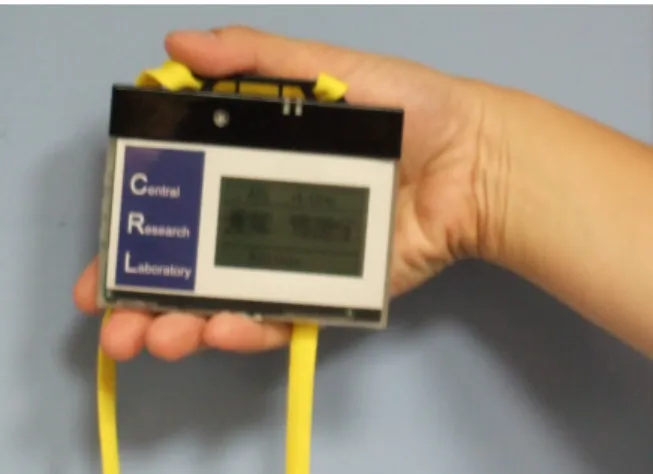
A low-power wearable sensor - “ Business microscope” [15, 16] is as Fig.1.3 shown. It is
designed for understanding individuals and their interactive relations with others inside an
Chapter 1
______________________________________________________________________________________________________________
- 8 -
organization. The system uses an ID-tag-shape wearable sensor node that transmits and receives infrared light to detect face-to-face interaction between people. It can track individuals’ movement using embedded accelerometers. At the same time, it can also detect and understand voice and ambient sound acoustic information inside a community by the integrated sound sensor. In this way, activities of all members within the organization can be sampled, collected, analyzed and illustrated. For example, this technology’s application is great benefit to the employees’ self-study and growth, the company’s management and efficiency improvement [15, 16, 17, 21, 22, 23, 24, 63]. Besides inside a company, this low-power wearable sensor node can also be utilized at home. It is helpful to implement
“household monitoring and assistance” and “household health monitoring and diagnose”
functions.
Figure 1.3 Our Wearable Sensor Node Embedded Sound, Acceleration, IR Sensor in Size of Worker’s ID Card (3.86 inch × 2.87 inch × 0.35 inch).
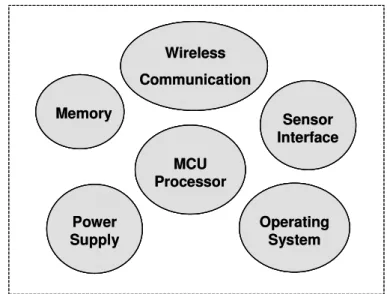
From introduction of these front-end wearable sensors, we learn that their architecture is quite similar. They mainly consist of six major components as depicted in Fig. 1.4.
MCU processor: the brain of the wearable sensor node.
Wireless Communication: wireless communication between sensor nodes.
Memory: external storage for sensor reading or program.
Sensor Interface: interface with sensors and other devices.
Power Supply: power provides for the sensor node.
Operating System: software for managing the networks and resources.
MCU Processor Memory
Wireless Communication
Power Supply
Operating System
Sensor Interface MCU
Processor Memory
Wireless Communication
Power Supply
Operating System
Sensor Interface MCU
Processor MCU Processor Memory
Memory
Wireless Communication
Wireless Communication
Power Supply Power Supply
Operating System Operating
System Sensor Interface Sensor Interface
Figure 1.4 Main Components of a Wearable Sensor Node.
1.2.4 Unique Constrains and Challenges
Three main constrains lead to special research challenges during designing the WSNs system and applications [1, 2, 6].
Limited support for networking: each node in the WSNs system acts as a router and
as an application host. The network is peer-to-peer, mesh topology, and dynamic,
mobile and unreliable connectivity. How to manage the networks effectively is a
challenge work and have some discussion in [2, 4, 5, 9].
Chapter 1
______________________________________________________________________________________________________________
- 10 -
Limited hardware: front-end sensor of the WSNs system has limited energy supply (on-board battery), memory, and communication capacity. Therefore, the methodology of signal processing, data storage and communication bandwidth of the WSNs system is different from the normal network system with a constant power supply.
Limited support for software development: energy is limited in the WSNs system.
For this reason, algorithms and network protocols need to maximize the system’s lifetime, address robustness and fault tolerance, and self-configure.
Different constrains lead to different research problems in the WSNs system. In this research, we just focus on the first issue - energy supply and hardware resource assigned to our wearable sensor in Fig. 1.3 are limited (technical details are presented in the Chapter 2).
This requires the applied algorithms upon the sensor platform must be operated within the very limited energy budget. Followed this energy constrains, the final performance must achieve to a reasonable and practical accuracy becomes meaningful. This is the difference from normal sound recognition research that mainly focuses on the recognition accuracy.
1.3 Environment Background Sound Detection for Activity Recognition
1.3.1 Low-Level Activity Recognition
Activity recognition [28] aims to recognize the actions and goals of one or more agents. It
can be detected from a series of observations on the agents’ actions and the environmental
context conditions. It is a part of research field of pattern recognition.
There are three levels of activity recognition. At low-level activity recognition, relative information is collected by the sensors and processed locally or transmitted to higher level. At intermediate-level, statistical inference concerns about how to recognize individuals’
activities from the inferred location and environmental conditions from the low-level. At the high-level, major concern is to discover the overall goal of an agent from the detected activity sequences through a mixture of logic and statistical reasoning. In this research, we focus on the low-level recognition by employing various kinds of sensors.
The low-level human activities can be recognized from two kinds of information. One is from the agent’s body information. It can be sampled and collected by accelerometers [18, 30, 31, 32, 33], thermo-sensor [17], infrared ray (IR) sensor [12, 21, 23], etc. Another is from the context-aware sensing, for example, acoustic environmental sound [10, 13, 15, 25, 35, 36, 37, 38, 77, 78] and image processing [34]. These two ways are sometimes combined together with different functional sensors embedded into the wearable devices. Employing these easy-carrying movable devices is helpful to achieve better performance of tracking, monitoring and recognizing human daily activities.
Daily activity recognition has many important applications and plays an important role on improvement of personal and social life qualities. Health care is one of applications, such as nursing home for the elders, assisting the sick and disabled, fitness monitoring, etc. [6, 29].
Traditionally, people’s physical and health information is acquired through self-reporting
based on diaries or questionnaires from the doctors. This method is time-consuming and
unreliable, especially for the elderly and subjects with memory impairment. Another method
of acquiring this information is through clinical observation, but it requires expert’s
involvement and may not accurately reflect the patient’s behaviors under the normal
household environment. With the current advances in sensor and wireless technology, it is
Chapter 1
______________________________________________________________________________________________________________
- 12 -
now possible to provide ubiquitous monitoring of the subjects under their natural physiological status. The activity detection results can also be used to a person’s behavior, intention, goal and social connection analyses. If these detection results are utilized in a company or an organization, every member’s working status can be understood and illustrated. This can be a beneficial feedback for them. Their working efficiency can be improved and “healthcare” of the organization can also be realized [15, 21].
1.3.2 Why Applies Sound as the Detection Media?
Many detection media are used to recognize human activities, the most commonly used are acceleration [18, 30, 31, 32, 33], video [34], IR [12, 21, 23], and sound [10, 13, 15, 25, 35, 36, 37, 38, 77, 78], etc.
In Bao’s work [30], five two-axis accelerometers were attached on the tester’s joints and successfully recognized 20 human daily activities and achieve 84% accuracy. Work [31, 32]
also used the acceleration sensor to detect people’s abnormal activities which lead by Parkinson’s or Alzheimer’s disease. Through their reports, it can be conclude that the acceleration is mainly applied to detect individual activities. It is rarely employed to person-to-person social activity detection. Video is also widely used to detect people’s individual and social activities [34]. Limitation of taking image as an activity detection media is at some unobtrusive situations, such as in hospital and toilet. In addition, image signal processing is more calculational complex than the acoustic signal processing.
In our research, the sound is chosen as the activities detecting media. Because compared
with other detecting media, it possesses some unique advantages:
Wide detection scopes - It can be person-to-person social activity detection, not like accelerometer is limited to the carrier’s individual detection. IR detecting content is not as rich as sound sensing is. Sometimes, image detection quality is effected by the environmental illumination and setting position.
Convenient and comfortable - Not like accelerometer and IR sensor which must be attached to the carrier, the sound sensor can be embedded into the background environment. This avoids inconvenience and discomfort of carrying the sensors.
Privacy protection - Some of the people’s activities are very personal, such as using toilet or taking bath. Applying sound as the activities detecting media is more suitable under these unobtrusive situations.
Appropriate calculation complexity - For human being, sound is the second most important source of information after vision. However, image processing is more complex than sound processing. Image processing needs much more data rate and sampling rate than sound processing does as Table 1-1 shown. Therefore, sound processing is appropriate for the power-aware WSNs system.
Low cost - From the Table 1-1, we notice that the number of the sound sensor is less than the accelerometers which makes the cost of sound system cheaper. Normally, sound sensor is cheaper than video sensor.
Table 1-1: Approximate Data Rate of Different Sensor Modalities.
1k B/s 8bit
100 Hz 10
Accelerometers
1 1 Sensors Num.
10k B/s 8bit
8k Hz Sound
4608k B/s 8bit
4608k Hz Video*
Data Rate Resolution
Sampling Rate Sensor Type
1k B/s 8bit
100 Hz 10
Accelerometers
1 1 Sensors Num.
10k B/s 8bit
8k Hz Sound
4608k B/s 8bit
4608k Hz Video*
Data Rate Resolution
Sampling Rate Sensor Type
* Assuming 15 frames per second (fps) and VGA solution (640 x 480) x15=4608k B/s
Chapter 1
______________________________________________________________________________________________________________
- 14 -
As above described, sound is an ideal sensing media for the human activities recognition upon our wearable sensor platform. This is very helpful and promising for future integration with other sensor(s) to enhance daily activity recognition.
1.3.3 Application Domains
With the WSNs involvement, embedded acoustic sound and other functional sensors wearable devices can realize many applications. They can recognize the environmental background sounds happening around the people. These sounds contain a lot of useful information to understand what activity a person is doing. They also act as a social interactive
“bridge” between people. Many applications can be built up based on the sound-context detecting results [11, 12, 15, 99].
Household Monitoring and Assistance is one of the main application fields. People’s
daily dietetic and sanitary information is hidden within the daily activities log. This is very
helpful to understand the people’s daily physical and health condition, and provides
assistance to establish household medical systems, such as long distance diagnose for patients
and elder-people health monitoring [29]. For example, we can deduce a person is having a
food through chewing and drinking sounds. Toilet flush and urination sounds can indicate
how often a person uses toilet, it is one of useful hints for doctor to diagnose the person’s
urinary system is abnormal or not. This household monitoring and assistance application is
our main concerning. Therefore, in our experiments of later chapters, the detecting sounds are
mainly targeted to the household events. The specific target test sounds are introduced in
Section 3.1.1.
“Healthcare” of an Organization can be benefit form sound-context based human activities detection technology. Staffs of the organization’s individual and social interaction, working status and efficiency can be illustrated from their daily activities log and other indicative methods [15, 16, 17, 18, 21]. Clearly understanding this information helps the staffs to realize their deficiencies during the working period and make improvement accordingly. This feedback-loop system inevitably improves the organization’s efficiency and makes it more productive and healthier.
Social Aware and Communication is also an application domain for our sound-context detection. Acoustic voices and sounds are a rich information source for identifying the social behaviors and interactions. A good example for the group dynamics application is to find common favorite individual in the group. The utilized wearable device “UberBadge”
mounted on each participants of the group employs sound sensor [11, 13]. A measuring interaction between people wearable sensor platform “Sociometer” shown in Fig. 1.2 is implemented with embedment of IR, acceleration and sound sensors [12].
1.4 Related Work
1.4.1 Environmental Background Sound Recognition
Some researches have been directed to recognize the environmental sounds happening around us [40-49, 80]. Most of them are algorithm level study and do not concern hardware implementation.
At the feature extraction stage, presenting the spectral envelope characteristic of a sound
signal, linear prediction cepstral coefficients (LPCC) [46, 47] is a typical sound feature.
Chapter 1
______________________________________________________________________________________________________________
- 16 -
However, it can be clearly concluded that Mel-frequency cepstral coefficients (MFCC) outperforms the LPCC algorithm in normal sound recognition from previous work [43, 44].
Conventional state-of-art MFCC filtering is used to extract the sound feature and obtains good recognition accuracy [35, 41, 44, 45, 48]. However, computational expensive FFT is calculated before entering a bank of Mel-scale filters in the feature extraction flow. This increases the calculation complexity of sound feature extraction. Recently, in Chu’s work [43], a new matching pursuit (MP) algorithm is introduced to decompose sound’s time-frequency feature. In each step, the best decomposed matching atom from a redundant dictionary (such as Gabor dictionary) is searched. The sound can be presented by linearly combination with those atoms. Problem of the MP algorithm is that calculation cost for the searching enlarges dramatically with the number of the atoms in the dictionary increase.
At the classification stage, Cowling’s work has a comprehensive comparison of most conventionally used classifiers [40]. Performance of the k-nearest neighbor (kNN), Gaussian mixture model (GMM), dynamic time wrapping (DTW), support vector machine (SVM), Linde-Buzo-Gray algorithm (LBG), k-means, and hidden Markov model (HMM) classifiers have been studied and compared.
1.4.2 Audio-Context Recognition on Hardware Platforms
Some researches about sound-context recognition based on DSP, FPGA, and MCU
hardware platforms have been reported [38, 50-59]. Besides the system’s recognition
accuracy, these researches also consider how to implement the acoustic recognition
algorithms on the hardware system.
A DSP system in Dong’s work [57] is applied to execute sound environmental recognition for hearing aid application. A traditional sound feature extraction - Mel-frequency cepstral coefficient (MFCC) with hidden Markov model (HMM) classifier are implemented upon the DSP system. In this work, the complicated MFCC-based sound feature with HMM classification is implemented on the Ezairo 5900 SoC system. A 24-bit specific DSP IP core is employed to process the acoustic environmental sounds. For our power-aware wearable sensor, to execute these complex algorithms is difficult.
An interesting system upon a combined DSP and MCU hardware platforms to realize acoustic scene analysis is carried out by a research group of Arizona State University [52, 53, 54]. The system can process the acoustic signal which is sampled by the front-end sensor.
Sampling data are transmitted through a RS232 serial link to the attached DSP board to process. These pre-processed acoustic features are wirelessly transmitted to the base station, and some functions are implemented inside the station. This system can fulfill speech/non-speech, gender (male or female) recognitions and other functions. In fact, these achieved various functions are at the cost of abundant power supply (power adaptor) in DSP board and base station. Moreover, all the classification is executed inside the base station, not inside the front-end sensor locally. This proposed system is not suitable for our wearable application.
MIT media center group basically completes social dynamics detection [10, 11, 12, 13].
Their wearable front-end sensor nodes - “UbER-Badge” [13] and “Sociometer” [12] have
been developed. Each member carrying these wearable sensors inside a social organization
can build up a social dynamic sensor networks. Social connections and interactions between
them can be detected and understood. Both “Uber-badge” and “Sociometer” employ
acceleration, microphone, IR sensors to complete the functions. The “Uber-badge” has four
Chapter 1
______________________________________________________________________________________________________________
- 18 -
AAA batteries with 100mA average current and continuously works for 15 hours. The microphone samples with 8-bit resolution and 8 kHz sampling rate. Only simple background sound’s average and difference of the amplitude values are calculated to indicate the carrier’s dynamic, such as during lunch, dinner, and buffet break these social dynamic moments.
However, this work just achieves a rough function of understanding acoustic context around the people. As to comprehensively understand the detail acoustic context, their proposed sound feature is simple and does not work.
Researcher of the Waseda University employs some sensors called “Cookie” and
“Muffin” [55, 56] to build up their sensor networks. This front-end wearable system can detect person’s daily activity from 11 genres sensors (microphone, RFID, pulse, 3-D acceleration, etc.). These sampling data are transmitted to a host mobile terminal (such as cellular phone or a PDA) that provides enough power to analyze and detect the carrier’s background context. The recognition software and hardware infrastructures have been introduced. Multi-sensors fusion and hierarchical context refinement methods help to complete context awareness function. However, as the system’s power consumption and how long the system maintains, the authors do not provide enough explanation and research effort.
In fact, power consumption is one of important factors during the algorithm’s implementation on power-aware front-end wearable sensor node.
1.4.3 Tradeoffs of the Sound-Context Recognition on Wearable Platform
The design of a wearable computing system needs to consider various factors: low power,
high performance, easily wearable, efficient communication channels, etc. In our research,
we focus on the sound-context recognition algorithm’s study. It must achieve acceptable
recognition accuracy and satisfy the power budget assignment of our wearable sensor [16, 18].
Including the algorithms introduced in Section 1.4.1, most reported environment sound recognition researches don’t need to consider the hardware factor. In Chen’s work [35], seven bathroom activities are recognized by detecting sounds happening in it, such as shower and brush tooth sounds, etc. The sounds are sampled by a microphone set on site and recognized by utilizing the MFCC+HMM algorithm on a PC afterwards. Similar cases also happen in acceleration-context activities study. Yin’s Work [31] uses the acceleration sensor to detect people’s abnormal activities which lead by Parkinson’s or Alzheimer’s disease. Even though the experiment raw data were sampled by some wearable sensors and transmitted to the computer, the recognition is not completed inside the sensor nodes locally, whereas inside the computer.
Comprehensively trading off the recognition system’s performance and power
consumption research was firstly reported by the ETH research group in 2004 [36, 38]. Their
researches are most close to our research. They employed wearable accelerometer and
microphone embedded sensor - ETH PadNET to detect carrier’s activities happening in a
wood shop [36, 38, 50, 51]. Recorded sounds are sampled at 48 kHz and down-sampled to 2
kHz, frame based FFT feature extraction is executed and linear discriminant analysis (LDA)
is applied to decrease the feature’s dimensions. Twenty-one sounds happened in wood shop,
such as from filing, sawing, drilling, and hammering, etc. can be detected with combination
of the carrier’s acceleration information. In Stager and Bharatula’s work [36, 38], how to
trade off the accuracy and power consumption of a sound-based context recognition system
upon a wearable platform is reported. Free combinations of nine time-domain features (mean,
variance, etc.) and five frequency-domain features (bandwidth, frequency centroid, etc.)
Chapter 1
______________________________________________________________________________________________________________
- 20 -
constitute sound feature sets. With different classifiers, different recognition results are yielded. A target sound feature set and classifier is decided by the accuracy and power consumption’s tradeoff. However, to explore this ideal sound feature set and classifier needs an empirical and complicated training process.
Power efficiency plays a crucial role for those wearable devices in WSNs system [61]. In our work, a sound sensor embedded in the power-aware wearable sensor node is utilized to recognize the environmental background sounds. Power supply for the wearable sensor is energy limited battery, not like DSP and FPGA board with adaptor power. Conventional sound recognition and acoustic signal processing algorithms which can be executed on the DSP or FPGA [57, 62] platforms may not perform well on our wearable sensor. Therefore, how to develop a new sound recognition algorithm to achieve high accuracy with low calculation cost to satisfy the energy requirement is the challenge of this research.
1.5 Research Objects and Contributions
Environmental background sound is a good context indicator for human activities, and contains rich information for identifying individual and social behaviors. Therefore, many front-end wearable devices in the WSNs system with sound recognition function are widely used to trace and understand human activities. Because those front-end sensor nodes are low-powered and the WSNs system has limited resource, these limitations decide our unique research objects:
1: the sound-context detection function in front-end wearable sensor node should work
continuously for 24 hours for a whole day observation.
2: the sound-based context recognition algorithms should be local processing. This can save energy than wireless transmitting the raw data to upper server to process.
3: the local processing decides the sound recognition algorithms must be of low computational complex. Therefore, our developed algorithms should achieve high recognition accuracy while still be with low calculation cost to satisfy our wearable sensor’s power requirement. This is the difference from the normal sound recognition researches of which mainly focus on the recognition accuracy.
In order to complete the above mentioned research objects, we make efforts and achieve these goals in this research.
Our power-aware front-end wearable sensor node inside the WSNs system shown in Fig.
1.3 has been thoroughly studied. Upon this resource limited platform, the assumptions and special constrains of this research are analyzed and discussed. Especially the local environmental background sound detection is the most crucial problem which must be solved.
After understanding the system’s limited recourse provided for our sound recognition algorithms, both the final detection accuracy and its power consumption are considered as the evaluation approach to those candidate algorithms. The target values of these two factors have been discussed and decided.
Two of our proposed sound recognition algorithms – MFCC+LBG and Haar+HMM are
studied. Their recognition accuracy and approximate power consumption for execution these
algorithms upon the wearable sensor node are also evaluated.
Chapter 1
______________________________________________________________________________________________________________
- 22 -
1.6 Thesis Organization
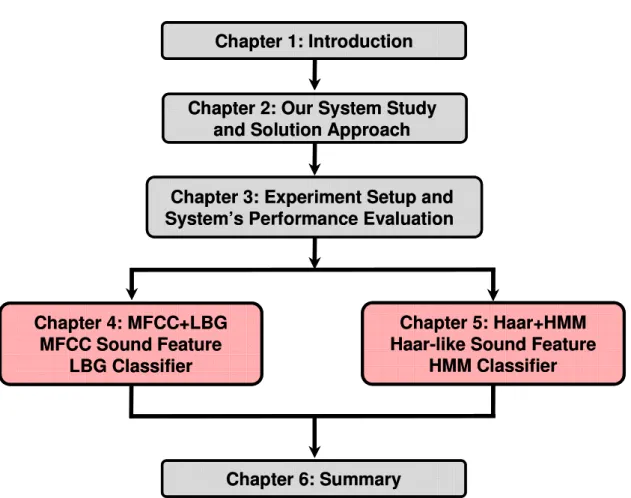
This dissertation is divided into six chapters, and its flowchart is shown in Fig. 1. 5.
In chapter 2, the power-aware wearable sensor’s hardware platform and software-level sound recognition flow are introduced. Assumptions and constrains of this research are also presented and discussed. Based on the introduced resource limited sensor node platform, basic solution approaches to satisfy both the recognition accuracy and energy budget requirements are proposed.
In chapter 3, experiment details including target detected 20 sounds, training and detected experimental data sets and recognition flow are introduced. Two evaluation benchmarks - the accuracy expected to achieve and computational power budget for the applied sound recognition algorithms are discussed and decided.
In chapter 4, sound feature extraction Mel-frequency cepstral coefficients (MFCC) and vector quantization (VQ) classification Linde-Buzo-Gray algorithm (LBG) algorithm is applied for the sound-based context recognition. How three parameters (i.e., Mel filters number, frame-to-frame overlap and LBG codebook cluster number) of the algorithm affect the system’s calculation burden and accuracy is investigated. Based on the performance evaluation method in Chapter 3, the comprehensive performance of proposed MFCC+LBG algorithm is evaluated.
In chapter 5, an extreme low calculation sound feature extraction Haar-like filtering with
hidden Markov model (HMM) classification algorithm is newly proposed and applied to
recognize the environmental sounds. Through experimental comparison, the proposed
method outperforms other normally utilized sound recognition algorithms as the recognition
accuracy and calculation cost two evaluation parameters concerned. Average recognition
accuracy 96.3% of 20 typical daily activity sounds can be achieved. At the same time, it also satisfies the amount of calculation cost decided by the wearable sensor node’s energy resource.
In chapter 6, we conclude the dissertation and also discuss potential directions for future work.
Chapter 6: Summary Chapter 4: MFCC+LBG
MFCC Sound Feature LBG Classifier
Chapter 1: Introduction
Chapter 2: Our System Study and Solution Approach
Chapter 3: Experiment Setup and System’s Performance Evaluation
Chapter 5: Haar+HMM Haar-like Sound Feature
HMM Classifier
Chapter 6: Summary Chapter 4: MFCC+LBG
MFCC Sound Feature LBG Classifier
Chapter 1: Introduction
Chapter 2: Our System Study and Solution Approach
Chapter 3: Experiment Setup and System’s Performance Evaluation
Chapter 5: Haar+HMM Haar-like Sound Feature
HMM Classifier
Figure 1.5 Flowchart of This Dissertation.
- 24 -
Chapter 2 Our System Study
In order to achieve our sound-based activity recognition upon the power-aware wearable senor node, we must have a clear understanding of the wearable system. Therefore, in the first part of this chapter, the system’s hardware-level architecture and software-level sound recognition flow of this research are introduced. Next, based on the introduced resource limited sensor node platform, important assumptions and constrains for this research are presented and discussed. Finally, aiming at achieving certain high recognition accuracy with limit assigned power, our basic approaches are proposed.
2.1 Our Hardware and Software System
2.1.1 Hardware Platform and Specifications of Our Wearable Sensor 2.1.1.1 Hardware Schematic Diagram
The wearable sensor used in our search is provided by the Hitachi’s Central Research Laboratory.
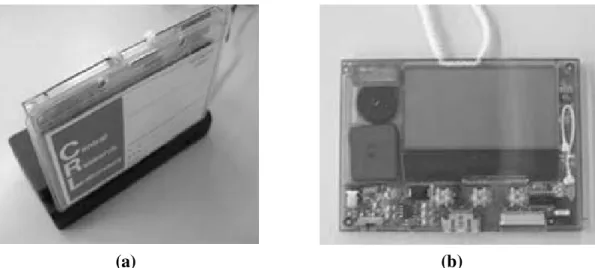
(a) (b)
Figure 2.1 Wearable Sensor Recharging on a Charging Pad (a) and Inner Hardware
Prototype (b).
Chapter 2
______________________________________________________________________________________________________________
- 26 -
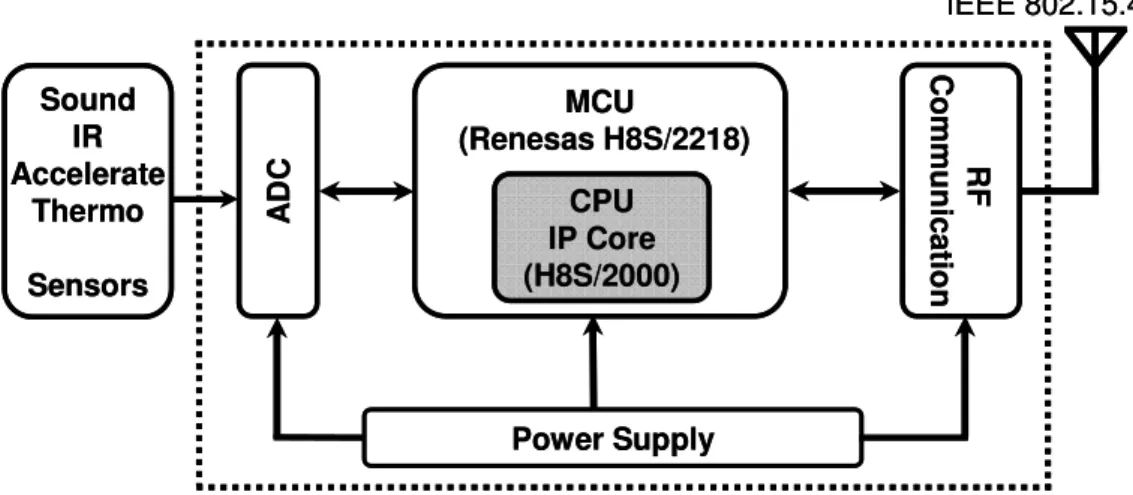
Recharging status and inner hardware structure outlooks of the wearable sensor are indicated in Fig. 2.1. From the inner hardware outlook indicated in Fig. 2.1 (b), we notice that the sensor node mainly includes:
Various types of sensors (acceleration, sound, temperature, etc.) Analog to digital converter (ADC)
RF communication module (IEEE 802.15.4 wireless communication protocol) Micro control unit (MCU) processor which contains CPU for calculation.
Li-ion battery power supply
ADC
Power Supply MCU
(Renesas H8S/2218) Communication RF CPU
IP Core (H8S/2000)
IEEE 802.15.4
Sound IR Accelerate
Thermo Sensors
ADC
Power Supply MCU
(Renesas H8S/2218) Communication RF CPU
IP Core (H8S/2000)
IEEE 802.15.4
Sound IR Accelerate
Thermo Sensors
Figure 2.2 Schematic Diagram of the Front-End Wearable Sensor Node.
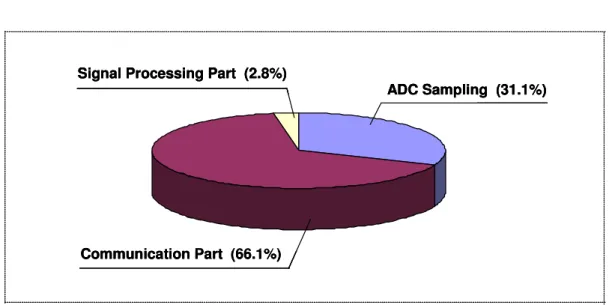
The schematic diagram of the front-end wearable sensor is illustrated in Fig. 2.2. Three blocks mainly consume the sensor’s limited energy: ADC block, communication block, and MCU microprocessor [16, 38, 61, 72].
ADC block can sample and convert a continuous physical environmental analog signal into discrete digital signals for later processing. Optimized low power MCU processor [64]
processes the converted signals, and can complete some control functions based on processed
results. The technical details of our MCU processor are introduced and discussed in Section 2.1.1.2, Section 2.1.1.3 and Section 3.2.3. RF and communication block are in charge of exchanging information between other sensors and with upper gateway nodes. Because this sensor node is applied to the power-aware WSNs system, this limitation decides the communication employs low-rate IEEE 802.1.4 and ZigBee protocols [6, 16]. The sensor node is with Li-ion rechargeable battery powered because of its superior discharge characteristics at high current as well as high energy density [16].
Inside the MCU processor, there is an embedded low-power CPU core in which our proposed sound recognition algorithm is executed. The algorithm is executed by individual addition and multiplication operations in the CPU [65, 66, 67]. In this work, we focus on sensor nodes which perform the whole environmental sound recognition process locally – from signal acquisition to classification. Thus, the challenge is to develop a sound-based context recognition algorithm upon the power-aware wearable sensor node. Executed algorithm in the MCU should guarantee certain recognition accuracy, and on the other hand satisfy the energy requirement.
2.1.1.2 Why MCU? DSP, FPGA, and MCU Comparison
To utilize which kind of processor as the processing and control unit decides the system’s
performance and cost. Comparison of candidate processors - DSP, FPGA, and MCU is listed
in Table 2-1. Because our sensor node is wearable and battery power supply for the
application is limited, therefore, the low-power MCU can be an appropriate choice. The
MCU’s energy requirement is less than that of DSP and FPGA. Another attractive advantage
is that the price of MCU is cheaper compared with the DSP and FPGA. Therefore, in our
Chapter 2
______________________________________________________________________________________________________________
- 28 -
research, a middle class MCU in the Renesas H8S series had been decided and used inside our wearable sensor [16, 64].
Table 2-1: DSP, FPGA, and MCU Technical Parameters’ Comparison.
X
Battery Power Adaptor Power Adaptor --- Battery
Power Source
10mAh*
150mAh Application dependent 650mAh d Energy
(mAh)
16 16 1~64 (customi
zable) 16 Data (bit)
X
128/12 Bigger than DSP & MCU (customizable)
4~256(ROM) 5~640(RAM) ROM/RAM
(KBit)
5~75 64mA USD
3.3V I/O 1.8V Core 66~300MHz
600MIPSmax Ultra-Low-Power
TI_DSP(TMS320 C54X)a (Audio Processing) d
(0.18μμμμmprocess)
20~200 USD Application
Dependent (X0 mA) 3.3V I/O
50M~500MHz (configurable) Xinlinx_FPGA
(Spartan-6)b (40 nm process )
4mA 6mA Average Current (mA)
7~10 3.0~3.6V USD
4~24MHz Renesas_MCU
(H8S/2218)c (0.35 μμμμmprocess)
X
20MHz 1.8V (50ns/Cycle) CPU core inside the
2218 MCU (H8S/2000)
Price (piece) Supply
Voltage (V) Working Freq.
(MHz)
X
Battery Power Adaptor Power Adaptor --- Battery
Power Source
10mAh*
150mAh Application dependent 650mAh d Energy
(mAh)
16 16 1~64 (customi
zable) 16 Data (bit)
X
128/12 Bigger than DSP & MCU (customizable)
4~256(ROM) 5~640(RAM) ROM/RAM
(KBit)
5~75 64mA USD
3.3V I/O 1.8V Core 66~300MHz
600MIPSmax Ultra-Low-Power
TI_DSP(TMS320 C54X)a (Audio Processing) d
(0.18μμμμmprocess)
20~200 USD Application
Dependent (X0 mA) 3.3V I/O
50M~500MHz (configurable) Xinlinx_FPGA
(Spartan-6)b (40 nm process )
4mA 6mA Average Current (mA)
7~10 3.0~3.6V USD
4~24MHz Renesas_MCU
(H8S/2218)c (0.35 μμμμmprocess)
X
20MHz 1.8V (50ns/Cycle) CPU core inside the
2218 MCU (H8S/2000)
Price (piece) Supply
Voltage (V) Working Freq.
(MHz)
a: TI_TMS320C54x data sheet (www.ti.com) [Ref. 68]
b: Xinlinx_FPGA_Spartan-6 data sheet (www.xinlinx.com) [Ref. 69]
c: Renesas_MCU_H8S/2218 data sheet [Ref. 64]
d: Refer to book “The application of programmable DSPs in mobile communications” [Ref. 70_A. Gatherer]
*: 10mAh is the energy assigned for the sound processing module in H8S/2000 CPU.
X -- none