A Study of Limited Resources and Security Adaptation in Wireless Sensor Network
著者 ジュマディ マベ パレンレン
著者別表示 Jumadi Mabe Parenreng journal or
publication title
博士論文要旨Abstract 学位授与番号 13301甲第4825号
学位名 博士(工学)
学位授与年月日 2018‑09‑26
URL http://hdl.handle.net/2297/00053071
doi: 10.3390/s18051594
Creative Commons : 表示 ‑ 非営利 ‑ 改変禁止 http://creativecommons.org/licenses/by‑nc‑nd/3.0/deed.ja
I
Dissertation Abstract
A Study of Limited Resources and Security Adaptation in Wireless Sensor Network
Graduate school of
Natural Science & Technology Kanazawa University
Division of
Electrical Engineering and Computer Science
Student ID: 1524042009
Name: Jumadi Mabe Parenreng
Chief Advisor: Prof. Akio Kitagawa
June, 2018
1
AbstractIn general, each node sensor has five main components namely, sensing device, processor, memory, power supply, and transceiver. The battery, CPU, and memory are the main resources have limited resources; therefore, resource availability must be maintained.
This is achieved through adaptation. Each node of a WSN must have the ability to compute and process data and to transmit and receive data. Memory limitations mean that WSN devices cannot store a lot of information, while CPU limitations make them operate slowly and limited battery capacity makes them operate for shorter periods of time. Security is the largest resource used when the highest security is required for the output security data. Resource- adaptation and security-adaptation solutions on sensors nodes are extremely important
In this study is implemented ARSy Framework which is a previous research proposed and using component Raspberyy pi 3 Model B and temperature sensor DS18B20. The advantage raspi because it has CPU and Memory resources are large enough capacity. With these advantages are highly manageable and allow to integrate several types of sensors in one raspi unit, and the battery resource becomes optional for battery capacity that will be used based on the design requirement, because the battery consumption is large enough.
Mining data mechanism is done on-board process, each data capture by the sensor directly in the process and selection with data mining algorithm at board node, then the final result is sent to the server. For security data in this research is done by estimating security- level based on resource system condition. The more average resource availability, it’s mean the higher the security level that will be implemented in the output data. For a while the discussion in this study has not implemented cryptography. The result of the research shows, if sensor node with resource and security adaptation through ARSy framework able to maintain resource availability not exceeding threshold, then high data security on each output data can be realized. In addition, by maintaining the balance of resource usage Battery, CPU and Memory, the time operational sensor node can prove to survive 3 times longer.
Keywords: WSN, ARSy Framework, Limited Resources, Resource Adaptation, Security Adaptation
1. Introduction
Wireless sensor network technology (WSNs) is known as low-cost, small, applicable, very powerful and useful technology for a wide range of applications, enabling to monitor and control the physical environment from remote locations with high accuracy, can be applied to various domains such us monitoring environment and agriculture, healthcare, public safety and military system, Industry, and transportation system [1]. The use of WSN is not only for regular area monitoring, but it is much more advanced and developed to monitor the more difficult and even extreme areas to reach by humans. For extreme areas usually use a new smart sensor that allows for areas such as underground, underwater and space [2]. For implementation in areas that are difficult to reach usually this sensor network system without regular maintenance. So that required mechanism to maximize lifetime system. Lifetime sensor nodes rely heavily on the success of system design whose determinant factors are based on several parts, such as fault tolerant, scalability, production cost, hardware constraints, network topology sensors, environment, transmission media and power consumption [3].
Nodes are usually widely distributed in certain environments for controlling, interconnecting and communicating, processing data when needed, sending and receiving data, from and to the sensing node, connected to the sync node in a centralized network between one node and the node other. These nodes are dispersed in large amounts of density in the target area of monitoring and sensing for a long time, with data transmitted so that the
2
node is able to provide much more detailed information about the physical environments in the area it is monitoring [4].The main components of the node sensor consist of a sensing unit usually composed of sub-unit sensors and analog to digital converters (ADCs), processing units for processing data, managing the procedures that make the sensor nodes collaborate to another node for completing a particular spell, a transceiver unit for connection node to a wider network, the power unit becomes a very important part of a sensor node because the lifetime depends on the availability of the battery resource [5].
With a small average node sensor size, the embedded resource also adjusts. With limited resources, unreachable placement, and without alternative energy scavenging, then the choice is only by using a power battery. In this condition, the energy saving mechanism is required from all operational aspects of the sensor node. The latest trend in the wireless network scope is online data stream where data processing is done on a wireless sensor network scope that rely on high speed data input stream, then at the same time sending data update with energy available [6]. Therefore energy efficiency and resource management are a very important part for data processing techniques in this network model. The cost efficiency of mining data stream of this model, which is to distribute data at high speed based on existing events and mining in data stream is the processing of data online and real time from certain desired data pattern [7]. Another method is by applying data mining mechanisms on-board process [8], each data captured by the sensor is directly processed on-board then the end result is sent to the server [9]. The on-board process of space astronomy is one example of its application because these onboard sensor devices generate large amounts of data captured streaming and with high data rates. This on-board process brings a tremendous impact because of its ability to minimize resource sensor utilization, especially energy saving on the side of communication media.
Another interesting issue is network security and data on sensor nodes. Traditionally security offers a model of system protection as strong as possible, but most data protection levels are always higher than the potential threats required. When security policies are implemented very strongly, it will affect the overall performance of the system, excessive protection will reduce reliability and availability and will affect global security[10]. Appropriate level of security can be estimated in terms of providing protection model with different security quality [11]. Another threat when the system implements a very strong security policy, it can be a threat of device performance that has limited resources and will be a way for new threats such as exhaustion of resources, whose impact will reduce system efficiency, availability and introduce redundancy. Another effect of excessive estimation on security will increase the complexity of the system, which then affects implementation, but enforcing restrictions will reduce its function. As a solution by predicting the appropriate level of security on each output data [12], [13], [7].
2. Resource and Security in Wireless Sensor Network 2.1. Parameter Resource Adaptation
The battery, CPU, and memory are the main resources; therefore, resource availability must be maintained. This is achieved through adaptation [14], [6], whereas the parameters data and process are maintained based on our ARSy framework. Each resource in a security system is limited by the critical threshold. If the threshold is exceeded, adaptation will be triggered to reduce excessive resource usage.
Table 4.2. Resource-adaptation formulas
Resource Definition Parameters
Battery
[6],[13][14]
batt crit threshold
lb available ub
bat ub
SI ( _ )* _ _ SI: Sampling Interval,
bat_available: free battery, ub: upper bound, lb: lower bound. RF: Random Factor, cpu_crit_threshold: critical
CPU
cpu crit threshold
lb used ub
CPU
RF (100 _ )* 100 _ _
3
Memory
mem crit threshold
lb used ub
mem
RT (100 _ )* 100 _ _ thres cpu, RT: Radius
Threshold, mem_crit_thres:
critical thres mem.
When an adaptation occurs in one of the sensor-node resources by applying the specific adaptation policy to that resource (see Table 4.2). These mechanisms are described in more detail as follows [6], [9].
a. Input: Battery adaptation is triggered on the input side and is based on battery resource availability via the sampling interval (SI). If the battery usage exceeded the threshold, adaptation will be triggered. Before battery-resource adaptation occurs, the input-data-collection time is normal (does not exceed the threshold), but adaptation is triggered when the input-data-collection time changes based on the available resources.
b. Process: CPU adaptation is triggered on the process-data side and is based the availability of the processor resource (CPU) via the random factor (RF). If the CPU usage does not exceed the threshold, all the collected data will be maintained on the counter data; otherwise, the system only stores some counter data with priority based on dominant and non-dominant counter data. Some non-dominant counter data will be eliminated to relieve the CPU; its value will be based on the RF value.
c. Output: Memory adaptation is triggered on the output-data side and is based on the availability of the memory resource via the radius threshold (RT). When the resource memory is normal (not exceeding the threshold), the final result is sent to the data server; as much as 50% of all counter data is saved. If the memory usage exceeds the threshold, the system will reduce memory utilization by limiting the amount of counter data created, and the counter data are stored as output data based on the RT presentation value.
2.2. Security Adaptation
Security systems offer as much protection as possible; thus, power consumption will increase and the lifetime of the system will decrease. System services are reduced to decrease power consumption, which decreases the lifetime of the system [15]. In fact, security is almost always higher than potential threats. When security is very strong, it affects the overall performance of the system, excessive protection will reduce reliability and availability and affect security globally. An appropriate level of security can be estimated in terms of providing different security-quality protection models for each type of data [16].
Previous studies focused on a security policy to model the security level of data that may have different outputs generated over time because determining the security level of data is based on the availability of resources. With a better availability of resources, the security level of data becomes higher [11], [13].
The absolute requirement of a security system is the guarantee of high data security;
however, in cases in which WSNs are used, high data security affects the performance and lifetime of the system because a higher data-security level means greater energy consumption for cryptographic data functions [17], [18], [19]. The solution is to balance the use of resources through the security level of data [11], [20], which is basically used to offset the use of resources when their availability has entered a critical phase. The policy of applying a high level of security to each output affects the lifetime of a WSN because higher security levels of data put greater demands on the CPU and increase battery consumption [18].
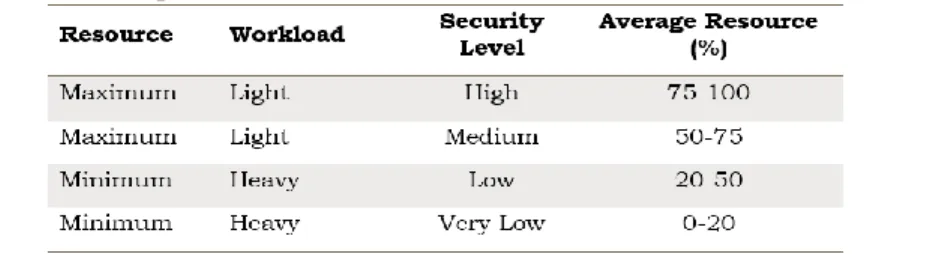
The adaptation of resources affects the security level of data. The security-adaptation model we applied is for estimating the security level of output data based on the resource condition. When the resource condition does not exceed the threshold, the output data have the maximum security level, but when resource availability falls below the threshold, the security level changes [13], as shown in Table 3.1 the security levels are high, medium, low, and very low. ARSy framework applies security level prediction, based on resource availability.
4
Table 3.1. Lists adaptations based on resources, workload and level of security3. Proposed ARSy Framework Model
To maintain the availability of a resource, researchers have tried to modify the algorithm in use. In particular, [9] discuss how the battery, CPU, and memory can be utilized in ways that can increase the lifetime of the network. They use a resource monitoring scheme to track resources of nodes. Their scheme works by monitoring the conditions of availability of the main resources. Significant changes to the availability affect the adaptation performance [21], [14]. The term ARSy Framework is an adaptable resource and security framework, consists of three main blocks. The first is the Client Node, which is equipped with resources to perform data processing. The second block processes the data. The third block is called the Server Data block which is in different area from the node and this research is done until to the delivery of the results of the node as the final destination of all the data.
Client Node Resource
Monitoring
Workload of System
Data Mining
Data Mining Results Security
Inplementation
Input Data
Data Server
1 2
Resource, Workload and Level Security
Setting 3
4
5
6
7 8
9 10
Resource Adaptation
11
Figure 3.1. ARSy framework.
The client node is a worker node. The process that occurs on the client node is divided into the following process blocks. Details of the relationship between the resources and security level of this process are listed in Section 3.2.3.
a. Data-input block: This block collects data. The collection time was every second in our study. Before the data are processed by the data-mining block, the system checks the conditions of the battery, CPU and memory resources in the resource-monitoring block.
b. Resource-monitoring block: This block reports the latest update of the average amount of the sensor node’s resources. This information is then input for the resource- adaptation block.
c. Resource-adaptation block: This block updates the resource condition with two modes, the first is the status of the resource under adaptation conditions and the second is the status of the resource not under such conditions.
5
d. Workload-system block: This block provides the workload status of the sensor node if the resources system has a heavy or light workload; heavy workload status if information resources received from resource adaptation blocks under adaptation conditions and light workload status if resource information from the resource- adaptation block is not under adaptation conditions.e. Resource-, workload-, and security-level-setting block: This block contains the summary of the all the system’s resource conditions, such as amount of resources that can be used to execute data mining, security-level status that will be given at data output, and overall system workload.
f. Data-mining block: This block involves mining data based on light-weight frequent algorithm [22], [23]. The data-mining process is carried out by creating counter data.
All the same data are placed on the same counter data and new counter data are created for new data types.
g. Data-mining-result block: This block temporarily stores the results of data mining whose time-limited, before the data-mining-result sent to the Security-implementation block.
h. Security-implementation block: This block implements the appropriate security level based on the resource-sensor-node condition, then the results are sent to the data server, i.e., the final destination of all data.
3.1. Hardware System
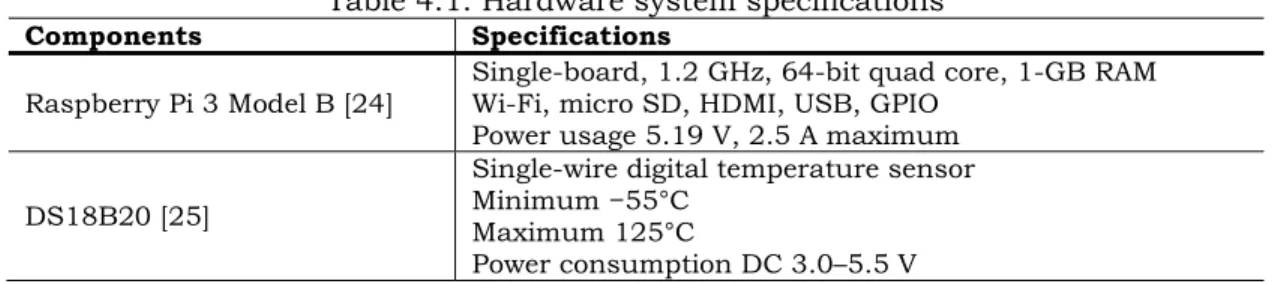
The Raspberry Pi 3 Model B was chosen because it is a single-board model, simple, and lightweight. The model has built-in Wi-Fi, eliminating the need for extra USB Wi-Fi adapters [24]. Another advantage is its compatibility with several operating systems and its plug-and-play compatibility with a variety of equipment. The specifications for this model are listed in Table 4.1.
Table 4.1. Hardware system specifications
Components Specifications
Raspberry Pi 3 Model B [24] Single-board, 1.2 GHz, 64-bit quad core, 1-GB RAM Wi-Fi, micro SD, HDMI, USB, GPIO
Power usage 5.19 V, 2.5 A maximum
DS18B20 [25]
Single-wire digital temperature sensor Minimum −55°C
Maximum 125°C
Power consumption DC 3.0–5.5 V
Devices with the Raspberry Pi 3 Model B pose challenges. One challenge involves memory sharing between a CPU and graphic processing unit (GPU) [26]. Some programs are not as demanding on the CPU, and some also run on the GPU such as Blu-ray video playback.
A GPU is powerful enough to handle applications. The second challenge is with the power- supply-management system. The DS18B20 temperature sensor is a single-wire digital sensor [25] that uses only one cable for communication with the CPU and for grounding. The sensor can derive power directly from the data line.
3.2. Architecture System
We conducted our laboratory testing on a single node; however, future work will involve integrating the node with a wider network system, such as the architecture system shown in Figure 4.1. The data collected by each node are processed with local node resources in accordance with the conditions of the resource node. The output data are sent at certain times to the server, which is the final destination of the data.
6
Ras-pi Sensor Ras-pi Sensor Ras-pi Sensor ...
Router Server
Ras-pi GPIO 4 (pin 7) Sensor
Figure 4.1. Architecture system 4. Testing Mechanism
Our testing was limited to single node, and the goal was to observe the differences in resource behavior and time efficiency when a security system operates under normal and stressful conditions and implementing an ARSy framework and a non-ARSy framework.
Normal and Stress Testing
ARSy Framework
Non-ARSy Framework
Adaptable Resource
Adaptable Security
Battery
Data Security
Without Adaptable Resources
CPU Memory
High Security Level Medium Security Level Low Security Level Very Low Security Level
SI RF
RT
High Security Level Figure 4.2. Testing design
We tested under two scenarios: normal and stress. Normal testing was conducted by allowing the system to run normally without any intervention or special treatment that would cause the CPU to become busier than usual. Stress testing was conducted by making the CPU busier, such as by playing games, browsing websites, and streaming videos. The sensor was touched so that variants data could be collected; otherwise, there would be too few data variants. Stress testing continued until the resources were completely exhausted. The uniform testing parameters are listed in Table 4.3.
Table 4.3. Testing parameters
Parameter Value
Critical threshold of Battery, CPU, and Memory 55% capacity in use
Time for data collection 1 s
Time for data release
30 s 60 s 120 s Battery capacity
30 mAh 100 mAh 1,000 mAh
Tests Normal
Stress
Sensor treatment Touched
Untouched
7
5. ResultThe resource activities of a WSN are interrelated. In general, battery consumption is strongly affected by the activity of the CPU, i.e., busy, normal, or idle. Increased CPU activity increases battery consumption [18].
5.1. Collecting and Data Mining
Data collected by the sensors are processed by an on-board mechanism [27], [8], [28], i.e., by directly applying a data-mining algorithm known as the Lightweight Frequent Item Algorithm [13], [22], [23]. The data are placed on the counter data based on the similarity of the data and new counter data are created if the collected data differ from those previously formed on the counter data. This data-mining process continues until the time limit is reached.
Figure 4.3 compares the three types of data collected after the data-mining process, the release period of the data-mining result was every 30 s: (1) total_item, all data collected by sensors that were limited by the timer; (2) total_variant, the number of data variants obtained during the data-mining period; and (3) send_to_server, the final data to be sent to the data server.
Figure 4.3. Collecting and mining data.
5.2. Battery
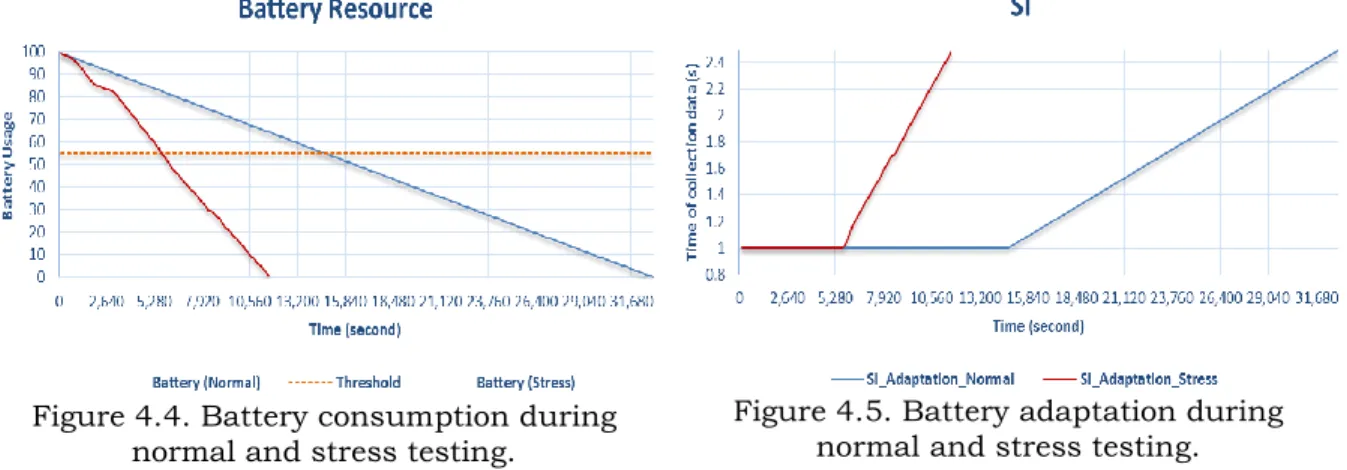
Figure 4.4 shows the battery slowly entering the critical phase and exceeding the threshold until the battery is completely discharged. The system’s policy before the battery exceeded the threshold significantly affected the sensor’s data-input process. Data were collected every second when the battery was not in the adaptation phase, as shown in Figure 4.5, and gradually changed as the battery entered the critical phase. Adaptation of the battery through the input data affected the data-collection time. Under normal battery-resource availability, the data-collection time was 1 s per datum and gradually changed when the availability of the battery resource was running low.
Figure 4.4. Battery consumption during normal and stress testing.
Figure 4.5. Battery adaptation during normal and stress testing.
8
5.3. CPUThe results from testing under CPU stress conditions are shown in Figure 4.6. Testing was conducted by making the CPU busier than usual by playing games, browsing websites, and streaming videos. This was done because Raspberry Pi 3 Model B has a large CPU capacity (see Table 4.1). Testing was conducted by allowing the CPU to run normally, and the results indicate that the CPU activity never exceeded the threshold, as shown in Figure 4.7.
Figure 4.6. CPU resource and adaptation during stress testing.
Figure 4.7. CPU resource during normal testing.
5.4. Memory
As mentioned above, the memory of Raspberry Pi 3 Model B is shared by the CPU and GPU. It is very difficult to monitor the memory exceeding the threshold value, so the procedure for testing the CPU was also conducted for the memory. Figures 4.8 and 4.9 show the results of the stress and normal testing of the memory, respectively.
Figure 4.8. Memory resource and adaptation during stress testing.
Figure 4.9. Memory resource during normal testing.
5.5. Security Level
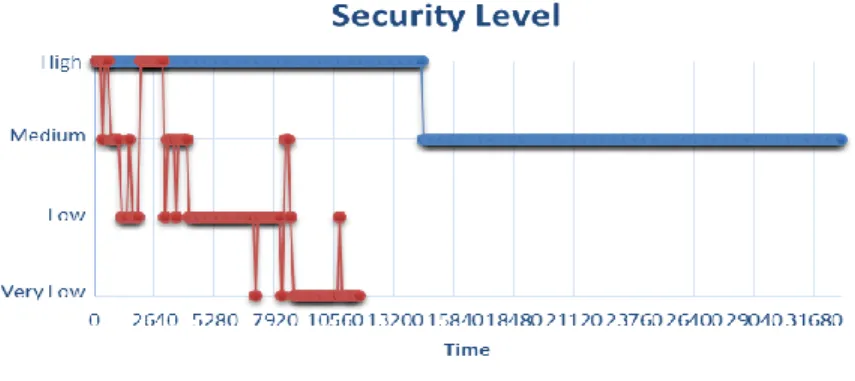
Determining the security level [20] is the last stage before data are sent to the data server. There are four security levels based on the availability of resources. Figure 4.10 shows the security levels during stress and normal testing. During stress testing, the security level of the data output fluctuated and reflected the current conditions. Normal testing showed more stable results at the high and medium security levels. Hence, maintaining resource stability can also stabilize the security level at the maximum average condition.
9
Figure 4.10. Security level of data output during stress and normal testing.5.6. Operation Time
Time operation is the duration or the length of operation time that measured in second units. Battery consumption [29] was divided into several modes, such as boot, idle, video playback, normal operation, and stress. The testing was conducted on an ARSy framework and a non-ARSy framework under normal and stress operating conditions. The results are listed in Table 4.4. The battery capacities were 30, 100, and 1000-mAh and release times were 30, 60, and 120 s. Details of this testing scenario are summarized in Table 4.3. With the ARSy framework for 1000-mAh battery capacity during normal testing, the operating duration reached 9.19 h, whereas during stress testing, the duration reached only 2.76 h. With the non-ARSy framework for 1000-mAh battery capacity during normal testing, the duration reached 3.44 h, and during stress testing, the duration reached 2.74 h.
Table 4.4. Operation duration.
Battery Capacity
[mAh] Release
Time [s]
ARSy Non-ARSy
Normal [s] Stress [s] Normal [s] Stress [s]
30 30 948 249 355 223
100 60 3265 1468 1222 900
1000 120 33,085 9971 12,397 9877
6. Conclusion and Future Work
The limited battery, CPU, and memory resources of WSN devices force such devices to use resources as efficiently as possible. Resource saving is very important when a WSN has limited resource availability and is deployed in extreme environments without any chance for maintenance. In addition, while maximizing data security is a good idea, the level of security should be determined through prediction in a way that considers the limited resources of the WSN, so that it can survive for long period of time. A higher security level imposes a greater cost on and shortens the lifetime of the WSN devices. We evaluated a security adaptation for limited resources in a WSN through the ARSy framework. By mining data on-board and applying resource and security adaptation, the operation duration can be tripled. Normal testing showed that the result is more stable at the high and medium security levels. Therefore, maintaining resource stability can also stabilize the security level under the maximum average condition. The comparison of the ARSy framework and a non-ARSy framework showed significant results during operation time.
To conserve the battery of the sensor node, harvesting energy can be the best solution, depending on the area where the system is deployed. Because our testing was conducted on a single node, for the future work testing should be conducted on several nodes integrated with a network system involving energy harvesting as the power source and implement security level based on cryptography.
10 References:
[1] T. Rault, A. Bouabdallah, and Y. Challal, “Energy efficiency in wireless sensor networks: A top- down survey,” Comput. Networks, vol. 67, pp. 104–122, 2014.
[2] A. A. Habib F. Rashvand., “Wireless Sensor Systems for Extreme Environments,” in John Wiley
& Sons Ltd, John Wiley & Sons Ltd, 2017.
[3] I. F. Akyildiz, W. Su, Y. Sankarasubramaniam, and E. Cayirci, “A survey on sensor networks,”
IEEE Commun. Mag., vol. 40, no. 8, pp. 102–105, 2002.
[4] P. Archana, Bharathidasan., Vijay, Anand, Sai, “Sensor networks: an overview,” IEEE Potentials, vol. 22, no. 2, pp. 20–23, 2003.
[5] I. F. Akyildiz, W. Su, Y. Sankarasubramaniam, and E. Cayirci, “Wireless sensor networks: a survey,” Comput. Networks, vol. 38, no. 4, pp. 393–422, 2002.
[6] N. D. Phung, M. M. Gaber, and U. Röhm, “Resource-aware Online Data Mining in Wireless Sensor Networks,” Pro- ceedings IEEE Symp. Comput. Intell. DataMining, no. Cidm, pp. 139–146, 2007.
[7] J. M. Parenreng and A. Kitagawa, “Resource Optimization Techniques and Security Levels for Wireless Sensor Networks Based on the,” Sensors (Basel)., 2018.
[8] S. Tanner, M. Alshayeb, and E. Criswell, “EVE: On-board process planning and execution,” Earth Sci. …, 2002.
[9] M. M. Gaber and P. S. Yu, “A framework for resource-aware knowledge discovery in data streams:
a holistic approach with its application to clustering,” Proc. 2006 ACM Symp. Appl. Comput. - SAC ’06, pp. 649–656, 2006.
[10] N. K. Pour, “Energy Efficiency in Wireless Sensor Networks,” no. December, 2016.
[11] B. Ksiezopolski, P. Szalachowski, and Z. Kotulski, “SPOT: Optimization Tool for Network Adaptable Security,” Commun. Comput. Inf. Sci., pp. 269–279, 2010.
[12] B. Ksiezopolski and Z. Kotulski, “Adaptable security mechanism for dynamic environments,”
Comput. Secur., vol. 26, no. 3, pp. 246–255, 2007.
[13] J. M. Parenreng and A. Kitagawa, “A Model of Security Adaptation for Limited Resources in Wireless Sensor Network,” J. Comput. Commun., vol. 05, no. 03, pp. 10–23, 2017.
[14] J. Parenreng, M. I. Syarif, S. Djanali, and A. M. Shiddiqi, “Performance analysis of resource-aware framework classification, clustering and frequent items in wireless sensor networks,” Proceeding Int. Conf. eEducation Entertain. eManagement, pp. 117–120, 2011.
[15] L. Caviglione and A. Merlo, “The energy impact of security mechanisms in modern mobile devices,”
Netw. Secur., vol. 2012, no. 2, pp. 11–14, 2012.
[16] Z. K. Bogdan Ksiezopolski., “Adaptive Approach to Network Security,” CCIS, pp. 233–241, 2009.
[17] V. Raghunathan, C. Schurgers, S. Park, and M. B. Srivastava, “Energy-aware wireless microsensor networks,” IEEE Signal Process. Mag., vol. 19, no. 2, pp. 40–50, 2002.
[18] N. R. Potlapally, S. Ravi, A. Raghunathan, and N. K. Jha, “A study of the energy consumption characteristics of cryptographic algorithms and security protocols,” IEEE Trans. Mob. Comput., vol. 5, no. 2, pp. 128–143, 2006.
[19] J. Sen, “A Survey on Wireless Sensor Network Security,” Comput. Networks, vol. 1, no. 2, pp. 55–
78, 2009.
[20] T. Xie, X. Qin, and A. Sung, “SAREC : A Security-Aware Scheduling Strategy for Real-Time Applications on Clusters,” 2005.
[21] A. M. Shiddiqi, “Performance Measurement of Resource-aware Framework in Online Data Stream Mining,” pp. 1–7, 2009.
[22] J. Parenreng, S. Djanali, and A. M. Shiddiqi, “ANALISA KINERJA RESOURCE-AWARE FRAMEWORK PADA ALGORITMA LIGHT-WEIGHT FREQUENT ITEM ( LWF ),” Proceeding SNPI ITS Surabaya, 2010.
[23] M. M. Gaber, S. Krishnaswamy, and A. Zaslavsky, “Adaptive Mining Techniques for Data Streams using Algorithm Output Granularity,” AusDM, 2003.
[24] S. Monk, Raspberry Pi Cookbook, no. December. 2015.
[25] Maxim Integrated, “Datasheet DS18B20,” Maxim Integr., vol. 92, p. 20, 2015.
[26] S. McManus, “Raspberry Pi For Dummies,” in John Wiley & Sons, Inc, 2014, p. 456.
[27] H. Kargupta, R. Bhargava, K. Liu, M. Powers, P. Blair, S. Bushra, J. Dull, K. Sarkar, M. Klein, M.
Vasa, and D. Handy, “VEDAS: A Mobile and Distributed Data Stream Mining System for Real- Time Vehicle Monitoring,” Proc. 2004 SIAM Int. Conf. Data Min., vol. 23, pp. 300–311, 2004.
[28] M. Michael C, Burl., Charless, Fowlkes., Joe, Roden., Andre, Stechert., Saleem, “Diamond Eye: A Distributed Architecture for Image Data Mining,” Proceeding AEROSENSE ’99, vol. 3695, 1999.
[29] Power, Power Requirements. 2018, pp. 2–3.