The Effect of the Anharmonicity in the Atomic Diffusion in Liquids: A Simple Model
Takaki Indoh and Masaru Aniya
Department of Physics, Kumamoto University, Kumamoto 860-8555 (Received September 30, 2008)
A simple analytical expression has been derived for the velocity autocorrelation function and diffusion coefficient that incorporates the effect of the anharmonicity. It is shown that the diffusion coefficient increases with the increase in the anharmonicity.
§1. Introduction
The ion diffusion in liquids has been studied for many years. It is well known that the atomic transport in materials are expressed in terms of time correlation functions. Zwanzig has proposed a simple model for the velocity autocorrelation function (VACF), and hence for the self diffusion coefficient.1) More recently, by using similar arguments to those used by Zwanzig, Tankeshwar and Tosi have proposed the following model for the calculation of VACF.2)
1. The particle in a liquid performs approximate harmonic oscillations with a fre quency u) around the local potential minima formed by other particles. The particle remains there for a certain time, until it finds a saddle point or bottle neck in the potential surface and jumps to other potential minima.
2. The volume of the entire system consists of a number of equivalent subvolumes V*. One effect of the atomic jump is to rearrange the equilibrium positions of the particles in a particular subvolume while the equilibrium positions of the remaining particles are unchanged. Another effect is to interrupt the harmonic oscillations of the normal modes associated with the region V*. The motions in V* after the jump are uncorrelated with the motions in V* before the jump.
3. The waiting time distribution for the jump affecting the content of any V* is written as sech(i/r), where r is the life time.
4. Harmonic oscillations in the region V* are adequately described by a Debye approximation, characterized by longitudinal and transverse sound velocities.
§2. Theory
Consider a system consisting of N particles with mass m. The self diffusion coefficient D is given by the Green-Kubo formula
m
r<itC{t\ (2.1)
Jo
where C(t) is the VACF, fee and T are the Bolzmann constant and temperature, respectively.
According to the model of Tankeshwar, the normalized VACF is given as
t=i
C0SM) sech(i/r), (2.2)
where Vi(t) is the velocity of the i-th particle at time t
In Eq. (2.2), the sum over particles becomes the sum over normal modes. For the case that a particular mode is dominant we have
C{t) = cos(urt) sech(*/r). (2.3)
This model has been found to yield good results for the self diffusion coefficients of
one component fluids like the Lennard-Jones fluids3) and liquid alkali metals.4) This model has been also extended to study the diffusion in multi-component fluids.2)»5)>6)
The model presented in this paper differs from the above model in respect to the assumption 1. In our model, the particle performs anharmonic oscillations during the waiting process. Therefore, there is a frequency fluctuation around the equilibrium value, and the fluctuation becomes larger with the anharmonicity. The anharmonic
effect is described as7)"9)
U{x) = cx2- /x4, (2.4)
where c > 0 and / > 0 are constants. The 4th order term indicates that the frequency becomes soft when the amplitude is large. This also corresponds to the decrease in the interaction force when the anharmonicity is increased.
The particle velocity in the potential given by Eq. (2.4) can be calculated easily
from the Hamiltonian H = p2/2m + ex2 — fx4 to be v{t) = a0 cos(7o
where ao is a constant and E is the particle energy. 70 and 71 are defined as
(2.6)
= ~3 \Tc)
In Eq. (2.5) 70 expresses the harmonic vibration term and 71 expresses the anhar monic term. By substituting v(t) into the definition of VACF, we obtain
C(t) = COS 7°.,2.2 Tai Sm 7° ' (2*7)
where 0 = l/kBT.
On the other hand, we are assuming that the particle which is executing anhar- monic vibration can jump from one site to another site in a short time. This jump process is incorporated into the model as
C(t) =
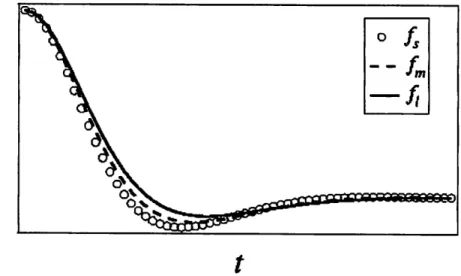
sech(</T). (2.8)If 7i* < 0, Eq. (2.8) is equivalent to Eq. (2.3). Figure 1 shows the behavior of C(t) calculated from Eq. (2.8). We can see the effect of the anharmonic term / on the behavior of C(t).
Fig. 1. The effect of the anharmonicity parameter / on the behavior of VACF C(t). Here, ft >
fm > fa > 0. The scales of the abscissa and ordinates are in arbitrary units.
§3. Diffusion Coefficient
The diffusion coefficient D is calculated not only by the integration of VACF, but also by using the expansion of VACF. The normalized VACF can be expanded
as
C(t) = 1 - C2t2/2\ + C4t4/4l • • • , (3.1)
where Ct and Ca are constants. Comparing the expansion of Eq. (2.8) with Eq.
(3.1), we obtain
(3.2)
T lr~2.
C4 =7o + 5r"4
Tankeshwax and Tosi have obtained the expression for the self diffusion coefficient
it m