When nonce words behave like “real” words
A case study of the Japanese verb oso(warer)u
Kow KURODA* Keiko NAKAMOTO** Hitoshi ISAHARA*
*National Institute of Information and Communications Technology (NICT), Japan 3-5 Hikari dai Seika cho, Soraku gun, Kyoto, 612-0289
**Bunkyo University, Japan 3337 Minami Ogishima, Koshigaya, Saitama, 343-811
1 Introduction
It can never be false to say that the meaning of word w in a specific context C(w) results from the complex in- teraction of w’s “lexical” meaning m(w) and the mean- ing of ¯ m(w) = m(C(w)), i.e., the “meaning of its con- text.” No lexicographic work can be done without as- suming the distinction between m and ¯ m, but it is not at all obvious how to make such a decision because we hardly know what ¯ m(w) really is. This is, in part, what makes it difficult to tell exactly what m(w) really is. We approached to this problem experimentally, hoping to forge a connection from the theory of language to real human behaviors.
Based on psychological experiments, called the task of semantic feature rating (SFR) on a Japanese verb, we do two things in this paper. First, we show that the meanings assigned to nonce words in specific contexts are predictable if we suppose that semantic interpreta- tion is situationally based, as claimed by Frame Seman- tics (FS) [4] and Berkeley FrameNet (BFN) [6, 19] and if we are able to specify, say in the form of a lattice, the hierarchical system of situations for which candi- date sentences are interpreted. We suggest that the situ- ational view could lead to a successful specification of how co-composition [17] is constrained. Second, we pose the question of how contextually induced complex meanings are constructed. Note that such meanings can be specified not only for constituents like “ NP-wo V,” namely VP of Japanese, but also for nonconstituents like “NP-ga V”.
1)How this is handled theoretically is an open question, but we are skeptical of whether an account based on “movements at LF” is a valid account of it since there is no guarantee that an account of this type fits the observed human behavior unless LF move- ments are proved to be “real.” [NOTE explain LF]
1.1 The basic idea
If human understanding is, as FS claims and BFN as- sumes, situationally based, it follows that:
1)Traditionally, the structure of VP of Japanese is characterized as [IPNP[+nom] [VPNP[−nom] V ]]. In our example, [IPNP-ga[VP
NP-woV ]] is an instance of this template under the condition that- gaand-woserve as nominative and accusative markers, respectively.
(1) Interpretation as selection: the interpretation of a sentence s = w
1w
2··· w
n(W (s) = { w
1, w
2, . . . , w
n} ) is not simply “constructed” from the set of lexical meanings { m
1, m
2, . . . , m
n} (m
iis the meaning of w
i) but is given as a “selection” from a predetermined set of possible situations for which s can be interpreted.
(2) Attraction-to-situation (A-to-S) effect: Given this selectional property, interpretations of a given sentence s are expected to be “attracted” to a par- ticular situation, and word sense modulation arises as a “side effect” of this attraction.
This predicts the following:
(3) A-to-S is effective even if all arguments of a predi- cate (“governor” in the sense of FrameNet [6]) are not explicitly given as long as “frame-evoking ele- ments,” which do not need to be words and can be collocational units, evoke frames strongly enough.
We tested this prediction (3) experimentally and ob- tained positive results. To this aim, we used the SFR technique [15]. In an SFR task, roughly, participants are asked to rate a word or phrase within a sentence for a pre-determined set of (usually fine-grained) semantic features or characteristics that seem to be necessary to fully account for the interpretational variation of S. De- tails of the SFR technique are presented in § 2.3.
1.2 Why the latent semantics of nonce words?
As pointed out above, a semantic description of any lex- ical item, say a word w, presupposes an appropriate dis- crimination of w’s lexical meaning from the meaning it gains from its context C(w), i.e., so-called “contextual effects.” There is no guarantee, however, that good dis- crimination can be achieved on all occasions because, in principle, there is no way to do it. We would like to say that this is the “dark side” of co-composition [17].
At present, all we can do is rely almost entirely on the
intuition of lexicographers and linguists. We hope that
our research into the latent semantics of nonce words
2)will contribute to the investigation of a systematic ac- count of contextual effects.
1.3 A theory of semantic attraction
1.3.1 Comparison of “constructivist” and “selec- tional” theories
Most theories of semantic interpretation, e.g., Gener- ative Lexicon Theory (GLT) [17], are “constructivist”
ones in that the meaning of a complex unit (e.g., phrase and sentence) is constructed from the lexical meanings of its “parts.” This is the traditional view of the mean- ing of construction. However, another kind of model is conceivable. We may refer to a “selectional” theory (as in the Darwinian theory of evolution). Let us begin by examining what will happen if semantic interpreta- tion is “selectional” rather than purely constructive in nature.
One of the best examples of a selectional theory of semantic interpretation would be Optimality Theory (OT) [2, 16]. It is selectional in that it characterizes the interpretation of a given sentence s as the selection of an “optimal” interpretation. An optimal interpretation is the interpretation that wins out of a set of “candidate”
interpretations generated in some way.
Note that, under this selectional view, semantic inter- pretation need not be truly compositional. The com- ponent for candidate generation, usually called GEN in the OT literature, may need to be compositional, whereas the component for output evaluation, usually called EVAL, cannot be. What the evaluation compo- nent does is select the one best candidate. In OT, this is implemented by a “ranking mechanism.” Candidates generated by GEN are “scored” against a set of “con- straints” and ranked according to their scores.
A more radical model is conceivable, however. Note that even GEN need not be compositional when candi- date generation is done by enumeration. We interpret Frame Semantics (FS) as implementing such a radical model in a sense to be explained later.
It is well-known that GLT argues against the so- called “sense enumerative lexicon.” But it is not clear what happens if we conceive of a database that enumer- ates all the situations for which all sentences are inter- preted. We investigate this in some detail below.
1.3.2 Test of the selectional view of interpretation We interpret FS as another, more radical selectional the- ory, since FS allows words and phrases in a discourse to freely “evoke” frames independently of each other.
In a radical interpretation, there is no requirement for structure building to occur.
Based on this, we can hypothesize the following:
(4) Possible semantic interpretations of a given sen- tence S are “attracted” to (ideally) one of the most
2)We know this phrase sounds really like an oxymoron, but we do not know of any other term to express our concept. This might, we suspect, explain why this line of research is very rare.
likely situations.
If this prediction is correct, then a nonce word w
∗should be feature-rated very much like a real word if the context of its occurrence C(w
∗) =W (s) − w
∗(mean- ing word sequence except w
∗) “evokes” a specific situa- tion strongly enough. We tested this hypothesis through psychological experiments using sentences containing osou. As explained in § 2.1, the Japanese verb osou is a rather polysemous verb. Its English translations include attack, hit, and seize (see Appendix 2.1 for relevant de- tails). The setting for our experiments is explained be- low using English analogs.
In our experiments, we used cases such as those in (5) for C(w
∗for h victim i ) and cases such as those in (6) for C(w
∗for h harm-causer i ):
(5) { a. was attacked by; b. was hit by; c. was seized by; d. suffered from } h harm-causer i (or
suffered h harm i )
(6) h victim i { a. was attacked by; b. was hit by; c.
was seized by; d. suffered (from) } .
Our prediction will be confirmed if SFRs for nonce words in C
1and C
2conditions are interpreted like real words in C
1, on the one hand, and if they are different from C
3, on the other:
(7) For the passive form “X-ga Y -ni osowareta,”
a. C
0: X is a real word for h victim i ; Y is a real word for h harm-causer i (Baseline 1) b. C
1: X is a real word for h victim i ; Y is a
nonce word for h harm-causer i
c. C
2: X is a nonce word for h victim i ; Y is a real word for h harm-causer i
d. C
3: X is a nonce word for h victim i ; Y is a nonce word for h harm-causer i (Baseline 2) In (7b), the attraction effect of the word for h harm- causer i in the oso(warer)u-context can be detected. In (7c), the attraction effect generated by the word for h Victim i in the oso(warer)u-context can be detected.
We tested this prediction using psychological experi- ments and obtained positive results.
3)The results for C
1, C
2, and C
3were obtained from different groups of participants.
1.4 Review of research into the “seman- tics of nonce words”
As far as we know, no intensive research into the “se- mantics of nonce words” has been attempted to date.
One study [10] investigated the meaning of “syntactic frame/patterns” in the following way. Nonsensical sen- tences such as The rom gorped the blickit to the dax, The grack mecked the zarg were presented to partici- pants, who were asked to rate the likelihood of various
3)To be precise, experiments on osou-contexts and osowareru- contexts were conducted on different occasions, so they are not di- rectly comparable. This paper reports on the latter experiment.
semantic properties that could be true of the nonsense verbs in them. The results suggested that the syntactic frames encoded specific meanings, even if the verbs did not have lexical meanings. This experiment used the same technique as ours, but it had different goals and implications from our results.
2 Specifying “attractors” of inter- pretation
2.1 Semantics of osou
Let us briefly describe the relevant semantics of the Japanese transitive verb osou that we used in our exper- iment. It is a rather polysemous verb used to denote a wide range of situations or cases of victimization (but note that Japanese has distinct words for victim, i.e., gisei-sha (犠牲-者) and higai-sha (被害-者). Its En- glish translations span over different classes of verbs.
The overall picture can be seen from Figure 1. As easily seen, the meanings of osou and osowareru at the most abstract level are h harm-causer i -ga h victim i -wo osou (meaning “ h harm-causer i attacks/hits h victim i ”) and h harm-causer i -ni h victim i -ga osowareru (both mean
“ h victim i is/are attacked/hit by h harm-causer i ”).
2.2 Identifying the situation lattice
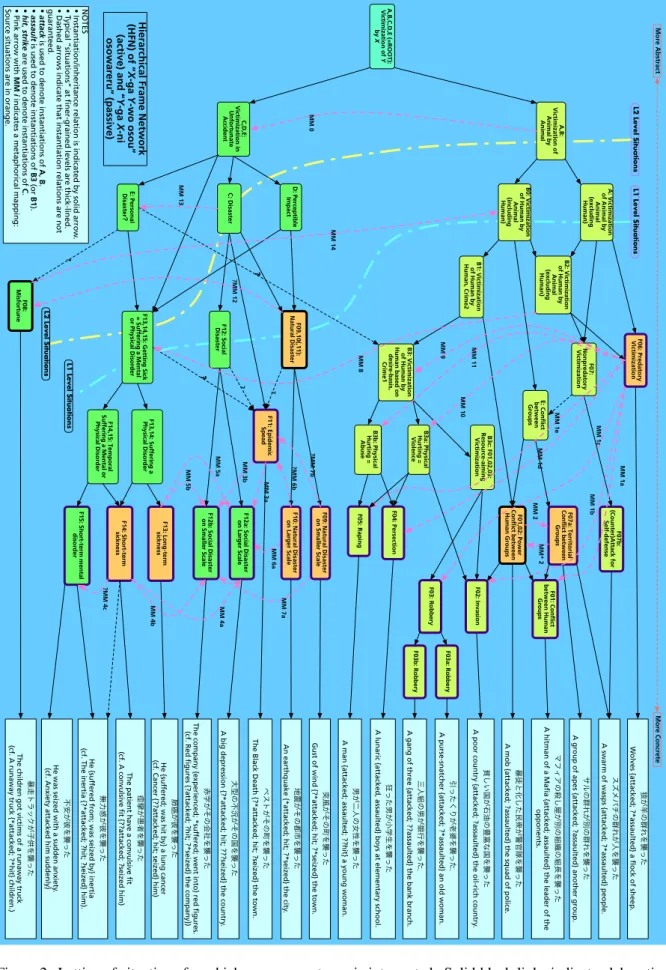
The system of situations for which F1 and F2 are inter- preted is represented by the lattice in Figure 2, which is called a hierarchical frame network (HFN). This was manually constructed from the corpus examples and validated through psychological experiments.
It should be noted, however, that it would not be ap- propriate to interpret the lattice in Figure 5 as a lat- tice of osou’s lexical meanings. A better interpretation would be that the HFN specifies the (partial) ontology of harm or harm-causation to which osou-sentences always refer. This interpretation was confirmed experi- mentally in [15].
2.2.1 How the HFN is related to “senses” of osou Words senses are sensitive to granularity. This means that word sense definitions will make no sense unless they make reference to a level of granularity. The low- ermost situations F01, F02, . . . , F15 would correspond to the finest-grained word senses. Most definitions for osou in Japanese lexica come between those two gran- ularity levels. The top division between volitional sub- jects ( { A, B } ) and nonvolitional subjects ( { C, D, E } ) corresponds to the most basic division of sense differ- entiation. It is suggestive that osou can be translated as attack or assault for situations under { A, B } , whereas it cannot be translated in this way for situations under { C, D, E } .
4)For the latter, hit and seize are transla-
4)One sense ofattack, in the meaning ofhaccuseiandhcriticizei, based on metaphor, is systematically missing in the use ofosou. Here, kougeki(suru)(攻撃(する)), one of the hyponyms ofosou, has a metaphorical sense. This verb refers to situations under A, namely
tions. In particular, seize is appropriate for situations under { F13, F14, F15 } , except for idiomatic cases like panic attack and heart attack.
The most coarse-grained distinction does not cor- respond to the distinction between the literal and metaphorical senses. Metaphorical senses appear all around the lattice, as indicated by links in magenta with an “MMi” index, where source and target domains are indicated.
It is reasonable to question if the situation/sense lat- tice for osou-sentences in Figure 5 has a wide enough coverage of osou-senses, if not exhaustive. Though in- direct, we have two sources of evidence. First, the lat- tice is the result of a careful manual annotation/analysis of all instances (413 in total) of osou- or osowareru- sentences taken from a reasonably large corpus [20] of 500,000 Japanese-English pairs. For instances out of 413, 95% instances of the corpus data were successfully classified. We conducted another psychological exper- iment [15] to see to what degree the sense hierarchy is valid and obtained a positive result.
Another source is an informal study that found that, while the sense lattice in Figure 5 was constructed to ac- count for the sense variation of osou-sentences, the lat- tice covered the sense variations of gisei-sha) and higai- sha), both meaning victim in English with different con- notations.
5)Roughly, 80% of gisei-sha uses and 60% of higai-sha uses were covered, though precise evaluation has not been done yet. In this sense, we guess that the lattice in Figure 5 is not only a lattice of osou-sentences, but also a lattice of victimization situations in general.
2.2.2 HFN specifies units of selectional restrictions It is reasonable to believe that the situations in the HFN correspond to the “units of selectional restric- tions” on oso(ware)u-sentences in that each situation specifies a combination of finer-grained semantic roles and only a limited number of combinations are allowed for oso(ware)u-sentences. Possible combinations are as follows: (i) “ h natural disaster i -ga h area i -wo osou”
(meaning “ h natural disaster i hit h area i ”), (ii) “ h man with mal-intention i -ga h opponent i -wo osou” (mean- ing “ h man with mal-intention i hit h opponent i ”), (iii)
“ h robber i -ga h bank i -wo osou” (meaning “ h robber i attacked h storehouse of valuables i ”), and (iv) “ h social disaster i -ga h domain of activity i -wo osou” (meaning
“ h social disaster i hit h domain of activity i ”). This is admittedly a strong claim, but it has been validated through psychological experiments reported in [14].
2.3 Background for SFR
The semantic feature rating (SFR) task, defined in [15], is an experimental procedure in (9), based on a (reason- able) theoretical assumption (8):
F01, F02, F06, and F07, and it is hard to use this verb to refer to other situations.
5)gisei-shatends to refer to one or more victims who were seri- ously injured and dead, whereashigai-shatends to refer to one or more victims who survived.
English verbs that translate OSOU 112 (TOTAL)
L0 = Sub L1 Level L1
Semantic Classes at Level 1
L2 Semantic Classes at
Level 2 L3 Semantic Classes
at Level 3
attack[+human(s)]: rob 4 7 10
Resource- threatenig situations
51 Intended Harm-
causation[+animate] 90 Cause oriented
attack[+human(s)]: rob: break into 2
attack[+human(s)]: rob: make off with MONEY 1
attack[+human(s)]: rob: hold up 1 3
attack[+human(s)]: rob: threaten 2
attack[+human(s)] 23 23 42
Life- threatening by
human
attack[+human(s)]: kill 1 1
attack[+human(s)]: assault 9 10
attack[+human(s)]: assault: raid 1
attack[+human(s)]: assault: shoot 3 5
attack[+human(s)]: assault: shoot, wound 1 attack[+human(s)]: assault: shoot; rob 1
attack[+human(s)]: assault: stab 3 3
attack[-human(s),+animal(s)] 7 8 9
Life- threatening by
nonhuman
attack[-human(s),+animal(s)]: kill 1
attack[-human(s),?animal]: assault[+metaphoric?]:
turn on 1 1
hit,strike: hit 3 8 18 Natural
disasters 39 Disasters = Harm- causation[-animate]
hit,strike: rock 1
hit,strike: strike 2
hit,strike: pound 2
hit,strike: destroy: wreak on 1 2
hit,strike: destroy: ravage 1
hit,strike: roar through 1 2
hit,strike: sweep through 1
hit,strike: wrought devastation 1 6
hit,strike: IMPLICIT in: earthquake 2
hit,strike: IMPLICIT in: in PLACE 2
hit,strike: there is 1
hit,strike[+metaphoric, +human(s)?]: occur[=attack] 1 2 21
Social disasters[+met
aphoric]
hit,strike[+metaphoric]: hurt 1
hit,strike[+metaphoric?]: hit 2 9
hit,strike[+metaphoric]: hit 5
hit,strike[+metaphoric]: paralyze 1
hit,strike[+metaphoric]: IMPLICIT in: shocks from 1
hit,strike[+metaphoric]: overtake 1 4
hit,strike[+metaphoric]: take a toll 1
hit,strike[+metaphoric]: besiege 1
hit,strike[+metaphoric]: engulf 1
hit,strike[+metaphoric]: occur 2 4
hit,strike[+metaphoric]: fall on 1
hit,strike[+metaphoric]: IMPLICIT in: in PLACE 1 hit,strike[+metaphoric]: IMPLICIT in: problems 1 2 hit,strike[+metaphoric]: IMPLICIT in: turmoil 1
suffer 3 5 10 Sufferings 10 Sufferings = Harm-
experience 10 Effect oriented
suffer: IMPLICIT in: victim 1
suffer: be injured 1
suffer: feel pain 1 3
suffer: bring sorrow to people 1
suffer: feel anxiety 1
suffer: seized with 1 4
suffer: suddenly begin a SYMPTOM 1
suffer: experience attack[-human(s), +metaphoric] 2
Figure 1: English translations of osou: variables like L1 and L2 refer to the “granularity” levels defined in Figure 2.
F07:NonpredatoryVictimization
A,B,C,D,E (=ROOT):Victimization of Yby X A,B:Victimization ofAnimal byAnimal
C,D,E:Victimization inUnfortunateAccident B3c: F01,02,03:Resource-aimingVictimization F01,02: PowerConflict betweenHuman Groups
F03: Robbery 暴徒と化した民衆が警官隊を襲ったA mob {attacked; ?assaulted} the squad of police.
貧しい国が石油の豊富な国を襲ったA poor country {attacked; ?assaulted} the oil-rich country.
F04: Persection
F05: Raping 三人組の男が銀行を襲った.A gang of three {attacked; ??assaulted} the bank branch.
狂った男が小学生を襲ったA lunaric {attacked, assaulted} boys at elementary school.
男が二人の女性を襲ったA man {attacked; assaulted; ??hit} a young woman. A: Victimizationof Animal byAnimal(excludingHuman) 狼が羊の群れを襲ったWolves {attacked; ?*assaulted} a flock of sheep.
スズメバチの群れが人を襲ったA swarm of wasps {attacked; ?*assaulted} people.
F09,10(,11):Natural DisasterD: PerceptibleImpact 突風がその町を襲ったGust of wind {?*attacked; hit; ?*seized} the town.
地震がその都市を襲ったAn earthquake {*attacked; hit; ?*seized} the city.
ペストがその町を襲ったThe Black Death {?*attacked; hit; ?seized} the town.
大型の不況がその国を襲ったA big depression {?*attacked; hit; ???seized} the country.F12: SocialDisaster
不安が彼を襲ったHe was seized with a sudden anxiety.(cf. Anxiety attacked him suddenly} 肺癌が彼を襲ったHe {suffered; was hit by} a lung cancer(cf. Cancer {??attacked; hit; seized} him) More AbstractMore Concrete
暴走トラックが子供を襲ったThe children got victims of a runaway truck(cf. A runaway truck {*attacked; ?*hit} children.) F08:Misfortune ? C: Disaster F01: Conflictbetween HumanGroups
?
F13,14,15: Getting Sick= Suffering a Mentalor Physical Disorder F13: Long-termsickness
F14,15: TemporalSuffering a Mental orPhysical Disorder F14: Short-termsickness
F15: Short-term mentaldisorder 無力感が彼を襲ったHe {suffered from; was seized by} inertia(cf. The inertia {?*attacked; ?hit; ?seized} him). 痙攣が患者を襲ったThe patient have a convulsive fit(cf. A convulsive fit {??attacked; ?seized him) F07a: TerritorialConflict betweenGroups F07b:(Counter)Attack forSelf-defense
サルの群れが別の群れを襲ったA group of apes {attacked; ?assaulted} another group.
MM 1dMM* 2
MM 6a
F12a: Social Disasteron Larger Scale
F12b: Social Disasteron Smaller Scale赤字がその会社を襲ったThe company {experienced; *suffered; went into} red figures.(cf. Red figures {?attacked; ?hit; ?*seized} the company})
MM 4b MM 7a F09: Natural Disasteron Smaller ScaleF10: Natural Disasteron Larger Scale MM 1b
MM 3b
MM 5b
NOTES• Instantiation/inheritance relation is indicated by solid arrow.• Typical “situations” at finer-grained levels are thick-lined.• Dashed arrows indicate that instantiation relations are notguaranteed.• attack is used to denote instantiations of A, B.• assault is used to denote instantiations of B3 (or B1).• hit, strike are used to denote instantiations of C.• Pink arrow with MM i indicates a metaphorical mapping:Source situations are in orange. MM 2
F11: EpidemicSpead B3: Victimizationof Human byHuman based ondesire-basis,Crime1 MM 1c
Hierarchical Frame Network(HFN) of “X-ga Y-wo osou”(active) and “Y-ga X-niosowareru” (passive) E: ConflictbetweenGroups
B3a: PhysicalHurting =Violence
F13,14: Suffering aPhysical Disorder MM 1e
B0: Victimizationof Human byAnimal(includingHuman) MM 1a
MM 3a
MM 4aMM 5a ?
?MM 4c ?MM 7b
?MM 6b MM 0
E: PersonalDisaster? F02: Invasion F06: PredatoryVictimization
B3b: PhysicalHurting =Abuse L2 Level Situations
L2 Level Situations L1 Level Situations
L1 Level Situations マフィアの殺し屋が別の組織の組長を襲ったA hitman of a Mafia {attacked; assaulted} the leader of theopponents.
? B2: Victimizationof Human byAnimal(excludingHuman)
B1: Victimizationof Human byHuman, Crime2
MM 9 MM 10 MM 11
?MM 12 MM 8
?
MM 13 引ったくりが老婆を襲った.A purse-snatcher {attacked; ?*assaulted} an old woman. F03a: RobberyF03b: Robbery
MM 14
Figure 2: Lattice of situations for which an osou-sentence is interpreted. Solid black links indicate elaboration
relationships. This lattice was designed to capture generalization from more concrete situation types (Fi with
thick border, 15 in total) at the bottom to the most abstract and generic type of situation (ROOT) at the top.
(8) Assumption: For every sentence s = u
1· u
2··· u
nwith units { u
1, u
2, . . . , u
n} , there exists a set of semantic features F(n) = { f
1, f
2, . . . , f
n} that, if chosen carefully, either characterizes the meaning of u, or, at least, differentiates the meaning of u from the meaning of another unit u
0(u 6 = u
0), as far as (i) features are allowed to take continuous values (say, between 0 and 1.0) and are sufficiently fine-grained and (ii) the number of features n is large enough (and not too large).
(9) Procedure: Given a set of sentences s
1=
··· u
1··· , . . . , s
k= ··· u
k··· (e.g., A family was hit by a runaway truck) in which target units u
1, . . . , u
k(e.g., a family) are to be rated for semantic fea- tures F (n) = f
1, . . . , f
n, ask a group of participants to rate u
iin the context of s
iagainst all features of F(n). Average their ratings.
Under (8), the simple procedure in (9) is expected to give a good approximation to the meaning of u in the specific context of s, which should have undergone co- composition [17], rather than giving the lexical mean- ing of u.
What the procedure in (9) gives us is an approxima- tion to the location of u in a high-dimensional space defined by the feature set F (n). If F(n) receives a good degree of dimensional reduction to become F(m) (n ¿ m), it is very likely that we will get a set of mini- mal factors F(m) that account for the semantics of u.
The approach we took to represent the sentential meanings could be a “semantic vector space” approach to sentential meanings in the following senses.
First, the method we called “semantic feature rating”
(SFR) is a natural extension of Osgood’s semantic dif- ferentiation method (SD method) [3]. The differences are as follows. In the SD method, the target is lexi- cal meanings, whereas in our method, the target is sen- tential, complex meanings. In SD, the domain of mea- surement is limited to a small set of usually emotional or evaluative adjectives: measurements are made on the scales of antonymous adjectives such as good–bad, tall–small, whereas in our model, the domain of mea- surement is general and basically open-ended propo- sitions such as [alive(x)]: measurements are made on scales encoded by semantic features.
Admittedly, empirical research on how such features are discovered needs to be done. We turn to this in the next section.
2.3.1 Constructing a vector space through SFR (10) Construct an HFN with a good coverage. Note:
an HFN is not verb-specific: it applies to a set of verbs. It is not obvious, however, what verbs be- long to what HFN. Determining this requires em- pirical research.
(11) Find a set of features such as f
1= [visible(x)], f
2= [carnivorous(x)] that, in combination, account for the entire HFN. This gives a feature set F(n)= { f
1,
f
2, . . . , f
n} .
(12) Reduce F(n) to F(m)
0= { f
1, f
2, . . . , f
m} (m < n) by removing redundant features. Such features can be detected if multivariate analysis such as Factor Analysis is applied to F.
(13) Construct the base of the semantic vector V
0= [ f
1, f
1, . . . , f
m] based on F
0. Note that V
0defines a
“semantic feature space” S specific for an HFN.
(14) Execute the SFR task for a set of sentences { s
1, s
2, . . . , s
k} . For each sentence, we get a semantic vector V
j= [v
1, v
1, . . . , v
m], where j denotes the index of s (1 ≤ j ≤ k) and v
idenotes the average value for feature f
i. Note that V
jdefines the “loca- tion” of s
jin the high-dimensional semantic space S.
Several caveats are necessary. First, it is usually ef- ficient if several features are determined in step (10) in the sense that [because?] they contribute to the differ- entiation of nodes of the HFN.
Different HFNs define different types of [values of?]
V
0. Thus, V
0needs to be modified or sometimes con- structed from scratch when a different HFN is investi- gated. Step (12) can be omitted when F is not very big.
(In fact, Step (12) was skipped in this experiment.) Feature representation of lexical meanings is very common both in psychological research and connec- tionist modeling. However, as far as we know, there has not been any serious research into what features are needed for what kind of task on a large scale. A notice- able exception is [13], in which the authors attempted a
“standardization” of semantic features commonly used in psychological research. If an array of semantic fea- tures is interpreted as a semantic vector, then a seman- tic space approach is possible. Many behavioral studies take this line. On the other hand, though, many psychol- ogists seem to be skeptical of whether sentential mean- ings can be represented in the same way. This would explain why we did not find any previous research that attempted to represent sentential meanings in semantic vectors.
2.3.2 Why not a binary feature system?
It is traditional in linguistics to represent word mean- ings as “bundles of features.” Our method deviates from this in that it uses continuous values for features. There are two strong reasons why we did this instead of using the traditional binary values, i.e., 1 (true) or 0 (false).
First, most, if not all, features have degrees, so binary decision is simply unnatural. Second, participants are more ready to make semantic judgments with a range of confidence, expressed on a scale from very true (1) to very false (0).
Additionally, binary representation is known to have
limitations and to need refinement, especially in a be-
havioral research setting and in computational model-
ing of cognitive activities, one of which is language
modeling. If the value of a feature is not continuous,
then the behavior of the system becomes too brittle and
clumsy.
Class ID English translation of rated feature Rated feature in Japanese
Harm-causer 1 X is a living thing. X!"#$%&'(
Harm-causer 2 X chose Y for its target. X!Y)*+%!,-
Harm-causer 3 X is visible. X!".#/'01%&'2
Harm-causer 4 X couldn't help doing it to Y. X3Y)!,-4!564789:;,-(
Harm-causer 5 X is human. X!<=%&'(
Harm-causer 6 X had an aim to do so. X!">)?,@!,-(
Harm-causer 7 X is a natural phenomenon. X!A$BC%&'(
Harm-causer 8 X did so to satisfy its desire or needs. X!AD4EF)G-H-I.!,-(
Harm-causer 9 X planned to take off something from Y. X!YJKLJ)MNOPQ;,-(
Harm-causer 10 X is the name for a sickness. X!RS%&'(
Harm-causer 11 X's activity can kill Y. X!Y)!,@T7U'9:3&'(
Harm-causer 12 X is a collection of living things. X!"#$4VWQ%&'(
Victim 1 Y is a living thing. Y!"#$%&'(
Victim 2 Y had a good chance to prepare for X's activity. Y3X4!X.Y/'4!Z[;,-(
Victim 3 Y had some reason to be victimized by X. Y.!X.!\]'LKJ4^_3&,-(
Victim 4 Y is human. Y!<=%&'(
Victim 5 Y was aware of being victimized by X. Y!X.!\]'`ab.cd8@8-(
Victim 6 X's activity on X may cause X to die. Y!X.!\]-43ef%Tg9:3&'(
Victim 7 Y is the name for a place. Y!hi)jHSk%&'(
Victim 8 Y could avoid X's harm. Y!X.!\]'4)lmH'9:P%#-(
Victim 9 The degree of Y's affectedness is greater than the
individual scale. Y4!\]6!n</n14%o)p/'(
Victim 10 Y suffered a harm by X's activity on Y. q!X.!\]@0r.st)uv-(
Victim 11 Y has been targeted by X long before. q!X.wkJKx\]@8-(
Victim 12 Y itself might have invited X's activity on it. Y3X.!\]-4.!Y.Pyz3&'(
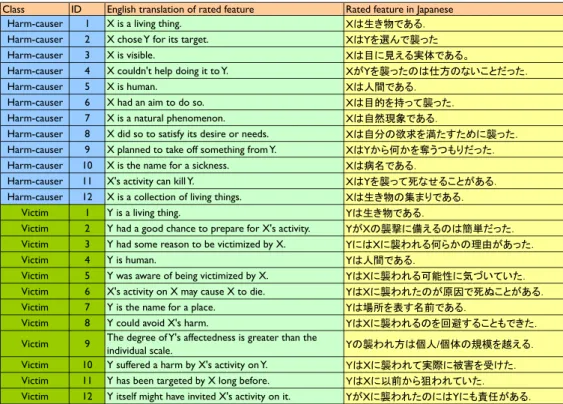
Figure 3: 24 features/characteristics used for rating experiment.
2.3.3 Comparison with LSA
A comparison with a relatively well-known model La- tent Semantic Analysis (LSA) [12] may be helpful here. In LSA, unlike our approach based on behavioral data, semantic vectors are constructed from corpus data (through a dimension-reduction technique called “sin- gular value decomposition”), though the idea of repre- senting word meanings in vector form is shared. The main difference is that semantic vectors in LSA are very big and that the notion of features is no longer tenable.
Furthermore, sentential meanings are constructed un- der strict compositionality: the meaning of a sentence s = w
1· w
2··· w
nis defined as the (logical) conjunction of semantic vectors v
1, v
2, . . . , v
n(where v
idenotes the semantic vector of word w
i), which corresponds to a particular point in a semantic space.
3 Experiments
3.1 Procedure
In our SFR task for osou-sentences (explained in § 3.2), participants are presented with Japanese sentences in which (i) the main verb is osou (active form) or os- owareru (passive form) and (ii) either the subject or ob- ject NP is a bisyllabic nonce word, which, therefore, has no lexical meaning.
Participants were asked to rate each of the 24 features in Figure 3 on a five-point scale (from “very true” 5.0 to “very false” 1). The results were averaged. Several types of multivariate analyses (e.g., Principal Compo-
nent Analysis (PCA) and Factor Analysis (FA)) were applied to it.
3.2 Materials
A Japanese sentence of the form “X -ga Y -wo osou” [ac- tive] or “Y -ga X-ni osowareru” [passive]) denotes a sit- uation in which Y is victimized by X , a h harm-causer i . All Japanese examples (in the 6th column) of Fig- ure 4 were constructed for a lattice of situations, pre- sented in Figure 2, with 15 lowermost, most finely grained levels (F01, . . . , F15).
6)The lattice of situations in Figure 2 was constructed from a frame-based man- ual analysis of the 413 examples from a corpus [20], whose validity was confirmed by an independent psy- chological experiment [15]. We assumed that contex- tual effects on u
ifrom its context s
iwere factored out and controlled in this way, though this point could, we are aware, be controversial.
4 Results and Discussion
4.1 Main results
For both osou- and osware-sentences, nonce words were rated very much like real words in the way pre-
6)This does not mean, however, that there are no classifications with a finer granularity than F01, . . . , F15. We plan to conduct an experiment to see if hyper-fine-grained situations in whichhattack by a large predatory animaliandhattack by a small predatory animali can show as much convergence as we had in our experiment that con- firmed those 15 situations.
Situation ID Subject NP denoting Victim
PP denoting Harm- causer
Transliteration (word-by-word translation from Japanese assuming that
osou translates to attack)
Natural Translation Original Example (in Passive form) F01: Power conflict
between human groups The President an assassin The President was attacked by an
assassin. The President was assaulted by an assasin. 大統領が 暗殺者に 襲われた。
F02: Invasion a country an(other) armed
country
A country was attacked by another armed country.
A country was attacked by another armed
country. ある国が 軍事国に 襲われた。
F03: Robbery on larger
scales a bank branch a masked man A bank branch was attacked by a masked man.
A bank branch was attacked by a masked
man. 銀行が 覆面の男に 襲われた。
F03: Robbery on smaller
scales an old lady a purse snatcher An old lady was attacked by a purse snatcher.
An old lady was assaulted by a purse
snatcher. ある老婆が ひったくりに 襲われた。
F04: Persecution, Violence passengers-by a lunatic man Passengers-by were attacked by a lunatic man.
Passengers-by were assaulted by a lunatic
man. 通行人が 精神障害の男に 襲われた。
F05: Sexual assault a woman a pervert A woman was attacked by a pervert. A woman was sexually assaulted a pervert.ある女性が 性的倒錯者に 襲われた。
F06: Preying animal attack;
Predation zebras lions Zebras were attacked by lions. Zebras were attacked by lions. シマウマが ライオンに 襲われた。
F07: Nonpreying animal
attack, usually for defence children wasps Children were attacked by wasps. Children were attacked by wasps. 子どもが スズメバチに 襲われた。
F08: Accident a family a runaway truck A family was attacked by a runaway truck.
A family got the victim of an accident by a
runaway truck. ある家族が 暴走トラックに 襲われた。
F09: Natural disater on
smaller scales a town gust of wind A town was attacked by gust of wind. A town was hit by gust of wind. ある集落が 突風に 襲われた。
F10: Natural disaster on
larger scales a local area a hurricane, a
typhoon An area was attacked by a hurricane. An area was hit by a hurricane. ある地方が 台風に 襲われた。
F11: Epidemic spread a city influenza, Black
Death A city was attacked by influenza. A city was hit by influenza. ある都市が インフルエンザの流行に 襲
われた。
F12: Social disaster the stock market a debacle (or a downturn, sharp fall)
The stock market was attacked by a
sharp fall. The stock market was hit by a sharp fall. 株式市場が 株価の暴落に 襲われた。
F13: Long-term sickness a man cancer, malignant
tumor A man was attacked by cancer. A man was seized by cancer; A man
suffered cancer. ある人が 悪性のガンに 襲われた。
F14,15: Short-term mental
disorder OR sickness an old man panic An old man was attacked by panic. An old man was seized by panic. ある老人が 不安に 襲われた。
F14: Short-term
sickness/symptom a man a sharp pain A man was attacked by a sharp pain. A man was seized by a sharp pain; A man
suffered a sharp pain. ある男性が 激痛に 襲われた。
F15: Short-term mental
disorder a young man strong jealousy A young man was attacked by a strong jealousy
A young man was seized by a strong
jealousy ある若者が 激しい嫉妬に 襲われた。
NONSENSICAL zebras a masked man Zebras were attacked by a masked man. Zebras were attacked by a masked man. シマウマが 覆面の男に 襲われた。
Figure 4: Materials used for experiment, with English translations (passive cases only).
!
"
#
$
% &'()*+,-'.')'/01)2)-'3/045
67'.')'/01)2)-'3/045 67'.')'/01)2)-'3/045
!
"
#
$
%
!"#$"%"&#'#()"*+#(),
!"#$"+-.%(,
/+0"10)200"34"!5$"%440,,,
!"#$"*+0"(%.0"432"%"6&,,,
!"#*$0&4".#)+*"+%'0"#(,,,
!"+%1"$3.0"20%$3("*3",,
!"+%$"700("*%2)0*01",,
!"8%$"%8%20"34"*+0"63,,,
!"+%1"%")331"9+%(90",,
!"93-&1"%'3#1":5$"%440,, :5$"%9*#'#*;"3(":".%;,,,
!"$-440201"%"+%2."7;":,,
&'4+3-'.'+1(,0819) 67'.'+1(,0819) 67'.'+1(,0819)
!
"
#
$
% &'*)1'.')'*),+:1)13'30*;/
67'.')'*):,+1)13'30*;/
!
"
#
$
%
!"#$"%"&#'#()"*+#(),
!"#$"+-.%(,
/+0"10)200"34"!5$"%440,,,
!"#$"*+0"(%.0"432"%"6&,,,
!"#*$0&4".#)+*"+%'0"#(,,,
!"+%1"$3.0"20%$3("*3",,
!"+%$"700("*%2)0*01",,
!"8%$"%8%20"34"*+0"6,,,
!"+%1"%")331"9+%(90",,
!"93-&1"%'3#1":5$"%440,, :5$"%9*#'#*;"3(":".%;,,,
!"$-440201"%"+%2."7;,,,
&',;4),')/8)'.'&'3-<=;;1 67'.')',)/:8'3-<=;;1
!
"
#
$
%
&
' ( )
!*
!!
!"
!#
!$
!%
!&
!'
!
"
#
$
%
&
' ( )
!*
!!
!"
!#
!$
!%
!&
!'
!
"
#
$
% +,-./,0,.,-.123/./4,45-67
89,0,89
89,0,.,-.312/./4,45-67
!
"
#
$
%
!"#$"%"&#'#()"*+#(),
!"#$"+-.%(,
/+0"10)200"34"!5$"%440,,,
!"#$"*+0"(%.0"432"%"6&,,,
!"#*$0&4".#)+*"+%'0"#(,,,
!"+%1"$3.0"20%$3("*3",,
!"+%$"700("*%2)0*01",,
!"8%$"%8%20"34"*+0"6,,,
!"+%1"%")331"9+%(90",,
!"93-&1"%'3#1":5$"%440,, :5$"%9*#'#*;"3(":".%;,,,
!"$-440201"%"+%2."7;,,, +,16:.1,.7;.,0,+,4<=>66/
89,0,89 89,0,.,1.73;,4<=>66/
F13: Long-term sickness
F10: Natural disaster on large scale
F08: Accident
F11: Spread of epidemic
Figure 5: SFR profiles for F13 and F10 (Group 1) and F08 and F11 (Group 2) for “ h victim(Y ) i -ga h harm-
causer(X ) i -ni osowareta” (X = NW (nonce word), Y =RW (real word)) contexts, comparing the results for the
real-word rating (in blue) and two response patterns. For Group 2, two response patterns (both in orange) were
differentiated. For comparison, NW-NW response (Baseline 2) is marked in green for F13 and F10.
dicted by the A-to-S effect. This is indicated by the fact that in cases F13 and F10, for example, nonce words for h victim i s were feature-rated as like real words (a man and a local area, respectively) in the correspond- ing full sentences, as indicated by the left-side profiles in Figure 5. The same was true of the nonce words for the h harm-causer i .
Green graphs for F13 and F10 indicate the NW-NW response. It is reasonable to think, from theory, that these represent the lexical meaning of oso(ware)u. Dif- ferences from it indicate the effects of co-composition.
It is also reasonable to think of the specific situation closest to the NW-NW response as being the prototyp- ical situation of the events that can be referred to by oso(warer)u. It turned out that F06: h predatory victim- ization i was the nearest situation when the Euclidean distance in the space defined by the first three princi- pal components of the semantic features was used as a measure of dissimilarity. We found that this was a rea- sonable result.
4.2 Discussion
4.2.1 When metonymic adjustment is called for SFR patterns for F08 and F11 behaved somewhat dif- ferently from the others. Unlike other cases, they re- flect “logical metonymy” for h victim i , giving rise to two different rating patterns, which correspond to two different orange graphs overlaid in the right-side pro- files in Figure 5. It seems that in one response pattern, nonce words for h victim i were characterized like [indi- viduals] (e.g., a family) that were at that location at that time;
7)in another, they were characterized like h loca- tion i s where h victims i were located at the time of vic- timization. For the former case, a metonymically based reference shift from [place] to [individuals] is observed.
Despite problems like this, it was found that the inter- pretations of oso(warer)u-sentences do not exceed the range of possible interpretations specified by the situa- tion lattice in Figure 2. This suggests that conventional metaphors are lexicalized and are not as productive as claimed by [11], in agreement with the claim in [1].
4.2.2 Strengths of A-to-S effects
Different nouns have different degrees of A-to-S ef- fects. This is not at all surprising, but it should be noted that nouns showing strong A-to-S effects are names for representative instances of h harm-causer i or h vic- tim i . Nouns that denote h harm-causer i s, on average, were found to have stronger A-to-S effects than nouns that denote h victim i when combined with osou.
4.2.3 Scalability
There is no reason to doubt that this result can be ex- tended to other constructions because there seems to be nothing special about the behavior of the oso(ware)ru
7)For F08,a familyis understood to refer to its members as indi- viduals.
construction that we investigated. It shows the normal behavior of a polysemous verb.
It is not at all easy, however, to see what will actually happen with other constructions. First of all, if we de- cided to do the same experiment with another verb V , a different set of situations, desirably in the form of an HFN, would need to be constructed for V . For example, if we decided to test y-ga x-kara nigeru (meaning “y ran away from x” in English), we would need to construct an HFN for this verb. This task would, admittedly, be very painstaking. We have a hope of semi-automated of this take using the method tested in [9].
4.2.4 Trouble with the basic units of evocation It is hard to reconcile what we have shown with the traditional account of semantic interpretation in which meaning construction is define as a rule-governed, com- positional process, but let us try.
As Frame Semantics tells us, words and phrases evoke specific situations, or “frames” in the sense of FS/BFN. Evoked frames are integrated, thereby giv- ing the semantic representation of a complex unit, say of a sentence. Frame integration should be a co- compositional process. Nothing is wrong so far. But here comes an annoying question, What are the “basic units” of situation/frame evocation? — Are they words or larger units like collocational patterns?
Our results strongly suggest the that larger units have stronger situation/frame-evocation effects than smaller units like words. This implies that colloca- tions patterns are better units of evocation than words.
This poses a challange to any lexicon-building attempt because it questions one of its most important assump- tions: Is it really promising to try to build a lexicon that should provide a (desirably) necessary and sufficient in- formation for semantic description? because a lexicon, by its defintion, mainly, if not only, gathers meanings of lexical items, typically words. If not, what shall we do?
This also implies that the semantics of regular units may not be as much compositional as is usually sup- posed to be, because if pairings of surface forms and their meanings are evocation-based, their semantics need not be compositional in the sense of traditional linguistics and logic. In this scenario, semantic speci- fications are directly associated with collocational pat- terns, and it is very likely that what Hunston and Fran- cis [8] call “patterns” and what Wray [21] calls “for- mulaic language” play more vital role than in the tra- ditional account. A similar insight plays an important role in Corpus Pattern Analysis (CPA) [7, 18].
Thus, there seems to be a serious need to establish a
good theory of the semantics of collocational patterns,
i.e., “superlexical” units, on the one hand, and to rec-
oncile between the description of lexical items and that
of collocational patterns, on the other. We are not pro-
fesional lexicographers, and clearly are not qualified to
propose any solution to this problem, but we can sug-
gest, we believe, some workaround that would make
a lexicon-building task more realistic, building on the
seminal work by [5]. We also hope it is compatible with
the basic idea underlying CPA.
The workaround we have in mind is to make a clever use of ontological information specified in HFNs like the one in Figure 2. Let us explain the basic idea with a few examples. Suppose we are on specifying the se- mantics of “NP attack NP.” Sentences like The lions attacked a herd of impalas, A group of killer whales attacked a humpback whale can be seen as instances of the [ h predator i attack h prey i ] schema interpreted against the situation of h predation i . Assuming a proper defintion of h predation i , we can say [the lions instance- of h predator i ], [(a herd of) impalas instance-of h prey i ], [killer whales instance-of h predator i ], and [a humpback whale instance-of h prey i ], using instance-of link. Re- call that the HFN in Figure 2 is the partical specification of the ontology of harm-causation, of which h preda- tion i is an instance.
It is important to note that many, if not all, situations are associated with role names equivalent to predator and prey for the h predation i situation. For one, victim is the role-denoting noun that is valid to denote any in- stance of y on the entire HFN in Figure 2. We have role hierarchies like [ h bank i is-a h victim i ] for h bank rob- bery i , [ h prey i is-a h victim i ] for h predation i . Based on this, we suggest that it is promising to build a lexicon in which senses of the arguments of a predicate (e.g., at- tack) are defined by referring to the role hierarchies de- rived form the situation hierarchies like the HFN in Fig- ure 2. A clever use of this kind of information should make a lexicon more realistic and amenable to the infor- mation encoded by collocational patterns, we believe.
5 Conclusion
In this paper, we tried, by presenting psychological ev- idence, to argue for a radically selectional theory of se- mantic interpretation based on Frame Semantics, and contrasted it with purely constructivist theories of se- mantic interpretation. We also pointed out that log- ically based models of sentential meaning need to be somehow modified to make them compatible with vec- tor space models of it, because there is a large gap between the logical forms and the behavioral data ob- tained through psychological experiments. We sug- gested that lexicon-building task can be made more re- alistic if we employ roles hierarchies derived from situ- ation hierarchies.
References
[1] N. Asher and A. Lascarides (2001). Metaphor in dis- course. In P. Bouillon and F. Busa, eds., The Language of Word Meaning, pp. 262–290. Cambridge University Press.
[2] Reinhard Blutner and Henk Zeevat, eds. (2004) Op- timality Theory and Pragmatics. Palgrave Macmillan, Houndmills, Basingstoke, Hampshire.
[3] Osgood C. E. (1952). The nature and measurement of meaning. Psychological Bulletin, 49(3):197–237.
[4] C. J. Fillmore (1985). Frames and the semantics of un- derstanding. Quaderni di Semantica, 6(2): 222–254.
[5] C. J. Fillmore and B. T. S. Atkins (1994). Starting where the dictionaries stop: The challenge for computational lexicography. In B. T. S. Atkins and A. Zampoli, eds., Compuational Approaches to the Lexicon, pp. 349–393.
Clarendon Press, Oxford.
[6] T. Fontenelle, ed. (2003). FrameNet and Frame Seman- tics: A Special Issue of International Journal of Lexi- cography, 16 (3).
[7] P. Hanks and J. Pustejovsky (2005). A pattern dictionary for natural language processing. Revue franc¸aise de la linguistique appliqu´ee, 10 (2).
[8] S. Hunston and G. Francis (2000) Pattern Grammar:
A Corpus-Driven Approach to the Lexical Grammar of English. Amsterdam: John Benjamins.
[9] Kanamaru, T., M. Murata, K. Kuroda, and H. Isahara (2005). Obtaining Japanese lexical units for semantic frames from Berkeley FrameNet using a bilingual cor- pus. In Proceedings of 6th International Workshop on Linguistically Interpreted Corpora, pp. 11–20.
[10] E. Kako (2006). The semantics of syntactic frames. Lan- guage and Cognitive Processes, 21(5): 562–575.
[11] G. Lakoff and M. Johnson (1980). Metaphors We Live By. University of Chicago Press.
[12] T. K. Landauer and S. T. Dumais (1997). A solution to Plato’s problem: The Latent Semantic Analysis the- ory of the acquisition, induction, and representation of knowledge. Psychological Review, 104: 211–240.
[13] K. McRae, G. Cree, M. S. Seidenberg, and Ch. Mc- Norgan (2005). Semantic feature production norms for a large set of living and nonliving things. Behavior Research Methods, Instruments, & Computers, 37(4):
547–559.
[14] K. Nakamoto and K. Kuroda (in press) Represent- ing selectional restrictions in terms of semantic frames equated with situational schemas: A case study of the japanese verb osou. Studies in Language Science, 7.
[15] K. Nakamoto, K. Kuroda, and H. Nozawa (2005) Proposing the feature rating task as a(nother) powerful method to explore sentence meanings. Japanese Jour- nal of Cognitive Psychology, 3 (1): 65–81. (written in Japanese).
[16] A. S. Prince and P. Smolensky (1993). Optimality The- ory: Constraint Interaction in Generative Grammar.
Technical Report No. 2, Rutgers University Center for Cognitive Science.
[17] J. Pustejovsky (1995). The Generative Lexicon. MIT Press.
[18] A. Rumshisky and J. Pustejovsky (2006). Inducing sense-discriminating context patterns from sense-tagged corpora. In Proceedings of LREC 2006, Genoa, Italy.
[19] J. Ruppenhofer, M. Ellsworth, M. R. L. Petruck, and C. Johnson (2005). FrameNet: Theory and Practice. [http://framenet.icsi.berkeley.
edu/book/book.html]