論 文
Abstract
Positioning of social welfare policy is shaken in the Aging Society, Japan, which was a small production multi-social. Long-term care is growing demand for care services also to penetration of the insurance system, needs have also diversified. However, the shift is beginning to occur and views on life and death of Elderly welfare policy and the Japanese have been the post-war development. Where do the dying, is the divergence to the ideal and reality whether that be greeted has occurred. As a result, the need to diversify not only welfare enhancement of living continues to conventional health, has come to be comprehensive to death. However, it is not sufficient. It of course proceed with construc-tion of enhancement and systems of care services, it is necessary to the construcconstruc-tion of a framework that encompasses the death even in law and policy. To continue to mature as a welfare state, it must be kept in mind also that what QOD (Quality of Death) is increased to anywhere that each individual die better, but still sufficient discussion and society, in-cluding the social maturity It is a state in which agreement is not formed. In the future, it is necessary to proceed with policy development in the form of comprehensive least death. Only when you realize this, it would not be able to present a new model as the welfare state. 要 約 少子高齢社会、少産多死社会となった我が国において社会福祉政策の位置づけが揺 らいでいる。介護保険制度の浸透も併せて介護サービスの需要は高まり、ニーズも多 様化している。しかし、戦後整備されてきた高齢者福祉政策と日本人の死生観とはズ レが生じはじめている。どこで死を迎えるのか、どこで死が迎えられるのかという理 想と現実に乖離が生じているのである。その結果、多様化するニーズは従来の健康で 生き続けるという福祉的充実だけでなく、死まで包括するようになってきた。しかし
高齢者の看取り支援に対する政策的課題
高橋 幸裕
Policy Issues for the Elderly of End-of-life Care Support
はじめに
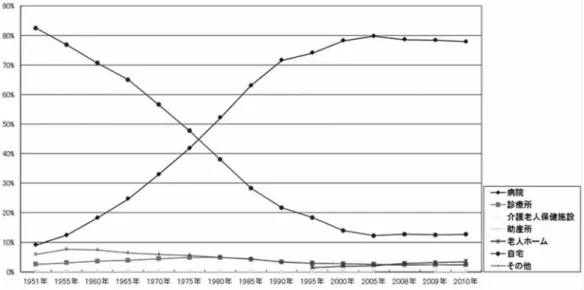
人生の最後をどこで迎えたいか、愛する家 族が最期を迎えるときはどのような場所で何 をしたいか考えたことがあるだろうか。多く の人は年齢が高くなるほど家族の最後に直面 し、人生の最後について考える機会があった だろう。 総務省統計局(1)によると「高齢者人口は 3384万人、総人口に占める割合は26.7%と共 に過去最高」、「80歳以上人口が初めて1000万 人を超える」と述べているように、高齢者の 割合が 4 人に 1 人以上となった。 もちろん、 人口減社会へと突入していることから死はま すます身近なものとしてなってきている「は ず」である。「はず」とつけたのは理由があ る。本稿でも示すように、人生の最期を迎え る場所は病院死が圧倒的に多く、また核家族 化が進展したことによって、家族や身近な人 ながら、それは十分なものではない。介護サービスの充実や体制の構築を進めていく のはもちろんのこと、法や政策においても死を包括した枠組みの構築をすることが必 要である。福祉国家として成熟していくには、各個人がより良く死ぬというQOD(ク オリティオブデス)がどこまで高められるのかということも念頭に置かねばならない が、社会的成熟も含めてまだまだ十分な議論と社会的合意が形成していく必要があ る。今後、少なくとも死を包括した形での政策的展開を進めていくことが必要であ る。これを実現した時こそ、福祉国家として新しいモデルを提示することができるの ではないだろうか。 キーワード 看取り(End-of-life care) 介護(Care) 介護職(Care workers) 法・政策(Law and Policy) 死生観(View of life and death)QOD(Quality of Death)