Participation and Integration of Multiple
Cultures in Berlin
journal or
publication title
Journal of social policy and social work
volume
16
page range
32-61
year
2012-03
Participation and Integration of Multiple Cultures in Berlin
1Ulrich LOHMANN
Arisa YAGI
Introduction
The Federal Republic of Germany, despite facing the same problems of low birthrate and longevity as Japan, has accumulated experienced in the acceptance and symbiosis of cultural / linguistic minorities in a historical background inseparable from geographical conditions, and quite different from Japan.
In the German President’s memorial day unification speech on October 9, 2010, his comment that “Islam is a part of Germany” caused controversy. In fact, the ratio of the Muslim population in Cologne has risen to approximately 10%. In addition to its role as an archbishop seat of the Catholic Church and the site of the Cathedral of Cologne, the city is also the site of the largest Mosque in Germany, completed in the autumn of 2011 as the emotional center for Muslims. Meanwhile, German citizens hold increasing antipathy to Islam. A commonly expressed view is disappointment that Muslims do not try to get used to
German culture, “even though we are trying to accept them.”2
The right to hand down original culture should be protected under democracy, but how should customs such as equal rights for men and women, be considered in situations when the basic philosophy concerning the origin of life differs? And is it possible to divide public behaviour and private sense of values? Holding
these questions as a focus of concern, this paper considers the situation of migrants3 in the capital city of
Berlin.
1In this paper, “integration” shall generally mean “unifying that it is indiscriminate”, after “integrated; racially integrated; racial
indiscriminate treatment (Grand Concise English-Japanese Dictionary. SANSEIDO, 2001, p.1300)” and “integrated; (based on discriminating abolition) reconciliation integrated; fusion. (Grosses Deutsch-Japanisches Wörterbuch, the 2nd edition. Shogakukan, 2000, p.1177)”.
2Germany: Influence of mosque construction − A barrier between German residents and migrants (「独:モスク建設の波紋 ―
ドイツ市民と移民 立ちはだかる壁」). NHK Broadcast “KAIGAI NETWORK (Overseas Network)”, 2011. Feb. 5 on air.
3Although people who have moved to a different country are generally called “immigrants”, there is also some criticism against
1. Migration in Germany
(1) Statistical Profile
Of Germany’s total population of 81,900,000 people, 19.2% are “people with a migration background” in a broad sense (statistics of the 2009 fiscal year published in 2011). This is a slight increase from 18.7%
and 18.3% in 2005 and 20074 .
The expression “people with a migration background” was first adopted when the Federal Statistical
Office released the small-scale national census results in 20055. Broadly, “person with a migration
background” refers to: a person of foreign citizenship who has moved from a foreign country into the Federal Republic of Germany in or after 1950; a person of foreign citizenship born in Germany; a person who was born with German nationality and at least one of the parents were born in Germany as
a transferee or a foreigner; or a person who acquired German nationality after transference6. The first
Type includes those who already had German nationality, returned to Germany after going to the old old Communist bloc in the war, and reacquired nationality.
There were about 15,700,000 “persons with a migration background” in the broad sense who lived in Germany in 2009. Of these, about 7,200,000 were “foreigners” (8.8% of the population), and 8,500,000 “persons with a migration background” in the narrow sense (10.4% of population), while the latter were also people with German nationality. This means that more than half of the migrants had acquired
German nationality7. “Persons with migration background” in the narrow sense came to 9.4% in 2005,
with a gradual increase to 9.9% in 2007, and 10.1% in 2008. The percentage of migrants without German nationality conversely tended to decrease. This is based on the German government policy of persuading migrants to acquire nationality as quickly as possible, and become integrated (Nationaler Integrationsplan, hereafter NIP). Around 1991, immediately after east-and-west reunification, there was a sharp increase in transference, but the difference of in-migrantion and out-migration can now no longer been seen.
Mainly from Turky and ex-Eastern Europe
In the investigation of fiscal 2009, Germany is mentioned as the migrant's first choice of destination
(15.9%) among the major powers, followed by Poland (15.5%)8 in second place. The ethnicities were also
various. 1,300,000 of 15,700,000 transferees did not have a notification at the time of transference, or had
4Statistisches Bundesamt Deutschland (2010). Anteil der Einwohner mit Migrationshintergrund leicht gestiegen: Pressemitteilung
Nr.033 vom 26.01.2010, www.destatis.de/jetspeed/portal/cms/Sites/destatis/Internet/DE/Presse/pm/2010/01/PD10__033__122,te mplateId=renderPrint.psml
5Saito, Junko (2008). ‘Foreigner integration policy of Germany’ in “Foreigner problem of a society of shrinking population:
synthesis investigation”, the Research and Legislative Reference Department of the National Diet Library (齋藤純子.「ドイツ
の外国人統合政策」, 『人口減少社会の外国人問題 総合調査』, 国立国会図書館調査及び立法考査局), p. 242.
6Statistisches Bundesamt Deutschland (2009). Bevölkerung und Erwerbstätigkeit: Bevölkerung mit Migrationshintergrund – Ergebnisse des Mikrozensus 2007 – Statistisches Bundesamt Fachserie 1 Reihe 2.2, pp. 5-6.
7Germany had traditionally followed the blood principle, but in the Nationality Law revision in 1999 (enforcement in 2000), the
principle of place of birth nationality was adopted for the first time, and it became possible for children of foreigners who could satisfy fixed requirements to acquire German nationality by birth.
8Bundesamt für Migration und Flüchtlinge (2011). Migrationsbericht 2009, www.bamf.bund.de/ nn_442016/SharedDocs/Anlagen/
unclear ethnic background in that their parents and/or grandparents had a combination of two or more nationalities. On the other hand, the countries from which Germany has so far accepted transferees are, in order of acceptance, Turkey (2,900,000), the old Soviet Union (2,900,000), Poland (1,400,000) and old Yugoslavia (1,300,000). Among the countries which have sent out foreign workers (Gastarbeiter) apart from old Yugoslavia and Turkey, are Italy (795,000) and Greece (391,000) among the major powers. Many repatriates have come from Russia (681,000), Poland (568,000), Kazakhstan (412,000), and Romania (210,000).
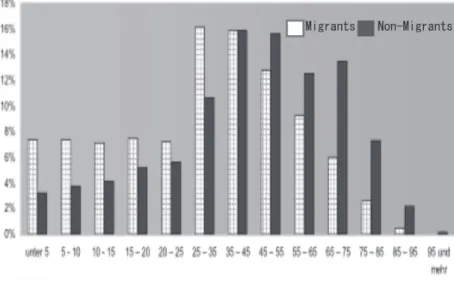
Comparing the age groups to the total population (Fig. 1), in each classification aged 35 and below the “migrant” ratio is higher, while the ratio of elderly (65 and over) were up to 23.1% (“non-migrant”) and 9.2% (“migrant”). While the average age of “migrants” was 34.4 years old, for “non-migrants” it was
45.3, a difference of about 10 years9.
The migrant population of each age group from 0 to 25 years old is maintained at about 7%, without the occurrence of low birthrate or longevity. As this younger age group marries, and builds families, it is predicted that the “migrant” population in the broad sense will continue to increase.
People who have moved in for economic reasons are leaving family in their nations of origin. After moving, they remit money monthly to support the family, and in most cases call them to Germany later.
The Migrant office tries to give guidance and information for these activities10.
More in ex-West than in ex-East
A comparison of states and special administrative areas shows (Fig. 2) that 96% of migrants lived
9Die Beauftragte der Bundesregierung für Migration, Flüchtlinge und Integration (2010). 8. Bericht der Beauftragten der Bundesregierung für Migration, Flüchtlinge und Integration über die Lage der Ausländerinnen und Ausländer in Deutschland,
p. 41.
10Bundesamt für Migration und Flüchtlinge (n.d.). Ehepartner/Familie nachholen, http://www. bamf.de/cln_103/DE/Migration/
EhepartnerFamilie/ehepartnerfamilie-node.html
Fig. 1 Population Comparison in Ages (2008)
in the states of former West Germany, and the
capital Berlin in 200811. As mentioned later
concerning Berlin, such regional difference has come about in response to the influence of the east-west division after World War II.
(2) The New Migration Law by “Demand
and Promotion”
In spite of the crucial role played by foreign workers in the industrial and economic revival of Germany after the war, their integration in German society did not progress at all. However, in order to overcome intensifying international competition for labour, humane treatment of foreigners and migrants, as such a big part of the German economy, became necessary. The new migrant law, proposed in 2001, was used as a major pillar to promote the integration of foreigners and migrants into German society. Due to the influence of the
September 11, 2001 attacks in the U. S., the incorporation of further measures against foreign extremists delayed enforcement of this law until January 1, 2005.
The theme of the new law was “demand and promotion” of integration. Under this law, while action as a member of German society was required of a migrant, a bilateral approach was taken, whereby the
German state also promoted the rights and fundamental measures for these activities12. To this end, in the
new law, residence permission and work permission were unified and simplified, and work permission from the labor bureau became unnecessary. In the new labor market-oriented new law, migrants were provided with integration courses to facilitate their mastery of German language, law, culture and values. In addition, because of humanitarian concerns, regulations concerning migrants’ families living in Germany, and the regulations concerning the calling of family from the motherlands were eased. On the other hand, a measure allowing for immigration restrictions of dangerous persons and their deportation
was also incorporated in the new law13.
Acceptance of professional competence in the labor markets
There has been a gradual easing of the labor market for foreigners and migrants with advanced professional competence. In August, 2000, the Schroeder government introduced a system similar to,
11Die Beauftragte der Bundesregierung für Migration, Flüchtlinge und Integration (2010). 8. Bericht der Beauftragten der Bundesregierung für Migration, Flüchtlinge und Integration über die Lage der Ausländerinnen und Ausländer in Deutschland,
p. 53.
12Maaßen, Hans-Georg (2007). The background and trend of the German immigration law and the unifying method enactment, Tsukuba Law Journal 2, p. 112.
13Ibid. , pp. 116-120.
Fig. 2 Migrant population rates for states and administration special areas in 2008.
though more restrictive than, the U.S. “Greencard” system. At this time, there was a major need for rapid introduction of IT-related engineers. Although 20,000 such introductions were planned, in reality only
18,000 people were introduced before 200414.
The EU has introduced the “Blue Card” in order to promote the inflow and long stay of qualified
workers or advanced specialists15. According to this framework, much deregulation was carried out by
January 1, 2009.
(3) Social Differences between Migrants and Non-Migrants
① Poverty and Low Employment
In 2009, the poverty rate of main breadwinners of migration background in the household economy exceeded 25% among all forms of household. This is significantly high compared with non-migrants, for whom the poverty rate is about 11%. There seems to be a tendency toward cheap labouring jobs and difficulty in employment for migrants.
Cultural / linguistic minorities, such as East Europeans, Turks and Muslims, play an important role as a
reserve of unskilled labor in the country. Tanaka16, in a comparison of the employment situation of foreign
workers (Turkey, old Yugoslavia, Italy, Greece, Spain) and German workers between 1984 and 1997, found remarkable differences. For example in 1984, 70% of foreign workers were unskilled or started as semi-skilled workers, while unskilled
or semi-skilled workers among German workers came to only 16%. Later, while the ratio of unskilled or the semi-skilled foreign workers fell, the ratio of special workers rose and middle and high-class white-collar worker ratios also increased sharply. As a result, the ratio of unskilled and semi-skilled foreign workers fell to 51% in 1997. De Groot and Sager compared the relationship between household income and unemployment rate in the year 2008 among the hometown regions. The situation was still obviously severe for migrants, especially for Turks (Fig. 3).
14Bundesregierung (n.d.) Zuwanderungsland Deutschland, Regierung Online, www.bundesregierung.de/nn_774/Content/DE/
Artikel/IB/Artikel/Geschichte/2009-05-23-zuwanderungsland-deutschland.html
15Councile of European Union (2009.5.25). Council adopts the “EU Blue Card”: more advantages for high-skilled foreign workers.
Brussels, 10266/09 (Presse 151), www.consilium.europa.eu/ uedocs/cms_data/docs/pressdata/en/misc/107989.pdf
16Tanaka, Nobuyo (2001). Population problem and immigration policy of Germany. ITI Jounal, Winter/No.46 ( 田中信世 .「ドイ
ツの人口問題と移民政策」『ITI 季報』Winter/No. 46), pp. 19-20.
Fig. 3 Household Income and Unemployment Rate: home country comparison (2008)
Although the foreign self-employed in the 1970’s constituted 2% or less of foreign migrants, this ratio later increased to 8.8% and in 2000, the number of self-employed foreigners was about 280,000. Foreign self-employed workers now employ 500,000 or more workers, and have played an important role as employers. The majority of these foreigners run businesses in the service industry, especially restaurants or the food retail trade.
In recent years, in Germany as well as in Japan, regular workers have decreased in number and there has been an increase in the number of so-called a-typical workers who find jobs in new ways, as short-term workers, temporary workers and self-employed who make short-short-term business contracts. Some of these self-employed workers are thought to be making a system in order to bring in new people from their home country. In Germany, the employer must pay social insurance premiums for non-regular workers,
and there is also a system for minimum income security for short time workers17.
② Difference in Education
There is clearly an education gap between migrants and non-migrants. The positive influence on later stages of school education of children with a migration background who go to a child-care facility for a year has recently been realized. However, the percentage of children who go to nursery school/ kindergarten among non-migrants is far higher, at 61%, than the 47% among migrants. In respect of the opportunity for children to integrate into the area, or to discover and develop their original capabilities, participation in recreation plays a function. But again, the participating rate in community recreation by
migrant children is static at 31.7% in comparison to 54.7%18 among non-migrant children.
There is a tendency that the younger the child, the more difficult it is to get such an opportunity. If young migrant mothers cannot integrate into the communities, their children also lose the opportunity at a very important time in childhood, when the influence on development of speech and language or cultural acquisition is strongest. According to the data in 2010, 39% of migrants have not received occupational education. On the contrary, for the non-migrants, the rate was only 12%. Extending to general education, while the percentage of those who have not finished basic education among non-migrants is 1.5%, in the
migrants’ group, up to 13% have not finished basic education19. Migrants could only find a job after 17
months even after basic education completion, while non-migrants would be employed on an average in
just three months20.
A correlation between the ratio of school dropouts and parents' level of education has also been reported. The tendency of low school attendance among migrant children seems to be a reproduction of low school education. Generally, the probability of boys' discontinuation in various educational stages is higher than of girls. The higher discontinuation rate of boys of migration background is explained by
17Tsuchida, T., Tanaka, K. and Fukawa, T. Ed. (2008). Social Security Reform – Challenges in Japan and Germany. Minerva Shobo
( 土田武史・田中耕太郎・府川哲夫 編 . 『社会保障改革―日本とドイツの挑戦―』ミネルヴァ書房 ), p. 218
18Schmaide, Nicole und Spieß, C. K. (2010). Einkommen und Bildung beeinflussen die Nutzung frühkindlicher Aktivitäten außer
Haus. Wochenbericht des DIW Berlin Nr. 45/2010, Deutsches Institut für Wirtschaftsforschung, pp. 15-21.
19Autorengruppe Bildungsberichterstattung (2010). Bildung in Deutschland 2010, p. 52.
20Die Beauftragte der Bundesregierung für Migration, Flüchtlinge und Integration (2010). 8. Bericht der Beauftragten der Bundesregierung für Migration, Flüchtlinge und Integration über die Lage der Ausländerinnen und Ausländer in Deutschland,
the influence of the sociocultural background in quitting school21. Even if someone clears an unfavorable
condition and goes to university with much trouble, tuition cannot be paid or studies may not be considered important in his ethnic community. For such reasons, the rate of quitting school is high.
A further bipolarization is recognized in comparing migrants’ national origins. Among the nationals of Turkey and Greece, which had sent out foreign workers in the past, there appear to be low results in many of the previous indices, but transferees from France or Spain sometimes have better indices than
Germans22.
③ Health and Welfare Service
When people with insufficient ability in German language get sick, or become aged, especially in the early stage of dementia, communication with medical staff can be overly delayed, and they can be faced with various problems caused by lack of information. Even among native speakers, individual differences and difficulties appear in the expression of feeling and concepts in regard to particular health conditions. It is a double problem if German is not well spoken. Therefore, mental health problems such as dementia and depression are a still bigger burden not only for the migrants but also for medical staff. Comparison among three social measures, education level, voluntary insurance subscription rate and German capability, is shown in Fig. 4 from an investigation by
the German Economic Research Institute. As expected, there seems to be correlation in the insufficiency of German capability and years of study, only a small proportion of migrants are insured and it is hard to receive social security benefits.
Dr. Schouler-Ocak and his team of Humboldt University Charité hospital psychiatry visitor section conducted an investigation of 350 psychiatry clinics in the country concerning the main problems
in regard to Muslim patients23. 28% of the
respondents pointed out the problem of communication or lack of understanding, and 40% of the respondents mentioned difficulty in cultural matters. In order to avoid such difficulty, the license education of social work and also of
21Tippelt, Rudolf (2009). Bildung fördern – regionale Entwicklung zukunftsorientiert gestalten, in “Perspektive Berufsabschluss”. Dokumentation der ersten Jahrestagung 27. und 28. Mai, 2009, in Berlin, p. 17.
22Bundesministerium für Bildung und Forschung (2008). Bildungs(miss)erfolge von Jungen und Berufswahlverhalten bei Jungen/
männlichen Jugendlichen. Bildungsforschung Band 23, p. 38.
23Müller-Lissner, Adelheid, Wenn Migranten alt werden. Der Tagesspiegel (2008.6.11).
www.tagesspiegel.de/wissen/wenn-migranten-alt-werden/1253794.html
Fig. 4 Migrant hometown comparison of German capability, a voluntary insurance subscription rate, and entering-school years (2008)
medical treatment must include training in understanding foreign cultures. Interpreter service in the respective native languages in these fields is also needed. The Ethnic Medical Center in Hannover established in 2003 is one such measure.
As Fig. 5 shows, not only is there a correlation between low education levels and high unemployment rate, no access to receiving a pension, and no specific benefits shows the difficulty of accessing basic benefits. The citizens’ feeling of mingled prejudice and rising unease, is that migrants would “exhaust all social security” and “block employment of Germans”.
④ Prejudice
The number of non-German suspects
in criminal statistics is not increasing24.
However, there is still a strong tendency to consider that migrants and foreigners have a high probability of being connected with crime.
Existence of prejudice to migrants also became clear in the investigation of Zick and others about the
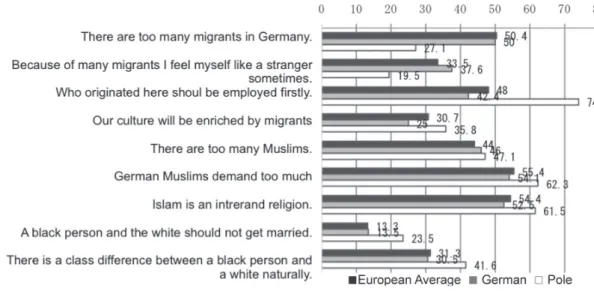
actual conditions of prejudice in Europe25. Fig. 6 shows some images of migrants or foreigners comparing
the European average, Germany and Poland: one out of two Germans thinks that there are too many migrants, about half have negative feelings towards Muslims, and think priority in employment should be given to Germans.
(4) Integration Strategies at the Federation Level
The Migrant Law, revised in 2005, started the simplification of various procedures and promotion of integration. There are three main components in the federation measure for promoting migrants' integration, through the abolition of discrimination: “NIP”, “monitoring”, and “agreement and offer of lectures.”
① NIP (National Integration Plan)
Following the March 2006 complaints to city administration by elementary school teachers in areas
24Kleff, Sanem und Seidel, Eberhard (2008). Stadt der Vielfalt: Das Entstehen des neuen Berlin durch Migration. Der Beauftragte
des Senats von Berlin für Integration und Migration, p. 175.
25Zick, A., Küpper, B. und Wolf, Hinna (2009). Europäische Zustände - Ergebnisse einer Studie über gruppenbezogene
Menschenfeindlichkeit in Europa. Material für die Pressekonferenz 13. November 2009 in Berlin unter der Schirmherrschaft der
Amadeu Antonio Stiftung, Berlin.
Fig. 5 Migrant and non-migrant Comparison by various indices (2009)
with high concentrations of foreigners and migrants in Berlin about the frequent occurrence of violent incidents in schools, the “1st Integration Summit” for comprehensive deliberation on the integration of foreigners and migrants, attended by 86 people from a wide variety of government and non-government
organizations, was held on July 14, 2006 sponsored by Prime Minister Merkel26.
This was regarded as the starting point for the decision on a “national integration plan”. Working groups for discussion on six themes were established: “integration course”, “German education”, “education, vocational education and vocational educational market”, “the situation of girls and women”, “integration
activities in local areas”, and “integration activities for strengthening civil society”27. Reports on 10
themes from the six working groups were submitted, and based on these, the “2nd Integration Summit” was held in July, 2007, where government decided upon the National Integration Plan. This national plan contains an action plans with 400 action duties and fixed numerical targets to which top priority should be
given not only at the national level but also in each state, areas and among NPOs28.
These indices are to be examined continuously, and the plan is expected to be agreed upon and widely implimented. “Integration Summits” have now been held up to four times, and deliberations and dialog are continuing. The position of the administration, that “the base of an integrated policy is a dialog
with migrants29” makes it clear that the present difficult condition cannot be overcome without sincere
26Bundeskanzleramt (2006). Teilnehmerinnen/Teilnehmer am Integrationsgipfel (Berlin, 14. Juli 2006), www.bundesregierung.de/
Content/DE/StatischeSeiten/Breg/IB/Anlagen/2006-10- 27-ib-nationaler-integrationsplan-teilnehmerliste,property=publicationFi le.pdf
27Die Beauftragte der Bundesregierung für Migration, Flüchtlinge und Integration (2006.7.14). Erster Integrationsgipfel, www.
bundesregierung.de/Content/DE/Artikel/IB/ Artikel/Nationaler_20Integrationsplan/2006-07-14-erster-integrationsgipfel.html
28Die Beauftragte der Bundesregierung für Migration, Flüchtlinge und Integration (2010). 8. Bericht, p. 26.
29Beauftragte der Bundesregierung für Migration, Flüchtlinge und Integration (2010). Kurz-Zusammenfassung mit ausgewählten Daten und Aussagen des 8. Berichts über die Lage der Ausländerinnen und Ausländer in Deutschland, p. 3. Underlined by the
author, www.bundesregierung.de/ Content/DE/__Anlagen/2010/2010-11-03-lagebericht,property=publicationFile.pdf
Fig. 6 Prejudice to migrant in Europe
Arranged from Zick et. al. (2009), Europäische Zustände. Ergebnisse einer Studie über gruppenbezogene
movement towards symbiosis.
② Monitoring
The minister on integration submitted the first report “Integration in Deutschland” on the degree of achievement of the integration index to the prime minister secretariat in June, 2009. The 12 indexes adopted here are:
Legal statuses, Education in early childhood and language-support, Education, Vocational Education, Labormarket integration, Social integration and incomes, Social integration in Comunities and participation, Dwelling, Health, Media, Intercultural opening of the administration and social services, ando also Crime, force and discrimination.
In the report, analysis of the national monitoring investigations and the influence of sociocultural
background are introduced, and detailed proposals for improvement are set out30.
③ Agreement to Integration and Integration Seminar-courses
Integration Seminar-courses, consisting of two levels of basic German, and a German culture course, with completion examinations, were started in 2007. About 600,000 people had started this course by 2009. This number corresponds to more than half of those who now have the qualification of lecture participation as a lengthier stay or as a migrant. The Federal Migrant, Refugee, and Integration Office evaluates this as proof of the great contribution of the courses in meeting the migrant needs.
In the application procedure for residence permission at the foreigner office, when permission is given, a guidance leaflet and application form are also given and the interview official is obliged to introduce the Integration Seminar. Participation is entirely voluntary.
The investigation conducted by the Department of the Interior showed “Results of Attending the Integration Course”, and the higher rank of “the Reason for Course Discontinuation”. It appears that even if people “became confident” in their German Language (41.4% ), it was not enough to be “Useful to go to a public office (23.8% ). Even if it could be” Useful in everyday life (42.4% ), there seems to be no special relation to “recieving education (13.4% )” or “Job finding (12.9% )”. Participation fees, one euro per hour, are reasonable, but even this is not easy for people who face severe living conditions, and many people have to resign before the course ends.
④ The Schools
Each ministry agency seems to hold different views of the problem. In the federal ministry of educational research, what should be emphasized for promotion of integration and serve as a core in
education is summarized as follows31.
Schools need to understand migrants' life situation more precisely. It is required not only to facilitate acquisition of German but also to give lessons in the native language, with greater employment of teachers of migration background. Diversity is not recognized in schools, and is seldom used as a resource. Research on the effects of self-image, ethnicity and re-ethnicity for those
30Beauftragte der Bundesregierung für Migration, Flüchtlinge und Integration (2009). Integration in Deutschland,www. bundesregierung.de/nn_56708/Content/DE/Publikation/IB/2009-07-07-indikatorenbericht.html.
31Bundesministerium für Bildung und Forschung (2008). Bildungs(miss)erfolge von Jungen und Berufswahlverhalten bei Jungen/
with a background of migration, and on gender topics such as the functions of gender roles and social class are insufficient. It is important to understand clearly just how negative effects are given to migrant children from such inequality in the school system and in the content of education.
Thus, although various efforts are being undertaken by the administration, people's understanding does not necessarily change. Vehrkamp et. al. carried out an opinion poll for 2026 suffrage persons in the summer of 2007. For the question “which is more important to promote equal opportunity?”, the answer “support in advancing to university, after graduating from school” obtained the greatest respondence of 81%. “Foreigners or migrants are employed more” obtained only 27% of total. Community sentiment is an important element of the environment, and considering “prejudice” in the results of this investigation, the need to change the sentiments of people in the community becomes obvious.
2. Immigration City Under Construction — Integration Policy of Berlin
(1) Present Condition of Immigration City Berlin
① Migrant population of 25%
Berlin is the city with the largest population in Germany, and in 2nd place after Saint Petersburg in Central-Eastern Europe. There are about 470,000 persons who do not have German nationality (13.2%) in the total population of 3,380,000.
Among these, about 200,000 are from Turkey,100,000 from the old Soviet Union, 60,000 from the former Yugoslavia, and 45,000 have Polish nationality. Since the fall of the wall, migrants’ transference into Berlin has increased. The first refugees came from East Europe, especially from the war of Bosnia Herzegovina in former Yugoslavia, and from the old Soviet Union bloc. Among those who took German nationality after migration, there are also many who came to Germany from East Europe or Central Asia, and the population of “people with a migration background”, including those with acquired nationality, rises to 25%. This exceeds the above-mentioned 19% of the whole country. It is probably not too much to call Berlin a migrant city like Hamburg and Bremen,
because one fourth of its population is migrant. The official logo for the Berlin state parliament integration migrant department is made from characters peculiar to various languages and various colors, such as red, blue, green, orange, purple, and navy blue, that form together the name of BERLIN, and express the image of cultural diversity (Fig. 7).
② More Turkish migrants and younger age groups.
From demographic statistics, tendencies similar to the national situation are also observed in Berlin. In a comparison by home country, people of Turkish origin accounted for the largest rate, about 100,000 people, as of December 31, 2008. They were followed by natives of Poland at about 40,000, Serbia at
19,000, Italy, Russia at around 15,000
and about 13,000 people from Vietnam32.
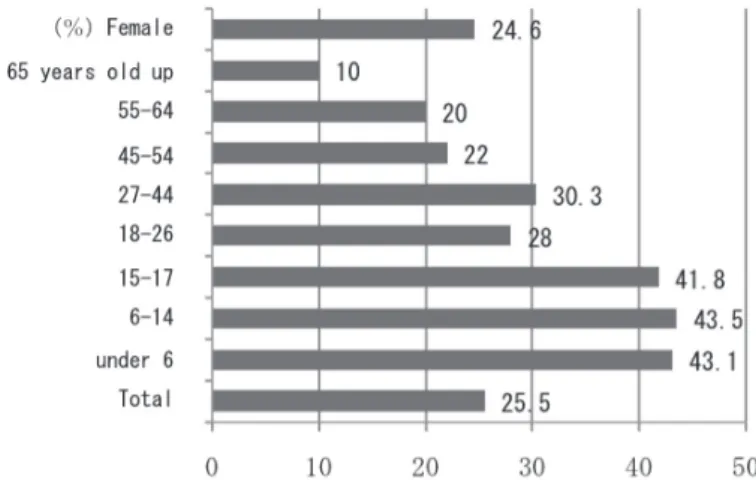
The migrant rate in each age group in Berlin at the end of 2009 is shown in Fig. 8. Here again, migrants' population percentage is high in the younger age group: among minors, the rate of migrants reaches almost half. It is clear from this that the average age of migrants is younger than that of Germans, similar to the nationwide tendency. These statistics also show vividly that migrants who first came to Berlin later brought in their family members, and that the young age group is giving birth to children in Berlin, and building bigger families.
③ Regional difference
1961 – 1989, while Germany was divided into east and west, Berlin had been in a special situation, as it existed as West Berlin surrounded by East Germany. Fig. 9 shows the relation between the placement of divide-and-rule countries in 1947 and the wall which divided Berlin into east and west in 1961. East Berlin was ruled by the then Soviet Union, while West Berlin was further divided and ruled by the Allies, U.K., U.S.A and France. The districts in old East Berlin such as Lichtenberg,
Marzahn-Hellersdorf, Treptow-Köpenick, Pankow have comparatively small percentages of migrants and foreigners, and areas like Mitte and Neukölln influenced by the Allies have larger ones.
One factor explaining the low migrant rate in the old east area could be the restricted acceptance of migrants in former East Germany. Also, after reunification, most contract workers (as foreign workers in former East Germany were termed) were returned to their nation of origin.
The especially large rate of migrants in central Berlin can be explained by the following economic structures. First, a downtown area tends to be easier to live in than a middle-classed residential town
32Der Beauftragte für Integration und Migration (2010.6.30). Zuwanderer in Berlin nach Staatsangehörigkeit. www.berlin.de/lb/
intmig/statistik/demografie/einwohner_staatsangehoerigkeit.html
Fig. 8 Migrant-Rates of each age group in Berlin
Arranged from the information in Amt für Statistik Berlin-Brandenburg (2011) Melderechtlich registrierte Einwohner mit Migrationshintergrund am Ort der Hauptwohnung in Berlin nach Lebensweltlich orientierten Räumen (Bezirksregionen) und Altersgruppen in Prozent. Stand: 31. Dezember 2009.
for those in an unstable economic situation immediately after transference. Next, in these areas, it is actually easy to move into rather cheap housing, and people from the same province increase in number automatically by following other family members or acquaintances.
④ Unemployment rate and insufficiant education
The unemployment rate also serves as an important index that informs the situation of social participation as part of the promotion of integration. Table 1 shows the transition in the unemployment rate of Berlin. Although the unemployment rate increased once, and then began to decrease gradually in 2005, the unemployment rate of migrants at 30% is twice the total average, and the situation for the migrants is still severe. According to the German Economic Research Institute, every second Turkish person of
working age does not have a job33. The cause of this situation is said to be insufficienct vocational training:
three out of four Turkish migrants in Berlin have not graduated from school. Moreover, among about 6000 vocational training organizations, only 3% of these are attended by migrants.
(2) Brief History of Integration Policy in Berlin 1971 - 2006
After reunification Berlin was again in the limelight as the capital. It had to absorb the harsh economic conditions of the former East Berlin. In addition to maintenance of the entire region, cultural assets completely neglected after the war needed to be repaired, and Berlin faced major reconstruction of society, economy, and space. Although the 20th anniversary of reunification of Germany was celebrated last year, dramatic reconstruction was accompanied by problems such as decline in employment, increase in unemployment, expansion of social differences, and increased poverty.
In this situation, most migrants belong to socially vulnerable groups. A high unemployment rate and
33Keilani, Fatina (2010.8.27). Probleme auf Dauer. Der Tagesspiegel, www.tagesspiegel.de/ berlin/probleme-auf-dauer/1311266.
html
Table 1 Unemployment-rate change in Berlin:Population category comparison (%)
Year Total Female Under 25 Nationality MigrantsGerman Non-German Nationality (N-G Femals)
2000 17.6 16 34.1 38.0 2001 17.9 16.3 35.7 38.3 2005 21.5 19.1 44.1 44.1 43.6 2006 20.1 16.4 16.8 17.7 39.8 41.9 44.3 2007 17.9 14.2 14.5 15.8 33.6 37.4 2008 16.1 13.2 13.7 14.3 31.4 25.9
① Der Beauftragte für Integration und Migration (2009). Umsetzungsbericht zum Berliner
Integrationskonzept 2007. Anhang “Berliner Integrationsmonitor 2009” Separate volume data, p. 3.
② “Arbeitslosenquoten und -zahlen deutscher und nicht-deutscher Staatsangehöriger,” www.berlin.de/lb/ intmig/statistik/wab/ arbeitslosenzahlen. html.
low school education makes for a negative view of the future, and promotes indifference to society and
economy, and the tendency to stay within the ethnic and religion group34. There seems to be a gap between
the reality and the image of better living following integration desired by people from old East Berlin. Both migrants and non-migrants each have a background which makes integration difficult. In spite of the chronic economic crisis, the Berlin Parliament has made various plans and efforts to respond to this situation.
According to Gesemann, the migrant integration policy of Berlin has so far passed through three stages. The 1st period was 1971 - 1981, the 2nd was 1981 - 2003, and the 3rd from 2003. In the 1st period, the norm was to manage the foreign worker who moves in for economic motives, through trans-jurisdictional cooperation. In the 2nd period, there was a strong push for migrant participation, and the direction of policy changed to development and enforcement of integration. In the process, the Berlin state parliament made the foreigner policy the representative policy, and decided to adopt a dual policy of developing a more restrictive migrant policy and a more liberal integration policy simultaneously.
The integration policy again become one of the central subjects in parliament from the necessity of promoting the idea of integration and understanding beyond the 3rd term, 2003 and afterwards. The trigger was that the consultative body on migration and integration was founded by Günter Piening who became the chair of the integration office in that year.
This organization deals with discrimination for reasons of ethnicity, religion or sense of values. The mission is to promote practice of programs counteracting extreme right-wing principles, xenophobia and anti-Islamic principles, as well as reorganization of the index for promoting integrated policy activity, and strengthening dialog with Muslims. The organization is further burdened with promotion of the project by the federation and EU, including migrants' education, job opportunity improvement, improvement of refugees' treatment and development of an integration index, and “strengthening of the social dialog on
migrant city Berlin”.35
(3) A New Strategy:“Promote Diversity, Strengthen Cohesion!”
The core plan of the integration policy was introduced in Berlin during 2007 - 2011. The plan,“Promote Diversity, Strengthen Cohesion!”, consists of eight elements. In order to realize these and build institutional checks, such concepts as “method abbreviation of enforcement”, an “enforcement domain”, a
“guidance project”, a “bigger goal”, a “smaller goal”, and a “check evaluation index” have been set out36.
① Cultural Diversity
The concern of Berlin is now to visualize the cultural diversity of “migrant city Berlin” and to create a welcoming environment for migrants. To that end, since it is important for culture facilities to be
34Gesemann, Frank (2009). Berlin – Einwanderungsstadt ‚under construction’? Von der Beauftragtenpolitik zur strategischen
Steuerung. In: Frank Gesemann und Roland Roth (Hrsg.), Lokale Integrationspolitik in der Einwanderungsgesellschaft:
Migration und Integration als Herausforderung von Kommunen. VS Verlag, Wiesbaden, pp. 311-334.
35Der Beauftragte des Senats von Berlin für Integration und Migration (n.d.). Aufgaben des Beauftragten für Integration und Migration, www.berlin.de/lb/intmig/aufgaben/ (2010.8.1).
36Abgeordnetenhaus von Berlin (2007). Vielfalt fördern - Zusammenhalt stärken: Das Berliner Integrationskonzept. Das am 3.7.2007
multicultural on various levels, Berlin promotes adoption of multilingual media in markets, public works and other areas so that more users including migrants can fully participate.
Concrete projects include “Exchange between cultures by artists and art”, “inter-culture dialog year 2008”, “foreigners public office as a service base for new transferees” and “proposal for specific object groups, such as company and university.” Among these are included “Business Immigration Service: BIS” for a business proprietors and foreigners with advanced skills that established by the IHK-Berlin and the foreigner office in 2007, and service by business trial and coordination center started in 2003.
② Career prospects for all citizens: routes to vocational education, employment and income.
Several efforts have been made to imporove the still insufficient vocational education for the younger migrant group of Berlin. One is to develop modules for occupational recommendation, and the other is the recommendation of vocational training for people without qualifications. Less than 3% of foreign employers have a system of qualification / training in comparison with 6% of German companies. Development of a qualification system is also for the sake of employers who cannot create a training program themselves.
The migrants who have low education also have anxiety that they cannot complete or even follow the usual qualification education and training. A program has been set up aiming at preparation for qualification education for such people, teaching fundamental German and fundamental occupational capabilities. At the end of the 1st-step program, an evaluation check is conducted in cooperation with job centres.
③ Discovery and promotion of all children's capability: Reexamination of the contents of kindergarten, nursery school and school education
In order to erase the gap in levels of linguistic competence before entering school and in levels in school education, and to realize equal participation in adult qualification education and training, it is necessary to raise attendance rates to nursery school or kindergarten. Raising the rates of college admission and graduation also result in improvement in the employment rate. The effectiveness of organizations concerned with migrants also having responsibility over education has become clear. Schools, communities, and parents also need to communicate and cooperate more often. For such a background, various indexes and programs from researching needs to leisure-time activities were prepared.
④ Being on the side of all citizens: User centralization in management of a public office and in offering services
The focus here is migrants' equality in both access to and quality of service from administration offices, services and infrastructure. Spatial and mental ease of access to such institutions and organizations will greatly enhance access to opportunities and a better life. Many tandem projects of local centers and migrant initiatives have been inaugurated.
⑤ Adjustment and responsibility: Promotion of cooperation
communication in many languages has proved difficult.
In the new policy, it is planned to increase training, to advance personnel training, and to advance the maintenance and availability of information from policy to statistical data. It has been recognized that multi-lingual and multicultural guidance services are important in medical treatment centers and health centers. Although it is important to improve German ability, such measures will be necessary for the elderly who are less able to adapt to new language and conditions than the younger generation.
In addition, there are two guidance projects: to banish the cultural barriers to local public office, to raise multicultural considerations by preparing the circumstances for learning about original culture in cooperation with schools and youth organizations, utilizing social education specialists with migrant background.
⑥ Activation and participation: Fighting discrimination and strengthening civil society by collaboration.
Here, the target is to increase the number of migrants who acquire German nationality, to increase the opportunity of political participation, to prevent and intervene in discrimination and violence related to racism, anti-Islam and sex discrimination, and to strengthen programs involving youth and boys.
There are guidance projects for the participating in integrated consultation committee and council for hearing advice, local election rights introduction initiatives, and the nationality naturalization promotion Berlin initiative.
The advisory committee has proposed the introduction of “ethics” as a lesson in schools (February, 2006), together with strengthening the support to youth and families with small children (May, 2006), and plans based on these proposals are beginning to be introduced.
Projects on respect for democratic culture in Berlin include promotion of equality and discrimination, damage consultation and criminal investigation of extreme right-wing, racism and anti-Semitic expression, construction of an anti-discriminatory network, and prevention of discrimination in collaboration between various institutions. There is also the promotion of intervention / prevention organization with emphasis on intrafamily violence like the Berlin intrafamily violence intervention center (BIG) mentioned later.
In addition, senses of values and religion peculiar to culture, such as the family's role and norms in education, in the situation of migration, work as a remote causes of discrimination and difficulty. As a result, many youths experience a contradictory situation in which they become much more dependent
Fig. 10 Campaign poster: Der deutsche Pass hat viele Gesichter (The German Passport has many faces).
on their ethnic group. This situation gives rise to an anti-social atmosphere and is connected with larger violence. As part of an anti-terrorism measures, approach to the youth also plays a very important role. For example, a program named Islamic Forum has been founded, to discuss the dignity of Islam and Muslims with Muslim groups, and to focus on fundamental values and norms, equal opportunity, self-determination, and democracy. About 25 representatives are sent into the forum from the Federal Republic, Islamic groups, other religions and migrant organizations. Various themes such as religious leaders’ training, the role of the mosque in Berlin, security, cooperation, and participation have been discussed.
⑦ Confronting exclusion: Refugees / political refugees’ prospects for the future
Although the state government knows the number of people who are officially asking for asylum, the number of those who cross the border illegally or reside in Berlin illegally is unknown. However, it is clear that their living situation is difficult. From 2003, the Berlin state government has carried out legal revision in order to offer housing and benefits to this group.
In Berlin there are respect of healthy, private support networks by ethnic networks, private organizations, and doctors, etc. who also provide people without status of residence with fundamental medical treatment in cases of serious injury or other medical emergency. Since medical expenses can not be paid without insurance, a fund is to be set up though the proposal of a refugee assistance organization, although it was very difficult to gather enough money. When a social worker intervenes, even in case of migrants, the treatment is the same for undocumented and homeless people, and the procedure of insurance calculation may also be possible.
⑧ Sharing of the target and clarification of responsibility: Strengthening collaboration between state government and community area.
Through cooperation with division administration Berlin state government expects to get consultations or support enforcement so that the actual conditions in the front line can be changed and the desired achievement could be adjusted, and that policies become more realistic. Specifically, the state imposed a rule that common decisions of the action plan on important items, common establishment of a consultative body, and common installation of an integration representative agency be reported during 2007 or the 2008 fiscal year.
(4) Evaluation
To control whether these plans and goals are fully achievable, and to clarify obstacles, the State of Berlin set up the original major ten items, as seen below, following national monitoring of 14 major items. Each major item consists of 1 to ten sub items.
① Labor, qualification, employment, and economy (the number of social insurance candidates,
unemployment rate, unemployment rate of aged 25 and below, the number of qualification education of 18-24 years old, etc.)
② Education (at least three-years attendance to nursery school: KInderTAgesstätte, German capability
test in the 7th grade, the number of graduation companies of universities and special universities, etc.)
④ Intercultural openness (migrant rate in employment; migrant rate in a public service)
⑤ Participation and strengthening of civil society (right to participate in local election, number
of lawmakers, and a consultative body, a criminal assailant / the number of victims, international marriage, etc.)
⑥ Refugee policy
⑦ Culture (cultural facilities, facility users, the number of program servers, etc.) ⑧ Legal integration
⑨ Health (participation in early childhood education)
⑩ Social situation (the numbers of recipients, such as service of the Social Law II3 and XII of Chapter
4, i.e., unemployment benefit, welfare benefit money, and pension)
3. Measures towards Multicultural Symbiosis
(1) Children and Families
In recent discussions regarding integration, people recognize the correlation among following factors: discrimination on the grounds of race and religion and values, high unemployment and poor education, language and culture barriers. Therefore, early childhood education is considered essential to interrupt this chain, and family support is an important focus in integration policies.
① Parents Support and Urban Mother Support
There are “parents supporter” and “urban mothers”, which act as cosponsorship enterprises between the government administration and community areas mainly for children and families in the guidance projects. The whole country is trying the “parents supporter” besides Berlin. The main contents of this program are raising and dispatching people who understand different cultures and customs and have good communication skills. Each area defines its own quality management methods, such as a rule to pay, project control and supervision for each supporter.
The purpose of the “urban mothers” project is the same as that of the case of a “parents supporter”: to support the growth and the education of children in families suffering from social disadvantage, through the staff training, the home visit, and station activities (for example, family cafes) and so reinforce support nets among families in the communities and build contacts among neighbourhood. In the Kreuzberg division with very many Turkey migrant families, this program is being carried out in cooperation with a Protestant welfare cooporation Diacony Berlin Stadt Mitte e.V.
There are some reports that of those who are trained and started activity in this way, some women have progressed to a social assistant's qualification program. It has also been observed that social participation not only of the families receiving support but also of people who try to become supporter has been further promoted.
② “Families in Berlin”
functions as a convenient contact address list in each place of residence.
③ “Berlin alliance for family”
The “Berlin family alliance” is a state-wide organization established in November, 2005. The combining of existing services and more effective setting out of new plans should have good influence not only for families but also for companies and organization, and for Berlin itself. Based on this idea, the goal is to obtain practical improvements for families through the cooperation of the business community, social organizations, state government and family solidarity organizations.
④ “Early Excellence” Berlin Model
The term “Early Excellence” means to provide a wonderful early childhood educational environment. The program has three principles: that ‘every child is wonderful’, ‘parents are the first educators’, ‘preschool / kindergarten is a center for the whole family’. The third principle especially focuses on such centers as service and communication centers for all families in cooperation with other institutions, by making the educational facilities for children into an important focal point of an area.
From the time of foundation in 1874, Pestalozzi-Fröbel-Haus has placed holistic education, consideration of every child’s characteristics and family background, and learning through play, at the center of its education philosophy. In accordance with this view and similar to the concept of “early excellence” developed in Great Britain in the 1980s, the first “early excellence center” in Germany was founded in 2001 in Berlin. In order to improve the environment fast, it began with nursery school and kindergarten. Now, family centers, elementary schools and junior high schools, school social work offices, youth institutions, run side by side, and connect the ideas with each field of practice. A PFH social education/vocational school program is also a subsidiary enterprise.
⑤ “Association of New Education: ANE (Arbeitskreis Neue Erziehung e.V.)”
ANE was established in Berlin in 1946, immediately after the war, to erase the educational ideas of national socialist despotism as soon as possible, and to realize a society in which small children, youth, and parents cooperate with each other. The contribution of such activities in developing German democracy is not inconsiderable. Activities with the focus on a child's right to protection are to be developed in order to secure safe space and the feeling belonging in the family and the school.
[Participating promotion] One of the activities on which ANE puts emphasis is support to people for whom social participation is difficult. Children, youths, and all families are included in this empahsis, as well as people for whom social participation is difficult, and those belonging to a minority group.
[Viewpoint of multiple cultures] The viewpoint of multiple cultures is indispensable to democratic education. In ANE, emphasis has been put on promoting multicultural skill, and this continues unchanged. One of the most important issues is for children and families to find ways to live together while respecting and learning from each other.
[Parents Forum: BEN (Berliner Eltern Netz)] In many cases, concerns of parents had been expressed from a special initiative group. Not being opened to various parents has been seen by some as a problem. Therefore they now run forums enabling active participation by clarifying various parents' individual as well as common concerns.
developed and published with a view to the accessibility of parents all over Europe. One such example, “Parents Correspondence”, is one such publication, while publications concerning children of 5 to 6 years old and 6 to 8 years old are quarterly issues. Publications for up to 3 years old and 4 to 5 years old can be received every two months and up to 1 year old, every month. Child-rearing information according to particular stages are sent 48 times over eight years for a total of 70.5 euros. In 200 cities and areas besides Berlin it can be applied for in youth offices and is available by post for free.
[“Parents Correspondence: Turkish-German version”] For Turkish families with 0 to 14-year-old children the publication is distributed in two languages. It describes how a Turkish family newly come to Germany engages in child-rearing in two cultures, and how children grow, in 16 stories. Daily life and the wisdom of children-raising are comprehensively set out.
Beside these, “Adolescence Correspondence ”, “Parents Correspondence: the special version”, “School Parents” are published in 4-10 languages. They are aimed to meet various needs by various themes, such as the problem of parental authority in connection with divorce and separation, compulsive marriage, intrafamily violence, language acquisition, and a big city encounter on the way to school, changes in adolescent mind and body and the influence of environmental, sex, violence and drugs.
(2) Projects for Youth
A very important role in the anti-terrorism measures mentioned above has been to develop early approaches to young boys. Such measures at the state level started as prevention, concentrating on racism and anti-Semitism and especially extreme right-wing ideas and also as an intervention measure to young men. According to Carola Bluhm, the Minister for Integration, Labor, and Social Problems of the State of Berlin, “democracy, diversity, and respect” are the keywords, and 35 projects have been planned for
2011, investing 2,325 million euros37. In addition, in order to introduce the Area School Project over 2008
– 2011, 22 million euros have been invested to create a more open system in which all children study together until tenth grade and so break down the rigid divisions Basic Schools, Vocational Schools and Gymnasia.
① “Anne Frank Zentrum”
To commemorate the 50th anniversary of the liberation from Nazism, in 1994 a touring exhibition, “1929-1945 World of Anne Frank”, was held also in Berlin. The Anne Frank center was established in
central Berlin in 199838, with the cooperation of the Anne Frank House of Amsterdam. The role of the
center is to keep alive the memory of persecution of Jews and in the hope of influencing youth of the same age as Anne Frank. From 2006, the regular exhibition “Anne Frank: now and here” is running, and many training programs are offered in educator-oriented multicultural capability and on the theme of anti-Semitism. According to the center, in 2010, 9000 persons participated in these educational programs, and a total of 16000 people visited the exhibition or heard the lecture.
37Rassismus, Antisemitismus, Rechtsextremismus - Was tut Berlin?. Pressemitteilung des Senats von Berlin, den 07.02.2011. www.
berlin.de/sen/ias/presse/archiv/20110207.1235. 330084.html
② Internet website “Younth Culture, Islam, and Democracy”
The State center for political education has
established an Internet website39 to bridge
democracy and Islamic youth, and publishes newsletters with messages from intellectuals or information exchange. Fig. 11 shows a photograph and comment published on the site. The combination of marine sports and the Islamic convention of a woman covering her hair and skin might indicate the groping for an attitude which accepts the diversity of modern society, and symbiosis.
While there are many attempts to promote such cultural understanding and multicultural symbiosis, the limits of acceptance can also be observed, as well as evasion mechanisms when positive efforts end in failure. A lecture course in Islamic-German symbiosis, established with the support of the German government at Osnabrück University, is currently attracting attention as the such first trial in Europe. Islamic leaders highly trusted by migrants are asked to focus on German culture,
and work to promote understanding of German culture within the Islamic community. This is a still new trial and only some Islamic religious groups participate. However, there are also people who feel that the ways of making compromises in the sense of values should be determined carefully by the inidviduals or communities concerned, and there has been something of a backlash because the proposal came from the
side of German culture40.
③ The migrants employment project in public service: Campaign “Berlin is asking for you41”.
One of the measures in connection with the integration policy 6 is “Berlin braucht Dich.” This initiative was carried out in cooperation by the Berlin state legislature migrant office, Labor and Social Affairs Bureau, Education and Science Bureau, the internal-affairs office, and the sports office, and coordinated by BQM, the Vocational qualification-network for Migrants in Berlin. It is expected that people who work in the public arena should function as role models.
All jobs in this system were short-term on-the-job training, requiring a fixed qualification and it was not possible to find a full-paying job immediately. Various occupational descriptions are introduced in the pamphlet which also explains clearly how to acquire qualification, to find funding and how to apply. The
39Bundeszentrale für politische Bildung, www.bpb.de/themen/1ZVOOY,0, 0,Jugendkultur_Islam_ und_Demokratie.html
40NHKBS1 “World Today” special edition: It is argument boil in? Germany where immigration ruins a country. February 17, 2011
on air ( 今日の世界 2011 年 2 月 17 日放映 特集:移民が国を滅ぼす?ドイツで議論沸騰 ).
41"Berlin braucht Dich! ". www.berlin-braucht-dich.de/
Islamic marine sports fashion:
Self-question answering oneself is often carried out how religious but modern teenager should act to suit
with Islam. Foto: AP
Fig. 11 A trial with a neutral educational expression showed in “Younth Culture, Islam, and democracy”
same thing can be seen on their website, where there is also an introduction of the proposed qualification courses.
As of February 10, 2011, the Federal Environment, Nature Conservation, and Nuclear-reactor Ministry
was calling for “federal office related professionals (3 years qualification) in Bonn and Berlin42, the Federal
Diet for “Plan development section person” and “computing professionals for system integration43”, and
the Federal Organization for Physical Technic in Berlin/Braunschweig for “Systems engineer44”.
As other examples, the occupational descriptions currently introduced in the pamphlet vary from construction apparatus engineer or surveyor to air-conditioning engineer, government official middle-class job, prison personnel, teacher, restaurant staff,
care worker, medical assistant, and IT related work. It comprehensively describes what kind of young person’s feature can be efficiently employed in relation to the features of the job.
So what has been the result of this kind of measure? Data published by the State of Berlin (Fig. 12) indicates that the rate of migrant unemployment remains at a low level compared with the percentage of the migrants to the whole population or youth, although it has increased slightly from 9% to 10% from 2005 through 2007.
(3) Projects for Women
Women meet many social difficulties in the course of pregnancy, delivery, and child-rearing, and these often come together in such a complex way that it is difficult to find a solution. Despite successful escape from intrafamily violence, there may still be a sense of despair with no place to live and no job to ensure survival. In order to focus on the state of support to such women, and to explore directions, the meeting “women facing a crisis: support-networking for women damaged by violence and become homeless” was held on September 22, 2010, sponsored by three organizations; the social worker training ASH (Alice Salomon Hochschule), AWOK which supports people who have housing problems, and BIG e.V., the Berlin initiative which opposes violence to women.
Some difficulties peculiar to foreign women were noted. Women with a migration background in
many cases45 do not have regular status of residence so they are not eligible for protection, based on SGB
42Training placement collection notice document of federal environment, nature conservation, and nuclear reactor ministry. http://
berlin-braucht-dich.de. server626-han.de-nserver.de/fileadmin/downloads/VfA-FaB-ab2011.pdf
43Training placement collection notice document of the Federal Diet. http://berlin-braucht-dich.de.server626-han.de-nserver. de/
fileadmin/downloads/2011-Stellenanzeige-VK-FISI.pdf
44Training placement collection notice document of the Federal Organization for Physical Technic in Berlin/Braunschweig, http://
berlin- braucht-dich.de.server626-han.de-nserver.de/fileadmin/downloads/2011-systeminformatiker-in.pdf
45Schelenz, Katharina und Hartmann, Petra (2010). Workshop handout, “Hilfen für wohnungslose Frauen in Berlin”, in: Gerull, S.
Fig. 12 Percentage of persons who found a job at public service.
XII (German Social-law Book 12th)46. Since such women fear discovery under the foreigner law, it is
potentially difficult for them to have access to a female protection institution (Frauenhaus)47. Huge barriers
of language and cultural understanding in supporting women with problems such as a psychiatric disorder
or addictions48 was also noted.
① “Encounter and information-exchange group for Turkish women TIO”49
Activities for specific ethnic groups are also being carried out. TIO in Kreuzberg is an authorized public organization for vocational training and job placement, established in 1978 and managed by 16 women from seven nations. It supports the campaign “Berlin braucht Dich!”, is a council member of “Public Service Employment Training for Migrants”, and also ties up with the Berlin parliamentary secretariat, and with the public offices of those divisions with large migrant populations such as Neukölln and Friedrichshain/Kreuzberg. TIO also cooperates with the protection institution PAPATYA for Turkish women, in order to bring the chance of employment to migrant women who have escaped from violence to a protection institution.
TIO has offered training for five years since its inauguration in 2004. According to the original data of TIO, of the 139 persons who participated, 64 took up the public training placement or gained employment,
and 37 persons achieved entrance to qualification schools50.
② Anonymous temporal shelter “PAPATYA”
One of women protection institutes, the anonymous temporary shelter, PAPATYA51 (meaning
Camomille) was established in 1986, superintended by Turkey-German Women's Coalition. This is a shelter for women from 13 to 21 years old, and besides victims of sexual assault, it accepts girls who escape from family threat, such as “compulsive marriage”, “not getting a visit to school”, and “going out being forbidden.” Stays are for two months in principle, but extensions may also be accepted.
③ “The Berlin initiative to fight violence against women”
BIG e.V. is an organization established in 1993 with the intention of gathering neighbourhood and social support in order to stop the damage of intrafamily violence. They are developing activities on the basis of strong cooperation with the state government secretariat and the police, and are working to
(Hrg.) Dokumentation - Frauen in Not: Vernetzung der Hilfen für wohnungslose gewaltbetroffene Frauen, p. 12.
46In SGB XII chapter 2 Section 8, the domain of social security is appointed at living expenses, advanced age, health, an obstacle,
care, special social difficulty, and others. In Section19, the fundamental view about the security candidate of each domain is defined, for example: “(1) Those to whom the living-expenses security specified in Chapter 3 can obtain necessary minimum living expenses from neither ability nor its tool, especially fixed income nor property are applicable. The income and property of the husband and wife or the life partner (de facto husband and wife: author) whose lives are united, and are the target of calculation. Minors and unmarried children belong to the household economy of the parents or parents, and it is to be taken into consideration that necessary minimum living expenses should be paid from the household economy of parents.”
47Gerull, Susanne und Oesterreich, Charlet (2010). “Frauen in Not – Wohnungslose Frauen in Gewaltbeziehungen” in: Reader zur Fachtagung: FRAUEN IN NOT. Vernetzung der Hilfen für wohnungslose gewaltbetroffene Frauen (2010), pp. 9-13.
48Leisle, Irma und Schelenz, Katharina (2010). “Süchtige Frauen” Workshop handout in: Gerull, S. (Hrg.) Dokumentation - Frauen in Not: Vernetzung der Hilfen für wohnungslose gewaltbetroffene Frauen, pp. 34-38.