and Public Health
Article
Quality of Life and Intention to Return among Former Residents of Tomioka Town, Fukushima Prefecture 9 Years after the Fukushima Daiichi Nuclear Accident
Makiko Orita
1,* , Yasuyuki Taira
1, Hitomi Matsunaga
1, Masaharu Maeda
2and Noboru Takamura
11
Department of Global Health, Medicine and Welfare, Atomic Bomb Disease Institute, Nagasaki University, Nagasaki 8528523, Japan; [email protected] (Y.T.); [email protected] (H.M.);
[email protected] (N.T.)
2
Department of Disaster Psychiatry, School of Medicine, Fukushima Medical University, Fukushima 960-1247, Japan; [email protected]
* Correspondence: [email protected]
Received: 14 July 2020; Accepted: 10 September 2020; Published: 11 September 2020
Abstract: We evaluated the association between health-related quality of life (HR-QOL) and intent to return home among former residents of Tomioka Town, Fukushima Prefecture 9 years after the Fukushima Daiichi nuclear accident to support the recovery of the community after the accident.
We conducted a questionnaire survey asking residents about their intention to return to their original home, risk perception for radiation exposure, HR-QOL using the HR-QOL Short Form 8 (SF-8), and sense of coherence using the Sense of Coherence Scale (SOC-13). Among the 1029 residents, a total of 138 (13%) had already returned to Tomioka (group 1), 223 (22%) were undecided (group 2), and 668 (65%) had decided not to return (group 3). Group 2 had poorer HR-QOL than groups 1 and 3, especially physical function, body pain, general health, social functioning, and mental health.
The ratio of residents with a better sense of coherence was significantly higher in group 1 than in groups 2 and 3. Our present study indicated poorer HR-QOL among residents who were undecided about returning home. It is necessary to provide a model for a multidisciplinary approach for the public during the recovery phase of a nuclear accident.
Keywords: Fukushima Daiichi nuclear accident; intention to return; quality of life; recovery efforts from the nuclear accident
1. Introduction
Nine years have passed since the Great East Japan Earthquake and the subsequent Fukushima Daiichi Nuclear Power Plant (FNPP) accident on 11 March 2011. It was the largest civilian nuclear accident since the Chernobyl Nuclear Power Plant (CNPP) accident in 1986 [1]. Radionuclides from the damaged plant were released into the environment, and the evacuation order was immediately issued by the Japanese central government to decrease radiation exposure of local residents. The evacuation radius was expanded to within 20 km of the plant the following afternoon [2]. Consequently, 160,000 residents were evacuated. As of 2015, about 67,000 evacuees had moved elsewhere within Fukushima Prefecture and lived in temporary homes, municipally subsidized rentals, and new homes, and about 46,000 evacuees had moved to other prefectures in Japan [3–5].
Tomioka Town (37
◦20
043.6” N, 141
◦0
031” E), which is located within 15 km of the FNPP, was severely damaged by the earthquake and tsunami and was contaminated by radionuclides such as iodine-131, cesium-134, and cesium-137 [4,5]. Immediately after the accident, almost all residents of Tomioka Town were forced to evacuate, mainly to Iwaki City and Koriyama City, 40–60 km away
Int. J. Environ. Res. Public Health2020,17, 6625; doi:10.3390/ijerph17186625 www.mdpi.com/journal/ijerph
from the town [4,5]. After the termination of the accident, the Tomioka Town municipal government led infrastructure recovery efforts and decontamination processes, and on 1 April 2017, the Japanese government lifted the evacuation order for Tomioka, except for the difficult-to-return zone that comprised almost 15% of the total area of the town [3–5]. Although decontamination efforts have decreased radiation levels [5], only about 1400 (11%) of former residents had returned to their homes in Tomioka as of 1 May 2020, 3 years after the evacuation order was lifted. Many residents are reluctant to return to Tomioka. The possible causes of their reluctance almost certainly include concerns over the town’s educational and healthcare infrastructure, as well as convenience in their daily lives. In addition, they might also have been discouraged by risks associated with the decommissioning work being carried out at the FNPP and concerns over the health effects caused by exposure to radiation [6].
Consequently, evacuees have various thoughts about their future. Some of them are set on returning to their homes, while others are eager to re-build their lives in the areas where they are currently living, and others have not yet made a decision [5,7]. It is important to respect the decisions made by individual evacuees regardless of whether they return to their homes or not [8]. It is important for experts to plan and implement measures to support residents that consider the various difficulties that residents have been facing, so that they can be satisfied with their health-related quality of life (HR-QOL) and well-being regardless of whether they return to their homes or not. For healthcare, measuring aspects of HR-QOL such as general health, vitality, and social functioning allows us to think about individual residents as integrated, emotional, and active beings, rather than just organisms. HR-QOL refers to the value of the integrity of life that emphasizes a person’s biographical characteristics and characteristics and is increasingly considered as well-being [9]. After the FNPP accident, Kashiwazaki et al. investigated the relationship between mindfulness and radiation risk perception and the role of health anxiety in Fukushima and Tokyo, and they suggested that mindfulness courses as a part of community support could contribute to the improvement of general health as well as the reduction of health anxiety [10]. In order to respond to the public’s anxiety and health problems, comprehensive community support projects such as managing radiation protection and general health consultations are important regardless of whether residents return to their homes or not. However, the association between HR-QOL and intention to return home has not been estimated. Therefore, in this study, we evaluated the association between HR-QOL and intent to return home among former residents of Tomioka to better understand the current HR-QOL status between returnees and evacuees.
2. Materials and Methods
2.1. Participants
The study was conducted in Tomioka Town, Fukushima Prefecture in January 2020. The subjects of this study were former residents of Tomioka who had resident cards as of 11 March 2011 and still had them in November 2019, and who were permitted to return to Tomioka Town after the evacuation order was lifted. The residents were not involved in the design, conduct, reporting, or dissemination plans of our research. Minors (aged <20 years old) were not included in this study. We included 1029 former residents of Tomioka (554 men and 475 women) in the analysis. We confirmed that written consent was obtained from the subjects. The study was approved by the ethics committee of Nagasaki University Graduate School of Biomedical Sciences (No. 19092702). Prior to the study, we obtained permission from the municipal government of Tomioka to implement the study.
2.2. Questionnaire
The questionnaire applied in this study was developed based on a questionnaire used in previous
studies conducted in Fukushima Prefecture [4,5,11] and on the mental health and lifestyle survey within
the framework of the Fukushima Health Management Survey, which was organized by Fukushima
Prefecture [12,13]. The questionnaire aimed to determine the intent of residents to return home within 5
years of the evacuation order being rescinded. We defined group 1 as “those who had returned to their
homes”, group 2 as “those who were undecided about returning home”, and group 3 as “those who had decided not to return home”. We collected data on the demographic variables of sex, age, and living with children aged <18 years. The questionnaire included questions about whether the residents were concerned about consuming locally sourced foods in Tomioka. Furthermore, we assessed perception of the potential health risks of radiation by living in Tomioka, such as cancer and genetic effects, on the next generation.
Quality of life status was assessed using the HR-QOL Short Form-8 (SF-8) scale, which is widely used around the world. The SF-8 is an eight-item instrument that measures general aspects of HR-QOL [14]. The original instrument was developed in the English language and subsequently translated into Japanese. Each administration of the SF-8 generates a health profile with eight dimensions: general health, physical function, role physical (role limitations because of physical health), bodily pain, vitality, social functioning, mental health, and role emotional (role limitations because of emotional problems). The SF-8 incorporates two dimensions: the Physical Component Summary and the Mental Component Summary. Physical Component Summary is composed of four subscales assessing physical function, role limitations caused by physical problems, bodily pain, and general health. Mental Component Summary is composed of four subscales assessing vitality, social functioning, mental health, and role limitations caused by emotional problems. Using the SF-8 to assess HR-QOL has become popular in part because of its ease of administration. The mean value of the Japanese general public was 50 ± 10, which was used to dichotomize the HR-QOL scores in this study [14]. A higher SF-8 score indicates better HR-QOL. We also assessed stress coping among the subjects using the SOC-13, which is widely used in epidemiological and psychological investigations [15]. Sense of coherence is a psychosocial factor that can help individuals be better prepared to maintain and improve their health condition by influencing self-perception and quality of life. The SOC-13 consists of 13 items with answers presented on a seven-point Likert scale. The SOC-13 score is the sum of all the items and ranges from 13 to 91. The higher the score, the stronger the SOC and stress coping. In this study, the criterion “>59 based on the Japanese standard value was used to dichotomize the SOC [15,16].
2.3. Statistical Methods
Factors associated with the intention to return home were identified using Mann-Whitney U tests or chi-square tests. Factors that independently differed among groups were identified using logistic regression analysis. Data were statistically analyzed using SPSS (Statistical Package for Social Science) Statistics 25 software (IBM Armonk, NY, USA). A p-value less than 0.05 was considered statistically significant.
3. Results
Of the 1029 residents investigated, a total of 138 (13%) had returned to Tomioka (group 1), 223 (22%) were undecided (group 2), and 668 (65%) had decided not to return (group 3) (Table 1). The ratio of residents living with children was significantly lower in group 1 than in groups 2 and 3. Compared with group 1, groups 2 and 3 had significantly higher concerns about consuming locally produced food (30.4% vs. 56.1% and 58.8%, respectively). The ratio of residents who felt that cancer would develop in Tomioka due to radiation exposure was significantly higher in groups 2 and 3 than in group 1. Likewise, the ratio of residents who felt that genetic effects would arise in the next generation by returning to Tomioka was significantly higher in groups 2 and 3 than in group 1.
As shown in Table 2, group 2 had poorer HR-QOL than groups 1 and 3, especially physical function, body pain, general health, social functioning, and mental health. The ratio of residents who had better sense of coherence was significantly higher in group 1 than in groups 2 and 3.
We compared group 1 and group 2 using logistic regression analysis (Table 3) and found that
the frequency of a better physical component summary score and age were independently higher in
group 1 than in group 2. In addition, the frequency of a better Sense of Coherence Scale (SOC-13) score
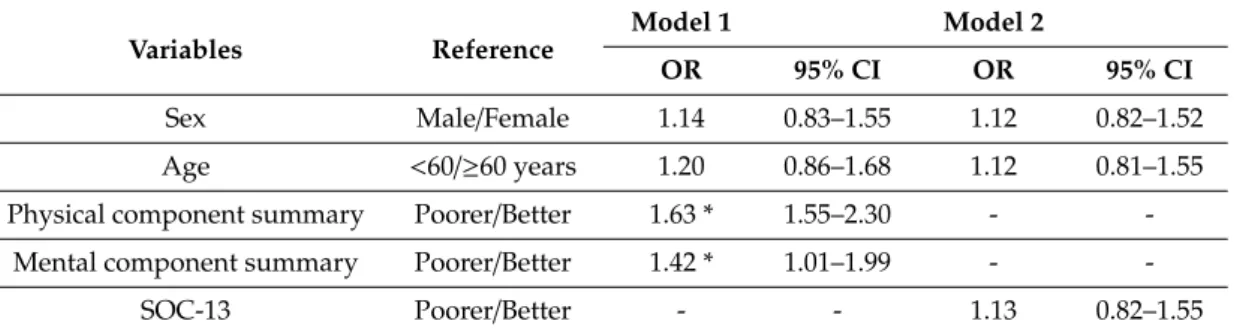
was independently higher in group 1 than in group 2. Similarly, we compared group 1 and group 3 using logistic regression analysis (Table 4) and found that the frequency of poorer HR-QOL status was not significantly different between the groups; however, the frequency of a better SOC-13 score was independently higher in group 1 than in group 3. Finally, we compared group 2 and group 3 using logistic regression analysis (Table 5) and found that the frequency of poor HR-QOL was independently higher in group 2 than in group 3.
Table 1. Demographics of groups 1, 2, and 3, and perception of the effects of radiation exposure on heath.
Variables Reference Group 1 (n=138) Group 2 (n=223) Group 3 (n=668) p-Value
Sex Male/Female 82/56 (59.4%) 122/101 (54.7%) 350/318 (52.4%) 0.308
Age ≥60/<60 years 105/33 (76.1%) 148/75 (66.4%) 460/208 (68.9%) 0.139
Living with children aged<18 years Yes/No 9/129 (6.5%) 39/184 (17.5%) 147/521 (22.0%) <0.001 * Concerns about consuming locally sourced food Yes/No 42/96 (30.4%) 125/98 (56.1%) 393/275 (58.8%) <0.001 * Belief that living in Tomioka will cause cancer Yes/No 35/103 (25.4%) 103/120 (46.2%) 362/306 (54.2%) <0.001 * Belief that genetic effects will appear in next generation Yes/No 57/81 (41.3%) 143/80 (64.1%) 413/255 (61.8%) <0.001 *
Values for groups 1, 2, and 3 are shown asn(%). * Significant difference using the chi-squared test.
Table 2. HR-QOL (SF-8) and sense of coherence (SOC-13) in groups 1, 2 and 3.
Variables Domains Group 1 (n=138) Group 2 (n=223) Group 3 (n=668) p-Value
SF-8
Physical functioning 47.7±6.9 46.4±7.2 47.8±7.2 0.043 *
Role physical 46.6±8.1 45.4±8.5 46.9±8.7 0.085
Bodily pain 46.9±8.6 44.8±8.8 46.4±9.1 0.046 *
General health 49.3±7.2 46.3±7.3 48.5±7.5 <0.001 *
Vitality 49.2±5.9 48.2±6.4 49.1±6.5 0.173
Social functioning 47.0±8.3 45.2±8.0 46.6±8.0 0.049 *
Role emotional 47.5±6.6 45.8±7.7 47.0±7.7 0.069
Mental health 48.3±7.1 45.9±7.0 47.6±7.1 0.003 *
Summary of SF-8 Physical component summary 46.2±7.7 44.8±7.9 46.4±8.1 0.044 *
Mental component summary 47.8±7.0 45.9±6.8 47.1±7.2 0.034 *
SOC-13 - 60.3±12.2 56.4±12.3 58.1±13.4 0.022 *
* Significant difference using the analysis of variance. HR-QOL (SF-8): Health-Related Quality of Life Short Form 8;
SOC-13: Sense of Coherence Scale.
Table 3. Factors related to intention to return home according to logistic regression analysis of groups 1 and 2.
Variables Reference
Model 1 Model 2
OR 95% CI OR 95% CI
Sex Male/Female 1.12 0.72–1.75 1.08 0.69–1.68
Age ≥60/<60years 1.78 * 1.08–2.94 1.55 0.95–2.52
Physical component summary Better/Poorer 1.85 * 1.15–2.98 - -
Mental component summary Better/Poorer 1.42 0.88–2.24 - -
SOC-13 Better/Poorer - - 1.82 * 1.18–2.82
CI: confidence interval; OR odds ratio; SOC-13: Sense of Coherence Scale. Model 1 analyzes the relationship between intention of return and SF-8 adjusted by sex and age. Model 2 analyzes the relationship between intention of return and SOC-13 adjusted by sex and age. *p<0.05 based on logistic regression analyses.
Table 4. Factors related to intention to return home according to logistic regression analysis of groups 1 and 3.
Variables Reference
Model 1 Model 2
OR 95% CI OR 95% CI
Sex Male/Female 1.30 0.90–1.89 1.27 0.88–1.86
Age ≥60/<60 years 1.44 0.93–2.23 1.38 0.90–2.11
Physical component summary Better/Poorer 1.11 0.75–1.64 - -
Mental component summary Better/Poorer 0.97 0.66–1.44 - -
SOC-13 Better/Poorer - - 1.62 * 1.12–2.34
CI: confidence interval; OR: odds ratio; SOC-13: Sense of Coherence Scale. Model 1 analyzes the relationship between intention of return and SF-8 adjusted by sex and age. Model 2 analyzes the relationship between intention of return and SOC-13 adjusted by sex and age. *p<0.05 based logistic regression analyses.
Table 5. Factors related to intention to return home according to logistic regression analysis of groups 2 and 3.
Variables Reference Model 1 Model 2
OR 95% CI OR 95% CI
Sex Male/Female 1.14 0.83–1.55 1.12 0.82–1.52
Age <60/ ≥ 60 years 1.20 0.86–1.68 1.12 0.81–1.55
Physical component summary Poorer/Better 1.63 * 1.55–2.30 - -
Mental component summary Poorer/Better 1.42 * 1.01–1.99 - -
SOC-13 Poorer/Better - - 1.13 0.82–1.55
CI: confidence interval; OR: odds ratio; SOC-13: Sense of Coherence Scale. Model 1 analyzes the relationship between intention of return and SF-8 adjusted by sex and age. Model 2 analyzes the relationship between intention of return and SOC-13 adjusted by sex and age. *p<0.05 based on logistic regression analyses.