Introduction
1 Faculty of Economics and Business, Hokkaido University, Japan.
Mayu IKEMI1
Vol. 1 (01) pp. 035-044, 2017 Sanitation Value Chain
Published by Research Institute for Humanity and Nature
This study discusses the possibility of a better management of sanitation project and the business model based on community participation in rural Burkina Faso. The case study was carried out based on the local residents’ economic and educational situations as well as their experiences of community- based organizational activities. This paper is focusing on the relationship patterns among their income, educational backgrounds, and participants’ experiences of community activities. Survey results show that people who have no primary education but have literacy education earn higher income than those with primary education. With regard to experience of community-based organizational activities, it has no relationship to both educational backgrounds and income levels. However, the incomes of those who have an experience of externally funded project or microfinance are higher than those who do not have the experience. For a success of sanitation project, a mechanism should be put in place to enable local residents appreciate the potential economic effects of the sanitation project through their interaction with external stakeholders. In order to create additional motivation for participants, it would be also effective to incorporate some literacy education services into the sanitation project for the purpose of income improvement. This study suggests a new approach for the success of the sanitation project. The local residents’ participation in externally funded project with enhancement of literacy skills leads to an improvement of both sanitation and income.
Keywords: Popular participation, Community-based organization, Economic and educational situations, Rural development, Burkina Faso
Improvement of water and sanitation in Sub-Saharan Africa has been one of the most critical issues, especially in rural areas. Improving sustainability of water and sanitation supplies has potential for both gains in health and economic development (Montgomery et al. 2009). Many studies and projects have been implemented for a sustainable sanitation system, but large-scale success has not been found yet (Haq and Cambridge 2012).
Previous studies report that current concepts or schemes on sanitation are not sufficient enough to resolve the stagnant situation of the sanitation improvement (Ushijima et al. 2015). It has also been reported that several water and sanitation projects failed not because of funding problem but because of ineffective systems and policies as well as misunderstanding of socio-economic issues in rural Africa (Jonah et al. 2015).
This study has taken into account the capability of a new sanitation business model which can contribute to improving both sanitation and income (Ushijima et al. 2015). The business model concept is for local residents, such as peasants living in rural Africa, not only to manage hygiene but also to generate some value from food or cash crops. It will in turn generate profit by utilizing a water and sanitation system. The value chain cycle should
on Local Economy, Education and Community Participation: A Case Study of Burkina Faso
Abstract
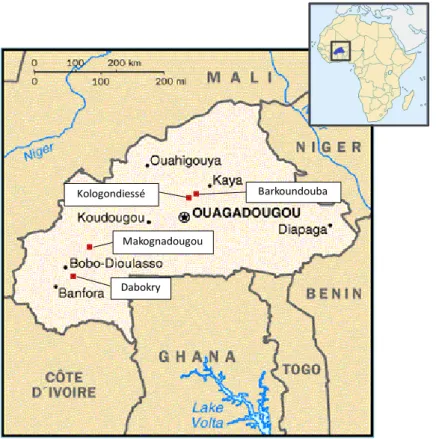
The research areas are four villages in rural Burkina Faso as postrayed in Figure 1. Two of them, called Kologondiessé village and Barkoundouba village, are located in Central Plateau region about 45 km north-east far from the capital of Ouagadougou. The other two villages are called Makognadougou village and Dabokry village. Makognadougou village is located in Hauts-Bassins region which is the seat of the second largest city, Bobo-Dioulasso about 350 km south-west far from Ouagadougou. Dabokry village is located in Cascades region which capital is Banfora about 435 km south-east from Ouagadougou.
1. Research Area
Figure 1. Research area.
be autonomously operated through participation of local residents in their respective communities.
From the above point of view, this paper examines the possibility of a successful sanitation project including the business model by community participation. A case study in rural Burkina Faso is applied to analyze in this study. Various studies on rural Burkina Faso have described that peasants’ income, which mostly depends on agriculture, is instable and vulnerable (Kawada 1973; Shimada 2001). Some of them emphasize the importance of investment in education and development of agricultural technology (Sakurai and Inoue 2014). There are also studies that have verified the formation process of residents’ self-organizational capabilities through their group activities of microfinance (Ikemi 2011; Kumashiro 2014).
The case study in this paper discusses the results of a field survey in rural Burkina Faso. The purpose of the survey is to examine the local residents’ economic and educational situations as well as their experiences of community-based organizational activities. These local residents' characteristics are regarded as important socio- economic factors to consider more effective and sustainable sanitation system by popular participation. In this paper, the main findings are based on the relationship patterns among their income, educational backgrounds, and experiences of community activities.
Kologondiessé ▣ ▣
▣ Dabokry
▣
Barkoundouba
Makognadougou
2. Survey Results
2.1. Educational context
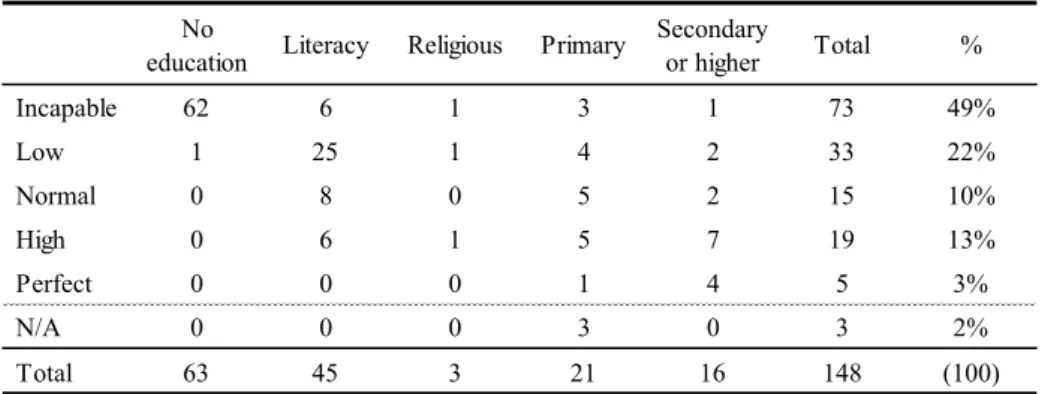
The composition of respondents’ educational backgrounds is shown in Table 2. For reference, according to World Bank data, the gross enrollment ratio of primary education in Burkina Faso is 85%, secondary is 26%, and higher is 5% (World Bank 2013a, 2013b). Compared to these data, the Table 2 illustrates that the respondents’ educational achievements and their literacy ability are generally quite low. For example, regarding the educational background, those who had no primary education (or less of that) account for 75% of the total respondents.
Table 3 shows their literacy ability measured by self-assessments and educational backgrounds. More than 70% of the total respondents answered as “Low” or “Incapable” for their literacy ability. From the table, it can be seen that the literacy ability of those who have formal education (“Primary” or higher) is basically higher than that of those who does not have any education or have non-formal education (“Literacy” or “Religious”).
There is a feature of literacy education that has been found through this survey. The education program is conducted by a literacy center with the support of local government and international organization in each rural area (Takeshita 2000; UNESCO 2012). It is not a public school, but the participants recognize or call themselves
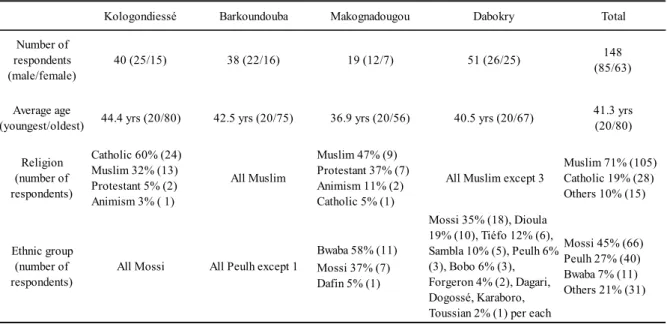
Table 1. Overview of the four research villages.
A field survey was conducted in the four villages in October 2014. The methods are questionnaire and interview surveys targeting adults mainly who are living in rural areas, and aged 20 years or older. The total number of respondents is 148, including 84 males and 64 females. The average age is 41.3 years. Table 1 shows an outline of the research villages on the number of respondents, their average age, religious ratios, and ethnic compositions.
The questionnaire of the survey includes the following three main categories: education (educational backgrounds, literacy ability), economy (income, expenditure, spending purpose, savings, occupation, type of agriculture and crops), and community activities (participation in local residents group or organization, externally funded project including a water and sanitation improvement project, and microfinance). For the purpose of comparative analysis in this paper, only income is analyzed as the category of economy.
Kologondiessé Barkoundouba Makognadougou Dabokry Total
Number of respondents
(male/female) 40 (25/15) 38 (22/16) 19 (12/7) 51 (26/25) 148
(85/63)
Average age
(youngest/oldest) 44.4 yrs (20/80) 42.5 yrs (20/75) 36.9 yrs (20/56) 40.5 yrs (20/67) 41.3 yrs (20/80)
Religion (number of respondents)
Catholic 60% (24) Muslim 32% (13) Protestant 5% (2) Animism 3% ( 1)
All Muslim
Muslim 47% (9) Protestant 37% (7) Animism 11% (2) Catholic 5% (1)
All Muslim except 3 Muslim 71% (105) Catholic 19% (28) Others 10% (15)
Ethnic group (number of
respondents) All Mossi All Peulh except 1 Bwaba 58% (11) Mossi 37% (7) Dafin 5% (1)
Mossi 35% (18), Dioula 19% (10), Tiéfo 12% (6), Sambla 10% (5), Peulh 6%
(3), Bobo 6% (3), Forgeron 4% (2), Dagari, Dogossé, Karaboro, Toussian 2% (1) per each
Mossi 45% (66) Peulh 27% (40) Bwaba 7% (11) Others 21% (31)
Table 3. Literacy ability (self-assessment).
“students” as if they are attending public school. Among the total of 148 respondents, 16 had secondary education or above. 8 out of the 16 respondents who had secondary education or above are as follows: 1 elementary school teacher, 1 junior high school teacher, and 6 working as village advisors. The village advisors are called “animateurs”, who in some cases work as literacy education teachers. Among those 6 village advisors, only one person had primary school education with “high” level of literacy ability.
Some other respondents answered that they were taking literacy education course during agricultural offseasons. Considering these circumstances, when it comes to employment or status in rural area, literacy ability would be more important than primary education. Through interview survey, it is speculated that local residents have shared this belief.
2.2. Economic situation
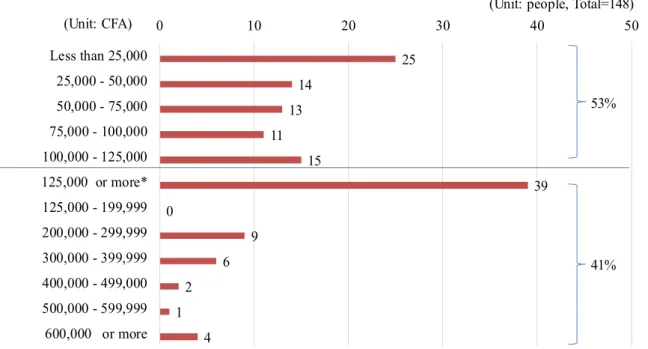
Figure 2 shows the respondents’ approximate annual income. It was not easy to get answers on the question of resident’s annual income, because the respondents are mainly occupied with agriculture and they do not have clear idea about their own incomes. According to World Bank (2013c) report, gross national income (GNI) per capita in Burkina Faso in 2013 is 720 US dollars which is about 355,000 CFA (approximately 500 CFA to the US dollar). About 45% of population in Burkina Faso live with less than 1.25 US dollars per day (UNDP 2014). Considering the facts and advice from local staff of International Institute for Water and Environmental Engineering (2iE), the answers of annual income questions on the questionnaire were decided to be the following 6 categories initially: less than 25,000 CFA, 25,000-50,000 CFA, 50,000-75,000 CFA, 75,000-100,000
Table 2. Educational background.
education LiteracyNo Religious Primary Secondaryor higher Total %
Incapable 62 6 1 3 1 73 49%
Low 1 25 1 4 2 33 22%
Normal 0 8 0 5 2 15 10%
High 0 6 1 5 7 19 13%
Perfect 0 0 0 1 4 5 3%
N/A 0 0 0 3 0 3 2%
Total 63 45 3 21 16 148 (100)
(Unit: people)
Male Female Total %
No education 31 32 63 43%
Literacy 24 21 45 30%
Religious 2 1 3 2%
Primary 13 8 21 14%
Secondary 13 1 14 9%
Post-secondary or higher 1 1 2 1%
Total 84 64 148 (100%)
(Unit: people)
Figure 2. Annual income.
CFA, 100,000-125,000 CFA, and more than 125,000 CFA. In fact, the respondents who chose the last category of more than 125,000 CFA of annual income were unexpectedly many. Therefore, additional information on the approximate numerical value of income was asked to the same respondents. The responses to that particular question are shown in the bar graph of Figure 2. In this study, 125,000 CFA is considered as the border between relatively “low-income” earners and relatively “high-income” earners. The low-income group accounts for 53%
and the high-income group accounts for 41% of the all respondents. It indicates that the ratio of low-income people is higher than that of high-income people.
2.3. Relationship between education and income
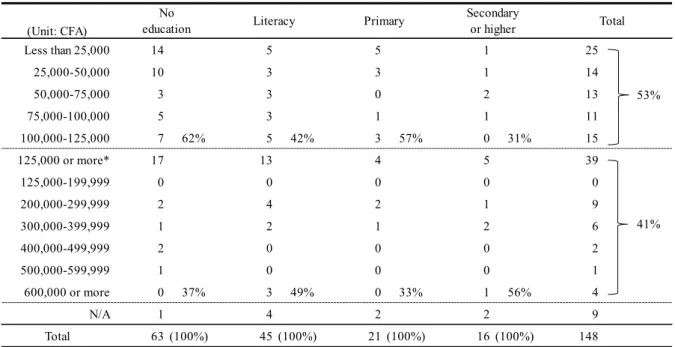
Table 4 shows the relationship between the respondents’ educational backgrounds and income levels. When
“No education” group is compared to the other three educational background groups (“Literacy”, “Primary”, and “Secondary or higher”), those three groups relatively have higher income than “No education” group. It is not so surprising, however, in the comparison between “Literacy” group and “Primary” group, it illustrates that “Literacy” group has relatively higher income than “Primary” group. Within “Literacy” education group, the ratio of high-income earners is higher than that of low-income earners. By contrast, the ratio of low-income earners is higher than that of high-income earners within “Primary” education group.
Based on the above findings, it can be presumed that literacy ability is more helpful than taking primary education to increase income for the local residents. Literacy education has a characteristic that not only young children but also adults can receive it. In other words, for adult peasants with no educational background, it is impossible to take primary education, but it is still possible to take literacy education if they have a will to learn.
Therefore, it can be said that people with literacy education (but no primary education), who took the education when they were adults, are generally perceived to have stronger motivation to develop their literacy ability for more and better economic activities.
25 14
13 11
15
39 0
9 6 2 1
4
0 10 20 30 40 50
Less than 25,000 25,000 - 50,000 50,000 - 75,000 75,000 - 100,000 100,000 - 125,000 125,000 or more*
125,000 - 199,999 200,000 - 299,999 300,000 - 399,999 400,000 - 499,000 500,000 - 599,999 600,000 or more
53%
41%
* The specific upper bound of income is unknown. (The rest of 6% is N/A) (Unit: people, Total=148) (Unit: CFA)
Not satisfied Sowewhat
satisfied Satisfied N/A Total*1
Yes 4 (4%) 24 (21%) 80 (71%) 4 (4%) 112
No*2 7 (23%) 1 (3%) 3 (10%) 19 (63%) 30
(Unit: people) Participation
experience
*1 Among total 148 respondents, 6 people had no answer.
*2 11 respondents answered even though they have no experience of participation.
Satisfaction with activities of community-based organization Table 5. Evaluation on activities of community-based organization.
2.4. Evaluation on community-based organization
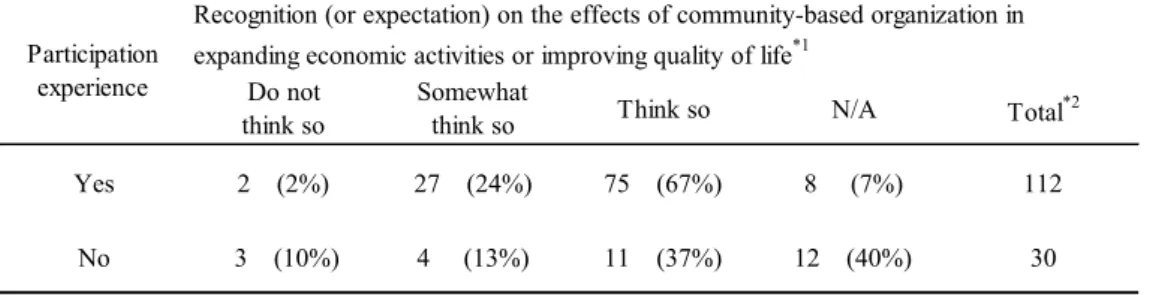
The community-based organization in this study is defined as a group formed by regional members having some common purpose (Sato 2004). Respondents’ evaluations on the activities of community- based organizations practiced in their villages are summarized in Table 5. In addition, their recognitions or expectations on the effects of the organizations in expanding their economic activities or improving their quality of life are provided in Table 6. According to the two tables, about 75% of the respondents have experiences of participation in certain community-based organizations. Both tables demonstrate that their evaluations of those activities are generally positive. The recognition on the effects of the activities is slightly lower than the evaluated satisfaction. On the other hand, 20% of the respondents do not have experience of participation.
Even though they have no experience, they could still evaluate those activities, and the result is relatively low.
However, their expectation to improve their quality of life by the activities is relatively high.
The result indicates that most of people, regardless of experience, have an expectation of improving their economic situation as well as quality of life through participation in community-based organizational activities, although it depends on the contents of the activities. Despite the expectation, some people do not participate
Table 4. Relationship between educational backgrounds and income distribution.
(Unit: CFA)
Less than 25,000 14 5 5 1 25
25,000-50,000 10 3 3 1 14
50,000-75,000 3 3 0 2 13
75,000-100,000 5 3 1 1 11
100,000-125,000 7 62% 5 42% 3 57% 0 31% 15
125,000 or more* 17 13 4 5 39
125,000-199,999 0 0 0 0 0
200,000-299,999 2 4 2 1 9
300,000-399,999 1 2 1 2 6
400,000-499,999 2 0 0 0 2
500,000-599,999 1 0 0 0 1
600,000 or more 0 37% 3 49% 0 33% 1 56% 4
N/A 1 4 2 2 9
Total 63 (100%) 45 (100%) 21 (100%) 16 (100%) 148
* The specific upper bound of income is unknown.
Total Primary
(Unit: people)
educationNo Secondary
or higher Literacy
53%
41%
Table 7. Relationship between the experience of community-based organization and income distribution.
in community-based organizations owing to concerns about risk. They are worried that these activities might not work successfully or might be a burden to the participants after they heard about others’ unsuccessful experiences directly or indirectly through rumors. Regarding that, when a sanitation project involved with community-based organization is planned and designed, it is necessary for the external stakeholders or project providers to take into account local residents’ value and intention in their communities.
2.5. Relationship of group activities with income
The relationship between respondents’ experience of community-based organization and their income is tabulated in Table 7. As this table shows, there is no significant correlation between those two. The income distribution of people with experience of community-based organization is nearly the same as that of people without the experience. In another analysis on the relationship between their experience of community-based organization and their educational backgrounds, the results show no significance of correlation between those two. The results are not tabulated in this paper because similar patterns with Table 7 were demonstrated. In other
Table 6. Recognition (or expectation) on the effects of community-based organization.
Do not
think so Somewhat
think so Think so N/A Total*2
Yes 2 (2%) 27 (24%) 75 (67%) 8 (7%) 112
No 3 (10%) 4 (13%) 11 (37%) 12 (40%) 30
*1 For those who do not have participation experience of community organizational activities, the answer of “recognition” was replaced to “expectation” on the questionnaire.
*2 Among total 148 respondents, 6 people had no answer.
(Unit: people) Participation
experience
Recognition (or expectation) on the effects of community-based organization in expanding economic activities or improving quality of life*1
(Unit: CFA) Yes No N/A Total
Less than 25,000 17 6 2 25
25,000-50,000 9 3 2 14
50,000-75,000 8 5 0 13
75,000-100,000 11 0 0 11
100,000-125,000 13 52% 1 50% 1 15
125,000 or more* 29 10 0 39
125,000-199,999 0 0 0 0
200,000-299,999 6 3 0 9
300,000-399,999 6 0 0 6
400,000-499,999 1 1 0 2
500,000-599,999 1 0 0 1
600,000 or more 4 42% 0 47% 0 4
N/A 7 1 1 9
Total 112 (100%) 30 (100%) 6 148
(Unit: people)
* The specific upper bound of income is unknown.
53%
41%
Table 9. Relationship between the experience of microfinance and income distribution.
Table 8. Relationship between the experience of externally funded project and income distribution.
words, residents’ participation in community-based organization is not influenced by their educational level or economic situations and vice versa.
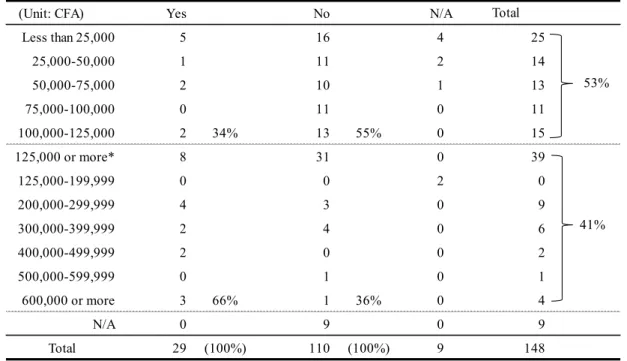
The relationship between the experience of externally funded project and income distribution is different from the result of Table 7. The group of people with an experience of externally funded project has relatively higher income than the other group without the experience as it is shown in Table 8. A similar result can be obtained
(Unit: CFA) Yes No N/A
Less than 25,000 5 16 4 25
25,000-50,000 1 11 2 14
50,000-75,000 2 10 1 13
75,000-100,000 0 11 0 11
100,000-125,000 2 34% 13 55% 0 15
125,000 or more* 8 31 0 39
125,000-199,999 0 0 2 0
200,000-299,999 4 3 0 9
300,000-399,999 2 4 0 6
400,000-499,999 2 0 0 2
500,000-599,999 0 1 0 1
600,000 or more 3 66% 1 36% 0 4
N/A 0 9 0 9
Total 29 (100%) 110 (100%) 9 148
(Unit: people) Total
* The specific upper bound of income is unknown.
53%
41%
(Unit: CFA) Yes No N/A
Less than 25,000 7 17 1 25
25,000-50,000 2 10 2 14
50,000-75,000 3 10 0 13
75,000-100,000 1 10 0 11
100,000-125,000 2 41% 13 55% 0 15
125,000 or more* 12 27 0 39
125,000-199,999 0 0 0 0
200,000-299,999 4 5 0 9
300,000-399,999 2 4 0 6
400,000-499,999 1 1 0 2
500,000-599,999 1 0 0 1
600,000 or more 2 59% 1 36% 1 4
N/A 0 9 0 9
Total 37 (100%) 107 (100%) 4 148
(Unit: people) Total
* The specific upper bound of income is unknown.
53%
41%
Acknowledgements
This study was supported by research projects headed by Prof. Naoyuki Funamizu and financed by Research Institute for Humanity and Nature (RIHN, Project No.14200107), Japan Society for the Promotion of Science (JSPS), Japan Science and Technology Agency (JST), and Japan International Cooperation Agency (JICA).
I would like to express my sincere gratitude to Prof. Funamizu for his thoughtful support and guidance. I would also like to express my deep appreciation to Associate Professor Tetsuhiko Takai for his comments and
Summary and Discussion
The main results from the field survey conducted in this paper are summarized in four noticeable findings.
First, with regard to education in rural area of Burkina Faso, literacy ability is considered as a more important factor than primary education. The importance of literacy ability is widely recognized and shared among local residents. Second, when it comes to income levels, people with literacy education but no primary education have a relatively higher income than those who have primary education. Third, according to the result of comparative analysis between people with and without the experience of community organizational activities, the experience has no relationship to both educational backgrounds and income levels. Both of the two groups have almost the same result. Fourth, however, the incomes of those who have an experience of externally funded project or microfinance are relatively higher than those who do not have such experiences.
Using the findings of this paper, several suggestions are proposed for a better management of sanitation project by community participation in rural Burkina Faso and, by extension, in rural Africa. First, after understanding residents’ general recognition about the importance of literacy ability, it is necessary to discuss how the sanitation project can effectively incorporate with literacy education. For example, a sanitation project attempts to provide literacy classes for the participants. It can also be considered to devote a certain portion of project revenue to tuition and purchases of educational materials for their literacy education. I also suggest a possibility of new concept of business model based on the field survey results. Local residents’ participation in externally funded project and enhancement of literacy skills lead to the improvement of both sanitation and income.
Second, it is essential to deepen local residents’ enthusiasm to participate in systems of the business model.
Attending to such activities as sanitation project or other externally funded project can help to improve their income and quality of life. It requires more efforts of interaction between project providers and local residents.
Third, for medium-and long-term sustainability of sanitation development project, a thoughtful management strategy for the local communities remains to be required. If the opportunities of access to external funds are cut off, residents may lose income when they only participate in their community-based organizational activities.
Fourth and finally, profit structure of community-based organization needs to be changed for the sustainability of sanitation project. The change makes it possible to achieve sustainable development even without combining community-based organizational activities with microfinance or external funding. Furthermore, greater attention should be paid to certain ways of stimulating participants’ proactive actions and their mental qualifications such as strong will or motivation to accomplish and willingness to invest.
from Table 9. This table shows the relationship between residents’ experience of microfinance and their income distribution. The group of people with an experience of microfinance also has relatively higher income than the other group without the experience.
Haq, G. and Cambridge, H. 2012. Exploiting the co-benefits of ecological sanitation. Current Option in Environmental Sustainability 4: 431-435.
Ikemi, M. 2011. A Challenge of Microcredit Program in Rural Africa: A Case Study of Fatick Integrated Development Program in Senegal. Economic Journal of Hokkaido University 40: 15-28.
Jonah, C., T. Maitho and Omware, Q. 2015. Water access and sustainable rural livelihoods: A case of Elementaita Division in Nakuru County, Kenya. International Journal of Science, Technology and Society 3(1): 9-23.
Kawada, J. 1973. Kouya kara. (in Japanese). Chuo Koron Shinsha, Tokyo.
Kumashiro, C. 2014. “Reinventing” Microfinance: A Case Study of a Woman’s Association in Burkina Faso.
Journal of African Studies 84: 17-30.
Montgomery, M. A., Bartram, J. and Elimelech, M. 2009. Increasing Functional Sustainability of Water and Sanitation Supplies in Rural Sub-Saharan Africa. Environmental Engineering Science 26(5): 1017-1023.
Sakurai, T. and Inoue, R. 2014. Development of the Rural Economy of Burkina Faso in 30 Years: Have They Escaped from the Poverty? (in Japanese). Keizai Kenkyu 65(1): 23-41.
Sato, H. ed. 2004. Enjo to jumin soshikika (in Japanese), Institute of Developing Economies - Japan External Trade Organization.
Shimada, S. 2001. Increased Vulnerability of the Mossi Society in Burkina Faso. Asian and African Area Studies 1: 21-36.
Takeshita, M. 2000. Local NGO and local governance for rural development in Burkina Faso: The case of Federation Nationale des Groupements Naam (FNGN) (in Japanese). Africa Report 31: 29-32.
UNESCO (United Nations Educational, Scientific and Cultural Organization) et Ministere de l’enseignement de base et de l’alphabetisation du Burkina Faso 2012. Plan d’action triennial d’alphabetisation du Burkina Faso.
UNESCO, Paris.
UNDP (United Nations Development Programme) 2014. Human Development Report 2014, Sustaining Human Progress: Reducing Vulnerabilities and Building Resilience. UNDP, New York.
Ushijima, K., Funamizu, N., Nabeshima, T., Hijikata, N., Ito, R., Sou, M., Maiga, A. H. and Sintawardani, N.
2015. The Postmodern Sanitation: Agro-sanitation business model as a new policy. Water Policy 17: 283-298.
World Bank 2013a. Burkina Faso: World Development Indicators. Online. http://data.worldbank.org/country/
burkina-faso (Accessed January 13, 2015).
________2013b. Data: School Enrollment, Tertiary (%Gross). Online. http://data.worldbank.org/indicator/
SE.TER.ENRR/countries (Accessed July 20, 2015).
________2013c. GNI per capita, Atlas Method (Current US$). Online. http://data.worldbank.org/indicator/
NY.GNP.PCAP.CD/countries/BF-ZF-XM?display=graph (Accessed May 10, 2016).
References
suggestions in the writing of this paper. My special thanks goes to Associate Professor Takako Nabeshima for her advice and encouragement on my African study. I would like to thank all colleagues of the projects for their great assistance.