Effects of aphid honeydew sugars on the survival and fecundity of the aphidophagous gall midge Aphidoletes aphidimyza
Hiroshi Watanabe1, Noboru Katayama2, Eizi Yano1, Ryohei Sugiyama 1, Shoko Nishikawa 1, Junji Takabayashi2, Rika Ozawa2
1 Entomological Laboratory, Faculty of Agriculture, Kinki University, 3327-204, Nakamachi, Nara, 631-8505, Japan; 2 Center for Ecological Research, Kyoto University, Otsu, Shiga, 520-2113, Japan
Abstract
Predatory gall midge Aphidoletes aphidimyza, which is used for augmentative biological control of aphids in greenhouses, take aphid honeydew as an energy source to survive. Currently Rhopalosiphum padi on barley plants and Melanaphis sacchari on sorghum plants are used as the banker plant systems for A. aphidimyza to control A. gossypii on eggplants in Japan. We analyzed the sugar components of three species aphid honeydew by HPLC. The major components of honeydew were sucrose, fructose and melezitose for A. gossypii, glucose and fructose for R. padi and glucose, fructose and melezitose for M sacchari. Two minor components for these three aphid species were maltose and trehalose. We investigated the influence of sugars including three aphid artificial honeydew, six sugar components of three species aphid honeydew and water on the longevity of unmated females and males of A. aphidimyza. Both females and males attained the longest lifespan on sucrose and artificial honeydew of A. gossypii. Mean longevities of both females and males were shortest when they were provided with only water. We conducted another experiment where a mated female was released in a cage with an eggplant seedling infested with A. gossypii and was fed with sucrose or only water. Number of eggs laid and survival of the female was examined every day.
Females fed with sucrose lived significantly longer and laid more eggs in their lifetime than those with only water.
Introduction
Honeydew is a generic term for sugar-rich excretions produced by sap-feeding Sternorrhynchae.
Most of honeydew producers are phloem-feeders (Wackers, 2005). Carbohydrates typically comprise more than 80% of honeydew by dry weight. Phloem sap is comprised primarily of sucrose (Lungren, 2009). Sucrose in the phloem sap is metabolized into fructose and glucose as it passes through the sternorrhynchan digestive system (Lungren, 2009; Karley et al., 2005). In addition to them, there are many insect-synthesized sugar found in honeydew, such as the trisaccharides melezitose and erlose and the disaccharides trehalose and trehalulose (Lungren, 2009). Other nutrients are also found in honeydew are amino acids. In agricultural systems, honeydew may be
consumed by predators and parasitoids (Hagen, 1986; Evans and England, 1996; Wackers and Steppuhn, 2003; Wackers et.al., 2008), as well as pest organisms (Swirski et al., 1980; Beerwinkle et al., 1993). Sugars, the major contents of honeydew, are useful for supporting survival of natural enemies but seldom directly support their development and reproduction (Lungren, 2009). However, the increased longevity that usually results feeding on sugar may indirectly enhance parasitoid reproduction by allowing more time for location and attack of more hosts (Heimpel and Jervis, 2005;
Idris and Grafius, 1995). Honeydew has been observed to act as a volatile cue for locating a host or prey from distance, as a contact oviposition stimulant, and as an arrestant for foraging natural enemies (Lungren, 2009).
The predacious gall midge, Aphidoletes aphidimyza (Rondani) (Diptera: Cecidomyiidae), is distributed worldwide including Japan, and larvae of this species feed on a wide variety of aphids, at least 80 species having been recorded as hosts (Harris, 1973; Yukawa et al., 1998). This gall midge has been used in many countries are an effective biological control agent against aphids, particularly in greenhouses (Markkula and Tiittanen, 1985; Nijveldt, 1988). An exotic strain of this species imported from the Netherlands has beeri commercialized to control aphids in protected cultures since 1998 in Japan. The application of this strain has not been patiicularly successful, perhaps due to maladaptation to environmental conditions in Japan or improper use of the strain. The use of domestic strains, which are well adapted to both the physical and biological environments of Japan, is recommended to avoid possible environmental risks associated with the exotic strain.
Both sexes of A. aphidimyza are known to take aphid honeydew as an energy source (Harris, 1973). Later, honeydew intake by females revealed that their lifespan was extended and fecundity was increased (Kuo-Sell, 1987). Since sugars are major contents of honeydew, sugars are expected to have effects to extend longevity and increase fecundity of A. aphidimyza. However, little is known about the effect of sugar feeding on longevity and fecundity of A. aphidimyza based on analysis of sugar components of honeydew of its host aphid species.
Banker plant systems typically consist of a non-crop plant that is deliberately infested with a non-pest herbivore (Hansen, 1983; Bennison and Corless, 1993; Van Driesche et al., 2008). The non-pest herbivore serves as an alternative host for a parasitoid or predator of the target crop pest (Frank, 2010). The banker plant system for A. aphidimyza was first developed by Hansen (1983) using broad beans infested with Megoura viciare (Buckton) as the alternative prey. Bennison (1992) and Bennison and Corless (1993) developed another system using Rhopalosiphum padi (Linne) on wheat or barley seedlings.
Cunently banker plant systems for an indigenous strain of A. aphidimyza using barley plants infested with Rhopalosiphum padi (Linne) and sorghum plants infested with Melanaphis sacchari (Zehntner) to control A. gossypii that is serious pest of egg plants are being developed in Japan (Abe et al. a, b 2011 ). When the banker plant systems are adopted, A. aphidimyza adults must intake
honeydew produced by aphids on banker plants and on crop . plants. However, the amount of honeydew on crops might be not sufficient for survival of the adults moved from the banker plants, because the adults must lay eggs when the pest aphid density has not reached to high level. In this case, artificial provision of sugars can support the survival of adults on crops and might eventually cause the increased number of eggs laid on crops. Therefore, sugar provision is expected to improve performance of biological control by A. aphidimyza.
The objectives of this study were to analyze the sugar components of honeydew of the pest aphid, A. gossypii, and the aphids on banker plants, R. padi and M sacchari in the Japanese banker '
plant system for A. aphidimyza, and to evaluate the effects of the sugars on longevity and fecundity of this natural enemy. If proper sugars are found as the result of this study, it facilitates development of provision technique of artificial foods for A. aphidimyza in the banker plant system.
Material and methods
Insects
Larvae of A. aphidimyza attacking turnip aphid, Lipaphis erysimi (Kaltenbach) were collected on the potherb mustard, Brassica rapa (var. Nipponsinica) in Nantan City, Kyoto prefecture, on August 25, 2005. Cotton aphids, A. gossypii, were collected from the strawberry, Fragaria x ananassa Duchesne in the fields in Ayabe City, Kyoto Prefecture, on April 21, 2006. The descendants of the one female individual of A. gossypii have been cultured for successive generations on eggplants ( cv.
Senryo 2 Gou) in rearing cages (30 x 30 x 25 cm) under condition of 25'C and 16L:8D. A.
aphidimyza has been reared on A. gossipii for successive generations under condition of 25'C and 16L:8D.
R. padi was collected from the corn, Zea mays L. in Nantan City, Kyoto prefecture, on August 29, 2003. R. padi has been cultured for successive generations on barleys (cv. Temairazu) in rearing cages (30 x 30 x 25 cm) under condition of 25'C and 16L:8D.
M sacchari was collected from the sorghum, Sorghum bicolor (L.) Moench, in Ayabe City, Kyoto Prefecture, on September 28, 2006. M sacchari has been cultured for successive generations on sorghums (cv. Kazetachi) in rearing cages (30 x 30 x 25 cm) under condition of 25'C and 16L:8D.
Honeydew collection
100 individuals of A. gossypii were infested uniformly among all leaves of an eggplant seedling in a plastic pot or those of R. padi on were infested barley seedlings planted in one pot or those of M sacchari on sorghum seedlings planted in one pot. These aphids were reared at 25°C under a 16L:8D photoperiod in an environmental chamber. When the number of aphids reached to 1000 individuals
in a pot after 7 days, we collected honeydew of each aphid species as follows.
We placed an eggplant seedling infested with A. gossypii in a plastic rearing cage (30 x 30 x 25 cm), whose both sides were covered with polyester screen (mesh-size: 1 x 1 mm). We put a glass Petri dish (8.5 cm in diameter) under leaves with many aphids and collected about 1000 droplets of aphid honeydew in the Petri dish for 3 h. We replicated this procedure 10 times.
We also placed a barley seedling with R. padi or sorghum seedling with M sacchari in the rearing cage. We bent the plant body to the wall and fixed the top of leaves with a wooden board.
This is because many individuals of R. padi and M sacchari infested the middle part of the leaves.
We put a glass Petri dish (8.5 cm in diameter) under leaves with many aphids and collected about 1000 droplets of aphid honeydew in the Petri dish for 24 h. We replicated this procedure 10 times for R. padi and 14 times for M sacchari .
Each Petri dish was rinsed by 1 ml distilled water. The rinsed solution was filtered through a Millipore filter (0.20 µm), and the solution was transported into a 1.5 ml microtube. The samples were kept in a -20°C freezer for sugar analysis.
Honeydew analysis
All solution containing honeydew samples were dried using a freeze-dryer (FDU-540, Tokyo Rikakikai CO, LTD, Tokyo, Japan). The dried samples were dissolved to 15 µl Milli-Q-Water. Ten µl volumes of the sample solution were used for sugar analysis.
Sugars in honeydew were analyzed by high-pressure liquid chromatography (HPLC), using a Wakosil 5NH2-MS packed column (4.6 x 150 mm; Wako Pure Chemical, Osaka, Japan) and an 78%
acetonitrile mobile phase at room temperature. The flow rate was 1 mL miu-1• Peak size for the various sugars present in the honeydew samples were calculated directly by a refractive index detector (RID; Shimadzu Corp., Kyoto, Japan). Honeydew samples were optimized using 12 sugar standards (fructose, glucose, sucrose, maltose, trehalose, melezitose, xylose, galactose, melibiose, mannitol, lactose, and raffinose), and the sugar composition of each sample was determined by comparison of retention times with those from a standard sample measured on the same day.
The influence of sugars on the longevity of unmated adults
Newly emerged unmated females and males ( <24 h old) were placed individually in a plastic cage (10 x 10 x 20 cm). They were given one of the following: 10% water solutions of sucrose or glucose or trehalose or maltose or melezitose or fructose or artificial honeydews, which mimicked the sugar compositions of honeydews of A. gossypii, R. padi and M sacchari (Table 1, 2), or distilled water. These diets were offered the adult by soaking in a facial tissue paper ball placed on a 100 ml vial filled with water. Survival of adults in each cage was checked daily until the adult was dead.
Diets were replaced with new ones every four days. The cages were maintained at 25°C, 75-85% RH,
and 16L: 8D photoperiod. Twenty replications were performed for each sugar source or water.
The influence of supply of sucrose or water on the longevity and fecundity of mated female The results of the experiment on the influence of sugars on longevity of unmated adults showed that the female mean longevity was the longest when females were provided with sucrose or mtificial honeydew of A. gossypii. When sugar sources are provided as energy sources for females of A. aphidimyza to extend their longevity and increase fecundity, aphid honeydews are also available for the females. From practical point of view, therefore, it is imp01tant to check whether mtificial provision of sugar sources actually result in extension of the longevity and increase of fecundity of A.
aphidimyza females or not when aphid honeydews are available for them. We have chosen sucrose as the sugar source because it was the most effective to extend the longevity among sugar sources tested. Sucrose is also easy to prepare and is the cheapest among the sugar sources. The petiole of a leaf of egg plant (10 cm length x 7 cm width) infested by 100 A. gossypii individuals of 4 -5 instar was inserted in a 50 ml plastic vial (6.5 cm height x 3 cm diameter) filled with water. It was placed in a 10 x 10 x 20 cm plastic cage. One female and three males of newly emerged adults ( <24 h old) were released in the cage and fed with 10% sucrose solution or water. These diets were offered the adults by soaking in a facial tissue paper ball placed on a 100 ml vial filled with water. Survival of adults and the nurpber of eggs laid on the leaf daily in the cage was checked until the female was dead. When the males died, the same number of newly-emerged males was released. The eggplant leaf and the tissue paper ball absorbed diets and the egg plant leaf with aphids were renewed one every day. These experiments were conducted at 25°C, 75-85% RH, and 16L:8D photoperiod.
Twenty replications were performed under each feeding condition.
Statistical analysis
Principal Component Analysis (PCA) was conducted to examine sugar composition in honeydew of three aphid species. PCl and PC2 sucrose were compared among aphid species usingANOVA.
Survival curves of unmated female and male adults provided with different type of diets and mated females provided with sugar or water were estimated using the Kaplan Meier method. The log-rank test was applied to compare these survival curves. Fecundity of mated females fed with sucrose and water were compared using t-test.
Results
Honeydew analysis
We detected six sugars in honeydew of A. gossypii, R. padi and M sacchari (Table 1). In honeydew of A. gossypii, sucrose was the most major component (38.39 weight %), and fructose
(24.79%) and melezitose (23.57%) were the second and third major components, respectively. In honeydew of R. padi, glucose was the most major component (42.74%), and fructose was the second major component (33.97%). In honeydew of M sacchari, glucose was the most major component (35.57%), and fructose (26.51 %) and melezitose (20.28%) were the second and third major components, respectively.
PCA identified two principal components (PC! and PC2) that accounted for 52.8% and 22.7% of the overall variance of sugar composition. Positive PCl indicate honeydew containing greater proportion of fructose, glucose and maltose, and negative PC 1 indicate honeydew containing greater proportion of sucrose and melezitose (Fig. 1). PC2 mainly consisted of trehalose component in honeydew. Scores of PCl and PC2 were significantly different among aphid species (ANOVA, PCl:
F2,31 = 61.67, P < 0.001; PC2: F2,31 = 12.22, P < 0.001). This indicates that each aphid species excreted honeydew consisting of different sugar composition. Honeydew of A. goossypii contained relatively greater · proportion of sucrose and melezitose, and honeydew of R. padi contained relatively greater proportion of fructose, glucose and maltose (Fig. 1 ). Honeydew of M sacchari contained relatively smaller proportion oftrehalose.
The influence of sugars on the longevity of unmated adults
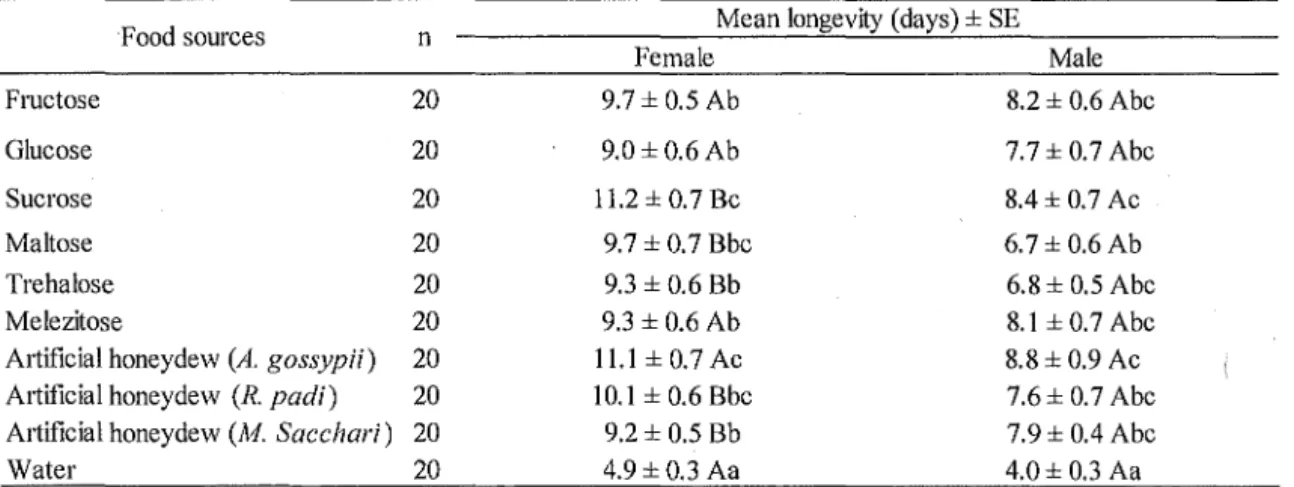
Table 3 shows the average longevity of both sexes fed with different sugars, artificial honeydews or water. The log-rank test showed that the female longevity varied depending on food sources (x2 = 142.50, df = 9, P < 0.0001). The female mean longevity was the shortest (4.9 days) when females were provided with only water. The mean longevity was 9.0 - 11.2 days when females were provided with sugars or artificial honeydews. Females attained the longest longevity on sucrose and artificial honeydew of A. gossypii. The log-rank test also showed that the male longevity varied depending on food source (x2 = 82.28, df= 9, P < 0.0001). The male mean longevity was the shortest (4.0 days) when males were provided with only water. The mean longevity was 6.7-8.8 days when males were provided with sugars or artificial honeydews. Males attained the longest longevity on artificial honeydew of A. gossypii and sucrose. Sucrose and artificial honeydew of A. gossypii are two best diets for survival of both sexes of A. aphidimaza. The female longevity tended to be longer than the male longevity but the difference was significantly different only when they were fed with sucrose, maltose, trehalose, attificial honeydews of R. padi or M sacchari.
The influence of supply or water on the longevity and fecundity of mated female
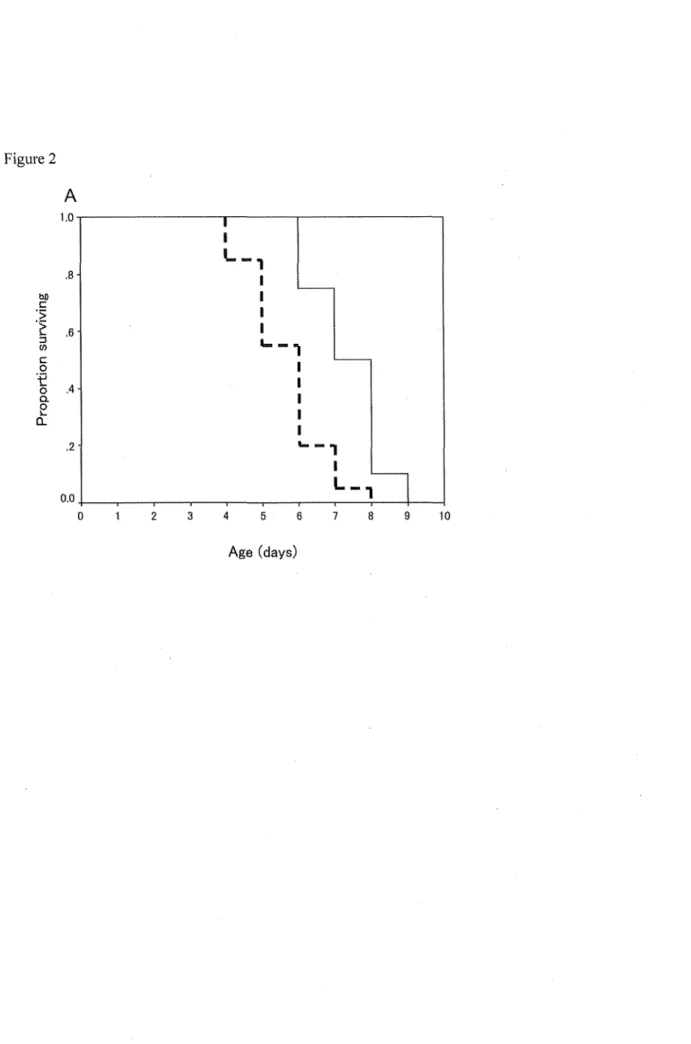
Survival curves for both sexes fed with sucrose or water are shown in Fig. 2. The long-rank test showed that females fed with sucrose lived significantly longer than those fed with only water (x2 = 82.28, df= 9, P < 0.0001). Lifetime fecundity was also significantly greater when females fed with sucrose than those fed with only water (t = 30.69, df = 39, P < 0.0001) (Table 4). The daily
oviposition was not significantly different between females fed with sucrose and only water in Fig.
2B.
Discussion
We detected six sugars in honeydew of A. gossypii, R. padi and M sacchari. The major components of honeydew were sucrose, fructose and melezitose for A. gossypii, glucose and fructose for R. padi and glucose, fructose and melezitose for M sacchari. Two minor components for these three aphid species were maltose and trehalose. Among them, sucrose and maltose are phloem sugars and glucose and fructose are considered to be their ingested sugars by digestive enzymes in the gut of phloem-feeders (Karley et al., 2005). Melezitose and trehalose are synthesized by sap-feeders (Wackers, 2005).
The result of PCA indicates that each aphid species excreted honeydew consisting of different sugar composition. We found that all honeydews of three aphid species analyzed here contained a relatively high percentage of sucrose, glucose and fructose (71-82% of the total sugars). The plant-derived sugars sucrose, glucose, and fructose generally have a high nutritional quality, whereas the aphid synthesized oligosaccharides are of lower nutritional value (Wackers, 2000, 2001 ).
Honeydew produced by A. gossypii showed very higher percentage of sucrose than other two species.
Compositions of plant derived sugars of honeydew produced by R. padi and M sacchari were similar. These differences and similarities might reflect the effect of host plant species. The host plant of A. gossypii is egg plant, whereas the host plants of other species are both gramineous species.
Honeydew composition may vary depending on a broad range of parameters, including the species of sap feeder (Hendrix et al., 1992) and host plant species (Hendrix et al., 1992; Sandstrom and Moran, 2001) and its growth conditions (Crafts-Bradner, 2002).
The availability of a sugar source increased the lifespan of both sex A. aphidimyza compared to water-fed adults. We investigated the influence of sugars including three aphid artificial honeydew, six sugar components of three species aphid honeydew and water on the longevity of unmated females and males of A. aphidimyza. Both females and males attained the longest lifespan on sucrose, and artificial honeydew of A. gossypii. Mean longevities of both females and males were the shotiest when they were provided with only water. When mated females, which were allowed to lay eggs on an egg plant seedling with A. aphidimyza, were fed with sucrose or water, females fed with sucrose lived significantly longer and laid more eggs in their lifetime than those with only water.
Cotton aphid honeydew modestly increased phorid fly Pseudacteon tricuspis lifespan by about 1 day with moderate but significant increases in body carbohydrate nutrient levels (Fadamiro and Chen, 2005), whereas feeding on sucrose solution was found in earlier studies to increase longevity by about 4-5 days with a relatively greater effect on body nutrient levels (Chen et al., 2005;
Fadamiro and Chen, 2005). As the physiological influence to predatory arthropods by providing
sugar, it has been reported that the number of egg production increase in ladybird (Richards and Evans, 1998; Evans, 2000) and that Ch,ysoperla carnea (Stephens) and Orius sauteri (Poppius) nymphal mortality rate decrease and nymphal stage shorten (McEwen et al., 1993; Maeda et al., 2002). In case of A. aphidimyza, Sell (1975) found that the adult lifespan was significantly extended if the adults were supplied with honeydew of Myzus percicae (Sulzer) instead of water and that the lifespan of males is always shorter than that of females. Also, Kuo-Sell (1987) showed that females feeding on honeydew of Metopolophium dirhodum (Walker) had a significantly longer mean lifespan than those feeding on the honeydew of M persicae. The results of this study showed that female A.
aphidimyza feeding on artificial honeydew of A. gossypii significantly increased its longevity compared with that fed with artificial honeydew of M sacchari. Probably it is due to the high percentage of sucrose in the attificial honeydew of A. gossypii. In conclusion, sucrose solution is the best sugar source to provide to improve longevity and fecundity of A. aphidimyza females.
Biological control of aphids using their natural enemies often can be difficult because of rapid population growth of aphids. Even in the baker plant system, it is impottant to ensure survival and fecundity of natural enemies in greenhouses for effective control of aphids. If artificial food resources, such as sugar solution, are placed in greenhouses applied the banker plant system, A.
aphidimyza would have more chances to survive and oviposit in greenhouses, especially when the aphid density is low. The results of the survival and oviposition experiments for mated females showed very interesting information about usefulness of provision of sugar solution. Provision of sugar solution made females live longer and oviposit more eggs than those provided only water.
Actually, in both cases, A. aphidimyza adults could feed on aphid honeydew. So, the result means that provision of additional sucrose solution is useful to improve longevity and fecundity of females compared with provision of only aphid honeydew and water. The effect on longevity by provision of sucrose is considered mainly due to the extension of longevity because the daily oviposition is not significantly different between females fed with sucrose and only water in Fig. 3B. In order to make provision of sucrose solution in the banker plant system practical, it is necessary to develop · an apparatus to provide sucrose solution in greenhouses and to evaluate its effectiveness in greenhouse experiments.
References
Abe J, Kumakura H & Yano E (2011a) Biological control of aphids in sweet pepper greenhouses using the banker plant system for aphidophagous gall midge, Aphidoletes aphidimyza (Rondani) (Diptera: Cecidomyiidae). Ann. Rept. Kansai PL Prot. 53: 37·46 (in Japanese).
Abe J, Mitsunaga T, Kumakura H & Yano E (2011b) Comparative studies on development and reproduction of four aphid species on sorghum or barley to
evaluate as alternative prey for bankerplant system. Japanese Journal of Applied Entomology and Zoology 55: 227·239 (in Japanese).
Beerwinkle KR, Shaver TN & Lopez, JD Jr. (1993) Field observations of adult emergence and feeding behavior of Helicove1pa zea (Lepidoptera: Noctuidae) on dallisgrass ergot honeydew. Environmental Entomology 22: 554·558.
Bennison, JA (1992) Biological control of aphids on cucumbers: Use of open rearing units or "Banker plants" to aid establishment of Aphidius matricmiae and Aphidoletes aphidimyza. Med. Fae. Landbouww. Univ. Gent 57/2b: 457·466.
Bennison JA & Corless SP (1993) Biological control of aphids on cucumbers: Further development of open rearing units or "Banker plants" to aid establishment of aphid natural enemies. IOBC/WPRS Bulletin 16: 5·8.
Chen L, Onagbola EO & Fadamiro HY (2005) Effects of temperature, sugar availability, sex, mating, and size on the longevity of phorid fly Pseudacteon t1icuspis (Diptera:
Phoridae). Environmental Entomology 34: 246·255.
Crafts· Bradner SJ (2002) Plant nitrogen status rapidly alters amino acid metabolism and excretion in Bemisia tabaci. Journal oflnsect Physiology 48: 33·41.
Evans EW (2000) Egg production in response to combined alternative foods by the predator Coccinella tTansveTsalis. Entomologia Experimentalis et Applicata 94:
141·147.
Evans EW & England S (1996) Indirect interactions in biological control of insects:
Pests and natural enemies in alfalfa. Ecological Applications 6: 920·930.
Fadamiro HY & Chen L (2005) Utilization of aphid honeydew and floral nectar by Pseudacteon tiicuspis (Diptera: Phoridae), a parasitoid of imported fire ants, Solenopsis spp. (Hymenoptera: Formicidae). Biological Control 34: 73-82.
Frank SD (2010) Biological control of arthropod pests using baker plant systems: Past progress and future directions. Biological Control 52: 8-16.
Hagen, KS (1986) Ecosytem analysis: plant cultivars (HPR), entomophagous species and food supplements. Interactions of Plant Resistance and Parasitoids and Predators oflnsects. (ed. by DJ Boethel & RD Eikenbary), pp. 153-197, John Wiley, New York.
Hansen LS (1983) Introduction of Aphidoletes aphidimyza (Rond.) (Diptera:
Cecidomyiidae) from an open rearing unit for the control of aphids in glasshouses.
IOBC/WPRS Bulletin 6 (3): 146-150.
Harris KM (1973) Aphidophagous Cecidomyiidae (Diptera): taxonomy, biology and assessments of field populations. Bulletin of Entomological Research 63: 305-325.
Heimpel GE & Jervis MA (2005) Does floral nector improve biological control by
parasitoids? Plant· Provided Food for Carnivorous Insects. (ed. by FL Wack:ers, PCJ van Rijn & J Bruin), pp. 267·304, Cambridge University Press, Cambridge.
Hendrix DL, Wei Y & Leggett JE (1992) Homopteran honeydew sugar composition is determined by both the insect and plant species. Comparative Biochemistry and Physiology 101B: 23·27.
Idris AB & Grafius EJ (1995) Wildflowers as nectar sources for Diadegma insulai-e (Hymenoptera: Ichneumonidae), a parasitoid of diamondback: moth (Lepidoptera:
Yponomeutidae). Environmental Entomology 24: 1726· 1735.
Karley AJ, Ashford DA, Minto LM, Pritchard J & Douglas AE (2005) The significance of gut sucrose activity for osmoregulation in the pea aphid, Acyl'thosiphon pisum.
Journal oflnsect Physiology 51: 1313·1319.
Kuo·Sell HL (1987) Some bionomics of the predacious aphid midge, APhidoletes aphidimyza (Rond.) (Diptera: Cecidomyiidae), and possibility of using the rose grain aphid, Metopolophium dirhodum (Wlk.), as an alternative prey in an open rearing in greenhouses. Integrated and Biological Control in Protected Crops (ed.
by R Cavalloro), pp. 151 · 161, AA Balk:ema, Rotterdam, The Netherlands.
Lungren JG (2009) Relationships of Natural Enemies and Non-Prey Foods. Springer, Breiningsville, PA, USA, 453pp.
Maeda S, Nakashima Y, Tagashira E & Takagi M (2002) Effects of sucrose on the longevity and fecundity of 01ius sautel'l· (Poppius) (Hemiptera: Anthocoridae).
Japanese Journal of Applied Entomology and Zoology 46: 169·173 (in Japanese).
Mak:k:ula M. & Tiittanen K (1985) Biology of the midge Aphidoletes and its potential for biological control. Biological Pest Control: The Glasshouse Experience (ed. By N W Hussey & N. Scopes), pp. 74·81, Blandford Press, Poole, UK.
McEwen PK, Jervis MA & Kidd NAC (1993) Influence of artificial honeydew on larval development and survival m Ch1ysopei-la ca1·nea (Neur., Chrysopidae).
Entomophaga 38: 241·244.
Nijveldt W (1988) Cecidomyiidae. Aphids - their biology, natural enemies and control.
Vol.2B (ed. by AK Minks & P Harrewijn), pp.271·277, Elsevier, Amsterdam, The Netherlands.
Richards DR & Evans EW (1998) Reproductive responses of aphidophagous lady beetles (Coleoptera: Coccinellidae) to nonaphid diets: An example from alfalfa. Annals of the Entomological Society of America 91: 632·640.
Sandstrom, JP & Moran N (2001) Amino acid budgets in three aphid species using the same host plant. Physiological Entomology 26: 202·211.
Sell P (1975) Neverwirk:ungen einiger Pestizide auf Aphidoletes aphidimyza (Rond.)
(Diptera: Cecidomyiidae) unter besonderer Berilck-sichtigung von Fraf3leistung und Fruchtbarkeit. Diss. Univ. Gottingen.
Swirski K, Izhar Y, Wysoki M, Gurevitz E & Greenberg S (1980) Integrated control of the long-tailed mealybug, Pseudococcus longispinus (Hom., Pseudococcidae), in avocado plantations in Israel. Entomophaga 25: 415-426.
Van Driesche RG, Lyon S, Sanderson JP, Bennett KC, Stanek EJ & Zhang RT (2008) Greenhouse trials of Aphidius colemani (Hymenoptera: Braconidae) banker plants for control of aphids (Hemiptera: Aphididae) in greenhouse spring floral crops.
Florida Entomologist 91: 583-591.
Wiickers FL (2000) Do oligosaccharides reduce the suitability of honeydew for predators and parasitoids? A further facet to the function of insect-synthesized honeydew sugars. Oikos 90: 197·201.
Wiickers F L (2001) A comparison of nectar and honeydew sugars with respect to their utilization by the hymenopteran parasitoid Cotesia glome1·ata. Journal of Insect Physiology 47: 1077·1084.
Wiickers FL (2005) Suitability of (extra·) floral necter, pollen and honeydew as insent food sources. Plant-Provided Food for Carnivorous Insects: a protective mutualism and its application (ed. by FL Wiickers, PCJ. van Rijn & J. Bruin), pp.17·7 4,Cambridge University Press, Cambridge.
Wiickers FL & Steppuhn A (2003) Characterizing nutritional state and food source use of parasitoids collected in fields with high and low nectar availability. IOBC/WPRS Bulletin 26: 203·208.
Wiickers F L, van Rijn PCJ & Heimpel GE (2008) Honeydew as a food source for natural enemies: Making the best of a bad meal? Biological Control 45: 176· 184.
Yukawa J, Yamaguchi D, Mizota K & Setokuchi O (1998) Distribution and host range of an aphidophagous species of Cecidomyiidae, Aphidoletes aphidimyza (Diptera), in Japan. Applied Entomology and Zoology 33: 185·193.
Table 1. Sugar composition in honeydew of three aphid species (weight%, mean± SE).
Aphid species n Frnctose Glucose Sucrose Maltose Trehalose Melezitose
Aphis gossypii 10 24.79 ± 1.73 7.86 ± 1.29 38.39 ± 2.95 1.12 ± 0.34 4.27 ± 0.55 23.57 ± 1.65 Rhopalosiphum padi 10 33.97 ± 1.72 42.74± 2.05 5.12±1.20 10.72 ± 1.37 6.54 ± 1.34 0.9 ± 0.31 Melanaphis sacchari 14 26.51 ± 2.20 35.57 ± 2.70 11.68 ± 1.80 5.52 ± 0.95 0.44 ± 0.44 20.28 ± 4.89
Table 2. Sugar composition in artificial honeydew of three aphid species (weight%).
Aphid species Frnctose Glucose Sucrose Maltose Trehalose Melezitose
Aphis gossypii 25 10 35 0 5 25
Rhopalosiphum padi 35 45 5 10 5 O
Melanaphis sacchari 25 35 15 5 . O 20
Table 3. Comparison of mean longevity (days± SE) of female and male A. aphidimyza fed with different food sources.
Food sources n Mean longevity (days)± SE
Female Male
Frnctose 20 9.7 ± 0.5 Ab 8.2± 0.6Abc
Glucose 20 9.0± 0.6Ab 7.7 ± 0.7 Abe
Sucrose 20 11.2 ± 0.7 Be 8.4 ± 0.7 Ac
Maltose 20 9.7 ± 0.7 Bbc 6.7± 0.6Ab
Trehalose 20 9.3 ± 0.6 Bb 6.8± 0.5 Abe
Melezitose 20 9.3 ± 0.6 Ab 8.1 ± 0.7 Abe
A1iificial honeydew (A. gossypii) 20 11.1 ± 0.7 Ac 8.8 ± 0.9 Ac
A1iificial honeydew (R. padi) 20 10.1 ± 0.6 Bbc 7.6±0.7 Abe
A1iificial honeydew (M. Sacchari) 20 9.2 ± 0.5 Bb 7.9± 0.4 Abe
Water 20 4.9± 0.3 Aa 4.0± 0.3 Aa
* Different lowercase letters in the same column indicate significant differences. Differrent uppercase leters in the same low indicate significant differences. Mean longevities were compared using pairwise log-rank test.
Table 4 Longevity and lifetime fecundity (mean ±SE) of A. aphidimyza fed with scrose or water
Treatment n Longevity (days) Lifetime fecundity
Sucrose 20 7.4 ± 0.2 57.4 ± 2.3a
Water 20 5.7±0.2 39:0±4.0b
Different letters in the same column indicate a significant difference.
Lifetime fecundity was compared with t-test.
Figure legends
Figure 1 Principal Component Analysis (PCA) of sugar components in honeydew. Error bars indicate 95%CI.
Figure 2 Survivorship curves (A) and age-related oviposition per living female (mean± SE) (B) for a mated female A. aphidimyza provided 10% sucrose solution (the solid line for A and solid bars for B) or water (the dashed line for A and hatched bars for B). Survival curves were constructed using the Kaplan Meier method.
Figure 1
3
2
Aphis gossypii
1
-1
-2
-3
-3 -2
Rhopalosiplmm padi
Trehalose
Fructose Melezitose Glucose
-1 0
PCl
Melmtaphis sacchari
1 2 3
Figure 2
A
1.0
L-,
I.8 I
bJ) I
C I
·5 ·~ .6 I
:I
'--,
(/)
C I
·,e
0.4 I
0
0. I
0 l,., I
0.. I
.2
..__,
I
0.0
L-,
0 2 3 4 5 6 7 8 9 10
Age (days)
>,
"O ro ...
rn
Q)E Q)
!!:::
C
:E 0
(/)
0 0.
'>
0 B
20
15
10
5
1 2 3 4 5 6 7 8 9 10
Age (days)