51
1 INTRODUCTION
Chronic arsenic poisoning in the general population is a worldwide public health issue as it has been widely reported in many areas of the world
1). Although many countries such as Argentina, Bangladesh, Chile, China, India, Mexico and Taiwan have been notably affected by arsenic contamination in drinking water
2-4), unfortunately Bangladesh is the most affected country in the world
3, 5, 6). Most human are exposed to arsenic through drinking water containing high amount of inorganic arsenic
1). Arsenicosis has caused a serious public health problem in
Bangladesh especially in rural areas where more than 95% people are drinking water from tubewell
3, 7, 8).
The overall situation of Bangladesh is so severe that around 50% of the Bangladeshi population
3, 5), liv- ing in 61 districts out of 64, is at risk of arsenic poison- ing from naturally occurring arsenic in well water where the maximum permissible level of arsenic in water is 0.05 mg/l
6). Although arsenic contamination in groundwater was first detected in 1993
3), already thou- sands of chronic arsenicosis patients are identified in Bangladesh, e. g., about 100,000 by Smith et al
9), main- ly manifested by skin lesions such as melanosis and
ORIGINAL
Case-control study of arsenicosis in some arsenic contaminated villages of Bangladesh
MMH K
HAN1, 2), Khandoker A
KLIMUNNESSA1), Nazmul A
HSAN3), M K
ABIR2), Mitsuru M
ORI1)1)Department of Public Health, Sapporo Medical University School of Medicine, Japan (Chief: Prof. M. Mori)
2)Department of Statistics, Jahangirnagar University, Savar, Dhaka, Bangladesh
3)Department of Genetic Engineering and Biotechnology, Dhaka University, Dhaka, Bangladesh.
ABSTRACT
This study compared the arsenicosis cases and frequency matched controls in Bangladesh by some selected socio- demographic characteristics, drinking water related characteristics, perceived health problems, and blood chemicals.
From four arsenic contaminated villages of a district in Bangladesh, 117 cases (male=55, female=62) and 120 controls (male=56, female=64) based on age and sex are selected for analyses. Arsenicosis cases were selected using the criteri- on of having either melanosis or keratosis at the time of survey. Various information relating to above-mentioned characteristics were collected from both cases and controls including aspartate aminotransferase (AST), alanine aminotransferase (ALT), hemoglobin, total bilirubin and random blood sugar. We approached 138 cases and 142 con- trols for blood collection, of which 117 (84.8%) and 120 (83.3%) gave complete information. The mean age (±stan- dard deviation) of the cases and controls was 46.0 (±16.2) and 45.2 (±13.9) years respectively. Among the cases, rate of having melanosis and keratosis were 93.2% and 73.5% respectively. Cases reported significantly: less education, higher single marital status, higher mud based floor material, less TV ownership, less TV watching daily, worse per- ceived health status, higher dissatisfaction by daily activities, higher abnormal result of the arsenic test and red paint- ing (arsenic contaminated) status of the tubewell than controls. Cases also reported significantly higher health prob- lems such as conjunctivitis, losing hair, chronic cough, problem in the eye and ear, weakness, weight loss, loss of appetite and depression than controls. Mean total bilirubin and AST were significantly higher among cases than con- trols. The logistic regression model- adjusted for age, sex, body mass index (BMI), marital status, education, occupa- tion, smoking status, watching TV daily and perceived health status- showed that arsenicosis was positively associated with the highest quartile of bilirubin (OR=4.84; 95% confidence interval (CI)=1.51-15.52) and AST (OR=2.94; 95%
CI= 1.15-7.52). Results suggest that arsenicosis cases are associated with poor socio-economic and health status as well as with liver dysfunction. However, these findings should be validated by further studies with large number of sub- jects.
(Received November 16, 2006 and accepted December 13, 2006) Key words: Arsenicosis, Case-control study, Socio-economic characteristics, Liver dysfunction, Bangladesh
keratosis
3). According to the Bangladesh Arsenic Mitigation Water Supply Project (BAMWSP), 38,430 arsenicosis patients have been identified by a survey on 66 million people, living in 270 arsenic contaminated Upzilas (i. e., a sub-district)(please see the link for Map:
http://www.bwspp.org/BAMWSPContents/Maps/Union WiseAsConc.jpg). In these areas, overall 29% of the 4.9 million tubewells were found arsenic contaminated by the field test. The cumulative number (percentage) of Upzilas with arsenic contaminated tubewells of
≧90%,
≧
80%,
≧60%,
≧40% and
≧20% were 11 (4.1%), 23 (8.5%), 61 (22.6%), 88 (32.6%) and 137 (50.7%) respec- tively
10). Some other large-scale studies also reported almost similar overall rate of contaminated tubewells.
For instance, 25% of the tubewells were found arsenic contaminated by British Geological Survey
11)and around 30% by Chowdhury
2). Various studies have speculated that if no action is taken now for discontinuing people to drink arsenic contaminated water, this situation would be more alarming in future and as a consequence, substantial proportion of the population will develop arsenic-related diseases called arsenicosis
3, 9, 12).
Review of literatures indicate that arsenicosis dis- eases are associated with numerous health problems such as dermatitis (e. g., melanosis, leukomelanosis, keratosis, hyperkeratosis, Bowen's disease-carcinoma in situ, skin cancer), cardiovascular (e. g., hypertension, myocardial infarction, thickening of blood vessels, gangrene), respi- ratory (e. g., bronchitis, shortness of breath), gastrointesti- nal (e. g., nausea, abdominal pain, diarrhea, anorexia, weight loss), hematological (e. g., anemia, bone marrow depression), hepatic (e. g., jaundice, cirrhosis, enlarged liver, fatty infiltration and degeneration, mitochondrial damage, elevated level of liver enzymes), renal (e. g., hematuria, proteinuria, renal failure, cortical necrosis, kidney cancer), neurological (e. g., headache, lethargy, mental confusion, hallucination, muscle weakness, numb- ness), reproductive (e. g. low birth weight, spontaneous abortions, still-birth, pre-eclampsia), mutagenetic (e. g.
chromosomal aberrations, DNA damage, inhibited DNA repair), and malignancies (e. g. lung, skin, bladder, kid- ney, liver)
1, 4). It is also associated with social uncertainty, social injustice, social isolation and problematic family issues
13).
This paragraph reports some of the findings associ- ated with arsenic exposure through drinking water in Bangladesh. Compared with drinking water containing
<8.1
µg/l of arsenic, drinking water containing 8.1-40.0, 40.1-91.0, 91.1-175.0 and 175.1-864.0 µg/l of arsenic
was associated with adjusted prevalence odds ratios of skin lesions of 1.91 (95% CI=1.26-2.89), 3.03 (95%
CI=2.05-4.50), 3.71 (95% CI=2.53-5.44), and 5.39 (95%
CI=3.69-7.86), respectively
14). The prevalence ratios for hypertension adjusted for age, sex, and BMI were 2.2 (95% CI=1.1-4.3) and 2.5 (95% CI=1.2-4.9) for those exposed to arsenic by 0.5-1.0 mg/l and >1.0 mg/l respec- tively compared with subjects not exposed to arsenic
15). The prevalence ratio for glucosuria in exposed subjects with skin lesions amounted to 1.9 (95% CI=1.5-2.4) com- pared with subjects not exposed
16). The multivariate adjusted odds ratios were 2.5 (95% CI=1.5-4.3) for spon- taneous abortion, 2.5 (95% CI=1.3-4.9) for still birth, and 1.8 (95% CI=0.9-3.5) for neonatal death for them who exposed to arsenic concentration of greater than 0.05 mg/l compared with 50 mg/l or less
17). The overall crude prevalence ratios for chronic cough and chronic bronchi- tis among the subjects with skin lesions and exposed to arsenic drinking water were 3.0 (95% CI=1.6-5.3) and 2.9 (95% CI=1.5-5.3) respectively as compared to control population
18). Chen and Ahsan
19)estimated at least a dou- bling of lifetime mortality risk from liver, bladder, and lung cancers. According to Lokuge et al
20), in Bangladesh arsenic related disease results in 9,136 deaths and 174,174 disability-adjusted life years lost per year in those exposed to arsenic concentration.
One of our previous studies based on arsenicosis patients in Bangladesh reported that longer duration of arsenicosis disease (>3 years) is significantly associated with elevated level (3
rdtertile) of AST (P for trend=0.027) and blood glucose (P for trend=0.029), although no sig- nificant association was found for ALT, total bilirubin and hemoglobin. The major limitation of this study was that there was no control (arsenicosis free) group to compare their blood chemicals
7). Considering this limitation in mind, we conducted the present case-control study in some arsenic contaminated rural villages of Bangladesh.
This study initially compared the arsenicosis cases and frequency matched controls with respect to socio-demo- graphic and water related characteristics. Self reported health problems were also compared by cases and con- trols. Finally the association of arsenicosis disease with AST, ALT, bilirubin, hemoglobin, and random blood sugar were studied through logistic regression analysis.
2 METHODS
2.1 Study areaThis study has been conducted in four rural villages
of two Upazilas in Narsingdi district, Bangladesh.
According to the information of British Geological Survey
11), this district is moderately affected where about 27% (26.8%) tested tubewells were found arsenic con- taminated by Bangladesh standard (>0.05 mg/l) with a mean concentration of 0.041
µg/l for all tested tubewells.
The mean concentration was below Bangladesh standard as majority (73%) of the tubewells was not contaminated.
This district consists of 6 Upazilas: Belabo, Monohardi, Shibpur, Raipura, Palash and Narsingdi Sadar. Because of close geographical proximity, still Belabo and Monohardi Upazilas are under the same constituency in Bangladesh. There are 7 and 11 Unions in Belabo and Monohardi Upzila respectively, of which 2 Unions (Binyabaid Union from Belabo Upazila and Char Mandalia Union from Monohardi Upazila) are selected for this study, based on the available information of arsenic contamination level in tubewell water provided by the BAMWSP, affiliated with the Department of Public Health Engineering (DPHE) of Bangladesh government.
Three closely located villages (namely Birkanda, Char Kashimnagar and Chhayan) from Binyabaid Union and 1 village (namely Khalia Baid) from Char Mandalia Union are selected for selecting arsenicosis cases and controls.
Verbal consent was obtained from all the subjects by explaining the objectives and importance of the study.
Written consent was not taken because of high illiteracy rate among study population. Before conducting the sur- vey, we explained our objectives to the local Chairman (administrative head of the Union Parisad) and elected Members of the Union Parisad residing in the study areas.
With the help of the some other elite people, we first vis- ited the selected villages to motivate the people, mainly the arsenicosis patients, to participate into this study.
Within two or three days after getting the consent of par- ticipation by most of the subjects, our survey including blood collection was started by a trained team composed of principal researcher, two laboratory technicians and four other expert members from the study areas who had experience of identifying arsenicosis patients.
2.2 Arsenic contamination level in the selected villages
According to the information from BAMWSP
10), arsenic contaminated tubewells were 53.7% (out of 177 tubewells tested), 53.2% (out of 280), 24.2% (out of 652), and 11.7% (out of 240) with arsenicosis cases of 51 (out of 1878 population), 32 (out of 2727), 47 (out of 5853) and 0 (out of 1221) in Birkanda, Chhayan, Char Kashimnagar, and Khalia Baid villages respectively.
Our survey team identified 138 arsenicosis cases
(131 from three villages of Binyabaid Union and 7 from Khalia Baid of Charmandalia Union) during July-August 2006, of which 117 (male=55, female=62) gave complete information including blood. The cases of the present study were selected using the criterion of having either melanosis or keratosis at the time of survey. Some of the arsenicosis cases were found common in the list provided by the BAMWSP. This list had information of arsenico- sis cases such as name of the patient, age, sex, father's name, village, Union, Upazila and district. We excluded some as cases who were listed by the BAMWSP but not fulfilled the above-mentioned criteria at the time of our survey. One hundred twenty frequency matched controls (male=56, female=64) from the study areas, based on age and sex, are considered in this study. Briefly we approached 138 cases and 142 controls for blood collec- tion, of which 117 (84.8%) and 120 (83.3%) gave blood.
Information was collected through trained inter- viewers from both cases and controls including socio- demographic; body height and weight to calculate body mass index (BMI); water related characteristics such as duration and quantity of drinking water from tubewell, contamination status of water; knowledge and attitudes toward arsenic; food habits and smoking; and self report- ed health problems; symptoms (melanosis and keratosis) including duration of arsenicosis (for cases only). Expert technicians (working in pathological laboratory) collected the samples of blood (about 5 ml each) by using the ster- ile disposable syringe and transferred into a clean and dry centrifuge tube. The blood samples, taken into centrifuge tube, are allowed to clot reaction and later centrifuged for 10-15 minutes at 4000 rpm. The serum samples storage in deep freeze are used mainly to measure the AST, ALT, hemoglobin, billirubin, and random blood sugar.
AST and ALT were determined according to the recommendations of the Expert Panel of the International Federation of Clinical Chemistry. Photometric Colorimetric tests for the determination of hemoglobin in blood (also called Cyanmethemoglobin method) and for the determination of total serum bilirubin (known as DCA method) were used. Random blood sugar was determined using Enzymatic Colorimetric Test for Glucose method without Deproteinisation (also called GOD-PAP method). The temperature in the assayed room was 37
OC (Human Gesellschaft fur Biochemica und Diagnostica mBH, Wiesbaden, Germany).
2.3 Statistical analysis
First we compared socio-demographic information,
Table 1 Basic characteristics of the arsenicosis cases and frequency matched controls in some arsenic contaminated villages in Bangladesh.
SD=Standard deviation Characteristics
Sex:
Male (number) Female (number)
Mean age (±SD) Mean BMI (±SD)
Mean per capita (in decimal) land owned (±SD)
Agriculture as occupation (%) Educational years ≧6 (%) Single marital status (%) Mud floor material (%) Number of room ≧2 (%) Family members ≧9 (%)
Living with other in the same room (%) Having electricity (%)
Having radio (%) Having TV (%) Watching TV daily (%)
Current tobacco consumption: smoking or chewing (%) Better perceived health status compared with last year (%) Satisfied or highly satisfied by daily activities (%) Having sufficient food (%)
Cases (N=117)
55 62
46.0 (±16.2) 19.2 (±2.0) 14.0 (±21.9)
52.1 13.7 10.3 96.6 21.4 17.1 30.8 42.7 19.7 3.4 7.7 70.9 7.7 50.7 32.5
Controls (N=120)
56 64
45.2 (±13.9) 19.2 (±2.6) 14.6 (±22.3)
42.5 25.0 1.7 85.8 26.7 9.2 28.3 47.5 26.7 20.0 19.2 64.2 36.7 64.8 42.5
P-value
0.678 0.978 0.841
0.328 0.044 0.005 0.004 0.364 0.117 0.919 0.461 0.201
<0.001 0.010 0.408
<0.001 0.017 0.111
Table 2 Drinking water related characteristics for the arsenicosis cases and frequency matched controls in some arsenic contaminated vil- lages in Bangladesh.
Characteristics Drinking tubewell water:
Having own tubewell:
Age (in year) of the tubewell for tubewell owner
Depth (in feet) of the tubewell:
Water was tested for arsenic:
Result of the last test for arsenic in water:
Still drinking contaminated water even knowing that the water is arsenic contaminated:
Amount of drinking water by number of glass:
Distance (in yard) of the nearest tubewell:
Present status/marking of the nearest tubewell:
Changed previous tubewell for arsenic contamination:
Categories
Yes No Yes No
≦10 11-20
≧21
≦75
≧76 Yes No
Contaminated Not contaminated Yes
No 3-9 10-12
≧13
≦15 16-30
≧31
Painted green (safe) Painted red (unsafe) Painted nothing Yes
No
Cases N(%) 117 (100.0)
0 (0.0) 108 (92.3)
9 (7.7) 50 (46.3) 41 (38.0) 17 (15.7) 68 (63.0) 40 (37.0) 97 (89.8) 11 (10.2) 80 (82.5) 17 (17.5) 68 (85.0) 12 (15.0) 72 (61.5) 35 (29.9) 10 (8.5) 49 (41.9) 45 (38.5) 23 (19.7) 31 (26.5) 62 (53.0) 24 (20.5) 20 (17.1) 97 (82.9)
Controls N (%) 120 (100.0)
0 (0.0) 114 (95.0)
6 (5.0) 54 (47.4) 46 (40.4) 14 (12.3) 76 (66.7) 38 (33.3) 109 (95.6) 5 (4.4) 19 (17.4) 90 (82.6) 14 (73.7) 5 (26.3) 66 (55.0) 45 (37.5) 9 (7.5) 44 (36.7) 62 (51.7) 14 (11.7) 85 (70.8) 14 (11.7) 21 (17.5) 12 (10.0) 108 (90.0)
P-value
0.395 0.752
0.563 0.095
<0.001 0.240 0.466
0.077
<0.001
0.110
water related characteristics, self-reported health prob- lems and blood related variables by cases and control. P- values based on
χ2test and t-test are also presented. Later blood chemicals were categorized using quartile tech- nique and the odds ratio of having arsenicosis (adjusted for age, BMI, sex, marital status, education, occupation, smoking status, watching TV daily, and perceived health status) by quartiles, estimated by logistic regression analysis, are calculated. All the analyses were performed using SPSS. Significant level was set at P<0.05.
3 RESULTS
Among arsenicosis cases, having melanosis and ker-
atosis were 93.2% and 73.5% respectively. The average duration of arsenicosis disease was 61.2 months with a standard deviation (SD) of 30.2 months (not shown).
Table 1 presents some of the basic characteristics of the arsenicosis cases and frequency matched controls. The average age (
±SD) of the cases and controls were 46.0 (
±16.2) and 45.2 (
±13.9) years respectively. The rate of education by 6 years and above was found to be signif- icantly lower among cases (13.7%) than controls (25.0%). Remained single (unmarried) was significantly higher among cases than controls. Mud based floor of the house was significantly higher among cases than controls.
Having TV as well as watching TV daily was significant-
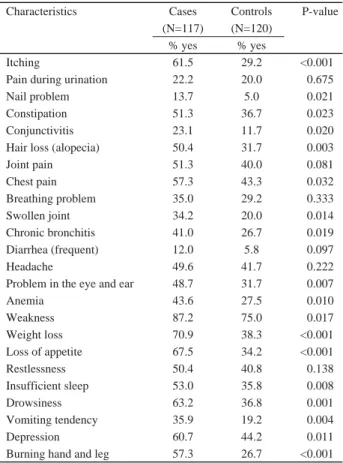
Characteristics
Itching
Pain during urination Nail problem Constipation Conjunctivitis Hair loss (alopecia) Joint pain Chest pain Breathing problem Swollen joint Chronic bronchitis Diarrhea (frequent) Headache
Problem in the eye and ear Anemia
Weakness Weight loss Loss of appetite Restlessness Insufficient sleep Drowsiness Vomiting tendency Depression Burning hand and leg
Cases (N=117)
% yes 61.5 22.2 13.7 51.3 23.1 50.4 51.3 57.3 35.0 34.2 41.0 12.0 49.6 48.7 43.6 87.2 70.9 67.5 50.4 53.0 63.2 35.9 60.7 57.3
Controls (N=120)
% yes 29.2 20.0 5.0 36.7 11.7 31.7 40.0 43.3 29.2 20.0 26.7 5.8 41.7 31.7 27.5 75.0 38.3 34.2 40.8 35.8 36.8 19.2 44.2 26.7
P-value
<0.001 0.675 0.021 0.023 0.020 0.003 0.081 0.032 0.333 0.014 0.019 0.097 0.222 0.007 0.010 0.017
<0.001
<0.001 0.138 0.008 0.001 0.004 0.011
<0.001
Table 4 Results of the blood test for some selected indicators by cases and frequency matched controls in some arsenic contaminated villages in Bangladesh
SD=Standard deviation Characteristics
Hemoglobin (g/dl) Billirubin (mg/dl)
AST (U/L) ALT (U/L) Random blood sugar (mmol/l)
Cases(N=117) mean ±SD 10.70 ±1.36
0.58 ±0.15 35.89 ±11.81
22.77 ±7.01 6.38 ±1.06
Controls(N=120) mean ±SD 11.94 ±1.38
0.53 ±0.17 31.88 ±9.27 21.50 ±6.38 6.13 ±1.10
Table 3 Perceived health problems reported by cases and fre- quency matched controls in some arsenic contaminated villages in Bangladesh
P-value
0.184 0.017 0.004 0.147 0.078
Table 5 Adjusted odds ratio (OR) for having arsenicosis by quartiles of different blood chemicals
**P<00.01, *P<0.05; CI=Confidence Interval
Adjusted for age, BMI, sex, marital status, education, occupation, smoking status, watching TV daily and perceived health status
Characteristics
Hemoglobin (g/dl):
1stquartile (≦10.90) 2ndquartile (10.91-12.00) 3rdquartile (12.01-12.60) 4thquartile (≧12.61)
Billirubin (mg/dl):
1stquartile (≦0.40) 2ndquartile (0.41-0.60) 3rdquartile (0.61-0.70) 4thquartile (≧0.71)
AST (U/L):
1stquartile (≦27.45) 2ndquartile (27.46-32.00) 3rdquartile (32.01-38.00) 4thquartile (≧38.01)
ALT (U/L):
1stquartile (≦18.00) 2ndquartile (18.01-20.00) 3rdquartile (20.01-25.00) 4thquartile (≧25.01)
Random blood sugar (mmol/l):
1stquartile (≦5.50) 2ndquartile (5.51-6.30) 3rdquartile (6.31-6.80) 4thquartile (≧6.81)
Case/Control n
37/31 28/26 27/31 25/32
23/43 58/51 17/14 19/12
25/35 34/25 21/40 37/20
30/30 26/34 28/29 33/27
29/40 27/29 28/33 33/18
OR (95% CI)
1.00 0.96 (0.40-2.28) 0.80 (0.31-2.05) 0.81 (0.31-2.13) P for trend=0.622
1.00 1.80 (0.82-3.96) 2.06 (0.70-6.05) 4.84 (1.51-15.52)**
P for trend=0.010
1.00 2.09 (0.83-5.24) 1.19 (0.48-3.00) 2.94 (1.15-7.52)*
P for trend=0.074
1.00 1.03 (0.43-2.49) 1.17 (0.50-2.73) 1.77 (0.71-4.41) P for trend=0.238
1.00 1.55 (0.63-3.85) 1.33 (0.54-3.28) 2.17 (0.82-5.72) P for trend=0.176
other studies in Bangladesh
21-23). For instance, melanosis and keratosis were reported 97.0% and 68.7% by Hossain et al
21), 100% and 80.9% by Milton et al
23), and 94.4% and 65.3% by Guha Mazumder
22).
Various socio-economic factors (Table 1) revealed that arsenicosis cases are relatively poorer than controls, which is consistent with the findings of other studies
5, 24-30). Some possible explanations could be given in this regard.
Firstly, a large percentage (20-70%) of the arsenicosis patients, most of which are extremely poor, remains untreated due to financial crisis. The status of being untreated further deteriorates the condition of arsenic vic- tims. In case of getting treatment for arsenicosis, the spending money diminishes household income and increases the economic burden of the poor victims and their family. Poverty could also be aggravated as the untreated poor victims are incapable of doing hard labor and associated with social discriminations such as losing jobs, barrier to access new jobs and social rejections
24).
Secondly, poorer families are more likely to depend on arsenic contaminated tubewell than socio-economical- ly better families because of limited alternatives of safe water
24, 31)including inability to install a new tubewell.
Rich people generally have the ability to take advantage of safe alternative water sources
31). Our data (not shown in Table) support both the above-mentioned explanations.
For instance, 85 arsenicosis cases (out of 117) and 15 controls (out of 120) were continuing to dink arsenic con- taminated water even after knowing that the water was arsenic contaminated by a previous test. Each of them was asked to mention the main reason of drinking such contaminated water. In response, 55 arsenicosis cases out of 85 (i. e., 68.6%) mentioned that scarcity of money including inability to install a new tubewell was the main reason, whereas this figure was 7 out of 15 (i. e., 46.7%) among controls.
Thirdly, various studies reported that socio-econom- ically poor people are significantly less likely to be aware about arsenic and related problems
25, 27). Fourthly, poor nutritional status, highly correlated with poor socio-eco- nomic status, is found to be associated with high arsenic toxicity
22, 29, 31, 32). For instance, the prevalence of keratosis was found significantly higher among the people of poor nutritional status than adequately nourished people
22). Mitra et al
29)also reported that the majority of the arseni- cosis patients came from very socioeconomic class with severely malnutrition. It is reported that poor nutritional status or dietary deficiency, associated with lower intake of the antioxidants, folate, and/or dietary proteins
33, 34), ly lower among cases than controls. Perceived health sta-
tus and satisfaction about daily activities differed signifi- cantly between cases and control. However, several char- acteristics such as age, BMI, per capital land owned, occupation, number of room, family members, household having radio and electricity, smoking/chewing tobacco, and food sufficiency in the whole year differed insignifi- cantly between cases and controls.
Drinking water related characteristics by cases and controls are shown in Table 2. This table also revealed that all the cases and controls (i. e. 100%) were drinking tubewell water, although 92.3% cases and 95% controls owned own tubewell (P=0.395). Only two characteristics namely result of the last test for arsenic in water (contam- inated versus not contaminated) and painting status of the tubewell (painted green means safe, painted red means unsafe, painted nothing) differed significantly (P<0.001) by cases and controls.
Table 3 shows that itching (P<0.001 based on
χ2test), nail problem (P=0.021), constipation (P=0.023), conjunctivitis (P=0.020), losing hair (P=0.003), chest pain (P=0.032), swollen joint (P=0.014), chronic cough (P=0.019), problem in the eye and ear (P=0.007), anemia (P=0.010), weakness (P=0.017), weight loss (P<0.001), loss of appetite (P<0.001), insufficient sleep (P=0.008), drowsiness (P=0.001), vomiting tendency (P=0.004), depression (P=0.011) and burning hand and leg (P<0.001) were significantly higher among cases than controls.
Table 4 indicates that mean level of some blood chemicals namely serum bilirubin (P=0.017) and AST (P=0.004) were significantly associated with arsenicosis.
Hemoglobin (P=0.184), ALT (P=0.147) and random blood sugar (P=0.078) were insignificantly associated with arsenicosis.
The logistic model adjusted for age, BMI, sex, mari- tal status, education, occupation, smoking/chewing tobac- co, watching TV daily and perceived health status (Table 5) indicates that arsenicosis cases were positively associ- ated with the highest quartile of bilirubin (OR=4.84; 95%
CI=1.51-15.52, P<0.01) and AST (OR=2.94; 95% CI=
1.15-7.52, P<0.05) level. Hemoglobin, ALT and random blood sugar were found to be insignificantly associated with arsenicosis.
4 DISCUSSION
Among cases of the present study, percentage of having melanosis and keratosis were 93.2% and 73.5%
respectively. This is consistent with the findings of some
diminishes the ability of metabolism and detoxification of arsenic in the body and hence increases an individual's susceptibility of chronic arsenic toxicity
31-35). In short, high protein containing diet possibly helps in clearance of inorganic arsenic by increased methylation
22). Unfortunately most of the poor people can not afford the cost of buying nutritious foods against arsenic toxicity
24).
Our study also showed significantly higher per- ceived health problems among cases than controls related to arsenic toxicity (Table 3). These findings are support- ed by many other studies
21, 28-30). For instance, loss of appetite (anorexia), nausea (vomiting tendency), diarrhea, anemia, neuropathy, hepatomegaly, lung disease, and weakness are frequently reported by the arsenicosis patients
22, 30). Mahmood and Ball
5)reported that patients with chronic arsenicosis in Bangladesh often present with weakness, conjunctivitis, aching, anorexia, nausea, vomit- ing, pain in abdomen, constipation, diarrhea, and weight loss. According to Milton et al
23), the predominant fea- tures of arsenicosis cases are cough, redness of eye, con- junctivitis, chronic bronchitis. Hossain et al
21)found sig- nificant association conjunctivitis, bronchitis, loss of appetite and wasting with keratosis. Mitra et al
29)reported that majority of the patients had multiple symptoms namely weakness, chronic cough, joint pain, itching, abdominal pain, chest pain, loss of appetite, insomnia, shortness of breathing, and burning in urination.
AST and ALT are used as indicators of hepatocellu- lar injury
36). Present study showed that AST level was significantly higher among cases than controls. Although elevated level of ALT was found among cases, it was sta- tistically insignificant. These findings are consistent with the findings of some other studies
22, 30, 37-39). For instance, increased activities of AST or ALT or both were reported among the individuals exposed to arsenic via drinking water
37, 39). An epidemiological study showed the evidence of hepatomegaly in 62 (92.5%) of 67 members who drank arsenic contaminated water (ranging from 0.2-2 mg/l). In contrast, only 6 (6.3%) of 96 persons from the same area who drank safe water (arsenic level, <0.05 mg/l) had non-specific hepatomegaly
30). According to Sinha et al
38)the reduced urinary excretion of arsenic observed in the arsenic affected patients may be related to liver dysfunction. Studies reported that inorganic arsenic is quickly absorbed into the blood stream
40)and mostly transported to the liver
40-43)and alters the hepatic functions or increases the liver enzyme activity indicating hepato- cellular injury
36, 43). The hepatic arsenic, weight of the liver, AST and ALT were increased significantly, after 6
or 12 months of arsenic contaminated water consumption, among arsenic-fed groups (mice) than controls
41).
Although hepatic damages caused by chronic expo- sure to arsenic has been reported by many studies
30, 36, 37, 41), little is known about the arsenic-induced liver toxicity
44). Particularly the mechanism by which arsenic causes liver damage remains elusive
36). However, it is reported that liver is the main site of inorganic arsenic methylation
4, 42)and associated with the process of liver dysfunction/car- cinogenesis. Some possible of carcinogenesis due to arsenic toxicity may include: DNA hypomethylation due to continuous methyl depletion facilitating aberrant gene expressions and abnormality in cell proliferation
44-48), decreased DNA repair
49), excessive formation of oxygen free radicals (oxidative stress) in plasma and reducing antioxidant capacity
40, 47, 50, 51), hypomethylation of the estrogen receptor-
αgene promoter
45), loss of tumor sup- pressor genes in the liver (e. g., glucocorticoid receptor (GR)) resulting from increased chromosomal aberrations and sister chromatid exchanges
52, 53), liver deletion of sele- nium via biliary excretion
54), presence of substantial chro- mosome damage in lymphocytes in the exposed popula-
tion
47, 55), and weakening of the antioxidant defense system
of the liver and consequent peroxidative damage of the lipid membranes due to the cumulative depletion of hepatic glutathione (GSH)
41, 56).
Present study revealed that serum bilirubin is signifi- cantly higher among arsenicosis cases than control (Table 4), which is consistent with the findings of some other studies
36, 37, 57). Armstrong et al
57)observed increased con- centration of total bilirubins in serum samples from seven individuals intoxicated with arsenic via drinking water.
Although insignificant, Lu et al
37)reported higher total bilirubin in arsenic affected areas than control area.
Hernandez-Zavala et al
36)also found significant correla- tion between total bilirubin and urinary arsenic concentra- tions, which suggest that arsenic exposure is strongly related to bilirubin alteration. The increase in bilirubin, a heme degradation product, could be explained by the induction of heme oxygenase (HO), the rate limiting enzyme of heme catabolism, since it has been reported that arsenic induces HO activity in rodents are associated with marked elevations in the biliary excretion of biliru- bin
36).
Our study showed elevated glucose level among
cases than controls although it was insignificant. Higher
concentration of blood glucose can be a sign of variety of
diseases such as diabetes mellitus (DM). This finding
may be supportive for other studies which reported the
positive associations of DM with both long term arsenic exposure and cumulative arsenic exposure
58-60). Significantly higher prevalence of DM was observed among the subjects with keratosis compared with subjects who did not have keratosis
59). The administration of arsenic has been demonstrated to cause hyperglycemia in experimental animals and to affect the functions of insulin receptor and glucose transportation
58). Arsenic has been found to cause mitochondrial damage, degeneration, and necrosis of β -cells in the islets of mice after intraperi- toneal injection or arsenic plus hydroxylamine, with a consequence of transient hyperglycemia
61). GR mediates blood glucose regulation and disrupting its normal func- tion due to arsenic which could be a part of how arsenic affects diabetes
52, 62).
As arsenic toxicity is more pronounced among poor and malnourished people as compared to rich, arsenic mitigation programs should target the arsenic exposed malnourished population as a priority
32). People should be urged to take food containing proteins in good quantity either from animal sources or if unable, from vegetable sources like pulses, soybeans, wheat and so on
22). Health education programs should be targeted to the lower socio- economic society for encouraging the well-switching
25). Some chief remedy should be available for poor victims.
In this regard, taking a potentized homeopathic medicine, called arsenicum albumin-30, may be beneficial at least for sometime where provision of safe arsenic-free drink- ing water or suitable medical help due to the remoteness of the area or any other more efficient drug is available.
A recent randomized controlled trail indicated that taking two doses of verum (arsenicum album-30 soaked globules) daily for 10 consecutive days (when each dose contains eight small globules soaked) is effective in improving the hepatic conditions. The notable changes observed in activities of hepatic functions as well as increased appetite reported by most of the subjects taking verum may ameliorate the arsenic-induced toxicity.
As this homeopathic remedy is reasonable (in terms of cost and accessibility) for most the poor people, there is a great potential of the remedy (by its large scale use) to ameliorate the groundwater arsenic toxicity in millions of poor rural people living in remote places
63).
Other mitigation activities or interventions such as (i) identification of a nearby tubewell with water of low arsenic concentration, (ii) installation of community wells where the proportion of safe wells is particularly low and the sharing of tube-wells is consequently not a viable option, (iii) close highly contaminated tubewells where
alternative water source is available, (iv) sharing nearby arsenic free tubewells, (v) proper watershed management, treating surface and ground water, (vi) rain water harvest- ing, (vii) traditional water management such as dug well and surface water with controls of bacterial and other chemical contamination through filtration and chlorina- tion, (viii) increasing public awareness of the arsenic calamity
5, 8, 9, 12, 25, 64)may be useful to address the arsenic problem effectively in Bangladesh. Community educa- tion, mobilization, motivation and proper monitoring may be essential for a sustainable solution to the problem
9, 12).
Media particularly TV can be used to deliver more and more messages regarding the consequences of ingest- ing arsenic as the significant negative association was found between television and drinking arsenic contami- nated water. As arsenic level may change over time
8, 65)and mislabeling of tubewells are reported
66), all the tube- wells should be checked periodically. Periodic testing by trained persons is necessary because many of the coun- try's people are facing the scarcity of uncontaminated water. Government also may extent the laboratory facili- ties phase by phase (based on contamination level) for testing the arsenic concentration in drinking water at the district level.
Some potential limitations such as small sample size, the possibility of mislabeling of arsenic contaminat- ed tubewell by previous tests, motivating patients to par- ticipate into the study, difficulty in obtaining blood in the field and carrying blood samples from the field to the lab- oratory for analysis within a reasonable time were impor- tant to note. Although significantly higher health prob- lems are reported by cases than control (Table 3), it is not possible to determine whether their perceived health problems appeared before or after their diagnosis of arsenicosis.
In short, arsenicosis cases are socio-economically poorer than controls. Perceived health problems as well as liver dysfunctions are also higher among cases than controls. These findings suggest us to recommend more mitigation activities and interventions for poor segment of the victimized society. The arsenicosis cases should be advised by the available health services to consult with medical practitioners for examining their liver functions to reduce the risk of developing liver cancer. Finally, arsenic poisoning should be on the top of the pubic heath agendas because of its' cascading effects.
Acknowledgments
The authors thank Sapporo Medical University
Foundation for Promotion of Medical Science for funding the study in Bangladesh. We also thank all other persons who supported us and involved in the data collection and blood testing during survey.
References
1. Yoshida T, Yamauchi H, Sun GF. Chronic health effects in people exposed to arsenic via the drinking water: dose- response relationships in review. Toxicol Appl Pharmacol 2004; 198: 243-252.
2. Chowdhury AMR. Arsenic crisis in Bangladesh. Sci Am 2004; 291: 86-91.
3. Khan MMH, Sakauchi F, Sonoda T, Washio M, Mori M.
Magnitude of arsenic toxicity in tube-well drinking water in Bangladesh and its adverse effects on human health includ- ing cancer: evidence from a review of the literature. Asian Pacific J Cancer Prev 2003; 4: 7-14.
4. Mandal BK, Suzuki KT. Arsenic around the world: a review. Talanta 2002; 58: 201-235.
5. Mahmood SAI, Ball C. Defining and implementing arsenic policies in Bangladesh: possible roles for public and private sector actors. J Health Hum Serv Administration 2004; 27:
158-174.
6. Fazal MA, Kawachi T, Ichion E. Extent and severity of groundwater arsenic contamination in Bangladesh. Water Int 2001; 26: 370-379.
7. Khan MMH, Hossain MK, Kobayashi K, Sakauchi F, Yamashita T, Ahmed MF, Hossain MD, Quamruzzaman Q, Mori M. Levels of blood and urine chemicals associated with longer duration of having arsenicosis in Bangladesh.
Int J Environ Health Res 2005; 15: 289-301.
8. Caldwell BK, Calwell JC, Mitra SN, Smith W. Searching for an optimum solution to the Bangladesh arsenic crisis.
Soc Sci Med 2003; 56: 2089-2096.
9. Smith AH, Lingas EO, Rahman M. Contamination of drink- ing-water by arsenic in Bangladesh: a public health emer- gency. Bull World Health Organ 2000; 78: 1093-1103.
10. Bangladesh Arsenic Mitigation Water Supply Project (BAMWSP). Newsletter and Upzila wise summary results.
Dhaka: National Arsenic Mitigation Information Centre (NAMIC), BAMWSP, DPHE, 2005.
11. Kinniburgh DG, Smedley PL editors. Arsenic contamination of groundwater in Bangladesh. In: Vol 1: Summary.
Keyworth: British Geological Survey; 2001 (British Geological Survey WC/00/19.)
12. Rahman M. Arsenic and contamination of drinking-water in Bangladesh: a public health perspective. J Health Popul Nutr 2002; 20: 193-197.
13. Hassan MM, Atkins PJ, Dunn CE. Social implications of arsenic poisonning in Bangladesh. Soc Sci Med 2005; 61:
2201-2211.
14. Ahsan H, Chen Y, Parvez F, Zablotska L, Argos M, Hussain I, Momotaj H, Levy D, Cheng Z, Slavkovich V, van Geen A, Howe GR, Graziano JH. Arsenic exposure from drinking water and risk of premalignant skin lesions in Bangladesh:
baseline results from the Health Effects of Arsenic Longitudinal Study. Am J Epidemiol 2006; 163: 1138-1148.
15. Rahman M, Tondel M, Ahmad SA, Chowdhury IA, Faruquee MH, Axelson O. Hypertension and arsenic expo- sure in Bangladesh. Hypertension 1999; 33: 74-78.
16. Rahman M, Tondel M, Chowdhury IA, Axelson O.
Relations between exposure to arsenic, skin lesions, and glu- cosuria. Occup Environ Med 1999; 56: 277-281.
17. Milton AH, Smith W, Rahman B, Hasan Z, Kulsum U, Dear K, Rakibuddin M, Ali A. Chronic arsenic exposure and adverse pregnancy outcomes in Bangladesh. Epidemiology 2005; 16: 82-86.
18. Milton AH, Hasan Z, Rahman A, Rahman M. Chronic arsenic poisoning and respiratory effects in Bangladesh. J Occup Health 2001; 43: 136-140.
19. Chen Y, Ahsan H. Cancer burden from arsenic in drinking water in Bangladesh. Am J Public Health 2004; 94: 741- 744.
20. Lokuge KM, Smith W, Caldwell B, Dear K, Milton AH.
The effect of arsenic mitigation interventions on disease burden in Bangladesh. Environ Health Perspect 2004; 112:
1172-1177.
21. Hossain MK, Khan MMH, Alam MA, Chowdhury AK, Hossain MD, Ahmed MF, Kobayashi K, Sakauchi F, Mori M. Manifestation of arsenicosis patients and factors deter- mining the duration of arsenic symptoms in Bangladesh.
Toxicol Appl Pharmacol 2005; 208: 78-86.
22. Guha Mazumder DN. Chronic arsenic toxicity: clinical fea- tures, epidemiology, and treatment: experience in West Bengal. J Environ Sci Health A 2003; A38: 141-163.
23. Milton AH, Hasan Z, Rahman A, Rahman M. Non-cancer effects of chronic arsenicosis in Bangladesh: preliminary results. J Environ Sci Health A 2003; A38: 301-305.
24. Chowdhury MAI, Uddin MT, Ahmed MF, Ali MA, Rasul SMA, Hoque MA, Alam R, Sharmin R, Uddin SM, Islam MS. Collapse of socio-economic base of Bangladesh by arsenic contamination in groundwater. Pakistan J Biol Sci 2006; 9: 1617-1627.
25. Parvez F, Chen Y, Argos M, Hussain AZMI, Momotaj H, Dhar R, van Geen A, Graziano JH, Ahsan H. Prevalence of arsenic exposure from drinking water and awareness of its health risks in a Bangladeshi population: results from a large
population-based study. Environ Health Perspect 2006; 114:
355-359.
26. Hadi A, Parveen R. Arsenicosis in Bangladesh: prevalence and socio-economic correlates. Public Health 2004; 118:
559-564.
27. Hadi A. Fighting arsenic at the grassroots: experience of BRAC's community awareness initiative in Bangladesh.
Health Policy Plann 2003; 18: 93-100.
28. Dey RK, Hoque MM, Haque MA, Hossain MZ, Cockcroft A. Assessment of risk factors for arsenicosis in a selected Upazila in Bangladesh: Final repot. Dhaka: UNICEF, September 2002.
29. Mitra AK, Bose BK, Kabir H, Das BK, Hussain M. Arsenic- related health problems among hospital patients in southern Bangladesh. J Health Popul Nutr 2002; 20: 198-204.
30. Guha Mazumder DN, Chakraborty AK, Ghose A, Gupta JD, Chakraborty DP, Dey SB, Chattopadhyay N. Chronic arsenic toxicity from drinking tubewell water in rural West Bengal. Bull World Health Organ 1988; 66: 499-506.
31. Hanchett S, Nahar Q, van Agthoven A, Geers C, Rezvi MFJ. Increasing awareness of arsenic in Bangladesh: les- sons from a public education programme. Health Policy Plann 2002; 17: 393-401.
32. Milton AH, Hasan Z, Shahidullah SM, Sharmin S, Jakariya MD, Rahman M, Dear K, Smith W. Association between nutritional status and arsenicosis due to chronic arsenic exposure in Bangladesh. Int J Environ Health Res 2004; 14:
99-108.
33. Gamble MV, Liu X, Ahsan H, Pilsner JR, IIievski V, Slavkovich V, Parvez F, Levy D, Factor-Litvak P, Graziano JH. Folate, homocysteine, and arsenic metabolism in arsenic-exposed individuals in Bangladesh. Environ Health Perspect 2005; 113: 1683-1688.
34. Steinmaus C, Carrigan K, Kalman D, Atallah R, Yuan Y, Smith AH. Dietary intake and arsenic methylation in a U. S.
population. Environ Health Perspect 2005; 113: 1153-1159.
35. Buchet JP, Geubel A, Pauwels S, mahieu P, Lauwerys R.
The influence of liver disease on the methylation of asrenite in humans. Arch Toxicol 1984; 55: 151-154.
36. Hernandez-Zavala A, Del Razo LM, Aguilar C, Garcia- Vargas GG, Borja VH, Cebrian ME. Alteration in bilirubin excretion in individuals chronically exposed to arsenic in Mexico. Toxicol Lett 1998; 99: 79-84.
37. Lu S-N, Chow N-H, Wu W-C, Chang T-T, Huang W-S, Chen S-C, Lin C-H, Carr BI. Characteristics of hepatocellu- lar carcinoma in a high arsenicism area in Taiwan: a case- control study. J Occup Environ Med 2004; 46: 437-441.
38. Sinha SK, Misbahuddin M, Ahmed ANN. Factors involved in the development of chronic arsenic poisoning in
Bangladesh. Arch Environ Health 2003; 58: 699-700.
39. Franzblau A, Lilis R. Acute arsenic intoxication from envi- ronmental arsenic exposure. Arch Environ Health 1989; 44:
385-390.
40. Chiou H-Y, Hsueh Y-M, Liaw K-F, Horng S-F, Chiang M- H, Pu Y-S, Lin JS-N, Huang C-H, Chen C-J. Incidence of internal cancers and ingested inorganic arsenic: a seven-year follow-up study in Taiwan. Cancer Res 1995; 55: 1296- 1300.
41. Santra A, Maiti A, Das S, Lahiri S, Charkaborty SK, Guha Mazumder DN. Hepatic damage caused by chronic arsenic toxicity in experimental animals. Clin Toxicol 2000; 38:
395-405.
42. Benramdane L, Accominotti M, Fanton L, Malicier D, Vallon J-J. Arsenic speciation in human organs following fatal arsenic trioxide poisoning- a case report. Clin Chem 1999; 45: 301-306.
43. Chiou PW-S, Chen K-L, Yu B. Effects of roxarsone on per- formance, toxicity, tissue accumulation and residue of eggs and excreta in laying hens. J Sci Food Agric 1997; 74: 229- 236.
44. Cui X, Li S, Shraim A, Kobayashi Y, Hayakawa T, Kanno S, Yamamoto M, Hirano S. Subchronic exposure to arsenic through drinking water alters expression of cancer-related genes in rat liver. Toxicol Pathol 2004; 32: 64-72.
45. Chen H, Li S, Liu J, Diwan BA, Barrett JC, Waalkes MP.
Chronic inorganic arsenic exposure induces hepatic global and individual gene hypomethylation: implications for arsenic hepatocarcinogenesis. Carcinogenesis 2004; 25:
1779-1786.
46. Liu J, Xie Y, Ward JM, Diwan BA, Waalkes MP.
Toxicogenomic analysis of aberrant gene expression in liver tumors and nontumorous livers of adult mice exposed in utero to inorganic arsenic. Toxicol Sci 2004; 77: 249-257.
47. Roy P, Saha A. Metabolism and toxicity of arsenic: a human carcinogen. Current Sci 2002; 82: 38-45.
48. Zhao CQ, Young MR, Diwan BA, Coogan TP, Waalkes MP. Association of arsenic-induced malignant transforma- tion with DNA hypomethylation and aberrant gene expres- sion. Proc Natl Acad Sci USA 1997; 94: 10907-10912.
49. Andrew AS, Karagas MR, Hamilton JW. Decreased DNA repair gene expression among individuals exposed to arsenic in United States drinking water. Int J Cancer 2003; 104:
263-268.
50. Pi J, Yamauchi H, Kumagai Y, Sun G, Yoshida T, Aikawa H, Hopenhayn-Rich C, Shimojo N. Evidence for induction of oxidative stress caused by chronic exposure of Chinese residents to arsenic contained in drinking water. Environ Health Perspect 2002; 110: 331-336.
51. Wu M-M, Chiou H-Y, Wang T-W, Hsueh Y-M, Wang I-H, Chen C-J, Lee T-C. Association of blood arsenic levels with increased reactive oxidants and decreased antioxidant capac- ity in a human population of Northeastern Taiwan. Environ Health Perspect 2001; 109: 1011-1017.
52. Kaltreider RC, Davis AM, Lariviere JP, Hamilton JW.
Arsenic alters the function of the glucocorticoid receptor as a transcription factor. Environ Health Perspect 2001; 109:
245-251.
53. Chen C-J, Chen CW, Wu M-M, Kuo T-L. Cancer potential in liver, lung, bladder and kidney due to ingested inorganic arsenic in drinking water. Br J Cancer 1992; 66: 888-892.
54. Spallholz JE, Boylan LM, Rahman MM. Environmental hypothesis: is poor dietary selenium intake an underlying factor for arsenicosis and cancer in Bangladesh and West Bengal, India? Sci Total Environ 2004; 323: 21-32.
55. Mahata J, Chaki M, Ghosh P, Das JK, Baidya K, Ray K, Natarajan AT, Giri AK. Chromosomal aberrations in arsenic-exposed human populations: a review with special reference to a comprehensive study in West Bengal, India.
Cytogenet Genome Res 2004; 104: 359-364.
56. Guha Mazumder DN. Effect of chronic intake of arsenic- contaminated water on liver. Toxicol Appl Pharmacol 2005;
206: 169-175.
57. Armstrong CW, Stroube RB, Rubio T. Outbreak of fatal arsenic poisoning caused by contaminated drinking water.
Arch Environ Health 1984; 39: 276-279.
58. Tseng C-H, Tai T-Y, Chong C-K, Tseng C-P, Lai M-S, Lin BJ, Chiou H-Y, Hsueh Y-M, Hsu K-H, Chen C-J. Long- term arsenic exposure and incidence of non-insulin-depend- ent diabetes mellitus: a cohort study in arseniasis-hyperen- demic villages in Taiwan. Environ Health Perspect 2000;
108: 847-851.
59. Rahman M, Tondel M, Ahmad SK, Axelson O. Diabetes mellitus associated with arsenic exposure in Bangladesh.
Am J Epidemiol 1998; 148: 198-203.
60. Lai M-S, Hsueh Y-M, Chen C-J, Shyu M-P, Chen S-Y, Kuo T-L, Wu M-M, Tai T-Y. Ingested inorganic arsenic and
prevalence of diabetes mellitus. Am J Epidemiol 1994; 139:
484-492.
61. Boquist L, Boquist S, Ericsson I. Structural β-cell changes and transient hyperglycemia in mice treated with com- pounds inducing inhibited citric acid cycle enzyme activity.
Diabetes 1988; 37: 89-98.
62. Josephson J. Arsenic and endocrines: new study suggests disruption. Environ Health Perspect 2001; 109: A132-A133.
63. Khuda-Bukhsh AR, Pathak S, Guha B, Karmakar SR, Das JK, Banerjee P, Biswas SJ, Mukherjee P, Bhattacharjee N, Choudhury SC, Banerjee A, Bhadra S, Mallick P, Chakrabarti J, Mandal B. Can homeopathic arsenic remedy combat arsenic poisoning in humans exposed to groundwa- ter arsenic contamination?: a preliminary report on first human trial. Evid Based Complement Alternat MED 2005;
2: 537-548.
64. van Geen A, Ahmed KM, Seddique AA, Shamsudduha M.
Community wells to mitigate the arsenic crisis in Bangladesh. Bull World Health Organ 2003; 81: 632-638.
65. National Institute of Population Research and Training (NIPORT), Mitra and Associates, ORC Macro. Bangladesh Demographic and Health Survey 2004. Dhaka: NIPORT, Mitra and Associates, and Calverton, MD: ORC Macro, 2005.
66. Rahman MM, Mukherjee D, Sengupta MK, Chowdhury UL, Lodh D, Chanda CR, Roy S, Selim M, Quamruzzaman Q, Milton AH, Shahidullah SM, Rahman MT, Chakraborti D. Effectiveness and reliability of arsenic field testing kits:
are the millions dollar screening projects effective or not?
Environ Sci Technol 2002; 36: 5385-5394.
Corresponding author:
MMH Khan
Department of Public Health Sapporo Medical University Chuo-ku, S 1, W 17 Sapporo 060-8556, Japan
Email: [email protected] or [email protected] Fax: 81-11-641-8101