• 検索結果がありません。

英語の授業における学習方略 古 屋 則 子

N/A
N/A
Protected

Academic year: 2021

シェア "英語の授業における学習方略 古 屋 則 子"

Copied!
11
0
0

読み込み中.... (全文を見る)

全文

(1)

本学助教授 社会言語学,TESOL

英語の授業における学習方略

古 屋 則 子

Learning Strategies of Japanese EFL Students

Noriko Furuya

要 旨 本研究は日本人学生が英語の授業に出席しているのにもかかわらず,英語力がなかなか伸び ないという教員の悩みを受けて行ったものである。学習を効果的に行うために不可欠な

Learning Strategies(学習方略)を学生が活用しているか,一年生50名を対象にアンケート調査を行った。その

結果,多くの学生は授業以外のところではほとんど学習方略を有効に活用していないことが判明した。

キーワード

learning strategies learner autonomy good language learner

The concept of learner autonomy has always been of interest in second language acquisition (SLA), and has been investigated since the 1970s. However, due to the proliferation of technology based instruction, the computerization of standardized testing, such as the Test of English as a For- eign Language, (TOEFL) and self-access learning via the Internet, there has been renewed interest in recent years in this subject among practicing teachers and researchers (Benson, 2001). Learner autonomy is especially relevant to those in the ˆeld of tertiary education in Japan today, as teachers face a greater diversity of students as a consequence of ``zennyu'' (entrance for all applicants) (Furusawa, 2001) and ``kiso gakuryoku no teika.'' (an overall decline in academic ability) (Tose and Nishimura, 2001) As a result, instructors in all subject areas are increasingly facing an in‰ux of students who enter college classrooms exhibiting poor usage of learning strategies.

Autonomy and learning strategies

Researchers on autonomy (e.g. Benson, 2001) claim that autonomous learners are more eŠective

than non-autonomous learners; that is, autonomy fosters better language learning. Furthermore,

learning can be enhanced when learners organize and manage their own learning. Many of the stu-

dies that have focused on autonomy have drawn largely from that of learning strategies. Wenden,

one of the pioneering researchers of learner strategies, linked them to autonomy, stipulating that

fostering autonomy was one of the most important goals of language learning (1985). How do learn-

ing strategies diŠer from learning styles? Learning styles are tendencies that an individual has for

learning in general. ``Styles are those general characteristics of intellectual functioning that pertain

to you as an individual, and that diŠerentiate you from someone else.'' (Brown, 2000) They tend to

(2)

be fairly consistent within individuals. An example of a learning style is a preference for visual or au- ditory input; does the learner prefer to read a text and look at pictures, or does he or she prefer to listen to lectures and listen to a CD? Another learning style is whether the learner is re‰ective or im- pulsive; does the learner take a lot of time to formulate a reply, or is the answer blurted out quickly?

Other learning styles are related to concepts of ˆeld independence and dependence, right or left brain dominance, and tolerance of ambiguity. Strategies on the other hand, are ways in which learn- ers handle a particular task. Ellis deˆnes learning strategies as:

... how learners accumulate new L2 rules and how they automatize existing ones. They include the strategies involved in the general processes of hypothesis formation and testing. These can be conscious or subconscious. (1986: 299)

There is still some controversy regarding whether strategy use is conscious or subconscious. Some researchers such as Cohen (1999) point out that the element of consciousness is exactly what is sig- niˆcant about strategies. He deˆnes learning strategies as ``learning processes which are conscious- ly selected by the learner. The element of choice is important here because this is what gives a strategy its special character.'' (p. 5)

Contrary to learning styles, learning strategies can vary substantially within individuals and among individuals. In the 1970s, some researchers noticed that certain learners were successful lan- guage learners regardless of what teaching method was used, and compiled a list of characteristics exhibited by a ``good language learner.'' (Rubin, 1975; Rubin and Thomson, 1982; Ellis, 1986) These include aŠective factors e.g. ``seeking out all opportunities to use the target language'', cogni- tive factors e.g. ``supplementing the learning that derives from direct contact with speakers of the L2 with learning derived from the use of study techniques'' (such as making vocabulary lists), and those that have to do with motivation, e.g. ``possess a strong reason for learning the L2.'' (Ellis, 1986: 122)

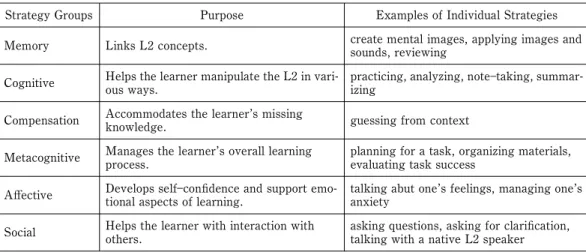
Extensive research on strategies was conducted in the 1980s and 90s (e.g. McDonough, 1999) and various taxonomies of strategies were compiled. Oxford (1990) proposed a comprehensive view of strategies and categorized them into six strategy groups, summarized in Table 1. The strategy groups are comprised of sixteen strategy sets, and sixty-two individual strategies.

The use and eŠectiveness of language strategies depend on numerous factors including age, moti- vation, (e.g. Gardner and Lambert, 1972; D äornyei, 1998) gender, ( Kaylani, 1996) and culture. Of particular interest when language learning is done by learners whose cultural background is not the same as that of the instructor is the eŠect of culture on the use of learning strategies. Research has shown that language strategy use is not consistent across cultures; furthermore, learners from diŠer- ent cultures show tendencies regarding strategy choice for various tasks. (Rubin, 1975; Chamot et.

al. 1999) A recent study investigating student attitudes regarding the use of the self-access center at

the University of Auckland indicates that of all of the international students studying English as an

(3)

Table 1 Oxford's Six Strategy Groups

Strategy Groups Purpose Examples of Individual Strategies

Memory Links L2 concepts. create mental images, applying images and sounds, reviewing

Cognitive Helps the learner manipulate the L2 in vari- ous ways.

practicing, analyzing, note taking, summar- izing

Compensation Accommodates the learner's missing

knowledge. guessing from context

Metacognitive Manages the learner's overall learning process.

planning for a task, organizing materials, evaluating task success

AŠective Develops self conˆdence and support emo- tional aspects of learning.

talking abut one's feelings, managing one's anxiety

Social Helps the learner with interaction with others.

asking questions, asking for clariˆcation, talking with a native L2 speaker

L2, Japanese students were the least prepared for independent study. (Reinders , 2005)

Research questions

This study is an initial attempt at investigating the language learning strategies employed by stu- dents at the researcher's institution. In recent years, instructors have been criticized for the lack of marked improvement in the students' English proˆciency despite regular attendance in class. In ord- er to accommodate the language learning process of these students, a genuine need was felt to ad- dress the following questions:

1. Are these students actively exploiting language strategies, and if so, which ones?

2. Which strategies should they be utilizing, so that they can become more successful learners?

Method

Assessing learning strategies is a complex task, due to the intricacy of the construct itself. Studies

have utilized journals, observations, think-aloud protocols, questionnaires, and interviews. (e.g. Ru-

bin, 1975; Cohen, 1998; Anderson, 1991, Oxford 1990) A strategy assessment questionnaire, one of

the many self-check questionnaires (See Appendix 2) in a strategy training manual for language

learners, was thought to be appropriate for this initial study. (Brown, 2002) The questionnaire is

comprised of sixteen items that ask students about the use of speciˆc learning strategies. Fourteen

out of the sixteen items address mainly strategies in the cognitive strategy group, and two items deal

primarily with strategies in the compensation strategy group. Inevitably, there is always some

degree of overlap when dealing with individual strategies. Take for example, the act of compiling a

vocabulary list of new words according to grammatical function. This involves a metacognitive func-

tion, helping the students arrange and plan their learning, as well as the cognitive function of creat-

ing structure for input and output. In addition, this would also entail a memory function, as the stu-

(4)

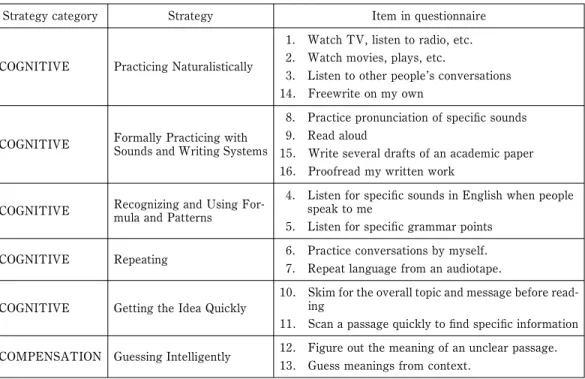
Table 2 Breakdown of items in questionnaire

Strategy category Strategy Item in questionnaire

COGNITIVE Practicing Naturalistically

1. Watch TV, listen to radio, etc.

2. Watch movies, plays, etc.

3. Listen to other people's conversations 14. Freewrite on my own

COGNITIVE Formally Practicing with Sounds and Writing Systems

8. Practice pronunciation of speciˆc sounds 9. Read aloud

15. Write several drafts of an academic paper 16. Proofread my written work

COGNITIVE Recognizing and Using For- mula and Patterns

4. Listen for speciˆc sounds in English when people speak to me

5. Listen for speciˆc grammar points COGNITIVE Repeating 6. Practice conversations by myself.

7. Repeat language from an audiotape.

COGNITIVE Getting the Idea Quickly

10. Skim for the overall topic and message before read- ing

11. Scan a passage quickly to ˆnd speciˆc information COMPENSATION Guessing Intelligently 12. Figure out the meaning of an unclear passage.

13. Guess meanings from context.

dent would use this list to create mental linkages and use these words to review. Table 2 shows a breakdown of the questions in the questionnaire, indicating which individual strategy the item ad- dresses. The students were asked to rate themselves on a scale of 1 to 5, indicating frequency of use of a particular strategy, 1 being the least frequent and 5 being the most frequent.

Subjects

Fifty 1

st

year students at a women's university in Tokyo, Japan were the subjects of this study.

The students belong to the International Fashion and Culture Studies Program in the Faculty of Liberal Arts and Sciences, a program whose primary aim is to produce graduates that can work in the fashion industry world-wide. English, therefore, is considered to be of major importance in their studies. The researcher administered the questionnaires to all of the students. Instructions were given in Japanese, and the sixteen questions were explained, in Japanese, in order to ensure compre- hension by all.

Results and Discussion

Twelve items in the questionnaire address ``Practicing'', what Oxford refers to as the most im-

portant strategy set in the Cognitive strategies group. Many researchers in SLA place particular im-

portance on the strategy ``Practicing Naturalistically'', as it has been claimed that this is one of the

(5)

most important things involved in successful second language acquisition. (e.g. Rubin, 1976) Four items in this questionnaire address this particular strategy. It had been assumed that item 1, ``Watch TV, listen to radio, etc.'' and item 2, ``Watch movies, plays, etc.'' would be rated highly since these activities include listening to current CDs of popular artists and watching box o‹ce hits, pastimes that are thought to be enjoyable and accessible to everyone, especially young Japanese women. On the contrary, the mean for items 1 and 2 were 2.2 and 2.4 respectively, and the median for both was 2. Similarly, item 14, ``Freewrite on my own'', a strategy that includes diary and journal writing yielded similar results, showing a mean of 1.9 and a median of 2. (Descriptive statistics for all 16 items are found in Appendix 1.)

Another individual strategy included in the ``Practicing'' strategy set is ``Repeating'', elicited in item 6, ``Practice conversations by myself'' and 7, ``Repeat language from an audiotape.'' The mean, 2.2, and 1.8 respectively, and the common median 2, for both items again show a medium rate when using these strategies. Items under ``Formally Practicing with Sounds and Writing Systems'' showed similar rates of use. These include item 8, ``Pronouncing speciˆc sounds'' and item 9,

``Reading aloud'', both with a medium rate of use, with mean scores of 2.6 and 2.9 respectively, and a common median of 3. Strategies used in writing are addressed in item 15, ``Write several drafts of an academic paper'' and item 16, ``Proofread my written work.'' Again medium rates of use of these strategies can be seen from the means, 2 and a slightly higher 2.3, respectively and a common medi- an of 2. One explanation of the low rates for these items may be that these students do not take any English writing courses, and the compulsory classes that they take involve mainly speaking, listen- ing, and reading. However, due to the low rate in ``Freewrite on my own'', it seems unlikely that these students voluntarily engage in any kind of writing in English.

``Recognizing and Using Formulas and Patterns'' is another individual strategy that is included in the ``Practicing'' strategy set. The items that address this strategy are item 4, ``Listen for speciˆc sounds in English when people speak to me'', and item 5, ``Listen for speciˆc grammar points.'' The mean scores for these items are 3.1, and 2.4, respectively and the respective median scores of 3 and 2 indicate that this strategy is used at a medium rate.

As mentioned above, many of these strategies elicited in the questionnaire involve more than one strategy group. The items that come under ``Practicing Naturalistically'', ``Formally Practicing Sounds and Writing Systems'', and ``Repeating'' clearly involve a metacognitive function. Although all of the students involved in this survey have access to English DVDs, videos and CDs, few of them actually take the time to sit at home or in the library to actively utilize these resources. A question- naire given to these students on the ˆrst day of class indicated that many of them had a desire to watch movies and TV programs in English. It would be fair to conclude that although they are will- ing to engage in these activities in the classroom, they are not interested in doing them on their own time. Similarly, the items in the questionnaire that are representative of the ``Repeating'' strategy,

``Practice conversations by myself'' and ``Repeat language from an audiotape'' involve metacogni-

tive aspects as well. In order to engage in these language learning activities, the learners would need

(6)

to ˆnd a place and time alone, in other words, actively seek an environment where they would manage and be accountable for their own learning. By the same token, metacognitive functions are involved in the four items that have to do with ``Formally Practicing with Sounds and Writing Sys- tems'': ``Practice pronunciation of speciˆc sounds'', ``Read aloud'', ``Write several drafts of an aca- demic paper'' and ``Proofread my written work.'' These are again activities that require a quiet place to work and uninterrupted time outside of the classroom.

Of the sixteen language learning tasks that the students were asked to evaluate, students rated themselves relatively highly for items 12 and 13 with a common median of 4, and means of 3.6 and 3.5 respectively. These two items come under the category of compensation strategies, what Oxford refers to as ``Guessing Intelligently by Using Linguistic and Other Clues.'' (1990: 19) It is worth noting that these two activities can be done solely during class; no commitment outside the class- room is required.

The above results share similar tendencies with another recent study done among Japanese university students. (Brown, 2005) In this study, ˆrst year Japanese university students were asked to provide examples of eŠective self-study methods. Many of the methods suggested were similar to the tasks in the questionnaire used in this study. (e.g.Watch TV and movies, Read English, Listen to English songs, Listen to news or TV) In Brown's study, the students knew what they should do, but he found that most of the students failed to act out these suggestions, citing lack of time as their pri- mary reason. Reinder (2005) also reported that the Japanese students came unprepared for study at the University of Auckland, citing the lack of metacognitive skills necessary to utilize the language support services that the university oŠered.

Conclusion

The students surveyed in this study take three 90-minute sessions of English per week for thirty weeks in a year. In intensive English programs, students take classes full-time and spend hours out- side the classroom reviewing and preparing. For example, international students enrolled in the Ari- zona State University American and English Program take classes from 840 to 530 ˆve days a week for eight weeks in order to complete one level of English. (http://www.asu.edu/wed/aecp/

course) For students to go from the low intermediate level (where most of the students in this study would most likely be placed) to the high advanced level necessary for study in credit programs, they would need to take four levels of English in this particular program. This translates roughly into 1, 120 hours of classroom instruction. As the numbers of hours spent in our university English class- rooms are clearly not su‹cient, it is apparent that these students will need to invest a substantial amount of time studying on their own. The results indicate that that these students show a lack of understanding of what it means to ``study'' English outside, and perhaps for that matter, inside the classroom.

In practical terms, there is a need to accommodate the lack of learning strategies exhibited by our

learners by incorporating strategy training into the curriculum. There is evidence to suggest that

(7)

strategy training will result in improved learning performance, in particular when teachers integrate it as part of their normal classroom practices. (McDonough, 1999) It was discussed above that

``Practicing Naturalistically'' is one of the most important strategies for language acquisition, and that good learners tend to take every opportunity in order to engage in this. However, the low rates of use by these particular learners suggest that one of the reasons they do not initiate this strategy, is simply because they do not how to go about it. Watching a video for enjoyment in their native lan- guage is one thing; using the same resource for the study of English is another. Therefore, teachers can instruct the students how to exploit video for language learning outside the classroom by demon- strating how do this in the classroom. A brief segment of a movie or a TV program can be shown, and the students will be instructed to write out the dialogue, by repeatedly listening to the excerpt.

They should also be encouraged to discuss their answers with each other, so that the stronger stu- dents can help the weaker ones. Through this simple learning task, not only will students attain lin- guistic knowledge, they will have exploited several learning strategies including ``Practicing Naturalistically'', ``Analyzing Expressions'', ``Repeating (Cognitive strategies) and ``Using Lin- guistic Cues to Guess Intelligently'' and ``Approximating the Language'' (Compensation strategies) as well as ``Cooperating with Peers'' and ``Cooperating with Proˆcient Users of the New Lan- guage.'' (Social strategies) (Oxford, 1990)

There are an increasing number of Japanese college students today that have essentially gone through twelve years of schooling with an inability to use basic learning strategies. Although the strategies addressed in this study are related to language learning, it would be fair to say that these strategies are in fact, used in all subject areas. It is worth noting that Japan is the land of juku, the ubiquitous cram schools that students, from elementary to high school, attend after regular school in order to learn ``how to study'', or rather, ``how to pass exams.'' Students, as well as their parents, feel that the students are ``studying'' if they go to juku. As juku classes guide students step-by step on speciˆc test taking skills in order to pass exams for a particular university, this may actually hin- der students from attaining the learning strategies they would need, if they were to study all on their own. (Kawakami, 1999)

When students actively utilize learning strategies, they make remarkable progress. One of the researcher's best students improved her TOEFL score by 100 points in approximately one year. She is concrete proof that the ``good language learner'' is not a myth. From informal interviews with the student, the researcher learned that this student made herself set aside at least one or two hours a day for studying English at home, her learning tool of choice being the English language newspaper.

In her free time, she made lists of vocabulary words, pronounced the words out loud, and wrote them

down repeatedly. In the researcher's English class, she was one of the few students that continuous-

ly received high grades in all of the classroom quizzes and tests. In addition, she completed an on-

line TOEIC program, and was an active member of the English Speaking Society. No one can deny

that she truly took every opportunity to practice her English! Having to meet her fashion assignment

deadlines while continuing all of her language learning activities was no easy feat, but she was re-

(8)

warded when she was able to clear the 550 TOEFL requirement to study at a major American university. The majority of the ˆrst-year students in this study failed to exhibit the qualities of a

``good language learner.'' However, by changing their behavior and by emulating the strategies uti- lized by this successful student, they should be able to make considerable improvement in their En- glish proˆciency. As Benson aptly puts it:

``Learners who lack autonomy are capable of developing it given appropriate conditions and preparation... The ways in which we organize the practice of teaching and learning therefore have an important in‰uence on the development of autonomy among our learners.'' (Benson, 2001: 2)

References

Anderson, N. (1991). Individual diŠerences in strategy use in second language reading and testing. Modern Lan- guage Journal 75: 460 472.

Arizona State University American and English Program web page http://www.asu.edu.

Wed/aecp/course.)

Benson, P. (2001). Teaching and Researching Autonomy in Language Teaching. Essex: Longman.

Brown, D. (2002). Strategies for Success. White Plains, NY: Longman.

Brown, R. (2005). Autonomous learning strategies of EFL students. The Language Teacher, 29(4), 11 14.

Chamot, A., Barnhart, S., El Dinary, P. and Robbins, J. (1999). The Learning Strategies Handbook. White Plains, NY: Longman.

Cohen, A. D. (1998). Strategies in Learning and Using a Second Language. London: Longman.

D äornyei, Z. (1998). Motivation in second and foreign language learning. Language Teaching 31: 117 135.

Ellis, R. (1986). Understanding Second Language Acquisition. Oxford: Oxford University Press.

Furusawa, Y. (2001). Daigaku Sabaibaru. Tokyo: Shueisha.

Gardner, R. and Lambert, W. (1972). Attitudes and Motivation in Second Language Learning. Rowley, MA: New- bury House.

Kawakami, R. (1999). Gakko Hookai. Tokyo: Soonsha.

Kaylani, C. (1996). The In‰uence of Gender and Motivation on EFL Learning Strategy Use in Jordan. In Lan- guage Learning Strategies Around the World. Honolulu: University of Hawaii Press.

McDonough, S. (1999). Learner strategies. Language Teaching 32: 1 18.

Oxord, R. (1990). Language Learning Strategies. Boston: Heinle & Heinle.

Reinders, H. (2005). Nonparticipation in University Language Support. JALT Journal 27(2): 209 222.

Rubin, J. (1975). What the ``good language learner'' can teach us. TESOL Quarterly 9: 41 51.

Rubin, J. and Thomson, I. (1982). How to Be a More Successful Language Learner, Boston: Heinle & Heinle.

Tose, N. and Nishimura, K. (2001). Daigakusei no gakuryoku o handan suru. Tokyo: Iwanami Shinsho.

Wenden, A. (1985). Learner strategies. TESOL Newsletter 19:1 7.

(9)

APPENDIX 1

Descriptive Statistics of Questionnaire

#1 #2 #3 #4 #5 #6 #7 #8

MEDIAN 2 SD 2 SD 2 SD 3 SD 2 SD 2 SD 2 SD 3 SD

AVERAGE 2.2 1.031 2.41 1.08 2.37 0.86 3.12 0.97 2.39 0.98 2.16 1.11 1.837 0.943 2.612 1.057

2 3 1 2 2 1 2 1

3 4 2 4 3 3 2 4

4 3 2 3 4 1 2 2

2 2 3 5 4 2 2 2

2 0 1 3 2 2 2 3

2 3 2 3 2 1 1 1

3 3 3 4 4 5 4 5

4 4 4 4 3 3 3 3

2 2 2 3 2 2 1 3

2 4 3 4 3 2 2 3

3 3 3 4 3 5 5 5

1 3 2 3 2 2 1 3

1 1 2 3 2 1 1 2

3 5 2 3 4 1 1 3

3 4 3 4 2 3 1 3

1 2 2 3 3 1 1 3

2 3 1 4 1 2 1 2

1 3 3 3 3 2 2 2

3 3 2 3 2 3 1 4

4 4 4 5 4 4 3 4

2 4 3 5 4 4 3 3

1 3 2 2 1 3 2 2

1 3 1 5 3 2 1 2

2 2 3 2 2 1 1 2

2 3 3 3 3 2 2 3

1 1 2 2 2 1 2 2

1 2 2 2 2 2 2 3

2 1 3 1 1 1 1 1

1 2 4 3 2 1 1 1

2 1 2 3 1 1 1 2

1 1 3 2 1 2 2 2

2 1 2 2 3 1 1 1

4 1 1 3 2 2 2 2

1 1 3 4 3 3 3 3

2 3 3 4 4 3 2 3

2 1 1 1 2 1 1 1

4 2 3 4 4 3 3 4

3 2 2 2 2 2 2 3

1 2 1 2 1 1 2 3

5 3 3 3 2 3 4 4

3 2 3 2 1 2 1 2

2 2 1 3 3 4 2 4

3 2 3 4 2 2 3 3

3 3 3 3 3 2 1 2

3 3 2 4 1 3 2 4

2 1 3 3 1 1 1 1

1 3 3 3 2 4 1 1

3 2 1 3 2 1 1 3

2 2 3 3 2 2 2 3

(10)

APPENDIX 1

Descriptive Statistics of Questionnaire

#9 #10 #11 #12 #13 #14 #15 #16

3 SD 3 SD 3 SD 4 SD 4 SD 2 SD 2 SD 2 SD

2.939 1.162 3.08 1.096 2.88 1.073 3.612 0.95 3.551 1.042 1.92 0.997 2.082 1.26 2.2857 1.31

2 2 1 2 3 2 2 2

2 3 4 5 4 1 2 2

3 3 2 5 3 1 3 1

4 5 5 5 5 3 2 2

3 3 3 5 3 1 2 2

3 3 3 4 4 1 3 4

4 4 4 5 5 3 4 4

3 3 3 3 4 3 2 2

4 2 2 4 4 1 1 1

2 4 4 4 5 4 3 3

5 5 2 5 3 2 5 5

2 4 4 4 4 2 4 4

1 3 1 3 3 1 1 2

3 5 3 3 4 5 1 4

2 4 4 3 3 3 2 3

3 4 3 4 5 2 4 5

2 2 3 3 4 4 2 3

4 4 4 5 5 2 3 4

2 3 3 3 5 3 1 1

4 5 5 5 5 4 3 2

3 3 4 5 4 3 2 5

2 4 3 3 3 3 2 4

2 2 2 3 4 2 1 1

3 3 2 3 4 1 1 1

5 4 2 3 4 2 2 2

2 2 3 3 2 1 1 1

3 2 2 2 2 2 1 1

1 1 1 2 2 2 1 1

3 3 3 3 3 1 1 1

2 3 3 4 3 1 1 1

2 1 1 2 1 1 1 1

3 3 4 5 4 1 1 1

2 2 2 3 2 2 1 2

3 4 4 4 4 1 4 3

5 4 4 4 5 2 1 2

1 2 1 2 2 1 1 1

4 4 3 3 4 2 3 3

3 3 3 3 3 2 2 2

2 3 2 4 2 1 1 1

5 4 4 4 3 2 3 3

2 1 1 2 2 1 2 1

5 5 4 4 4 2 4 2

3 1 2 4 3 2 1 1

1 2 2 4 5 1 5 3

4 2 3 4 4 1 1 1

2 3 3 3 3 1 1 1

4 3 3 4 3 2 1 3

5 3 3 4 5 2 5 2

4 3 4 3 3 1 1 5

(11)

APPENDIX 2

Circle the number that best describes how often you do these activities in English.

Circle only one number. Use the following scale:

5 Always 4 Often 3 Sometimes 2 Seldom 1 Never

1 Watch television, listen to radio, and so on (news, other programs) 5 4 3 2 1

2 Watch movies, plays, and so on 5 4 3 2 1

3 Listen to other people's conversations 5 4 3 2 1

4 Listen for speciˆc sounds in English when people speak to me 5 4 3 2 1 5 Listen for speciˆc grammar points (verb tenses, articles, and so on) 5 4 3 2 1

6 Practice conversations by myself 5 4 3 2 1

7 Repeat language from an audiotape 5 4 3 2 1

8 Practice pronunciation of speciˆc sounds 5 4 3 2 1

9 Read aloud 5 4 3 2 1

10 Skim for the overall topic and message before reading 5 4 3 2 1

11 Scan a passage quickly to ˆnd speciˆc information 5 4 3 2 1

12 Figure out the meaning of an unclear passage 5 4 3 2 1

13 Guess meanings of words from the context 5 4 3 2 1

14 Freewrite on my own (diary, journal, e mail) 5 4 3 2 1

15 Write several drafts of an academic paper 5 4 3 2 1

16 Proofread my written work 5 4 3 2 1

Table 1 Oxford's Six Strategy Groups
Table 2 Breakdown of items in questionnaire

参照

関連したドキュメント

In Section 3 the extended Rapcs´ ak system with curvature condition is considered in the n-dimensional generic case, when the eigenvalues of the Jacobi curvature tensor Φ are

We present sufficient conditions for the existence of solutions to Neu- mann and periodic boundary-value problems for some class of quasilinear ordinary differential equations.. We

In Section 13, we discuss flagged Schur polynomials, vexillary and dominant permutations, and give a simple formula for the polynomials D w , for 312-avoiding permutations.. In

Analogs of this theorem were proved by Roitberg for nonregular elliptic boundary- value problems and for general elliptic systems of differential equations, the mod- ified scale of

Then it follows immediately from a suitable version of “Hensel’s Lemma” [cf., e.g., the argument of [4], Lemma 2.1] that S may be obtained, as the notation suggests, as the m A

Definition An embeddable tiled surface is a tiled surface which is actually achieved as the graph of singular leaves of some embedded orientable surface with closed braid

Correspondingly, the limiting sequence of metric spaces has a surpris- ingly simple description as a collection of random real trees (given below) in which certain pairs of

[Mag3] , Painlev´ e-type differential equations for the recurrence coefficients of semi- classical orthogonal polynomials, J. Zaslavsky , Asymptotic expansions of ratios of