Criteria for the maturity of
compost
NH4+, NH3
Temperature change
NO3-
Detection of ammonium and nitrate ions during composting
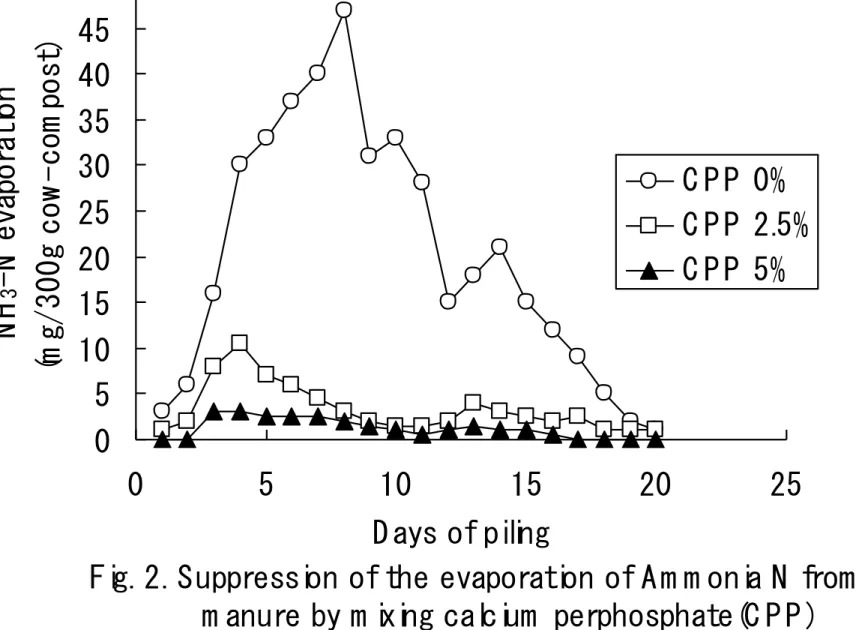
Fig. 2. Suppression of the evaporation of A m m onia N from cow m anure by m ixing calcium perphosphate(C P P )
(Shintoku Experim ent Station of Anim al H usbandry, 1998).
0 5 10 15 20 25 30 35 40 45 50
0 5 10 15 20 25
D ays of piling NH3-N evaporation (mg/300g cow-compost)
C P P 0%
C P P 2.5%
C P P 5%
High
temperature(thermoph ilic)stage
60℃
Mature stage
Temperature change during composting (simplified)
Change in pH of compost
• First rise in pH is due to ammonia forma6on.
• Following decrease is due to the forma6on of nitrate, carbonate, and humic substances.
7 8
6
Increase in ca*on exchange capacity(CEC)
• Increase in CEC is remarkable in composts made from rice straw, woods, bark, sewage sludge, and municipal refuse
HOOC COOH
COOH
COOH OH
OH
C/N ra*o
• C/N ra6o was higher than 30 in the
beginning, then reaches 15-‐20, it will be
the sign of maturity. However, when the
C/N was low from the beginning (such as
cow manure), this criteria cannot be
applied.
Carbon
Organic nitrogen
Inorganic nitrogen
Soil
Microbes
When soil microbes proliferate utilizing organic matter with wide C:N ratio, they also absorb soil inorganic nitrogen.
This causes nitrogen starvation for crops.
CO
2Earthworm method
• Put a compost sample in a cup.
• Place a few earthworms on it.
• Cover the cup with a black cloth.
• If the earthworms creep into the compost, it is mature.
• If they try to escape, it is immature.
Earthworm escapes if your
compost does not taste good.
Vermi-‐compos6ng
• Earthworm can also be used for preparing compost itself.
• Earthworm is a powerful decomposer of
vegetable wastes, and turn the wastes into valuable and safe compost.
• Earthworm cast is enriched with nutrients and it is a soil aggregate already.
Germina6on test
• Seeds of Komatsuna(Brassica campestris), Cress (Lepidium sa/vum), or radish (Raphanus sa/vus) may be used, because these seed are small, quick to germinate, and sensi6ve to phytotoxic (plant damaging) substances like the organic acids temporarily present in immature composts. Using the water extract of the compost, germina6ng rate is compared with the control (dis6lled water).
Control (Distilled Water) Starting time of composting
24 hrs after composting 2 weeks after composting
Example of Failure Case in Composting
Germination Test
Seedling growth method
• Compost (150 g) and soil (350 g) are mixed and put in a Neubauer pot. The control is only the soil (500 g). Each 35mg of N, P2O5, and K2O are applied to each pot in forms of ammonium sulfate, ammonium phosphate, and potassium sulfate. Water is applied to about 60 % of the water holding capacity. Twenty seeds of Brassica campestris are sawn on the surface of mixture, and germina6on rate and growth rate are observed.
Seedling growth method 2
• Compost (equivalent to 100, 200, 300, 400 mg of nitrogen) are mixed with soil (500 g) in Neubauer pots. The control is only the soil (500 g). 25 mg of N, P2O5, and K2O are applied to each pot in forms of ammonium sulfate, ammonium phosphate, and potassium sulfate. Water is applied to about 60 % of the water holding capacity. Twenty seeds of Brassica campestris are sawn on the surface of mixture, and germina6on rate and growth rate are observed.
Growth of Brassica campestris
To 500mL of soil, compost equivalent to 400mg of N was applied (1 week after seed sowing)
Soil + Chemical
Fertilizer (control)
Raw Sewage sludge
After 1st turning
After 5th turning
Effect of Sewage Sludge Compost on the Growth of Brassica campestris
To 500mL of soil, compost equivalent to 400mg of N was applied (19 days after seed sowing)
Soil + Chemical
Fertilizer (control)
Raw Sewage sludge
After 1st turning
After 5th turning
Difficul6es in Compost U6liza6on
• Uneven distribu6on and deficiency of raw materials for compost making
• Hard work for prepara6on and applica6on of compost
• Special technology, skill, and facili6es are required for the produc6on of compost
• Varia6on in cons6tuents and effec6veness of compost
Difficul6es in Compost U6liza6on 2
• Occurrence of microbes tolerant to
an6bio6cs, and germ microbes (in case compost was produced at low
temperature)
• Enhancement of soil born plant disease for potato and soy bean.
• Contamina6on of raw materials by heavy metals (by radioac6vity, recently)
Period, Quality, Amount
Obstacles in the Recycling of Organic Resources
Heavy metals As
Residual
Pesticides Antibiotics
Odor Ammonia Moisture
Oil, salts
Foreign materials 50 ppm
5 ppm 2 ppm
Pathgenic microbes Tolerant bacteria
Heaviness
O157, Foot and Mouth Disease, Potato scale
Heterogeneity
Mercaptane
VFA Cd
Hg
Conclusion 1
• Production of compost is
indispensable for reducing the
environmental load of dairy farming, maintaining the fertility of farm soils, and creating healthy soils and crops.
The qualities of composts, however, differ considerably from product to product,
because different kinds of raw materials are used besides animal feces and various
methods of compost preparation are adopted.
Conclusion 2
• Some of the composts may be unfavorable for use in agriculture. It is important for us to
keep the principles in compost
preparation (for example, activating aerobic process, experiencing the thermophilic period, providing enough duration for maturing,
minimizing the mixing of heavy metals and
foreign / artificial materials), in order to make safe and effective composts.
Conclusion 3
• On the other hand, preparation and utilization of compost both require a
huge labor. Reward for this labor is not remarkable, because higher yield of
crops can be achieved by the use of
cheaper chemical fertilizers and cheaper crops may be imported from foreign
countries.
Conclusion 4
Community based organic maBer recycling project -‐-‐-‐ Subsidy
and the understanding from the consumer is, therefore, very important.
Awareness to environment, ecology, and health helps the u*liza*on of compost.