Abstract
Abstract nouns are basically noncount, but many of them have a count use as well. They often take an indefinite article (a/an) and a plural form (pl.). Efforts have been made by linguists from various aspects: semantic, syntactic, contextual and cognitive to explore the conditions that allow abstract nouns to accept a/an and pl. None of them fully accounts for the count/noncount distinction
(C/NC) of abstract nouns. 1) English learner’s dictionaries have grammar labels ‘countable’ and
‘uncountable,’ but labelling varies from dictionary to dictionary and they often give both count and noncount labels to a noun (or a meaning of a noun). 2) Dictionaries label nouns on the assumption that C/NC is determined by the meaning of a noun: e.g. chicken denoting a bird is count and chicken designating its meat is noncount, but it does not apply to abstract nouns. The same referent of an abstract noun can be count or noncount. 3) The syntactic account claims that an abstract noun accepts a/an when it is modified, but modification does not force the use of a/an. 4) Some linguists try to explain the distinction from context, but neither formality nor abstractness (or concreteness)
determines the distinction. 5) Cognitive linguists argue that temporal bounding determines the distinction, but a temporally bounded event or state can be referred to by a noun with a zero article (ø) or a/an. None of these efforts has succeeded in providing a full account of the C/NC of abstract nouns. The C/NC of those abstract nouns that have both a count and a noncount use is not determined by syntax, semantics, context or bounding in objective reality, but by a speaker’s intention to communicate his/her construal of the referent. Reviewing previous studies on C/NC makes it clear that a thorough and comprehensive study of the C/NC of abstract nouns with data from large corpora and a questionnaire survey is required to find a general rule that motivates the use of ø, a/an and pl.
Key Words
abstract nouns, count/noncount distinction, countability, countable, uncountable, bounding 1. Introduction
Much of the recent research into the count/noncount distinction (C/NC) of English nouns has
KODERA, Masahiro
Searching for a General Rule on Count/Noncount
Distinction of Abstract Nouns in English
been centered on concrete nouns, and little on abstract nouns1 ). Various efforts have been made by linguists to explore the conditions that allow abstract nouns to accept an indefinite article (a/an) and a plural form (pl.). None of them, however, provides a full account of the C/NC of abstract nouns.
Abstract nouns are basically noncount and used with a zero article (ø), but most of them accept a/
an and some take pl., which confuses L2 learners of English because guidelines are not available for them to make a choice between three noun phrases (NPs): zero article singular (øN), indefinite article singular (aN) and zero article plural (øNs). They may use learner’s dictionaries to see if a noun is labelled as ‘Countable’ or ‘Uncountable,’ but grammar labels of [C] and [U] confuse them.
Grammar labelling of ‘culture shock,’ for example, varies from dictionary to dictionary: ‘uncountable,’
‘countable,’ ‘singular and uncountable,’ and ‘countable and uncountable.’2 )Dictionaries fail to provide sufficient information on the C/NC of abstract nouns.
Efforts have been made by linguists from various aspects: semantic, syntactic, contextual and cognitive to explore the conditions that allow abstract nouns to accept a/an. Grammars (Quirk et al.
1985: 287, Swan 2005: 132, Berry 1993: 20-21) and learner’s dictionaries claim that an abstract noun accepts a/an when it is modified and its meaning is limited: e.g. Mavis had a good education. Syntactic explanation of this type leads L2 learners to misunderstand that an abstract noun takes a/an when it is modified by an adjective. Contrary to their claim, good education accepts ø as well: e.g. Contrary to much public opinion, good education is not just a matter of dispensing facts and theories. The syntactic account fails to explain the C/NC of abstract nouns.
Abstract nouns deriving from verbs and adjectives often have both a count and a noncount use with a/an available to express a generality: e.g. (A) dependence on drugs is increasing. Bergsnev (1976, cited in Celce-Murcia and Larsen-Freeman 1999: 285) finds that ø is preferred in hard sciences whereas a/an is favored in the humanities, and he argues that the more concrete and informal the context, the better the count form sounds with a/an. Corpus data from the British National Corpus
(BNC), the Corpus of Contemporary American English (COCA) and others do not support his argument. Both natural and social sciences show a similar tendency in their use of ø and a/an. The choice of ø or a/an is not motivated by the formality or abstractness of a context. Context does not account for the C/NC of abstract nouns.
Cognitive linguists (Langacker 1987: 207, Radden & Dirven 2007: 81) argue that an abstract noun is used as a count noun when it refers to a temporally bounded event or state (e.g. war, doubt) and as a noncount when referring to a temporally unbounded event or state (e.g. help, peace). Their description of C/NC confuses objective reality with construal, and it leads L2 learners to believe
1) There is no clear definition of concrete and abstract nouns. Concrete nouns are tentatively defined as nouns that refer to a physical entity which can be experienced with our five senses while abstract nouns are those that refer to an entity which cannot be experienced with our five senses. One question arises with this definition: the same noun can be both concrete and abstract. For example, ‘war’ in ‘They fought a war over the disputed territory’ is concrete while that in ‘Congress has the power to declare war’ is abstract. In the same way, ‘dog’ in ‘I have a dog’ and ‘car’ in ‘I have a car’ are concrete while ‘dog’ in ‘I do not have a dog’ and ‘car’ in ‘We decided to go by car’ are abstract.
2) Grammatical terms ‘countable’ and ‘uncountable’ are referred to as ‘count’ and ‘noncount’ in this article.
The terms ‘countable’ and ‘uncountable’ and the symbols ‘[C]’ and ‘[U]’ may be used when referring to grammar labels.
that an abstract noun accepts a/an and pl. when it refers to a situation with a beginning and an end.
An abstract noun accepts a/an whether a referent is temporally bounded or not (e.g. There was
(a) silence for a few seconds). Temporal bounding in objective reality does not explain the C/NC of abstract nouns. An external physical condition (i.e. being bounded or unbounded in objective reality)
may influence, but it does not force the use of a/an, ø or pl.
Hewson (1972) and Berry (1993) may provide a clue to a better understanding of C/NC. Hewson
(1972: 94) argues that C/NC is “not dependent on ‘rules,’ but on the representation sought by the speaker.” Berry (1993: 21) argues that a/an does not have to be used when a noun is modified; a/
an is used when the speaker wants to emphasize the individual, particular nature of a referent. Both argue that it is the speaker’s intention to communicate his/her construal of a referent that motivates his/her choice of ø, a/an or pl.
Construal, however, is not so powerful as to determine C/NC. Some nouns (e.g. advice, information) never accept a/an or pl. even when their referents are construed as count. My first/
second advice and the first information, for instance, indicate that advice and information allow episodic construal and are count, but they do not accept a count use. *An advice or *two advices are unacceptable in present-day English. Advice is grammatically noncount and does not accept a/an or pl. even if a referent is count in objective reality or in construal. Lexical restrictions are stronger than construal. On the other hand, advice used to accept a/an and pl. until around 1950s, which suggests that diachronically construal may have a stronger influence on C/NC.
The construal of a referent that a noun allows the speaker to conceive varies from noun to noun.
Beauty, for example, allows an anthropomorphic interpretation (e.g. all these Bond beauties), while anger can refer to an individual experience (e.g after the initial angers). Anger, however, does not allow an anthropomorphic interpretation (*all these Bond angers) or beauty does not refer to an individual experience (*after the initial beauties). Lexical restrictions of each noun on C/NC have to be examined on an individual basis.
The purpose of this research is to show that none of the previous studies has succeeded in providing a full account of the C/NC of abstract nouns and that a thorough, comprehensive study is required to find a general rule that motivates the use of ø, a/an and pl. I will present a hypothesis that an abstract noun accepts a/an (and probably pl. as well) when it refers to a particular instance of the abstract concept, i.e. when the referent is construed as a bounded instance in physical, temporal and quality spaces. A referent being bounded in physical and temporal spaces means that the speaker experiences the referent at a particular time and place. A referent being bounded in quality space means that the referent is located at the lowest level in a type hierarchy, where the referent is a type with only one instance. The speaker chooses a/an when s/he wants to communicate that s/he has a particular referent in mind and s/he wants to emphasize its particular nature.
2. Reviewing previous studies
2.1. Grammar labels and count-noncount distinction
C/NC was first recognized by Jespersen, and the terms ‘countable’ and ‘uncountable’ were
first introduced in his Modern English Grammar (Vol.2, 5.211). Palmer adopted these terms in his Grammar of English Words (1938) for the first time in the history of English learner’s dictionaries
(Cowie 1999: 46). He mentioned the importance of C/NC for L 2 learners in the introduction as follows:
1. “Countables” and “Uncountables.” One of the greatest difficulties encountered by foreign students of English is to know when a noun refers to a thing that can be counted (e.g. a book, a house, a moment, an advantage, etc.), or to something that cannot be counted (e.g. water, snow, weather, bread, wisdom, dryness, etc.). For it is not enough (nor is it true) to say that the names of material substances and abstract things are used without a or an, and that they are not used in the plural. There are many cases in which the noun stands for things countable or uncountable often according to the sense in which it is used, but often quite arbitrarily. Thus, for instance, the word wood refers to something uncountable in made of wood, but something countable in a hard (sort of) wood, and in the fields and woods. The problem may be stated in a long series of rules and exceptions, but in this book cases are marked specifically Countable or Uncountable, often with explanations, and generally with examples.
Hornby, under the pressures of space, introduced the abbreviations [C] and [U] in his Idiomatic and Syntactic English Dictionary (1942) for the first time. Other learner’s dictionaries followed this practice of labelling nouns [C] and [U]. Other labels, such as [singular] and [plural], are now used to further specify the morphosyntactic behavior of nouns. Miller (2006: 435) says: “the inclusion of countability in learners’ dictionaries has provided successive generations of students with a ready- made tool to help them acquire one of the hardest grammatical features of the English language.”
The grammar labels [C] and [U] are, however, not as helpful as Miller expects (Xue 2010).
L2 learners check learner’s dictionaries to see if a noun (or a meaning of a noun) is count or noncount. Unfortunately dictionaries often fail to meet their expectations. First, grammar labelling varies from dictionary to dictionary. Second, it often happens that two labels [U] and [C] are given to a noun (or a meaning of a noun). Third, example sentences of a count use and/or a noncount use are often missing when a noun is labelled both [C] and [U].
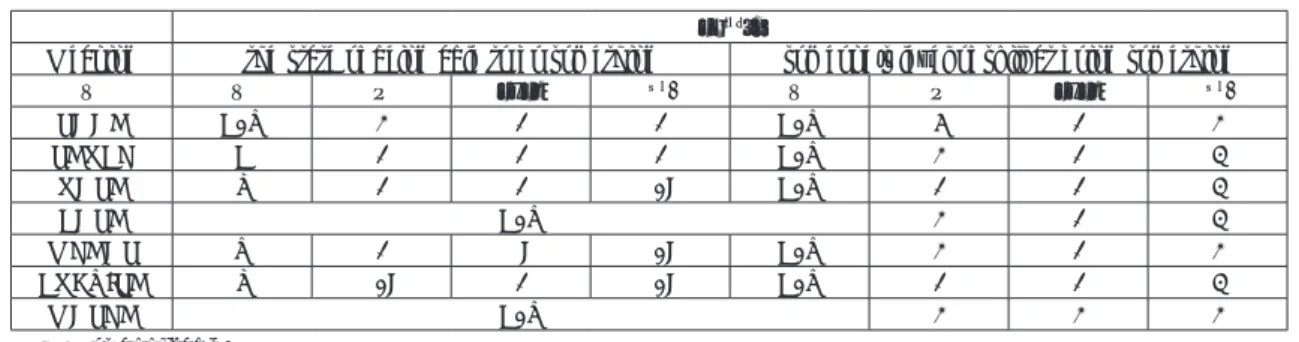
Ability, for example, is labelled as shown in Table 1. Some dictionaries distinguish between [C, U]
and [U, C], but both are represented as [C/U] here. COBUILD’s label [N-VAR], an abbreviation of ‘variable noun’ that combines the behavior of both count and noncount nouns in the same sense, is replaced with [C/U]. Grammar labelling of ability in the sense of ‘the state of being able to do something’ varies from dictionary to dictionary: count, noncount, singular, and both count and noncount. On the other hand, ability in the sense of ‘someone’s level of skill’ is unanimously labelled both count and noncount. However, no dictionary, except MALED, provides an example with a/
an (Table 2). OALD and COBUILD do not provide examples with a/an or ø. In all their examples, ability is premodified by either a possessive or a definite article (with one exception of ‘some’ in OALD), which makes it difficult for L2 learners to understand C/NC.
Table 1. Ability and grammar labelling
NOUNS Meaning LAAD LDOCE OALD CALD MEDAL COBUILD MALED
ability
the state of being able to
do something C/U C S
C/U U S
someone’s level of skill at C/U
doing something C/U C/U C/U C/U C/U
U: Uncountable, C: Countable, S: Singular
LAAD: Longman Advanced American Dictionary, 2nd Ed.
LDOCE: Longman Dictionary of Contemporary English, 5th Ed.
OALD: Oxford Advanced Learner’s Dictionary, 8th Ed.
CALD: Cambridge Advanced Learner’s Dictionary, 3rd Ed.
MEDAL: Macmillan English Dictionary for Advanced Learners.
COBUILD: Collins COBUILD Advanced Learner’s English Dictionary, 5th Ed.
MALED: Meriam-Webster’s Advanced Learner’s English Dictionary
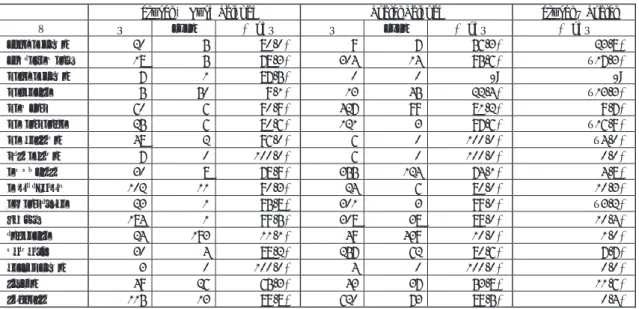
Table 2. Ability and the number of example sentences with ø, a/an and pl.
ability
Meaning the state of being able to do something someone’s level of skill at doing something
Ø a/an pl. Ø a/an pl.
LAAD C/U 1 0 0 C/U 4 0 1
LDOCE C 0 0 0 C/U 1 0 2
OALD S 0 0 N/A C/U 0 0 2
CALD C/U 1 0 2
MEDAL U 0 NA N/A C/U 1 0 1
COBUILD S N/A 0 N/A C/U 0 0 2
MALED C/U 1 1 1
N/A: Not applicable.
Labelling a noun (or a meaning of a noun) both [C] and [U] confuses L2 learners. OALD gives the label [uncountable, countable] to 1,400 words (or meanings) and [countable, uncountable] to 1,365 words (or meanings). Noise, for example, is labelled both [C] and [U], as shown in Table 3, which means that noise can take ø, a/an and pl. in the same sense. L2 learners, faced with the following examples (1-3), never understand the difference between ø noise, a noise and ø noises.
Table 3. Noise and [C]/[U] labelling
OALD LAAD LDOCE CALD MEDAL COBUILD MALED
noise C/U C/U C/U C/U C/U C/U C/U
1) There was noise of people coming and going.
2) There was a noise of people coming and going.
3) There were noises of people coming and going.
[All boldface and underlines are added by the author of this article, unless otherwise mentioned.]
Depression is another example that shows lexicographers’ indifference to the C/NC of abstract nouns. Depression is labelled as in Table 4. Five dictionaries label depression [C/U] in either or both senses, and only LAAD gives an example of the count use (a deep depression). None of them gives
an example of the plural form. CALD shows serious indifference to C/NC. It labels sense 1 both [C]
and [U] and provides as many as seven example sentences, none of which is of the count use. Other dictionaries show indifference to C/NC as well. LDOCE labels effort in the sense of ‘an attempt’ both count and noncount and provides six example sentences, all of which are of the count use. Grammar labelling of [C] and [U] does not help L2 learners to understand C/NC as Palmer expected.
Table 4. ‘Depression’ and [C]/[U] labelling
depression OALD LAAD LDOCE CALD MEDAL COBUILD MALED
1) illness U C/U C/U C/U U C/U U
2) sadness C/U U
2.2. Semantic account of count/noncount distinction
For concrete nouns, such as chicken, C/NC is basically determined by the meaning of a noun: e.g.
chicken is count in the sense of a bird while noncount in the sense of meat. Semantic analysis of C/
NC, however, does not apply to abstract nouns. Difference in meaning does not fit into C/NC. First,
[C]/[U] labelling does not really reflect C/NC. It often happens that a noun accepts a/an even when all dictionaries unanimously label it [U]. For example, silence designating ‘a complete lack of sound,’
which is labelled [U] by all seven dictionaries (Table 5), accepts a/an as in (4). Ø silence, a silence and utter silence in (4) refer to the same state that the author experienced at a particular time and place, and they all denote ‘a complete lack of sound.’ Ø silence and utter silence refer to silence and utter silence in general respectively, whereas a silence describes the silence as one of the silences of a similar nature that the author experienced in the past. This suggests that C/NC is not determined by the meaning of a noun. A/an seems to be chosen when a speaker wants to describe the particular nature of a referent.
Table 5. Meanings of abstract nouns and [C]/[U] labelling
NOUNS Meaning LAAD LDOCE OALD CALD MEDAL COBUILD MALED
silence complete lack of sound U U U U U U U
a situation when nobody is
speaking C/U C/U C/U C/U C/U C/U C/U
4) I had a dream once that still troubles me, I was driving fast along a road bordering a cliff and missed a turn and went over the cliff. I expected to die in the impact, but when it came, there was nothing but silence, a silence such as I have only experienced in the wilderness. I thought, this is what death is, utter silence, nothingness. (A Single Degree of Freedom: An Exploration of Faith, Love and Loss in a Medical Practice by Bernard Mccann)
Second, abstract nouns, unlike count nouns, are often labelled both count and noncount. Silence in the sense of ‘a situation when nobody is speaking’ is labelled both [C] and [U] by all seven dictionaries (Table 5). In the following example (5), both ø silence and a silence denote ‘a situation when nobody is speaking.’ L 2 learners wonder if there is any difference in meaning between ø
silence and a silence when both are used in the same sense.
5)“Hi Darren, it’s me.”
There was silence at the other end of the line for a few seconds, before I heard his sleepy tones. “I wasn’t expecting you to call this early, Cathy ...”
“I know. I’m sorry, I realise you probably wanted a lie-in, but I had to let you know. I’ve been thinking about it all night, and yes, I will go away with you this weekend.”
Again, there was a silence for a few seconds, but whereas the first one had been expected, this absence of speech was a bit unnerving. Finally, after what seemed like eons, he responded.
“Wow. I wasn’t really expecting that, if I’m honest. Don’t get me wrong,” came the hurried addition, “I think it’s great. Look, why don’t we talk about it at work tomorrow?
(Spoilt for Choice by Steve Wilson)
It may be possible to interpret the difference between ø silence and a silence in the above example as follows: Ø silence gives a feeling that the speaker (or writer) is in the middle of experiencing the silence that encompasses the whole space around him/her, and s/he is in no state of mind to describe its particular nature. On the other hand, a silence gives the impression that s/he is describing the silence as one of the silences s/he has experienced, as if s/he is detached from the situation and describing the silence from afar or in retrospect. If there is such a difference in meaning between ø silence and a silence and if the difference determines the C/NC of abstract nouns, it is necessary to look into the motivation for choosing ø, a/an or pl., when both ø and a/an (or all three NPs) are available to refer to the same situation. A questionnaire survey, in addition to analyzing corpus data, is one way to explore the conditions that motivate the choice between øN and aN.
2.3. Syntactic account of count/noncount distinction
Grammars (Quirk et al. 1985: 287, Swan 2005: 132, Berry 1993: 20-21) and learner’s dictionaries describe the conditions that allow an abstract noncount noun to accept a/an as follows:
Syntactic conditions: a. The noun is pre-modified by an adjective.
b. The noun is post-modified by a phrase or a clause.
Semantic conditions: c. The meaning of a noun is limited in some way.
d. The particular quality or feeling of a referent is described.
e. The noun refers to one example.
The conditions (a-c) can be summarized as ‘when a noun is modified,’ since modification always limits the meaning of a noun. The conditions (d) and (e) can be paraphrased respectively as ‘when the referent is of a particular nature’ and ‘when the referent occupies a particular location in physical, temporal or quality space.
Quirk et al. (1985: 287) argue that noncount nouns that refer to a quality or other abstraction of a person (e.g. education, dislike, sensitivity) can be used with a/an when they are modified and that the greater the amount of modification, the greater the acceptability of a/an. Kodera (2017) examines
the influence of modification on the acceptability of a/an with ten abstract nouns that refer to an attribute of a person (education, dislike, sensitivity, knowledge, distrust, understanding, help, hatred, anger, charm) with the data collected from two large corpora, BNC and COCA. The corpus data do not support the argument that abstract noncount nouns are often used with a/an when they are premodified by an adjective. There is no evidence that confirms the influence of premodification on the acceptability of a/an. The a/an acceptability varies greatly from 0.0% to 100.0% depending on adjectives (or attributive nouns).
The corpus data show that qualitative adjectives allow abstract noncount nouns to accept a/
an more than classifying adjectives. Great education, working knowledge and clearer understanding show a very high acceptability of a/an (90.6%, 90.2%, 96.3% respectively), while religious education, linguistic knowledge and human understanding show a very low acceptability (5.7%, 0.0%, 0.9%
respectively). Qualitative adjectives describe a particular quality of someone or something, and the corpus data suggest that a/an may be chosen when a speaker has a particular referent in mind.
Types of adjectives seem to influence the acceptability of a/an, but nevertheless they do not force the use of a/an or ø. Great education, working knowledge and clearer understanding can be used with ø as in (6-8), and in the same way religious education, linguistic knowledge and human understanding can be used with a/an. It may be the case that the intention of the speaker whether or not to emphasize the particular nature of the referent influences the choice of a/an and ø. If it is the case, a/an is chosen when a speaker has a particular referent in mind and s/he wants to describe its particular nature, and it is not modification that demands a/an, but it is a/an, which indicates a particular instance, that demands modification. Neither the type nor the amount of modification forces the use of a/an. Abstract nouns (e.g. knowledge) can take ø even when they are both pre- modified with an adjective and post-modified with a long adjective clause as in (9). The use of a/an cannot be explained syntactically.
6) A room full of young men, not necessarily with great education but with tremendous involvement. (COCA)
7) It may also be the case that the measure we employed to assess general working knowledge of HIV transmission was inadequate, and that in fact, these participants did not have sufficient levels of general knowledge to reinforce healthy choices. (COCA)
8) Many in my church prefer the Message translation for clearer understanding of scripture, including my 51-year-old pastor. (COCA)
9) The growth of industry requires more specialized scientific and technical knowledge which results in the development of professions such as science and engineering. (BNC)
2.4. Context and count/noncount distinction
Bergsnev (1976, cited in Celce-Murcia and Larsen-Freeman 1999: 285) shows that abstract nouns deriving from verbs and adjectives often have both a count and a noncount use with a/an available to express a generality: e.g. (A) dependence on drugs is increasing. Bergsnev finds that ø is preferred in hard sciences whereas a/an is favored in the humanities, and he argues that the more concrete and informal the context, the better the count form sounds with a/an: e.g. Demographic change often
causes (population dispersion / ?a population dispersion).
His argument is examined with the data collected from BNC to see if the following 17 nouns:
acceleration, achievement, deceleration, decrease, demand, dependence, depression, dispersion, emphasis, equilibrium, expenditure, growth, increase, priority, retardation, strain, and success, which Bergsnev uses for his argument, prefer ø or a/an in the written sub-corpus of Natural and Pure Science (4,255,911 words) and that of Social Science (15,656,389 words). Table 6 shows the number of instances of NPs immediately pre-modified by ø or a/an in two sub-corpora, Natural and Pure Science and Social Science. The symbols ‘% of ø’ show the percentage of the instances of ø in each corpus. All nouns except decrease and increase take ø in more than 50% of the instances in both corpora. Out of 16 nouns, excluding deceleration, which has no instance with either ø or a/an in the Social Science corpus, only one noun (acceleration) shows a difference of more than 20% in the instances with ø between the two corpora. Nine nouns (demand, depression, dispersion, emphasis, expenditure, increase, priority retardation, success) show a difference of less than 10%. The corpus data indicate that both natural and social sciences show a similar tendency in the use of ø and a/
an. The choice of ø and a/an does not seem to be motivated by the formality or abstractness of a context.
Table 6. Areas of study and acceptability of a/an and ø
Natural & Pure Science Social Science Natural – Social
ø a/an % of ø ø a/an % of ø % of ø
acceleration 20 5 80.0% 9 7 56.3% 23.8%
achievement 18 5 78.3% 304 14 95.6% -17.3%
deceleration 7 1 87.5% 0 0 N/A N/A
decrease 5 50 9.1% 13 45 22.4% -13.3%
demand 60 6 90.9% 427 99 81.2% 9.7%
dependence 25 6 80.6% 121 3 97.6% -16.9%
depression 48 2 96.0% 6 0 100.0% -4.0%
dispersion 7 0 100.0% 6 0 100.0% 0.0%
emphasis 30 8 78.9% 355 124 74.1% 4.8%
equilibrium 102 11 90.3% 24 6 80.0% 10.3%
expenditure 23 1 95.8% 301 3 99.0% -3.2%
growth 184 1 99.5% 308 38 89.0% 10.4%
increase 24 193 11.1% 49 439 10.0% 1.0%
priority 30 4 88.2% 257 62 80.6% 7.7%
retardation 3 0 100.0% 4 0 100.0% 0.0%
strain 49 26 65.3% 43 37 53.8% 11.6%
success 115 13 89.8% 620 73 89.5% 0.4%
N/A: Not applicable.
Below (10-17) are examples of ø/an increase and ø/a success cited from the two sub-corpuses.
There is not much difference in their formality and abstractness (or concreteness) between two corpora and between ø and a/an. They all sound serious and formal. The choice of ø and a/an does not seem to be motivated by the abstractness of a context, either. It is the choice of ø or a/an that makes the context abstract or concrete, not the other way round. It is not unusual to discuss an abstract topic with a concrete example.
10) Increase in annual temperature range on the continents as a consequence of regression of epicontinental seas might well have played a significant role in the mass extinctions of large reptiles at the end of the Palaeozoic and Mesozoic. (Natural and Pure Science)
11) However, women will have to be more alert in future in view of the growing violence against them and increase in sexual attacks. (Social Science)
12) An increase in the amount of carbon dioxide is responsible for about half the total warming.
(Natural and Pure Science)
13) An increase in AIDS cases will strain both preventive and curative services. (Social Science)
14) Success in computation relating to time intervals is highly dependent on a number of factors
and therefore is variable. (Natural and Pure Science)
15) Success would encourage young people to stay in the inner city instead of moving out of the
area. (Social Science)
16) The independently testable attempt to save Newton’s theory by a speculative hypothesis was a success because that hypothesis was confirmed by the discovery of Neptune and not because
it was falsified. (Natural and Pure Science)
17) For primary schools, the National Curriculum can only be a success if authorities use the opportunity of the new funding formulas to increase their staffing. (Social Science)
2.5. Cognitive account of count/noncount distinction 2.5.1. Cognitive account of concrete nouns
2.5.1.1. Bounding in physical space and count/noncount distinction
The C/NC of concrete nouns has been traditionally explained in terms of bounding in physical space (Wierzbicka 1985: 507, Langacker 1991a: 70, Taylor 2002: 367, Radden and Dirven 2007: 64).
As a conceptual basis of C/NC, Wierzbicka (1988: 506-508) proposes ‘arbitrary divisibility’ and
‘qualitative identification,’ and Taylor (2002: 367) uses the concept of ‘internal homogeneity,’ which includes ‘divisibility,’ ‘replicability,’ and ‘inherent boundedness.’ Langacker (1991: 69-70) suggests
‘boundedness,’ ‘homogeneity,’ ‘expansibility/contractibility,’ and ‘replicability.’
Chicken, for instance, is a count noun when it denotes a bird, which is a discrete entity, being bounded in physical space (e.g. There are chickens in the yard). It is noncount when it designates chicken meat, which is a substance, being unbounded in physical space (e.g. I don’t eat chicken)
(Taylor 2002: 377-378). In the same way, egg is noncount when it refers to a small quantity of egg yolk and/or white (e.g. He’s got egg on his tie). The concept of bounding works very well for these examples, but it does not for others like egg yolk and egg white. Egg yolk and egg white designate a substance and are expected to be noncount, but they can be used as a count noun (e.g. Separate the yolks from the whites. Use the whites of two eggs. (OALD)). Strangely enough, no dictionary gives an example sentence of the noncount use of white, although they all label it both count and noncount, except MALED, which labels it count.
There are some nouns, whose C/NC shows regional differences between American and British English, which cannot be explained by the concept of bounding. Table 7 shows the number of instances of the singular and the plural form of mashed potato, scrambled egg and bathroom scale found in BNC and COCA. Attributive nouns (e.g. mashed potato in mashed potato mixture) are not
counted. BNC (British English) finds 35 instances of mashed potato and 30 mashed potatoes, while COCA (American English) finds 63 mashed potato and at least 991 mashed potatoes (COCA has a total of 1396 occurrences of mashed potatoes, but their KWIC concordancer shows no more than 1,000 hits). As for scrambled egg, BNC finds 30 instances of the singular form and 61 of the plural, while COCA finds 61 and 547 respectively. As for bathroom scale, BNC finds 0 instances of the singular and 13 of the plural, while COCA finds 63 and 17 respectively.
Table 7. British and American English and Count/Noncount Distinction
mashed scrambled bathroom
potato potatoes egg eggs scale scales
BNC UK 100 million 35 30 30 61 0 13
COCA US 520 million 63 991-1392 21 547 63 17
British English is split over the count and noncount use of mashed potato and scrambled egg, while American English overwhelmingly prefers the count use for both. Mashed potato(es) and scrambled egg(s) are substances which are unbounded in physical space, and they are expected to be noncount.
It seems that Americans have opted for a semantic shift to construe the substance state of potato and egg as a multiple structure, while the British have not decided which way to go and remain in a random stage. Wisniewski et al. (2003: 611) argue that Americans use the plural form to characterize how the substance originated because they do not want to incorrectly imply that the act of cooking
(mashing, scrambling) was applied to a substance.
For bathroom scale(s), British English prefers the plural form whereas American English prefers the singular. Scales takes the plural form because it denotes a pair of scales with a bipartite structure, like eye glasses and trousers. The device is still called scales in British English, although it does not keep the bipartite structure any more. The mismatch between syntax and perception has led American English speakers to take the solution to change its syntax from scales to scale to reflect a semantically proper construal of the device as a discrete object. British English speakers retain the original morphosyntax, not because they see the device as a bipartite structure, but they construe it as a multiple structure(Wierzbicka 1996: 388). A mismatch between semantics and syntax (i.e.
between construal and lexical behavior) may cause a shift in construal or in syntax. Objective reality
(i.e. bounding in physical space) may influence but does not determine C/NC. Construal seems to have a stronger influence on C/NC, but at the same time, morphosyntax influences construal as well.
The theory of bounding fails to fully account for the C/NC of concrete nouns. It does not explain the cases of egg yolk, egg white, mashed potato(s), scrambled egg(s) and bathroom scale(s).
2.5.1.2. Bounding in physical space and count-to-mass shifting.
It is often argued that nouns can be used as either count or noncount depending on how the referent is construed. Some linguists (Gleason 1965: 136-137, Pelletier 1979: 6, Allan 1980: 547, Reid 1991: 88-89, Langacker 1991a: 73, Copestake & Briscoe 1991: 98, Talmy 2001: 52, Huddleston & Pullum 2002: 337, Taylor 2002: 378, Cruse 2011: 274) claim that every noun can have a mass reading in a proper context. To support their argument, they contrive sentences that cause a syntactic mismatch which is expected to force a mass reading of a count noun, e.g. After the accident, there was cat all
over the road, in which a cat loses its physical integrity and the noun cat gains a noncount sense
(Langacker 1991a: 73).
There are two types of count-to-mass shifting: deformation and domain shift. In the deformation type (Talmy 2001: 52), a referent loses its physical integrity and turns into a substance as in the case of a disintegrated cat. The domain shift type (Dirven 2003: 14-15), also called ‘metonymical reinterpretation’ (Cruse 2011: 274) or ‘image-schematic transformation’ (Evans and Green 2006:
187), has the attention focused on a noncount aspect of the referent, i.e. being conceptualized in a different domain: e.g. baby in It smells like new baby here (Reid 1991: 88), car in With pre-owned vehicles, you get a lot of car for your money (Langacker 2008: 143), in which baby and car denote baby smell and car size respectively. Baby smell and car size are unbounded in physical space, which causes a count-to-mass shift.
Kodera (2016b) has shown that count nouns are resistant to count-to-mass shifting (of both the deformation type and the domain shift type) in a context that demands a mass reading of a count noun. As for the deformation type, neither expansibility nor deformation forces a mass reading. A concrete count noun is still used as a count noun when a referent’s physical integrity is lost. Taylor
(2002: 367) argues: “Dismantle a car and you have car parts, not a car any more.” Contrary to his claim, dismantled car accepts a/an and pl. but not ø, as shown by the acceptability scores of the following sentences (Kodera 2016b).
A dismantled car takes up far more space than you think. ( Acceptability score: 4.88 out of 5.00)
Dismantled car takes up far more space than you think. (2.36)
Dismantled cars shall not be stacked higher than the fence. (4.28)
Dismantled car shall not be stacked higher than the fence. (1.56)
Acceptability Scores 1: Totally Unacceptable 2: Moderately Unacceptable
3: Neither Acceptable nor Unacceptable 4: Moderately Acceptable
5: Perfectly Acceptable
Even a threefold mass reading context does not force a mass reading of bottle in After I ran over the bottle(s) with our car, there was a/ø shattered bottle(s) all over the driveway. The deformation of the bottle is implied in the subordinate clause (ran over the bottle) and indicated by the premodification (shattered), and the expansibility is suggested by all over the drive way. As the acceptability scores below show, neither ø nor a/an is acceptable with one bottle (the acceptability scores are both 3.44). With more than one bottle, ø is not acceptable (3.04) while pl. is highly acceptable (4.72). Deformation and expansibility do not force a mass reading whether with one or more than one referent, but allow a plural form to avoid count-to-mass shifting.
After I ran over the bottle with our car,
there was shattered bottle all over the driveway. (3.44)
there was a shattered bottle all over the driveway. (3.44)
After I ran over the bottles with our car,
there was shattered bottle all over the driveway. (3.04)
there were shattered bottles all over the driveway. (4.72)
The domain shift type of count-to-mass shifting allows a count noun to behave syntactically as a mass noun, but it does not necessarily force a mass reading. Cat can take any of the three NPs (øN, aN, øNs) when it refers to cat smell, which is unbounded in physical space. Ø or pl. is likely to be chosen when cat refers to cat smell in general: e.g. Her apartment smells of cat/cats (4.84 and 4.72 respectively), Her apartment smells of a cat (3.72). A/an is likely to be chosen when the existence of a cat is emphasized: e.g. Mice will leave if they smell a cat (4.96), Mice will leave if they smell cat
(3.92). Neither deformation nor domain shift forces count-to-mass shifting. Count nouns are resistant to count-to-mass shifting. The theory of bounding does not fully account for the C/NC of concrete nouns.
2.5.2. Cognitive account of abstract nouns
2.5.2.1. Bounding in temporal space and count/noncount distinction
It is generally agreed that the conceptual basis of the C/NC of concrete nouns lies in bounding in physical space (Biber et al. 1999, Cruse 2011, Crystal 1995, Celce-Murcia & Larsen-Freeman 1999, Hewson 1972, Huddleston & Pullum 2002, Jesperson 1924, Langacker 1987, 1991a, 1991b, Lee 2001, Matthews 1997, Quirk et al. 1985, Swan 1995, Taylor 2002, Trask 1993, Wierzbicka 1988, 1996). Semantically, count nouns refer to individuated countable entities, and noncount nouns to a nonindividuated mass or notion. Cognitive linguists claim that the conceptual basis of the C/NC of concrete nouns applies to abstract nouns. Langacker (1987: 207) and Radden & Dirven (2007: 81)
argue that the concept of bounding applies to abstract nouns and that abstract noncount nouns can be used as count nouns when they allow an episodic construal, i.e. being construed as a temporally bounded event or state (e.g. jump vs. jumping). Langacker (1987, 1991b) says as follows:
By definition, an episodic nominalization refers to just a single instance of the process, i.e. a single pass through the component states. I suggest, in fact, that the bounded region it designates has these component states as its constitutive entities. These entities are interconnected because they are scanned continuously and sequentially through processing time, with each employed as a standard of comparison for evaluating its successor. This interconnection establishes them as a region, which is bounded because the processes in question have both an initial and a final state.
(Langacker 1987: 207-208)
The fact that episodic nominalizations are count nouns follow directly from their characterization: an episodic noun profiles a region comprising the component states of a pefective process, and since such a process is inherently bounded, so is the region it forms.
(Langacker 1991b: 25)
Radden and Dirven (2007) says as follows [Bold face is not added by the author of this article]:
Like concrete nouns, abstract nouns fall into count nouns and mass nouns. Their distinction is, however, less clear-cut. As a rule, episodic situations, i.e. situations that are thought of as holding for a limited time, are converted into objects and hence coded as abstract count nouns, such as attack, while steady situations, i.e. situations that are thought of as lasting indefinitely, are converted into substances and hence coded as abstract mass nouns, such as knowledge. (Radden and Dirven 2007: 84)
The abstract nouns war, attack, protest, problem, doubt and desire are generally used as count nouns. What these abstract count nouns have in common is that they describe episodic situations, i.e. situations which, due to their limited duration, are seen as discrete episodes.
Episodic situations are typically events that take place or come up (attack, protest, objection), but also certain states that can suddenly arise are seen as episodic (disease, idea, doubt).
In contrast, the abstract nouns peace, knowledge, happiness, information, help and advice are mostly used as mass nouns. They describe steady situations, i.e. situations which are seen as lasting indefinitely or holding in general. Steady situations are typically states (peace, knowledge, happiness), but also certain events are seen as steady (information, help, advice). (Radden and Dirven 2007: 81)
They argue that war, for example, is a count noun because it denotes a temporally bounded event, while peace is noncount because it designates a temporally unbounded state. Their argument is misleading in that it gives the impression that an abstract noun is used as a count noun when it refers to a temporally bounded situation in objective reality. Contrary to their claim, war as well as peace accepts both a/an and ø as shown in the following examples (18-21). War in (18) takes a/
an whereas that in (19) accepts ø in a similar context. In the same way, peace in (20) accepts a/an while that in (21) takes ø in a similar context.
18)In 1793, a war broke out between France and Great Britain.
(Mark Thorburn. 2012. The President and the Executive Branch: How Our Nation Is Governed)
19)[I]n December 1946, war broke out between the Vietminh and France.
(James E. Westheider. 2007. The Vietnam War)
20)[T]he end of the war did not bring a lasting peace.
(Charles F. Howlett, Robbie Lieberman. 2009. For the People: A Documentary History of the Struggle for Peace and Justice in the United States)
21)But the treaties that ended the first world war did not bring lasting peace.
(Elizabeth Raum. 2014. A World War II Timeline)
Every war is temporally bounded in objective reality. War in (19) refers to the First Indochina War, which started in 1946 and ended in 1954, but it accepts ø. On the other hand, lasting peace denotes a state that continues for a long time with no end in sight and is temporally unbounded, but it accepts a/an as in (20). Temporal bounding in objective reality does not explain why war accepts
ø while peace accepts a/an. These examples indicate that an external condition (i.e. being bounded or unbounded in objective reality) does not force the use of a/an or ø.
Silence, for another example, accepts both ø and a/an when a referent is temporally bounded, as is shown by the examples (22) and (23), in both of which the silence continued for a short period of time and then ended. In (23), ø absolute silence and a silence refer to the same instance of silence, which continued for a moment and is temporally bounded. Absolute silence, however, accepts ø. The sentence (23) poses another problem: a silence is described as ‘with no time,’ which means that the referent of a silence is temporally unbounded and the noun is expected to behave as a noncount, but it accepts a/an. Temporal bounding cannot explain 1) why silence accepts ø when the referent is temporally bounded in objective reality and 2) why silence accepts a/an when the referent is construed as temporally unbounded. Temporal bounding whether in objective reality or in construal does not determine the C/NC of abstract nouns.
22) There was an absolute silence for a moment. I felt the tears welling up in my own eyes.
(Sable Shadow & The Presence by William Peace)
23) There was absolute silence for a moment, a silence with no time and no feeling. I could hear the world ticking inside my head — tick, tick, tick ... (The Road of the Dead by Kevin Brooks)
The same referent can be construed as count or noncount as in (24) and (25). A good experience and ø good experience in (24) refer to the same temporally bounded event (a year at the London School of Economics), but the former takes a/an and the latter, ø. In (25), his childhood experiences and this primal experience refer to the same event (Ballard’s childhood experiences in a Japanese prisoner-of-war camp), but the former takes pl. and the latter takes the singular form. A series of temporally bounded events can be expressed in either a singular or plural form, which means that the same temporally bounded situation can be referred to with all three NPs: øN, aN, øNs. Some other factors, other than temporal bounding, have to be considered to analyze the complexity of the C/NC of abstract nouns.
24) Andrew Walshe ’02, from Herndon, VA, spent a year at the London School of Economics. “It was more work than I thought it would be, but it was a good experience.”[…] “[…] On all, it was good experience and a good time. Living in London was tremendous.”
(http://blogs.hsc.edu/international/category/may-term/page/3/)
25) As is well known, after decades of writing impersonal science fiction Ballard wrote Empire of the Sun (1984), a novel dealing with his childhood experiences in a Japanese prisoner-of-war camp. The most inscrutable of novelists, Ballard confides that he cannot explain why it took him 40 years to come to terms with this primal experience. (WBO: WordbanksOnline)
2.5.2.2. Bounding in quality space and count/noncount distinction
Abstract noncount nouns can gain a count sense in quality (or type) space. Biber et al. (1999:
244) says: “the uncountable use refers to the general phenomenon, while the countable use refers to individual instances or types,” and they give the following examples:
I don’t think her parents gave her much — very much freedom.
These are tiny freedoms, and if a woman enjoys being part of a couple, they should count for nothing.
‘Very much freedom’ refers to the total amount of freedom ‘she’ has received from her parents.
‘Tiny freedoms’ needs more context to see what it refers to. The following is the sentence immediately preceding it:
What a single mother represents may seem touchingly attractive: not having to cook another adult’s meals, or wash his clothes; being able to go to bed when you want; being able to go to sleep when you want. These are tiny freedoms, and if a woman enjoys being part of a couple, they should count for nothing. (BNC)
With more context, it is clear that tiny freedoms refers to various types of freedom, such as ‘being able to go to bed when you want.’ Tiny freedoms are conceptualized in quality space and occupies more than one location in the space, referring to various types of freedom she enjoys in her life.
Freedom in this sense is a count noun and can take a/an (26) and pl. (27).
26) Descartes was to enjoy a freedom to publish in Holland that was denied him in France. (BNC)
27)You might have noticed four different types of freedoms named in the amendment:
• The first is freedom of religion.
• The second is freedom of speech.
• The third is freedom of the press.
• The fourth is freedom to demand that the government stop doing wrong.
(First Amendment: The Right of Expression by Rich Smith)
2.5.3. Construal and lexical restrictions
Construal influences C/NC, but it does not determine it. There are some nouns (e.g. advice, information) that never accept a/an or pl. even when their referents are construed as count. We can say, for example, my first/second advice or the first information, which suggests advice and information are construed as episodic events, but lexical restrictions of these nouns do not allow a count use. We do not say *an advice or *two advices. Instead, we say a piece of advice or two pieces of advice with a numeral classifier. Fully noncount nouns (Downing 2002: 423), such as advice and information, never accept a/an or pl. in present-day English even when a referent is countable in objective reality or in construal. Wechsler (2015: 169) says: “[I]t seems clear that words belong to semantic categories that affect their syntactic distribution but cannot be assigned by inspecting their denotations. [...] Count/mass assignment is clearly semantically based but notoriously subject to lexical idiosyncracy.”
C/NC has not been rigidly demarcated in the history of the English language. Advice used to have both a count and a noncount use. A quick look at The Corpus of Historical American English (with more than 400 million words of text from the 1810s to 2000s) indicates that advice used to accept a/
an and pl. until around 1950s as in (28) and (29).
28) If you had taken an advice from me, it would have been to buy that suit.
(William MacLeod Raine. 1920. The Big-Town Round-Up)
29) My brother told me he had given advices to you to go without delay.
(Thomas B. Costain. 1957. Below the Salt)
C/NC is flexible diachronically but lexically restricted synchronically. A recent example is e-mail, which has both a count and a noncount use in the current usage. Checking five learner’s dictionaries
(excluding LAAD and MALD, which were published fairly recently) indicates that e-mail used to have only a noncount sense until around the mid 1990s. LDOCE 3rd Edition (1995) defines it as
“[uncountable] a system that allows people to send messages to each other by computer.” Its 4th edition (2003) adds a second meaning: “[uncountable and countable] a message that is sent from one person to another using the email system.” OALD 7th Edition (2005), CALD 2nd Edition (2005) and other dictionaries follow LDOCE. This noncount-to-count shift shows that e-mail has gained a count sense designating a message or a letter sent by the e-mail system, and this semantic shift is mapped onto syntax.
Interestingly enough, mail in the sense of e-mail is still labelled as noncount by all learner’s dictionaries except CALD and COBUILD, neither of which lists the sense of e-mail. WBO, a sub- corpus of the Bank of English with 100 million words from 1974 to 2009, finds ten instances of mails and no instance of a mail out of 4,415 instances of the singular form. Mail in the sense of e-mail resists the count use whereas e-mail allows it. Lexical restrictions are more powerful than construal.
If construal is stronger than lexical restrictions, we could say *a mail or *mails to refer to an e-mail message or messages. The theory of bounding cannot explain the count-to-noncount shift of advice or the lexical restrictions of mail. Objective reality and construal influence C/NC, but they do not force the count or noncount use of an abstract noun.
2.6. Developmental Psychologists’ account of the acquisition of C/NC
Developmental psychologists (Gordon 1985, Gentner 2001, Barner & Snedeker 2006) cast doubt on the claim that children’s acquisition of C/NC is based on an object/substance distinction. A lot of research has been done by developmental psychologists (Wynn 1992, Spelke 1990, 1994, Spelke et al.
1994, Imai & Gentner 1997, Hauser 2000, Wynn et al. 2002) to determine whether C/NC is rooted in prelinguistic knowledge, or syntax provides the foundations for the conceptual development of the distinction.
Studies by developmental psychologists deny the Quinian view of empiricism (Quine 1960), and indicate that the object/substance distinction and the concept of individuation are prelinguistic. On the other hand, children do not have a clear semantic categorization of mass nouns prelinguistically, and they acquire it as they grow older with more linguistic experience and syntactic information
(Gordon 1988, Soja et al. 1991, Bloom et al. 1995, Yoshida & Smith 2005, Kouider et al. 2006, Barner
& Snedeker 2006). Children become sensitive to the count/mass and singular/plural distinction at the age of two and become able to extend the semantic categorization of mass nouns to novel
words at around five. Children acquire the semantic categorization of mass nouns through syntactic information, but not through semantic analysis.
Bathroom scale(s), for example, takes the singular form in American English, reflecting its unitary structure whereas it takes the plural form in British English, reflecting the original bipartite structure of scales. Wierzbicka (1996: 388) asked a number of children and teenagers in Australia why they thought the device was called ‘scales’ rather than ‘scale.’ To her surprise, they all came up with the same answer: it is because of all the little numbers they see on the device. This suggests that the forms of NPs (øN, aN, øNs) force a count or a noncount construal of a referent. Imai (2013:
20) argues on the object-substance categorization as follows:
When the perceptual affordance of a given entity strongly suggested the entity’s individuation status, then there was little room for language to affect people’s default construal for that entity
(cf. Gentner, 1982). When the perceptual affordance of the entity was weak and ambiguous, language influenced the construal, pushing the boundary between object kinds and substance kinds one way or the other (cf. Gentner & Boroditsky, 2001; Malt, 1995; Medin, Lynch, Coley, &
Atran, 1997).
In the case of bathroom scale(s), the influence of language seems to be stronger than the perceptual affordance. The bathroom scale(s) is clearly a discrete object, and Australian children and teenagers have chosen to construe it as a multiplex structure to avoid the contradiction between syntax and ontologically correct categorization.
It can be assumed that this applies to the C/NC of abstract nouns. The perceptual affordance of an entity that an abstract noun refers to is weak, and the lexical restrictions force a count or a noncount construal of a noun, as in the case of fully noncount nouns such as advice, which never accept a count use even when a referent is countable in objective reality. Considering the strong influence of lexical restrictions, research on the C/N of abstract nouns should be limited to those that allow both a count and a noncount use.
3. Types of abstract nouns and count/noncount distinction
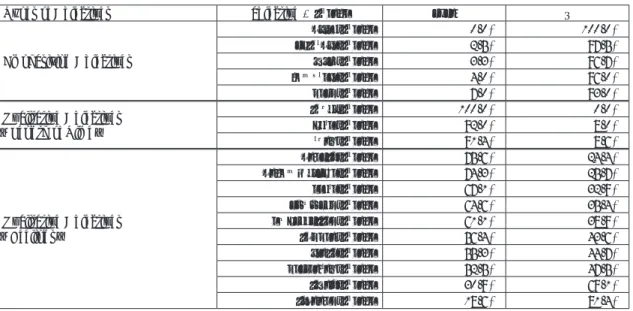
Abstract nouns can be divided into at least nine types (probably more): state, action, quality
(or attribute), mental activity, feeling/emotion, cause/effect, event, abstract concept, and names of art, science and sport (Table 8). Most abstract nouns listed below can be used as both count and noncount, except those in the group of art/science/sport.