フラム海峡における熱フラックスの経年変動
川崎 高雄1, 2、羽角 博康2
1国立極地研究所 北極観測センター
2東京大学 大気海洋研究所
Inter-annual variability of heat flux at the Fram Strait
Takao Kawasaki1, 2 and Hiroyasu Hasumi2
1 Arctic Environment Research Center, National Institute of Polar Research
2Atmosphere and Ocean Research Institute, University of Tokyo
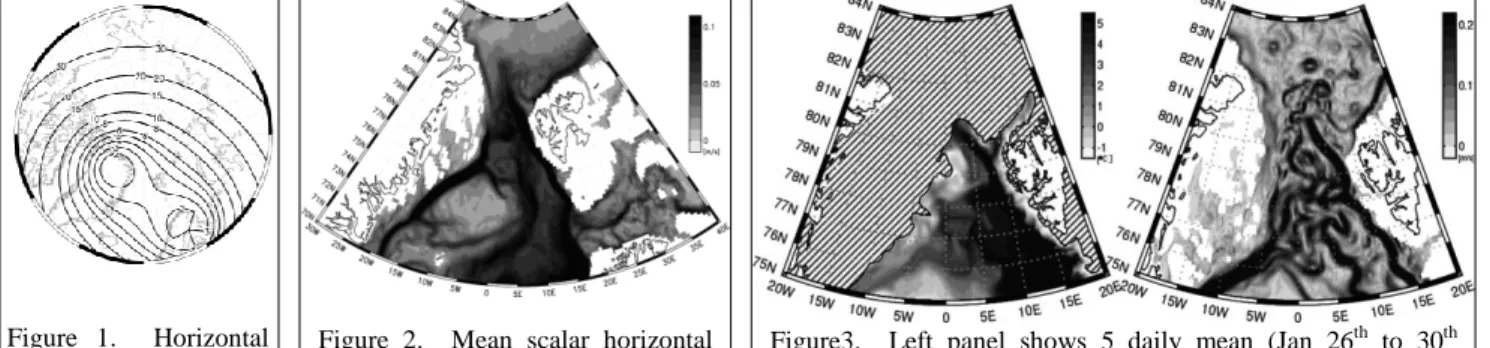
It is important to examine the mechanism of the formation and changes of the oceanic stratified structure for the inter-decadal prediction of the sea ice in the Arctic Ocean. We investigate the interannual variability of the inflow of the Atlantic Water, which supplies the warm water at the subsurface layer in the Arctic Ocean, by using a realistically configured high resolution ocean general circulation model with sea ice (Figure 1). Our model well reproduced not only the current returning to the south at the Fram Strait but also the inflow of warm water to the Arctic Ocean (Figure 2), which has not been the case in low resolution models. The observed eddy activities and meandering sea-ice margins are also simulated around the Fram Strait (Figure 3). The temperature, horizontal velocity, and eddy kinetic energy are quantitatively consistent with the observations at the Fram Strait. The result of our model demonstrates that the effect of mesoscale eddies on the heat flux to the Arctic Ocean is less significant than that of mean current. We explored the causes of the interannual variabilities of heat fluxes by the returning current and inflow to the Arctic Ocean. It is suggested that the cause of enhancement of heat transport by the returning current is the cyclonic wind anomaly centered at the Greenland Sea. On the other hand, that by the inflow to the Arctic Ocean is induced by the variability of water mass formed at the eastern Greenland Sea. We will closely verify the causes of interannual variabilities by comparison with several observations and reanalysis data in our future work.
北極海の数十年先の海氷分布の予測を行うために、北極海の成層構造の形成・変動メカニズムを明らかにするこ とは重要である。本研究では、北極海亜表層の高温水を形成している大西洋水の流入の経年変動メカニズムを、
現実的設定下の高解像度海洋大循環モデルを用いて調べた(Figure 1)。フラム海峡での大西洋への再循環流に加え て、低解像度モデルでは再現できない北極海への大西洋水の流入がよく再現された(Figure 2)。フラム海峡付近で は、衛星観測で見られる活発な渦活動およびそれに伴う氷縁の特徴的な形状が再現された(Figure 3)。水温・流 速・渦運動エネルギーも定量的に妥当な値が再現されたことが確認された。熱フラックスの解析によって、北極 海内に流入する熱量に対する中規模渦活動の影響は平均流によるそれに比べて小さいことが示された。フラム海 峡付近で大西洋へ戻る再循環流と北極海内への流入による熱フラックスについてそれぞれの経年変動の要因につ いて調べた。再循環流が輸送する熱の経年変動の要因はグリーンランド海を中心とする低気圧偏差であることが 示唆された。一方、北極海へ流入する熱の経年変動は東部グリーンランド海の水塊形成の変動が要因であること が示された。今後、これらの変動要因について観測・再解析データを用いて検証する予定である。
Figure 1. The horizontal grid size of our model (km).
The model is high resolution around the Fram Strait and Barents Sea
Opening. Figure 1. Horizontal
grid size of our model (km). The model is high resolution around the Fram Strait and Barents Sea Opening
Figure 2. Mean scalar horizontal velocity at 200 m depth (2000- 2010; m/s). The recirculation and inflow of the Atlantic Water is simulated in our model.
Figure3. Left panel shows 5 daily mean (Jan 26th to 30th 2005) of sea surface temperature (shade; Celsius degree) and sea ice concentration more than 10% (hatch). Right panel shows same as left panels but scalar horizontal velocity at 200 m depth (cm/s). The meandering of sea ice margin and activities of mesoscale eddies are reproduced in our model.