
JAIST Repository: ストップフロー法によるポリプロピレン系コポリマーの合成と結晶性分布の評価
7
0
0
全文
(2) Crystallinity Distribution of Propylene-block-Poly(Ethylene-co-Propylene) Prepared by Stopped-flow Polymerization Method Ryota Taniyama Introduction The commercial polypropylene (PP) can be usually divided roughly into three grades according to the strucure and compotion: homopolymer, random copolymer, and block-type copolymer, that is impact copolymer (ICP). In particular, ICP has improved toughness and therefore applied for the various industrial fields such as electronic and automobile filed. ICP is generally produced by two-stage polymerization process with MgCl2-supproted. Ziegler. catalyst. in. which. (ethylene-co-propylene) (EPC) are sequentially produced. homopolymer. and. poly. 1) – 5). . At first, polymerization. of propylene is carried out in the first series of reactors (1~several hours). Then, copolymerization of ethylene and propylene is carried out in the second series of reactors. However, most of EPC chains are not connected to a homopolymer chain through a covalent bond because chain transfer reactions are so frequently occurred. ICP is eventually a blend of PP, polyethylene (PE), and EPC. For further improvement of PP materials, it is desired to develop real block copolymer in which a homopolymer chain and an EPC chain are connected through a covalent bond. It has been reported that in a stopped-flow polymerization method, the chain transfer reactions are nearly negligible because of its very short polymerization period below 0.2 s6), 7). Therefore, it was expected to be able to connect PP and EPC by the method. In this study, three-vessel (two-stage) stopped-flow polymerization was conducted to make propylene-block-poly(ethylene-co-propylene) (PP-block-EPC). It was confirmed that the obtained PP-block-EPC was a real block type, based on its crystalline distribution. Furthermore, the EPC part of PP-block-EPC was separately characterized from the PP part. Experimental Catalyst preparation MgCl2 (36 g) and ethyl benzoate (7.8 ml) were placed in a 1 L stainless steel vibration mill pot with 55 stainless balls (25 mm diameter) under nitrogen and co-ground for 30 hours at RT. The ground product was vigorously stirred with TiCl4 (400 ml) in a 1 L.
(3) flask at 90oC for 2 hours under nitrogen. The reaction product was washed with 200 ml of n-heptane 3 times at 70oC, 5 times at 50oC, and once at RT. The catalyst was then washed with 200 ml of toluene 3 times and stored as toluene slurry. A small amount of the catalyst slurry was dried to determine the concentration (90 mg/ml). The Ti content was measured by titration with the aqueous solution of sulfateferric ammonium and sulfuric acid in the presence of solution of thiocyanate ammonium as an indicator (1.97 wt%). Synthesis of PP-block-EPC The apparatus used in this study is schematically illustrated in Fig.1. Vessels (A), (B), and (C) are 150 ml vessels equipped with stirrers and water jackets. The measured amount of the catalyst in toluene (0.47 mmol-Ti in 100 ml), toluene solution of TIBA (14 mmol in 100 ml), and toluene (100 ml) were placed in vessels (A), (B), and (C), respectively. The Al/Ti molar ratio was kept at 30. Propylene was introduced at normal pressure into o. vessels (A) and (B) for 15 min at 30 C to saturate. Fig.1. Three-vessel stopped-flow polymerization apparatus. toluene in them. Toluene in vessel (C) was saturated with ethylene similarly. Toluene was used as a solvent because of the higher solubility of ethylene than in heptane. (D) is a 500 ml beaker containing conc. HCl (20 ml) and ethanol (200 ml) with a vigorous agitation for quenching polymerization immediately. The contents of the vessels were flown through Teflon tubes to conduct polymerization. Propylene polymerization was occurred during point (a) to (b), followed by copolymerization with ethylene and propylene during point (b) to (c). Polymerization time of propyrene was set to 0.1 s and copolymerization time to 0.05 s. The inner diameter of the Teflon tubes was 2.0 mm except the part of 2.5 mm diameter between point (b) and (c). Polymerization time was precisely adjusted by changing the length of the corresponding part. The obtained polymer was washed with water and dried. Then, the polymer was dissolved into a small amount of xylene and poured into the mixture of ethanol (400 ml) and water (100 ml)..
(4) Then, he apparatus in Fig. 2 was constructed to remove the catalyst residue from the polymer. In this method, the polymer on a glass filter was washed for 10 hours by n-heptane which were evaporated from flask and then cooled by water. Finally, the product was dried in vacuo at 60oC for 6 hours. Synthesis of homo PP Homo PP was polymerizated by two-vessel. stopped-flow. method.. Where the apparatus was similar to that in Fig.1. The polymerization time of propylene was set to 0.1 s. The obtained. Fig.2. Special apparatus to remove the. homopolymer was washed similarly to the. catalyst residue.. PP-block-EPC except that the catalyst residue was removed by reprecipitation from a boiling xylene to methanol. Analysis The molecular weight and molecular weight distribution of the polymer was determined by gel permeation chromatography (GPC, Waters Associates, ALC/GPC 150C) with polystyrene columns (Showa Denko K. K., AD806M/S) at 140oC using o-dichlorobenzene (containing 2,6-di-tert-butyl-4-methylphenol) as solvent. The isotacticity of the polymer was determined by. 13. C NMR spectroscopy (Varian. o. Instruments Ltd. Gemini-300 spectrometer at 120 C). The polymer was dissolved in 1,1,2,2-tetrachloroethane with hexachloro-1,3-butadiene as an internal standard. The crystallinity distribution of the polymer was measured and fractionated on the basis of crystallinity by temperature rasing elution fractionation (TREF, Senshu Scientific Co., Ltd. SSC-7300). The polymer was dissolved in o-dichlorobenzene (containing 2,6-di-tert-butyl-4-methylphenol). The original polymer was fractionated in three in different temperature regions: RT~35oC, 35~80oC and 80~160oC..
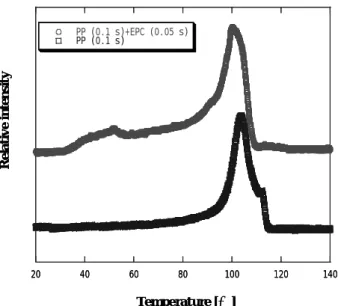
(5) Results and discussion The crystallinity distribution of the obtained polymer was investigated by TREF (Fig.3.).. Relative intensity. PP (0.1 s)+EPC (0.05 s) PP (0.1 s). 20. 40. 60. 80. 100. 120. 140. Temperature [℃]. Fig 3. Crystallinity distribution of homo PP and PP+EPC When PP and EPC synthesized separately are blended, the whole EPC is eluted below 20oC without changing the crystallinity distribution of the PP. However, the PP-block-EPC synthesized with three-vessel stopped-flow polymerization method showed the shift of the crystallinity distribution of the PP to the low temperature side, which proved that the obtained PP-block-EPC was a real block type. In order to understand the relation between the shift on the crystallinity distribution and ethylene content in PP-block-EPC, the PP and PP-block-EPC were fracionated into three: fraction 1 (RT~35oC), fraction 2 (35~80oC) and fraction 3 (80~160oC). Table 1 shows the weight ratio and 13C NMR results of each fraction. At first, the weight ratio of fraction 3 significantly decreased (almost 50%) by adding the EPC part, i.e. the addition of EPC lowered the degree of crystallinity. This was supported by the fact the ethylene content of fraction 3 for the PP-block-EPC was the smallest..
(6) Table 1. Results of fractionation by TREF. wt%. sample PP-block-EPC (Original) fraction 1 fraction 2 fraction 3 PP (0.1 s) (Original) fraction 1 fraction 2 fraction 3. 100 39 18 43 100 8 8 84. ethylene content [%] 31.6 36.5 45.2 22.1 -. mmmm [mol%] 69.2 62.1 60.7 76.8 94.5 70.0 85.8 96.0. The characteristics of the obtained real block copolymer and PP were shown in Table 2. The characterization of the EPC part could be approximately determined based on the molecular weights and polymerization degrees of the PP synthesized by two-vessel stopped-flow polymerization method and PP-block-EPC, and the ethylene content of the PP-block-EPC. Table 2. Characteristics of PP and PP-block-EPC. sample PP-block-EPC PP EPC*. polymerization time [s] PP EPC 0.10 0.10 ‐. 0.05 ‐ 0.05. Mn. yield [g/mol-Ti]. ntotal. 16655 8470 8185. 198 101 97. 458.6 201.6 257.0. etylene mmmm content [%] [%] 69.2 94.5 ‐. 31.6 ‐ 56.3. * The charactaristics of the EPC part in the PP-block-EPC was determined by subtracting the contribution PP from the PP-block-EPC. In this way, the characteristics of EPC part in the PP-block-EPC were analyzed (Table 3). The calculated ethylene content of the EPC part was as high as 56.3 mol%.. The average chain lengths of propylene and ethylene monomer units were 2.81 and 3.63, respectively. And the χ value as an indicator of the copolymerization pattern was 0.72, i.e. the EPC part was a random copolymer with a little blocky nature. kXY is the propagation rate for Y when the end of growing polymer is X. It was understood that the propagation rates of each monomer were faster when the chain end was the same monomer: kPP > kEP and kEE > kPE. The propagation rate constant of ethylene, the kE is 7 times higher than the kP..
(7) sample. polymerization time [s] 0.05. EPC. Mn 8185. ethylene content [%] 56.3. kPE kEE kPP [l/mol・s] [l/mol・s] [l/mol・s] 5520. 16320. 33290. L*P. L*E. χ. 2.81. 3.63. 0.72. kEP kP kE [l/mol・s] [l/mol・s] [l/mol・s] 2360. 3730. 25880. Table 3. Characteristics of the EPC part * Average chain length From these result, it was understood that synthesis of PP-block-EPC was successed and high crystallinity part was easily shifted to low crystallinity by adding the EPC part. Reference 1) 角五 正弘, 「ポリプロピレン製造プロセスの最近の動向」, 化学工学, 12, 781 (1981) 2) J. V. Prasad, J. Polym.Sci., Part A: Polym.Chem., 30, 2033-2036 (1992) 3) T. Kanezaki, K. Kume, K. Sato, T. Asakura, Polymer, 34, 3129 (1993) 4) J. Ito, K. Mitani, Y. Mizutani, J. Appl. Polym. Sci., 46, 1221-1233 (1992) 5) J. Ito, K. Mitani, Y. Mizutani, J. Appl. Polym. Sci., 46, 1235-1243 (1992). 6) B. Liu, H. Matsuoka, M. Terano, Macromol.Rapid Commun., 22, 1-24 (2001). 7) V. Busico, R. Cipullo, V. Esposito, Macromol.Rapid Commun., 20, 116-121, (1999).
(8)
図


関連したドキュメント
(Construction of the strand of in- variants through enlargements (modifications ) of an idealistic filtration, and without using restriction to a hypersurface of maximal contact.) At
It is suggested by our method that most of the quadratic algebras for all St¨ ackel equivalence classes of 3D second order quantum superintegrable systems on conformally flat
[56] , Block generalized locally Toeplitz sequences: topological construction, spectral distribution results, and star-algebra structure, in Structured Matrices in Numerical
Keywords: continuous time random walk, Brownian motion, collision time, skew Young tableaux, tandem queue.. AMS 2000 Subject Classification: Primary:
This paper develops a recursion formula for the conditional moments of the area under the absolute value of Brownian bridge given the local time at 0.. The method of power series
Answering a question of de la Harpe and Bridson in the Kourovka Notebook, we build the explicit embeddings of the additive group of rational numbers Q in a finitely generated group
Then it follows immediately from a suitable version of “Hensel’s Lemma” [cf., e.g., the argument of [4], Lemma 2.1] that S may be obtained, as the notation suggests, as the m A
In our previous paper [Ban1], we explicitly calculated the p-adic polylogarithm sheaf on the projective line minus three points, and calculated its specializa- tions to the d-th
