集合値写像の錐無性について
*
Daishi $\mathrm{K}\mathrm{U}\mathrm{R}\mathrm{O}\mathrm{I}\mathrm{W}\mathrm{A}\uparrow$ and Tamaki $\mathrm{T}\mathrm{A}\mathrm{N}\mathrm{A}\mathrm{K}\mathrm{A}\ddagger\S$\dagger Departmentof Mathematics and Computer Science, Faculty ofScience and Engineering
Shimane University, Matsue 690, Japan
\ddagger Department of Information Science, Faculty of Science, HirosakiUniversity, Hirosaki 036, Japan
Abstract: In this paper, we define various kinds ofcone convexityfor set-valued maps as
gener-alizations of classical concepts of cone convexity for vector-valued maps; that is, convexity,
con-vexlikeness, quasiconvexity, properly quasiconvexity, and naturally quasiconvexity. Moreover, we
investigatesomerelations amongthosekinds ofconeconvexityfor set-valued maps. Especially, we
show that, amongsomekinds ofcone convexityfor set-valued maps, there are similar relations to
those among the correspondingcone convexities for vector-valued maps.
Key words: Set-valuedanalysis, convexityof set-valued maps.
1. INTRODUCTION
How is the concept of convexity of set-valued map defined? In this paper, we propose
some
methods and useful symbols to define concepts of convexity of set-valued maps. If $f$ is a
vector-valued map, concepts of convexity
are
based on vector-ordering for two vector. Onthe other hand, the case of set-valued map is not
so
simple, because we should compare two image sets with respect to vector-ordering. For set-valued maps, we knowsome
generalized concepts ofconvex
of vector-valued mapsare
proposed to extend optimal conditions in thearea of optimization theory; [2, 3, 4, 5, 9, 11, 12, 16, 17]. Such generalizations
are
natural and useful for optimization problems, but there isno
detail report about unified theory forconvexityof set-valued maps. Therefore, theaimof thispaper isto give a unifiedreporton such convexity, that is,
we
define five kinds ofcone
convexity for set-valued mapsas
generalizationsof
some
convexities for vector-valued maps, and we investigate relationship among suchcone
convexities.
The organization of the paper is
as
follows. In Section 2, we considersome
concepts ofcomparison oftwo sets with respect to a vector ordering,
an
we introduce six kinds ofrela-tions. In Section 3, based
on
each of the six relationships,we
introduce five categories ofcone
convexity for set-valued maps
as
generalizations ofsome
convexities for vector-valued maps; convexity, convexlikeness, quasiconvexity, properly quasiconvexity and naturallyquasiconvex-ity for set-valued maps. It is simpletodefine convexities, convexlikenesses and quasiconvexities
ofset-valued maps, however, the concepts ofthe others, that is, properly quasiconvexities and naturally quasiconvexities for set-valued maps
are more
complicated. Because convexity,con-vexlikeness, and quasiconvexity for vector-valued maps
are
represented by conditions between*京都大学数理解析研究所に於ける研究集会「連続と離散の最適化数理」, 平成8年10月16日$-$平成8年10
月 18 日, 研究代表者
:
岩本誠- (九州大学・経済)$\S_{\mathrm{T}\mathrm{h}\mathrm{e}}$ authors are very grateful
to Professor K. Tanaka of Niigata University his useful suggestions and
two vectors, however, properly quasiconvexity and naturally quasiconvexity
are
defined by conditions betweena
vector anda
$\mathrm{s}\mathrm{u}\mathrm{b}_{\mathrm{S}\mathrm{e}}\mathrm{t}_{1}$ Moreover,we
investigatesome
relationsamong
those kinds of
cone
convexity for set-valued maps. Especially,we
show that,among some
kinds of
cone
convexity for set-valued maps, thereare
similar relations to thoseamong
thecorresponding cone convexities for vector-valued maps.
2. RELATIONSHIP BETWEEN TWO SETS WITH RESPECT TO CONES
Throughout this paper, let $Z$ be an ordered topological vector space with the vector ordering
$\leq c$ induced by
a convex cone
$C$: for $x,$$y\in Z$,$x\leq cy$ if$y-x\in C$. (2.1)
The
convex cone
$C$ is assumed not to be pointed but to be solid, that is, its topological interiorint $C$ is nonempty; hence, $C^{0}:=$ (int $C$) $\cup\{0\}$ is
a
pointedconvex cone
and induces anotherantisymmetric vector ordering $\leq c^{0}$ weaker than $\leq c$ in $Z$
.
Also, $F$ is said to be a set-valuedmap from $X$ into $Z$ if $F$ is a map from $X$ into $2^{Z}$, which is the power set of $Z$, and also we
write $F:X\sim Z$
.
Moreover, for a set-valued map $F:X\sim Z$ we use the following symbols: Graph$(F):=\{(x, y)|x\in X, y\in F(x)\}$ ; $\mathrm{D}\mathrm{o}\mathrm{m}F:=\{x\in X|F(x)\neq\emptyset\}$ . (2.2)In this paper, we consider several generalizations of convexity of vector-valued function
into that of set-valued map. With respect to convexity offunctionthere are twoways of
gener-alization. One is
a
generalization based on values of set-valued map $F$, that is, a prescriptionof relationship between two sets $F(\lambda x_{1}+(1-\lambda)x_{2})$ and $\lambda F(x_{1})+(1-\lambda)F(x_{2})$; the other is
a
generalization basedon
equivalent characteristic sets of set-valued map $F$, that is,prescrip-tions by epigraph of$F$, image set of $F$, and lower level set of $F$. This paper’s approach is the
former, because the latter generalization is included in the former
as
mentioned in Section 3.Now,
we
start with discussion on set-relationship, that is, we introduce eight kinds of relationships between two sets inan
ordered vector space with respect toa convex cone.
Thisclassification is based
on
two ideas for set-relation.First, with respect torelationship between two vectors $a,$$b\in Z$, one of the followings holds:
(i) $a\in b+C$ (equivalently $b\in a-C$); (iii) $b\in a+C$ (equivalently $a\in b-C$);
(ii) $a\not\in b+C$ (equivalently $b\not\in a-C$); (iv) $b\not\in a+C$ (equivalently $a\not\in b-C$).
These relationships are summarized as $b\leq_{C}a,$ $b\not\leq c$ $a$
or
$a\leq_{C}b,$ $a\not\leq_{C}b$, that is,one
vector is dominated by the other vectoror
otherwise. In thecase
ofrelationship betweena
nonempty set $A\subset Z$ anda
vector $b\in Z$, a different situation is observed;we
have two domination structure(i) for all $a\in A,$ $a\leq_{C}b$;
(ii) there exists $a\in A$ such that $a\leq_{C}b$.
The first relation
means
the vector $b$ dominates the whole set $A$ from above with respect toan
element of the set $A$.
If the set $A$ is singleton, theyare
coincident with each other. Theserelationships
are
denoted by $b\in A\cap+^{C}$ and $b\in A\oplus C$, respectively, where$A+\cap C:=\mathrm{n}a\in A(a+C)$ and $A\omega C:=\cup(a\in Aa+C)$
.
(2.3) Analogously,we
use
the following notations fora
nonempty set $B\subset Z$:$B- \cap C:=\bigcap_{b\in B}(b-C)=B\cap+(-c)$ and $B \cup-C:=\bigcup_{b\in B}(b-c. )=B\oplus(-C)$. (2.4)
It is easy to
see
that $A\cap+C\subset A\mathrm{t}_{9}C$ and $B\mathrm{n}-c\subset B\cup-c$, and also that $A\omega B=A+B$ and$A\cup-B=A-B$.
Secondly, we consider the relationship between two nonempty sets in $Z$, which is strongly
concerned withintersectionand inclusion in set theory. Given nonemptysets $A,$ $B\subset Z$, exactly
one
of following conditions holds: (i) $A\cap B=\emptyset;(\mathrm{i}\mathrm{i})A\cap B\neq\emptyset$. The latter case includes itsspecial
cases
$A\subset B$ and $A\supset B$.By usingabove two ideas,
we
classify the relationship between two nonempty sets$A,$$B\in Z$in the
sense
that $A$ is (partially) dominated from above by $B$or
$A$ (partially) dominates $B$from below:
(i) $A\subset B\mathrm{n}-c$; (v) $A\cap+C\supset B$;
(ii) $A\cap(B-\cap C)\neq\emptyset$; (vi) ($A\cap+^{C)}\cap B\neq\emptyset$;
(iii) $A\omega C\supset B$; (vii) $A\subset B\cup-c$;
(iv) $(A\Theta C)\cap B\neq\emptyset$; (viii) $A\cap(B\cup-C)\neq\emptyset$
.
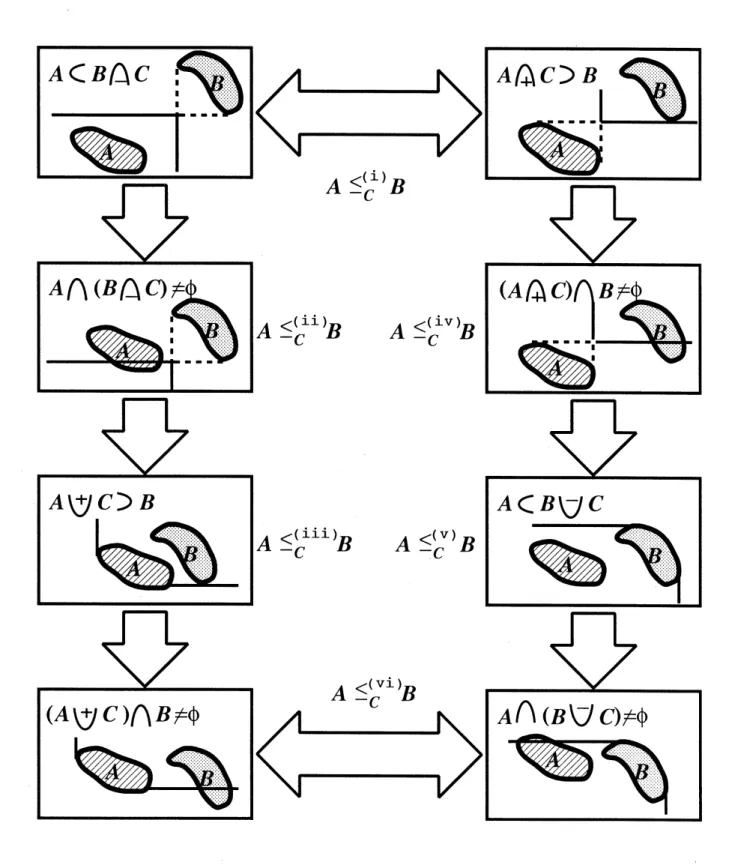
Since conditions (i) and (v) coincide and conditions (iv) and (viii) coincide, we define six
kinds of classification for set-relationship;
see
Figure 1.DEFINITION 2.1. For nonempty subsets $A,$ $B$ of $Z$, we denote
$\bullet$ $A\cap+C\supset B$ by $A\leq_{C}(\mathrm{i})B$; $\bullet$ ($A\cap+^{C)}\cap B\neq\emptyset$ by $A\leq_{C}(\mathrm{i}\mathrm{v})B$;
$\bullet$ $A\cap(B-\cap C)\neq\emptyset$ by $A\leq_{C}(\mathrm{i}\mathrm{i})B$; $\bullet$ $A\subset B\cup-c$ by $A\leq_{C}(\mathrm{v})B$;
$\bullet$ $A\oplus C\supset B$ by
$A\leq_{c^{)}}(\mathrm{i}\mathrm{i}\mathrm{i}B$
; $\bullet$ $(A\oplus C)\cap B\neq\emptyset$ by $A\leq_{C}(\mathrm{v}\mathrm{i})B$
.
As shown in Figure 1, all implications among the set-relations
are
easily verified.PROPOSITION 2.1. For nonempty subsets $A,$ $B$, the following statements hold:
$\bullet$ $A\leq_{C}(\mathrm{i})B$ implies
$A\leq_{C}(\mathrm{i}\mathrm{i})B$;
$\bullet$ $A\leq_{C}(\mathrm{i})B$ implies $A\leq_{C}(\mathrm{i}\mathrm{v})B$;
$\bullet$ $A\leq_{C}(\mathrm{i}\mathrm{i})B$ implies
$A\leq_{C}(\mathrm{i}\mathrm{i}\mathrm{i})B$;
$\bullet$ $A\leq_{C}(\mathrm{i}\mathrm{v})B$ implies $A\leq_{C}(\mathrm{v})B$;
$\bullet$
$A\leq_{c^{\mathrm{i}\mathrm{i}}}(\mathrm{i})B$ implies $A\leq_{C}(\mathrm{V}\mathrm{i})B$;
3. CATEGORIZED CONVEXITY FOR SET-VALUED MAPS
In this paper, convexity of set-valued maps is generalized in the following two ways:
One
is basedon
prescriptions ofrelationship between two sets $F(\lambda x_{1}+(1-\lambda)x_{2})$ and $\lambda F(x_{1})+(1-$$\lambda)F(x_{2})$; the other is based
on
prescriptions by epigraph of$F$, image set of$F$, and lower levelset of$F$. Epigraph convexity, Image-set convexity, and lower leve-Let convexity
are
concernedwith convexity, convexlikeness, and quasiconvexity ofset-valued map, respectively.
Using the six kinds of relationships between two nonempty sets introduced in Section 2,
we
considersome
different concepts with respect to six different set-relations $\leq_{C}(k)(k=\mathrm{i},$$\ldots$ ,
vi) for each convexity of set-valued map
as
generalizations of those of vector-valued function. We categorize such generalized convexities into five class, that is, convexity, convexlikeness,quasiconvexity, properly quasiconvexity, naturally quasiconvexity; and this section consists of four subsections related to them.
3.1. CONVEXITY AND CONVEXLIKENESS OF SET-VALUED MAP
A vector-valued function $f$ : $Xarrow Z$ is said to be $C$
-convex
([14, 15]) iffor every $x_{1},$$x_{2}\in X$and $\lambda\in(0,1)$,
$f(\lambda x_{1}+(1-\lambda)x_{2})\leq_{C}\lambda f(X_{1})+(1-\lambda)f(x_{2})$, (3.1)
which is equivalent to the following condition:
$\mathrm{G}\mathrm{r}\mathrm{a}_{\mathrm{P}^{\mathrm{h}}}(f)+\{\theta_{X}\}\cross C$ is a convexset. (3.2)
Whenever $Z=R$ and $C=R_{+},$ $C$-convexity above is the
same as
the ordinary convexity ofareal-valued function. Based on the six different set-relations $\leq_{C}(k)$ ($k=\mathrm{i},$
$\ldots$, vi), we propose
the following generalization ofconvexity (3.1) to set-valued map. DEFINITION 3.1. A set-valued map $F:X\sim Z$ is said to be
$\bullet$ type $(k)$
convex
($k=\mathrm{i},$$\ldots$
,
vi) if for every $x_{1},$$x_{2}\in \mathrm{D}\mathrm{o}\mathrm{m}F$ and $\lambda\in(0,1)$,$F(\lambda x_{1}+(1-\lambda)x_{2})\leq_{C}(k)\lambda F(x_{1})+(1-\lambda)F(x2)$ ; (3.3)
$\bullet$ graphical-convex if Graph$(F)+(\{\theta_{X}\}\cross C)$ is
a
convex set. (3.4)We have
some
implications among convexities above:PROPOSITION 3.1. For
a
set-valued map $F:X\sim Z$, the following relationships hold: type (i)convex
$arrow$ type (iv)convex
$\downarrow$ $\downarrow$
type (ii)
convex
type (v)convex
$\downarrow$ $\downarrow$
Next,
we
proceed to the convexlikeness of set-valued map. A vector-valued function $f$ :$Xarrow Z$ is said to be $C$-convexlike ([14, 15]) iffor every
$x_{1},$$x_{2}\in X$ and $\lambda\in(0,1)$, there exists
$x\in X$ such that
$f(x)\leq_{C}\lambda f(_{X_{1}})+(1-\lambda)f(x2)$, (3.5)
which is equivalent to the following condition:
$f(X)+C$ is
a
convex
set. (3.6)Based
on
the six different set-relations $\leq_{C}(k)(k=\mathrm{i}, .:..’\mathrm{v}\mathrm{i})$,we
propose the followinggeneral-ization of convexlikeness (3.5) to set-valued map.
DEFINITION 3.2. A set-valued map $F:X\sim Z$ is said to be
$\bullet$ type $(k)$ convexlike $(k=\mathrm{i}, \ldots, \mathrm{v}\mathrm{i})$ if for every $x_{1},$ $x_{2}\in \mathrm{D}\mathrm{o}\mathrm{m}F$ and $\lambda\in(0,1)$, there
exists $x\in \mathrm{D}\mathrm{o}\mathrm{m}F$ such that
$F(x)\leq_{C}(k)\lambda F(x_{1})+(1-\lambda)F(x2)$; (3.7)
$\bullet$ graphical-convexlike if$F(\mathrm{D}\mathrm{o}\mathrm{m}(F))+C$ is
a
convex set. (3.8)We have some implications among convexlikeness above:
PROPOSITION 3.2. For a set-valued map $F:X\sim Z$, the following relationships hold:
type (i) convexlike $arrow$ type (iv) convexlike
$\downarrow$ $\downarrow$
type (ii) convexlike type (v) convexlike
$\downarrow$ $\downarrow$
type (iii) convexlike $arrow$ graphical-convexlike $arrow$ type (vi) convexlike
PROOF. By Proposition 2.1, we can show that the above relations amongtype $(k)$
convexlike-nesses. Next, weshow type (iii) convexlikeness implies convexlikeness and graphical-convexlikeness implies type (vi) graphical-convexlikeness. We can
see
that $F$ is graphical-convexlike ifand only if for each $x_{1},$ $x_{2}\in \mathrm{D}\mathrm{o}\mathrm{m}(F),$ $y_{1}\in F(x_{1}),$ $y_{2}\in F(x_{2})$ and $\lambda\in(0,1)$, there exist
$x\in \mathrm{D}\mathrm{o}\mathrm{m}(F)$ and $y\in F(x)$ such that $y\leq c\lambda y_{1}+(1-\lambda)y_{2}$. From this and definitions of
type $(k)$ convexlikeness, the claim is proved. $\square$
PROPOSITION 3.3. Foraset-valuedmap $F:X\sim Z$and each$k=\mathrm{i},$ $\ldots$,
$\mathrm{v}\mathrm{i}$, type $(k)$ convexity
implies type $(k)$ convexlikeness.
3.2. QUASI CONVEXITY OF SET-VALUED MAP
A vector-valued function $f$
:
$Xarrow Z$ is said to be quasi $C$-convex ([14, 15]) ifit satisfiesone
ofthe following two equivalent conditions:
$\bullet$ (Luc’s quasi $C$-convexity) for every $x_{1},$$x_{2}\in X$ and $\lambda\in(0,1)$,
$f(\lambda x_{1}+(1-\lambda)x_{2})\leq c^{z}$, for all $z\in C(f(x_{1}), f(x_{2}))$, (3.9)
$\bullet$ (Ferro’s quasi $C$-convexity) for each $z\in Z$, the set
$f^{-1}=\{x\in X|f(x)\in z-C\}$ is
convex.
(3.10)Based
on
the six different set-relations $\leq_{C}(k)(k=\mathrm{i}, \ldots, \mathrm{v}\mathrm{i})$,we
propose two ways ofgeneral-ization ofquasi $C$-convexities (3.9) and (3.10) to set-valued map.
First, to define Luc’stype quasiconvexityof set-valued map
we
introduce thefollowing sets. Fora
set-valued map $F:Xarrow Z$ and $x_{1},$$x_{2}\in \mathrm{D}\mathrm{o}\mathrm{m}F$,we
denote, respectively, the dominatedset from below by sets $F(x_{1})$ and $F(x_{2})$ and the set ofpoints dominatingsets $F(x_{1})$ and $F(x_{2})$
simultaneously from above by
$C_{L}(F(x_{1}), F(x_{2}))=(F(x_{1})\oplus c)\cap(F(x_{2})\omega c)$, (3.11)
and
$C_{U}(F(X_{1}), F(x2))=(F(x_{1})+\cap C)\cap(F(x_{2})\cap+^{C)}\cdot$ (3.12)
When $F$ is a single-valued map, we
can
verify that$C_{L}(F(x_{1}), F(x_{2}))=C_{U}(F(X_{1}), F(x2))=C(F(x_{1}), F(x_{2}))$. (3.13) By using two sets and the six different set-relations $\leq_{C}(k)$ ($k=\mathrm{i},$
$\ldots$, vi),
we
considergener-alization ofquasi $C$-convexity (3.9), but types $(\mathrm{i}\mathrm{v})-(\mathrm{V}\mathrm{i})$ generalizations
are
meaningless since the following conditions (3.14) and (3.15) are trivial in thecases.
DEFINITION 3.3. For each $k=\mathrm{i},$ $\mathrm{i}\mathrm{i},$ $\mathrm{i}\mathrm{i}\mathrm{i}$, a set-valued map $F:X\sim Z$ is said to be
$\bullet$ type $(k)$-lower quasiconvex iffor every $x_{1},$$x_{2}\in \mathrm{D}\mathrm{o}\mathrm{m}F$ and $\lambda\in(0,1)$,
$F(\lambda x_{1}+(1-\lambda)x_{2})\leq_{C}(k)C_{L}(F(X_{1}), F(x2))$; (3.14)
$\bullet$ type $(k)$-upper quasiconvex if for every $x_{1},$$x_{2}\in \mathrm{D}\mathrm{o}\mathrm{m}F$ and $\lambda\in(0,1)$,
$F(\lambda x_{1}+(1-\lambda)x_{2})\leq_{C}(k)C_{U}(F(X_{1}), F(x2))$. (3.15)
Second,
we
define Ferro’s type quasiconvexity ofset-valued map.DEFINITION 3.4. A set-valued map $F:X\sim Z$ is said to be
$\bullet$ Ferro type $(-1)$-quasiconvex if for every $z\in Z$,
$F^{-1}(z-C)$ $:=\{x\in X|F(x)\cap(z-C)\neq\emptyset\}$ is convex; (3.16)
$\bullet$ Ferro type $(+1)$-quasiconvex if for every $z\in Z$,
These sets
are
said to be the lower level sets of set-valued map $F$, and Ferro type $(-1)-$quasiconvexity and Ferro type $(+1)$-quasiconvexity
are
provided by convexity of their sets,respectively. By Proposition 2.1. and simple demonstration,
we
have the following interestingimplications
among
quasiconvexities above, including the level-set convexity.PROPOSITION 3.4. For
a
set-valued map $F:X\sim Z$, the following relationships hold:type (i)-lower
$arrow$ type
(i)-upper
$rightarrow$
Ferro type
quasiconvex quasiconvex (+l)-quasiconvex
$\downarrow$ $\downarrow$
type (ii)-lower
$arrow$ type (ii)-upper
quasiconvex quasiconvex
$\downarrow$ $\downarrow$
Ferro type $rightarrow \mathrm{t}\mathrm{y}\mathrm{p}\mathrm{e}(\mathrm{i}\mathrm{i}\mathrm{i})$-lower
$arrow$ type (iii)-upper
$(-1)$-quasiconvex quasiconvex quasiconvex
3.3. PROPERLY QUASI CONVEXITY OF SET-VALUED MAP
A vector-valued function $f$ : $Xarrow Z$ is said to be properly quasi $C$
-convex
([14, 15]) if forevery $x_{1},$$x_{2}\in X$ and $\lambda\in(0,1)$,
$f(\lambda x_{1}+(1-\lambda)x_{2})\leq_{C}f(x_{1})$
or
$f(\lambda x_{1}+(1-\lambda)x_{2})\leq cf(x_{2})$. (3.18)This condition can be described in another way, $f(\lambda x_{1}+(1-\lambda)x_{2})\in(\{f(x_{1}), f(x_{2})\}-C)$,
and hence various types of generalization of the properly quasiconvexity can be considered, but we concentrate upon a generalization of properly quasi $C$-convexity (3.18) to set-valued
map.
DEFINITION 3.5. For each $k=\mathrm{i},$
$\ldots$ ,
$\mathrm{v}\mathrm{i}$, a set-valued map $F:X\sim Z$
is said to be type $(k)$
properly quasiconvex if for every $x_{1},$$x_{2}\in \mathrm{D}\mathrm{o}\mathrm{m}F$ and $\lambda\in(0,1)$,
$F(\lambda x_{1}+(1-\lambda)x_{2})\leq_{C}(k)F(x_{1})$ or $F(\lambda x_{1}+(1-\lambda)x_{2})\leq_{C}(k)F(x_{2})$. (3.19)
By Proposition 2.1,
we
havesome
implicationsamong
properly quasiconvexities above:PROPOSITION 3.5. For a set-valued map $F:X\sim Z$, the following relationships hold:
type (i) properly quasiconvex $arrow$ type (iv) properly quasiconvex
$\downarrow$
$\downarrow$
type (ii) properly quasiconvex type (v) properly quasiconvex
$\downarrow$ $\downarrow$
type (iii) properly quasiconvex $arrow$ type (vi) properly quasiconvex
3.4. NATURALLY QUASI CONVEXITY OF SET-VALUED MAP
A vector-valued function $f$ : $Xarrow Z$ is said to be naturally quasi $C$
-convex
([14, 15]) if forevery $x_{1},$$x_{2}\in X$ and $\lambda\in(0,1)$, there exists $\mu\in[0,1]$ such that
This condition
can
bedescribed in another way, $f(\lambda x_{1}+(1-\lambda)x_{2})\in$ (co $\{f(x_{1}),$$f(x_{2})\}-C$),and hence various types of generalization of the naturally quasiconvexity
can
be considered,but
we
concentrate upona
generalization of naturally quasi $C$-convexity (3.20) to set-valuedmap.
DEFINITION
3.6.
For each $k=\mathrm{i},$$\ldots$,
$\mathrm{v}\mathrm{i}$,
a
set-valued map $F:X\sim Z$ is said to be type$(k)$
naturally quasiconvex iffor every $x_{1},$$x_{2}\in \mathrm{D}\mathrm{o}\mathrm{m}F$ and $\lambda\in(0,1)$, there exists $\mu\in[0,1]$ such
that
$F(\lambda x_{1}+(1-\lambda)x_{2})\leq_{C}(k)\mu F(x_{1})+(1-\mu)F(x2)$. (3.21) By Proposition 2.1, we have
some
implicationsamong
naturally quasiconvexities above:PROPOSITION 3.6. For
a
set-valued map $F:X\sim Z$, the following relationships hold: type (i) naturally quasiconvex $arrow$ type (iv) naturally quasiconvex$\downarrow$ $\downarrow$
type (ii) naturally quasiconvex type (v) naturally quasiconvex
$\downarrow$ $\downarrow$
type (iii) naturally quasiconvex $arrow$ type (vi) naturally quasiconvex
Finally,wehave the following results
on
the relationshipsamongthe generalizedconvexities ofset-valued map introduced in the paper,see
[8].THEOREM 3.1. For a set-valued map $F:X\sim Z$, the following statements hold: (i) For each $k=\mathrm{i},$ $\ldots$, $\mathrm{v}\mathrm{i}$, type $(k)$ convexity implies type
$(k)$ convexlikeness;
(ii) For each $k=\mathrm{i},$ $\ldots$
,
$\mathrm{v}\mathrm{i}$, type $(k)$ convexity implies type $(k)$ naturally quasiconvexity;
(iii) For each $k=\mathrm{i},$
$\ldots$
,
$\mathrm{v}\mathrm{i}$, type
$(k)$ properly quasiconvexity implies type $(k)$ naturally
quasiconvexity;
(iv) Type (iii) naturally quasiconvexity implies type (iii)-lower quasiconvexity; (v) Type (vi) naturally quasiconvexity implies type (ii)-upper quasiconvexity;
(vi) Assume that $C$ is a closed
convex cone
and that $F$ is an upper semicontinuous andconvex-valued set-valued map. If$F$ is type (iii) naturally quasiconvex then it isalso
type (iii) convexlike.
These results
are
similar to those ofvector-valued versions;see
$[14, 15]$.REFERENCES
1. AUBIN J.-P. &FRANKOWSKA H., Set-Valued Analysis, Birkh\"auser, Boston (1990).
2. BORWEIN J., Multivalued ConvexityandOptimization: A Unified Approach to Inequality andEquality
Constraints, Math. Programming, 13, 183-199 (1977).
3. CORLEY H.W., Existence and Lagrangian Duality for Maximizations of Set-Valued Functions, J.
Op-tim. Theory. Appl., 54, 489-501 (1987).
4. CORLEY H.W., Optimality Conditions for Maximizations of Set-Valued Functions, J. Optim.
5. HA T.X.D., Demicontinuity, Cone Convexity and Saddle Point Theorem for Set-Valued Maps, Preprint
of
Hanoi Instituteof
Mathematics, 15 (1995).6. KUROIWA D., Convexity for Set-Valued Maps, Appl. Math. Lett., 9, 97-101, (1996).
7. KUROIWA D., Convexity for Set-Valued Maps and Optimization, Doctoral thesis, Niigata University,
Niigata (1996).
8. KUROIWA D., TANAKA T., and HA T.X.D., On Cone Convexity of Set-Valued Maps, to appear in
the Proceedings of the Second World Congress of Nonlinear Analysts, (1996).
9. LUC D.T., An Existence Theorem in Vector Optimization, Math. Oper. Res., 14, 693-699 (1989).
10. LUC D.T., Theory ofVector Optimization, Lecture Notesin Economics andMathematicalSystems, 319,
Springer-Verlag, Berlin (1989).
11. LUC D.T. &VARGAS C., A Saddlepoint Theorem for Set-Valued Maps, Nonlinear Analysis: Theory,
Methods $\xi y$Appl., 18, 1-7 (1992).
12. TAN K.K., YU J., &YUAN X.Z., Existence Theorems for Saddle Points of Vector-Valued Maps,
J. Optim. Theory. Appl., 89, 731-747 (1996).
13. TANAKA T., Cone-Convexity of Vector-Valued Functions, Science Reports
of
Hirosaki University, 37,170-177 (1990).
14. TANAKA T., Generalized Quasiconvexities, Cone Saddle Points, and Minimax Theorem for
Vector-ValuedFunctions, J. Optim. Theory. Appl., 81, 355-377 (1994).
15. TANAKA T., Cone-Quasiconvexity of Vector-Valued Functions, Science Reports
of
Hirosaki University,42, 157-163 (1995).
16. TANINO T. & SAWARAGI Y., Duality Theory in Multiobjective Programming, J. Optim.
The-ory. Appl., 27, 509-529 (1979).
17. TANINO T. &SAWARAGI Y., Conjugate Maps and Duality in Multiobjective Optimization, J.
Op-tim. Theory. Appl., 31, 473-499 (1980).
18. YU P.L., Cone Convexity, Cone ExtremePoints, and Nondominated Solutionsin Decision Problems with