Journal of Environmental Biotechnology Vol. 15, No. 2, 105–108, 2016
Original paper (regular paper)
2,3,7,8-tetrachlorodibenzo-p-dioxin (TCDD) degradation
by the thermophilic Geobacillus sp. UZO 3
Yuzo Suzuki
1, Masaya Nakamura
2*, Yuichiro Otsuka
2, Nao Suzuki
3, Keisuke Ohyama
3,
Takeshi Kawakami
1, Yusuke Umeka
3, John Solomon Maninang
4, Kanna Izawa-Sato
3, Shojiro
Hishiyama
2, Kouya Inoue
5, Toshiji Kameyama
5, Atsushi Takahashi
1, Yoshihiro Katayama
61 Takasago Thermal Engineering Co. Ltd., Shinjyuku, Tokyo 160–0022, Japan 2 Forestry and Forest Products Research Institute, Tsukuba, Ibaraki 305–8687, Japan
3 Graduate School of Bio-Applications and Systems Engineering,
Tokyo University of Agriculture & Technology, Koganei, Tokyo 184–8588, Japan
4 Department of International Environmental and Agricultural Science,
Tokyo University of Agriculture & Technology, Fuchu, Tokyo 183–8538, Japan
5 Kantteku Co. Ltd., Bunkyo, Tokyo, 112–0004, Japan
6 College of Bioresource Sciences, Nihon University, Fujisawa, Kanagawa 252–0880, Japan * TEL: +81–29–829–8282 Fax: +81–29–873–3797
* E-mail: [email protected]
(Received: 24 February, 2016/Accepted: 28 March, 2016)
2,3,7,8-tetrachlorodibenzo-p-dioxin (2,3,7,8-TCDD) is the most toxic among the dioxin isomers. Despite previous break-throughs, the global quest to discover bioremediation agents for this pollutant remains unabated. In this study, we charac-terize the 2,3,7,8-TCDD-degrading activity of the Geobacillus sp. UZO 3. Cell-free extracts of Geobacillus sp. UZO 3 were incubated for 18 h at 65°C in a reaction milieu that contained 2,3,7,8-TCDD as substrate. Reaction products in the milieu were dissolved in ethyl acetate and directly analyzed by GC-MS. GC-MS data revealed peaks that corresponded to 3’,4’,4,5-tetrachloro-2-hydroxydiphenyl ether (TCDE). Moreover, performing a similar assay that instead contained TCDE as substrate showed that the cell-free extract may also play a catalytic role in the subsequent conversion of TCDE to dichlorophenol (DCP). Our present results suggest that this thermophilic specie catalyzes the reductive cleavage of the diaryl ether bonds of 2,3,7,8-TCDD to TCDE as intermediate by-product which is then converted to DCP. We hereby demonstrate the nouveau 2,3,7,8-TCDD-degrading activity by a bacterial cell-free extract.
Key words: Dioxin, 2,3,7,8-TCDD, Microbial degradation, Geobacillus sp. UZO 3
1. Introduction
Dioxins continue to pose serious threat to the environment. Polychlorinated dibenzo-p-dioxins (PCDDs) and polychlo-rinated dibenzofurans (PCDFs), consisted of 75 and 135 isomers, respectively, are stable hydrophobic contaminants which persist in the environment. PCDD/Fs are introduced into the biosphere on a large scale not only as by-products from the manufacture of chlorinated phenols as pesticides in the 1930s, but also by incineration of wastes6,7,12). They
induce a broad spectrum of biochemical and toxic effects to mammals and other organisms, such as teratogenesis, immunosuppression and tumor promotion. Rapid advances in the field of molecular toxicology revealed that these effects by PCDD/Fs are mediated by aryl hydrocarbon receptors (AhR). Among the PCDD/F isomers, 2,3,7,8-TCDD has been found highly toxic because it has the highest binding affinity to AhR4,13,14).
From the mid-1980s, attention has been directed towards
the development of technology for the clean-up of PCDD/ Fs by bioremediation, marking the beginning of such kind of research3,19). The aerobic bacterium Sphingomonas wittichii
RW1 is one of the most well studied dioxin-degrading bacteria17,18). Armengaud et al.1) succeeded in cloning a
dioxin dioxygenase gene dxnA1A2 from Sphingomonas wittichii RW1 and demonstrated that DxnA1A2 introduces two atoms of oxygen at angular positions neighboring the diaryl ether bonds for subsequent degradation through an unstable intermediate acetal structure. Nam et al.5,15) revealed
that resting cells from Sphingomonas wittichii RW1 degra-dated 2,7-dichlorodibenzo-p-dioxin (2,7-DCDD), 1,2,3-tric hlorodibenzo-p-dioxin, 1,2,3,4-tetrachlorodibenzo-p-dioxin, and 1,2,3,4,7,8-hexachlorodibenzo-p-dioxin to their corre-sponding chlorocatechols. On the other hand, in an anaerobic bacterium, Bunge et al.2) reported that Dehalococcoides
sp. strain CBDB1 is capable of converting 1,2,3,4-tetrac hlorodibenzo-p-dioxin to 2-monochlorodibenzo-p-dioxin, and 1,2,3,7,8-pentachlorodibenzo-p-dioxin to 2,7- or 2,8-DCDD
Suzuki et al. 106
by dechlorination. Despite numerous studies on the microbial degradation of PCDD/Fs, no report has demonstrated a 2,3,7,8-TCDD-degrading activity of bacterial origin.
We have investigated the 2,3,7,8-TCDD-degrading activity of the Geobacillus sp. UZO 3 for several years. As preliminary step, we have previously reported 2,7-DCDD-degrading activity of the cell-free extract from Geobacillus sp. UZO 3 and demonstrated that it reductively cleaves diaryl ether bonds of 2,7-DCDD in a sequential fashion producing 4',5-dichloro-2-hydroxydiphenyl ether (DCDE) as the intermediate, and 4-chlorophenol as the final reaction product16). The structure of intermediate DCDE was
identi-fied by comparing it to the chemically-synthesized authentic compound in GC-MS analysis. Moreover, the detection of DCDE implicated the discovery of an unprecedented dioxin degradation enzyme that reductively cleaves the diaryl ether bonds similar to glutathione-S-transferase, a reduction cleavage enzyme8–11).
To investigate the degradation activity of the cell-free extract from Geobacillus sp. UZO3 on 2,3,7,8-TCDD in vitro, we chemically synthesized the authentic compound of putative intermediate 3’,4’,4,5-tetrachloro-2-hydroxydiphenyl ether (TCDE) (Fig. 1). It appears difficult to demonstrate degra-dation of persistent organic pollutants like 2,3,7,8-TCDD by existing analytical methods which are based on substrate quantitative assay. To overcome this problem, structural identification of the intermediate that demonstrates degra-dative reaction was employed in this study. We monitored the production of the reaction intermediate TCDE in the degradation of 2,3,7,8-TCDD mediated by Geobacillus sp. UZO 3 cell-free extract.
2. Materials and Methods
2.1. Chemicals
2,3,7,8-TCDD was purchased from Cerilliant (Round Rock, Texas, USA). DCP, Cu(OAc)2, CH2Cl2, CDCl3, tetra-methylsilane and N,O-Bis(trimethyl silyl)trifluoroacetamide (BSTFA) were purchased from Wako Pure Chemical (Osaka, Japan). 4,5-dichlorocatechol and 3,4-dichlorophenylbo-ronic acid was purchased from Sigma-Aldrich (Steinheim, Germany). Purities of these chemicals range from 96.6 to 100%. All other chemicals used were of analytical grade and of the highest purity available.
2.2. Synthesis of TCDE
TCDE synthesis from 4,5-dichlorocatechol and 3,4-
dichlorophenylboronic acid was adapted from the method for DCDE synthesis described previously16). Analysis by
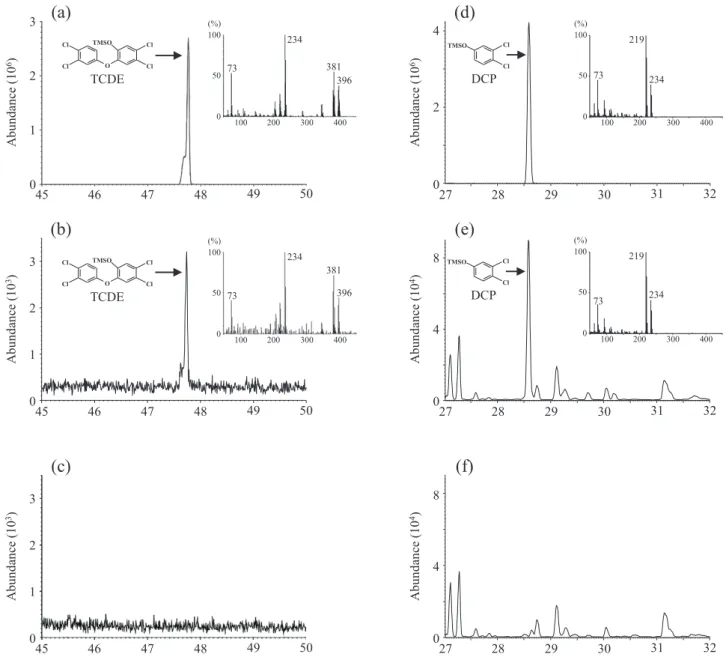
GC-MS showed that the synthesized TCDE has a molecular ion peak of m/z=396 (Fig. 2d) that corresponds to the estimated molecular weight of TCDE. Further analyses by
1H-NMR and 13C-NMR have consistently confirmed the
identity of TCDE. The 1H-NMR spectrum δ (ppm, CDCl
3)
of TCDE is as follows: 5.51 (H, s, OH), 6.89 (1H, dd, J=2.4 Hz), 6.94 (1H, d, J=8.5 Hz), 7.17 (1H, d, J=8.5 Hz), 7.26 (1H, d, J=8.5 Hz), 7.44 (1H, dd, J=8.5 Hz). The 13C-NMR spectrum δ (ppm, CDCl 3) of TCDE is as follows: 154.7, 146.4, 142.0, 133.8, 131.4, 128.6, 128.2, 123.6, 120.2, 120.0, 118.1, 117.6.
2.3. Preparation for cell-free extracts, enzymatic reaction assays and analytical methods
The preparation for cell-free extract of Geobacillus sp. UZO 3 using french pressure cell press and the enzymatic reaction assays were performed as described previously16).
Geobacillus sp. UZO 3 was maintained in tryptic soy agar plates (Difco). Geobacillus sp. UZO 3 and routinely culti-vated in liquid cultures of tryptic soy broth medium (Difco) at 65°C with vigorous shaking. When the optical density at 600 nm reached 1.2, cells were harvested by centrifuga-tion, washed twice with 100 mM phosphate buffer (pH 7.0), and resuspended in a reduced volume of the same buffer. Cell free extracts was prepared from the disrupted bacte-rial cells using the french pressure cell press (Ohtake Co. Ltd., Tokyo, Japan). The disrupted cells were centrifuged at 25,000 g for 30 min (25°C) to remove intact cells and the supernatant was collected as cell free extracts. Briefly, the 1 mL reaction mixture contained 7.5 μM 2,3,7,8-TCDD dissolved in dimethyl sulfoxide (final concentration 5%) and the cell-free extract (about 2 mg of protein). The enzymatic reaction was performed at 65°C for 18 h. Ethyl acetate extracts from 2,3,7,8-TCDD reaction mixture were dried over anhydrous sodium sulfate and the solvent was volatilized by nitrogen gas. The dried enzyme reactant was derivatized by N,O-Bis(trimethyl silyl)trifluoroacetamid prior to GC-MS analysis. GC-MS and NMR analyses were performed as described previously16).
3. Results and Discussion
3.1. 2,3,7,8-TCDD-degrading activity producing TCDE by Geobacillus sp. UZO 3 cell-free extract
We analyzed the 2,3,7,8-TCDD-degrading activity of
Fig. 1. Proposed degradation pathways for 2,3,7,8-TCDD by the Geobacillus sp. UZO 3 cell-free extract.
Compound definitions: 2,3,7,8-tetrachlorodibenzo-p-dioxin (2,3,7,8-TCDD); 3’,4’,4,5-tetrachloro-2-hydroxydiphenyl ether (TCDE); and dichlorophenol (DCP).
107 New dioxin-degrading bacteria degrades 2,3,7,8-TCDD
Geobacillus sp. UZO 3 cell-free extract after 18 h of incu-bating the reaction milieu at 65°C. GC-MS analysis of the ethyl acetate extract of the complete reaction milieu in addition to the substrate 2,3,7,8-TCDD showed peak for TCDE at retention time 47.75 min (Fig. 2b). The peaks of the substrate and product corresponded well with those of their respective authentic compounds (Fig. 2a, b). Ethyl acetate extract of a reaction mixture that did not contain the cell-free extract (control) was detected of 2,3,7,8-TCDD, but showed no peak for TCDE (Fig. 2c). These results suggest that the chlorinated dioxin degradation enzymes contained in Geobacillus sp. UZO 3 cell-free extract reductively cleaves diaryl ether bonds of 2,3,7,8-TCDD to produce TCDE.
3.2. Geobacillus sp. UZO 3 cell-free extract degrades TCDE to DCP
We further investigated the TCDE-degrading activity of Geobacillus sp. UZO 3 cell-free extract. We likewise analyzed by GC-MS the ethyl acetate extract of a similar reaction milieu that instead contained TCDE as substrate. DCP was detected in the ethyl acetate extract (Fig. 2e) implying that the Geobacillus sp. UZO 3 cell-free extract catalyzes the reductive cleavage of the two diaryl ether bonds in 2,3,7,8-TCDD in a sequential fashion. That is, TCDE is first produced as a reaction intermediate which is then converted to DCP.
Fig. 2. GC-MS analyses of the reaction mixtures for 2,3,7,8-TCDD and TCDE degradations mediated by Geobacillus sp. UZO 3 cell-free extract.
The MS chromatograms of the detected intermediates TCDE at m/z=396 (b) from 2,3,7,8-TCDD degradation, and DCP at m/z=234 (e) from TCDE degradation, and their corresponding MS spectrums. The MS chromatograms at m/z=396 (c) and at m/z=234 (f) represent the control chromatograms obtained when the cell-free extract was lacking from the enzyme assay. The MS chromatograms of the au-thentic compounds TCDE at m/z=396 (a) and DCP at m/z=234 (d), and their corresponding MS spectrums.
Suzuki et al. 108
The results of this study provide strong evidence that Geobacillus sp. UZO 3 cell-free extract reductively cleaves the diaryl ether bonds of 2,3,7,8-TCDD (Fig. 1). This is the first report to demonstrate a 2,3,7,8-TCDD-degrading activity of bacterial origin. Work is in progress to clone the genes of the enzymes involved in the reductive cleavage of the diaryl ether bonds of 2,3,7,8-TCDD. Further enzymo-logical characterization of the response mechanism towards 2,3,7,8-TCDD is envisioned to contribute in the remediation of PCDD/Fs-contaminated areas.
Acknowledgments
This work was supported in part by grant-in-aid for Scientific Research (A), 21248037, from the Ministry of Education, Culuture, Sports, Science and Technology of Japan and a fund from Ministry of Environment of Japan.
References
1) Armengaud, J., B. Happe, and K.N. Timmis. 1998. Genetic analysis of Dioxin Dioxygenase of Sphingomonas sp. strain RW1: catabolic genes dispersed on the genome. J. Bacteriol. 180: 3954–3966.
2) Bunge, M., L. Adrian, A. Kraus, M. Opel, W.G. Lorenz, J.R. Andreesen, H. Gorisch, and U. Lechner. 2003. Reductive dehalogenation of chlorinated dioxins by an anaerobic bacte-rium. Nature. 421: 357–360.
3) Field, J.A. and R. Sierra-Alvarez. 2008 Microbial degradation of chlorinated dioxins. Chemosphere. 71: 1005–1018. 4) Gibbons, A. 1993. Dioxin tied to endometriosis. Science. 262:
1373.
5) Hong, H.B., Y.S. Chang, I.H. Nam, P. Fortnagel, and S. Schmidt. 2002. Biotransformation of 2,7-dichloro- and 1,2,3,4- tetrachlorodibenzo-p-dioxin by Sphingomonas wittichii RW1. Appl. Environ. Microbiol. 68: 2584–2588.
6) Hutzinger, O., M.J. Blumich, M. Vanderberg, and K. Olie. 1985. Sources and fate of PCDDs and PCDFs—An overview. Chemo-sphere. 14: 581–600.
7) Kaiser, J. 2000. Just how bad is dioxin? Science. 288: 1941– 1944.
8) Masai, E., Y. Katayama, S. Nishikawa, M. Yamasaki, N.
Morohoshi, and T. Haraguchi. 1989. Detection and localiza-tion of a new enzyme catalyzing the beta-aryl ether cleavage in the soil bacterium (Pseudomonas paucimobilis SYK-6). FEBS Lett. 249: 348–352.
9) Masai, E., Y. Katayama, S. Kawai, S. Nishikawa, M. Yamasaki, and N. Morohoshi. 1991. Cloning and sequence of the gene for a Psedomonas paucimobilis enzyme that cleaves β-aryl ether. J. Bacteriol. 173: 7950–7955.
10) Masai, E., Y. Katayama, S. Kubota, S. Kawai, M. Yamasaki, and N. Morohoshi. 1993. A bacterial enzyme degrading the model lignin compound beta-etherase is a member of the glutathione-S-transferase superfamily. FEBS Lett. 323: 135–140.
11) Masai, E., A. Ichimura, Y. Sato, K. Miyauchi, Y. Katayama, and M. Fukuda. 2003. Roles of the enantioselective glutathione S-transferases in cleavage of β-aryl ether. J. Bacteriol. 185: 1768–1775.
12) Meharg, A.A. and D. Osborn. 1995. Dioxins released from chemical accidents. Nature. 375: 353–354.
13) Mimura, J., K. Yamashita, K. Nakamura, M. Morita, T.N. Takagi, K. Nakao, M. Ema, K. Sogawa, M. Yasuda, M. Katsuki, and Y. Fujii-Kuriyama. 1997. Loss of teratogenic response to 2,3,7,8-tetrachlorodibenzo-p-dioxin (TCDD) in mice lacking the Ah (dioxin) receptor. Genes Cells. 2: 645–654.
14) Mimura, J. and Y. Fujii-Kuriyama. 2003. Functional role of AhR in the expression of toxic effects by TCDD. Biochim. Biophys. Acta. 1619: 263–268.
15) Nam, I.H., Y.M. Kim, S. Schmidt, and Y.S. Chang. 2006. Bio-transformation of 1,2,3-tr- and 1,2,3,4,7,8-hexachlorodibenzo- p-dioxin by Sphingomonas wittichii RW1. Appl. Environ. Microbiol. 72: 112–116.
16) Suzuki, Y., M. Nakamura, Y. Otsuka, N. Suzuki, K. Ohyama, T. Kawakami, K. Sato, S. Kajita, S. Hishiyama, T. Fujii, A. Takahashi, and Y. Katayama. 2011. Novel enzymatic activity of cell-free extract from thermophilic Geobacillus sp. UZO 3 catalyzes reductive cleavage of diaryl ether bonds of 2,7- dichlorodibenzo-p-dioxin. Chemosphere. 83: 868–872. 17) Wilkes, H., R.M. Wittich, K.N. Timmis, P. Fortnagel, and W.
Francke. 1996. Degradation of chlorinated dibenzofurans and dibenzo-p-dioxin by Sphingomonas sp. strain RW1. Appl. Environ. Microbiol. 62: 367–371.
18) Wittich, R.M., H. Wilkes, V. Sinnwell, W. Francke, and P. Fortnagel. 1992. Metabolism of dibenzo-p-dioxin by Sphingomonas sp. strain RW1. Appl. Environ. Microbiol. 58: 1005–1010.
19) Wittich, R.M. 1998. Degradation of dioxin-like compounds by microorganisms. Appl. Microbiol. Biotechnol. 49: 489–499.