
Conversion of Cholesterol to Coprostanol and
Cholestanol in the Estuary Sediment
著者
TESHIMA Shin-ichi, KANAZAWA Akio
journal or
publication title
鹿児島大学水産学部紀要=Memoirs of Faculty of
Fisheries Kagoshima University
volume
27
number
1
page range
41-47
別言語のタイトル
海底堆積物におけるコレステロールからコプロスタ
ノールおよびコレスタノールへの変換
URL
http://hdl.handle.net/10232/13110
Conversion of Cholesterol to Coprostanol and
Cholestanol in the Estuary Sediment
Shin-ichi Teshima* and Akio Kanazawa*
Abstract
This paper deals with the conversion of cholesterol-4-14C to radioactive coprosta nol, cholestanol, and cholestenone in the estuary sediment from Kagoshima Bay, Kagoshima, Japan.
The incubation of cholesterol-4-14C with the sediment and sea water gave radio active coprostanol, cholestanol, and cholestenone. The identification of these radio active compounds was performed by thin-layer chromatography and preparative gas-liquid chromatography followed by radioactive measurements. However, the incu bation of cholesterol-4-14C with sterilized sediment and with sea water (or sterilized sea water) produced extremely small amounts of the above mentioned conversion products. These results indicated that the conversion of cholesterol to coprostanol, cholestanol, and cholestenone is effected by the action of microorganisms in the
sediment.
Several workers have attempted to use coprostanol (5^-cholestane-3y?-ol) as an indicator of fecal pollution in water1"7*. Since the feces of human and mam mals are regarded as the only source of coprostanol in natural environments, the occurrence of coprostanol has been conceived to be indicative of water pol lution in the cause of human life.
As to the marine environments, the authors have pointed out the presence of coprostanol in both sea water and the sediments in Ariake Sea, indicating that the concentration of coprostanol was markedly high in the sediments as com pared with that of sea water7). Later, we have found that the estuary sedi ment from Kagoshima Bay contained large amounts of 5^-stanols such as co prostanol, 24-methylcoprostanol (24-methyl-5y0-cholestane-3y9-ol), and 24-ethyl-coprostanol (24-ethyl-5y9-cholestane-3^-ol) and 5ar-stanols such as cholestanol (5a:-cholestane-3/9-ol), 24-methylcholestanol (24-methyl-5a-cholestane-3^-ol), and 24-ethylcholestanol (24-ethyl-5<x-cholestane-3y9-ol) besides common unsatu rated sterols". Generally, living organisms contain only small amounts of satu rated sterols in their bodies9), except for some species of sponges10>. There fore, it is open to question that the saturated sterols including coprostanol in the estuary sediments are formed by microbiological or chemical hydrogenation from corresponding unsaturated sterols such as cholesterol. In order to resolve
42 Mem. Fac. Fish., Kagoshima Univ. Vol. 27, No. 1 (1978)
this question, we intend to examine the conversion of cholesterol in the estuary
sediment by using tracer techniques. The present paper deals with these results
and discussion.
Materials and Methods
Incubation of cholesterol-4-14C with the sediment and sea water
Cholesterol-4-14C (specific activity, 143/*Ci/mg; Radiochemical Centre, Amersham, England)
was purified by thin-layer chromatography (TLC) on Kieselgel G with chloro
form"
and on 10^ (w/w) AgN03-Kieselgel G with ethanol-free chloroform1".
Sea water (surface water) and the sediment (0-5cm depth) were aseptically
collected near the estuary of River-Koutsuki, July 10, 1977.
Cholesterol-4-14C
was incubated in a 100ml-Erlenmyer flask containing sea water (10 ml) and the
estuary sediment (10 g in wet weight) without shake at 20°C as shown in Table 1.Table 1. Incubation of cholesterol-4-14C with the sediment and sea water
^ i -
Incubation median,
Q$X£'8&? DSS
added (uCi)*2 period (days)1 Sterilized sediment (10 g) -f- Sterilized sea water (10 ml) 2 Sterilized sediment (10 g) + Sea water (10 ml)
3 Sediment (10 g) + Sea water (10 ml) 4 Sediment (10 g) + Sea water (10 ml) 5 Sediment (10 g) + Sea water (10 ml)
+ Yeast extract (5mg) + Polypeptone (10 mg)
** Incubation was carried out without shaking at 20°C.
*2 Cholesterol-4-14C was dissolved in 0.15 ml of 5 % Tween 80 and added to each flask.
Extraction and identification of conversion products After incubation, lipids were extracted twice with chloroform-methanol-water (2: 2: 1) according to the method of Bligh and Dyer12> from the incubation mixture. Lipids were saponi fied with 10 % KOH in ethanol at 80°C for 3 hr, and the unsaponifiable matters were isolated from the saponification mixture by extraction with ether. The unsaponifiable matters were separated into '5^-stanol fr.' and 'sterol fr.' by thin-layer chromatography (TLC) on Kieselgel G with chloroform". '5^-Stanol fr.' contained coprostanol and cholestenone (cholest-4-en-3-one), whereas 'sterol fr.' involved cholestanol and other unsaturated sterols. 'Sterol fr.' was acety-lated with dry pyridine-acetic anhydride (1: 1) and then subjected to 10 % (w/w) AgN03-Kieselgel G with ethanol-free chloroform11' to separate A0-, A7-, and A5-sterol fractions. Finally, the incorporation of radioactivity into each sterol was ascertained by preparative gas-liquid chromatography (GLC) on 1.5 % OV-17 (column temperature, 250°C) followed by radioactive measurements13'. Radioactivity was determined on a Beckman liquid scintillation counter LS-230 using a solution of 0.&96 PPO as a scintillator. The efficiency of counting of
2 10
2 10
2 10
2 30
radioactive steroids was about 90 per cent. In addition, the presence of radio active compounds was checked by means of autoradiography after TLC.
Results
Cholesterol-4-14C was incubated with the sediments and sea water as shown
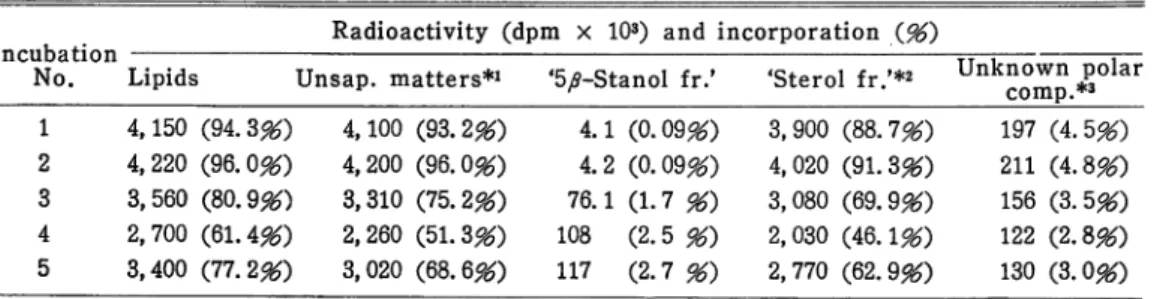
in Table 1. The results are given in Tables 2 and 3. The recoveries of radio activity in lipids were low in incubations No. 3, No. 4, and No. 5 which con tained non-sterilized both sediment and sea water. Gaskell and Eglinton14) have pointed out the difficulty in quantitative extraction of sterols from the sediment. However, the low recoveries of radioactivity in incubations No. 3, No. 4, and No. 5 were attributable to loss of 14C-activity, probably as an expired carbon dioxide during the incubation period, because of the high recoveries of
Table 2. Incorporation of 14C activity into lipid fractions
Incubatior No.
Radioactivity (dpm x 103) and incorporation (96) i
Lipids Unsap. matters*1 '5,0-Stanol fr.' 'Sterol fr/*2 Unknown polar comp.*3 1 4,150 (94.3#) 4,100 (93.2*0 4.1 (0.09*0 3,900 (88.7*0 197 (4.5*0 2 4,220 (96.0*0 4,200 (96.0*0 4.2 (0.09*0 4,020 (91.3*0 211 (4.8*0 3 3,560 (80.9*9 3,310 (75.2*0 76.1 (1.7 96) 3,080 (69.9*0 156 (3.5*0 4 2,700 (61.4*9 2,260 (51.3*0 108 (2.5 96) 2,030 (46.1*9 122 (2.8*0 5 3,400 (77.2*0 3,020 (68.6*0 111 (2.7 96) 2,770 (62.9*0 130 (3.0*0
% Incorporation was expressed as percentage of cholesterol-4-14C (2 #Ci) added to each incubation flask. *2 Unsaponifiable matters. *2 Sterols except 5 ^-stands. *3 TLC on Kieselgel G of the unsaponifiable matters showed the presence of radioactive substances (Rf 0.00, 0.05) besides two radioactive bands corresponding to 5 ^-stanols and other ste rols. These radioactive compounds are referred as 'unknown polar compounds'.
Table 3. Distribution (%) of radioactivity in f5fi-and incorporation (%) of radioactivity
stenone, cholesterol, cholestanol, and
-stanol fr/ and 'sterol fr.
into coprostanol, chole
cholest-7-enol t ion '5,0-Stanol fr.' 'Sterol fr/ Incubat: No. Corpostanol % % Distr.*1 Incorp.
Cholestenone Cholestanol Cholesterol
% Distr. Cholest-7-enol % Distr. % *2 Distr. % Incorp. Distr.% % Incorp. 1 49 0.04 51 0.05 3.7 3.3 96.3 — 2 56 0.05 44 0.04 3.2 2.9 96.8 — 3 48 0.82 52 0.88 15.8 11.0 84.2 — 4 42 1.05 58 1.45 27.4 12.6 72.6 trace*3 5 50 1.35 50 1.35 12.2 7.7 87.8 trace
** % Distribution of radioactivity in '5y?-stanol fr/ or 'sterol fr/ determined by using TLC. *2 % Incorporation expressed as percentage of cholesterol-4-14C added to each incubation
flask.
44 Mem. Fac. Fish., Kagoshima Univ. Vol. 27, No. 1 (1978)
radioactivity in lipids from incubations No. 1 and No. 2 which contained either sterilized or non-sterilized sea water in addition to sterilized sediment. Also, the results of the present study suggests that cholesterol is undergone degrada tion to carbon dioxide within a short period in the estuary sediment; namely, about 40 % of cholesterol-4-14C was suspected to be converted to carbon dioxide in incubation No. 4 (30-day incubation).
Aliquots of the radioactive unsaponifiable matters were subjected to TLC on Kieselgel G and autoradiographed. The autoradiograms of the unsaponifiable matters from incubations No. 3, No. 4, and No. 5 showed the presence of four
o o >-4 -1.0 0.4-8 4 1 [A] Coprostanol [B] Cholestenone [C] Cholestanol o g 10 C$ [D]
fl;
Cholesterol:il
SDrr^a 4 ' 25RETENTION TIME (MIN)
50
Fig. 1. Preparative GLC on 1.5% OV-17 of the fractions corresponding to coprostanol £A]], cholestenone CB], J°-sterols [X]], and J5-sterols
CD].
To each fraction obtained by TLC, coprostanol, cholestenone, cholestanol, and cholesterol were added as carriers and subjected to GLC. Trapped samples were then subjected to determination of radioactivity with a liquid scintillation counter.
radioactive bands with the identical Rf values to coprostanol (Rf 0.45; referred as '5,0-stanol fr.'), cholesterol (Rf 0.40; referred as 'sterol fr.'), and unknown polar compounds (Rf 0. 05 and 0. 00). Since the unknown polar compounds were also detected in incubations No. 1 and No. 2, they were assumed to be formed by inorganic process.
The '5/9-stanol fr.' was acetylated with dry pyridine-acetic anhydride and then subjected to TLC on Kieselgel G with chloroform. The autoradiograms after TLC gave two radioactive bands corresponding to coprostanyl acetate (Rf 0. 80) and cholestenone (Rf 0.45) in incubations No. 3, No. 4, and No. 5. In incubations No. 1 and No. 2, radioactive bands were not observed definitely in the autoradio grams, however the zone corresponding to coprostanyl acetate and cholestenone gave radioactivity slightly by means of liquid scintillation counting. Since the percentage incorporation of cholesterol-4-14C into coprostanol and cholestenone was higher in incubations No. 3, No. 4, and No. 5 than in incubations No. 1 and No. 2, the conversion of cholesterol to both the steroids is suggested to be effected by the microorganism in sediment rather than by inorganic process. To confirm the identity of radioactive coprostanol and cholestenone, the zones corresponding to both compounds were scraped from TLC plates and steroids were eluted with ether for preparative GLC analysis followed by radioactive measurements. The preparative GLC analysis showed that coprostanol and cholestenone were the sole radioactive compounds of their respective fractions (Fig. 1).
The 'sterol fr.* was acetylated and then separated into A0-, A7-, and A5-steryl acetates by using TLC on 10 % AgN03-Kieselgel G. The autoradiograms
after TLC showed radioactive bands corresponding to cholestany (Rf 0. 65) and
cholesteryl (Rf 0. 57) acetates in all incubations. However, the percentage incor poration of cholesterol to cholestanol was higher in incubations No. 3, No. 4, and No. 5 than in incubations No. 1 and No. 2. The results indicated that thehydrogenation of cholesterol to cholestanol was also operated mainly by micro
bial transformation as well as the formation of coprostanol and cholestenone. The preparative GLC analysis of A0- and A5-steryl acetates from TLC onAgN03-Kieselgel G revealed that radioactivity was associated with cholestanyl
and cholesteryl acetates but not with C28- and C29-steryl acetates (Fig. 1).
On the basis of the above results, we concluded that cholesterol is converted to coprostanol, cholestenone, and cholestanol in the estuary sediment mainly by the action of microorganisms.
Discussion
Steroids have been regarded as a usuful indicator of biological origin of or ganic matters in recent15-1" and ancient sediments17~21) and petroleum2". Apart from these studies, coprostanol is also regarded to reflect fecal pollution in waterw). Our previous study8) has shown that the estuary sediment collected
46 Mem. Fac. Fish., Kagoshima Univ. Vol. 27, No. 1 (1978)
from the same station as the present study contained coprostanol, cholesterol, and cholestanol in the weight ratio about 2.6: 1. 0: 0. 7, with suggestion that a
part of coprostanol may be formed from cholesterol in the sediment. The present study showed that cholesterol is transformed to coprostanol besides cholestanol and cholestenone. Recently, Gaskell and Eglinton have also demonstrated by using tracer techniques that cholesterol is hydrogenated to cholestanol and coprostanol in the sediment of Rostherne Mere (Cheshire, En gland), a highly productive lake, and in the model environment of anaerobic
sewage sludge14). They have reported that the rate of hydrogenation of chole
sterol is approximately 0.5 % in 3 months. In the present study, the approxi
mate % conversion rates of cholesterol to coprostanol and cholestanol were 1 %
and \2>%, respectively, in 30 day-incubation (incubation No. 4, see Table 3). These values on % conversion may not always agree with those on % conver sion of cholesterol to coprostanol and cholestanol in the estuary sediment under natural environments. However, the results of the present study suggest
that the amounts of coprostanol deriving from cholesterol in the sediments
should be taken into consideration in evaluation of fecal pollution using copro stanol concentration of sediments. Since both cholestanol and coprostanol are formed from cholesterol in the sediments, it may give available informations
on the origin of coprostanol to determine the concentrations of cholestanol and
cholesterol and the weight ratio of coprostanol to cholesterol and/or cholesta
nol.
References
1) Murtaugh, J. J. and R. L. Bunch (1967) : /. Water Pollution Control Fed., 39, 404-409.
2) Smith, L. L., D.P. Kohler, J. E. Hempel, and J. E. van Lier (1968): Lipids, 3, 301-306.
3) Smith, L. L. and E. Gouron (1969): Water Res., 3, 141-148. 4) Ogura, K. and T. Hanya (1970): Yosui to Haisui. 12, 1132-1136.
5) Reichert, J. K. (1971) : Gas-Wasserfach/Wasser Abwasser, 112, 403-406.
6) Tabak, H. H. Bloomhuff, and R. L. Bunch (1972) : Develop. Ind. Microbiol, 13, 296-307.
7) Kanazawa, A. and S. Teshima (1978): Oceanol. Acta, 1, 39-44.
8) Teshima, S. and A. Kanazawa (1978): /. Oceanogr. S>c. Japan, 34, 85-92. .
9) Goad, L. J. (1976): In *Biochemical and Biophysical Perspective in Marine Biology (Edited, by Malins, D. C. and J. R. Sargent)', Vol. 3, Academic Press, London, pp. 213-319. 10) De Rosa, M., L. Minale, and G. Sodano (1973): Comp. Biochem. Physiol, 46 B, 823-837.
11) Rubinstein, I. and L. J. Goad (1974): Phytochem., 13, 481-484.
12) Bligh, E. G. and W. J. Dyer (1959) : Can. J. Biochem. Physiol, 37, 911-917. 13) Teshima, S. and A. Kanazawa (1975): Comp. Biochem. Physiol, 52 B, 437-441. 14) Gaskell, S. J. and G. Eglinton (1975): Nature, 254, 209-211.
15) Attaway, D. and P. L. Parker (1970): Science, 169, 674-675. 16) Ogura, K. and T. Hanya (1973) : Proc. Japan. Acad., 49, 201-204.
17) Burlingame, A. L., P. Hang, T. Belsky, and M. Calvin (1965) : Proc. natn. Acad. Sci. U. S. A., 54, 1406-1412.
18) Henderson, W., V. Wollrab, and G. Eglinton (1968): Chem. Comm., 710-712.
19) Anderson, P. C, P. M. Gardner, E. V. Whitehead, D. E. Anders, and W. E. Robinson (1969) : Geochim. cosmochim. Acta, 33, 1304-1307.
20) Mattern, G., P. Albrecht, and G. Ourisson (1970): Chem. Comm., 1570-1571. 21) Steel, G. and W. Henderson (1972) : Nature, 238, 148-150.

![Fig. 1. Preparative GLC on 1.5% OV-17 of the fractions corresponding to coprostanol £A]], cholestenone CB], J°-sterols [X]], and J5-sterols CD].](https://thumb-ap.123doks.com/thumbv2/123deta/6398047.1106330/5.733.166.595.344.862/fig-preparative-fractions-corresponding-coprostanol-cholestenone-sterols-sterols.webp)
