Flower Visitors of 32 Plant Species in West
Sumatra
著者
KATO Makoto, ICHINO Takao, HOTTA Mitsuru,
ABBAS Idrus, OKADA Hiroshi
journal or
publication title
南太平洋海域調査研究報告=Occasional papers
volume
16
page range
15-32
URL
http://hdl.handle.net/10232/16619
FLOWER VISITORS OF 32 PLANT SPECIES IN WEST SUMATRA
M. Kato1, T. Ichino2, M. Hotta3, I. Abbas4 and H. Okada5
1 Yoshida College, Kyoto University, Kyoto
2 Faculty of Agriculture, Kagawa University, Kita-gun, Kagawa
3 Faculty of Science, Kagoshima University, Kagoshima
4 Faculty of Science, Andalas University, Padang, West Sumatra
5 College of General Education, Osaka University, Toyonaka, Osaka
Abstract
We recorded flower visitors of 32 plant species belonging to 14 families:
Annonaceae (1), Cruciferae (1), Leguminosae (1), Melastomataceae (1),
Balsaminaceae (7), Verbenaceae (3), Gesneriaceae (3), Rubiaceae
(2),
Compositae (2), Musaceae
(4), Zingiberaceae (4), Palmae (1),
Pandanaceae
(1) and Araceae (1) (number of species studied being in parenthesis) in
West Sumatra.
Introduction
Reproductive biology of plant species in neotropical lowland rain forest
has been investigated from various standpoints; sexual systems of trees
(Bawa et ah, 1985a),
pollination systems of trees
(Bawa
et al.,
1985b),
bird-pollination
syndrome
(Feinsinger,
1976,
Murray
et
al.,
1987),
and
pollination ecology of euglossine bees (Dressier, 1982), hummingbirds
(Stiles, 1975) and bat (Heithaus et al., 1974). In contrast, reproductive
biology of plants in the lowland tropical rain forest in Southeast Asiahas only recently been investigated, and pollination systems of many
plants remain unknown excluding some members of Dipterocarpaceae (Appanah
and Chan, 1981; Appanah, 1985), Sapindaceae (Appanah, 1982), Leguminosae
(Atmowidjojo and Adisoemarto, 1986), Rafflesiaceae (Beaman et al., 1988),
Oxalidaceae
(Lack and
Kevan,
1987)
and
Bignoniaceae
(Gould,
1978).
To
compare the evolutionary history of pollination systems in palaeotropicswith that in neotropics, we need basic information on pollination systems
of the tropical plants of Southeast Asia.
The floral characters of many plants are thought to have coevolved with
the pollinators. For example, the length of tubular perianths and spurs of
bumblebee-pollinated flowers in temperate zone and of hummingbird- or
-15-euglossine bee-pollinated flowers in neotropics are good examples
(Hein-rich,
1975;
Murray
et al.,
1987;
Dressier,
1982).
In lowland
rain forest
of Southeast Asia where there are neither bumblebees, hummingbirds nor
euglossine bees, we can find many plant species which have long tubular
perianths or long spurs. What kinds of organisms with long tongue or long
bills pollinate these flowers?
Moreover there
are
various
types
of
tropical flowers which are not distributed in temperate zone. Here weprovide information on the flower visitors of 32 plant species belonging
to 14 families, which have various floral characters.
Materials and Methods
We studied flower visitors of 32 plant species, of which 23 were
indigenous
species,
5 were
naturalized and 4
were
cultivated ones.
In
natural and disturbed vegetations ranging from lowland to montane zone inWest Sumatra, we directly observed and sometimes collected flower visitors
mainly in daytime on fine days between Nov. 27, 1987 and Jan. 30, 1988.
Behavior of some flower visitors were recorded by video tape recorder
(checked by (v) in the list of flower visitors). To analyze the relation
ship between floral characters and tongue characters of bees, we measured
the lengths
of
proboscises
and
of forewings
of
bees
collected
on
the
flowers.Results
We provide a list of flower visitors in phylogenetical order of plant
family. For each plant species studied, locality, date of observation,
habitat and floral characters are added. Flower visitors are classified into the following 7 categories of anthecological status according to Inouye (1980): pollinator searching for nectar [Pn], pollinator searching for pollen [Pp], primary nectar robber [Rnp], secondary nectar robber [Rsn], nectar thief [Tn], pollen thief [Tp] and ovule parasite [O].1 Achasma macrocheilos Griff. (Zingiberaceae)
Ulu Gadut (350m), Padang, Jan. 21, 1988. Gigantic herb in young secondary forest. Floral characters are somewhat similar to Carenophila sp., but the tubular calyx is longer and the labellum is large and crimson. Length of the tubular calyx is about 80mm.
Hymenoptera
Anthophoridae
Amegilla elephas (Lieftinck) [Pn]
2
Amomum sp. (Zingiberaceae)
Tanjunlolo (250m), Sawahlunto Sijunjung, Jan. 27, 1988. Floral characters
-are somewhat similar to Costus sp. excluding the smaller size and the pale color of perianths. Hymenoptera Halictidae Nomia sp. 7 [Pn] Nomia sp. 8 [Pn]
3 Cocos nucifera L. (Palmae)
Sungaidareh (125m), Sawalunto Sijunjung, Jan. 26-27,
1988. Monoecious tree cultivated in a orchard near primary rain forest. Flowers are small and composed of three separate petals and three separate sepals. Nectary is absent. Flower visitors were collected only on male
inflorescences. Hymenoptera
Apidae
Trigona (Geniotrigona) thoracica Smith [TpJ T. (Tetragonula) collina Smith [Tp]
T. (T.) geissleri Cockerell [Tp] T. (T.) reepeni Friese [Tp] T. (T.) drescheri Schwarz [Tp] T. (T.) melina Gribodo [Tp]
4 Cosmos sulphureus Cav. (Compositae)
Sungaidareh (125m), Sawahlunto Sijunjung, Jan. 26, 1988. Naturalized herb originating from North America and growing roadside. A capitulum is composed of hermaphrodite disk florets and asexual bilabiate florets, corolla of which is orenge yellow.
Diptera Syrphidae Baccha sp. 2 [Pn] Hymenoptera Halictidae Nomia sp. 1 [Pn, Pp] Megachilidae Heriades sp. 1 [Pn, Pp]
Pithitis smaragdula (Fabricius) [Pn, Pp]
Anthophoridae
Ceratina (Ceratinidia) nigrolateralis (Cockerell) [Pn, Pp]
ApidaeApis (Megapis) dorsata (Fabricius) [Pn, Pp]
5 Costus sp. (Zingiberaceae)
Tanjunlolo (250m), Sawahlunto Sijunjung, Jan. 27, 1988. Yellow hermaphro
dite flowers are borne in a cyme just on the ground. The flower is enclosed by two whorls of perianth segments fused into a tubular calyx. Two large staminoids form the yellow labellum and the single stamen is-17-concealed under the posterior perianth.
Hymenoptera Halictidae
Nomia sp. 1 [Pn]
6 Cyrtandra sp. (Gesneriaceae)
Ulu Gadut (350m), Padang, Jan. 21, 1988. Herb growing on a dark forest floor. White hermaphrodite flowers are borne on a cyme just on a ground. Five petals are fused into a long (38mm) tube. Nectar is secreted at the bottom of the corolla tube. Two of four stamens are vestigial.
Hymenoptera
Anthophoridae
Amegilla pendleburyi (Cockerell) [Pn]
Diptera
Tachinidae 2 unidentified species [Tp] Anthomyiidae 1 unidentified species [Tp]
7 Eupatrium odoratum L. (Compositae)
Ulu Gadut (300-400m), Padang, Nov. 28, 1987-Jan. 22, 1988 and Bukit Sabarah (300m), Sawahlunto Sijunjung, Jan. 27-30, 1988. Naturalized herb (from tropical America) by roadside or wasteland near primary and secondary forest. A capitulum is composed of hermaphrodite disk florets, corolla of which is white, (v, at Alahanpanjang)
Hymenoptera Halictidae
Lasioglossum (Ctenonomia) aff. vagans (Smith) [Pn]
Anthophoridae
Ceratina (Ceratinidia) cognata Smith [Pn] Apidae
Trigona (Lepidotrigona) terminata Smith [Pn] T. (Tetragonula) laeviceps Smith [Pn]
T. (Heterotrigona) itama Cockerell [Pn]
T. (Lepidotrigona) ferminata Smith [Pn] Apis (Megapis) dorsata (Fabricius) [Pn] 8 Globba cf. pendula (Zingiberaceae)
Batang Barus (1300m), Alahanpanjang, Jan. 30, 1988. Herb beside streamlet in a montane forest. Hermaphrodite flowers are borne in a raceme. The flower is enclosed by two whorls of perianth segments fused into a tubular calyx. Two staminoids form the yellow labellum and the single stamen and the style protrude from the tubular calyx drawing an arc.
Hymenoptera
Anthophoridae
Elaphopoda impatiens (Lieftinck) [Pn]
9 Homalomena pendula (Bl.) Buckh. f. (Araceae)
-Batang Barus (1300m), Alahanpanjang, Dec. 8, 1987. Monoecious herb beside a stream in a montane forest. The inflorescence consists of a large spathe enveloping a spadix of numerous small unisexual flowers. Female flowers are borne in the lower position of spadix than male flowers. Both flowers
lack nectaries.
Coleoptera
Nitidulidae 1 unidentified species [Pp]
10 Impatiens albo-flava Miq. (Balsaminaceae) Airsirah (1000m), Padang, Jan. 6-8, 1988 and
Batang Barus (1300m), Alahanpanjang, Jan. 14-15, 1988. Irregular herma phrodite flower is borne on a raceme. One of three free sepals is petaloid and spurred. Length of the spur is about 22 mm. Five petals are yellow and lower lateral petals are markedly larger than upper ones.
Lepidoptera Satyridae
Mycalesis oroatis [Tn]
Diptera Syrphidae
Epistrophe aff. balteata de Geer [Tp]
Baccha sp. 1 [Tp]
Tachinidae 1 unidentified species [Tp]
Hymenoptera Formicidae
Crematogaster sp. 2 [Tn]
Vespidae
Polybioides raphigastra (Saussure) [Rpn]
Halictidae
Lasioglossum (Evylaeus) sp. 1 [Tp, Rsn]
L. (E.) vuloanicum (Bluthgen) [Tp, Rsn]
Thrincostoma (Diagonozus) sp. 1 [Pn]
Anthophoridae
Amegilla andrewsi (Cockrell) [Rpn]
A. smatrana (Lieftinek) [Pn]
Protomelissa vulpecula (Lieftinck) [Rpn]
11 Impatiens eubotrya Miq. (Balsaminaceae)
Batang Barus (1300m), Alahanpanjang, Jan. 14-15, 1988. Herb growing beside streamlet in a montane forest. The peduncle is distorted and the yellow
flower is inverted. The length of spurred sepal is 24 mm. Coleoptera
Mordellidae
Glipa aff. malaccana Pic [Tp]
Diptera Syrphidae
Epistrophe aff. balteata de Geer [Tp, Rsn]
-Baccha sp. 1 [Tp, Rsn] Hymenoptera Formicidae Paratrechina sp. 1 [Tn] Halictidae Lasioglossum (Evylaeus) sp. 1 [Tp, Rsn] Anthophoridae
Amegilla andrewsi (Cockerell) [Rpn] A. sumatrana (Lieftinck) [Pn]
Elaphopoda impatiens (Lieftinck) [Pn] Protomelissa vulpecula (Lieftinck) [Rpn]
Braunsapis sp. 1 [Rsn]
12 Impatiens 'gadutensis9 M. Hotta, nom. nud. (Balsaminaceae)
Gunung Gadut (1600m), Padang, Jan. 1-2, 1988. Herb growing on a floor of a montane moss forest. The floral characters are almost similar to I.
albo-flava excluding the shorter and thickness and hairiness of wall of the
s p u r .
Hymenoptera Apidae
Bombus (Rufipedibombus) rufipes Lepeletier [Pn] Bombus (Senexibombus) senex Vollenhoven [Pn]
Several individuals of these two species flying around the I. gadutensis flowers were collected, but their visits on the flower were not
directly observed. We found
some scars on lower
petals
indicating
pollinator visits. The fact that the two
Bombus species were only
bees
observed at this site suggests that some Bombus individuals have visited the flower.13 Impatiens junghuhnii Miq. (Balsaminaceae)
Mukomuko (800m), Maninjau, Dec. 21, 1987. Herb with fleshy stem growing
beside streamlet in a hill forest. The floral characters resemble J.
pyr-rhotricha, but the lower sepal is saccate and the petals forming slightly
campanulate collora.Hymenoptera Anthophoridae
Amegilla pendleburyi (Cockerell) [Pn]
14 Impatiens platypetala Lindl. (Balsaminaceae)
Airsirah (1000m), Padang, Jan. 6-8, 1988. Herb growing beside streamlet
around a hill forest. A few irregular hermaphrodite flowers are borne in a raceme. One of three free sepals is petaloid and spurred. Length of thespur is about 32 mm. Five pink petals are nearly equal in size and shape,
(v)
Lepidoptera Sphingidae
-20-Macroglossum corythus Rothschild et Jordan [Pn] Diptera
Syrphidae
Epistrophe aff. balteata de Geer [Tp] Hymenoptera Formicidae Crematogaster sp. 1 [Tn] Halictidae Lasioglossum sp. 2 [Tp, Rsn] Anthophoridae
Amegilla andrewsi (Cockerell) [Rpn]
15 Impatiens pyrrhotricha Miq. (Balsaminaceae)
Batang Barus (1300m), Alahanpanjang, Jan. 30, 1988. The floral characters are similar to I. albo-flava excluding the larger size and the short (18 mm) curved spur.
Hymenoptera
Anthophoridae
Elaphopoda impatiens (Lieftinck) [Pn]
16 Impatiens 'talangensis9 M. Hotta, nom. nud. (Balsaminaceae)
Batang Barus (1300m), Alahanpanjang, Jan. 30, 1988. Herb growing beside streamlet in a montane forest. The floral c h a r a c t e r s a r e similar to I.
pyrrhotricha excluding the larger size and the long (23mm) broad spur. Diptera Calliphoridae ?Protophormia sp. [Tp] Hymenoptera Formicidae Paratrechina (Nylanderia) sp. 1 [Tn]
Monomorium pharanonis (Linne) [Tn]
Pheidole sp. 1 [Tn]
Halictidae
Lasioglossum (Evylaeus) vuloanicum (BHithgen) [Tp, Rsn]
Anthophoridae
Amegilla sumatrana (Lieftinck) [Pn] Elaphopoda impatiens (Lieftinck) [Pn]
Protomelissa vulpecula (lieftinck) [Rpn, Rsn]
17 Lantana aculeata L. (Verbenaceae)
Ulu gadut (400m), Nov. 27-Dec. 30, 1987. Small red hermaphrodite flowers are arranged in a cyme. The length of corolla tube is about 10 mm.
Lepidoptera Papilionidae
Papilio memnon L. [Pn] P. polytes L. [Pn]
-Graphium sarpedon L. [Pn]
Amathusiidae
Hypolimnas bolina Linnaeus [Pn]
Danaidae
Danaus sp. [Pn]
Hymenoptera
Anthophoridae
Amegilla andrewsi (Cockrell) [Pn] 18 Mimosa pudica L. (Leguminosae)
Sungaidareh (125m), Sawahlunto Sijunjung, Jan. 25-27, 1988. Naturalized weed by roadside near primary rain forest. Regular hermaphrodite flowers are arranged in tight clusters. Five petals are small and equal. Numerous stamens are pink and showy.
Diptera
Sarcophagidae 1 unidentified species [Tp] Tachinidae 1 unidentified species [Tp] Anthomyiidae 1 unidentified species [Tp]
Hymenoptera Halictidae
Nomia sp. 1 [Pn, Pp]
Lasioglossum (Ctenonomia) xystonotum (Vachal) [Pn, Pp}
Megachilidae
Heriades sp. 2 [Pn, Pp] Anthop horidae
Ceratina (Ceratinidia) cognata Smith [Pn, Pp] C. (C.) nigrolateralis (Cockerell) [Pn, Pp] 19 Monophyllaea hirtella Miq. (Gesneriaceae)
Ladang Padi (400m), Padang, Dec. 25, 1987. Herb growing on a calcareous rocky slope beside a stream in primary rain forest. Small white hermaphro dite flowers are borne on a raceme. Five white petals are fused into a
shallow basal tube. Hymenoptera
Halictidae
Nomia sp. 2 [Pn]
20 Monophyllaea hirtella x M. horsfieldii (Gesneriaceae)
Ladang Padi (400m), Padang, Dec. 25, 1987. Herb growing at the same habitat as the former species. Floral characters are almost similar to M. hirtella excluding the smaller size and the slightly pink color of the
corolla. Hymenoptera Halictidae Nomia sp. 2 [Pn] Anthophoridae 2 2
-Ceratina (Lioceratina) flavopicta Smith [Pn]
21 Musa acuminata Coll. (Pisan lidi) (Musaceae)
Ulu Gadut (370m), Padang, Dec. 14, 1987. Primitive cultivated banana. Floral characters are almost similar to M. acuminata subsp. halabanensis
but bracts crimson in color. Hymenoptera
Apidae
Trigona (Tetrigona) apicalis Smith [Rsn] T. (Tetragonula) laeviceps Smith [Rsn]
Vespidae
Polybioides raphigastra (Saussure) [Rsn]
Chiroptera (Mammalia) Pteropodidae
?Macroglossus sobrinus (Andersen) [Pn]
22 Musa acuminata Coll. subsp. halabanensis (Meijer) M. Hotta (Musaceae) Ulu Gadut (350m), Padang, Dec. 11, 1987-Jan. 22, 1988. Gigantic monoecious herb growing in open area and secondary forest. Floral characters are roughly similar to M. salaccensis excluding the horizontal female and the pendent male part of inflorescence and the purplish-black bracts. Male flowers open in evening and fall by the morning of the next day whereas female flowers last for more than 1 day.
Lepidoptera Hesperiidae
Ancistroides nigrita Latreille [Tn]
Diptera Drosophilidae Drosophila sp. [Rsn] Hymenoptera Formicidae Crematogaster sp. [Rsn] Apidae
Trigona (Tetragonula) laeviceps Smith [Rsn]
Rodentia (Mammalia) Tupaiidae
Sundasciurus sp. [Pn?, Rpn?] Chiroptera (Mammalia)
Pteropodidae
Macroglossus sobrinus (Andersen) [Pn]
23 Musa balbisiana Colla (Pisan batu) (Musaceae)
Sungaidareh (125m), Gigantic monoecious herb cultivated in orchard, (v, at Ulu Gadut)
Hymenoptera Vespidae
-Vespa sp. [Rsn] Apidae
Trigona (Tetragonula) atripes Smith [Rsn]
T. (T.) melina Gribodo [Rsn]
T. (T.) fuscobalteata Cameron [Rsn] T. (T.) reepeni Friese [Rsn]
T. (T.) drescheri Schwarz [Rsn]
T. (T.) geissliri Cockerell [Rsn]
T. (Homotrigona) fimbriata Smith [Rsn] T. (Tetratrigona) collina Smith [Rsn]
T. (Lepidotrigona) nitidiventris Smith [Rsn]
Apis (Apis) cerana javana Enderlein [Rsn]
Chiroptera (Mammalia) Pteropodidae
?Macroglossus sobrinus (Andersen) [Pn] 24 Musa salaccensis Zoll. (Musaceae)
Ulu Gadut (350m), Padang, Dec. 11, 1987-Jan. 22, 1988. Gigantic monoecious herb in open area and young secondary forest by a stream. Unisexual flowers are borne in a erect inflorescence; females in basal clusters and males terminal on the same inflorescence. Bract covering 2-6 flowers is showy purplish pink. A flower has two laticiferous perianths forming a stout tube and secrete plentiful nectar at the bottom of the tube. Male flowers open in early morning and fall by the end of the day, whereas female flowers last for about two days, (v, at Ulu Gadut)
Blattariae
Blattellidae 2 unidentified species [Tn]
Dermaptera
Pygidicranidae 1 unidentified species [0] Lepidoptera
Hesperiidae
Ancistroides nigrita Latreille [Tn] Erionata thrax L. [Tn]
Diptera
Bombyliidae 1 unidentified species [Rsn]
Hymenoptera Formicidae
Crematogaster sp. [Rsn] Vespidae
Polybioides raphigastra (Saussure) [Rsn]
Apidae
Trigona (Tetragonula) drescheri Schwarz [Rsn] T. (T.) minangkabau Sakagami [Rsn]
T. (T.) laeviceps Smith [Rsn]
Passeriformes (Aves)
Nectariniidae
-Arachnothera longirostra [Pn] Aethopyga siparaja [Pn] Rodentia (Mammalia) Tupaiidae Sundasciurus sp. [Pn?] 25 Ophiorrhiza sp. 1 (Rubiaceae)
Airsirah (1000m), Padang, Jan. 16, 1988. Herb growing at margin of a hill forest. Small hermaphrodite flowers are borne in cymes. Five white petals are fused into a corolla tube.
Hymenoptera Halictidae
Nomia sp. 2 [Pn]
26 Ophiorrhiza sp. 2 (Rubiaceae)
Airsirah (1000m), Padang, Jan. 20, 1988. Herb growing at margin of a hill
forest. Flower characters are similar to the former species.Hymenoptera Halictidae
Nomia sp.6 [Pn]
27 Pandanus sp. (Pandanaceae)
Gunung Gadut (1700m), Padang, Jan. 1, 1988. Dioecious tree in a montane moss forest. Unisexual flowers are arranged in a racemose spadix, and lack both calyx and corolla. In the male flower the numerous stamens are arranged in a raceme. Nectary is lacking.
Coleoptera Nitidulidae ?Carpophilus sp. 1 [Pp] Staphylinidae ?Anthobium sp. 1 [Pp] Curculionidae ?Apion sp. 1 [0] Hymenoptera
Braconidae 1 unidentified spices
28 Cf. Polyalthia sp. (Annonaceae)
Ulu Gadut(450m), Padang, Dec. 1-24, 1987. High tree growing in a primary
rain forest.
Hermaphrodite flowers are borne on trunks. The fleshy
perianth is in three whorls of three, and is green at an early stage and then turns yellow. Stamens are numerous and spirally arranged. Nectary is absent. Coleoptera Scarabaeidae ?Blitopertha sp. [Pp] ?B. sp. [Pp]-25-Chrysomelidae 1 unidentified species [Tp?] Curculionidae 2 unidentified species [0] Hemiptera
Miridae 1 unidentified species [0] Diptera
Ephydridae 1 unidentified species [Tp] 29 Raphanus sativus L. (Cruciferae)
Danau Talang (1500m), Alahanpanjang, Dec. 8, 1987. Herb cultivated in a field near primary montane forest. Hermaphrodite flowers are borne in a raceme, and have four sepals, four white petals, six stamens and nectaries in a shallow position, (v, at Danau Talang)
Hymenoptera
Apidae
Bombus (Rufipedibombus) rufipes Lepeletier [Pn, Pp] Apis (Apis) cerana javana Enderlein [Pn, Pp]
30 Stachytarpheta indica (L.) Vahl. (Verbenaceae)
Sungaidareh (125m), Sawahlunto Sijunjung, Jan. 26, 1988. Floral characters are almost similar to S. jamaicensis excluding the white color of the corolla, (v, at Ulu Gadut)
Hymenoptera Halictidae
Nomia sp. 1 [Pn] Anthophoridae
Ceratina (Ceratinidia) nigrolateralis (Cockerell) [Pn] 31 Stachytarpheta jamaicensis Vahl. (Verbenaceae)
Ulu Gadut (350-400m), Padang, Nov. 27,
1987-Jan. 22, 1988 and Sungaidareh (125m), Sawahlunto Sijunjung, Jan. 26, 1988. Naturalized weed originating from Central America and growing by roadside. Several purple flowers are borne on a raceme. The corolla is small, tubular and five-lobed. The flower tube is rich in nectar, (v, at Ulu Gadut)
Diptera
Asilidae 1 unidentified species [Tn] This species is mimic to Trigona itama. Syrphidae
Epistrophe aff. balteata de Geer [Pn] Lathyrophthalmus sp. [Pn]
Tachinidae 1 unidentified species [Pn]
Hymenoptera Halictidae Nomia sp. 1 [Pn] Nomia sp. 3 [Pn] Megachilidae
-26-Coelioxys sp. 1 [Pn]
Anthophoridae
Amegilla andrewsi (Cockerell) [Pn]
A. sp. 1 [Pn] Thyreus sp. 1 [Pn]
Xyrocopa (Koptortoscyma) aff. confusa (Perez) [Pn]
X. sp. 2 [Pn]
Ceratina (Ceratinidia) nigrolateralis (Cockerell) [Pn]
Apidae
Trigona (Tetragonula) minangkabau Sakagami [Pn] Apis (Megapis) dorsata (Fabricius) [Pn]
32 Tibouchina semidecandra Cogn. (Melastomataceae)
Sungaidareh (125m), Sawahlunto Sijunjung, Jan. 25-27, 1988. Ornamental shrub (from Brazil) growing by roadside. Large hermaphrodite flowers have five blue petals, five yellow stamens and open nectaries.
Hymenoptera Anthophoridae
Xylocopa (Koptortoscyma) aff. confusa (Perez) [Pn, Pp]
X. sp. 1 [Pn, Pp] X. sp. 2 [Pn, Pp] Apidae
Trigona (Heterotrigona) itama Cockerell [Tn, Tp]
T. (Tetragonula) drescheri Schwarz [Tn, Tp]
T. (T.) laeviceps Smith [Tn, Tp]
Length of proboscis of bees
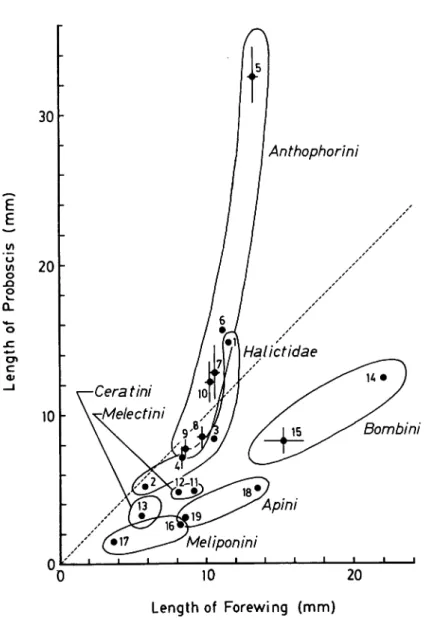
The most common visitors of the plant species other than Annonaceae, Pandanaceae and Araceae were bees. Because bees imbibe nectar secreted from nectaries in flowers by proboscises, the length of proboscis and depth of nectary are key characters of the pollination syndrome. Fig. 1 shows the relationship between the length of proboscis and the length of forewing of 19 bee species belonging to Halictidae, Anthophoridae
(Anthophorini,
Melectini and
Ceratinini)
and
Apidae
(Bombini,
Meliponini
and Apini). The long proboscis were found in Halictidae, Anthophorini and
Bombini. Amegilla elephas having the longest proboscis visited Achasma macrocheilos flowers which have long tubular perianths. The anthophorid bees with long proboscis visited flowers of Balsaminaceae, Gesneriaceae and Zingiberaceae to imbibe nectar left in deep flower tube legitimately, whereas those with short proboscis such as Amegilla andrewsi visited Impatiens flowers and robbed nectar by biting the spur.-£ £ O o c 30 20 10
Meliponini
j iAnthophorini
Bombini 0 10 20Length of Forewing (mm)
Fig. 1. The relationship between lengths of proboscis and forewing of
bees. Bar denotes standard deviation.
1, Thrincostoma sp. 1. 2, Lasioglossum sp. 1. 3, Nomia sp. 1. 4.
Nomia sp. 2. 5, Amegilla elephas. 6, A. sendleburyi. 7, A. smatrana.
8, A. andrewsi. 9, A. sp. 1. 10, Elaphopoda impatiens. 11, Protomelissa
sp. 1. 12, Thyreus sp. 1. 13, Ceratina nigrolateralis. 14, Bombus senex
(queen). 15, B. rufipes (worker). 16, Trigona fimbriata. ' 17, T. minang-kabau. 18, Apis dorsata. 19, A. cerana.
-28-Discussion
The plant species listed above can be classified as in Table 1 according to reward type, position of nectary and pollinators. The* native plants whose rewards were only pollen were pollinated by pollen-feeding beetles whereas male inflorescences of cultivated palm (Cocos nucifera) were visited many stingless bees. Of the plants which secrete nectar in a shallow position in a flower, those growing in disturbed and/or open area such as Raphanus sativus, Mimosa pudica, Tibouchina semidecandra, Stachy
tarpheta spp., Lantana aculeata, Cosmos sulphureus and Eupatrium odoratum
were visited and pollinated by various insects, especially bees. Those growing on a forest floor such as Monophyllaea spp. and Ophiorrhiza spp. were pollinated by solitary bees, especially Halictidae.
Of those plants with deep nectaries, the herbs growing on the floor of lowland rain forest such as Impatiens spp., Cyrtandra sp. and those of Zingiberaceae were pollinated by anthophorid and/or halictid bees. The deep nectaries of these rain forest herbs in Southeast Asia have coevolved neither with the hummingbirds nor with euglossine bees as in neotropics but with these long-tongued anthophorid and/or halictid bees (Fig. 1). In contrast with Impatiens species pollinated by long-tongued bees, I. platypetala having pink petals and long thin spur were pollinated by hawkmoth, and I. gadutensis growing in high altitudes (1600m) were by bumblebees.
Table 1. Reward type, positon of nectaries and main pollinators of plant species studied in West Sumatra
Reward Position Main
type of nectary1 pollinators
pollen absent beetles
pollen absent
-nectar shallow various bees/
flies
nectar shallow halictid bees nectar deep butterfly
nectar deep hawkmoth
nectar deep anthophorid/
halictid bees
nectar deep bumblebee ?
nectar deep birds
nectar deep bats
Plant family
(number of species studied)
Annonaceae(l), Pandanaceae(l), Araceae(l) Palmae(l) Cruciferae(l**), Leguminosae(l*), Melastomataceae(1), Verbenaceae(2 *), Compositae( 1+1*) Gesneriaceae(2), Rubiaceae(2) Verbenaceae (1 *) Balsaminaceae (1) Balsaminaceae(5), Gesneriaceae(1), Zingiberaceae (1) Balsaminaceae (1) Musaceae(l) Musaceae(l+2**)
1 Distance from the flower entrance to nectary: shallow, < 5 mm; deep, > 5 mm.
* Naturalized species. ** Cultivated species.
-29-The native gigantic herbs with stout long tubular perianths, Musa salaccensis and M. halabanensis^ were pollinated by nectariniid birds and pteropodid bats, respectively. Flowers of M. salaccensis are borne in an erect inflorescence with pink showy bracts and provide nectar mainly in daytime, whereas flowers of M. halabanensis are in a pendent inflorescence with black bracts and provide nectar mainly in night. Thus floral characters and flowering habits of these Musa species are well adapted with their pollinators, i.e., diurnal birds and nocturnal bats, respectively.
Though flower visitors and their anthecological status were recorded, our data were very insufficient to clarify the reproductive biology of the plant species, because (1) pollinator visits on flowers were not quantitatively analyzed, (2) transportation of pollen by pollinators were not traced, and (3) observation time was very short and limited in three
months in a
year. Phenological studies in Southeast Asia (Medway,
1972;
Appanah, 1985; Schaik, 1986; Ashton et ah, 1988) suggest that environment for successful pollination is not constant irrespectively of constant condition of temperature in tropical rain forest. Pollination syndromes in species-rich tropical rain forest in Southeast Asia must be studied on a long-term scale.Aknowledgments
We thank Dr. S. Sakagami of Hokkaido University and Mr. Sk. Yamane of Kagoshima University for identifying bees and some of the ants, respec tively.
References
Atmowidjojo, A. H. and S. Adisoemarto. 1986. Potential pollen-transferring
insects of Indigofera spp. Treubia 29: 225-235.
Appanah, S. 1985. General flowering in the climax rain forests of South east Asia. J. Trop. Ecol. 1: 225-240.
Appanah, S. and H. T. Chan. 1981. Thrips: the pollinators of some diptero-carps. Malay. Forester 44: 234-252.
Ashton, P. S., T. J. Givnish and S. Appanah. 1988. Staggered flowering in the Dipterocarpaceae: new insights into floral induction and the evolu tion of mast fruiting in the aseasonal tropics. Am Nat. 132: 44-66.
Bawa, K. S., D. R. Perry and J.H. Beach. 1985a. Reproductive biology of tropical lowland rain forest trees. I. Sexual systems and incompatibil ity mechanisms. Amer. J. Bot. 72: 331-345.
Bawa, K. S., S. H. Bullock, D. R. Perry, R. E. Coville and M. H. Grayum. 1985b. Reproductive biology of tropical lowland rain forest trees. II. Pollination systems. Amer. J. Bot. 72: 346-356.
Beaman, R. S., R. J. Dechker and J. H. Beaman. 1988. Pollination of
-Rafflesia (-Rafflesiaceae). Amer. J. Bot. 75: 1148-1162.
Dressier, R. L. 1982. Biology of the orchid bees (Euglossini). Ann. Rev.
Ecol. Syst. 13: 373-94.
Feinsinger, P. 1976. Organization of a tropical guild of nectarivorous birds. Ecol. Monogr. 46: 257-291.
Gould, E. 1978. Foraging behavior of Malaysian nectar-feeding bats. Bio-tropica 10: 184-193.
Heinrich, B. 1975. Bee flowers: a hypothesis on flower variety and bloom ing times. Evolution 29: 325-334.
Heithaus, E. R., P. A. Opler and H. G. Baker. 1974. Bat activity and pol lination of Bauhinia pauletia: plant-pollinator coevolution. Ecology
55: 412-419,
Inouye, D. W. 1980. The terminology of floral larcency. Ecology 61:
1251-1253.
Lack, A. J. and P. G. Kevan. 1987. The reproductive biology of a distylous tree, Sarcotheca celebica (Oxalidaceae) in Sulawesi, Indonesia. Bot. J.
Linn. Soc. 75: 1-8.
Medway, L. F. L. S. 1972. Phenology of a tropical rain forest in Malaya.
Biol. J. Linn. Soc. 4: 117-146.
Murray, K. G., P. Feinsinger, W. H. Rusbey and Y. B. Linhart. 1987. Evalu ation of character displacement among plants in two tropical pollina tion guilds. Ecology 68: 1283-1293.
Schaik, C. P. van. 1986. Phenological changes in a Sumatran rain forest.
J. Trop. Ecol. 2: 327-347.
Stiles, F. G. 1975. Ecology, flowering phenology, and hummingbird pollina tion of some Costa Rican Heliconia species. Ecology 56: 285-301.