South Pacific newsletter : 6
著者
Kagoshima University Research Center for the
South Pacific
journal or
publication title
South Pacific newsletter
volume
6
page range
1-24
year
1995
ISSN 1341-2418
SOUTH PACIFIC NEWSLETTER
No. 6
March, 1995
KAGOSHIMA UNIVERSITY RESEARCH CENTER
FOR THE SOUTH PACIFIC
Birds-eye view of the main campus of Kagoshima University, the home base of the Research Center.
CONTENTS
Page
From Micronesia to Kagoshima 1
Scientific Survey of Pohnpei Island 3
Abstracts from Seminars 5
Abstracts from Symposium Decompression Sickness in Divers 13
Public Lecture Series The South Pacific: Countries and Peoples 17
Recent Publications from Kagoshima University Research Center
for the South Pacific 23
Editor's Note 24
Front: The souls of the dead help fishermen locate a school of bonito. A picture inscribed
on an oar. Santa Isabel, Solomon Islands. (Source: Minami Taiheyo no Bijutsu.
From Micronesia to Kagoshima
June 1 to December 1, 1994
Harley Ichiro Manner
Visiting Foreign Professor, University of Guam
Throughout the Caroline Islands (Palau, Yap, Chuuk, Pohnpei, Kosrae) and other parts of Micronesia, one can find various
artifacts and memorials of Japan's presence during the earlier part
of this century. On Koror Island in Palau, the extensive founda
tions of the Kampei Taisha Nan'yo Jinja is a remainder of the
extent of Japanese migration and colonization in Micronesia.
Others are quite small and may be found in some of the remotest and smallest islands of Micronesia. On Losap Atoll, for example, there is a stone memorial commemorating a visit to those islands by a group of Kyoto University researchers in the early 1940s. Evidently, this group had stopped at Losap in order to watch a solar eclipse. Unfortunately, the details and results of that visit to
Losap are not known. In 1988, I visited Losap Atoll and saw that stone memorial. I began to wonder about the nature and extent of Japanese research in Micronesia during that period.
Most of my research is concerned with the ways Pacific Islanders have adapted to and
modified their natural environment as expressed through their traditional systems of agriculture, land use, and resource management. My perspectives and understanding of these traditional systems are mainly based on the Western scientific literature and fieldwork experiences. During
the years of the Japanese Mandate in Micronesia, many of these islands were visited and studied by Japanese researchers, who wrote their findings mainly in Japanese publications. While some
of their studies have been translated into English, their findings, in many cases, remain largely
unknown to Western scholars, including myself.
The purpose of my visit to the Kagoshima University Research Center for the South Pacific is to analyze the Japanese scientific literature on traditional subsistence agriculture and related
areas (geography, anthropology, ethnology, botany) of Micronesia written between 1890 and
1940, in order to publish a much needed review and an annotated bibliography of their work during the above period. As the nature of Micronesian subsistence agriculture is changing quickly
because of rapid socio-economic, political, and demographic changes, this project will provide a
baseline description and analysis for comparison with that of today. I am collaborating on this project with Dr. Kazutaka Nakano, whom I first met in Fiji in 1981. Thus far, we have reviewed between 50 to 60 articles written during the Mandate period on the above topic. In addition, I hope to find out what the Kyoto University scientists learned on their visit to Losap Atoll more than
There are other reasons why I appreciate this visit. First, it is my belief that a geographer can best learn of a place, in this case, Kagoshima, and its people by living and working in it.
Second, the position here gives me time to think about my research (for example, future research agendas) and to do research. At my post at the University of Guam, 85% of my time is spent in
teaching and administration. Since my arrival here in June, I have written two articles, presented three seminars and four lectures, and edited six papers by Japanese colleagues for publication. I am also editing two large manuscripts by foreign authors. Two other papers are in progress, generated in part by my interactions and discussions with Japanese colleagues. Third, this appointment offers the intellectual stimulation and resources for scholars from the Pacific to
participate in studies of mutual concern needed for the proper growth and development of the
Pacific islands. Finally, the position at the Research Center is an opportunity to further enhance
cultural, technical and intellectual interchange, and friendship between two universities commit ted to the Pacific islands.
Scientific Survey of Pohnpei Island
Kazutaka Nakano Party Leader
Since 1981, the Kagoshima University Research Center for the South Pacific has been organizing series of research projects called "Scientific Survey of the South Pacific", funded by the Ministry of Education, Science and Culture of Japan. After the two years' interruption, a new series of projects focusing on Micronesia was begun in 1994. In the first year of this series, the field survey for this research project was successfully conducted in cooperation with the concerned personnel of College of Micronesia and the national and the state governments in Pohnpei, the
Federated States of Micronesia.
The research party was composed of five survey teams:
Team 1, Appropriate agricultural development in relation to the terrestrial environment; Team 2, Development of marine biological resources and conservation of the marine environment; Team 3, Community health of islanders; Team 4, Development of the system of administration and its relationship to cultural autonomy; and, Team 5, Some biological aspects of oceanography.
A presentation of the survey results will be held in May 1995, and a progress report of the survey will be published in October 1995.
The itinerary and the members of the research party are as follows: Itinerary;
24 October, 1994. Departure from Kagoshima Port, Japan 9 November, 1994. Arrival at Kolonia Port, Pohnpei Island 17 November, 1994. Departure from Kolonia Port
25 November, 1994. Arrival at Kagoshima Port
Members of Team 1;
NAKANO Kazutaka, Professor, Dr., Terrestrial Ecology and Geography, Research Center for the South Pacific, Kagoshima University
HAYASHI Mitsuru, Professor, Dr., Crop Science, Faculty of Agriculture, Kagoshima University
TOMINAGA Schigeto, Associate Professor, Dr., Fruit Science, Faculty of Agriculture,
Kagoshima University
ONJO Michio, Research Associate, Tropical Agriculture Science, Faculty of Agriculture, Kagoshima University
ARIZONO Takuya, Graduate Student, Crop Science, Faculty of Agriculture, Kagoshima University
YASUMIZU Yoshihisa, Undergraduate Student, Crop Science, Faculty of Agriculture,
Kagoshima University
ISHIGAKI Tae, Undergraduate Student, Crop Science, Faculty of Agriculture, Kagoshima University
Members of Team 2;
INOUE Akio, Professor, Dr., Marine Ecology, Research Center for the South Pacific,
Kagoshima University
MATSUOKA Tatsuro, Associate Professor, Dr., Fishing Technology, Faculty of Fisheries, Kagoshima University
NORO Tadahide, Associate Professor, Dr., Marine Botany, Faculty of Fisheries, Kagoshima University
SHIMOHIGASHI Yasuyuki, Associate Professor, Dr., Biochemistry, Faculty of Science,
Kyushu University
ETO Saori, Undergraduate Student, Marine Biology, Faculty of Fisheries
Member of Team 3;
MIKAMI Seiji, Research Associate, Dr., Epidemiology, School of Medicine, Hirosaka University
Member of Team 4;
TSUCHIDA Mitsuyoshi, Professor, Dr., Architectural History in Japan, Faculty of Engineer ing, Kagoshima University
Members of Team 5;
ICHIKAWA Toshihiro, Professor, Dr., Biological Oceanography, Faculty of Science, Kagoshima University
KAWAMURA Nobuko, Graduate Student, Biological Oceanography, Faculty of Science, Kagoshima University
YUWAKI Yasutaka, Professor, Oceanography, Faculty of Fisheries, Kagoshima University
SHIMADA Kiyoshi, Associate Professor, Oceanography, Faculty of Fisheries,
Kagoshima University
MASUMITSU Sunao, Assistant Professor, Oceanography, Faculty of Fisheries, Kagoshima University
HIGASHI Masataka, Assistant Professor, Oceanography, Faculty of Fisheries, Kagoshima University
Clerkship;
KANEKO Shinichi, Program Officer, Research Center for the South Pacific, Kagoshima
ABSTRACTS FROM SEMINARS
Saving Tropical Forests through Production of
Non-Wood Forest Products in Southeast Asia
February 2, 1994
Some so-called conservationists insist that the extinction of plants and animals is
mainly caused by the harvesting and hunting of forest resources, thus requiring prohibi tions against entering the forest.
In fact, rural people living near forests have harvested and collected various forest
products such as food, fodder, fuel wood,
medicinal plants, etc. In southeast Asia, the
number of people who depend mainly on their
daily foods from the forests is estimated at least 27 million.
Recently, both in natural forest and in man-made forest management, there has been a shift from timber production to the exploi
tation of non-wood forest products. There
fore, it is expected that forests may be main
tained without severe damage to their structure and function.
"Inventory" projects are launched in
some areas and often emphasize that people's deep knowledge of plants and animals is ap
plicable to conservation of forests and utili zation of forest resources for both their lives and our lives. In this sense, all organisms are
useful or potentially useful products.
In southeast Asia, the various non-wood
forest products, such as resins (oleo-resin,
damar, copal, lacquer, benjoin, rubber latex,
gutta-percha, jerutong, etc), essential oils (kayu putih oil, vanilla), fiber and paper making materials (papermulberry, climing fern), medicinal plants, foods (tengkawang,
cinnamon), ornamental plants, animals prod ucts (bee-honey, lac insects, silk) are pro
duced at varying scales of production. There are many villages supported by the
production of those non-wood products which contribute much to the development of their
communities. In addition, there are many appropriate tools and knowledge used to sup ply those products constantly and at the same
time to maintain forest sustainability.
Conservation of bio-diversity can not be achieved without the understanding and co
operation of the inhabitants in rural commu
nities. The exploitation of commercially valuable forest products is important for increasing the standard of living and the na tional economy. While it is surely hard to
solve those two problems, we have to look for
ways to maintain bio-diversity and raise liv
ing standards.
Hiroyuki Watanabe (Faculty of Agriculture, Kyoto University)
Easter Island, Earth Island
February 21, 1994
Easter Island is unique in many ways. Its
position in the Southeast Pacific makes it the most isolated inhabited land in the world. It
is famous for its giant stone statues, con
structed by a lost civilization. It is also
uniquely depauperate in its flora and vegeta tion, having only one species of tree and no
forest.
Archaeology tells us that the island was first colonized about 400 AD, by Polynesians, probably from the Marquesas. They intro duced food plants and rats. By 700 AD the people were already making large statues, but the civilization flowered mainly between 1100
AD and 1680 AD when over 600 statues were
made, transported distances of up to 10 + km, and erected on special platforms. How this was done without large timbers is a mys tery, as is its purpose. Perhaps a form of ancestor worship was practised. A kind of writing, the rongo-rongo script, was devel oped.
About 1680 AD the civilization collapsed. There are legends of famine and war about this time. Obsidian spearheads of this age
are common. Many of the statues were delib
erately overturned, and the people turned to
the bird-man cult, based around the annual arrival of the sooty tern to breed on an off
shore islet. This could suggest a special inter est in the protein food supply provided by eggs. There is evidence that fish-hook size declined about this time, suggesting the aban donment of deep-sea fishing. Human popula tion probably crashed from about 10,000 peo ple to 4,000 people.
The island was first contacted by the outside world in 1722 AD and the pouplation suffered badly from introduced diseases and slave raiding. By the 1890s the population was 111, and most legends, and the ability to decipher rongo-rongo, were lost.
An attempt to discover the ecological history of the island by palynology of crater sediments has been very successful. Sediment records have been radiocarbon dated and go back to before 30,000 years ago. They show that the island was continuously forested until about 800 AD, the dominant tree being a palm similar to the Chilean wine palm.
This could have provided food, and timber for
canoes and for statue-moving. Remains of the fruits of this palm from 1200 AD show signs of being eaten by rats.
After 800 AD the island was progres sively deforested by people, and by 1500 AD it was almost treeless. It is hypothesized that an ecological disaster thus occurred, resulting in the collapse of the civilization around 1680
AD.
While at Kagoshima, a new pollen core
from the island has been investigated. This
shows that the decline of the forest occurred
in two stages. The earlier decline, which was
without the burning of the later stage, could have resulted from a climatic shift such as an
increase in storminess, or from a biological
event such as the introduction of rats by peo ple.
We may draw an analogy between Easter Island, isolated in the Pacific, and the Earth,
isolated in space. The computer model for the
Earth in the 21st Century, produced by the
Club of Rome in The Limits to Growth,
shows a decline (by over-use) of resources
followed by a population crash. The Easter
Island history, in which the decline (by over use) of the forest resources is followed by a
population crash, suggests the Club of Rome model could be valid. What is even more
disturbing is that, since Easter Island is
small, the ecological decline must have been
obvious, where as the degradation of the com
plex Earth ecosystem is less easy to observe. It is suggested that co-operation, rather than competition, is the only way to survival.
Further details of this topic are given by Paul Bahn and John Flenley in their book
Easter Island, Earth Island (Thames and Hud son, London,1992)
J.R. Flenley
(Massey University, Visiting Foreign Re
search Professor, Kagoshima University Re search Center for the South Pacific)
Cultivation of the Marine Lettuce Ulva pertusa in a Fish Farm
March 14, 1994
Marine lettuce is a common name for the sterile Chlorophyta, Ulva pertusa. The
sepcies had long been regarded as "trash sea weed of the sea" because of its high growth rate. In 1987, we started cultivating U. pertusa for the purpose of maintaining the "homeostasis of ecosystem" in mariculture
farms. Our initial attempts to cultivate it in the sea were met with various difficulties, the
major one being typhoon problems. However, when the floating culture system by net cage was designed for U. pertusa, that problem
was solved. Since then, the culture system for marine lettuce has been established, and a
wide variety of ways to utilize it have been developed. The impression of marine lettuce
has changed from a "bad" seaweed to a bene ficial one.
Major characteristics of U. pertusa are as follows: 1) It has high growth rate; its growth rates were 20 to 25 times per tide (about 2 weeks) in summer, and 4 to 5 times
per tide in winter; 2) U. pertusa containes
higher amounts of vitamin C (165 mg/lOOg) and magnesium (4.84g/100g) than Chlorella or Spirulina; and, 3) U. pertusa is regarded as
vitally functional in diets. In our experi ments, the fish fed on dry pellets with U. pertusa (2%) as supplemental feed showed an increase in the amount of positive cholesterol
and decrease in the amount of negative cho lesterol.
We examined the polyculture of red sea bream Pagrus major and sterile U. pertusa in
a mariculture farm on a scale similar to com
mercial farming. The results obtained are as
follows: 1) The 02 in experimental cage in creased by 9%, while C02 decreased by 4%; 2)
The growth rate of the fish in the experimen tal cage was higher than that of the control
group by 1.5%; and, 3) The fish in the experi
mental cage fectched a price 15% higher than
that of the fish in control cage, as the former
has added value of being associated with "ecosystem culture". From the results men tioned above, it is highly recommended that
the mass culture system of U. pertusa in fish farms will be widely adopted in the near fu
ture.
Hachiro Hirata
(Faculty of Agriculture, Kinki University)
Study on Fermented Food and Drinks in Kagoshima Prefectural
Institute of Industrial Technology
April 18, 1994
Kagoshima Prefectural Institute of In
dustrial Technology is a core facility designed to support technological development and technical improvement. The Institute pro motes advancement in many technological fields, especially in high technologies such as biotechnology, electronics and development of new materials for industrial products.
Our research and development is for utilization of local resources, of new produc tion and processing systems, of new materi als, in the fields of biotechnology and food, environmental preservation and amenity. The fermented food and drinks produced in
Kagoshima have unique characteristics due to a mild and humid natural environment where
fermented materials are enriched by microor ganisms. Shochu from sweet potato, rice vinegar of Fukuyama, citric acid fermenta tion, Miso, soy sauce and Yamagawa-zuke pickles are some examples. Collection, im provement and breeding of microorganisms,
and new technology such as cell fusion and
bioreactor technique have been introduced to
develop new products from these fermented
foods and drinks.
Studies for the biotechnology and food
fields are as follows:
(1) Improvement of food product process for
controlling microorganisms so as to prevent pollution of food,
(2) Study with regard to new-type alcoholic
drinks using a new kind of purple sweet po
tato,
(3) Improvement of shochu flavor using
batch rectification,
(4) Research on solid-liquid separation of
stillate from sweet potato shochu distillery using unique yeast and
(5) Effect of sweet potato cut 10 mm cubic
size on shochu flavor and research on cooking
the cut sweet potato.
Akira Haseba
(Kagoshima Prefectural Institute of Industrial Technology)
The Effective Use of "Shirasu'
May 23, 1994
flow at quaternary age both by Aira volcano, situated at the innermost part of Kagoshima Bay, and by Ata volcano, at the entrance of
the bay.
The chemical components of shirasu are
rather homogeneous containing 68 —78% of
Si02 and 12-15% of A1203. Its main
constitent is volcanic glass which also in cludes such crystalline substances as feldspar, quartz, magnetite and pyroxenes.
A variety of possible uses of shirasu has
been searched for by many investigators until now, and some products are developed such as
light-weight aggregate, microballoon,
zeolite, silicon carbide, silicon nitride, porous glass, alkali-proof glass fiber, tile, sound-absorbing materials and abrasive.
The author is now engaging in researches pursuing further utilization of shirasu using its minutely fractured materials as men
tioned below.
1) The development of weather-proof
paints and air bubbler in the waste-water
treatment process by mixing with paints and
plastics.
2) The development of microballoon (mean
diameter: 7 —17/^m). The microballoon has far smaller granule size, 1/5 —1/10 of those balloons produced in the past, and its bulk density is less than 0.5 which suggests the possibility of wider uses for light-weight building materials or adiabatic light-weight
polymers.
3) The development of adiabatic materials
by thermal spray of microballoon to the sur
face of metals and concretes.
4) The development of high density con
crete resistant to acid rain or saline water by
mixing minutely fractured shirasu with con
crete.
Accumulated amount of shirasu is esti mated to be more than 9 X 10¹⁰ tons. Shirasu
has often been accused of being the culprit for
natural disasters. However, we, who live on the surface of shirasu, should think over how
to use shirasu effectively for our happier and
more comfortable lives.
Akira Nakashige
(Kagoshima Prefectural
Institute of Technology)
Presumed Center of Origin of Garlic
June 13, 1994
The center of origin of garlic was uniden tified and only cultivated clones were known. These clones were sterile, and the cause of sterility was unknown. To clarify its center of origin, the author collected and examined 180 garlic clones from all over the world. The clones showed a wide variation in bolting habit and meiosis, from non-bolting without flower-buds to complete-bolting with sterile
flowers and irregular meiosis. Only one was discovered to be fertile and showed regular meiosis, suggesting an evolution from sexual
propagation to vegetative propagation.
Therefore, it was expected that there still
remain more fertile garlics in its center of
origin. Vavilov (1951) thought Central Asia
was the primary center, and besides
Mediterranean areas were the secondary cen ters. The author collected 161 garlic clones
from those areas and examined them at Kagoshima.
In conclusion, all of the 16 garlic clones
collected from the northern side of the Tien
Shan Mountains in Central Asia showed pol len fertile or female fertile, suggesting this
area as the primary center of origin.
Caucasia, where 17 collected clones showed a
great variation in bolting habit and two of them were found to be pollen fertile, was identified as the secondary center. On the
other hand, the Mediterranean area, where most of the collected clones were sterile and
characterized by non- or incomplete-bolting
was not identified as the secondary center. Takeomi Etoh
(Faculty of Agriculture,
Kagoshima University)
Micronesia: Issues and Concerns for Research
July 18, 1994
Much of research is concerned with the
ways peoples have modified or adapted to their island environments. In particular, I focus mainly on the traditional agricultural system to see whether or not it is an adaptive and sustainable component of a people's cul
ture and environment. As a result of some recent studies in the atoll islands of Microne sia, I feel that our understanding of atoll
ecology and subsistence systems is far from complete. Let me present two examples from
Puluwat Atoll to prove my point. On
Puluwat Atoll, which is located in Chuuk State of the Federated States of Micronesia, Colocasia esculenta and other food crops are
cultivated on the maa (taro islet). The maa seems to be a very labor intensive system of
food production, but until 1989, we knew lit
tle of this form of agriculture, let alone its
existence. Secondly, the atoll was said to have a flora containing between 42 to 46 vas
cular plant species. Based on very recent re
search, however, the atoll has 182 species of vasular plants of which 50% are indigenous to the atoll.
I present these two examples to under score the point that basic, as well as applied
research, in both the natural and social sci
ences, is very much needed in Micronesia, and that what may be true of Puluwat Atoll, may
be true for all of the atolls in Micronesia, the Pacific, and elsewhere. If such is the case, one
needs to ask why this has happened. I would suggest that because of their apparently sim ple habitats, relatively small human popula tions, perceived low potential for agricul tural development, distance and isolation from the more populated islands and urban centers, the atoll islands have been largely ignored by researchers. However, because of
these "constraints" the atolls may be more suitable for research and model building than the larger, more socially and environmentally
complex islands of the Pacific. Research in the atolls is all the more important given their very rapid rate of social, environ
mental, and economic change.
There is a context into which research
must be placed. As researchers often working in foreign countries, we are all too often
guilty of what may be described as scientific imperialism, the belief that whatever we study is paramount to other peoples' inter
ests and concerns, that as researchers we have
a right to share other peoples' knowledge
with the world. However, Micronesians and other Pacific Islanders believe that "knowl
edge is power"; the difficulty of obtaining research permits; and locally raised questions concering the proprietary rights to tradi tional knowledge and resources, all suggest that we need to reconfigure, rethink our ap proaches to research in foreign countries.
At a 1989 Women of the Pacific Confer
ence workshop on research, 50 indigenous women, mainly from Micronesia, developed a set of concerns and guidelines for "outsider research" in Micronesia. They recognized
that "the fulfillment of their own research agendas would benefit in some instances from
collaboration, of possibly, reciprocal mentor relationships with outside researchers", and articulated a set of guidelines as "a means of improving both the quality of research ••• and
the ways their respective communities experi
ence the research enterprise" (Participants, 1992: 432). While the guidelines are con
cerned mainly with research projects about
local women's issues, I believe that there are
implied messages applicable to the conduct of
all outsider research on Micronesia that we
should incorporate into our research perspec tives. If followed, the result may be even better research products, the development of local capacity, and long lasting relationships
between researchers here and our hosts in other parts of the world.
From: Participants. 1992. Concerns and guidelines for outsider research in Microne sia. (1989 Women-Centered Research Method
ology Workshop, University of Guam).
Isla: A Journal of Micronesian Studies, 1(2):
432-434.
Harley I. Manner (University of Guam, Visiting Foreign
Professor, Kagoshima University Research Center for the South Pacific)
A Record of Personal Experiences in Indonesia
—Mainly in Freshwater Fishery—
September 26, 1994
Three subjects were selected as the main
purpose of visiting Indnesia: 1) to conduct
ecological research in Segara Anakan Lagoon,
Central Java; 2) to research the present
situation of freshwater fishery, especially
freshwater aquaculture; and, 3) to study the
ecology and distribution of freshwater crus taceans in some islands.
1) The water surface area of the lagoon is
becoming too narrow because of the
sedimentation of fine mud from rivers that
flowed into the lagoon. The shallow fords are
invaded by various species of mangrove
plants which have grown thick and form small islands. Many fishermen catch fish,
prawns, shrimp, and crabs in the lagoon. Thus, the sedimentation will become a ques tion of vital importance for these fishermen
in the near future.
2) The governmental institutes of fresh-11 —
water aquaculture are establishing and propagating cultivation techniques for carp, tilapia, freshwater prawn, and other fresh
water resources. The development of fresh
water aquaculture will bring about a stable income to the fishermen, but may result in environmental pollution of inland waters.
3) I collected ca. 17 crustaceans in the in land waters of south Sulawesi. Most of
them, except potamoid crabs and
Macro-brachium weberi, are thought to be amphid-romous species whose larvae develop in coastal and sea waters. The amount of larval
recruitment is thought to affect the popula tion size of amphidromous freshwater re s o u r c e s .
Hiroshi Suzuki
(Faculty of Fisheries, Kagoshima University)
Recent Progress in Myrmecological Studies in Southeast Asia
December 5, 1994
Ants are an extremely important insect
group in the ecosystem of tropical rain for
ests. They may be predators, decompositors, or partners of many other insects and plants.
An intensive ecological study in an
Amazonian rain forest shows that in biomass ants occupy more than one-third of all the insects, and are more than four times heavier than all the vertebrates combined.
Many species, subspecies and varieties of
ants were described from various parts of Southeast Asia mainly in the later half of the 19th century and at the beginning of the 20th century. Most of the descriptions during this period were quite incomplete, and no one has
made a synthetic treatment of ants of this
region. Reliable taxonomic revisions are available for only a few groups. Most species
can be identified only at genus level even by taxonomic specialists, which creates serious
difficulties for ecologists who plan to analyze
data and write scientific reports.
It is, therefore, clear that what should be
done first is taxonomic solution of problems surrounding common and ecologically impor tant species. Despite this practical need
Southeast Asian countries have virtually no
ant taxonomists. Main efforts by American
and European myrmecologists are devoted to Neotropical and Afrotropical faunas. In this difficult situation, I have recently planned to develope a network connecting specialists of Japan, Indonesia, Malaysia and Singapore. The first step will be gathering materials
from various localities in Greater Sunda Is
lands and sorting the specimens into supposed species in order to make it possible to com pare them with the type specimens. Identified specimens will be distributed to several insti
tutions in these countries to establish firm reference collections.
Ecological studies of ants, especially on
the species composition in various forest types and ant-Homoptera-plant interactions,
are now carried out in Malay Peninsula and Borneo in parallel with taxonomic studies. Cooperation between taxonomists and ecolo
gists will become increasingly important in
the future.
Seiki Yamane
(Department of Biology, Faculty
of Science, Kagoshima University)
ABSTRACTS FROM SYMPOSIUM
Decompression Sickness in Divers
January 22, 1994
This compendium of papers presented at
the symposium on "Decompression Sickness
in Divers" held on January 22, 1994 at Kagoshima University Dental School com
prises a broad spectrum of interest which
parallels the natural evolution of cooperation between the diving and medical communities all over our country. The name of the Sympo sium was chosen to reflect the many facets of
diving, from diving physiology and medicine,
the history of diving and undersea science, actual and practical conditions and states of
breath-hold divers (Ama), hygienic and
pathological problems of air-divers, to hyperbaric champer environments of high oxygen partial pressures involved in the ther apy of diver's diseases. Clinical papers were
encouraged in both diving medicine and
hyperbaric oxygen therapy, and chronic bone and joint distress due to diving were also
addressed. At the same time, the basic
pathophysiology traditional to this kind of symposium was maintained in order to a ba
sic forum for scientists troughout Japan to communicate their research results.
I deeply appreciate the collaborative atti
tude of Research Committee, Kagoshima
University Research Center for the South
Pacific towards the success of the sympo sium.
MotOO KlTANO
(Department of Oral Pathology,
Kagoshima University Dental School)
13-1) Diving Medicine
Mankind has a long history of diving. It
is said that Chinese divers had caught pearl
oysters beneath the sea about 4,000 years ago. It is a rigorous matter for man who lives on land to go into water. An environment with
which diver must encounter under the water
has many severe conditions such as no air to breathe, high water pressure, low water tem perature, difficulties in communications with others. They are hostile to man and threaten his life. Based on these background, diving medicine has developed to find the way to let him dive safely without ill-effects. As space medicine, diving medicine forms an impor tant part of environmental medicine. The followings are the leading topics of diving
medicine; 1) Respiratory problems of diving,
2) Compartive physiology of diving animals,
3) Effects of high pressure on man, 4) Ther mal problems of diving, 5) Decompression
sickness, and 6) Others.
Ichiro Nashimoto
(Department of Hygiene,
Saitama Medical School)
2) Recent Survey on Diving Fishers in Japan A questionnaire survey was distributed
to 2,135 Costal Fisheries Cooperative Asso
ciations (CFCA) in 1986-87 to obtain updated
information on diving fishers in Japan.
Out of 2,135 CFCA, 764 were conducting diving fishery. The number of male diving
3,037. The breath-hold divers made 63.6% of
all diving-fishing divers. The fishers in their
forties occupied 30.1%, indicating that the
average age was getting higher and they were
in want of successors.
The energetics of diving-fishers were
measured using two types of diving data log
gers, one developed by Henderson et al, and
the other by Vine Bionic Systems. Both log
gers have the same operational characteris tics. The subjects were 4 unassisted divers (Cachido-Ama) who wore wet suits and swim fins, and 9 assisted divers (Funado-Ama). The depth and R-R intervals were recorded
every second, and total time in water, total
diving time, total surface time, total number of dives per day, average depth of single dive, average deepest dive, average single dive
time, average longest dive, descent velocity,
ascent velocity, descent time, ascent time and bottom time per dive were calculated.
The average diving duration time and
depth in Cachido-Ama were 37.0 ± 0.4 sec and 6.9 + 0.1 m and in Funado-Ama 68.5 ± 4.3 sec and 9.7 ± 0.5 m, respectively. Total diving time was 63 ± 12 min in Cachido-Ama and 26 ± 2 min in Funado-Ama. But total bottom time in Funado-Ama was 45.0 sec much longer than in Cachido-Ama. Funado-Ama
was thought to be more profitable for under water fishing.
Motohiko Mohri
(Japan Marine Science and
Technology Center)
3a) Statistical
Investigation
of
Working
Pressure and Decompression Sickness at Compressed-air WorksRecently compressed-air engineering
work mostly employs pneumatic caisson
method and tends to use higher working pres
sures in accordance with mechanization of
shield works. Under the circumstances, the present author totaled results of five years' surveys on development of decompression
sickness (DCS) and compared the results with
former research findings. For this compari son, the control data was chosen among those which had been comprised by the same proce
dures as Mano & Shibayama (1987).
It is commonly said that DCS could not be developed under a condition of working
pressures less than 1.0 kg/cm2. Although we experienced seven patients with DCS develop ment under 1.0 kg/cm2 of the pressure, no case
was observed in the present survey conducted with a total of 12,503 exposures of comp ressed-air works. Total number of compre ssed-air works with over 1.0 kg/cm2 pressures include: 3,822 more exposures found in 1986 or later than before 1986; 9,649 more expo
sures observed in 1985 or former with work ing pressures of 1.0-2.0kg/cm2; and, with
higher pressures over 2.0 kg/cm2, the number of the works showed rapid increase in 1986 or
later. This means that deep excavation
works, which need higher working pressures than before, are becoming popular for to
day's compressed-air works. In other words, working circumstances became more strict in
these years, therefore, more precise safety supervision should be required. When decom pression control is carried out basing on the current decompression table, development rate of DCS increases in line with enlarge ment of working pressures. This was also observed in the present study.
Comparing onset rates of DCS during these five years with those observed before the years, the results of these five years show
lower rates, based on the working pressures
divided by each 1.0 kg/cm2 group, than those
seen before the five years. This supposedly indicates that more strict decompression con trol is being carried out today than before.
Yosihiro Mano
(School of Allied Health Sciences, Faculty of Medicine, Tokyo Medical and Dental University)
3b) Safety and Health at Nonsaturated Div
ing: The Actual Situation of Japanese Sport Divers
To draw a profile of Japanese sport di
vers, we have conducted personal interviews at 3 diving spots situated in the Izu Penin sula, during the summer vacation periods of
1991 and 1992. The results of 235 interviews are presented. The male v.s. female ratio was
of 2.8 v.s. 1, the average of age being of 28.4 years. The average diving experience was of
230.1 tanks (27.3 tanks per year, 2 tanks per day). Recorded in 40 (17%) cases, nitrogen
narcosis was the most frequent dysbaric dis
order, followed by barotrauma at paranasal
sinus and ear, dental barotrauma, and DCS.
Nitrogen narcosis has manifested at the aver age depth of 35.0 meters, and almost half of the divers with more than 5 years of experi ence have already had experienced such kind
of narcosis. Occurrence of barotrauma at ear (12%) was associated with non-traditional
ear-clearing methods, as the so-called 'natu
ral' (spontaneous) equalization. Positive
answers to questions concerning paranasal
barotrauma (12%) have pointed to some pre disposing factors, such as cold, sleeplessness and hangover. DCS, reported by 3%, affected exclusively divers with 5 or more years of
experience.
Yoshihiro Mano
15-4) Pathogenesis and Prevention of Dysbaric
Osteonecrosis
Japanese diving fishermen are known to have a high prevalence of dysbaric osteone crosis. Their typical dive practices are char
acterized by long exposure to high pressure
and by repetitive diving.
The etiology of dysbaric osteonecrosis
still remains controversial. Because the de velopment of dysbaric osteonecrosis may oc cur silently, the diver may be unaware of the actual ischemic event. Moreover, key etio-logic evidence is often lost before the diver is examined.
The early stage of dysbaric osteonecrosis
was evaluated in four autopsy cases of divers
who died of acute decompression sickness. Hypercoagulability of blood was present in
these cases. Hypercoagulability of blood has also been observed in experimental rats after decompression.
Dysbaric osteonecrosis has been experi mentally induced in six sheep at the Univer sity of Wisconsin-Madison. These findings are reviewed by comparing dysbaric
ostone-crosis in both divers and experimental ani mals.
In conclusion, a bone compartment syn
drome and hypercoagulability appear to be pathogenetic factors in dysbaric osteone
crosis.
Mahito Kawashima
(Kawashima Orthopedic Hospital)
5) A Clinical Study of Twelve Cases of De
compression Illness in Kagoshima Prefec ture during the Past Two Years, December 1991 -December 1993
Twelve cases of decompression illness during the past two years were studied.
Among these, one death was encountered.
Half of the twelve cases were Type I (Bends),
characterized by localized pain around the
joints. The other half were the more severe
Type II, which includes spinal cord injuries,
pulmonary disturbances (Chokes), cerebral
disturbances, arterial gas embolism, and vestibular staggerings. Two of the severest cases, one of which was fatal, were reported with the common risk factor of obesity. The fatal case, in which the patient died shortly after recompression therapy, was related to reperfusion injury. Diving after a long inter val of diving inactivity was also found to be a probable risk factor of decompression ill n e s s .
Kazuhiro Arikawa
(Emergency Department,
Kagoshima University Hospital)
6) Pathological Aspects of Decompression
Sickness
Recent studies concerning the pathogene sis of decompression sickness (DCS) were
reviewed. Discussion of the related evidence
linking the observations of pathological find ings in human beings and experimental ani
mals with acute DCS leads us to conclude that
the acute elevation of tissue pressure inside a compartment such as a bone marrow cavity which is encased by rigid cortical bone, fol lowing acute decompression of atmospheric
pressure is the most responsible for the deve
—
16-lopment and progression of tissue damage in DCS. The brain and the spinal cord are also located within compartments which are en cased by a rigid dual membrane with or with out an overlying rigid bone. A high incidence of damage of all of these three organs is seen in patients with acute DCS. However, the severity of tissue damage is not equally dis tributed throughout a compartment, and can not be understood only by this etiology. In stead, "watershed zones" may explain the site predisposition of tissue damage in each or
gan. "Watershed zones" are the most vulner able areas where the arterioles and arteries
may easily collapse due to the acute increase of the perivascular tissue pressure.
Abnormalities of the venous vessels are
widely observed in these three organs in DCS, which are characterized by many nitrogen gas
bubble emboli, fat emboli and thrombi in the venous system. These abnormalities in the venous system should cause disturbances in venous blood circulation. Disturbance in ve
nous blood returning towards the heart from
these organs should accentuate the elevation
of the tissue pressure inside the compart ments. The disturbance of the venous system may not be the last word when discussing the pathogenesis of tissue damage in DCS, but it should be considered in any further research on this subject.
PUBLIC LECTURE SERIES
The South Pacific
— Countries and Peoples —
August 6 & 7, 1994The public lecture series of the Kago shima University Research Center for the
South Pacific were held in the campus of
Kagoshima University for two days, on
August 6 and 7, 1994. The lectures were fo cused on introducing of the respective coun tries and peoples in the western South Pacific and around it, namely, the Philippines, Ma laysia, Indonesia, the Federated States of
Micronesia and the Mariana Islands, and Belau (the Palau Islands). The lectures were
delivered by the full and part-time campus staff, including a Foreign Visiting Professor,
of the Research Center, who had conducted
fieldwork, and who were pursuing the studies of either scientific or cultural aspects of
those countries.
The fields of the topics were appropri ately mixed and varied greatly. As a conse
quence, the content of each introduction was
quite unique and very different from stale presentations usually given to the tourists.
As well as the previous year, the number
of participants were not very numerous. Many of them, however, participated in this
series for the first time, and all of them lis
tened assiduously. At this series, besides the
direct questions to the lecturers at each lecuture session, an hour was alloted for over all discussions between all of the lecturers
and the participants. Such an attempt had not been made before. One of the purposes of
this attempt was to direct the attention of
—
17-the participants to 17-the comprehensiveness of the region concerned and interrelationship amongst the respective countries. Both the lecturers and the participants had such lively
discussions that it was necessary to greatly
extend the schedule despite the fact that the series occurred during the hottest season on record. Thus, the attempt for the overall
discussions, in addition to the whole series, was a great success.
Subjects and abstracts of the lectures are as follows:
Kazutaka Nakano
(Kagoshima University
Research Center for the South Pacific)
1) The Whole Region Concerned with the
Following Lectures
As the common topic of these series of lectures is "countries and peoples", we should first consider what a country is. Although
most Japanese seem to accept naturally the country of Japan and her territory without much consideration, a similar situation is not applicable to the countries which the follow
ing lectures will consider. Excluding Belau
(Trust Territory of USA), the governing poli
cies of the Philippines, Malaysia, Indonesia,
and the Federated states of Micronesia were greatly influenced by the European countries and the United States of America at their respective times of establishment. A country is a political unit potentially based on the use
of authoritative force.
The economic positions of all the count ries concerned in the following lectures may be summarized as the developing countries. Malaysia and Indonesia, however, have been noticeably developing in recent years. On the other hand, the Philippines appear to have a
stagnant economy. These three countries
have already achieved the change from an economy chiefly dependent on the agricul tural sector to one dependent on manufactur ing and processing.
In respect to the climate of the region concerned, the rainfall pattern is more impor tant than temperature. Generally speaking, an area close to the Equator rarely has a dry season. As the distance from the Equator increases in the tropics, the occurrence of a dry season with very little rainfall increases.
It should be noted, however, that the ocean
area east of the Philippines and the Caroline Islands has a mean annual rainfall greater than 3,000mm even though it is not close to
the Equator.
Note: The Republic of Belau became an inde
pendent country on October 1, 1994.
Kazutaka Nakano
2a) The Philippines: Nautilus Research in
the Philippines
The distribution of six species of Nauti lus, a famous living fossil of the cephalopods, is restricted to the archipelago in the south western Pacific. Among them, Nautilus pom pilius has the greatest distribution area, and
the northern limit of it is the Philippines. The Nautilus research group of Kagoshi ma University and University of Tokyo have carried out joint research with the University of San Carlos in the Philippines to study the
habitat of Nautilus around Sebu island and
Bohol island in the middle part of the Philip
pines islands in 1992 and 1993 for about one
month each. We prepared in advance two
types of Nautilus trap in Japan. We expected
to capture considerable numbers of Nautilus
with these traps because we had excellent results earlier with the same traps in Fiji,
Palau and Papua New Guines.
We took 19 individuals of living shells in 1992 and 45 in 1993; however, among them we captured only two in 1992 and four in 1993 with our own traps. Fifty eight other speci
mens were obtained with the assistance of the
native fishermen and their special traps for
Nautilus. In the Philippines there are a few
professional fishermen catching only Nauti lus, who have been making traps especially devised for capturing Nautilus. We learned much of the knack of making and using the "native" trap from them. At the end of our research we expressed our heartfelt "Daghang salamat" to them for their kindly help.
* "Daghang salamat" means thank you very much in Tagalog.
Junzo TSUKAHARA
(Faculty of Science, Kagoshima University)
2b) Filipino Fishermen Culture Japanese
Seasonal Gifts "Ocyugen"
Japanese people have appreciated agar
from the earliest times. For the extraction of
agar, red algae, such as Gracilaria {ogo-nori in Japanese) and Gerdium {ten-gusa), were
originally harvested in the Japanese coastal waters. However, increasing demand for agar from the food and medical industries
have recently created a worldwide shortage of
agar.
Thus in place of agar, another viscous
material extracted from tropical red algae,
Eucheuma, has been utilized. This viscous
material is known as carrageenan and is util ized as a gel additive in the production of such products as ham, beer, fruit juice, ice
cream, pet food, cosmetics and medicines.
Gelatinized carrageenan solution is neces sary in the summer in Japan. This is because a fruit jelly, sold in cake shops and distrib
uted as a seasonal gift {ocyugen) in Japan,
requires carrageenan. Traditional Japanese jelly has been made from agar. However, this modern European-style fruit jelly is produced using carrageenan. The carrageenan used is extracted from red algae, Eucheuma, cultured in the Philippines.
The cultivation of Eucheuma was devel oped in the Philippines with the assistance of
the University of Hawaii in the 1970s and 1980s. Fragments of Eucheuma easily grow in tropical shallow seas. Without equipment
and funds, even small-scale fishermen can
afford the cultivation of this red algae to
contribute to their income.
The lecture introduced Filipino fishermen engaged in the aqua-culture of red algae and the relationship between the Japanese Food Industry and a Filipino fishing village.
Tadahiro Noro
(Faculty of Fisheries, Kagoshima University)
3) Malaysia
The beautiful island that became the
main stage of the musical movie SOUTH PA
CIFIC was a small island called Pelau Tioman, located off the east coast of the Malay Peninsula. The South Pacific is his torically and culturally related to the so-called Malay world, the center of which is the Malay peninsula. The Malay world covers a
wide area from Madagascar to the west, Tai
wan and the Philippines to the north, and the islands of the South Seas to the east. There can be seen some common basic cultural traits in these areas.
The states of Kelantan and Trengganu on the east coast of the Malaysia are the places
where a strong Malay traditional culture can be seen. Though Malaysia is well-known to be multi-ethnic as a nation, most of the ethnic
groups in these two states are ethnic Malays. The Malay culture has been well preserved in
the two states, where are places often dear to
the hearts of Malays.
Most Malays who live in town areas have
original villages called kampung and they are deeply attached to their kampung. Those who
are in towns often talk about their home vil
lages or kampung with nostalgia. Even in the
cities, there are some residential areas called kampung.
Sueo KUWAHARA
(College of Liberal Arts, Kagoshima University)
4a) Indonesia
The territory of Indonesia stretches over a wide area. The distance between her eastern
(the boundary with Papua New Guinea) and western (the northwestern tip of Sumatra Island) ends is approximately 5,000 km. This
is equal to the distance between the Ural Mountains and the west coast of Ireland
(along latitude 54° N). The establishment of
such an insular country with some very large
islands in a vast ocean area was partly based on the fact that the Netherlands had once
governed the whole territory, although the Indonesian intention of establishing such a
large country despite the possiblity of choos ing another way should be taken into account.
Population maps of Indonesia indicate that the Island of Java has a distinctively high population density. This population density is more than twice of that of Japan, which is also famous amongst population geographers for her very high population den sity. Java has many volcanos, and its soils which originated from volcanic eruptions are recognized as being very fertile. It is often said that the high population density there is based, to some degree, on Java's highly fer tile soils, which indirectly affect culture. The cultures of the Javanese and the Sundanese appear to be adaptations to the conditions of high population densities.
Kazutaka Nakano
4b) On Indonesian Passer (Local Market)
Morning market (Asaichi) near Nishi
Kagoshima Station carried many farm prod
ucts by villagers. It is a good circulation system for consumers. Many farm products are directly on sale to the city residents by village women. I treated such product circu
lation systems (passer) in Africa, South Pa
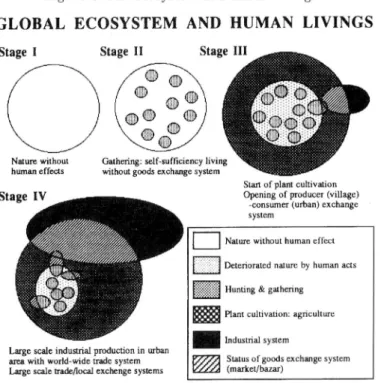
cific Islands and Indonesia. Discussion of origin, development and decline of the passer is in relation to figure 1.
Goods supply systems for human living based on exchange existed on a limited scale in hunting and gathering societies. The pas
ser did not exist before beginning of agricul
ture. In Africa, the South Pacific, and Indo nesia, the existence of extenxive passers is guaranteed by rich products from villages
around the city. A record of video documen tation on a big passer of Padang, West Suma
tra is presented by the author for considera
tion. It is a good example of supply system
of village products for the city consumer.
Fig. 1. Global ecosystem and human living.
GLOBAL ECOSYSTEM AND HUMAN LIVINGS
Stage I Stage II Stage III
Nature without human effects
Gathering: self-sufficiency living without goods exchange system
Stage IV
Start of plant cultivation
Opening of producer (village)
-consumer (urban) exchange
system
Nature without human effect
I Deteriorated nature by human acts
Large scale industrial production in urban
area with world-wide trade system
Large scale trade/local exchenge systems
Hunting & gathering
Plant cultivation: agriculture
1 Industrial system
Status of goods exchange system
(market/ba/^r)
Mitsuru Hotta
(Department of Biology, Faculty of Science, Kagoshima University)
•20-5) Micronesia: Yesterday and today
As a geographic region Micronesia en compasses an oceanic area of 11,658,000 km2,
and consists of the follwing political entities: the Commonwealth of the Northern Mari
anas, Territory of Guam, Federated States of Micronesia, Republic of Nauru, Republic of
Kiribati, Republic of Palau (Belau), and the
Republic of the Marshall Islands. The land
area by contrast amounts to only 377,815
km2. Micronesia is Greek for small islands of
which there are more than 1000. Most of these islands are uninhabited, atoll islands,
which because of their small size and geologi cal origins, have very limited terrestrial re
sources and little opportunities for economic development.
The political-economic-social infrastruc tures of the Micronesian states are still
largely undeveloped. Except for Nauru, all
countries in Micronesia have an unfavorable trade balance as imports of manufactured
goods greatly exceed exports of mainly agri cultural products. The tuna industry, which is still undeveloped, may be the exception and an important future source of income, given the large Exclusive Economic Zones surround ing each of the Micronesian states. Guam
and the Commonwealth of the Northern
Mariana Islands have developed a tourism industry based primarily on Asian, particu larly Japanese, visitors. By contrast, the
Federated States of Micronesia has limited
opportunities for development; its GDP was $ US 1,052 per capita in 1988, and subsistence production is still very important, particu
larly in the outer atoll islands. The FSM is
also characterized by a high rate of popula
tion growth (4% per annum) and high emi
gration to the US and its territories. Ironi
-21-cally, during the 1920s and 1930s, these is
lands and the Northern Marianas were cen ters of Japanese trade and industry. For the Northern Mariana islands, sugar accounted
for almost 1/2 of all exports from Microne sia to Japan in 1938, amounting close to 20 million yen in 1937. Places like Kolonia, Pohnpei, were structurally and functionally,
Japanese towns in Micronesia, and produc tion centers of katsuobushi, copra, and other agricultural products.
Note: At the end of the lecture, comparative data on the political and economic status of the Micronesian states, and slides of the Federated States of Mi cronesia and a video on various areas of Micronesia were shown to the audi
ence to give them an idea of the multi
cultural nature of Micronesia.
Harley I. Manner and Yasuyuki Karakita (Kagoshima University Research Center
for the South Pacific)
6) Nature and Peoples of Palau
In the course of my lecture, I introduced the topics of Palau's history and natural characteristics. The history of Palau occurs in relation to other countries, principally Spain, Germany, Japan and the U.S.A. Spain ruled Palau from 1885 to 1899, Germany,
from 1889 to 1914, Japan, from 1914 to 1945.
A pamphlet about Palau expained seriously in the succeeding sentence about the rule of
Japan.
"1914 marked the beginning of a 30-year rule by Japan. Agriculture, trade and fisher
ies were developed to an extent never before
or since seen in Micronesia. During Japanese
many barren coral islands and displaced peo
ple in its wake."
After that, Palau was a trust territory
of the U.S.A. In 1980 the Republic of Palau was established, but the relationship between Palau and the U.S.A. was continued. (This year, subsequent to my lecture, Palau became independent.)
In the course, I recalled Palau's legend about Uab. "He was so big and always hun gry. Uab's father and mother couldn't gather enough food. The giant Uab roared his disap proval when he felt hunger. The people of the island were bringing taro, yams, fish and crabs to him. They shrank back in fear and wondered how long they would be able to provide enough food to keep him satisfied. In a short time, they believed that Uab would destory their villages. One night, the people crept up and tied him up. Uab struggled and
kicked so strongly that his body split apart
and pieces flew out to sea. Uab's body turned into islands and Palau's people believe
Babeldaob island is Uab's torso. Rocky
Peleliu is one of his legs and the high island at Aimeliik is his other leg, as if still kicking."
The existence of Palau and the number of
islands was something I referred to. The Is lands of Palau were made up of fringing reef,
barrier reef and atoll. I also referred to the
variety and beauty of nature at Palau, espe
cially Foraminifera which is a group of pro
tozoa including amoeba. I explained group ing, life cycle, internal structure, collecting
methods and how to research Foraminifera. I illustrated a lecture with slides of
Baculogypsina sphaerulata, Baculogypsinoi-des spinosus, Calcarina calcar, C. defrancii, C. gaudichaudii and C. hispide.
The art and culture of Palau were also
introduced through a guide book. Palau's guide book give an account that "Palauan
craftsmen transform the tools and utensils that have been used in their islands for centu
ries into some of the most exquisite handi crafts in Micronesia." Story boards are given special mention among the arts of Palau.
These were carved on wooden beams of the
building, "men's Abai", used as a meeting house. Hats, purses and baskets made from pandanas are still used by the people today. Also, diving is a wonderful way to see the sights of Palau. For humans, to see fish at
the bottom of the sea, is to feel a sense of
continuity with other forms of life.
Elsewhere, I introduced discussions about
the transition of population, a "laboratory of toropical industry" during the Japanese ruled period, the deposits of bauxite ore, and the summary of geology of Palau.
Akio Hatta
(Faculty of Education, Kagoshima University)
Recent Publications of Kagoshima University
Research Center for the South Pacific
SOUTH PACIFIC STUDY
Vol. 13, No. 1 (1992)
Ding Yang and Akira Nagatomi. The Chinese Clitellaria (Diptera: Stratiomyidae).
Jiraporn Tayutivutikul and Kanetoshi Kusigemati. Biological Studies of Insects Feeding on the Kudzu Plant, Pueraria lobata (Leguminosae).
Masao Ishii. Displaying Political Order: Yam Cultivation in Tokaimalo, Ra Province, Viti Levu,
Fiji.
Jun Takeda. Seasonality and Change in Traditional Fishing Patterns in Minatogawa, Okinawa.
Vol. 13, No. 2(1993)
Ding Yang and Akira Nagatomi. The Chinese Oxycera (Diptera: Stratiomyidae).
Md. Lutfe Alam, Teruzane Kakoi, Nobufumi Miyauchi and Akio Shinagawa. Electron
Microscopic Observation of Clays of Calcareous and Noncalcareous Soils in Bangladesh.
Motoo KiTANO, Charles E. Lehner, Mahito KAWASHIMA, Yasushi Taya and Edward H. Lanphier. Experimentally Induced Dysbaric Osteonecrosis in Sheep: A Histopathological
Analysis.
Masahiro Yamao. Cooperative Movement in Thailand: Towards the Establishment of Coopera
tives Society Act in 1968.
Jun Takeda. The Ikei Islanders: Fishing Practices in an Okinawan Coral Ecosystem.
Vol. 14, No. 1 (1993)
Ding Yang and Akira Nagatomi. The Xylomyidae of China (Diptera). Akira Nagatomi. Taxonomi Notes on Xylomyidae (Diptera).
John Mckinnon. Resource Management under Traditional Tenure: The Political Ecology of a Contemporary Problem, New Georgia Islands, Solomon Islands.
Masahiro Yamao. Political Economy of Agricultural Cooperatives in Southeast Asia.
Vol. 14, No. 2 (1994)
Akira Nagatomi, Ningwu Liu and Kazuaki Yanagida.
Notes on the Proratinae (Diptera:
Scenopinidae).
Motoo Kitano, Mahito Kawashima, Ko Hayashi, Shin-ichiro Tokufuji, Yasushi Taya, and
Charles E. Lehner. Histopathological Study of the Bone Marrow of Rabbit Femora with
Experimentally Induced Acute Decompression Sickness.
Sueo Kuwahara. Dyadic Relations in Malay Village Politics: A Case of Village Leader Election in Negeri Sembilan.
Vol. 15, No. 1 (1994)
Munetomo Nedachi, Akio Inoue and Sachihiro Taguchi: Water Geochemistry of the Wewak
Region, East Sepik Province, Papua New Guniea.
Fidias E. Leon-S., Amparo Ariza-Deleon, Adriana Ariza-C. and Martha E. Leon-S. Mito
chondrial DNA and Some More on the Ancient Japanese-South American Linkage: Recent
Concepts.
Shinichi Terashi, Motoo Kitano, Yasuto Uchio, Hideharu Kuniyoshi, Taulealea Eti Enosa, Faalii Aloaina and Vaasili Faleniu Asaua. Seroepidemiological Study of Anti-Adult T-cell Leukemia Assoicated Antibodies in Western Samoa.
Hiromitsu Iwamoto. Nanshin and Japanese Migrants in Papua New Guinea: Myth and Reality of
Japanese Expansion in the South Seas.
OCCASIONAL PAPERS
No. 24 (1994)
People's Lives and History in the South Pacific Region, (in Japanese) (Reprinted with
permission from TROPICS Vol. 3, 1994)
EDITOR'S NOTE
South Pacific Newsletter is published annually by the Kagoshima University Research Center for the South Pacific with the aim of introducing the activities of the Center to overseas researchers. It was first published in 19 9 0. Its original title Newsletter was subsequently
changed to the current one in 1 9 9 3 .
The editors hope that our South Pacific Newsletter will link Japan into the flow of information available in the South Pacific. Letters to the editors are invited. We hope to publish
some of them in a future issue of the Newsletter. The address is shown on the back cover of this
Newsletter. All contributions are welcome.
-24-KAGOSHIMA UNIVERSITY RESEARCH CENTER
FOR THE SOUTH PACIFIC
APPOINTMENT AVAILABLE
VISITING RESEARCHER
The Research Center is engaged in interdisciplinary research activities concerning tropical Oceania and surrounding regions, and the staff carries out comprehensive studi es under the common research subject, "Man and the Environment". Every year until
1997, the Center will host one Visiting Researcher with a distinguished record of publi
cations on some aspect of regional studies of the above-stated areas. Once selected, the candidate will be appointed as a Visiting Professor or Associate Professor and take
office for 6 months to one year.
The candidate should undertake, during the term of their appointment, collabora
tive research with the staff concerning one of the following themes: 1) terrestrial environments,
2) organisms and resources in marine environments,
3) conditions of health, and 4) history and/or cultural studies.
As a rule, the applicant should hold a Ph.D. or M.D.
An appointee can be granted a salary and research expenses equivalent to a corre sponding staff member of Kagoshima University and round-trip travelling expenses as well as the right to use an office, equipment, library, and other facilities and services.
Detailed inquiries are always welcome and should be addressed to the following: Kagoshima University Research Center for the South Pacific
1-21-24, Korimoto, Kagoshima, JAPAN 890
Facsimile: (81) 992-56-9358 (Inquiries by telephone are not accepted.)
KAGOSHIMA UNIVERSITY RESEARCH CENTER M!J£gi±^±¥-ftMffllR9Z.-b>2-FOR THE SOUTH PACIFIC SMS*^ 8 9 0
1-21-24, Korimoto, Kagoshima, JAPAN 890 • ffiiB^TffSPTt: 1 TB
21*24^-TEL : (81) 992-85-7394 S IS 0992-85-7394 F A X : (81) 992-56-9358 nlvV) 0992-56-9358