137 科学・技術研究 第 9 巻 2 号 2020 年
Union Press
Research Letter
Deformation behavior at interface between glass fiber and polypropylene
Shinichi Funase (Faculty of Production Systems Engineering and Sciences, Komatsu University, [email protected])Toshihiko Shimauchi (Faculty of Intercultural Communication, Komatsu University, [email protected])
Haruhiko Kimura (Faculty of Production Systems Engineering and Sciences, Komatsu University, [email protected])
Abstract
A fiber-reinforced polymer material often uses a thermosetting polymer material as a matrix, but the use of a thermoplastic polymer material could widen the use of fiber-reinforced polymer material into various fields because of its higher moldability. This paper has two aims: 1) to investigate the interfacial properties of the fiber and the matrix for exploring better physical prop-erties; and 2) to summarize the influence of the properties on the interfacial adhesive strength. In this study, the deformation behavior near the glass fiber / polypropylene interface was observed. First, as a development of a test piece manufacturing de-vice, a vacuum forming device was prototyped. Next, fiber reinforced plastic (FRP) was manufactured to investigate the relation-ship between the molding of spherulites and transcrystalline layers and the molding conditions. The results showed that the transcrystalline layer could be formed by applying a shearing force to the fibers at the crystallization temperature after melting at a high temperature. Using the test pieces manufactured by the device, a tensile experiment of spherulite and transcrystalline was carried out, and it was found that the formation of the transcrystalline layer enhanced the interfacial adhesive strength.
Key words
polypropylene, fiber reinforced plastic, spherulite, tensile de-formation behavior, interfacial adhesive strength
1. Introduction
Thermoplastic polymer materials, especially glass fiber reinforced plastics using polypropylene as a matrix, have advantages in terms of workability and cost, and are widely used in various fields. On the other hand, the characteristics of the interface between the fiber and the matrix of the fiber-reinforced polymer material have a great influence on the properties of the entire composite material (Nomura, Yamaza-ki, and Hamada, 2003; Motozuka et al., 2013). In particular, when a crystalline thermoplastic polymer material is used as a matrix, crystallization around the fibers has a large effect on the interfacial strength, and its improvement is an important factor in material design (Editorial Board, Japan Research In-stitute of Material Technology, 1986).
The properties of the matrix interface of the fiber-reinforced polymer material have a great influence on the properties of the composite material as a whole. Specifically, when a crystalline thermoplastic polymer material is used as a matrix, crystallization around the fibers has a great influence on the interfacial adhesive strength. Therefore, it is considered that the method of directly observing the change of crystal structure such as spherulite and the state of the interface is useful for visual understanding of the material property and is an effective method for clarifying the fracture phenomenon (Inoue, 1984; Fujita and Ushida, 1985).
In this paper, tensile deformation behaviors were directly observed by using a polarizing microscope to study the su-permolecular structure and interface centered on spherulites
that affect the physical properties of crystalline polypropyl-ene composite materials. In addition, in conducting research, a polymer composite materials manufacturing device was developed to manufacture test pieces for the experiments. Tensile tests were conducted on these test pieces to observe their fracture morphologies, on which analytical models were developed (Bower, 2002; Hermabessiere et al., 2017).
2. Development of test piece manufacturing devise 2.1 Purpose
The manufacturing devise which was designed and devel-oped in this study was able to manufacture FRP test pieces in vacuum environment, preventing oxidation deterioration through high temperature heating and avoiding residual air bubbles in the test pieces.
2.2 Components and functions
Figure 1 shows the construction diagram and its main specifications of the devise. The main function of the devise is to enable, in a vacuum environment, a series of operations from melting, compression molding to solidification. Each composing section functions as follows:
• Heating section:
Heating is performed by FIREROD cartridge heater and temperature control is managed by thermocouple and PID control circuit.
• Compression:
Compression is performed by a hydraulic jack placed be-neath the devise.
• Insulation:
138 Studies in Science and Technology, Volume 9, Number 2, 2020 plate and a heater block and the jack and the heater block.
• Observation:
Observation is conducted through an observation win-dow placed at an upper side of the devise.
• Others:
A vacuum vessel is composed of separable upper and lower sections to facilitate experiment operations. Bellows are employed for main axis and cooling axis for ensuring mobility and retaining vacuum environment.
The manufactured devise allowed each section to perform its function. The devise was used to manufacture FRP test pieces.
3. Manufacturing of FRP test pieces 3.1 Manufacturing method
Polypropylene, a crystalline high polymer, was used in this study. Glass fibers were commercial items and each fiber had the diameter of approximately 10μm and was applied with silane treatment. A test piece was placed in the devise after which the air in the vessel was sucked until the degree of the vacuum reaches 0.01 Torr. After the suction, heating, compressing and molding was performed. A glass fiber was placed between two test pieces and these were then put be-tween release agent and two copper plates. Heating process
continued for several minutes at the test piece’s melting tem-perature. Compressing process used atmospheric pressure on the bellows. Molding was conducted through annealing, during which the test piece’s crystallization temperature was maintained for its crystallization.
3.2 The results and observations
Various test pieces were manufactured under wide range of control settings.
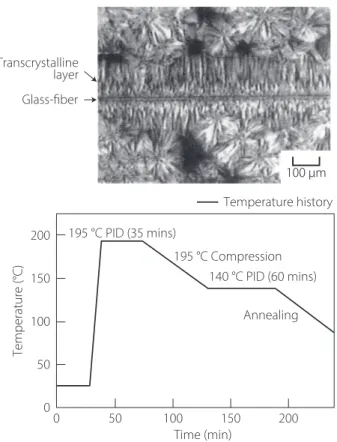
The crystallization characteristics of the polypropylene composites was the appearance of transcrystalline layer ex-tending vertically from a spherulite and surrounding areas of glass fiber. Figures 2 and 3 show the state of spherulites and transcrystalline layers with temperature history. Spheru-lites were molded over entire material following the process of high temperature heating, annealing and maintaining crystallization temperature (135 to 140 degrees in Celsius). The longer retention time at the crystallization temperature developed larger spherulites. Transcrystalline layers were molded after the process of heating at high temperature and exerting shearing force to the glass fiber at the crystallization temperature, which caused high density crystalline nucleus to develop.
Various forms of transcrystalline layers were observed by controlling the test settings, such as the temperature, the
Figure 1: Test piece molding devise with vacuum vessel Presser Plate Handle Test Piece Heating Blocks Cooling Block
Cooling Tubular Bar Insulators Main Axis Hydraulic Jack Upper Window Column Observation Window Cartridge Heater Test Piece Form Connectors to Heater Connectors to Thermocouple Stage
Specifications: Material: Stainless
Maximum Vacuum Degree: 0.01 Torr Maximum Load: 4 tons
Stage Stroke: 16 mm (max) Cooling Axis Stroke: 6 mm (max)
139 科学・技術研究 第 9 巻 2 号 2020 年
S. Funase et al.: Deformation behavior at interface between glass fiber and polypropylene
magnitude of shearing force to the glass fiber, and reten-tion time at the crystallizing temperature. The thickness of the transcrystalline layers was larger when cooling was con-ducted by retention at the crystallizing temperature than by annealing. The thickness was also affected by how a shearing force was exerted.
4. Tensile tests on spherulites and transcrystalline layers The test pieces manufactured by the devise were used for tensile testing to observe fracture morphologies of the spherulites and transcrystalline layers.
4.1 Experiment methods
A test piece was sliced from the FRP and placed in a small-size tensile testing devise developed by our laboratory. The testing devise was then attached to a polarizing microscope to conduct experiments and observations simultaneously. 4.2 The results
Figures 4 and 5 show fracture morphologies of the spherulites and transcrystalline layers when tensile forces were exerted in the direction parallel to the longitudinal direction of the glass fiber. Fractures of spherulites started from an appearance of crazes at weaker grain boundary and was accompanied by a separation of glass fiber and matrix. Fractures of transcrystalline layers followed a different path: Crazes appeared on glass fiber’s matrix and developed along
200 150 100 50 0 Temperature (°C) Time (min) 0 50 100 150 200 195 °C PID (35 mins) 170 °C Compression 140 °C PID (60 mins) Annealing Temperature history Glass-fiber 100 µm
Figure 2: Spherulites and temperature history
200 150 100 50 0 Temperature (°C) Time (min) 0 50 100 150 200 195 °C PID (35 mins) 195 °C Compression 140 °C PID (60 mins) Annealing Temperature history Glass-fiber Transcrystalline layer 100 µm
Figure 3: Transcrystalline layers and temperature history
Tensile direction
100 µm
Figure 4: Fracture morphology of the spherulites
Figure 5: Fracture morphology of the transcrystalline layers Tensile direction
140 Studies in Science and Technology, Volume 9, Number 2, 2020 the layers. The fracture occurred when crazes from
spheru-lites and those from transcrystalline layers were merged. The separation of glass fiber and matrix was not observed. The difference in fracture process suggests that the formation of the transcrystalline layers around the fiber could enhance the interfacial adhesive strength between glass fiber and matrix. 5. Conclusion
A composite manufacturing devise was designed and developed which allows heating, compressing and molding of a test piece to be executed in a vacuum vessel. Using the devise, polypropylene films containing glass fiber was manu-factured to investigate formation conditions of spherulites and transcrystalline layers.
The experiments suggested that the interfacial adhesive strength could be enhanced when transcrystalline layers were formed around the glass fiber.
References
Bower, D. I. (2002). An introduction to polymer physics. Cam-bridge University Press.
Editorial Board, Japan Research Institute of Material Technol-ogy (1986). Composite materials and interfaces. Sougo Gi-jyutsu Publishing. (in Japanese)
Fujita, Y. and Ushida, Y. (1985). Thermoplastic resin. Kobunshi, Vol. 34, No.5, 394-397. (in Japanese)
Hermabessiere, L., Dehaut, A., Ika, P., Lacroix, C., Jezequel, R., Soudant, P., and Duflos, G. (2017). Occurrence and effects of plastic additives on marine environments and organisms: A review. Chemosphere, Vol. 182, 781-793.
Inoue, T. (1984). Structure and properties of thermoplastic elastomers. Nippon Gomu Kyokaishi, Vol. 57, No. 11, 668-675. (in Japanese)
Motozuka, S., Hashimoto, R., Tagaya, M., and Kobayashi, T. (2013). Surface functionalization of carbon fibers and the composite techniques with polymers. Kobunshi Ronbunshu, Vol. 70, No. 6, 242-252. (in Japanese)
Nomura, M., Yamazaki, Y., and Hamada, H. (2003). Influence of glass-fiber length and interface properties on impact strength of GFPP. Seikei-Kakou, Vol. 15, No. 12, 830-836. (in Japanese)