INTRODUCTION
Neuroendocrine cell (NEC) carcinomas of the colon and rectum are uncommon, comprising less than 1 percent of colon and rectal cancer. NEC carcinomas typically stain for the immunohisto-chemical markers synaptophysin, chromogranin, or neuron-specific enolase. It is well known that common colorectal carcinoma has relatively good prognosis, whereas NEC carcinomas of the colon and rectum has very poor prognosis(1-3). A lot of patients had liver and lymph node involvement at the time of diagnosis. Treatments of NEC carcino-mas of the colon and rectum are very difficult. We
herein report the malignant potential and the treatment of colorectal NEC carcinoma.
CASE REPORT
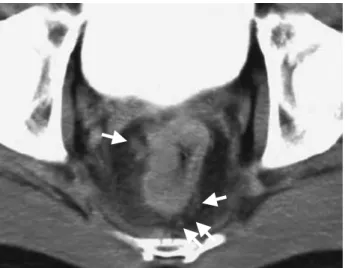
A 56-year-old man presented with anal bleeding. Laboratory findings showed no abnormalities on peripheral blood and serum examination. Colono-scopy disclosed type 4 lesion mainly located right side in the lower rectum (Fig.1A). Biopsy from this tumor revealed poorly differentiated adenocarci-noma. Gastrografin enema suggested type 4 tumor in the rectum, 8 cm from anal verge (Fig.1B). Ab-dominal computed tomography (CT) suggested lymph node metastases in the mesorectum (Fig. 2) and the periarterial lesion along the superior rectal artery. However, there was no liver metastasis. Following a diagnosis as poorly differentiated adenocarcinoma
CASE REPORT
Poorly differentiated neuroendocrine cell carcinoma of the
rectum : report of a case and literal review
Hidenori Miyamoto
1), Nobuhiro Kurita
1), Masanori Nishioka
1), Tsutomu Ando
1),
Takashi Tashiro
2), Mitsuyoshi Hirokawa
2), and Mitsuo Shimada
1) 1)Department of Digestive and Pediatric Surgery, and2)
Department of Human Pathology, Institute of Health Biosciences, The University of Tokushima Graduate School, Tokushima, Japan
Abstract : A 56-year-old man was admitted to our hospital because of anal bleeding. Colonoscopy and barium enema revealed type 4 tumor in the rectum. Biopsy revealed poorly differentiated adenocarcinoma. Low anterior resection with total mesorectal excision and lymph node dis-section was performed. In immunohistochemical staining, chromogranin A and synap-tophysin were positive at major lesion, and CEA were focal positive. The resected tumor was diagnosed pathologically as neuroendocrine cell carcinoma. The Ki-67 labeling index (LI) was 87.8%%, so proliferative activity and potential malignancy was very high. Multiple metastatic tumors appeared in pelvis and lung eight months after operation. Treatment for neuroendocrine cell carcinoma of the rectum was controversial. Surgical resection and adjuvant chemotherapy might be one of the methods for gastrointestinal neruroendo-crine cell carcinoma. J. Med. Invest. 53 : 317-320, August, 2006
Keywords : neuroendocrine cell carcinoma, rectum, Ki-67
Received for publication May 24, 2006 ; accepted July 10, 2006. Address correspondence and reprint requests to Dr. Hidenori Miyamoto, Department of Digestive and Pediatric Surgery, In-stitute of Health Biosciences, The University of Tokushima Graduate School, Kuramoto-cho, Tokushima 770-8503, Japan and Fax : +81-88-631-9698.
The Journal of Medical Investigation Vol. 53 2006
of the rectum, low anterior resection with lymph node dissection and total mesorectal excision was performed. The tumor was a 6.0×4.0 cm with type
4 shaped (Fig. 3) and the clinical stage was III, T3N2M0 in TNM classification. Histological features were poorly differentiated, nuclei were irregular in size and mitotic figures were frequently identified (Fig. 4A). The tumor was diagnosed pathologically as NEC carcinoma by immunohistochemical study using
Chromogranin A (Chr A) (Fig. 4B) and Synapto-physin (SNP) (Fig. 4C). A part of this tumor was stained with carcinoembryonic antigen (CEA). The proliferation marker, Ki-67, was diffusely stained and Ki-67 LI was 87.8% (Fig. 4D). The post
opera-Fig. 1 : (A)Colonoscopy shows type 4 shaped tumor mainly located right side in the lower rectum.
(B)Gastrografin enema shows irregular stenosis of the rectum at 8cm from anal verge.
Fig. 2 : Computed tomography shows lymph node enlargement in the mesorectum (arrow) and hypertrophy at right side of the rectum.
Fig. 3: Resected specimen. A type 4 shaped tumor was located in the rectum.
Fig. 4: Histological features. (A) Nuclei of the NEC carcinoma cells were irregular in size and mitotic figures were frequently identified (×100).
Immunohistochemical features. The NEC carcinoma cells are immunoreactive for (B) Chr A (×200) and (C) SNP (×200). (D) Nuclear labeling index of Ki-67 immunostaining shows 87.8% in
the NEC carcinoma (×100).
Table 1. Review of the literature.
Auther Cases (rate) Treatment (n) Survival
Saclarides TJ, et al. Bernick PE, et al.
Grbowski P, et al. 15(1.5%) 38(0.6%) 9(0.4%) unknown surgery ±CT or RT CT±RT
best supportive care
surgery (±CT or RT unknown) 29 8 1 9 MST 5.0 months MST 10.4 months
2 year survival rate 11% CT : chemotherapy RT : radiotherapy
MST : median survival time
H. Miyamoto, et al. Neuroendocrine cell carcinoma of the rectum
tive course was uneventful. However, the multiple recurrent tumors appeared in pelvis and lung, eight months after operation, and he died 1 year after operation.
DISCUSSION
Neuroendocrine cell (NEC) carcinomas of the colon and rectum are uncommon, comprising less than 1 percent of colon and rectal cancer. The first documented series of colonic small cell undifferen-tiated carcinomas with neuroendocrine features was reported by Gould and Chejfec in 1978(4). In Japan, The first case of a neuroendocrine cell carcinoma of the rectum was reported by Shimoda in 1984 (5). Since that initial description in Japan a total 40 cases of neuroendocrine cell carcinomas of the rectum have been reported (6, 13-14).
To determine NEC carcinoma, the immunohis-tochemical study by both Chr A, a marker for large dense core vesicles, and SNP, a marker for small synaptic vesicles are needed(7-8). In this case, the tumor was immunohistochemically stained with Chr A and SNP. However, a part of this tumor was stained with CEA. It seems that this tumor had both components of neuroendocrine cell carcinoma and adenocarcinoma. According to the recent report, it was considered that both NEC carcinoma and adenocarcinoma are derived from a same common epitherial cell of the rectum(7-8). Neuroendocrine cell is seen in the colorectal epithelium(7). However, NEC carcinoma, especially poorly differentiated type, is not capable to arise from neuroendocrine cell(8).
NEC carcinomas of the colon and rectum are clinically more aggressive than colorectal adeno-carcinoma and they are capable of rapid distant spread, so the prognosis is generally worse(8). Grabowski et al .(12) showed that neuroendocrine differentiation was often seen in small cell undif-ferentiated colorectal cancer. NEC carcinoma would be a part of poorly differentiated adenocarcinoma. However, the underlying mechanism for the ag-gressiveness of this disease is still not clear. The Ki-67 LI of poorly differentiated NEC carcinoma is very high, demonstrating that the proliferative ac-tivity and the potential malignancy are high. In this case, the Ki-67 LI was very high and the prognosis was very poor.
Treatment of the disease has not yet been estab-lished. It was reported that combination chemo-therapy of etoposide (VP16) plus cisplatin (CDDP)
would be effctive in poorly differentiated NEC car-cinoma(9). Mitry, et al.(10) reported that a response rate was 41.5% and median survival range was 15 months. Bernick, et al .(11) reported that a median survival range was 10.4 months.
Adjuvant chemotherapy was not performed in this case and remains controversial. If lymphatic infiltration or nodal involvement is present, radical surgery with lymph node dissection and adjuvant chemotherapy are the treatment of choice.
In conclusion, the prognosis of NEC carcinoma seems to be worse than that of adenocarcinoma. NEC carcinoma would be a part of poorly differen-tiated adenocarcinoma. Surgical resection and ad-juvant chemotherapy would be the main treatment for colorectal NEC carcinoma.
REFERENCES
1. Saclarides TJ, Szeluga D, Staren ED : Neuroen-docrine cancers of the colon and rectum : results of a ten-year experience. Dis Colon Rectum 37: 635-642, 1994
2. Vilor M, Tsutsumi Y, Osamura YR, Tokunaga N, Soeda J, Ohta M, Nakazaki H, Shibayama Y, Ueno F : Small cell neuroendocrine carcinoma of the rectum. Pathol Int 45 : 605-609, 1995 3. Grabowski P, Schindler I, Anagnostopoulos I,
Foss HD, Riecken EO, Mansmann U, Stein H, Berger G, Buhl HJ, Scherübl H : Neuroendocrine differentiation is a relevant prognostic factor in stage III-IV colorectal cancer. Eur J Gastroenterol Hepatol 13 : 405-411, 2001
4. Gould VE, Chejfec G : Neuroendocrine carci-nomas of the colon. Ultrastructural and bio-chemical evidence of their secretory function. Am J Surg Pathol 2 : 31-38, 1978
5. Shimoda T, Ishikawa E, Sano T, Watanabe K, Ikegami M : Histopathological and immuno-histochemical study of neuroendocrine tumors of the rectum. Acta Pathol Jpn 34 : 1059-1077, 1984
6. Tsujie M, Shibata N, Nomura T : A case of en-docrine cell carcinoma of the rectum (in Japanese with English abstract). Nippon Syokakigeka Gakkaizasshi (Jpn J Gastroenterol Surg) 36 (in Japanese) : 240-244, 2003
7. Helpap B, Köllermann J : Immunohistochemical analysis of the proliferative activity of neuroen-docrine tumors from various organs. Are there indications for a neuroendocrine tumor-carcinoma
sequence? Virchows Arch 438 : 86-91, 2001 8. Grabowski P, Schönfelder J, Ahnert-Hilger G,
Foss HD, Heine B, Schindler I, Stein H, Berger G, Zeitz M, Scherübl H : Expression of neuroen-docrine markers : a signature of human undif-ferentiated carcinoma of the colon and rectum. Virchows Arch 441 : 256-263, 2002
9. Rougier P, Mitry E : Chemotherapy in the treat-ment of neuroendocrine malignant tumors. Digestion 62(Suppl 1) : 73-78, 2000
10. Mitry E, Baudin A, Ducreux M, Sabourin JC, Ruffié P, Aparicio T : Treatment of poorly dif-ferentiated neuroendocrine tumors with etoposide and cisplatin. Br J Cancer 81 : 1351-1355, 1999 11. Bernick PE, Klimstra DS, Shia J, Minsky B, Saltz L, Shi W, Thaler H, Guillem J, Paty P, Cohen AM, Wong WD : Neuroendocrine car-cinomas of the colon and rectum. Dis Colon Rectum 47 : 163-169, 2004
12. Grabowski P, Schönfelder J, Ahnert-Hilger G, Foss HD, Stein H, Berger G, Zeitz M, Scherübl H : Heterogeneous expression of neuroendo-crine marker proteins in human undifferenti-ated carcinoma of the colon and rectum. Ann N Y Acad Sci 1014 : 270-274, 2004
13. Kurokawa S, Imamura A, Muraoka S : Type IIc+
IIa (Superficial Depressed Type) Intramucosal Endocrine Cell Carcinoma of the Rectum, Report of a Case (in Japanese with English abstract). I to Chou (Stomach and Intestine) 39(in Japanese): 1547-1554, 2004
14. Yamauchi N, Miyata T, Okada M, Nita T, Kawai H:Neuroendocrine Cell Carcinoma of the Rec-tum, Report of a Case (in Japanese with English abstract). Nippon Rinsyou Geka Gakkaizassi (J Jpn Surg Assoc) 65 (in Japanese) : 751-755, 2004
H. Miyamoto, et al. Neuroendocrine cell carcinoma of the rectum