LOCAL
SOLUTIONS
WITH POLYNOMIAL DECAY IN THEVELOCITY
VARIABLES
TO THE BOLTZMANN EQUATIONFOR SOFT POTENTIALS YOSHINORI MORIMOTO AND TONG YANG
GRAD. SCHOOL OFHUMAN&ENVIRON.STUDIES, DEP. OF MATHEMATICS,
KYOTO UNIVERSITY, CITY UNIVERSITY OF HONG KONG
1. INTRODUCTION
In the present note
we
consider the Cauchy problem for the spatially inhomoge-neous Boltzmann equation,(1.1) $\partial_{t}f+v\cdot\nabla_{x}f=Q(f, f) , f(O,x,v)=f_{0}(x, v)$,
where $f=f(t, x, v)$ is the density distribution function of particles with velocity
$v\in \mathbb{R}^{3}$ at time $t$ and position $x$
.
The right hand side of (1.1) is given by theBoltzmann bilinear collision operator
$Q(g, f)(v)= \int_{\mathbb{R}^{3}}\int_{\mathbb{S}^{2}}B(v-v_{*}, \sigma)\{g(v_{*}’)f(v’)-g(v_{*})f(v)\}d\sigma dv_{*},$
where the conservation of momentum and energy implies that for $\sigma\in \mathbb{S}^{2}$
$v’= \frac{v+v_{*}}{2}+\frac{|v-v_{*}|}{2}\sigma, v_{*}’=\frac{v+v_{*}}{2}-\frac{|v-v_{*}|}{2}\sigma.$
The non-negative
cross
section $B$ usually takes the form(1.2) $B= \Phi(|v-v_{*}|)b(\cos\theta) , \cos\theta=\frac{v-v_{*}}{|v-v_{*}|} \sigma, 0\leq\theta\leq\frac{\pi}{2},$
where
$\Phi(|z|)=\Phi_{\gamma}(|z|)=|z|^{\gamma}$, for
some
$\gamma>-3,$$b(\cos\theta)\theta^{2+2s}arrow K$ when $\thetaarrow 0+$,for $0<s<1$ and $K>0.$
In fact, for the physical model, if the inter-molecule potential satisfies the inverse
power law potential $U(\rho)=\rho^{-(q-1)},$$q>2($, where $\rho$ denotes the distance between
twointeracting molecules), then $s$ and $\gamma$
are
given by$0<s=1/(q-1)<1, 1>\gamma=1-4_{\mathcal{S}}=(q-5)/(q-1)>-3.$
As usual, the hard $(\gamma>0)$ and soft $(\gamma<0)$ potentials correspond to $q>5$ and
$2<q<5$, respectively, and the Maxwelhan potential $(\gamma=0)$ corresponds to $q=5.$
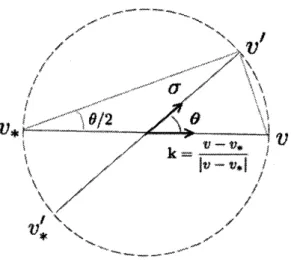
The angle$\theta$isthe deviationangle, i.e., the angle between post- and pre-collisional
velocities (see Figure 1 in the next page). Though the range of $\theta$ is originally a
full interval $[0, \pi]$, it should be noted that the angle $\theta$ in (1.2) is now restricted to
$[0, \pi/2]$, as in [1], by replacing $b(\cos\theta)$ by its ’symmetrized” version $[b(\cos\theta)+b(\cos(\pi-\theta))]1_{0\leq\theta\leq\pi/2},$
FIGURE 1. post- and pre-collisional velocities
which is possible due to the invariance of the product $f(v’)f(v_{*}’)$ in the collision
operator $Q(f, f)$ under the change of variables $\sigmaarrow-\sigma$
.
This device enables us touse the regularchange ofvariables between post- and pre-collisional velocities (in
the proof of the celebrated cancellation lemma in [1]$)$,
$v \mapsto v’=\frac{v+v}{2}*+\frac{|v-v_{*}|}{2}\sigma,$
where the Jacobian is found to be
$| \frac{\partial v}{\partial v’}|=\frac{8}{|I+k\otimes\sigma|}=\frac{8}{|1+k\cdot\sigma|}=\frac{4}{\cos^{2}(\theta/2)}\leq 8, \theta\in[0, \pi/2].$
In [15, 2], the singularchange of variables$v_{*}arrow v’$ (, whose Jacobianis computed
as
$| \frac{\partial v_{*}}{\partial v’}|=\frac{8}{|I-k\otimes\sigma|}=\frac{8}{|1-k\cdot\sigma|}=\frac{4}{\sin^{2}(\theta/2)}\sim\theta^{-2}, \theta\in[0, \pi/2],)$
was also introduced to show the existence of solutions to the‘linearized”
Boltz-mann equation, and was used in [3, 4, 9] to prove the uniqueness ofsolutions with
polynomial decay in the velocity variable to the nonlinear Boltzmann equation for Maxwellian and soft potentials. Especially in [9], the uniqueness of solutions was considered in the following function space; for $m\in \mathbb{R},$$\ell\geq 0$ and $T>0,$
$\mathcal{P}_{\ell}^{m}([0, T]\cross \mathbb{R}_{x,v}^{6}) = \{f\in C^{0}([0, T];S’(\mathbb{R}_{x,v}^{6}))$;
$s.t. f\in L^{\infty}([0, T]\cross \mathbb{R}_{x}^{3};H_{\ell}^{m}(\mathbb{R}_{v}^{3}))\},$
$\Vert f\Vert_{H_{\ell}^{m}(\mathbb{R}_{v}^{3})}=(\int_{\mathbb{R}^{3}}|\langlev\rangle^{\ell}(\langle D_{v}\rangle^{m}f(v))|^{2}dv)^{1/2} \langle v\rangle=(1+|v|^{2})^{1/2}$
An effective use ofthe singularchange ofvariables gives us
Theorem 1.1 ([9]). Assume that the cross section $B$ takes the
form
(1.2) with$0<s<1$
and $\max\{-3, -3/2-2s\}<\gamma\leq 0$.
Suppose that the Cauchy problem (1.1) admits two weak solutions $f_{1}(t),$$f_{2}(t)\in \mathcal{P}_{\ell_{0}}^{2s}([0, T]\cross \mathbb{R}_{x,v}^{6})$ with $0<T<+\infty$and$\ell_{0}\geq 14$ having the
same
initial datum$f_{0}\in L^{\infty}(\mathbb{R}_{x}^{3};H_{\ell 0}^{2s}(\mathbb{R}_{v}^{3}))$
.
If
one solutionHere the weak solution to the Cauchy problem (1.1) is defined by
$\int_{\mathbb{R}^{6}}f(t, x, v)\eta(t, x, v)dxdv-\int_{\mathbb{R}^{6}}f_{0}(x,v)\eta(0, x, v)dxdv$
$- \int_{0}^{t}d\tau\int_{\mathbb{R}^{6}}f(\tau, x, v)(\partial_{\tau}+v\cdot\nabla_{x})\eta(\mathcal{T}, x, v)dxdv$
$= \int_{0}^{t}d\tau\int_{\mathbb{R}^{6}}Q(f, f)(\tau,x, v)\eta(\tau, x, v)dxdv,$
where $\eta\in C^{1}(\mathbb{R};C_{0}^{\infty}(\mathbb{R}^{6}))$ is a test function.
Comparedwith theuniquenessof polynomial decay solutions in the velocity vari-ables, there are few results concerning the existence of such slowly decay solutions
in spatially inhomogeneous case (cf., renormalized solutions by [13, 11], and [12] in
the cutoff case). In fact, the existence of classical solutions for the spatially
inho-mogeneous Boltzmann equation has been usually discussed for solutions with the Maxwellian decay weight in the velocity variables (see [3, 4, 5, 6, 8, 10, 14] in the non-cutoff case). In the next section we state a local existence result concerning polynomial decay solutions in the velocity variable to the full nonlinear Boltzmann
equation in a certain soft potential case, by aneffective
use
of the singular changeofvariables between post- and pre-colhsional velocities.
2. LOCAL EXISTENCE FOR SOFT POTENTIALS Throughout this sectionwe confine ourselves to the
case
(2.3) $0<s< \frac{1}{2}, -\frac{3}{2}<\gamma\leq 0,$
because of the technical difficulties, though the uniqueness result,Theorem 1.1,
holds under the
more
general situation$0<s<1$ and$\max\{-3, -2_{\mathcal{S}}-3/2\}<\gamma\leq 0.$We introduce our working function spaces as follows: Set
$\partial_{\beta}^{\alpha}=\partial_{x}^{\alpha}\partial_{v}^{\beta}, \alpha, \beta\in \mathbb{N}^{3}.$
and
(2.4) $\mathcal{W}=\{\begin{array}{ll}\langle v\rangle if 0<s\leq 1/4,\langle v\rangle^{2s/(1-2s)} if 1/4<s<1/2,\end{array}$
which ensures $\langle v\rangle^{2s}\leq \mathcal{W}^{1-2s}$ and $\langle v\rangle\leq \mathcal{W}$ for the later use. As in [4, 7], we use a
kind ofcutoff function in both space and velocity variables,
(2.5) $\phi(x, v)=\frac{1}{1+|v|^{2}+|x|^{2}},$
which possesses the commutator property $|[v\cdot\nabla_{x},$$\phi||=2|v\cdot x|\phi^{2}\leq\phi$
.
For $k\in \mathbb{N},$ $\ell\in \mathbb{R}$with $k<\ell$, we define(2.6) $\mathcal{H}_{u}^{k}|^{\ell}(\mathbb{R}^{6})=\{g|\Vert g\Vert_{\mathcal{H}_{u}^{k}}^{2}i^{\ell_{(\mathbb{R}^{6})}}$
$= \sum_{|\alpha+\beta|\leq k}\sup_{a\in \mathbb{R}^{3}}\int_{\mathbb{R}^{6}}|\phi(x-a, v)\mathcal{W}^{\ell-|\alpha+\beta|}\partial_{\beta}^{\alpha}g(x, v)|^{2}dxdv<+\infty\}.$
The function space $\mathcal{H}_{u}^{k}|^{\ell}(\mathbb{R}^{6})$ is a variant of the uniformly local Sobolev space
and a usual smooth cutoff function $\phi_{1}(x)\in C_{0}^{\infty}(\mathbb{R}^{3})$, respectively. In [8],
bounded classical solutions for the initial data $f_{0}(x, v)$ satisfying
(2.7) $\exists\rho_{0}>0s.t. e^{\rho_{0}\langle v\rangle^{2}}f_{0}\in H_{u}^{k}i^{0}(\mathbb{R}^{6})$
are constructed in the whole space without specifying any limit behaviors at the
spatial infinity and without the smallness condition on initial data, under the
as-sumptions on the
cross
section $B$ with$0<s<1/2, -3/2<\gamma, \gamma+2s<1.$
From the point view ofthe local existence of polynomial decay solution in the velocity variable, we have the following improvement ofTheorem 1.1 of [8] for the
soft potential case;
Theorem 2.1. Assume that the cross section $B$ takes the
form
(1.2) with (2.3),that is, $0<s<1/2,$ $-3/2<\gamma\leq 0$
.
If
the initial data $f_{0}$ isnon-ne9ative
andbelongs to $\mathcal{H}_{u}^{k}|^{\ell}(\mathbb{R}^{6})$
for
$k\geq 6,\ell\geq k+7$, then, there exists a $T_{*}>0$ such that theCauchy problem (1.1) admits a non-negative unique solution in the
function
space$C^{0}([0, T_{*}];\mathcal{H}_{u}^{k}|^{\ell}(\mathbb{R}^{6}))$
.
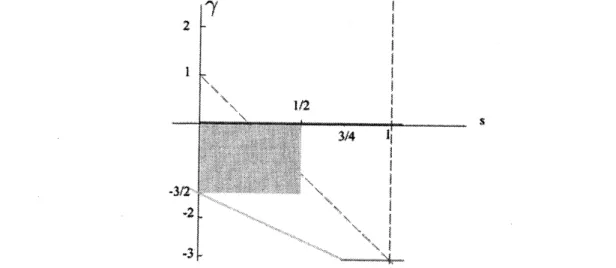
Remark 2.2. The rectangle below expresses the domain
of
$(\gamma, s)$ covered byTheo-rem
2.1. The previous local existence result under (2.7) in [8] covers an additionaltriangle region below the line $\gamma=1-2s$, which is contained in the hard potential
region $\gamma>0$
.
Time global solutions near a global equilibrium,$f=\mu+\sqrt{\mu}g, \mu=e^{-|v|^{2}/2}/(2\pi)^{3/2}.$
were given in [4, 5, 6], [14], which cover the
full
region$0<s<1$
, $\gamma>$$\max\{-3, -3/2-2s\}$ indicated by the figure below.
$
FIGURE 2. dashed line: $\gamma=1-4s$ in case ofinverse power law potential
For theproofof Theorem 2.1, weconstruct the approximatesolutions by angular cutoff approximation. That is, for $0<\epsilon\ll 1$, we approximate (cutoff) the cross
section by
Theorem 2.3 (Cutoff case). Assume that $-3/2<\gamma\leq 0$ and replace the angular
factor of
thecross
section $b$ by$b_{\epsilon}$.
If
the initial data $f_{0}$ is non-negative and belongsto $\mathcal{H}_{u}^{k}|^{\ell}(\mathbb{R}^{6})$
for
$k\geq 5,$$\ell\geq k+7$, then, there exists a $T_{\epsilon}>0$ such that the Cauchyproblem (1.1) admits a non-negative unique solution$f^{\epsilon}(t, x, v)$ in the
function
space$C^{0}([0, T_{\epsilon}];\mathcal{H}_{u}^{k}|^{\ell}(\mathbb{R}^{6}))$
.
Remark 2.4. In the
cutoff
case.
the orderof
derivative $k$ can be taken not lessthan 5 instead
of
6for
thenon-cutoff
case
inour
analysis. We might improve the$\partial_{x},\partial_{v}$
order.
$of$ derivatives by
use
of
thefractional
derivatives employed in [10],instead
of
Another key ingredient is to obtaina uniform estimate for solutions in the given function space. Let $T>0$ and $f(t)\in C^{0}([0, T];\mathcal{H}_{u}^{k}|^{\ell}(\mathbb{R}^{6}))$ with$k\geq 6$ and $\ell\geq k+7.$
If
we
put$\mathcal{E}(t)=\Vert f(t)\Vert_{\mathcal{H}_{u}^{k}}^{2}i^{\ell}$’
then there exists a $C>0$ depending only on $s,$$\gamma,$ $k,$$P$ and $K>0$ in the hypothesis
of$b$ such that
(2.8) $\mathcal{E}(t)\leq \mathcal{E}(0)+C\int_{0}^{t}\mathcal{E}(\tau)(1+\mathcal{E}(\tau))d\tau, t\in[0, T],$
wherewe refer [16] to thedetailderivation ofthis estimate, by
means
of both regular and singular changes of variables between post- and pre-collisional velocities. It follows from (2.8) that we have$\mathcal{E}(t)\leq\frac{\mathcal{E}(0)e^{Ct}}{1-(e^{Ct}-1)\mathcal{E}(0)},$
by exactlythe
same
calculationas
theone
after (4.3.11) of [3]. Ifwe
choose $T_{*}>0$small enough such that
$T_{*}= \frac{1}{C}\log(1+\frac{3}{1+4\Vert f_{0}\Vert_{\mathcal{H}_{u}^{k}}i^{\ell_{(\mathbb{R}^{6})}}})$
then we obtain a uniform estimate
(2.9) $\Vert f(t)\Vert_{\mathcal{H}_{u}^{k}}i^{\ell_{(\mathbb{R}^{6})}}\leq 2\Vert f_{0}\Vert_{\mathcal{H}_{u}^{k}}i^{\ell_{(\mathbb{R}^{6})}}$ for $t\in[O, T_{*}].$
The proofofTheorem 2.1 canbecompleted in the almost same way asinthe proof
of Theorem4.11 of [3] and the subsequent paragraph there, takinginto account the
uniform estimate (2.9) and Theorem 2.3.
REFERENCES
[1] R. Alexandre, L. Desvillettes, C. Villani and B. Wennberg, Entropy dissipation and
long-range interactions, Arch. Ration. Mech. Anal. 152 (2000), 327-355
[2] R.Alexandre, Y.Morimoto, S.Ukai, C.-J.Xu and T.Yang, Uncertainty principle and kinetic
equations, J. Funct. Anal., 255 (2008) 2013-2066.
[3] R. Alexandre, Y. Morimoto, S. Ukai, C.-J. Xu and T. Yang, Regularizing effect and local
existencefornon-cutoffBoltzmann equation, Arch. Ration. Mech. Anal.,198 (2010), 39-123.
[4] R. Alexandre, Y. Morimoto, S. Ukai,C.-J. Xuand T. Yang, Global existence andfull
regular-ityofthe Boltzmann equationwithout angular cutoff, Comm. Math. Phys.,$3-4-2(2011),513-$
581.
[5] R. Alexandre, Y. Morimoto, S. Ukai,C.-J. Xu and T. Yang, The Boltzmann equation without
angular cutoffin the whole space: I. Global existencefor soft potential, J. Funct. Anal. 262
[6] R. Alexandre, Y. Morimoto, S. Ukai, C.-J. Xu, T. Yang, The Boltzmann equation without angularcutoffin the whole space: $\Pi$, global existenceforhard potential, Anal. Appl. 9 (2011) 113-134,
[7] R. Alexandre, Y. Morimoto, S. Ukai, C.-J. Xu and T.Yang, Boltzmann equation without angular cutoffin the whole space: Qualitative properties ofsolutions, Arch. Rational Mech. Anal.,202(2011), 599-661.
[8] R. Alexandre, Y. Morimoto, S. Ukai, C.-J.Xu and T. Yang, Bounded solutions ofthe
Boltz-mann equationin the whole space, Kinetic andRelated Models. 4 (2011) 17-40.
[9] R. Alexandre, Y. Morimoto, S. Ukai, C.-J. Xu and T. Yang, Uniqueness of solutionfor the non cutoffBoltzmann Equation with the soft potential, Kinet. Relat. Models, 4 (2011),
919-934.
[10] R. Alexandre, Y. Morimoto, S. Ukai, C.-J. Xu and T. Yang, Local existence with mild
regu-larotyforthe Boltzmann equation, to appearin Kinet. Relat. Models, 4 (2013).
[11] R. Alexandre and C. Villani, On the Boltzmann equationforlong-range interaction, Comm. Pure Appl. Math., 55 (2002), 30-70.
[12] L. Arkeryd, R. Esposito, M.Pulvirenti,. The Boltzmann equationfor weakly inhomogeneous data. Comm. Math. Phys. 111 (1987), 393-407.
[13] R. J. DiPerna and P. L. Lions, On the Cauchy problem for Boltzmann equations: global existence and weak stability. Ann. Math., 130 (1989), 321-366.
[14] P.-T.Gressman and R.-M. Strain, Global classicalsolutions oftheBoltzmann equation
with-out angular cut-off. J. Amer. Math. Soc., 24 (2011), 771-847.
[15] Y. Morimoto, S. Ukai, C.-J. Xu and T. Yang, Regularity ofsolutions to the spatially
ho-mogeneous Boltzmann equation without angular cutoff, Discrete and Continuous Dynamical
Systems-Series A 24, (2009), 187-212.
[16] Y. Morimotoand T. Yang, Local existence ofpolynomial decay solutions to the Boltzmann
equationfor softpotentials, to appearinAnal. Appl.
YOSHINORI MORIMOTO, GRADUATE SCHOOL OF HUMAN AND ENVIRONMENTAL STUDIES,
KYOTO UNIVERSITY, KYOTO, 606-8501, JAPAN
$E$-mail address: [email protected]
TONG YANG, DEPARTMENT OF MATHEMATlCS, CITY UNIVERSITY OF HONG KONG, HONG KONG, P. R. CHINA