An Improved Randomized
Approximation
Algorithm for
Max
TSP
Zhi-Zhong Chen
(陳 致中)Lusheng
Wang (王 魯生)Department
of Mathematical
Sciences
Departmentof
Computer
Science
Tokyo
Denki
University City Universityof
HongKong
Hatoyama,
Saitama
350-0394,
Japan. TatChee
Avenue, Kowloon, Hong Kong.(東京電機大学理工学部数理科学科) (香港城市大学計算機系)
Abstract
We present an $O(n^{3})$-timerandomized approximation algorithm for themaximum
trav-eling salesmanproblemwhoseexpected approximationratio is asymptotically $\frac{2\mathrm{S}1}{331}$, where
$n$
is thenumber ofvertices in the input (undirected) graph. This improves the previous best.
1
Introduction
The maximum traveling salesman problem $({\rm Max} \mathrm{T}\mathrm{S}\mathrm{P})$istocompute
a
maximum-weightHamil-toniancircuit (calleda tour) in
a
given edge-weighted (undirected) graph. The problemis known to be ${\rm Max}- \mathrm{S}\mathrm{N}\mathrm{P}- \mathrm{h}\mathrm{a}\mathrm{r}\mathrm{d}[1]$ and there have been anumber of approximation algorithms known forit [3, 4, 7]. In $19\mathrm{S}4$, Serdyukov [7] gave an $O(n^{3})$-time approximation algorithm for ${\rm Max}$ TSP
that achieves an approximation ratio of $\frac{3}{4}$
.
Serdyukov’s algorithm is very simple and elegant,and it tempts
one
to ask ifa
better approximation ratiocan
be achieved for ${\rm Max}$ TSP by apolynomial-time approximation algorithm. Along this line, Hassin and Rubinstein [4] showed
that with the helpofrandomization, better approximation ratio for${\rm Max}$ TSP can beachieved.
More precisely, they gave
an
0 $(n^{3})$-time randomized approximation algorithm for ${\rm Max}$ TSPwhose expectedapproximation ratio is asymptotically $\frac{25}{33}$
.
Their algorithm is basicallya
combi-nation of Serdyukov’s algorithm andanearlieralgorithm oftheir own [3].
The asymptotic ratio $\frac{25}{33}$ achieved byHassin and Rubinstein’s algorithm ismarginally better
than the ratio $\frac{3}{4}$ achieved by Serdyukov’s algorithm. However, Hassin and Rubinstein said in
their paper [4]: “the better ratio at least dem onstratesthat the ratio of $\frac{3}{4}$ canbe improved and
furtherresearch along this line isencouraged”. Moreover, it is widely recognizedthat improving
approximation algorithms for TSP and its variants
are
not easy. In this paper, following andimproving Hassin and Rubinstein’s work,
we
give anew
$O(n^{3})$-time randomized approximationalgorithm for ${\rm Max}$ TSP whose expected approximation ratio is asymptotically $\frac{251}{331}$. Hassin and
Rubinstein [4] show that each approximation algorithm for ${\rm Max}$TSP canbe translated into an
approximation algorithm foraproblem called the maximum latency $TSP$which
was
first studiedbyChalasani andMotwani [2]. Using their translation, our
new
algorithmcan
be trivially turnedinto
a
new
randomized approximation algorithm for the maximum latency TSP whose expectedapproximation ratio improves the previous best.
Like all previousapproximation algorithms for${\rm Max}$ TSP,
our new
algorithm starts bycom-puting a maximum-weight cycle
cover
$C$ of the input graph $G$ and then modify the cycles in$C$(somehow) to a tour of$G$without losing much weight. All the previous algorithms modify the
cycles in $C$ in
an
arbitrary order. In contrast,our
algorithm modify the cycles in a carefully8
cycle heavily depends on how the previous cycles were modified. This is why our algorithmis
complicated.
Throughout therest of thePaPer, fix aninstance $(G, w)$ of${\rm Max} \mathrm{T}\mathrm{S}\mathrm{P}$, where$G$is acomplete
(undirected) graph and $w$ is
a
functionmapping each edge$e$ of$G$to a nonnegativereal number$w(e)$
.
For a subset $F$ of$E(G),$ $w(F)$ denotes $\sum_{e\in F}w(\mathrm{e})$.
The weightofa
subgraph $H$ of$G$ is$w(H)=w(E(H))$
.
Our goal is to compute atourof large weight in $G$.
For ease ofexplanation,we assume that $n=|V(G)|$ is
even.
Wefirstsketchourrandomizedalgorithmfor${\rm Max} \mathrm{T}\mathrm{S}\mathrm{P}$ inthe nextsection and then describe
its details in Sections 3 through5. For a random variable $X$, $\mathcal{E}[X]$ denotes its expected value.
For a random event $A$, $\mathrm{P}\mathrm{r}[A]$ denotes the probability that $A$
occurs.
2
Outline of the
New
Randomized Algorithm
Like Hassin and Rubinstein’s randomized algorithm (H&R-algorithm) for ${\rm Max} \mathrm{T}\mathrm{S}\mathrm{P}$
,
ouralgo-rithmstartsbycomputingamaximum-weight cycle
cover
$C$of$G$, uses itto computethree tours$T_{1}$,
$\ldots$ ,
T3
of$G$, and outputstheone
of the largest weight amongthem. Our computationof$T_{1}$is the same
as
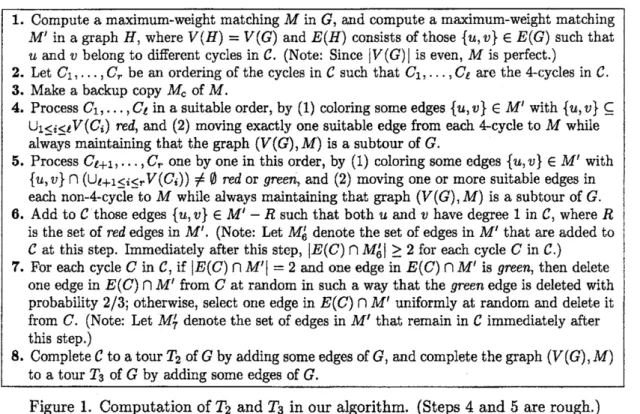
in H&R-algorithm. Our computationof$T_{2}$ and $T_{3}$ isas
shownin Figure 1:1. Computeamaximum-weight matching$M$in$G$, and computeamaximum-weightmatching
$M’$ inagraph $\mathrm{F}$, where $V(H)=V(G)$ and$E(H)$ consistsof those $\{u, v\}\in E(G)$ such that
$u$and $v$belong to different cyclesinC. (Note: Since $|V(G)|$ is even, $M$isperfect.)
2. Let $C_{1}$,
$\ldots$,$c_{r}$ beanorderingof the cycles in
$\mathrm{C}$such that $C_{1}$,
$\ldots$ ,$C_{t}$ arethe 4cycles inC.
3. Make abackupcoPy $M_{\mathrm{c}}$ of$M$
.
4. Process$C_{1}$,
$\ldots$, Ct inasuitable order, by (1) coloringsomeedges $\{u, v\}\in M’$with $\{u,v\}\subseteq$
$\bigcup_{1\leq}:\leq pV$(Ci) red,and (2) moving exactly onesuitable edgefrom each 4-cycleto$M$ while
alwaysmaintaining that the graph$(V(G),M)$ is asubtourof$G$
.
5. Process$C_{\ell+1}$,$\ldots$,$C_{\mathrm{r}}$ onebyoneinthis order,by (1) coloringsome edges $\{u,v\}\in M’$ with
$\{u,v\}$rl$(\cup\ell+1\leq:\leq rV(C:))$
I
$\emptyset$redor$g\Gamma een$, and (2) moving oneor moresuitable edges in
each non-4-cyc1e to$M$ while alwaysmaintaining that graph $(V(G), M)$ isasubtour of$G$.
6. Add to $\mathrm{C}$thoseedges
$\{u,v\}\in M^{l}-R$such that both $u$ and$v$ havedegree 1 in $\mathrm{C}$, where
$R$ is the set of rededges in$M’$
.
(Note: Let $M_{6}’$ denote the setofedges in $M’$ that areaddedto $\mathrm{C}$at this step. Immediatelyafter thisstep, $|E(C)\cap M_{6}’|\geq 2$foreach cycle $C$ inC.)$\tau$
.
For eachcycle $C$in $\mathrm{C}$, if$|E(C)\cap M’|=2$and oneedge in$E(C)\cap M’$ is green, then deleteoneedge in $E(C)\cap M’$ from$C$at random in such away that the greenedge is deletedwith
probability 2/3; otherwise, select oneedge in$E(C)\cap M’$ uniformly at random anddeleteit
fromC. (Note: Let $M_{7}’$denote the set ofedges in$M’$ that remain in$\mathrm{C}$ immediatelyafter
thisstep.)
8. Complete$\mathrm{C}$toatour
$T_{2}$of$G$by addingsomeedgesof$G$, andcompletethegraph$(V(G),M)$
toa tour$T_{3}$ of$G$ byaddingsome edgesof$G$
.
Figure 1. Computation of$T_{2}$ and $T_{3}$ in
our
algorithm. (Steps 4and 5are
rough.)Steps 4 and 5 in Figure 1
are
rough; their detailsare
very complicated and will be givenin the subsequent sections. An important property will be that $w(R)$ is small compared with
$w(M’)$
.
Several definitions and two useful facts
are
in order. Throughout the rest of this paper, for each integer $\mathrm{i}\in\{1, \ldots, r\}$,
the phrase “at time $\mathrm{i}$”means
the time at whichzero or more
cycles in $\mathrm{C}$ have been processed and$C_{i}$ is the next cycle to be processed. A set $F$ of edges in $G$ is
available at time 2 if $F$ is
a
matching in $C_{i}$, $F\cap M_{\mathrm{c}}=\emptyset$, and the graph $(V(G), M\cup F)$ is $\mathrm{a}$subtour of $G$ at time $\mathrm{i}$
.
An edge$e$ in $G$ is available at time ! if $\{e\}$ is available at time 2. A
maximal available set at time$\mathrm{i}$ isan availableset$F$at time
2 such that for every$e\in E(C_{i})-F$
,
are two adjacent edges in $C_{\dot{\mathrm{q}}}$ such that $F$ contains no edge incident to
$u_{\mathrm{I}}$, $u2$, or $u3$
.
Then,$F\cup\{e_{1}\}$ or$F\cup\{e_{2}\}$ is available at time $\mathrm{i}$
.
3
Processing
$4$-Cycles
We saythat twodistinct edges $e1$ $=\{u1, v1\}$and$e_{2}=\{u_{2}, v_{2}\}$in$M’$ formasquarepair, denoted
by $\{e_{1,2}e\}_{\mathrm{s}\mathrm{p}}$, if$\{u_{1}, u2\}$ is an edgein
a
$4$-cycle $C_{i}$ and $\{v1, v2\}$ is an edge in another $4$-cycle $C_{j}$.We call $C_{i}$ and
Ci
the dependent $\mathit{4}$-cycles of the squarepair. An edge $e\in M’$is a square edgeif$e$ is contained in some square pair.
We construct a multigraph $H_{1}$ from $M’$ and $C_{1}$,
$\ldots$,$C\ell$
as
follows. The nodes of$H_{1}$one-to-one correspond to $C_{1}$,
$\ldots$,$Gg$
.
Forconvenience,we
stilluse
Ci
$(1\leq \mathrm{i}\leq\ell)$ to denote the nodeof$H_{1}$ corresponding to it. The edges of$H_{1}$ one-to-one correspond to the square pairs. In more
detail, corresponding to each square pair$p$, $H_{1}$ has an edge between the dependent $4$-cycles of
p. $H_{1}$ has no other edges. Foreach edge $f$ of$H_{1}$
, we
denote the squarepair corresponding to $f$ by$p(f)$.
An edge$\{u, v\}\in M’$ is 4-cycle-closed if there
are
two 4-cycles$C_{i}$ and$C_{j}$ in$C$ with$u\in V(C_{i})$and$v\in V(Cj)$
.
An edge $e\in M’$ is 4-cycle-pendentiffor exactlyone
endpoint $u$ of$e$, there is a4-cycle$C_{i}$ in$C$ with $u\in V(C_{i})$. Let $Q$ be aconnected subgraph of$H_{1}$
.
An edge $\{u, v\}\in M’$ is$Q$-closed ifthere aretwo nodes $C_{i}$ and $C_{j}$ in $Q$with$u\in V(C_{i})$ and $v$ $\in V(Ci)$
.
Anedge $e\in M’$is $Q$-pendent if for exactly one endpoint $u$ of$e$, there is a node $C_{i}$ in $Q$ with $u\in V(C_{i})$
.
Theweight of$Q$ is the total weight of$Q$-closed edges in $M’$, and is denoted by $w(Q)$
.
Obviously, we
can
classifythe connected components $Q$ of$H_{1}$ into ten typesas
follows:Type 1: $Q$ is
a
single node.Type 2: $Q$ is
a
bunch of four parallel edges between two nodes.Type 3: $Q$ is anodd cycle.
TyPe 4: $Q$ is an even cycle of length 4 or more.
Type $\mathit{5}_{i}$ $Q$ is
a
pathof length 1or
more, and $Q$ hasan endpoint Ci$\cdot$ (a4-cycle in $C$) such
that neither
a
$Q$-pendent edge nor a $Q$-closed non-square edge is incident toa
vertexof$C_{\mathrm{i}}$
.
(Note: We call $C_{\acute{l}}$ a dead end of$Q$.
Note that if there is a $Q$-closed non-squareedge, then $Q$ has no deadend.)
TyPe 6: $Q$ is
a
pathof length 3or
more, and $Q$ has no dead end.TyPe 7: $Q$ is
a
2-cycle.Type 8: $Q$ is apath of length 1 and $Q$ has
no
dead end.Type 9: $Q$ is apath of length 2, $Q$ hasno dead end, and there is no $Q$-closed non-square
edge.
Type 10: $Q$ is
a
path of length 2 and there isa
$Q$-closed non-square edge.Lemma 3.1 Suppose that our $algor\dot{8}thm$ has processed zero or more $\mathit{4}$-cycles and that $C_{i}$ and
$C_{j}$ are two distinct$\mathit{4}$-cycles not yetprocessed. Let$e1$ and$e_{2}$ be two nonadjacent edges in $C_{i}$ such
that
for
each $ek\in$ $\{\mathrm{e}15 \mathrm{e}2\}_{;}$ $ek$ $\not\in M_{\mathrm{c}}$ and the graph $(V(G), M\cup\{e_{k}\})$ is a subtourof
G. Then,we can
choose two nonadjacent edges $e3$ and$e_{4}$ in $E(C\mathrm{i})-M_{\mathrm{c}}$ such thatfor
each $e_{x}\in\{e_{1}, e_{2}\}$and
for
each $e_{y}\in\{e_{3}, e4\}$, the graph $(V(G), M\cup\{e_{x}, e_{y}\})$ is a subtourof
$G$.
Corollary 3.2 For every 4-cycle $C_{i}$ in C, there are two nonadjacent edges available at time i.
Toprocessthe4-cycles in$\mathrm{C}$, ouralgorithm considers the connected components of$H_{1}$
one
byone.
When considering aconnected component $Q$ of$H_{1}$,our
algorithmprocesses those $4$-cycles(in arow) that are nodes of$Q$
.
Since the details heavily dependon
the type of$Q$,we
describe10
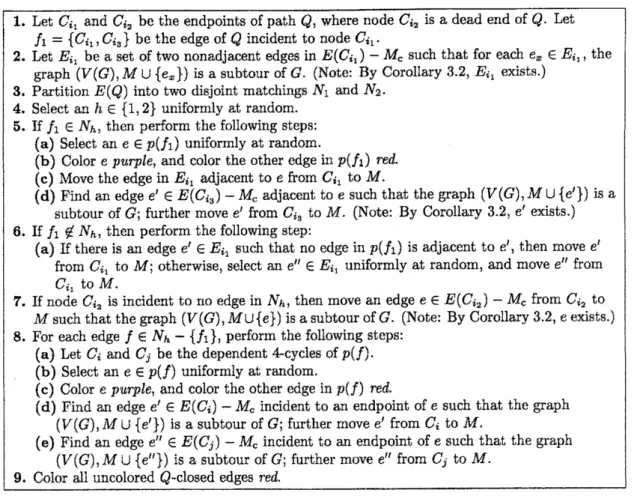
1. Let $C_{i_{1}}$ and$C_{i_{2}}$ be the endpointsofpath$Q$, where node$C_{\dot{l}2}$ is adead end of$Q$. Let
$fi=\{C_{i_{1}}, C_{\dot{\mathrm{t}}_{3}}\}$be theedge of$Q$ incident to node$C_{i_{1}}$.
2. Let $E_{\dot{2}1}$ beaset oftwo nonadjacent edgesin $E(C_{_{1}})$ $-M_{\mathrm{c}}$ such that for each $e_{x}\in E_{i_{1}}$, the
graph $(V(G), M\cup\{e_{x}\})$ isa subtourof G. (Note: ByCorollary 3.2, $E_{i_{1}}$ exists.) 3. Partition $E(Q)$ into two disjoint matchings $N_{1}$ and $N_{2}$.
4. Select an$h\in\{1,2\}$ uniformly at random.
5. If$f_{1}\in N_{h}$, then perform the followingsteps:
(a) Select an$e\in p\langle f1$) uniformlyat random.
(b) Color$e$ purple, and color the other edgein$p(f_{1})$ red.
(c) Move the edge in$E_{i_{1}}$ adjacent to$e$ from$C_{:_{1}}$ to$M$
.
(d) Find an edge$e’\in E(C_{i_{\theta}})-M_{\mathrm{c}}$ adjacent to$e$such that the graph $(V(G),M\cup\{e’\})$is $\mathrm{a}$
subtour of$G$; further move $e’$ from $c_{i_{3}}$ to M. (Note: By Corollary 3.2, $e’$exists.)
6. If$f_{1}\not\in N_{h}$, then performthefollowingstep:
(a) Ifthere isan edge$e’\in E_{\dot{\iota}_{1}}$ suchthat noedge in$p(f_{1})$ is adjacent to$e’$, thenmove $e’$
from $C_{i_{1}}$ to $M_{\}$
.
otherwise,select an$e’\in E_{i_{1}}$ uniformly at random, andmove $e’$ from $C_{i_{1}}$ to $M$.
$\tau$
.
If node $C_{2}\dot{.}$ isincidenttono edge in$N_{h}$, thenmoveanedge $e\in E(C_{i_{2}})-M_{\mathrm{c}}$ from$C_{i_{2}}$ to$M$suchthat the graph ($V(G)$,WLJ$\{e\}$)isasubtour ofG. (Note: By Corollary 3.2, $e$exists.)
8. Foreach edge$f\in N_{h}-\{f_{1}\}_{1}$ performthefollowingsteps:
(a) Let $C_{\dot{\mathrm{z}}}$ and$C_{j}$ be thedependent4-cycles of$p(f)$
.
(b) Select an $e\in p(f)$ uniformly at random.
(c) Color$e$purple, and colorthe other edge in$p(f)$ red.
(d) Findanedge $e’\in E(C_{i})-M_{\mathrm{c}}$incident toanendpoint of$e$ such that thegraph
$(V(G),M\cup\{e’\})$isasubtour of$G$; furthermove$e’$ from
Ci
to $M$.
(e) Findan edge$e’\in E(Cj)-M_{\mathrm{c}}$ incident toan endpointof$e$such that thegraph
$(V(G),M\cup\{e’\})$ is asubtour of$G$; furthermove $e’$ from $C_{j}$ to$M$.
9. Color all uncolored $Q$-closededges red.
Figure 2. Steps for processing aTyPe-5 connected component $Q$ of$H_{1}$
.
In general, immediately after considering a $\mathrm{c}\mathrm{o}\mathrm{n}\mathrm{n}\mathrm{e}\mathrm{c}\tau^{\mathfrak{l}}\mathrm{e}\mathrm{d}$component $Q$ of $H_{1}$ and
processing
the 4-cycle(s) that
are
nodesof$Q$, the following three invariants hold:(11) The graph $(V(G), M)$ remains to be a subtour of$G$
.
(12) Let $C_{i}$ be a4-cycle that is
a
node of$Q$.
Then, exactlyone edge of$C_{i}$ was moved from $C_{i}$ to $M$ during considering $Q$.
(13) Let $u$ beavertex ina 4-cycle $C_{i}$ that is anode of$Q$. Suppose thatno $Q$-closed edge in
$M’$ is incident to$u$
.
Then, with probabilityat least 1/2, exactlyone
edge of$C_{i}$ incidentto $u$
was
moved from$C_{:}$ to$M$ during considering $Q$.
Obviously, immediately after considering a Type-5 connected component $Q$ of $H_{1}$,
Invari-ants (II) through (13) hold. We
can
show that this is also true after consideringa
connectedcomponent of each other type. Then,
we
canfurther show the following (main) lemma:Lemma 3.3 Immediately
after
Step4
inFigure 1 ($\mathrm{i}.e.$,
immediatelyafter
processingthe$\mathit{4}- \mathrm{C}’gcles$$C_{1}$
,
$\ldots$,$C_{l}$), thefollowing hold:
1. The graph $(V(G), M)$ is a subtour
of
$G$.
2. Each $C_{i}(1\leq \mathrm{i}\leq\ell)$ becomes a path in C.
3. Let$e$ be a4-cycle-pendent edge in $M’$
.
Then, with probability at least $1/2_{\gamma}$ the endpointof
$e$ in a $C_{i}(1\leq \mathrm{i}\leq\ell)$ isof
degree 1 in C.4.
Let$S$ be the setof
4-cycle-closed edges in $M’$.
Then, $\mathcal{E}[w(S\cap M_{7}’)]\geq w(S)/6$.
4
Process\’ing
Non-4-Cyc1es
For convenience, we transform each edge $\{u,v\}\in M’$ to
an
ordered pair $(u_{1}v)$, where the $C_{i}$Let be an integer in $\{\ell+1, \ldots, r\}$
.
A $C_{i}rightarrow settled$ edge is an edge $(u,v)\in M’$ such that$u\in V(C_{i})$ (and so $v\in V(Cj)$ for
some
$j<\mathrm{i}$). A $C_{\dot{9}}$-settled edge $(u, v)$ is active at time $\mathrm{i}$ ifthedegree of$v$ in$\mathrm{C}$ at time $\mathrm{i}$is 1. A $C_{i}rightarrow settled$vertex isa vertexof$C_{i}$ incident to a$C_{i^{-}}\mathrm{s}\mathrm{e}\mathrm{t}\mathrm{t}1\mathrm{e}\mathrm{d}$edge.
A matching-pair in$C_{i}$isan(unordered)pair $\{A_{1}, A_{2}\}$suchthat both$A_{1}$ and
A2
are(possiblyempty) matchingsin $C_{i}$
.
An available matching-pair attime $\mathrm{i}$ is amatching-pair
{
$A_{1}$,A2}
in $C_{i}$suchthat both$A_{1}$ and $A_{2}$ areavailable at time$\mathrm{i}$
.
A maximal available matching-pair at time$\mathrm{i}$ isa
matching-pair $\{A_{1}, A_{2}\}$ in $C_{i}$ such that both$A_{1}$ and $A_{2}$are
maximalavailable sets at time $\mathrm{i}$.
A matching-pair $\{A_{1}, A_{2}\}$ in $C_{i}$
covers a
vertex $u$ of $C_{i}$ ifat least one edge in $A_{1}\cup A_{2}$ isincident to $u$
.
A matching-pair $\{A_{1}, A_{2}\}$ in $C_{i}$favors
a vertex $u$ of$C_{i}$ if$A_{1}$ containsan
edge$e_{1}\in E(C_{i})$ incident to $u$ and $A_{2}$ contains anedge $e2\in E(C:)$ incident to $u$ (possibly $e_{1}=$ $e_{2}$).
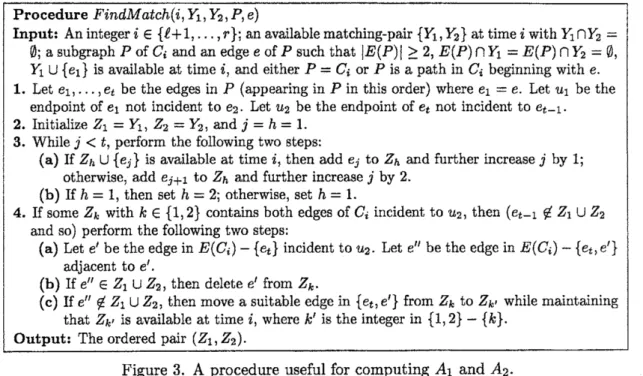
Figure3showsaprocedure useful for computinganavailable matching-pairat time $\mathrm{i}$that
covers
the vertices ofagiven subgraph $P$ of$C_{i}$
.
ProcedureFindMatch(i,$\mathrm{Y}_{1}$,$\mathrm{Y}_{2},$P,e)
Input: Aninteger$\mathrm{i}\in\{l+1, \ldots ,r\}$; anavailablematching-pair $\{\mathrm{Y}_{1}, \mathrm{Y}_{2}\}$ at time$\mathrm{i}$with$\mathrm{Y}_{1}\cap \mathrm{Y}_{2}=$
$\emptyset$; asubgraph$P$of
C.
$\cdot$ andanedge$e$of$P$such that $|E(P)|\geq 2$, $E(P)\cap \mathrm{Y}_{1}=E(P)$$\cap$$\mathrm{Y}=\emptyset$, $\mathrm{Y}_{1}\cup\{e_{1}\}$ isavailable at tlme$\mathrm{i}_{?}$ andeither $P=C_{i}$ or$P$isa pathin$c_{i}$ beginning with$e$.
1. Let $e_{1}$,$\ldots$,$e_{t}$ be the edgesin $P$ (appearing in$P$ inthis order) where $e_{1}=e$. Let $u_{1}$ be the
endpoint of$e_{1}$ not incident to $e_{2}$
.
Let $u_{2}$ be the endpoint of$e_{t}$ not incident to $e_{t-1}$.2. Initialize$Z_{1}=\mathrm{Y}_{1}$, $Z_{2}=\mathrm{Y}_{2}$, and $j=h=1$ .
3. While$i<t$, performthe followingtwo steps:
(a) If$Z_{h}\cup\{ej\}$ is available at time$\mathrm{i}$, then add
$ej$ to$Z_{h}$ and furtherincrease$i$ by 1;
otherwise, add $ej+1$ to $Z_{h}$ and further increase$i$ by 2.
(b) If$h=1$, then set $h=2$; otherwise, set $h=1$
.
4. Ifsome $Z_{k}$ with $k\in\{1,2\}$ containsbothedgesof
Ci
incident to$u_{2}$, then $(e_{t-1}\not\in Z_{1}\cup Z_{2}$and so) performthe followingtwosteps:
(a) Let $e’$ betheedge in$E(C:)-\{e_{\mathrm{t}}\}$ incident to$u_{2}$. Let
$e^{\prime t}$betheedge in
$E(C_{i})-\{\mathrm{e}\mathrm{i}\}$$e’\}$ adjacentto$e’$
.
(b) If$e’\in Z_{1}$ LJ$Z_{2}$, then delete$e’$ from $Z_{k}$
.
(c) If$e’\not\in$ $Z_{1}\cup Z_{2}$, thenmove asuitableedgein $\{e_{t},e’\}$from $Z_{k}$ to $Z_{k’}$ while maintaining
that $Z_{k’}$ is availableat time $\mathrm{i}$, where $k’$ is the integerin $\{1, 2\}-\{k\}$
.
Output: Theorderedpair $(Z_{1}, Z_{2})$.
Figure 3. A procedure useful forcomputing $A_{1}$ and $A_{2}$
.
4.1
Serious
Pairs,Critical
Pairs,and
Dangerous PairsThroughout this subsection, fixa$C_{i}$ with$\ell+1\leq \mathrm{i}\leq r$
.
A seriouspair at $t\acute{\mathrm{z}}me\mathrm{i}$ is an unorderedpair $\{(u\iota,v_{1}), (u_{2}, v_{2})\}$ of$\mathrm{C}\mathrm{i}\cdot-$settled edges satisfying the following condition:
.
At time $\mathrm{i}$,some
connected component of$\mathrm{C}$ is
a
path between$v_{1}$ and $v_{2}$
.
A matching-pair $\{A_{1}, A_{2}\}$ in $C_{i}$ is good for
a
serious pair$p=\{(u_{1}, v_{1}), (u_{2}, v_{2})\}$ at time$\mathrm{i}$ if$\{A_{1},A_{2}\}$satisfies at least one of the following threeconditions:
(G1) For each $h\in\{1, 2\}$, $C_{i}-A_{h}$ has no path from$u_{1}$ to$u_{2}$
or
at leastone
of$u_{1}$ and $u_{2}$has degree 2 in $C_{i}-A_{h}$
.
(G2)
{
$A_{1}$,A2} favors both $u_{1}$ and $u_{2}$.
(G3)
{
$A_{1}$,A2}
favors exactly one of$u_{1}$ and $u_{2}$.
(Note: If this condition is satisfied butCondiion (G1) is not,
we
say that $\{A_{1}, A_{2}\}$ is weakly good for $p.$)A critical pair at time $i$ is a serious pair$p=\{(u_{1}, v_{1}), (u_{2},v_{2})\}$ at time $\mathrm{i}$ such that there is
a path$Q$from $u1$ to $u_{2}$ in $C_{i}$ with $|E(Q)|\leq 3$
.
We call the path $Q$ a witnesspath of the criticalpair$p$
.
A dangerous pair at time$\mathrm{i}$ is
a
critical pair$p=\{(u_{1},v_{1}), (u_{2}, v_{2})\}$ at time$\mathrm{i}$ that has $\mathrm{a}$ witness path$Q$ of length 1 or 3 satisfying the following condition:
.
{
$e_{1}$,
e2}
isan
available set at time$\mathrm{i}$
,
where$e_{1}$ and $e_{2}$
are
thetwo edges in $E(C_{i})-E(Q)$12
4.2
Details
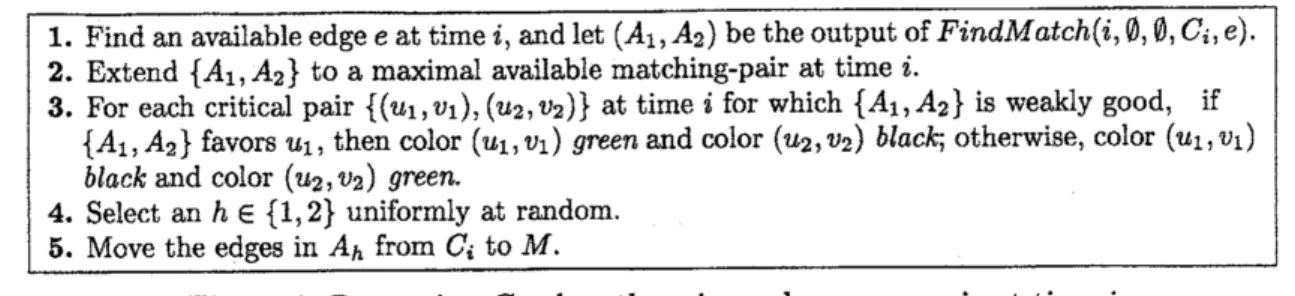
ofProcessing Non-4-CyclesIfthere isnodangerous pairat time$\mathrm{i}_{7}$ thenwe color
no
vertex of$C_{i}$ redand process$C_{:}$ as below: 1. Findanavailable edge$e$attime$\mathrm{i}$, andlet $(A_{1},A_{2})$betheoutputofFindMatch(i,
$\emptyset$,$\emptyset,C:,e$).
2. Extend
{
$A_{1}$,A2}
toamaximal availablematching-pair at time $\mathrm{i}$.
3. For each critical pair $\{(u_{1},v_{1}), (u_{2},v_{2})\}$ at time$\mathrm{i}$ for which $\{A_{1},A_{2}\}$ is weakly good, if
{
$A_{1}$,A2}
favors$u_{1}$, then color $(u_{1},v_{1})$ green and color $(u_{2},v_{2})$ $black_{1}$. otherwise, color $(u_{1}, v_{1})$black and color $(u_{2},v_{2})$ green
4. Select an $h\in\{1,2\}$uniformly at random.
5. Move the edges in $A_{h}$ from $C_{\dot{*}}$to$M$
.
Figure 4. Processing
Ci
when there isno
dangerous pair at time $\mathrm{i}$.
Whenthere is at least
one
dangerous pairat time $\mathrm{i}$,
the processing of$C_{i}$ is verycomplicatedand is omittedhere for lack of space. What we
can
show is the following:Lemma 4.1Let S be the set
of
$C_{i}$-settled edges. Suppose that there is at least one dangerouspair at time i. Then, we can process $C_{i}$
so
that$\mathcal{E}[w(S\cap M_{7}’\rangle]\geq 11w(S)/80$.
5
The Main Result
Suppose that $T$ is a maximum-weighttour of$G$
.
Let $T_{\mathrm{i}\mathrm{n}\mathrm{t}}$ denote the set of all edges $\{u, v\}$ of$T$such that
some
cycle $C$ in $\mathrm{C}$ contains both$u$ and $v$
.
Let $T_{\mathrm{e}\mathrm{x}\mathrm{t}}$ denote the set of edges in$T$ butnot in The. Let $\alpha=w(T_{\mathrm{i}\mathrm{n}\mathrm{t}})/w(T)$
.
By Lemmas3.3 and 4.1, wecan
prove the following:Lemma 5.1 Let$\delta w(T)$ be the expected total weight
of
edges movedfrom
C to M at Step4
or5in Figure 1. Then, $\mathcal{E}[w(T_{2})]\geq(0.5+\delta)w(T)$ and$\mathcal{E}[w(T_{3})]\geq((1-\delta)+\frac{11}{160}(1-\alpha))w(T)$
.
Hassin and Rubinstein [4] show that $w(T1)$ $\geq(1-\epsilon)\alpha w(T)$
.
So, we have:Theorem 5.2 For anyfixed$\epsilon>0$, there isan$O(n^{3})$-time approximation algorithm
for
${\rm Max}$TSPachieving
an
expected approximation ratioof
$\overline{\overline{331-}320\epsilon}251\{1-\epsilon\}$.
References
[1] A. I. Barvinok, D. S. Johnson, G. J. Woeginger, and R. Woodroofe. Finding Maximum
Length Tours under PolyhedralNorms. IPCO\prime g8, LNCS, 1412 (1998) 195-201.
[2] P. Chalasaniand R. Motwani. Approximating Capacitated Routing andDeliveryProblems,
SIAMJournal on Computing, 28 (1999)
2133-2149.
[3] R. Hassin and S. Rubinstein. An Approximation Algorithm for the Maximum Traveling
Salesman Problem.
Information
Processing Letters, 67 (199S) 125-130.[4] R. Hassin and S. Rubinstein.Better Approximations for ${\rm Max}$TSP.
Information
ProcessingLetters, 75 (2000)
181-186.
[5] R. Hassin and S. Rubinstein. A $7/8$-Approximation Approximations for Metric ${\rm Max}$ TSP.
Information
Processing Letters, 81 (2002) 247-251.[6] A. V. Kostochka and A. I. Serdyukov. Polynomial Algorithms with the Estimates $\frac{3}{4}$ and $\frac{5}{6}$
for the Traveling Salesman Problem ofMaximum (inRussian). Upravlyaemye Sistemy, 26
(1985) 55-59.
[7]A. I. Serdyukov. An Algorithm with