Global
structure
of
plane
closed elastic
curves
Murai Minoru(Ryukoku University)
1
Introduction
This is
a
joint work with Waichiro Matsumoto and Shoji Yotsutani(Ryukoku University).
Let$\Gamma$ beapl$\mathfrak{W}1e$closed elastic
curve
with length $2\pi$.
We denotearc-lengthand curvature by $s$ and $\kappa(s)$, respectively. Let $M$ be the signed
area
definedby
$M:= \frac{1}{2}\int_{\Gamma}xdy-ydx,$
where $(x, y)=(x(s), y(s))\in\Gamma$ with $(x(O), y(O))$ $:=(0,0)$
.
Letus
consider thefollowing variational problem $(VP)$:
Find
a curve
$\Gamma$ (the curvature $\kappa(s)$) which minimize $\frac{1}{2}\int_{0}^{2\pi}\kappa(s)^{2}ds$subject to $\pi>M$ and $\omega\pi\neq M$, where $\omega$ is the winding number.
K.
Watanabe
([1, 2])considered
thisvariational
problem $(VP)$ with $\omega=$$1$
.
He derived the Euler-Lagrange equation to $(VP)$ and showed the existenceof the minimizer arid investigate the profile near the disk.
The Euler-Lagrange equation to $(VP)$ is
$(P^{\omega})\{\begin{array}{l}\kappa_{ss}+\frac{1}{2}\kappa^{3}+\mu\kappa-\nu=0, s\in[0,2\pi],\kappa(0)=\kappa(2\pi), \kappa_{s}(0)=\kappa_{s}(2\pi) ,\frac{1}{2\pi}\int_{0}^{2\pi}\kappa(s)ds=\omega,4\mu\pi^{2}+\pi\int_{0}^{2\pi}\kappa(s)^{2}ds\overline{4\pi\omega\mu+\int_{0}^{2\pi}\kappa(s)^{3}ds}=M,\end{array}$
where $\mu$ and $\nu$
are some
constants. We can obtain the following propositionby using the argument of K.Watanabe [1, Lemma 3 and Lemma 4]
Proposition 1.1 Suppose that $\kappa(s)$ is a solution
of
$(P^{\omega})$, then the followingproperties hold:
(i) $\kappa(s)\in C^{\infty}([0,2\pi])$
.
with period $\mathcal{S}=2\pi/m$ and axially symmetric with respect to $s=\pi/m$ and
$m$ denotes the number
of
minimum pointsof
$\kappa(s)$ by normalizing $\kappa(0)$ $:=$$\max_{0\leq s\leq 2\pi}\kappa(s)$
.
(We call this solution $tm$ –mode $\mathcal{S}$olution”
$.$)
Let us normalize $\kappa(s)$
as
$\kappa(0)$ $:= \max_{0\leq s\leq 2\pi}\kappa(s)$.
For $n$-mode solution $\kappa(\mathcal{S})$, we may consider the following differential equation:$(P_{n}^{\omega})\{\begin{array}{ll}\kappa_{ss}+\frac{1}{2}\kappa^{3}+\mu\kappa-\nu=0, s\in[0, \frac{\pi}{n}], (1.1)\kappa_{S}(0)=\kappa_{s}(\frac{\pi}{n})=0, \kappa_{s}(s)<0s\in(0, \frac{\pi}{n}), (1.2)\int_{0}^{\pi/n}\kappa(s)d_{\mathcal{S}}=\frac{\omega\pi}{n}, (1.3)\frac{2\mu\pi^{2}+n\pi\int_{0}^{\pi/n)}\kappa(s)^{2}ds}{2\pi\omega\mu+n\int_{0}^{\pi/n}\kappa(s)^{3}ds}=M. (1.4)\end{array}$
We introduce the followingauxiliary problem. Let $\kappa(s)$ be unknown
func-tion, and $\mu,$ $\nu$ be unknown constants. Find $(\kappa(s), \mu, \nu)$ such that
$(E_{n})\{\begin{array}{ll}\kappa_{SS}+\frac{1}{2}\kappa^{3}+\mu\kappa-\nu=0, s\in[0, \frac{\pi}{n}], (1.5)\kappa_{s}(0)=\kappa_{s}(\frac{\pi}{n})=0, \kappa_{s}(s)<0 for s\in(0, \frac{\pi}{n}) .(1.6)\end{array}$
First we represent all solution $(\kappa(s), \mu, \nu)$ of $(E_{n})$. Next
we
give therepresentation of the constraint (1.3) and (1.4).
We prepare notations to state
our
theorems.Definition 1.1 We
define
the complete elliptic integralof
first, second andthird kind by
$K(k) ;= \int_{0}^{1}\frac{d\xi}{\sqrt{(1-\xi^{2})(1-k^{2}\xi^{2})}},$
$E(k) ;= \int_{0}^{1}\sqrt{\frac{1-k^{2}\xi^{2}}{1-\xi^{2}}}d\xi,$
Definition 1.2
Jacobi’s
sn
function
isdefined
by$z= \int_{0}^{sn(z,k)} d\xi$
$\sqrt{(1-\xi^{2})(1-k^{2}\xi^{2})}$
and Jacobi’s cn
function
isdefined
by$cn(z, k):=\sqrt{1-sn^{2}(z,k)}$
for
$z\in[-K(k), K(k)]$.
These ellipticfunctions
are
extended
to $(-\infty, \infty)$by using the relation
sn
$(z+2K(k), k)=-$sn
$(z, k)$ andcn
$(z+2K(k), k)=$$-cn(z, k)$
.
1.1
Main Result
Theorem 1.1 All solutions $(\kappa(s), \mu, v)$
of
$(E_{n})$are
represented by thefol-lowing (i), (ii) and (iii):
(i) $\kappa(s)=\overline{\kappa}_{n}(s;k, h),$ $\mu=\overline{\mu}_{n}(k, h)$ and $\nu=\overline{\nu}_{n}(k, h)$
for
$(k, h)\in\overline{\Sigma}$, where$\overline{\Sigma} :=\Sigma_{S^{*}}\cup\Sigma_{S}$, (1.7)
$\Sigma_{S^{*}};=\{(k, h);-1<k\leq 0,2<h<3\}$, (1.8) $\Sigma_{S}:=\{(k, h);0\leq k<1,0<h\leq 3-2k^{2}\}$, (1.9)
$\overline{\kappa}_{n}(\mathcal{S};k, h):=\{\begin{array}{l}\kappa_{n}^{s*}(s;k, v(k, h)) for (k, h)\in\Sigma_{S^{*}},\kappa_{n}^{S}(s;k, u(k, h)) for (k, h)\in\Sigma_{S},\end{array}$ (1.10)
$\overline{\mu}_{n}(k, h)$ $;=\{\begin{array}{ll}\mu_{n}^{s*}(k, v(k, h)) for (k, h)\in\Sigma_{S^{*}},\mu_{n}^{s}(k, u(k, h)) for (k, h)\in\Sigma_{S},\end{array}$ (1.11)
and
$\overline{\nu}_{n}(k, h):=\{\begin{array}{l}\nu_{n}^{S^{*}}(k, v(k, h)) for (k, h)\in\Sigma_{S^{*}},\nu_{n}^{\mathcal{S}}(k, u(k, h)) for (k, h)\in\Sigma_{S}.\end{array}$ (1.12)
Here the
functions
$\kappa_{n}^{*}(s;k, v),$ $\mu_{n}^{*}(k, v),$ $\nu_{n}^{*}(k, v)$ and$v(k, h)$ aredefined
by$\kappa_{n}^{S^{*}}(s;k, v):=-\frac{\sqrt{1-v}\sqrt{(1-k^{2})v+1+k^{2}}}{\sqrt{v+1}(2-(1+v)cn^{2}(\frac{n}{\pi}K(k)(\frac{\pi}{n}-s),k))}(\frac{4\sqrt{2}n}{\pi}K(k))$
(1.13)
$\mu_{n}^{S^{*}}(k, v);=(\frac{-3(4-(1-k^{2})(1-v)^{2})^{2}}{(1-v^{2})((1-k^{2})v+1+k^{2})}+8(2-k^{2}))(\frac{n}{2\pi}K(k))^{2}$ (1.14) $\nu_{n}^{S^{*}}(k, v);=\frac{-2\sqrt{2}(4-(1-k^{2})(1-v)^{2})}{(1-v^{2})^{3/2}((1-k^{2})v+1+k^{2})^{3/2}}.$ $((1+v)^{2}((1-k^{2})v+1+k^{2})^{2}-k^{4}(1-v)^{2}))( \frac{n}{2\pi}K(k))^{3}$ (1.15) and $v(k, h)$ $:= \frac{-2+(2-k^{2})(2-h)+\sqrt{(2-k^{2})^{2}(2-h)^{2}+4k^{4}(3-h)}}{2(1-k^{2})}$ (1.16)
and the
functions
$\kappa_{n}(s;k, u),$$\mu_{n}(k, u),$ $v_{n}(k, u)$ and$u(k, h)$ are alsodefined
by$\kappa_{n}^{S}(s;k, u):=-\frac{(1-k^{2})(1-ku)+k((1-k^{2})u+k)cn(\frac{2n}{\pi}K(k)(\frac{\pi}{n}-s),k)}{(1-k^{2})u+k-k(1-ku)cn(\frac{2n}{\pi}K(k)(\frac{\pi}{n}-s)s,k)}.$ $\frac{\sqrt{u}\sqrt{(1-2k^{2})u+2k}}{\sqrt{(1-k^{2})u^{2}+1}}. (\frac{4nK(k)}{\pi})$ $+ \frac{(1-ku)((1-k^{2})u+k)}{\sqrt{u}\sqrt{(1-2k^{2})u+2k}\sqrt{(1-k^{2})u^{2}+1}}(\frac{2nK(k)}{\pi})$, (1.17) $\mu_{n}^{S}(k, u);=(\frac{-3(1-ku)^{2}((1-k^{2})u+k)^{2}}{2u((1-2k^{2})u+2k)((1-k^{2})u^{2}+1)}+1-2k^{2})$ (1.18) $( \frac{2nK(k)}{\pi})^{2}$ $v_{n}^{S}(k, u);= \frac{-(1-ku)((1-k^{2})u+k)}{4u^{3/2}((1-2k^{2})u+2k)^{3/2}((1-k^{2})u^{2}+1)^{3/2}}.$ $(4k^{2}((1-k^{2})u^{2}+1)^{2}+(1-k^{2})u^{2}((1-2k^{2})u+2k)^{2})$
.
(1.19) $( \frac{2nK(k)}{\pi})^{3}$ and $u(k, h);= \frac{1}{4k(1-k^{2})}\cdot(2-h+$ $\frac{(1-2k^{2})((2-h)^{2}+16k^{2}(1-k^{2}))}{8k^{2}(1-k^{2})+\sqrt{(1-2k^{2})^{2}(2-h)^{2}+16k^{2}(1-k^{2})}})$ (1.20)$(i_{j}i)\kappa(s)=\underline{\kappa}_{n}(s;k, h),\mu=\underline{\mu}_{n}(k, h)$ and $v=\underline{\nu}_{n}(k, h)$
for
$(k, h)\in\underline{\Sigma}$, where$\underline{\Sigma} :=\Sigma_{R^{*}}\cup\Sigma_{R}$, (1.21)
$\Sigma_{R}\cdot;=\{(k, h);-1<k\leq 0, -3<h<-2\}$, (1.22) $\Sigma_{R}:=\{(k, h);0\leq k<1,2k^{2}-3\leq h<0\}$
.
(1.23)Here
$\underline{\kappa}_{n}(s;k, h):=-\overline{\kappa}_{n}(\frac{\pi}{n}-s, k, -h)$ ,
(1.24)
$\underline{\mu}_{n}(k, h) :=\overline{\mu}_{n}(k, -h) , \underline{\nu}_{n}(k, h) :=-\overline{\nu}_{n}(k, -h)$
.
(iii) $\kappa(s)=\overline{\kappa}_{n}(s;k, h),\mu=\overline{\mu}_{n}(k, h)$ and $\nu=\overline{\nu}_{n}(k, h)$
for
$(k, h)\in\Sigma_{0}$, where $\Sigma_{0};=\{(k, h);0<k<1, h=0\}$.
(1.25)Here
$\overline{\kappa}_{n}(s;k, h)=\frac{4nkK(k)}{\pi}cn(\frac{2n}{\pi}K(k)s, k)$ ,
$\overline{\mu}_{n}(k, h)=(1-2k^{2})(\frac{2nK(k)}{\pi})^{2}, \overline{v}_{n}(k, h)=0.$
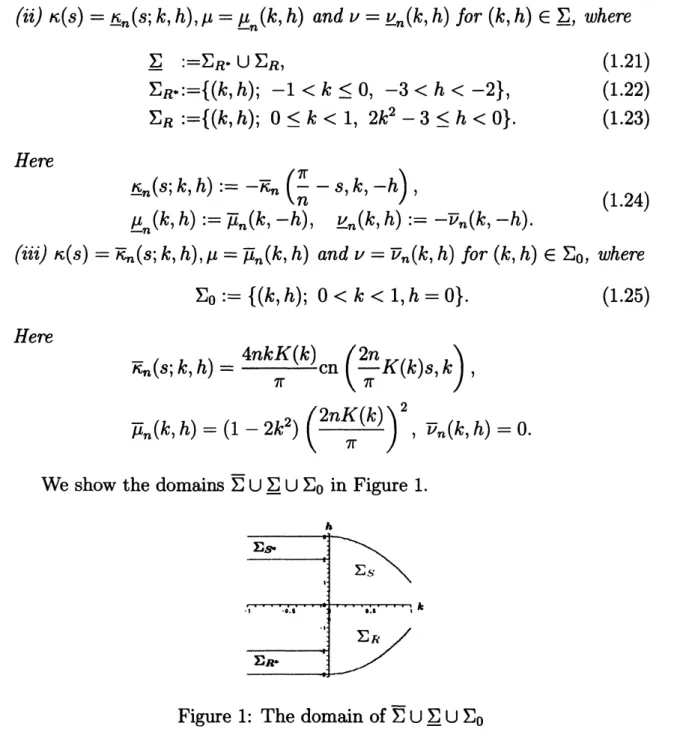
We show the domains $\overline{\Sigma}\cup\underline{\Sigma}\cup\Sigma_{0}$ in Figure 1.
Figure 1: The domain of$\overline{\Sigma}\cup\underline{\Sigma}\cup\Sigma_{0}$
Remark 1.1 It is
more
useful
by using the parameter $(k, u)$ and $(k, v)$ than$(k, h)$
.
Letus
set$\Sigma_{v};=\{(k, v);-1<k\leq 0, -1<v<1/k\}$, (1.26)
$\Sigma_{u};=\{(k, u);0<k<1,0<u<1/k\}$
.
(1.27)Then thefolloutng (i), (ii),(iii) and (iv) hold:
(i) Changing the parameters
from
$(k, h)$ to $(k, v)$ by $k=k$ and $v=v(k, h)$,(ii) Changing the parameter
from
$(k, h)$ to $(k, u)$ by $k=k$ and $u=u(k, h)$,$\Sigma_{S}become\mathcal{S}\Sigma_{u}.$
(iii) Changing the pammeter
from
$(k, h)$ to $(k, u)$ by $k=k$ and$u=u(k, -h)$,$\Sigma_{R}$ becomes $\Sigma_{u}.$
(iv) Changing the pammeter
from
$(k, h)$ to $(k, v)$ by $k=k$ and$v=v(k, -h)$,$\Sigma_{R^{*}}$ becomes $\Sigma_{v}.$
We note that all changing the pammeters
are
bijective.We show the domains $\Sigma_{v}$ arid $\Sigma_{u}$ in Figure 2.
Figure 2: The domains $\Sigma_{v}$ and $\Sigma_{u}$
Theorem 1.2 Let $\kappa(s)$ be given by Theorem 1.1 and
$Z(k, h);= \int_{0}^{\pi/n}\kappa(s)ds.$
Then $Z(k, h)$ is given by the following $(i)_{f}(ii)$ and (iii):
(i) $Z(k, h)=\overline{Z}(k, h)for(k, h)\in\overline{\Sigma}$, where
$\overline{Z}(k, h):=\{\begin{array}{l}Z^{S^{*}}(k, v(k, h)) for (k, h)\in\Sigma_{S^{*}},Z^{S}(k, u(k, h)) for (k, h)\in\Sigma_{S}.\end{array}$
Here the
function
$Z^{S^{*}}(k, v)\iota s$defined
by$Z^{S^{*}}(k, v):= \frac{Z_{\infty}^{*}(k,v)}{Z_{0}^{*}(k,v)}$, (1.28)
$Z_{\infty}^{*}(k, v):=((1-k^{2})(1+v)(3-v)+4k^{2}v)K(k)$ (1.29) $-4(1-k^{2})(1-v^{2}) \Pi(\frac{1}{2}(1-k^{2})(1-v)-1, k)$ ,
and the
function
$Z^{s}(k, u)$ is alsodefined
by $Z^{s}(k, u):= \frac{2((1-k^{2})u+k)Z_{\infty}(k,u)}{Z_{0}(k,u)}$, (1.31) $Z_{\infty}(k, u):=(2(1-k^{2})u^{2}+2-(1-ku)^{2})K(k)$ (1.32) $-2((1-k^{2})u^{2}+1) \Pi(\frac{k^{2}(1-ku)^{2}}{u((1-2k^{2})u+2k)}, k)$ , $Z_{0}(k, u)$ $:=(1-ku)\sqrt{u}\sqrt{(1-2k^{2})u+2k}\sqrt{(1-k^{2})u^{2}+1}$.
(1.33) (1.34) (ii) $Z(k, h)=\underline{Z}(k, h)$for
$(k, h)\in\underline{\Sigma}$, where$\underline{Z}(k, h) :=-\overline{Z}(k, -h)$
.
(iii) $Z(k, h)=0$
for
$(k, h)\in\Sigma_{0}.$The relation $Z(k, h)$ is represented by twoforms$\overline{Z}(k, h)$ and$\underline{Z}(k, h)$
.
The$curvesofZ(k, h)=$ inthecase $\omega=0$ inFigure 3
$relationZ(k, h)=\frac{\omega\pi}{n,0}isequiva1$entto ($1.3).$ Forexample,
we
show the levelFigure 3: The level
curves
of $Z(k, h)=0$Theorem 1.3 Let $\kappa(s)$ be given by Theorem 1.1 and
Then $\mathcal{E}_{n}(k, h)$ is given by the following (i), (ii) and (iii):
(i) $\mathcal{E}_{n}(k, h)=\overline{\mathcal{E}}_{n}(k, h)$
for
$(k, h)\in\overline{\Sigma}$, where$\overline{\mathcal{E}}_{n}(k, h):=\{\begin{array}{l}\mathcal{E}_{n}^{s*}(k, v(k, h)) for (k, h)\in\Sigma_{S^{*}},\mathcal{E}_{n}^{s}(k, u(k, h)) for (k, h)\in\Sigma_{S}.\end{array}$ (1.35)
Here the
function
$\mathcal{E}_{n}^{s*}(k, v)$ isdefined
by$\mathcal{E}_{n}^{s*}(k, v):=\frac{2n^{2}}{\pi}K(k)$.
$(( \frac{(4-(1-k^{2})(1-v)^{2})^{2}}{(1-v^{2})((1-k^{2})v+k^{2}+1)}+8k^{2}-16)K(k)+16E(k))$
(1.36)
and the
function
$\mathcal{E}_{n}^{S}(k, u)$ is alsodefined
by$\mathcal{E}_{n}^{S}(k, u):=\frac{4n^{2}}{\pi}K(k)$
.
$( \frac{(1-ku)^{2}((1-k^{2})u+k)^{2}K(k)}{u((1-2k^{2})u+2k)((1-k^{2})u^{2}+1)}-4((1-k^{2})K(k)-E(k)))$
.
(1.37)
(ii) $\mathcal{E}_{n}(k, h)=\underline{\mathcal{E}}_{n}(k, h)$
for
$(k, h)\in\underline{\Sigma}$, where$\underline{\mathcal{E}}_{n}(k, h):=\overline{\mathcal{E}}_{n}(k, -h)$
.
(iii) $\mathcal{E}_{n}(k, h)=\overline{\mathcal{E}}_{n}(k, h)$
for
$(k, h)\in\Sigma_{0}$, where$\overline{\mathcal{E}}_{n}(k, h)=\frac{-16n^{2}}{\pi}K(k)\cdot((1-k^{2})K(k)-E(k))$
.
Theorem 1.4 Let $(\kappa(s), \mu, \nu)$ be given by Theorem 1.1 with (1.3) and $h\neq 0$
and
$M_{n}(k, h):= \frac{2\mu\pi^{2}+n\pi\int_{0}^{\pi/n)}\kappa(s)^{2}ds}{2\pi\omega\mu+n\int_{0}^{\pi/n}\kappa(s)^{3}ds}.$
Then $M_{n}(k, h)$ is given by the following (i) and (ii):
(i) $M_{n}(k, h)=\overline{M}_{n}(k, h)$
for
$(k, h)\in\overline{\Sigma}$, whereHere the
function
$M_{n}^{s*}(k, v)$ isdefined
by $\underline{M}_{n}^{s}.(k, v):=\frac{\sqrt{2}\pi^{2}}{n}\cdot\frac{\sqrt{1-v^{2}}\sqrt{(1-k^{2})v+k^{2}+1}}{((1-k)v+1+k)}\cdot\frac{\varphi_{1}(k,v)}{\varphi_{2}(k,v)}\cdot\frac{1}{K(k)^{2}},$ $(1.39)$ $\varphi_{1}(k, v)$ $:=(-(1-k^{2})(1-v)^{2}+4)^{2}K(k)$ (1.40) $-8(1-v^{2})((1-k^{2})v+k^{2}+1)E(k)$, $\varphi_{2}(k, v)$ $:=((1+k)v+1-k)((1-k^{2})(v+1)^{2}+4k^{2})$.
(1.41) $(-(1-k^{2})(1-v)^{2}+4)$and the
function
$M_{n}^{S}(k, u)$ is alsodefined
by$M_{n}^{s}(k, u):= \frac{-\pi^{2}}{2n}\cdot\frac{\sqrt{u}\sqrt{(1-k^{2})u^{2}+1}\sqrt{(1-2k^{2})u+2k}}{(1-ku)((1-k^{2})u+k)}\cdot\frac{\varphi_{3}(k,u)}{\varphi_{4}(k,u)}\cdot\frac{1}{K(k)^{2}},$
(1.42)
$\varphi_{3}(k, u)$ $:=-((1-ku)^{2}((1-k^{2})u+k)^{2}$ (1.43)
$+u((1-2k^{2})u+2k)((1-k^{2})u^{2}+1))K(k)$ $+2u((1-2k^{2})u+2k)((1-k^{2})u^{2}+1)E(k)$,
$\varphi_{4}(k, u)$ $:=k^{2}(1-ku)^{2}((1-k^{2})u^{2}+1)$ (1.44)
$+u((1-2k^{2})u+2k)((1-k^{2})u+k)^{2}$
(ii) $M_{n}(k, h)=\underline{M}_{n}(k, h)$
for
$(k, h)\in\underline{\Sigma}_{f}$ where$\underline{M}_{n}(k, h)=-\overline{M}_{n}(k, -h)$
.
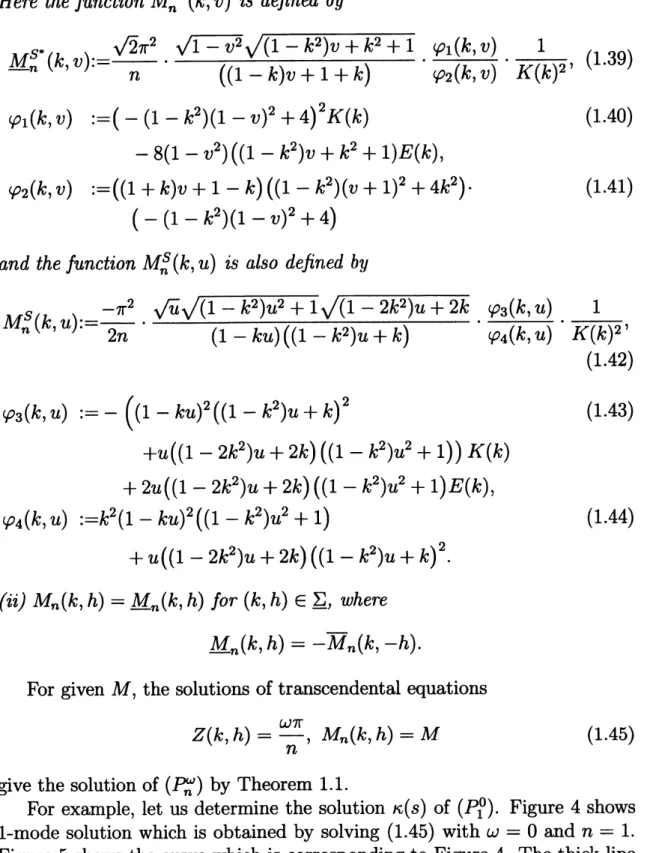
For given $M$, the solutions of transcendental equations
$Z(k, h)= \frac{\omega\pi}{n}, M_{n}(k, h)=M$ (1.45)
give the solution of $(P_{n}^{\omega})$ by Theorem 1.1.
For example, let
us
determine the solution $\kappa(s)$ of $(P_{1}^{0})$.
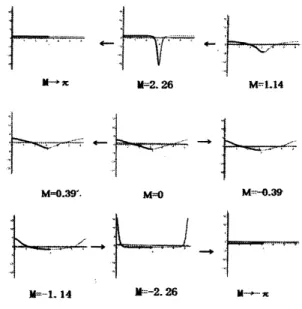
Figure 4 shows1-mode solution which is obtained by solving (1.45) with $\omega=0$ and $n=1.$
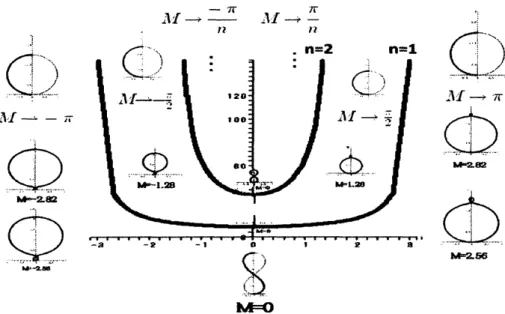
Figure 5 shows the
curve
which is corresponding to Figure 4. The thick-line$hI=0.\Re’. M\triangleleft$ $M^{--}\triangleleft.\theta 9$
$r\Rightarrow 1.14$ $M$–2.26 $\mathfrak{U}\cdot\cdotarrow-\pi$
Figure 4: Curvatures of 1-mode solution for $\omega=0$
$\mapsto\pi raz\epsilon u_{-\backslash }l.14$
$M^{z}4.3y. u\triangleleft *\cdots O.\theta 9$
u–1.14 r-r-2.ffl $I^{\ovalbox{\tt\small REJECT}}arrow-\pi$
Figure 5: Curves of 1-mode solution for $\omega=0$
We note that the other
curves
are not closed except for $k=k_{0}$ with $h=0$in Theorem 1.1, where $k_{0}$ is the unique solution of
$2E(k)-K(k)=0(0<$
$C_{\sim}^{\backslash }f_{-\cdot\vee}\prime\backslash :_{\grave{L}^{-\mathfrak{i}}}$
maae
aes
$rs\infty$
Figure 6: Energy
curves
ofstationary solutions for $\omega=0$Figure 6 shows the energy
curves
of stationary solutions for $\omega=0$ whichare
obtained from the equation (1.45) and Theorem1.3.
Investigating the global structure, we obtain the following theorems.
Theorem 1.5 Let $\omega=0$ and $n\geq 1$
.
Then, there existsa
unique $n$-modesolution $\kappa(s)=\kappa_{n}(s;M)$
of
$(P_{n}^{0})for- \frac{\pi}{n}<M<\frac{\pi}{n}.$ $\mathbb{R}$rther there existsno
solution
for
$M \leq-\frac{\pi}{n},$ $\frac{\pi}{n}\leq M.$Theorem 1.6 Let$\omega=0$ and$n\geq 1$ Then, there exists
a
unique minimizer$\kappa(s)=\kappa(s;M)for-\pi<M<\pi$ with the normalizing condition $\kappa(0)$ $:=$
$\max_{0\leq s\leq 2\pi}\kappa(\mathcal{S})$. This minimizer is 1-mode solution.
Theorem
1.7
Let $\omega=0$ and $n\geq 1$.
Then, the $n$-mode solution $\kappa(s)=$$\kappa_{n}(\mathcal{S};M)$
of
$(P_{n}^{0})$ with property $\kappa(0)$ $:= \max_{0\leq s\leq\pi/n}\kappa(s)$for
$0\leq s\leq\pi/n$satisfies
the following relations:(i) $\lim_{M\uparrow\frac{\pi}{n}}\kappa_{n}(s;M)=\{\begin{array}{ll}n for s\in[0, \frac{\pi}{n}) , uniformaly in [0, \frac{\pi}{n})-\infty f\alpha rs=\frac{\pi}{n}.\end{array}$
Inthis paper,
we
show theproofof Theorem 1.1. We need longcalculationto obtain Theorem 1.$2\sim 1.7$
.
The complete proofs of them will appear in aforthcoming papers.
This kind of method
was
first proposed by $Lou-Ni-Yotsut_{M1}i[5]$.
Later,Ikeda-Kondo-Okamoto-Yotsutani
[3] and Kosugi-Morita-Yotsutani [4]devel-oped the method.
2
Proof
of Theorem 1.1
We rewrite $(E_{n})$ as first order differential equation to find the solution
$\kappa(s)$
.
Let
us
set$\kappa(0):=\alpha, \kappa(\frac{L}{2n}):=\beta(\alpha>0, \alpha>\beta)$.
Multiplying $2\kappa_{S}$ to $(E_{n})$,
we
have$\frac{d}{ds}(\frac{d\kappa}{ds})^{2}=\frac{d}{ds}(-\frac{1}{4}\kappa^{4}-\mu\kappa^{2}+2\nu\kappa)$
Integrating above equation on $[0, s]$, we obtain
$\frac{d\kappa}{ds}=-\sqrt{\tilde{g}(\kappa)}$, (2.1)
where
$\tilde{g}(\kappa)=-\frac{1}{4}\kappa^{4}-\mu\kappa^{2}+2\nu\kappa+\frac{1}{4}\alpha^{4}+\mu\alpha^{2}-2v\alpha$. (2.2)
By the Neumann boundary condition of $(E_{n})$,
we can
rewrite $\tilde{g}(\kappa)$as
$\tilde{g}(\kappa)=\frac{1}{4}(\alpha-\kappa)(\kappa-\beta)((\kappa+\frac{\alpha+\beta}{2})^{2}+4\delta)$ , (2.3)
where $\delta$ is some
constarlt. Comparing the coefficients of (2.2) with that of
(2.3), we obtain
$\mu = \frac{-1}{8}(3(\alpha+\beta)^{2}-\frac{1}{2}(3\alpha+\beta)(\alpha+3\beta)-8\delta)$ ,
$\nu= \frac{1}{32}(\alpha+\beta)((\alpha-\beta)^{2}+16\delta)$
.
Let us set
Then $\mu$ and $\nu$
are
represented by$\mu = \frac{-1}{8}(3(A+B)^{2}-8(AB+\delta))$,
(2.4)
$\nu= \frac{1}{8}(A+B)((A-B)^{2}+\delta)$
.
Further, let
us
set$\hat{\kappa}:=\frac{1}{2}(\kappa+\frac{A+B}{2})$ (2.5) Then (2.1) is represented by $\frac{d\hat{\kappa}}{ds}=-\sqrt{\hat{g}(\hat{\kappa})},$ $\hat{\kappa}(0)=A,\hat{\kappa}(\frac{L}{2n})=B,$ (2.6) where $\hat{g}(\hat{\kappa})=(A-\hat{\kappa})(\hat{\kappa}-B)(\hat{\kappa}^{2}+\delta)$
.
(2.7)We need to consider the following five
cases
in (2.6):($i$) $A+B<0,$ $\delta\leq 0,$
(ii) $A+B<0,$ $\delta>0,$
(iii) $A+B>0,$ $\delta>0,$
(iv) $A+B>0,$ $\delta\leq 0,$
(v) $A+B=0.$
After the proofof Theorem 1.1, we obtain the following five equivalent
rela-tions:
($i$) $A+B<0,$ $\delta\leq 0\Leftrightarrow\Sigma_{S}\cdot,$
(ii) $A+B<0,$ $\delta>0\Leftrightarrow\Sigma_{S},$
(iii) $A+B>0,$ $\delta>0\Leftrightarrow\Sigma_{R},$
(iv) $A+B>0,$ $\delta\leq 0,$ $\Leftrightarrow\Sigma_{R}\cdot,$
($v$) $A+B=0,$$\delta\geq 0\Leftrightarrow\Sigma_{0},$
where $\Sigma_{S^{*}},$ $\Sigma_{S},$ $\Sigma_{R^{*}},$ $\Sigma_{R}$ arld $\Sigma_{0}$
are
given by (1.8), (1.9), (1.22), (1.23) and(1.25), respectively.
We notethat there exists no solution for $A+B=0,$ $\delta<0$
.
We also notethat if $(\kappa(s),\mu, v)$ is a solution of $(E_{n})$, then $(-\kappa(\pi/n-s), \mu, -\nu)$ is also the
solution of $(E_{n})$ by (2.1) and (2.3). Hence if
we
have the solutions of $(E_{n})$ inthe
case
of (i) and (ii), then we also obtain the solutions of $(E_{n})$ in thecase
2.1
Representation of solutions for
$A+B<0,$
$\delta\leq 0$Lemma 2.1 Suppose that $A+B<0$ and$\delta\leq 0$ in (2.6). Then the solution
$\kappa(s)$
of
$(E_{n})$ is represented by$\kappa(s)=\kappa_{n}^{S^{*}}(s;A, B, \eta):=2\hat{\kappa}_{n}^{S^{*}}(s;A, B, \eta)-\frac{A+B}{2}+2\eta$, (2.8)
where $\eta$ $:=\sqrt{-\delta}$ and
$\hat{\kappa}_{n}^{S^{*}}(s;A, B, \eta):=\frac{(A-\eta)(B-\eta)}{B-\eta+(A-B)cn^{2}(\frac{n}{\pi}K(k)(\frac{\pi}{n}-s),k)}$. (2.9)
Moreover it holds that
$\sqrt{(A-\eta)(B+\eta)}=\frac{2n}{\pi}K(k)$ (2.10)
with
$k=-\sqrt{\frac{2\eta(A-B)}{(A-\eta)(B+\eta)}}$
.
(2.11)Proof. Under the condition that $A+B<0$ and $\delta=-\eta^{2}\leq 0(\eta\geq 0)$, we
have
$B<A\leq-\eta\leq 0\leq\eta,$
since
$A>B$
and (2.7) is positive on the interval $(B, A)$. Now we show$A\neq-\sqrt{-\delta}$
.
Assume that $A=-\sqrt{-\delta}<0$.
Then, substituting $\hat{\kappa}=A-1/\xi$into (2.6), we have $\frac{L}{2n}$ $=$ $\int_{B}^{A}\frac{d\hat{\kappa}}{(A-\hat{\kappa})\sqrt{-(\hat{\kappa}-B)(\hat{\kappa}+A)}}$ $= \frac{1}{\sqrt{-2A(A-B)}}\int_{1/(A-B)}^{\infty}\overline{\sqrt{(\xi-)(\xi-\frac{1}{2A})}}$ $= \frac{1}{\sqrt{-2A(A-B)}}[2\log|\sqrt{\xi-\frac{1}{A-B}}+\sqrt{\xi-\frac{1}{2A}}|]_{1/(A-B)}^{\infty}$ $=$ $\infty.$
This is
a
contradiction. In thesame
way,we
obtainin the
case
$A=-\sqrt{\eta}=0$.
This is also contradiction. Thus it holds that $B<A<-\eta\leq 0\leq\eta$.
(2.12) Letus
set $\hat{\kappa}(s)=\frac{1}{\tilde{\kappa}(s)}+\eta$. (2.13) Then (2.6) becomes $\frac{d\tilde{\kappa}}{ds}=\sqrt{(A-\eta)(B-\eta)}\sqrt{(\tilde{\kappa}-\frac{1}{A-\eta})(\frac{1}{B-\eta}-\tilde{\kappa})(2\eta\tilde{\kappa}+1)}.$Further
we
introduce change ofvariable $\tilde{\kappa}$to $\varphi$ by
$\tilde{\kappa}(s)=\frac{1}{B-\eta}-(\frac{1}{B-\eta}-\frac{1}{A-\eta})\sin^{2}\varphi(s)$
for
$\varphi(s)\in[0,$ $\frac{\pi}{2}]$ (2.14) We obtain$\frac{d\varphi}{ds}=\frac{-1}{2}\sqrt{(A-\eta)(B+\eta)}\sqrt{1-k^{2}\sin^{2}\varphi}.$
Integrating the above equation on $[0, s]$, we have
$\frac{\sqrt{(A-\eta)(B+\eta)}}{2}s=K(k)-\int_{0}^{\varphi(s)}\sqrt{1-k^{2}\sin^{2}\varphi’}d\varphi$ (2.15)
since $\varphi(0)=\pi/2$
.
At $s=\pi/n$, we obtain (2.10) by $\varphi(\pi/n)=0.$Substituting (2. 10) and $\xi=\sin\varphi$ into (2. 15),
we
have$\sin(\varphi(s))=$
sn
$( \frac{n}{\pi}K(k)(\frac{\pi}{n}-s),$$k)$ ,which implies that
$\tilde{\kappa}(s)$ $=$ $\frac{1}{A-\eta}+(\frac{1}{B-\eta}-\frac{1}{A-\eta})cn^{2}(\frac{n}{\pi}K(k)(\frac{\pi}{n}-\mathcal{S}),$$k)$
.
(2.16)On the other hand, it follows from (2.5) and (2.13) that
we
have$\kappa(s)=2\hat{\kappa}(s)-\frac{A+B}{2}=\frac{2}{\tilde{\kappa}(s)}-\frac{A+B}{2}+2\eta.$
2.2
Representation of solutions for
$A+B<0,$
$\delta>0$Lemma 2.2 Suppose that $A+B<0,$$\delta>0$ in (2.6). Then the $\mathcal{S}$olution
of
$\kappa(s)$
of
$(E_{n})$ is represented by$\kappa(s)=\kappa_{n}^{S}(s;A, B, \delta):=2\hat{\kappa}_{n}^{S}(s;A, B, \delta)-\frac{A+B}{2}$, (2.17)
where
$\hat{\kappa}_{n}^{S}(s;A, B, \delta):=$
$\frac{AB_{\delta}+A_{\delta}B-(AB_{\delta}-A_{\delta}B)cn(\frac{2n}{\pi}K(k)(\frac{\pi}{n}-s),k)}{A_{\delta}+B_{\delta}+(A_{\delta}-B_{\delta})cn(\frac{2n}{\pi}K(k)(\frac{\pi}{n}-s),k)}$, (2.18)
$A_{\delta}:=\sqrt{A^{2}+\delta}, B_{\delta}:=\sqrt{B^{2}+\delta}$. (2.19)
Moreover it holds that
$\sqrt{A_{\delta}B_{\delta}}=\frac{2n}{\pi}K(k)$ (2.20)
with
$k= \sqrt{}\frac{1}{2}(1-\frac{AB+\delta}{A_{\delta}B_{\delta}})$
.
(2.21)Proof.
Let us set$\hat{\kappa}(s)=\frac{1}{\tilde{\kappa}(s)}+B$. (2.22)
Then (2.6) becomes
$\frac{d\tilde{\kappa}}{ds}=B_{\delta}\sqrt{A-B}\sqrt{(\tilde{\kappa}-\frac{1}{A-B})(\tilde{\kappa}^{2}+\frac{2B}{B_{\delta}^{2}}\tilde{\kappa}+\frac{1}{B_{\delta}^{2}})}.$
Further we introduce change of variable $\tilde{\kappa}$
to $\varphi$ by
$\tilde{\kappa}(s)=\frac{1}{A-B}(1+\frac{A_{\delta}}{B_{\delta}}\tan^{2}\frac{\varphi(s)}{2})$ , (2.23)
where $\varphi(\mathcal{S})\in[0, \pi]$
.
We get$\frac{A_{\delta}}{(A-B)B_{\delta}}\tan\frac{\varphi}{2}(1+\tan^{2}\frac{\varphi}{2})\frac{d\varphi}{ds}$
$= \sqrt{A_{\delta}B_{\delta}}\cdot\frac{A_{\delta}}{(A-B)B_{\delta}}\tan\frac{\varphi}{2}\sqrt{1+\tan^{4}\frac{\varphi}{2}+2\frac{AB+\delta}{A_{\delta}B_{\delta}}\tan^{2}\frac{\varphi}{2}}$
$= \sqrt{A_{\delta}B_{\delta}}\cdot\frac{A_{\delta}}{(A-B)B_{\delta}}\cdot\tan\frac{\varphi}{2}\sqrt{(1+\tan^{2}\frac{\varphi}{2})^{2}-4k^{2}\tan^{2}\frac{\varphi}{2}}$
Thus
we
obtain$\frac{d\varphi}{ds}=\sqrt{A_{\delta}B_{\delta}}\sqrt{1-k^{2}\sin^{2}\varphi}.$
Integrating the above equation on $[0, \mathcal{S}]$, we have
$\sqrt{A_{\delta}B_{\delta}}s=\int_{0}^{\varphi(s)} d\varphi$ (2.24)
$\sqrt{1-k^{2}\sin^{2}\varphi}$
by $\varphi(0)=0$. At $s=\pi/n$, we have (2.20) by $\varphi(\pi/n)=\pi.$
Substituting (2.20) and $\xi=\sin\varphi$ into (2.24),
we
obtain$\sin\varphi(s)=$ sn $( \frac{2n}{\pi}K(k)s,$$k)$ ,
which implies that
$\cos(\varphi(s))=cn(\frac{2n}{\pi}K(k)s, k)$
Thus we have
$\tan^{2}\frac{\varphi(s)}{2}=\frac{1-\cos\varphi(s)}{1+\cos\varphi(s)}=\frac{1-cn(\frac{2n}{\pi}K(k)s,k)}{1+cn(\frac{2n}{\pi}K(k)s,k)}.$
Substituting above relation into (2.23), $\tilde{\kappa}(s)$ becomes
$\tilde{\kappa}(s) = \frac{A_{\delta}+B_{\delta}-(A_{\delta}-B_{\delta})cn(\frac{2n}{\pi}K(k)s,k)}{(A-B)B_{\delta}(1+cn(\frac{2n}{\pi}K(k)s,k))}$
.
(2.25)On the other hand,
we
obtain$\kappa(s)=2\hat{\kappa}(s)-\frac{A+B}{2}=2(\frac{1}{\tilde{\kappa}(s)}+B)-\frac{A+B}{2}$
by (2.5) and (2.22). Thus, substituting (2.25) into above relation, we obtain
(2.17) since
cn
$( \frac{2n}{\pi}K(k)s,$$k)=- cn(\frac{2n}{\pi}K(k)(\frac{\pi}{n}-s),$ $k)$2.3
Change of parameters for
$A+B<0,$
$\delta\leq 0$Let
us
consider thecase
$A+B<0,$$\delta\leq 0$. It is difficult forus
to investigatethe global structure by using the parameters $A,$ $B$ and $\eta$ $:=\sqrt{-\delta}.$ $A$ and
$B$ belong to serm-infinite interval arld
$\eta$ is constrained by (2.20) and (2.21).
Thus
we
change the parameter.Let
us see
$(k,\tilde{h})$ be known and $A,$ $B$ and$\eta$ be the solutions of the system of
$\{\begin{array}{ll}k^{2}=\frac{2r\int(A-B)}{(A-\eta)(B+\eta)}, (2.26)\sqrt{(A-\eta)(B+\eta)}=\frac{2n}{\pi}K(k) , (2.27)A=(1-\tilde{h})B(0<\tilde{h}<2) .(2.28)\end{array}$
Then we obtain the following lemma:
Lemma 2.3 Suppose that
$A+B<0$
and $\delta\leq 0$.
Then $A,$ $B$ and $\eta$are
represented by
$A = - \frac{((1-k^{2})v+1)\sqrt{1-v}}{\sqrt{2}\sqrt{v+1}\sqrt{(1-k^{2})v+k^{2}+1}}\cdot(\frac{2n}{\pi}K(k))$,
$B = - \frac{(2-k^{2})v+k^{2}+2}{\sqrt{2}\sqrt{1-v^{2}}\sqrt{(1-k^{2})v+k^{2}+1}}\cdot(\frac{2n}{\pi}K(k))$, (2.29)
$\eta = \frac{k^{2}\sqrt{1-v}}{\sqrt{2}\sqrt{1+v}\sqrt{(1-k^{2})v+k^{2}+1}}. (\frac{2n}{\pi}K(k))$
and $v=v(k, h)$
for
$(k, h)\in\Sigma_{S^{*}}$, where $\Sigma_{S^{*}}$ and $v(k, h)$ are $def\dot{\ddagger}ned$ by (1.8)and (1.16), respectively.
Proof.
It follows from (2.26),(2.27) and (2.28) thatwe
obtain$\eta=\frac{-k^{2}}{2\tilde{h}B}(\frac{2n}{\pi}K(k))^{2}$ (2.30)
Substituting (2.28) and (2.30) into (2.27), we have
$(1- \tilde{h})B^{4}-\frac{1}{2}(2-k^{2})(\frac{2n}{\pi}K(k))^{2}B^{2}-\frac{k^{4}}{4h^{2}}(\frac{2n}{\pi}K(k))^{4}=0.$
If $\tilde{h}\geq 1$, then the left hand
side of above equation is negative. Thus, we may
consider
$0<h<1$
. Solving the above equation with respect to $B$, we obtain$A=-(1- \tilde{h})\xi(\frac{2n}{\pi}K(k)), B=-\xi(\frac{2n}{\pi}K(k))$ ,
(2.31)
since $B<0$, where
$\xi:=\frac{\sqrt{(2-k^{2})\tilde{h}+\sqrt{(2-k^{2})^{2}\tilde{h}^{2}+4k^{4}(1-\tilde{h})}}}{2\sqrt{\tilde{h}}\sqrt{1-\tilde{h}}}$
for
$(k,\tilde{h})\in\{(k,\tilde{h});0<k<1,0<\tilde{h}<1\}.$To simplify the representation,
we
set$v= \frac{-2+(2-k^{2})\tilde{h}+\sqrt{(2-k^{2})^{2}\tilde{h}^{2}+4k^{4}(1-\tilde{h})}}{2(1-k^{2})},$
which implies that
$2(1-k^{2})v+2-(2-k^{2})\tilde{h}=\sqrt{(2-k^{2})^{2}\tilde{h}^{2}+4k^{4}(1-\tilde{h})}$
.
(2.32)Solving (2.32) with respect to $\tilde{h}$
yields
$\tilde{h}=\frac{(v+1)((1-k^{2})v+k^{2}+1)}{(2-k^{2})v+k^{2}+2}.$
Hence
we
have$(2-k^{2})\tilde{h}+\sqrt{(2-k^{2})^{2}\tilde{h}^{2}+4k^{4}(1-\tilde{h})}=2(1-k^{2})v+2,$
$1- \tilde{h}=\frac{(1-v)((1-k^{2})v+1)}{(2-k^{2})v+k^{2}+2}$
by (2.32). Thus $\xi$ becomes
$\xi=\frac{(2-k^{2})v+k^{2}+2}{\sqrt{2}\sqrt{1-v^{2}}\sqrt{(1-k^{2})v+k^{2}+1}}.$
Substituting $h=\tilde{h}+2$ and above relation into (2.31), the lemma holds. $\square$
2.4
Change
of
parameters
for
$A+B<0,$
$\delta>0$Let us consider the case $A+B<0,$$\delta>0$
.
It is also difficult for us toinvestigate the global structure by using the parameters $A,$ $B$ and $\delta$
.
ThusLet $(k,\tilde{h})$ be known and $A,$ $B$ and $\delta$ be the solutions of the system of
$\{\begin{array}{ll}k^{2}=\frac{1}{2}(1-\frac{AB+\delta}{\sqrt{(A^{2}+\delta)(B^{2}+\delta)}}) , (2.33)\sqrt[4]{(A^{2}+\delta)(B^{2}+\delta)}=\frac{2n}{\pi}K(k) , (2.34)A=(1-\tilde{h})B(0<\tilde{h}<2) .(2.35)\end{array}$
Then we obtain the following lemma:
Lemma 2.4 Suppose that $A+B<0,$ $\delta>0$
.
Then $A,$ $B$ and $\delta$are
repre-sented by
$A = - \frac{\sqrt{u}(1-2k^{2}-2k(1-k^{2})u)}{\sqrt{(1-k^{2})u^{2}+1}\sqrt{(1-2k^{2})u+2k}}\cdot(\frac{2n}{\pi}K(k))$ ,
$B$ $=$ $- \frac{\sqrt{(1-2k^{2})u+2k}}{\sqrt{u}\sqrt{(1-k^{2})u^{2}+1}}\cdot(\frac{2n}{\pi}K(k))$ , (2.36)
$\delta= \frac{(1-k^{2})u((1-2k^{2})u+2k)}{(1-k^{2})u^{2}+1}. (\frac{2n}{\pi}K(k))^{2}$
and $u=u(k, h)$
for
$(k, h)\in\Sigma_{S}$, where $u(k, h)$ and $\Sigma_{S}$ aredefined
by (1.9)and (1.20), respectively.
Proof. It follows from (2.34) and (2.33) that
we
obtain$\delta=(1-2k^{2})(\frac{2n}{\pi}K(k))^{2}-(1-\tilde{h})B^{2}$
.
(2.37)Substituting (2.35) and (2.37) into (2.34), we have
$- \tilde{h}^{2}(1-\tilde{h})B^{4}+(1-2k^{2})\tilde{h}^{2}(\frac{2n}{\pi}K(k))^{2}B^{2}-4k^{2}(1-k^{2})(\frac{2n}{\pi}K(k))^{4}=0.$
Solving above equation with respect to $B$, we obtain the following two
solu-tions (i) and (ii):
(i)
$B= \frac{-2\sqrt{2}k\sqrt{1-k^{2}}}{\sqrt{\tilde{h}}\sqrt{(1-2k^{2})\tilde{h}+^{-}\sqrt{\tilde{h}^{2}-4k^{2}(1-k^{2})(2-\tilde{h})^{2}}}^{-}}.$
$( \frac{2n}{\pi}K(k))$
for
$(k,\tilde{h})\in\{(k,\tilde{h});0<k\leq 1/\sqrt{2}, H(k)<\tilde{h}<2\}$ $\cup\{(k,\tilde{h});1/\sqrt{2}<k\leq 1,1<\tilde{h}<2\},$(ii)
$B= \frac{-2\sqrt{2}k\sqrt{1-k^{2}}}{\sqrt{\tilde{h}}\sqrt{(1-2k^{2})\tilde{h}-\overline{\sqrt{\tilde{h}^{2}-4k^{2}(1-k^{2})(2-\tilde{h})^{2}}}}}.$
$( \frac{2n}{\pi}K(k))$
since $B<0$, where
$H(k):= \frac{4k\sqrt{1-k^{2}}}{1+2k\sqrt{1-k^{2}}}.$
Further changing the parameter $(k,\tilde{h})$ to $(k, h)$ by
$h=\{\begin{array}{l}2-\sqrt{\tilde{h}^{2}-4k^{2}(1-k^{2})(2-\tilde{h})^{2}} for case (i),2+\sqrt{\tilde{h}^{2}-4k^{2}(1-k^{2})(2-\tilde{h})^{2}} for case (ii),\end{array}$
$\tilde{h}$
becomes
$\tilde{h}=\frac{(2-h)^{2}+16k^{2}(1-k^{2})}{8k^{2}(1-k^{2})+\sqrt{(1-2k^{2})^{2}(2-h)^{2}+16k^{2}(1-k^{2})}}$
(2.38)
for
$(k, h)\in\Sigma_{S},$where $\Sigma_{S}$ is defined by (1.9).
To simplify the representation,
we
set$u$ $=$ $\frac{1}{4k(1-k^{2})}.$ $(2-h+$
$\frac{(1-2k^{2})((2-h)^{2}+16k^{2}(1-k^{2}))}{8k^{2}(1-k^{2})+\sqrt{(1-2k^{2})^{2}(2-h)^{2}+16k^{2}(1-k^{2})}})$
$= \frac{1}{4k(1-k^{2})}. (2-h+$
$\frac{-8k^{2}(1-k^{2})+\sqrt{(1-2k^{2})^{2}(\overline{2-}h)^{2}+16k^{2}(1-k^{2}})-}{1-2k^{2}})$ ,
(2.39)
which implies that
$(1-2k^{2})(4k(1-k^{2})u-2+h)+8k^{2}(1-k^{2})=\sqrt{(1-2k^{2})^{2}(2-h)^{2}+16k^{2}(1-k^{2})}.$
Solving the above equation with respect to $h$ yields
$h= \frac{2(1-ku)((1-k^{2})(1-2k^{2})u+k(3-2k^{2}))}{(1-2k^{2})u+2k}.$
Substituting the above relation into (2.38) gives
$\tilde{h}= \frac{4k(1-k^{2})u-(2-h)}{(1-2k^{2})}$
by (2.39). Hence we have
$1- \tilde{h}=\frac{u(1-2k^{2}-2k(1-k^{2})u)}{(1-2k^{2})u+2k}.$
Further we obtain
$(1-2k^{2})\tilde{h}+\sqrt{\tilde{h}^{2}-4k^{2}(1-k^{2})(2-\tilde{h})^{2}}=4k(1-k^{2})u$
by (2.38) and (2.39) in the
case
(i). We also obtain$(1-2k^{2})\tilde{h}-\sqrt{\tilde{h}^{2}-4k^{2}(1-k^{2})(2-\tilde{h})^{2}}=4k(1-k^{2})u.$
in the
case
(ii). Using above relations, the lemma holds. $\square$Proof of
Theorem 1.1. Substituting (2.29) and (2.36) into (2.4), (2.8) and(2.17), we obtain (i) of Theorem 1.1.
We obtain (ii) of Theorem 1.1 since if $(\kappa(s), \mu, v)$ is
a
solution of $(E_{n})$,then $(-\kappa(\pi/n-s),\mu, -v)$ is also the solution of $(E_{n})$ by (2.1) and (2.3).
It follows from Lemma 2.4 that $A+B=0,$ $\delta\geq 0$ is equivalent to $\Sigma_{0}.$
Thus we obtain (iii) of Theorem 1.1 since $u(k, 0)=1/k.$ $\square$
References
[1] K.Watanabe, Plane domains which
are
spectrally determined,Ann.GlobalAnal. Geom.18$(2000),447-475.$
[2] K.Watanabe, Plane domains which
are
spectrally determined II, J.ofIneq.and Appl.7 $(2002),25-47.$
[3] H.Ikeda, K.Kondo, H.Okamoto and S.Yotsutani, On the global branches
of the solutions to
a
nonlocal boundary-value problem arising in Ossen’sspiral flows, Commun. Pure. Appl. Anal., 3(2003), 381-390.
[4] S.Kosugi, Y.Morita and S.Yotsutani, A complete bifurcation diagram
of the Ginzburg-Landau equation with periodic boundary condition,
preprint.
[5] Y.Lou,W.-M.Ni and S.Yotsutani, On a Limiting System in the
Lotka-Voltera Competition with Cross-Diffusion, Discrete Contin. Dyn.Syst.