Connection
problem
for first integrals of
nonintegrable
Hamiltonian
system
By
Masafumi
YOSHINO*
Abstract
We study the connection problem for a system of first integrals of a nonitegrable Hamil-tonian system. Wewill show several new properties of the connection functions.For the proof we construct a formal first integral and then we use the moment Borel sum of the first inte-grals. Indeed, this method is convenient in order to avoid the small denominator difficultiy in constructing formal first integrals.
\S 1.
IntroductionLet $n\geq 2$ and $\sigma\geq 1$ be an integer and let $q=(q_{2}, \ldots, q_{n})$ and $p=(p_{2}, \ldots,p_{n})$ be
the variables in $\mathbb{R}^{2(n-1)}$ or in $\mathbb{C}^{2(n-1)}$. We consider a Hamiltonian system
(1.1) $z^{2\sigma} \frac{dq}{dz}=\nabla_{p}\mathcal{H}(z, q,p) , z^{2\sigma}\frac{dp}{dz}=-\nabla_{q}\mathcal{H}(z, q,p)$,
where $\mathcal{H}=\mathcal{H}(z, q, p)$ is
a
Hamiltonian function in $(z, q,p)\in \mathbb{C}\cross \mathbb{C}^{n-1}\cross \mathbb{C}^{n-1}.$We take $q_{1}=z$ as a unknown function and define the Hamiltonian function by
(1.2) $H(z, q_{1},p_{1}, q,p) :=p_{1}q_{1}^{2\sigma}+\mathcal{H}(q_{1}, q,p)$.
Eq. (1.1)
can
be written in the equivalent autonomous form(1.3) $\dot{q}_{1}=q_{1}^{2\sigma}, \dot{p}_{1}=-2\sigma p_{1}q_{1}^{2\sigma-1}-\frac{\partial}{\partial q_{1}}\mathcal{H}(q_{1}, q,p)$,
$\dot{q}=\nabla_{p}H(z, q,p) , \dot{p}=-\nabla_{q}H(z, q,p)$.
The main subject in this note is to study theconnectionproblemor the nonlinear Stokes
functions
for (1.1). We say thata
function $\psi(q_{1},p_{1}, q,p)$ is the first integral of (1.3) if2010Mathematics Subject Classification(s): Primary$34M30$; Secondary$37F50,37G05$:
Key Words: connection problem, integrability, transseries, monodromy
Partiallysupported by Grant-in-Aid for Scientific Research (No. 20540172), JSPS, Japan.
for
every solution $(q_{1}(t), q(q),p_{1}(t),p(t))$of
(1.3) the function $\psi(q_{1}(t),p_{1}(t), q(t),p(t))$ isconstant in $t$
.
We will construct $a$ (divergent) formal first integral anduse
the momentBorel
sum
in order to construct functionallyindependent first integrals. We then studythe connectionproblemfor first integrals bythe moment Laplacetransform. The proofs
of the theorems in this note will be published elsewhere.
\S 2.
Construction of formal first integralsConsider the Hamiltonian system
(2.1) $\dot{q}_{j}=\partial_{p_{j}}H, \dot{p}_{j}=-\partial_{q_{j}}H, j=1,2, \ldots, n,$
with the Hamiltonian funtion $H$ $:=H_{0}+H_{1}$ given by
(2.2) $H_{0}=q_{1}^{2\sigma}p_{1}+ \sum_{j=2}^{n}\lambda_{j}q_{j}p_{j}, H_{1}=\sum_{j=2}^{n}q_{j}^{2}B_{j}(q_{1}, q_{1}^{2\sigma}p_{1}, q)$
where
we
assume
thenonresonance
condition(2.3) $\lambda_{j}\in \mathbb{C}(j=2,3, \ldots, n)$
are
linearly independentover
$\mathbb{Z}.$We suppose that $B_{j}\equiv B_{j}(q_{1}, s, q)$ is holomorphic in
some
neighborhood of $(q_{1}, s, q)\in$$\mathbb{C}\cross \mathbb{C}\cross \mathbb{C}^{n-1}$ and
(2.4) $B_{j}(q_{1}, q_{1}^{2\sigma}p_{1}, q)=B_{j,0}(q_{1}, q)+q_{1}^{2\sigma}p_{1}B_{j,1}(q_{1}, q)$ ,
where $B_{j,0}$ and $B_{j,1}$
are
holomorphic at $q_{1}=0,$ $q=0.$Construction
of formal
first
integml. We continue toassume
the conditions in thepreceeding paragraph. Set $E^{\alpha}=E_{\lambda_{2}}^{\alpha_{2}}\cdots E_{\lambda_{n}}^{\alpha_{n}}$, where $E_{c}(q_{1})$ $:=\exp(cq_{1}^{-2\sigma+1}/(2\sigma-1))$
.
We fix $\alpha\geq 0$. We look for the solution $v=v^{(\alpha)}E^{\alpha}$, where
$v^{(\alpha)}= \sum_{\nu,k,\ell}v_{\nu,k,\ell(q_{1})(q_{1}^{2\sigma}p_{1})^{\nu}p^{k}q^{\ell}}^{(\alpha)}.$
Indeed,for $m=2,$ $\ldots,$$n$, the lowerest order term with respect to the expansion of$q$ is
givenby$p_{m}q_{m}q^{\alpha}$
.
Next,one
can
show that the coefficients of$q^{\ell}$ for $\ell\not\geq e_{m}+\alpha$ vanish.On
the other hand,as
for $\ell\geq e_{m}+\alpha$ thecoefficients
of $q^{\ell}$are
calculated inductively.We set $\alpha=0$
or
$\alpha=e_{m}$, where $m=2,$$\ldots$ ,$n$. Then
we
obtain functionally independent$2n-1$ formal first integrals because $H$ is also
a
first integral. Wecan
also show thatthe first integrals
are
linear with respect to $p$ and $p_{1}.$\S 3.
Moment Borel and Laplace transformsWe begin with the definition of a Gevrey asymptotic expansion. We say that the
formal power series $f(z)= \sum_{n=0}^{\infty}\hat{f}_{n}z^{n}$ belongs to $\tau$-Gevrey class $G^{\tau}(\tau>0)$ if there
Figure 1. Path ofBorelTransform
Let $\tau=1/(2\sigma-1)$ and the direction $\xi\in \mathbb{C}\backslash 0$ be given. $A$ formal power series
$f\in G^{\tau}$ is said to be $(2\sigma-1)$-Borel summable in the direction $\xi$ if there exist
a
sector $\Sigma$ with direction $\xi$ and opening greator than $\pi/(2\sigma-1)$ and the holomorphic function$f$ in $\Sigma$ such that $f$ has a
$\tau-$ Gevrey expansion, $f$ in $\Sigma$, namely $f\sim_{\tau}f$in $\Sigma.$
Moment Borel and Laplace
tmnsforms.
The momentsum
is defined in terms ofthepair of the so-called kernel functions. Let $\tau>1/2$ and $\nu\in z_{+}$ be given. We define
kernel
functions of
order $\tau,$ $e(x)$ and $E(x)(x\in \mathbb{C})$, respectively by(3.1) $e(x):= \tau x^{-2\sigma v}\exp(-x^{\mathcal{T}}) , E(x):=\sum_{j>2\sigma\nu}\frac{x^{j}}{\Gamma(\frac{j-2\sigma\nu}{\tau})}.$
Note that
we use
kernel functions which is not integrable at the origin. In the usualBorel summation we use exponential functions for the kernel functions. (cf. [1]).
Let $\theta\in \mathbb{R},$ $r>0$, and $0<\epsilon<\pi$ be given. Let $\gamma_{\tau}(\theta)$ denote the path from the origin
along $\arg z=\theta+(\epsilon+\pi)/(2\tau)$ to some $z_{1}$ of modulus $r$, then along the circle $|z|=r$
to the ray $\arg z=\theta-(\epsilon+\pi)/(2\tau)$, and back to the origin along the ray. (cf. Figure
1$)$. Then the moment Borel transform and the moment Laplace transform
are
defined,respectively, by
(3.2) $\mathcal{B}_{M}(f)(z) :=-\frac{1}{2\pi i}\int_{\gamma_{\tau}(\theta)}E(z/t)f(t)\frac{dt}{t},$
(3.3) $\mathcal{L}_{M}(g)(t) :=\int_{0}^{\infty(d)}e(z/t)g(z)\frac{dz}{z},$
where the path of integration in (3.3) is the straight line in the direction $d$
.
We alsoassume
that $f(t)$ in (3.2) satisfies $f(t)=O(t^{2\sigma\nu+1})$,as
$tarrow 0$ which implies theconver-gence of the integral (3.2). Indeed, the convergence of (3.2) is clear except for the
case
when $t$ tends to
zero on
the two lines of$\gamma_{\tau}(\theta)$.
We haveIf $t\in\gamma_{\tau}(\theta)$ and $\arg z$ is sufficiently small, then with $x=z/t$ the function $x\tilde{E}(x)$ is
bounded when $x$ tends to infinity
as
$tarrow 0,$ $t\in\gamma_{\tau}(\theta)$. This yields the convergence of(3.2) and the desired estimate. We have that $\mathcal{B}_{M}(f)(z)=O(z^{2\sigma\nu+1})$
as
$zarrow\infty$.
Hence,it is natural to
assume
$g(z)=O(z^{2\sigma\nu+1})$, from which the integral (3.3)converges.
Moment summability. Let $v(q_{1}, p_{1}, q,p)=O(q_{1}^{2\sigma\nu+1})$be the formal power series of
$q_{1}$
analytic in $q$ and polynomial in $p_{1}$ and$p$. We say that $v(q_{1}, p_{1}, q,p)$ is $\tau-$ Borel moment
summable in the direction $\theta$ if there exists
a
cone
$\Omega_{0},$ $\Omega_{0}$ $:=\{z\in \mathbb{C};|\arg z-\theta|<\epsilon_{1}/2\}$such that the
formal
Boreltransform
$\hat{\mathcal{B}}_{M}v$ is analytic at $z=0,$ $q=0$ and itcan
beextended
as an
analytic function of $z$ in $\Omega_{0}$ with exponential growth$\sup_{z\in\Omega_{0}}|\hat{\mathcal{B}}_{M}v(z, q,p_{1},p)e^{-cz^{\tau}}|<\infty,$
for some $c>0$ where $q$ is in some neighborhood of the origin and $p_{1},$ $p$ in a bounded
set. Then the moment Borel
sum
is defined by $\mathcal{L}_{M}\hat{\mathcal{B}}_{M}v$. For the general $v(q_{1},p_{1}, q,p)$,write $v(q_{1},p_{1}, q,p)=v_{0}(q_{1},p_{1}, q,p)+\tilde{v}(q_{1},p_{1}, q,p)$ with $v_{0}$ being the polynomial of $q_{1}$
and $\tilde{v}=O(q_{1}^{2\sigma\nu+1})$
.
Then the moment Borelsum
is defined by(3.4) $\mathcal{L}_{M}\hat{\mathcal{B}}_{M}v:=v_{0}(q_{1},p_{1}, q,p)+\mathcal{L}_{M}\hat{\mathcal{B}}_{M}\tilde{v}.$
We note that the summability and the
sum
ofa
formal power series does not dependon
the choice of $v_{0}$ and the moments. (cf. [1]). Hence if there isno
fear of confusionwe
say Borel summable instead of moment Borel summable. In order to study globalbehaviors of summed integrals
we
need to study fundamentalproperties ofthemomentBorel and the moment Laplace transforms.
\S 4.
Borel summability of formal first integralsFor the neighborhood ofthe origin $\Omega_{0}\subset \mathbb{C}$ and the
convex
cone
with vertex at theorign $\Omega_{1}\subset \mathbb{C}$
we
set $\Sigma_{0}$ $:=\Omega_{0}\cup\Omega_{1}.$Singular directions. Let $\alpha\geq 0$ be given. For $v^{(\alpha)}$
we
define the set
of
singulardirections $S_{0}$ by
(4.1) $S_{0}:=\{z\in \mathbb{C};\exists\nu\geq 0, k\geq 0, \ell\geq 0, \alpha\geq 0$
$(2\sigma-1)z^{2\sigma-1}+\lambda\cdot(\ell-\alpha-k)=0;v_{\nu,k,\ell}^{(\alpha)}\neq 0, \ell-\alpha-k\geq 0\}\backslash O.$
Thenwe have
Theorem 4.1 (Borel summability). Assume that (2.4) and (2.3) are
satisfied.
Sup-pose that there exists $\Sigma_{0}$ such that$\overline{S_{0}}\cap\Sigma_{0}=\emptyset$
.
Then,for
every $\xi\in\Omega_{1}$, there existsan neighborhood
of
the orignof
$q,$ $V_{0}$for
which $v^{(\alpha)}$ is analytic in $q\in V_{0}$, and it isEspecially,
if
there exists a polynomial $B_{j,0}$of
$q$ withcoefficients
analytic at $q_{1}=0$such that$B_{j}=B_{j,0}(q_{1}, q),$ $2\leq j\leq n$, then$S_{0}$ is a
finite
set. Hence$v^{(\alpha)}$ is $(2\sigma-1)$-Borelsummable with respect to $q_{1}.$
The $(2\sigma-1)$-sum in the above theoremcanbe constructed
as
the Borelsum. By thistheorem
one can
construct $(2n-1)$-functionally independent first integrals. The firstintegrals have the form of the so-called transseries or $\log$-exponential series. Note that
it gives the alternative expression of analytic continuation of the solution of an initial
value problem.
\S 5.
Semi formal solution and Stokes functionWe begin with the alternative definition of
a
semi formal solution introduced byBalser in [2].
Given
functionallyindependentfirstintegrals$H(q_{1},p_{1}, q,p),$ $F_{j}(q_{1}, p_{1}, q,p)$$(j=1,2, \ldots, 2n-2)$ of (1.3), where the functional independentness
means
that thevectors
(5.1) $\nabla_{q,p,p_{1}}H, \nabla_{q,p,p_{1}}F_{j}, (j=1,2, \ldots, 2n-2)$
have full rank, $2n-1$
on some
open dense set. Incase
$F_{j}$’sare
formal power series of$p_{1},$ $q$ and$p$, then we understand that the linear part of the Taylor expansionsof$H$ and
$F_{j}$ in $p_{1},$$q,p$ is invertible. Then, for $\tilde{c}=(\tilde{c}_{1}, \ldots,\tilde{c}_{2n-2})\in \mathbb{C}^{2n-2}$ sufficiently small we
can solve$p_{1},$ $q$ and$p$ from the system of equations
(5.2) $H(q_{1},p_{1}, q,p)=0, F_{j}(q_{1},p_{1}, q,p)=\tilde{c}_{j}+c_{j}^{0}=c_{j}, j=1,2, \ldots, 2n-2,$
where
(5.3) $H(q_{1}^{0},p_{1}^{0}, q^{0},p^{0})=0, F_{j}(q_{1}^{0},p_{1}^{0}, q^{0},p^{0})=c_{j}^{0}, j=1,2, \ldots, 2n-2,$
and
(5.4) $q_{1}^{0}\neq 0, q_{k}^{0}\neq 0, q_{k}^{0}\neq 0 (k=2,3, \ldots, n), q^{0}=(q_{2}^{0}, \ldots, q_{n}^{0}),p^{0}=(p_{2}^{0}, \ldots,p_{n}^{0})$.
We write the solution of (5.2) by $q=q(q_{1}, c),$ $p=p(q_{1}, c)$ and$p_{1}=p_{1}(q_{1}, c)$
.
If the firstintegrals are formal series, then we call them a semi formal solution of (1.3).
Remark. In the category of formal power series,
one
can give the alternativedefi-nition of$q=q(q_{1}, c),$ $p=p(q_{1}, c)$ and $p_{1}=p_{1}(q_{1}, c)$
.
(cf. [2]). Let $\tilde{S}_{0}$be the universal
covering space of the punctured disk $\{z;|z|<r\}\backslash O$ for
some
$r>0$ and $\mathcal{O}(\tilde{S}_{0})$ be theset of holomorphic
functions
on $\tilde{S}_{0}$.
The vector$\check{x}(q_{1}, c)$ of formal power series of $c$
(5.5)
is said to be
a
semiformal
solution of (1.1) if $\check{x}_{\nu}\in \mathcal{O}(\tilde{S}_{0})$. Here $X(q_{1})$ isa
$2n-2$square matrix with component belonging to $\mathcal{O}(\tilde{S}_{0})$
.
If$X(q_{1})$ is invertible, thenwe
call$\check{x}(q_{1}, c)$
a
complete semiformal
solution of (1.3). Wecan
constructa
complete semiformal solution by solving
an
initial value problem.Stokes
function.
Suppose that $\tilde{F}_{j}(j=1,2, \ldots, 2n-2)$ satisfy (5.1). Moreover,assume
that we have the relations(5.6) $F_{j}(q_{1},p_{1}, q,p)=\tilde{F}_{j}(q_{1},p_{1}, q,p)+m_{j}(q_{1},p_{1}, q,p), j=1,2, \ldots, 2n-2.$
For example (5.4) holds for $m_{j}=F_{j}-\tilde{F}_{j}$ in the category of formal power series.
Clearly, $m_{j}$’s
are
first integral of (1.3). Let $(p_{1}, q,p)(q_{1}, c)$ be the (formal) solution of(5.2). Because $m_{j}$ is
a
first integralwe
define $\tilde{v}_{j}(c)$ $:=m_{j}(q_{1},p_{1}, q,p)$ forsome
constant$\tilde{v}_{j}(c)$ and $\tilde{v}$
$:=(\tilde{v}_{j}(c))$
.
Hencewe
have $\tilde{F}_{j}(q_{1},p_{1}, q,p)=c_{j}-\tilde{v}_{j}(c)$.
Therefore, by (5.1)we
have(5.7) $q(q_{1}, c)=\tilde{q}(q_{1}, c-\tilde{v}(c)) , p(q_{1}, c)=\tilde{p}(q_{1}, c-\tilde{v}(c))$
.
We call $v(c)$ $:=c-\tilde{v}(c)$ the Stokes function. Let $X(q_{1})$ and $\tilde{X}(q_{1})$ be the linear part of
$(q,p)$ and $(\tilde{q},\tilde{p}),$respectively. Let $V$ be the linear part in the Taylor expansion of$v(c)$
.
Then
we
have $X(q_{1})=\tilde{X}(q_{1})V$. Hence $V$ is the Stokes multiplier ina
widersense.
One can
deducea
property of the Stokes function from that of the correspondingconnection problem for first integrals. The details will be published inthe forthcoming
paper.
\S 6.
Connection problem for Borel summed first integralsLet$\theta_{0}$ beanysingular direction whichisnot
an
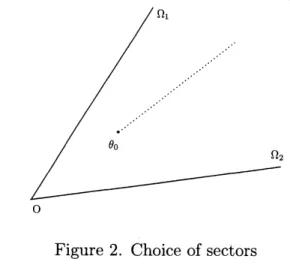
accumulation pointoftheset ofsingu-lar directions. Let $\Omega_{1}$ and $\Omega_{2}$ be the adjacent sectors inthe Borel plane whose
common
boundary is$\theta_{0}.($Figure 2$)$
.
Let $\Sigma_{1}$ and $\Sigma_{2}$be the sectors in the$q_{1}$ planewhich correspond
to $\Omega_{1}$ and $\Omega_{2}$ by the Laplace transform, respectively. Let $F:=(F_{1}, F_{2}, \ldots, F_{2n-1})$ and $\tilde{F}$
$:=(\tilde{F}_{1},\tilde{F}_{2}, \ldots,\tilde{F}_{2n-1})$ be the Borel
sum
of functionally independentformal first
in-tegrals in the sectors $\Sigma_{1}$ and $\Sigma_{2}$, respectively. We study the connection relation (5.6)
in $\Sigma_{1}\cap\Sigma_{2}.$
Theorem 6.1 (robustness). Suppose that the equation
(6.1) $q_{1}^{2\sigma} \frac{dv}{dq_{1}}-2\lambda_{k}v=B_{k}(q_{1},0,0)$
has no analytic solution $v$ in some neighborhood
of
the originfor
$k=2,3,$$\ldots,$$n$
.
Then,if
$m(q_{1}, p_{1}, q,p)$ is analytic at the origin, then there exists an analytic vectorfunction
$0$
Figure 2. Choice of sectors
We note that the condition of the non existence of
an
analytic solution of (6.1) isa
generic condition.
Theorem 6.2 (monodromy vanishing theorem). Suppose that
$B_{j}(q_{1}, t, q)=\tilde{B}_{j}(t, q) (j=2, \ldots, n)$
holds
for
somefunction
$\tilde{B}_{j}$ being analytic in$q$ and apolynomial in$t$
.
Moreover,assume
(2.3) and the Poincare condition, namely the convex hull
of
$\{\lambda_{j};j=2,3, \ldots, n\}$ doesnot contain the origin. Then we have
(i) $m_{j}(q_{1},p_{1}, q, p)$ in (5.6) vanishes.
(ii) Let$V_{m}(m=2, \ldots, n)$ be the
first
integml constructed inSection2for
$\alpha=0$. Then$V_{m}s$ are analytic at the origin $q_{1}=0,$ $p_{1}=0,$ $q=0,$ $p=0$. Moreover,
if
$W$ is a uniqueanalytic solution
of
the equation $q_{m} \frac{\partial}{\partial q_{m}}W=q_{m}p_{m}-V_{m}$, then $W$ is independentof
$m,$$2\leq m\leq n.If$ we
define
$\tilde{W}$ by $\tilde{W}$$:= \sum_{j=2}^{n}q_{j}y_{j}-W(q)$, then the (partial) symplectic
tmnsformation
$(q,p)\mapsto(y, -x)$(6.2) $q_{1}=x_{1},p_{1}=y_{1}, x_{j}=\tilde{W}_{y_{j}}=q_{j},p_{j}=\tilde{W}_{q_{j}}=y_{j}-W_{q_{j}}, (j=2, \ldots, n)$
maps $\chi_{H}$ to $\chi_{H_{0}^{-}}$
.
Namely it gives the genemtingfunction of
a resonantBirkoff
trans-formation.
Here $\tilde{H}_{0}$$:=x_{1}^{2\sigma}y_{1}+ \sum_{j=2}^{n}\lambda_{j}x_{j}y_{j}$, and $\chi_{H}$ and $\chi_{H_{0}^{-}}$ are the corresponding
Hamiltonian vector
fields.
Single-valuedness
of
connectingfunctions.
Let $\Omega(\lambda_{2}, \ldots, \lambda_{n})\equiv\Omega(\lambda)$ be theconvex
positive cone generated by $\lambda_{j}(j=2,3, \ldots, n)$. Then we have
Theorem 6.3. Suppose (2.3) and the conditions $B_{j}=B_{j,0}(q_{1}, q),$ $2\leq j\leq n$
are
satisfied
for
some
$B_{j,0}$ being a polynomial in $q$ withcoefficients
analytic at $q_{1}=0.$when $q_{1}\neq 0$. Moreover, $m$ is not analytic at$q_{1}=0$ provided the equation (6.1) has no
analytic solution $v$ at the origin
for
$k=2,3,$$\ldots,$$n$
.
There existsa
neighborhoodof
theorigin $U$ such that $m$ is a single-valuei
function of
$q_{1}$ in $\{q_{1}\in \mathbb{C}\cap U;q_{1}\neq 0\}.$Exponential series expansion
of
a connectingfunction.
Nextwe
study theconnec-tion problem with dense singular directions in
some
propercone.
In sucha
case, anexponential series expansion naturally appears for
a
connectionfunction.
For thede-tailed study of such
a
serieswe refer
[5] and [6]. To bemore
precise, let $z_{j}\equiv z_{j}(\ell, \alpha, k)$$(j=1, \ldots, 2\sigma-1)$ be the solution of the equation $(2\sigma-1)z^{2\sigma-1}+\lambda\cdot(\ell-\alpha-k)=0.$
Let $C_{j}(S_{0})$ be the closed
convex
positivecone
containing $z_{j}(\ell, \alpha, k)$ for $\ell,$ $k$ such that$v_{0,k,\ell}^{(\alpha)}\neq 0$ and $\ell-\alpha-k\geq 0,$ $\ell-\alpha-k\neq 0$
.
Let $C(S_{0})$ $:= \bigcup_{j=1}^{2\sigma-1}C_{j}(S_{0})$. Notethat $C(S_{0})=-\Omega(\lambda)$ if$\sigma=1$, where $\Omega(\lambda)$ is the
convex
positivecone
generated by $\lambda_{j}$$(j=2,3, \ldots, n)$. The opening of every $C_{j}(S_{0})$ is smaller than $\pi/(2\sigma-1)$ ifwe
assume
the Poincar\’e conditionfor $\lambda_{j}$
.
We remark that the singular directions may be dense in$C(S_{0})$
.
Take $C_{j}(S_{0})$ arbitrarily and define $\v{c}(S_{0});=C_{j}(S_{0})$.
Take the adjacent sectors$\Omega_{1}$ and $\Omega_{2}$ to $\tilde{C}(S_{0})$
so
that $\Omega_{j}\cap\v{c}(S_{0})=\emptyset$.
(cf. Figure 3.) We define $\Sigma_{k}$ for $k=1,2$by$\Sigma_{k}$ $:=\{q_{1};\arg(q_{1}-z)<\pi/(2(2\sigma-1)), z\in\Omega_{k}\}$
.
For the sake of simplicitywe
assume
that $\v{c}(S_{0})$ lies in the direction
of
positive real axis. Thenwe
haveTheorem 6.4. Assume that (2.3) and the condition
(6.3) $B_{j}(q_{1}, q_{1}^{2\sigma}p_{1}, q)=B_{j,0}(q_{1}, q)+q_{1}^{2\sigma}p_{1}\tilde{B}_{j,1}(q) , 2\leq j\leq n,$
are
satisfied for
some
analytic $\tilde{B}_{j,1}(q)$ independentof
$q_{1}$. Assume that the opening
of
$\Omega(\lambda)$ is smaller than $\pi$.
Then we have $\Sigma_{1}\cap\Sigma_{2}\neq\emptyset$ and there exist a neighborhoodof
the origin $V$
of
$(q,p_{1},p)$ and the connectingfunction
$m\equiv m(q_{1}, q, p_{1}, p)$ in (5.6) whichis holomorphic in $(q_{1}, q,p_{1},p)\in\Sigma_{1}\cap\Sigma_{2}\cross V.$
There exists
an
$\epsilon_{0}>0$ such thatfor
every $0<\epsilon_{1}<1$ and every $N\geq 0$ satisfying$\Re\lambda\cdot(\ell-k-\alpha)\neq N\tau$
for
any$\ell$ and $k$we
have the asymptotic expansion(6.4)
$m(q_{1},p_{1}, q,p)= \sum_{k,\ell,\Re\lambda\cdot(\ell-k-\alpha)<N\tau}c_{\ell,k}(q,p,p_{1})\exp(\frac{\lambda\cdot(\ell-k-\alpha)}{q_{1}^{\tau}\tau})+O(e^{-\epsilon_{1}Nqi^{\tau}})$
when $q_{1}arrow 0,$ $q_{1}\in\{q_{1};\Re(z/q_{1})^{\tau}>0,\forall z^{\tau}\in-\Omega(\lambda)\}\cap\{q_{1};|\arg q_{1}|<\epsilon_{0}\}$ , where $c_{\ell,k}(q,p,p_{1})$’s are holomorphic at the origin.
Multi-valuedness when there are dense singular directions. We show multi valuedness
of a connecting function in the
case
ofdense singular directions. In the followingwe
continue to use the same notation
as
in Theorem 6.4.Theorem 6.5. Assume (2.4) and (2.3). Suppose thatthe opening
of
$\Omega(\lambda)$ is smallerFigure 3. Deform ofPath
of
$(q,p_{1},p)$ and a connectingfunction
$m(q_{1}, q,p_{1},p)$ in (5.6) which is holomorphic in$(q_{1}, q,p_{1},p)\in\Sigma_{1}\cap\Sigma_{2}\cross V.$
\S 7.
Proof ofTheorem 6.2Proof.
We look for the formal first integral $v=\phi^{(\alpha)}E^{\alpha}$ with(7.1) $\phi^{(\alpha)}=\sum_{\nu,k,\ell,\ell\geq\alpha}\phi_{\nu,k,\ell}(q_{1})(q_{1}^{2\sigma}p_{1})^{\nu}p^{k}q^{p}.$
We substitute the expansioninto $\chi_{H}v=0$ and comparethe coefficientsof$(q_{1}^{2\sigma}p_{1})^{\nu}p^{k}q^{\ell}.$
Then
we
havea
recurrence
relation(7.2) $(q_{1}^{2\sigma}\partial_{q_{1}}+\lambda\cdot(\ell-k-\alpha))\phi_{\nu,k,\ell}=F_{\ell}(\phi_{\gamma}, \gamma<\ell)$,
where $\phi_{\gamma}$ denotes the terms $\phi_{\nu,k,\gamma}$ for
some
$v$ and $k$, and $\ell-\alpha\neq 0$. Here we regard$t$ $:=q_{1}^{2\sigma}p_{1}$
as an
independent variable. Indeed, the right-hand side follows from theassumption on $B_{j}$ and the use of expansion of$t=q_{1}^{2\sigma}p_{1}$ instead of that of$p_{1}.$
In order to determine the form of$F_{\ell}$
we
first notethat the term $\partial_{p_{1}}B_{j}\frac{\partial}{\partial q_{1}}-\partial_{q_{1}}B_{j}\frac{\partial}{\partial p_{1}}$in the right-hand side vanishes if it is applied to thefunction of$t=q_{1}^{2\sigma}p_{1}$
.
On the otherhand
we
have$(\partial_{p_{1}}B_{j})\partial_{q_{1}}E^{\alpha}=(\partial_{t}B_{j})q_{1}^{2\sigma}\partial_{q_{1}}E^{\alpha}=-\langle\lambda, \alpha\rangle(\partial_{t}B_{j})E^{\alpha}.$
Therefore, by simplecalculations of$\{H_{1}, \cdot\}$, theterms in$F_{\ell}$
are
calculatedbysubtitutingthe expansion of$\phi^{(\alpha)},$ $(7.1)$ into the following
We note that $F_{\ell}$ does not contain the
function of
$q_{1}$ by assumption. By the
same
argument as in the construction offormal integral one
can
determine the formal series$\phi_{\nu,k,\ell}$ from (7.2). Indeed we have $\phi_{\nu,k,\ell}=F_{\ell}/\lambda\cdot(\ell-k-\alpha)$. By the Poincar\’e condition
we see
that thesum
(7.1) withrespect to$\ell$converges when$q$ is in
some
neighborhood ofthe origin because $k$
moves
on
a
finite
set bydefinition.
On
the other hand thesum
withrespect to $\nu$ also
converges
because the coefficientsare
analyticfunction
of $t=q_{1}^{2\sigma}p_{1}$and $\lambda\cdot(\ell-k-\alpha)$ does not contain $\nu$
.
Therefore the moment Borelsum
of $\phi_{\nu,k,\ell}$ withrespect to $q_{1}$ coincides with itself. This proves that connection function $m(q_{1},p_{1}, q,p)$
vanishes for every $\Sigma_{1}$ and $\Sigma_{2}.$
We will show the latter half. If
we
expand $\sum_{j}q_{j}^{2}\tilde{B}_{j}=\sum_{\mu}c_{\mu}(t)q^{\mu}$, thenwe
have$F_{\ell}(v_{\gamma}^{(0)})=\ell_{m}c_{\ell}$ and$v_{\ell}^{(0)}=-\ell_{m}c\ell/\lambda\cdot\ell$. Let $W$ be the analyticfunctionwhosecoefficient
of $q^{\ell}$ is given by $c_{\ell}/\lambda\cdot\ell$if $|\ell|\geq 2$, and $0$ if otherwise. Clearly $W$ is independent of$m,$
$2\leq m\leq n$. Then the unique solutionof $q_{m} \frac{\partial}{\partial q_{m}}W=q_{m}p_{m}-V_{m}$ is given by $W.$
Moreover, the Hamiltonian $\tilde{H}_{0}$ is transformed to the
one
$q_{1}^{2\sigma}p_{1}+ \sum\lambda_{j}p_{j}q_{j}+\sum\lambda_{m}q_{m}W_{q_{m}}=H_{0}+\sum_{m}\lambda_{m}(q_{m}p_{m}-V_{m}^{(0)})$
$=H_{0}+ \sum_{m}\lambda_{m}(\sum_{|\ell|\geq 2}\frac{\ell_{m^{\mathcal{C}\ell}}}{\lambda\cdot\ell}q^{\ell})=H_{0}+\sum q_{j}^{2}\tilde{B}_{j}=H.$
Hence
we
see
that (6.2) transforms $\chi_{H}$ to $\chi_{H_{0}^{-}}.$$\square$
References
[1] Balser, W., Formal Power Series andLinear Systems
of
Memmorphic OrdinaryDifferential
Equations, Universitext, Springer-Verlag, New York, 2000.
[2] –, Semi-formaltheory and Stokes’ phenomenon of nonlinearmeromorphicsystemsof
ordinary differential equations, to be published in Banach Center Publications.
[3] Balser, W. and Yoshino, M., Integrability of Hamiltonian systems and transseries expan-sions, Math. Z. 268 (2011), 257-280.
[4] Bolsinov, A. V. and Taimanov, I. A., Integrable geodesic flows with positive topological entropy, Invent. Math. 140 (2000), 639-650.
[5] Costin, O., Asymptotics and Borel Summability, Chapman & Hall/CRC Monogr. Surv. Pure Appl. Math. 141, CRC Press, Boca Raton, FL, 2009.
[6] Ecalle, J., Six lectures on transseries, analysable functions and the constructive proof of Dulac’sconjecture,
Bifurcations
and Periodic Orbitsof
VectorFields (Montreal, PQ, 1992),NATO Adv. Sci. Inst. Ser. C Math. Phys. Sci., KluwerAcad. Publ., Dordrecht, 408, (1993),
75-184.
[7] Gorni, G. and Zampieri, G., Analytic-non-integrability ofan integrable analytic Hamilto-nian system,
Differential
Geom. Appl. 22 (2005), 287-296.[8] Ito, H., Integrability of Hamiltonian systems and Birkoff normal forms in the simple