Asymptotic
theory
of
tsunami
waves:
geometrical
aspects and
the
generalized
Maslov
representation.
Sergey
Dobrokhotov*
Sergey
$\mathrm{S}\mathrm{e}\mathrm{k}\mathrm{e}\mathrm{r}\mathrm{z}\mathrm{h}- \mathrm{Z}\mathrm{e}\mathrm{n}\mathrm{k}\mathrm{o}\mathrm{v}\mathrm{i}\mathrm{c}\mathrm{h}^{\uparrow}$Brunello
Tirozzi\ddagger
Timur Tudorovskiy
\SApril
7,
2006
Abstract
We suggest a
new
asymptotic representation for the solutions to the 2-D waveequationwith variable velocity andlocalized initial data. Thisrepresentation is a
gen-eralization of the$\mathrm{M}\mathrm{a}s$lov canonical operator
and gives theformulasfor the relationship between initial localized perturbationsand
wave
profilesnearthewave
hontvincluding the neighborhood ofbacktracking (focal or turning) and selfintersection points. We apply these formulas to the problem ofa
propagation of tsunamiwaves
in the frameof so-called “piston model”. Finally we suggest afast asymptotically-numerical algo-rithm forsimulation of tsunami
wave over
nonuniform bottom. Different scenarios ofthedistributionofthewaves
are
considered, thewave profilesof thefront are obtainedin connection with thedifferent shapes of the
source
and with the diverse raysgener-ating the honts. It is possible to
use
the suggested algorithm to predict in real timethe
zones
ofthe beaches where theamplitudeofthe tsunamiwave has dangeroushigh values. The paper concentrates mainly onthe final formulas and geometrical aspectsof the proposed asymptotic theory.
1
Introduction
The traditional calculations of the diffusion of thetsunami
waves
are
done bysolvingthe linear shallow water equations in the framework of the so called “piston model”,
which
assumes
thatthesource
of theperturbation ofthewave
is given byan
instanta-neous
verticalvelocity ofa
certainregion ofthe bottom oftheocean.
Thecorrespond-ing mathematical problem is the search of the solution of the two-dimensional wave equation with variable velocity and localized initial conditions:
$\frac{\partial^{2}\eta}{\partial t^{2}}=<\nabla,$
$C(x)\nabla>\eta$, (1.1)
$\eta|_{t=0}=V(\frac{x}{\mu})$, $\eta_{t}|_{t=0}=0$
.
(1.2)*Institute forProblems in Mechanics, RAS, Moscow; E–mail: [email protected]
\dagger Iotitute forProblems inMechanics, RAS, Moscow; E–mail: [email protected]
\ddagger Department ofPhysics,University “La Sapienza”, Rome; E–mail: [email protected]
$\S_{\mathrm{I}\mathrm{o}\mathrm{t}\mathrm{i}\mathrm{t}\mathrm{u}\mathrm{t}\mathrm{e}}$
Here$\mu<<1$ and thefunction $V(y)$ decays fast as $|y|arrow\infty$
.
It is usual to solve directlywith numerical methods this equation for computing the tsunami in $\mathrm{b}\mathrm{a}s$ins with non
uniform bottom. In this way the position ofthe front is rather welldefined but there
are errors in the estimate of the amplitudes ([2]), this could be the cause of the not
very high effectiveness ofthe tsunami alarm system ([1]). In particular, in order to
obtai$n$ a good accuracy in a neighborhood of a caustic, it is necessary to spend a
large amount of computer time and this makes almost impossible to
use
the direct numerical solution of the wave equation for realtime simulation ofthe propagation oftsunami. Fkom our point of view the existing methods of computing the wave field
for the case of the ocean with
non
uniform bottomare
good $on$ly for a qualitativedescription of the distribution of the wave but satisfactory quantitative calculations
are
still missing. The mathematical complications encountered in solving theproblemare connected with the metamorphosis of the solution: at the initial time the wave
is concentrated in a point and after sometime in a neighborhood of acurve (i.e. the
&ont
ofthe wave). Theproblemisessentially two dimensional with theeffect, typical ofthe multi dimensional wave equation with variable velocity, of the intersection ofthe characteristics. These arguments for the problem of $1\mathit{0}$calized initial conditions
have been treated with accuracy in the paper [15] but the final formulas, based
on
the representation ofthe asymptotic [29] for the equations with constant coefficients,
are
not veryeffective from the point of view of the real applications. Themain result of this paper consists in the derivation $\mathrm{h}\mathrm{o}\mathrm{m}$ the mentioned formulas of essentiallysimple asymptotic equationsfor thewave amplitude $((4.4), (4.7),$ $(4.14))$ generated by
some localized source. It is necessary to emphasize that these formulas refer only to
the well known wave theory and geometrical optic and that can be implemented in a
computer in a relatively easy way bymeans of programs of the typeof Mathematica and Maple. In this paperweconcentrate mainlyonthe construction of the geometrical andtopological concepts (likethewavefront, the Morseand Maslov indexetc) $\mathrm{p}\mathrm{l}\mathrm{a}\dot{\mathrm{p}}\mathrm{g}$
a fundamentalrole intheasymptoticbehavior. As we mentioned aboveourfinal results
arebased on the relatively simple piston model. We observe thatuntil now, despite its simple formulation and the
numerous
publications about it, no completeand accurateasymptotic solutions of this model have been published. On the contrary, we show that many features, not only qualitative but also quantitative, ofthe tsunami
waves
can beexplained by
means
of thepiston model without any useless complications. We briefly describe the plane of the work. In Sect. 2 we give a detailed description of the linear case, in Sect. 3, starting $\mathrm{h}\mathrm{o}\mathrm{m}$ the example of the problem with constantcoefficients,
we
justify the utilization of thewave
equation for analyzing the tsunamiwaves. In Sec. 4 we give the asymptotic formulas for the case when the front passes
through a focal point and the self-intersections of the wave front appear. In Sec. 5
the topological and geometrical concepts, on which the formulas $((4.4), (4.7),$ $(4.14))$
arebased, are shown. The global uniformasymptotic solution $(6.9)-(6.10)$ toproblem $(1.1)-(1.2)$ based on the generalization of the Maslov canonical operator (6.1) (and
reahized in different situations inthevarious forms of theequations (4.4), (4.7), (4.14)$)$ ispresentedinSec. 6. The proofs of the main theorems given inthispaper
are
omitted, they will be presented in aforthcoming paper.2
The
main
equations and
a
simple example:
the
wave
field
in
the
case
of
constant
bottom
2.1
Some
notations
Let us introduce the notations used in this paper. A two dimensional vector can be written with capital or small letters $X=(X_{1},X_{2})$
or
$x=(x_{1}, x_{2})$.
The vectorcan
be written also as a column vector
form
a
column vectorvectors$X$ and $\mathrm{Y}$, with real components, is indicated by $<X,\mathrm{Y}>$, the complex scalar
productamong $\mathrm{b}\mathrm{i}$-dimensional vectors $Z,$ $W$, with complex components, is written as
$<Z,$$W>_{c}$, the two by two matrix generated by two $\mathrm{b}\mathrm{i}$-dimensional vectors $X,$ $\mathrm{Y}$ is
writtenas (X, Y) wherein the first column there
are
thecomponents ofthevector $X$andinthesecond column those ofthevector $\mathrm{Y}$; the transposed matrix of$C$is denoted
by${}^{t}C$
.
2.2
The
main
equations
Let
us
remindthestatements of problems used in tsunamiwave
problemsas
wellas ingeneral linearwater wave theory; see e.g. $([2]-[14])$ whereit is possible tofind a more
complete bibliography.
Let us
assume
that the bottom of the basin is moving $H=H_{0}(x)-H_{1}(x, t)$.
We assume also that the perturbation $H_{1}(x, t)$ is small with respect to $H_{0}$
$|H_{1}|<<H_{0}(x)$, and that $H_{1}$ is localized in a neighborhood of
some
given point $x_{0}$.
If$L$ is the dimension of the region where the
wave
phenomena is studied, \‘and $l$ is the dimension of the perturbed region, then our hypothesis implies that $l<<L$.
Anotherassumption isthat the bottom “changes slowly”, i.e. that $\nabla H_{0}\sim\mu$, where $\mu$ is some
small (”adiabatic parameter”). We discuss below its meaning. Introducing the scaled variables $x’=\Sigma x$, then $H=H_{0}(x’)-H_{1}( \frac{x’}{\mu}, t)$, where$\mu=\frac{\iota}{L}<<1$
.
Theequation for the velocity potential$\Phi$ in the
$\mathrm{w}\mathrm{a}\mathrm{t}\mathrm{e}\mathrm{r}-H\leq z\leq\eta$
,
where$\eta(x,t)$ isthe
sea
elevation in the linear approximation, has theform:
in dimensional variables,:$\Delta\Phi=0$
,
(2.1)$\eta_{t}-\frac{\partial\Phi}{\partial z}|_{z=0}=0$, $\Phi_{t}+g\eta|_{z=0}=0$, (2.2) $\frac{\partial\Phi}{\partial n}\equiv\frac{\partial\Phi}{\partial z}+<\nabla H,\nabla\Phi>=v(x, t)|_{z=-H}$
.
(2.3)where $v(x, t)$ is the normal component of the velocity of the motion of the
bot-tom in the point $x$
.
The velocity $v$can
be expressed bymeans
of the derivative$*^{\partial H}$ by : $\underline{\partial}H*/\sqrt{(\nabla H)^{2}+1}$, since $v$ is the projection of the velocity on the vector $\sqrt{(\nabla H)^{2}+1}^{1}{}^{t}(\nabla H, 1)$ normal to the surface$z=-H$
.
Ifweconsider$\nabla H_{0}$ to be small(be-cause
ofthe slow variation of the bottom relief), and that also V$H_{1}$ issmall (because3
A
simple
example: the
wave
field
in
the
case
of constant
bottom
3.1
The
solution
in
the
form of
the
Fourier
transform
Let us begin considering thesystem $(2.1)-(2.3)$ in thecaseof constant bottom. In this
case
the velocity potential and its derivativesare zero
for $t=0$.
We make the Fouriertransform of the system $(2.1)-(2.3)$ with respect to the variables $x_{1},$ $x_{2}$
.
The dualvariables will be denoted with $p_{1},p_{2}$ and the Fourier transform of the corresponding
function will be consideredas a “wave”. Then $(2.1)-(2.3)$ get the form
$\tilde{\Phi}_{zz}-p^{2}\overline{\Phi}=0$, (3.1) $\eta_{t}-\sim\frac{\partial\tilde{\Phi}}{\partial z}|_{z=0}=0$, (3.2) $(\tilde{\Phi}_{t}+g^{\sim}\eta)|_{z=0}=0$, (3.3) $\frac{\partial\tilde{\Phi}}{\partial z}|_{z=-H}=\tilde{v}\equiv\frac{\partial\tilde{H}_{1}}{\partial t}$
.
(3.4) Solving $((3.1))-((3.4))$, we find $\tilde{\Phi}=\frac{\mathrm{c}\mathrm{h}((z+H)|p|)}{\mathrm{c}\mathrm{h}H|p|}\tilde{\varphi}+\frac{\mathrm{s}\mathrm{h}(z|p|)}{|p|\mathrm{c}\mathrm{h}(H|p|)}\frac{\partial\overline{H_{1}}}{\partial t}$ (3.5) and $\tilde{\Phi}_{z}|_{z=0}=|p|\tanh(H|p|)\tilde{\varphi}+\frac{1}{\mathrm{c}\mathrm{h}H|p|}\frac{\partial\overline{H_{1}}}{\partial t}$ (3.6)Thus theequations $((3.2))-((3.3))$ take the form
$\frac{\partial\tilde{\eta}}{\partial t}-|p|\tanh(H|p|)\tilde{\varphi}-\frac{1}{\mathrm{c}\mathrm{h}(H|p|)}\frac{\partial\overline{H_{1}}}{\partial t}=0$
$\frac{\partial\overline{\varphi}}{\partial t}+g\overline{\eta}=0$ (3.7) Where $\overline{\varphi}=\tilde{\Phi}_{t}|_{z=0}$, and wehave
theinitial conditions $t=0$
$\tilde{\varphi}|_{t=0}=0$, $\overline{\varphi}_{t}|_{t=0}=0\Leftrightarrow\overline{\eta}|_{t=0}=0$
.
(3.8)These conditions define the so called Cauchy-Poisson problem for the system (3.7).
They arecompatible with the perturbation of the bottomonly ifwe supposethat the
$\mathrm{e}$ rthquake starts atatime different from zero. So we
assume
that the bottom hasan
“mstantaneous” movement at asmalltime $t=\epsilon$:
$H_{1}(x,t)=\theta(t-\epsilon)V(x)$, (3.9)
then
we
send $\epsilon$ tozero
at the end of thecalculation; thesmooth function $V(x)$ decaysrapidly at infinity.
Differentiating thefirstequation in (3.7) with respect to$t$ and substituting$\not\in^{\partial^{-}}$with
$-g\tilde{\eta}$we get theequation for $\tilde{\eta}$:
Differentiating the second equation of the system (3.7) with respect to $t$ and
sub-stituting the derivative $\eta_{t}$ with the expression of the first equation and consider-ing the condition that the source is active at the moment $t=\epsilon>0$, we get
$\varphi_{u}|_{t=0}=-g|p|\tanh(H|p|)\overline{\varphi}|_{t=0}=0$and the initial condition for (3.10)
$\eta_{t=0}=0$ $\eta_{t}|_{t=0}=0$
.
(3.11)It is easyto find the solution $\tilde{G}$
ofthe homogeneous equation associated with (3.10):
$\tilde{G}_{tt}+\mathcal{L}(p, H)\tilde{G}=0$, $\tilde{G}|_{t=\tau}=0$, $\tilde{G}_{t}|_{t=\tau}=1$
,
$\tilde{G}(t,\tau,p)=\frac{e^{1\sqrt{L}(t-\tau)}-e^{-i\sqrt{L}(t-\tau)}}{2i\sqrt{\mathcal{L}}}=\frac{\sin\sqrt{\mathcal{L}}(t-\tau)}{\sqrt{\mathcal{L}}}$
.
In this way the solution of the
non
homogeneous equation (3.10) is$\overline{\eta}=\int_{0}^{t}\tilde{G}(t, \tau,p)\frac{1}{\cosh(H|p|)}\frac{\partial^{2}\tilde{H}_{1}(\tau,p)}{\partial t^{2}}d\tau$
.
Theinverse Fourier transform of the function $\tilde{\eta}$ gives theelevation ofthe hae surface.
Underourassumption ofinstantaneousmotion at time $\epsilon$wehave
$\frac{\partial^{2}\overline{H}_{1}(\tau,p)}{\partial t^{2}}=\delta’(t-\epsilon)\tilde{V}$ and
so:
$\overline{\eta}=\int_{0}^{t}\tilde{G}(t,\tau,p)\frac{1}{\cosh(H|p|)}\frac{\partial^{2}\tilde{H}_{1}(\tau,p)}{\partial t^{2}}d\tau=\frac{\tilde{V}}{\cosh H|p|}\int_{0}^{t}\frac{\sin\sqrt{\mathcal{L}}(t-\tau)}{\sqrt{\mathcal{L}}}\delta’(\tau-\epsilon)d\tau=$
$- \frac{\tilde{V}}{\cosh H|p|}\frac{\partial}{\partial\tau}(\frac{\sin\sqrt{L}(t-\tau)}{\sqrt{\mathcal{L}}})|_{\tau=e}=\frac{\tilde{V}}{\cosh H|p|}\cos\sqrt{\mathcal{L}}(t-\epsilon)$
.
We sendnow $\epsilon$ to
zero
sowe
get the function $\overline{\eta}=\frac{\overline{V}}{\mathrm{c}\mathrm{o}\mathrm{e}\mathrm{h}(H|p|)}\cos\sqrt{\mathcal{L}}t$.
It is evident that$\overline{\eta}$ is the solutionof the equation (3.10) with the following Cauchy conditions
$\overline{\eta}|_{t=0}\equiv\frac{\tilde{V}}{\cosh(H|p|)}$, $\overline{\eta}’|_{t=0}=0$. (3.12)
We shall discuss the relevance of such initial conditions for the function $\eta$ in the
next section.
3.2
The
solution of the Cauchy
problem
for constant
bottom
and
instantaneous
source
Letus studythesolution$\eta$correspondingto (3.12). It is not restrictive toassumethat the center of the
source
is located in the origin of the coordinates $x_{0}=0$ and thatthe perturbation decays rapidly with the distance from the origin and that it has a maximum in asmall neighborhood of the origin. We
use
also dimensionless variables:$V=V( \frac{x}{l})$,
where $l$ is the size of theshifted region and
$\overline{V}=\frac{1}{2\pi}\int V(_{l}^{\xi})e^{-ip\cdot\xi}d\xi=\frac{l}{2\pi}\int V(y)e^{-il<p,y>}dy=l\overline{V}(pl)$ ,
where we made the substitution $\xi=yl$ and $\overline{V}(p)$ is the usual Fourier transform of
the function $V(y)$
.
We assume that $V(y)$ is a smooth function rapidly decaying as$|y|arrow\infty$
.
Then wecan make the inverse Fourier transform:
$\eta=\frac{l}{4\pi}\sum_{\pm}\int e^{\pm it\sqrt{L(_{\zeta}H)}+i<\mathrm{p},x>}$” $\overline{\eta}_{0}(p)dp=\frac{l}{4\pi}\Sigma_{\pm}\int e^{\pm it\sqrt{L(pH)}+i<p,x>}\frac{1}{\cosh(|p|H)}\overline{V}(pl)dp$
.
Changingthe variables$p=p’/l$
,
we get$\eta=\frac{1}{4\pi}\Sigma_{\pm}\int 6^{\pm i\sqrt{\oplus\tanh(|p|_{\mathrm{T}}^{H})}+i^{\underline{<n_{i^{x>}\frac{1}{\cosh(|p|_{\mathrm{T}}^{H})}\tilde{V}(p)dp}}}}$
.
In this way the problem is reduced to the computation of the asymptotic behavior of the integral.
We will study the asymptotic values for $|x|$ $>>$ $l$
.
We changevariables inside the integral and pass to polar coordinates $(\rho, \varphi)$,
where $\varphi$ is defined
as
the angle among $p$ and $x$–
$x_{0}$
.
Thus$p=\rho\Theta(\varphi)_{\Pi x}^{x}$, where $\Theta(\varphi)$ is the two dimensional matrix defining the rotation
ofan angle $\varphi$
.
$\Theta(\varphi)=$
Then the last integral has the form
$\eta=\frac{1}{4\pi}\Sigma_{\pm}\int_{0}^{\infty}\rho d\rho\int_{0}^{2\pi}d\varphi\exp$ $( \pm it\sqrt{\frac{g\rho}{l}\tanh(\rho\frac{H}{l}}))\exp(i\frac{\rho|x|}{l}\cos\varphi)\frac{1}{\cosh(\rho_{\mathrm{T}}^{H})}\overline{V}(\rho\Theta\frac{x}{|x|})$
.
The inter$n$al integral canbecomputed usingthe method of stationary phase. The
phase hasthe form: $\Phi=e\mu_{\cos\varphi}^{x}$, the equation $\delta^{\frac{\Phi}{\varphi}}\partial=0$ gives $\varphi=0,$$\varphi=\pi$; however it is not possible to apply the method of the stationary phase in the point $\rho=0$
.
One can reduce the interval of integration to a sufficiently small neighborhood of the
saddle points of the variable $\varphi$ and show that, [12, 13, 14], the error is smaller than the contribution of the terms that have been neglected. The result is:
$\eta\approx\frac{1}{2\sqrt{2\pi}}\sqrt{\frac{l}{|x|}}\Sigma_{\pm}\int_{0}^{\infty}d\rho\frac{\sqrt{\rho}}{\cosh(\rho\frac{H}{l})}$
$\exp(\pm it\sqrt{\frac{g\rho}{l}\tanh(\rho\frac{H}{l})})\Sigma_{\pm}(e^{\mp i\pi/4}e^{\frac{\pm\cdot\rho|x|}{\iota}}\overline{V}(\pm\rho\frac{x}{|x|}))$
.
Let
us
consider the last integral. Its global phases are:$\Phi_{\pm,\pm}/l=\pm(t\sqrt{gl\rho\tanh(\rho\frac{H}{l})}\pm\rho|x|)/l$
.
For $t>0,$$\rho>0$ the derivative $\frac{\partial \mathrm{g}_{\pm.+}}{\partial\rho}$ is strictly positive, this implies the absence
of critical points for the functions $\Phi\pm,+\cdot$ It follows that these terms give, for $t>0$, a
contribution to the wave field which is asymptotically small with respect to the other contributions and so it can be dropped. IFUrthermore since $V$ is a real function then
$\mathrm{t}\mathrm{h}\mathrm{e}\tilde{V}(\rho^{x}[_{\mathrm{o}\mathrm{r}\mathrm{m}}^{x1^{)\mathrm{a}\mathrm{n}\mathrm{d}}}\overline{V}(-\rho_{\Pi x}^{x})$are complex conjugates so the last integral may be written in
$\eta\approx\frac{1}{\sqrt{2\pi}}\sqrt{\frac{l}{|x|}}\cross$
${\rm Re} \int_{0}^{\infty}\mathrm{d}\rho\frac{\sqrt{\rho}}{\cosh(\rho_{\mathrm{T}}^{\mathrm{H}})}\tilde{\mathrm{V}}(\rho\frac{\mathrm{X}}{|\mathrm{x}|})\mathrm{e}^{-\mathrm{i}\pi/4}\exp(\frac{\mathrm{i}}{1}(\rho|\mathrm{x}|-\mathrm{t}\rho\sqrt{\mathrm{g}\mathrm{H}}\sqrt{\frac{1}{\rho \mathrm{H}}\tanh(\frac{\rho \mathrm{H}}{1})})$
.
coming from the small values of $\rho$
.
Then we get that the functions$\frac{1}{\cosh(\rho_{\mathrm{T}}^{H})}$ and
$t\rho\sqrt{gH}\sqrt{\rho T^{\tanh(*^{H})}\iota}$ can be expanded in Taylor series. If
we
substitute the firstfunction with 1 we neglect a term of the order of $O( \frac{H}{l})^{2}$
.
The second functioncan
be approximated by thefirst two non zero terms of its expansion $t \rho\sqrt{gH}(\frac{1}{l}-\frac{1}{6}(\not\simeq)^{2})$
makingan
error
oftheorder of$t\sqrt{gH}(_{\mathrm{T}}^{H})^{4}$.
Itis clearfromthe previousestimates thattheseterms
are
small andso we
obtain$\eta\approx\frac{1}{\sqrt{2\pi}}\sqrt{\frac{l}{|x|}}{\rm Re}\int_{0}^{\infty}\mathrm{d}\rho r\rho\tilde{\mathrm{V}}(\rho\frac{\mathrm{x}}{|\mathrm{x}|})\mathrm{e}^{-\mathrm{i}\pi/4}\exp(\frac{\mathrm{i}}{1}(\rho|\mathrm{x}|-\mathrm{t}\rho\sqrt{\mathrm{g}\mathrm{H}}(1-\frac{\rho^{2}}{6}(\frac{\mathrm{H}}{1})^{2})))$
.
It will be explained below that the integral gets its larger values in the neighborhood of thefront, i.e.
near
thecurve (circle) $|x|=\sqrt{gH}t$.
In this way the dispersion effectscan influence the asymptoticvalues in the far wave field under the condition that the coefficient of$\rho^{3}$ in the exponent is larger or equal to one. Thus we obtain different behaviors, putting $\sqrt{gH}t$ equal to $|x|$ in this coefficient, according to the possible
relations among $|x|,$$H,$$l$ (compare $[3]-[8],[14]$):
a) For $|x|>> \frac{l^{3}}{H}\mathrm{z}$ the dispersion has
an
important influence in the neighborhoodof the front, and the asymptotic can be expressed by
means
ofa function similar tothe Airyfunction. In this
case
thebehavior ofthe function$V$ is not important for thedefinitionof the profile of the hont.
b) For $|x| \sim\frac{\iota}{H}73$ the weak dispersion and the function $\overline{V}$
influences the formation of the wave profile;
c) For $|x|<< \frac{\iota}{H}\mathrm{v}3$ the dispersion is not important and the function $\tilde{V}$
is important for determining the profile. If the term with $\rho^{3}$, is dropped from the phase of the integral an errorof the order of $|x|H^{2}/l^{3}$ isdone.
Let us consider the example where $H=4km,$ $l=40km$, thus $l^{3}/H^{2}=4000$km.
Thus a (weak) effect of the dispersion starts at 4000km. If the size of the
source
increases twice this distanceincreases
8
times and becomes32000
km,a
distance largerthan any $\mathit{0}$cean. Thus we will start analyzing the point $\mathrm{c}$ (it possible to neglect the
effect of the dispersion).
3.3
Asymptotic
behavior of the
wave
field with very
small
dispersion
in
the
case
of
constant
depth
Thus, assumingthat the inequality $|x|<<l^{3}/H^{2}$ is satisfied, we have
$= \frac{l^{1/2}}{\sqrt{|x|}}{\rm Re}(\mathrm{e}^{-\mathrm{i}\pi/4}\mathrm{F}(\frac{\Phi(\mathrm{x},\mathrm{t})}{1}, \frac{\mathrm{x}}{|\mathrm{x}|}))$, $\Phi(\mathrm{x}, \mathrm{t})=|\mathrm{x}|-\mathrm{t}\sqrt{\mathrm{g}\mathrm{H}}$, (3.13)
where
$F(z, \mathrm{n})=\frac{1}{\sqrt{2\pi}}\int_{0}^{\infty}e^{iz\rho}\sqrt{\rho}\tilde{V}(\rho \mathrm{n})d\rho$
.
(3.14)Here $\mathrm{n}$ is the unit vector parallel to the vector
$x$
$\mathrm{n}=\mathrm{n}(\psi)=$
.
(3.15)The angle $\psi$ is chosen in such
a
way that $\psi=0$corraepondsandto change infinalasymptotic formulas$\mu$ by$l$
.
to the axis $x_{1}$
.
Hence the function $\tilde{V}(\rho, \mathrm{n}(\psi))$ dependson
$(\rho, \psi)$ and the function $F(z, \mathrm{n}(\psi))$ dependson
$(z, \psi)$.
For avoiding complicate notationswe use
thesame
symbols$\tilde{V}$
and$F$for them
an
$\mathrm{d}$sometimeswrite$\overline{V}(\rho, \psi)$ and$F(z, \psi)$instead $\tilde{V}(\rho, \mathrm{n}(\psi))$
and $F(z, \mathrm{n}(\psi))$ respectively.
We note, that the function $F(z, \mathrm{n})$ decreases for $|z|arrow\infty$ as an inverse power.
Indeed, let uschange variable in the last integral$\rho=L^{2}2$; then
$F(z, \mathrm{n})=\frac{1}{\sqrt{2\pi}}{\rm Re}\{\mathrm{e}^{-\frac{\mathrm{i}\pi}{4}}\int_{0}^{\infty}\mathrm{y}^{2}\mathrm{e}2\tilde{\mathrm{V}}(\frac{\mathrm{y}^{2}}{2}\mathrm{n})\mathrm{d}\mathrm{y}\}\underline{\mathrm{i}-}\mathrm{z}_{-}^{2}$
.
Using the method of the stationary phaae we get, because of the proeence of the factor $y^{2}$ under the integral, $F(z,\omega)$
$\sim$ $\frac{1}{z^{3/2}}$, if $\tilde{V}(0)$ $\neq$ $0$. Thus for
$||x|-\sqrt{gH}t|>>l$ and $|x|>>l$, we havethat $\eta\sim W^{\tilde{V}(0)}xl^{3}$
.
Example 1. Let us give some example
of
thefunction
$F(z,\omega)$.
We choosefor
thefunction
$V$, defining the source, thefunction
$V(y)=\overline{V}\cos(a_{1}\mathrm{Y}_{1}+a_{2}\mathrm{Y}_{2}+\delta)e^{-b_{1}Y_{1}^{2}-b_{2}Y_{2}^{2}},$ $\mathrm{Y}=\Theta(\theta)y$, (3.16)
$\ominus(\theta)=$ , where $\overline{V},$
$a_{1},$ $a_{2},$ $b_{1},$ $b_{2}>0,$ $\theta,$$\chi$ are pammeters. In this case the
fimction
$F(z,\psi)$ can be $e\varphi ressed$intermsof
pambolic cylinderfunctions
$D_{-3/2}$ orconfluent
$hyperyeometr\dot{\tau}c$functions
$1F_{1}$$\tilde{V}(\rho, \psi)$
$=$ $\frac{\overline{V}\sqrt{\rho}}{2\sqrt{b_{1}b_{2}}}e^{-\alpha-\beta\rho^{2}}\cosh(i\delta+\gamma\rho)$, (3.17)
$F(z, \psi)$ $=$ $\frac{\overline{V}\sqrt{b_{1}b_{2}}e^{-\delta}}{2\sqrt{2\pi}}{\rm Re}(\mathrm{e}^{-\frac{\mathrm{i}\pi}{4}}\int_{0}^{\infty}\sqrt{\rho}(\mathrm{e}^{-L_{\frac{2_{\beta}}{2}+\gamma\rho+\mathrm{i}\rho \mathrm{z}}}e^{\mathrm{i}\theta}+\mathrm{e}^{-L^{2}g_{-\gamma\rho+\mathrm{i}\mu}}2\mathrm{e}^{-\mathrm{i}\theta})\mathrm{d}\rho)$
$\equiv$ $\frac{\overline{V}\sqrt{b_{1}b_{2}}}{4e^{\delta}\beta^{3/4}}{\rm Re}(\exp(\frac{(\gamma+i\mathrm{z})^{2}}{4\beta})\mathrm{D}_{-3/2}(-\frac{\gamma+\mathrm{i}\mathrm{z}}{\sqrt{\beta}})\mathrm{e}^{\mathrm{i}\theta}$
$+ \exp(\frac{(-\gamma+iz)^{2}}{4\beta})D_{-3/2}(-\frac{-\gamma+iz}{\sqrt{\beta}})e^{-l\theta})$
$\equiv$ $\overline{V}\sqrt{\frac{1}{32\pi b_{1}b_{2}}}Re[(Q_{+}+Q_{-})]$,
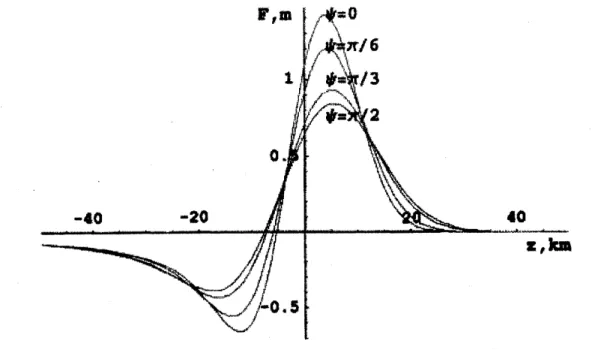
Figure 1:
Source
function
$F$for
Gaussian
perturbation.The
form
of the
source
isdetermined
by (3.16)where
$\overline{V}=10\mathrm{m},$ $a_{1}=0,$ $a_{2}=0,$ $b_{1}=$$0.01\mathrm{k}\mathrm{m}^{-2},$ $b_{2}=0.005\mathrm{k}\mathrm{m}^{-2}$,
th
$=0,$ $\delta=0$where $\sigma=(b_{1}\alpha_{2}^{2}+b_{2}\alpha_{1}^{2})/(4b_{1}b_{2}),$$\beta=(b_{1}\sin^{2}(\psi-\theta)+b_{2}\mathrm{c}o\mathrm{s}^{2}(\psi-\theta))/(4b_{1}b_{2}),$ $\gamma=$ $(b_{1}\alpha_{2}\sin(\psi-\theta)+b_{2}\alpha_{1}\cos(\psi-\theta))/(2b_{1}b_{2}),$ $w\pm=\pm\gamma+i\Phi,$ $1F_{1}($
.
$)$ is hypergeometn$c$Kummerfunction, $\Gamma$ is a gamma
function
(see Fig.1, Fig.2).Main conclusion: the phase in the neighborhood of the hont defines completely
a
one
parameter family of trajectories which generate the front. Furtherwe
remark that, since the function $F$ decreases, we can expand in the formula (3.13) $|x|$ ina
neighborhood of thefront,keepingin the expansion only the
zero
orderterm, and thatwe
can
substitute the factorvla
(the amplitude ofthe wave) with the term $\frac{1}{\sqrt\sqrt{gH}t}$.
We want to find analogous formulas for the
wave
field in thecase
of negligible small dispersion and for variablebottom.4
Localized
solutions
to
the
wave
equation
and
asymptotic behavior of
the
wave
field
over
nonuniform
bottom
for very
small dispersion
4.1
The
wave
equation, rays
and
wave
fronts
Inthis section we start the analysis of the behavior of theamplitude of the
wave
whenthe bottom is not constant. We use here well known objects and their characteris-tics which
one can
find in booksconnected with thesemiclassical asymptotic and raymethod, geometrical optics and
wave
fronts, Hamiltonian mechanics, catastrophe the-ory etc. We try to collect here all necessary concepts and give their description inelementary form. More complete presentations and details
one
can find in $[16]-[25]$.
It is clear that in practice
we
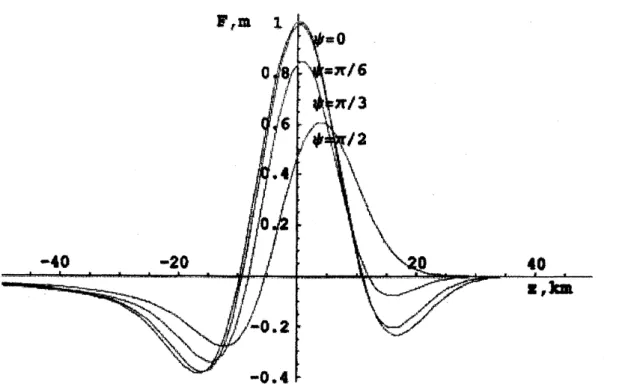
have studied the solution of the wave equation in theFigure
2:
Source
function
$F$ for“modulated” Gaussian
perturbation.The form of the
source
isdetermined
by (3.16)where
$\overline{V}=10\mathrm{m},$ $a_{1}=0,$ $a_{2}=0.1\mathrm{k}\mathrm{m}^{-1}$, $b_{1}=0.01\mathrm{k}\mathrm{m}^{-2},$ $b_{2}=0.005\mathrm{k}\mathrm{m}^{-2},$ $\psi=0,$ $\delta=\pi/4$there the small parameter
$\mu=\frac{l}{L}$ (4.1)
expressing the relationship among the characteristic size of the source and the char-acteristic size of the basin. We begin introducing
non
dimensional variables in theequations and scale using the characteristic depth of the basin $H_{0}$
.
After we makethe change of variables $x’=x/L,$ $t’=t\sqrt{gH_{0}}/L,$ $H=H_{0}H’(x’)$
our
equations andinitial data will take the form (1.2). Our asymptotic expansions will be done in term ofthis parameter under the assumption$\mu<<1$
.
To come back to original variables itis enough to
use
the original variables $x,$$t$ to change infinal
asymptoticformulas
$\mu$ by$l$ and in $(\mathit{4}\cdot \mathit{2})C(x)=\sqrt{H(x)}$ by $C(x)=\sqrt{gH(x)}$
.
We
assume
that thesource
ofthe perturbation islocalized in$x=0$.
Itiseasy tosee
that finding thefieldfarfromthe source,$|x|\gg l$, issimilar tofind theasymptoticvalues
for $\muarrow 0$ in theproblem (1.1). The problem
now
is to study thewave
equation withvariable coefficient. Theasymptoticvalues of thewaveamplitude$\eta$canbeexpressedby
means
of thewave
frontformed byrays. It is aknown fact that instead ofthestraight raysonehas to introduce curved rays and characteristics given by theone
dimensional family oftrajectories $P(\psi, t),$$X(\psi,t)$ ofan
appropriateHamiltonian system. The endsof the rays form the wavehont, a complicated closed
curve
probably with cusps andselfintersection points. In the considered situation these rays and characteristics are
determined in thefollowing way.
We introduce the function $C(x)=\sqrt{H(x)}$and, as before, let $\mathrm{n}$ be the unit vector
(3.15) directed
as
the external normaltothe unit circle. Then the Hamilton systemis:i.e. the family oftrajectories $P(\psi, t),$ $X(\psi, t)$ going out fromthe point $x=0$with unit
impulse$p=\mathrm{n}(\psi)$. Let
us
indicate $C(\mathrm{O})=C_{0}$.
The Hamiltonian corresponding to (4.2)is$\mathcal{H}=C(X)|p|$
.
From theconservation of the Hamiltonian onthe trajectories we havethe important equation
$|P|C(X)=C_{0}$
.
(4.3)The projections $x=X(\psi,t)$ of the trajectories on the plane $\mathbb{R}_{x}^{2}$
are
called the rays.Recall that the
front
in theplane $\mathbb{R}_{x}^{2}$ at thetime $t>0$ is thecurve
$\gamma_{t}=\{x\in \mathbb{R}^{2}|x=$$X(\psi,t)\},$ $[25,16]$
.
The pointson
thiscurve areparameterized bythe angle$\psi\in(0,2\pi]$.If ineachpoint$x$of the front$\gamma_{t}$ $T\psi\partial X_{-}\neq 0$, then the front is asmoothcurve. Thepoints
where $T\psi\partial X=0$
are
named focals, in these points the front looses its smoothness. In thesituation in which thefocalpoints appear, (theyare veryinteresting fromthepoint of
viewoftsunami), itisreasonable tointroduce theconceptofthehont inthe phase space $\mathbb{R}_{p,x}^{4}$ at the moment $t>0$, i.e. the
curve
$\Gamma_{t}=\{p=P(\psi,t),x=X(\psi,t),\psi\in[0,2\pi]\}$.
We note that at least oneofthe component of the vector $P_{\psi},X_{\Psi}$ is different fromzero
and also the rays $x=X(t, \psi)$ are orthogonal to thefront $\gamma_{t}:\langle\dot{X}, X_{\psi}\rangle=0$
see
Lemma3.
4.2
The
wave
field before
critical
times.
It is notdifficultto check thata (possiblysufficientlysmall) $t_{1}$ exists suchthat, for any
$t,$ $t_{1}\geq t>\delta>0$, there areno focal points in $\gamma_{t}$
.
The first instant of time$t_{c\mathrm{r}}$, in whichfocal points are formed is called $c$ritical. Let us first write the solution before critical
times, larger than 6, when the front is already defined. In this
case
the asymptoticsolution is defined in the following way. We define a neighborhood of the hont for
sufficiently small (but independent of $\mu$) coordinates Cb,$y$, where $|y|$ is the distance
among thepoint$x$ belonging toaneighborhood of theffontandthe front. Forthisaim
we will take $y\geq 0$ for the external subset of the front and $y\leq 0$ and for the internal
subset of the front. Then a point $x$ of the neighborhood of the hont is characterized
by two coordinates: $\psi(t, x)$ and $y(t, x)$, where $\psi(t, x)$ is defined by the condition that
thevector $y=x-X(\psi,t)$ isorthogonal to thevector tangent to the hont in the point
$X(\psi,t)$
.
Thus wehave thecondition $\langle y, X_{\psi}(\psi,t)\rangle=0$.
Letus
find the phase$S(t, x)= \langle P(\psi(t,x),t), x-X(\psi(t, x), t)\rangle=\frac{C(0)}{C(X(\psi(t,x),t))}y=\sqrt{\frac{H(0)}{H(X(\psi(t,x),t))}}y$
The second equalityis a consequence ofthe equation (4.3).
Now
we
state the first important theorem of this paper connecting thewave
ampli-tude with the initial perturbation$V(x)$ and the profileofthebottomandtheintegration
over the characteristics.
Theorem 1. For$t_{\mathrm{c}t}>t>\mathit{6}>0$, in
some
neighborhoodof
theffont
$\gamma_{t}$
,
not dependingon
$\mu,$ $\eta$, the asymptotic elevationof
theflee
surface, has theform:
$\eta==^{\sqrt{\mu}}|X_{\psi}(\psi, t)|\sqrt[4]{\frac{H(0)}{H(X(\psi,t))}}{\rm Re}[e^{-\frac{:\pi}{4}}F(\frac{S(t,x)}{\mu}, \mathrm{n}(\psi))]|_{\psi=\psi(t,x)}+O(\mu^{3/2})$ (4.4)
Outside this oegion $\eta=O(\mu^{3/2})$
.
Thefunction
$F(z, \mathrm{n})$ isdefined
in (3.14).In this way till the critical time the asymptotic elevation of the free surface is completely defined by
means
of the trajectory, which forms thefront ofthewave, andof the function $V$, corresponding to the source of the perturbation. Despite of the
simple and natural form of the asymptotic of$\eta$, the proofofthe formula (4.4) is not trivial at all;the main step is thecomputationof the function$V$,
more
exactlythe proofof the fact that the formula is the sam$e$ as in the case of constant bottom, if the right
choice of the rays is made. We will give below the necessary tools for a constructive
approach of theproofofthis formula, in the meantimewe now show some elementary
consequence of theequation (4.4).
Since
the phase$S(x, t)$ is equal to zero onthefrontand$S(x, t)/\mu$ getslarge going out from thefront, then$\eta$, as onecould expect, decreases enough quickly and the maximum of$|\eta|$ is attained in
a
neighborhoodofthe front. Asaconsequence, $\eta$ can havesome oscillations depending
on
the formofthesource.
The second factorin (4.4) is the two dimensional analogue of theGreen rule, wellknown in the theoryof waterwaves
in the channels: the amplitude $\eta$ increases whenthe depth decreases as the inverse of the fourth root of the depth $1/\sqrt{C(x)}=1/\sqrt[4]{H(x)}$; thefactor $1/\sqrt{|X_{\psi}|}$ is $\mathrm{c}\mathrm{o}n$nected to the divergenceof the rays, in other words if a smaller
number of rays goes through a neighborhood of the point $X(\psi, t)$
,
the smaller will be$\mathrm{t}\mathrm{h}\mathrm{e}\mathrm{p}\mathrm{h}\mathrm{a}\mathrm{s}\mathrm{e}\mathrm{e}\mathrm{x}\mathrm{p}\mathrm{r}\mathrm{e}\mathrm{s}\mathrm{s}\mathrm{e}\mathrm{s}\mathrm{t}\mathrm{h}\mathrm{e}\mathrm{p}\mathrm{h}\mathrm{e}\mathrm{n}\mathrm{o}\mathrm{m}\mathrm{e}\mathrm{n}\mathrm{a},\mathrm{a}1\mathrm{s}\mathrm{o}\mathrm{w}\mathrm{e}11\mathrm{t}\mathrm{h}\mathrm{e}$ “$\mathrm{c}\mathrm{o}\mathrm{n}\mathrm{t}\mathrm{r}\mathrm{a}\mathrm{c}\mathrm{t}\mathrm{i}\mathrm{o}\mathrm{n}$”
$\mathrm{o}\mathrm{f}\mathrm{t}\mathrm{h}\mathrm{e}\mathrm{w}\mathrm{a}\mathrm{v}\mathrm{e}\mathrm{t}\mathrm{h}\mathrm{e}\mathrm{a}\mathrm{m}\mathrm{p}\mathrm{l}\mathrm{i}\mathrm{t}\mathrm{u}\mathrm{d}\mathrm{e}\mathrm{o}\mathrm{f}\mathrm{t}\mathrm{h}\mathrm{e}\mathrm{w}\mathrm{a}\mathrm{v}\mathrm{e}\mathrm{f}\mathrm{i}\mathrm{e}\mathrm{l}\mathrm{d}.\mathrm{T}\mathrm{h}\mathrm{e}\mathrm{f}\mathrm{a}\mathrm{c}\mathrm{t}\mathrm{o}\mathrm{r}\frac{C\mathrm{o}}{C(X(\psi(t,x),t,\mathrm{k}\mathrm{n}\mathrm{o}\mathrm{w}\mathrm{n},\mathrm{o}i)}\mathrm{a}\mathrm{p}\mathrm{p}\mathrm{e}\mathrm{a}\mathrm{r}\mathrm{i}\mathrm{n}\mathrm{g}\mathrm{i}\mathrm{n}\mathrm{t}\mathrm{h}\mathrm{e}\mathrm{f}\mathrm{o}\mathrm{r}\mathrm{m}\mathrm{u}1\mathrm{a}\mathrm{o}\mathrm{f}$
profile and the increase of its amplitude as thedepth decreases. In fact the amplitude
increases because of the factor in hont of the function $V$ but also the phase $S(x, t)$
increases and this makes thewave profilenarrower. This result explains the well know
fact that the
wave
lengthof the tsunami decreases when thewave
approaches thecoast
and that its amplitude increases. The same profile (i.e. asection of$\eta(x, t)$ for fixed $t$
and $\psi$)
can
dependonthe way thetrajectory (ray) intersects the initial perturbationof the bottom at $t=0$
.
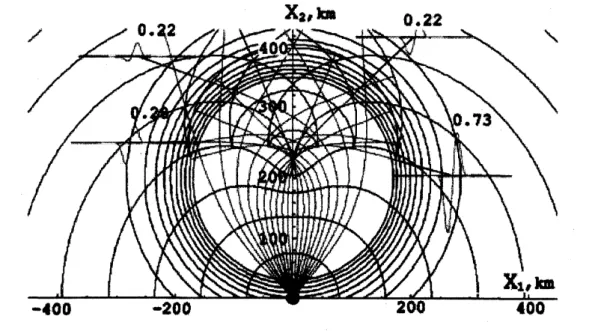
It isjust thisfact to givethedependence ofthe diagramof the directions on two factors: the shapeof thesourceand the angle ofits intersection with the ray passing through agiven point of the front. For this reason, dependingon theform of the bottom, two raysgoing out with two verydifferent angles, can arrive
near
the
same
pointof the front and contribute to theprofilewith verydifferentamplitudes.These effects can be wellseen in Fig.3, Fig.4.
4.3
The
structure
and
metamorphosis
of
wave
profiles
af-ter
critical
time.
4.3.1
TheMaslov index and
metamorphosisof
thewave
proflle.
For $t>t_{\mathrm{c}\mathrm{r}}$ when the focal points appear,
as
it is well known in thewave
theory,the hont can have “angles” and sometimes the hont lines can have self intersection
points. The ends of the arcs corresponding to these angles
are
thefocal
points (orbacktracking orturningpoints). For$t>t_{\mathrm{c}\mathrm{r}}$ thefront divides in some arcs $\sqrt{t}$
,
indexed by the number$j$, separated by focalpoints. The internal points of these arcsare
theends of the trajectories $P(\psi,t),$$X(\psi, t)$ with the same topological structure. Namely
theseequivalent trajectories cross the
same
numbers of focal points at times $t^{F}$ before$t,$ $t^{F}<t$
.
They are characterized, from the topological point ofview, by the Maslovindex,
an
integernumberm$(\psi, t)$ dependingonth,$t$.
The Maslov index$m$can
bedefinedon the regular points of the hont in different ways, we give below
a more
practicaldefinition of this important concept by
means
ofasimple definition of its incrementsin these points. Thus moving along the front $\gamma_{t}$ or along the trajectory $(P, X)$ after
Figure
3:
Tsunami spreadingover bottom with bank-like mountain. Amplitudes maximaare
given inmeters.The depth of the bottom in [km] is $H(x_{1},x_{2})=4.5-4\exp[-(x_{1}/1\infty)^{2}-(x_{2}/1\infty-2)^{2}]$
.
The form of the
source
is determined by (3.16) where $\overline{V}=10\mathrm{m},$ $a_{1}=0,$ $a_{2}=0.1\mathrm{k}\mathrm{m}^{-1}$,
$b_{1}=$$0.01\mathrm{k}\mathrm{m}^{-2},$ $b_{2}=0.\mathrm{N}5\mathrm{k}\mathrm{m}^{-2},$ $\psi=0,$ $\delta=\pi/4$
Figure
4:
Tsunami spreadingover the well with ridge.Amplitudes maxima
are
given in meters.The depth ofthe bottom in km] is $H(x_{1},x_{2})=1+d_{1}(x_{1}+50,x_{2}-1\mathrm{m})d_{2}(x_{1}+50,x_{2}-1w)$,
$d_{1}(x_{1}, x_{2})=1.3\mathrm{i}\mathrm{f}|x_{1}|<1\mathrm{m}\mathrm{a}\mathrm{n}\mathrm{d}d_{1}(x_{1}, x_{2})=1.3-\mathrm{c}\mathrm{o}\mathrm{e}^{2}(\pi x_{1}/2W)\mathrm{i}\mathrm{f}|x_{1}|\geq 1\mathrm{m}$
.
$d_{2}(x_{1}, x_{2})=2\cos^{2}(\pi(x_{1}^{2}+x_{2}^{2})^{1/2}/900)$if $(x_{1}^{2}+x_{2}^{2})^{1/2}<450$and$d_{2}(x_{1}, x_{2})=0$otherwise. The form
of the
source
is determined by (3.16) where $\overline{V}=10\mathrm{m},$ $a_{1}=0,$ $a_{2}=0.1\mathrm{k}\mathrm{m}^{-1}$, $b_{1}=0.01\mathrm{k}\mathrm{m}^{-2}$, $b_{2}=0.\infty 5\mathrm{k}\mathrm{m}^{-2},$ $\psi=0,\mathit{6}=\pi/4$prescribes areceipt for assigning the correct sign to the square root of$J$and it canbe
defined in a way independent from the trajectories. But ifwe
move
alonga
trajectory there is, in thisproblem, the niceand useful fact that the$\mathrm{M}\mathrm{a}s$lov index coincides with the simpler Morse index. So, considering the trajectories arriving to$\sqrt{t}$,we
have thatthe Morse index $m(\psi, t)$
of
the point $x=X(\psi, t)\in \mathbb{R}_{x}^{2}$ is equal to the numberof
focal
points
on
the $tmjecto\eta p=P(\psi, \tau),$$x=X(\psi,\tau),\tau\in(0, t)a7\gamma\dot{\eta}ving$ to $x=X(\psi, t)$.
Note also that,
as
the time $t$ changes, the ends of thearcs
$\sqrt{t}$ produce the entire setof focal points. It is also
a
well known fact that these setsconstitute the (space-time)causticswhich
are
the singularitiesof the projections ofsome
Lagrangian manifold (wedenote it $M^{2}$) from the phasespace $\mathbb{R}_{\mathrm{p},x}^{4}$ to the plane (configuration space) $\mathbb{R}_{x}^{2}$
.
Example 2.
Let us illustrate the concepts $e\varphi lained$ above by the example (considered in [$\mathit{9}J$
for
the scattering $pmblems$)$about$ the
waves
on
an
axially symmetrical bank described bythe depth
function
(see Fig.$S$)$H=H(\rho),$ $\rho=\sqrt{x_{1}^{2}+x_{2}^{2}}$
.
(4.5)In this
case an
additional integral enists$p_{\varphi}=x_{1}p_{2}-x_{2}p_{1}$ (4.6)
and the Hamiltonian system $(\mathit{4}\cdot \mathit{5})$ is completely integrable.
We assume that the source is located in a neighborhood
of
the point $x_{1}=0,$$x_{2}=$$-\rho_{0}$
.
For each
fixed
time$t$ thefront
$\gamma_{t}$ is separated into two arcs: the first,
a
long one,is $\gamma_{t}^{1}$ wzth
self-intersection
points, and the second, a short one, is $\gamma_{t}^{2}$,
located betweenthe angles
on
thefrvnts.
Theunionof
the endsof
thearc
$\gamma_{t}^{2}$for
different
times$t$givesa caustic. The arc$\gamma_{t}^{1}$ consists
of
the endsof
trajectories (rays) utthoutfocal
pointson
them (except$t=0$). Thus the Jacobian $J(\psi,t)=\det(\dot{\mathrm{X}},\mathrm{X}_{\psi})(\psi,\tau)>0$
for fixed th
andfor
each $\tau\in(0,t]$; hence the Morse index$m(x\in\gamma_{t}^{1})=0$.
On the contrary thearc
$\gamma_{t}^{2}$consists
of
thefinal
pointsof
the trajectories (rays) whichcrvss
onefocal
point at the time $t=t_{F}(\psi),0<t_{F}(\psi)<t$ when they touch the caustic. In this $\omega se$before
$t_{F}(\psi)$$J>0,$ $J(\psi,t_{F}(\psi))=0$, and $J<0$
for
$t>t_{F}(\psi)$.
Hence$m(x\in\gamma_{t}^{2})=1$.
Now letus fixthe time$t$and
move
along the&ont
$\gamma\iota$.
Then after thepassagethroughthe focalpoints the $\mathrm{p}\mathrm{h}\mathrm{a}\mathrm{s}\mathrm{e}-\pi/4$ in formula (4.4) increases bya $\mathrm{q}\mathrm{u}\mathrm{a}\mathrm{n}\mathrm{t}\mathrm{i}\mathrm{t}\mathrm{y}-\pi/4\pm\pi/2$, $\mathrm{w}\mathrm{h}\mathrm{e}\mathrm{r}\mathrm{e}\pm 1$is the jump of the Maslov index. Finally after passing through several focal points instead of the factor $e^{-\frac{i\pi}{4}}$
one has the factor $e^{-\frac{1l}{4}-\frac{1\# m(\psi,l\}}{2}}$
.
The number $m$ is
defined mod4. Theappearanceof thisnewfactor produces crucial changes
of
theform
of
the wave prvfile in the formula (4.7) i.e. in the function$\mathrm{R}\epsilon(\mathrm{e}^{-\mathrm{g}_{-i}}‘\yen \mathrm{F})$.
This fact is analogous to the well known metamorphosis of the discontinuity in the theory ofhyperbolic systems (see
e.g.
[10, 17, 21]), and the formula (4.7) describesexplicitlytheappearanceofthe
same
fact in thecase
oflocalized initial perturbations.Let us present the formula for the
wave
amplitude ina
neighborhood of the frontbut outside of
some
neighborhood ofthe focal points. As we have justseen
in theprevious example, points ofself-intersection
can
appear for $t>t_{\mathrm{c}\mathrm{r}}$.
The amplitudeof the wave in a point $x$ belonging to aneighborhood ofthese pointsnow
is thesum
ofthe contributions coming fromdifferent$\psi_{j}(x, t),$ $y_{j}(x, t)$, and$S_{j}(x,t)$ with index$j$, and
Theorem 2. In a neighborhood
of
thefront
but outsideof
some neighborhoodof
thefocal
points the wavefield
is the sumof
thefields
$\eta=\sum_{j}\{=^{\sqrt{\mu}}|X_{\psi}(\psi, t)|\sqrt[4]{\frac{H(0)}{H(X(\psi,t))}}{\rm Re}[e^{-\frac{i\pi}{4}-\frac{i\pi m}{2}}F(\frac{S_{j}(x,t)}{\mu}, n(\psi))]\}|_{\psi=\psi_{j}(x,t)}+O(\mu^{3/2})$
.
(4.7)
Outside this neighborhood
of
thefront
$\gamma_{t}$ $\eta(x, t)=O(\mu^{3/2})$.
Again thefunction
$F(z, \mathrm{n}(\psi))$ is determined in (3.14).
Let usemphasize that the number$m$ hasa pure topological and geometrical
char-acter andcan becalculated withoutany relation with the asymptoticformulas forthe
wave field. Firom the theorem 2 it follows that, in order to construct the wave field at
some time $t$ in a point $x$,
one
hasto know only the initial values $\eta|_{t=0}$ and$\eta_{t}|_{t=0}$ and
hasnot to know the
wave
field$\eta$for allprevioustime between$0$and $t$.
The trajectoriesand the Maslov (Morse) index take into account all metamorphosis of the wave field duringthe evolution $\mathrm{h}\mathrm{o}\mathrm{m}$timezero until time
$t$
.
4.4
Wave
field asymptotic in
a
neighborhood of focal
point
4.4.1
Completelynon
degeneratefocal points and coordinate system
Now we consider the situation when for some $t$ the point $(P^{F}, X^{F})$ $=$ $(P(\psi^{F}(t), t),X(\psi^{F}(t), t))$ correspondingto theangle$\psi^{F}(t)$ isa
focal
one. In thispoint $X_{\psi}=0$and onehastouse
another asymptotic representationfor thesolution. Roughlyspeakingthe neighborhood ofthe point$X(\psi^{F}(t), t)$ ontheplane$\mathbb{R}_{x}^{2}$caninclude several
arcsof$\gamma_{t}$ with the angles$\psi$different from $\psi^{F}(t)$
.
Thismeans that one hastotake into account the contribution ofall ofthese arcs inthefinal formulas for$\eta$ in the neighbor-hood ofthe point $x=X(\psi^{F}(t), t)$.
The influence of nonsingular pointsaredefined byformula (4.7) and the influenceofthe pointsfromthe neighborhood ofthe focal points
are described by formulas (4.14) given below. Thus it is necessary to enumerate the focal points with nearby projections and write $P(\psi_{j}^{F}(t), t),$ $X(\psi_{j}^{F}(t), t)$
.
These pointshave the
same
position $X^{F}=X(\psi_{j}^{F}(t), t)$, but different momentum $P^{F}=P(\psi_{j}^{F}(t), t)$.
To simplify the notations we discuss here the influence on $\eta$ ofonly one focal point omitting the subindex$j$ but keeping $P^{F}$
.
We present the correspondingformula underthe assumptionthat some derivative
$X_{\psi}^{(n)F}= \frac{\partial^{n}X}{\partial\psi^{n}}(\psi^{F}(t),t)\neq 0$, (4.8)
and the derivatives $X_{\psi}^{(k)F}=0$ for $1\leq k<n$
.
Itmeans
that this focal point is notcompletely degenerate. For future convenience we introduce the “mixed” Jacobian
$\overline{J}=\det(\dot{X}, P_{\psi})(\psi, t)=\frac{C^{2}(X)\det(P,P_{\psi})}{C_{0}}(\psi, t)$ (4.9)
and some characteristics of the focal point $(P^{F}, X^{F})$:
$C_{F}=C(X^{F}), \dot{X}^{F}=\dot{X}(\psi^{F}(t),t)=\frac{P^{F}C_{F}^{2}}{C_{0}},$ $P_{\psi}^{F}=P\psi(\psi^{F}(t),t)$
,
Again the topological characteristic appears, i.e. the Maslov index of this focal
point
or
its neighborhood (it is the same), butnow
it depends on the choice ofthe coordinates in the neighborhood of $(P^{F}, X^{F})$. It is natural to choose the newcoordi-nates $(x_{1}’, x_{2}’)$ associated with thenonzerovector $\dot{X}^{F}=\dot{X}(\psi^{F}(t), t)$; namelywe assume
that the direction of the new vertical axis $x_{2}’$ coincides with the vector $X^{F}$
.
We put$\mathrm{k}_{2}={}^{t}(k_{21}, k_{22})=\dot{X}^{F}/|\dot{X}^{F}|=\dot{X}^{F}/C_{F}=P^{F}C_{F}/C_{0},$ $\mathrm{k}_{1}={}^{t}(k_{11}, k_{12})=(k_{22}, -k_{21})$ and
introduce the new coordinates $p’,$$x’$ in the neighborhood of $(P^{F}, X^{F})$ in the phase
space $\mathbb{R}_{p,x}^{4}$ by the formulas:
$x_{1}’= \langle \mathrm{k}_{1}, x-X^{F}\rangle=-\frac{\det(\dot{X}^{F},x-X^{F})}{C_{F}}=-\frac{C_{F}}{C_{0}}\det(P^{F}, x-X^{F})$,
$x_{2}’= \langle \mathrm{k}_{2}, x-X^{F}\rangle=\frac{\langle\dot{X}^{F},x-X^{F}\rangle}{C_{F}}=\frac{C_{F}}{C_{0}}\langle P^{F}, x-X^{F}\rangle$ ,
$p_{1}’=\langle \mathrm{k}_{1,p}\rangle,$ $p_{2}^{j}=\langle \mathrm{k}_{2,p}\rangle$
.
(4.11)It is easytosee that
$\det(_{x_{2}^{1}}^{P}:’,$ $X_{2\psi}P_{1\psi)}’,=\overline{J}_{F}$
.
(4.12)4.4.2
The
Maslov index ofa focal
point.Since the determinant $\overline{J}\neq 0$ in the $\mathrm{f}\mathrm{o}\mathrm{c}\mathrm{a}1_{-}\mathrm{p}\mathrm{o}\mathrm{i}\mathrm{n}\mathrm{t}(P^{F}, X^{F})$, the same inequality takes place in some of its neighborhood, thus $J$ has a constant sign. On the contrary the
Jacobian $J$changessign inthis neighborhood. We
define
the Maslov index$\mathrm{m}(P^{F}, X^{F})$of
thenon (completely) degeneratefocal
point $(P^{F}, X^{F})=(P, X)(\psi^{F}(t), t)$ asthe index$m(\overline{P},\overline{X})(\psi,t)$
of
aregularpoint$(\overline{P},\tilde{X})=(P,X)(\overline{\psi},\overline{t})-$ in the neighborhoodof
$(P^{F},X^{F})$such that the signs
of
the determinants $J(\psi,\overline{t})$ and $\tilde{J}(\overline{\psi},\overline{t})$ coincide. For instance onecan
choose $\overline{\psi}=\psi^{F}(t),\overline{t}=t\pm\delta$, where delta is small enough. Thismeans
that wecompare the sign of $J$ with the sign of $\overline{J}$
on the trajectory $(P, X)$ crossing the curve
$\Gamma_{t}$ in the focalpoint $(P^{F}, X^{F})$ before and after this crossing.
4.4.3
The model functions
and thewave
profilein a
neighborhoodof
the focal point.
Now we present the formulas for the wave field in the neighborhood ofa focal point
$x=X^{F}$
.
Let us put $\sigma=\mathrm{s}\mathrm{i}\mathrm{g}\mathrm{n}(\tilde{J}_{F}J_{F}^{(n)})$ and introduce the function (or more precisely thelinear operator actingto the source function $V(y_{1}, y_{2}))$$g_{n}^{\sigma}(z_{1}, z_{2}, \psi)=\int_{-\infty}^{\infty}d\xi\int_{0}^{\infty}\rho d\rho\overline{V}(\rho \mathrm{n}(\psi))\exp\{i\rho(z_{2}-\xi z_{1}-\sigma\frac{\xi^{n+1}}{(n+1)!})\}$
$=$ $\int_{-\infty}^{\infty}d\xi\int_{0}^{\infty}\sqrt{\rho}d\rho\tilde{f}(\rho \mathrm{n}(\psi))\exp\{i\rho(z_{2}-\xi z_{1}-\sigma\frac{\xi^{n+1}}{(n+1)!})\}$
.
(4.13)We put
$z_{1}^{F}$ $=$
$\frac{x_{1}’}{\mu^{\frac{n}{n+1}}}\frac{\tilde{J}_{F}}{|\tilde{J}_{F}J_{F}^{(n)}|^{\frac{1}{n+1}}C^{\frac{n}{Fn-1}}}\equiv-\frac{\det(P^{F},x-X^{F})}{C_{0}C^{\frac{1}{Fn-1}}\mu^{\frac{n}{n+1}}}\frac{\overline{J}_{F}}{|\overline{J}_{F}J_{F}^{(n)}|^{\frac{1}{n+1}}}$,
Theorem 3. In a neighborhood
of
thefront
$\gamma_{t}$ eachfocal
point $(P^{F}, X^{F})$ gives thefollowing contnbution to the asymptotic values
of
the solution $\eta$$\eta^{F}=\mu^{\frac{1}{n+1}}\{\frac{\sqrt{C_{0}|\overline{J}_{F}|^{\frac{n-1}{n+1}}}}{|J_{F}^{(n)}|^{\frac{1}{n+1}c_{F}}}{\rm Re}[\mathrm{e}^{-\mathrm{i}\frac{\pi}{2}\mathrm{m}(\mathrm{P}^{\mathrm{F}},\mathrm{X}^{\mathrm{F}})}\mathrm{g}_{\mathrm{n}}^{\sigma}(\mathrm{z}_{1}^{\mathrm{F}}, \mathrm{z}_{2}^{\mathrm{F}}, \psi^{\mathrm{F}})]+\mathrm{O}(\mu)\}$
. (4.14)
If
several arcsof
$\gamma_{t}$ belong to the neighborhoodof
the point $x$,
then one needs to sumover
all the cortespondingfunctions
(4.14) and (4.7).5
The
geometric base
of the
asymptotic theory:
Lagrangian manifolds, the Maslov and
Morse
in-dices.
Theaim of the next section is the discussion of the geometrical objects appearing in Theorems1-3. Let usfirst recall thegeometrical concepts andthe important properties
of the Hamiltonian system (4.2), in order to give an asymptotic solution to problem (4.2) includingthe behavior in a neighborhood of the focal points, initial moment of
time, calculation of the Maslov and Morse indices etc. The majority of these
con-structions and properties are well known, we present them in the most simple form
and collect them inour paper forgivinga self-contained treatment. An exhaustive
de-scriptionof thewave frontsand the focal points, their connectionwith theraymethod
and the semiclassical asymptotic, can be found for instance in [25, 20, 16, 18]. There
exist different equivalent definitions of the Maslov index; one ofthe aims of the next
subsection is to recall the definition $\mathrm{h}\mathrm{o}\mathrm{m}[26,17,28]$ which, in our opinion, is more
suitable for concrete calculations.
5.1
Lagrangian
manifolds
$(” \mathrm{b}\mathrm{a}\mathrm{n}\mathrm{d}\mathrm{s}")$and their properties.
As we have already said, taki$n\mathrm{g}$ into account the fact that after the appearance of the focal points the front line
can
intersect itself, it is convenient to add to the point$x=X(\psi, t)$ the corresponding momentum component $p=P(\psi, t)$, and consider the
point $\mathrm{r}=\mathrm{r}(\psi,t)=(P(\psi, t),X(\psi,t))$ in the 4 dimensional phase space $\mathbb{R}_{p,x}^{4}$
.
Each point $\mathrm{r}(\psi,t)$ is completely defined byits coordinates, which are the angleCb
(definedmod $2\pi$) and the “proper time” $t$
.
Fixing theangle
th
we obtain the trajectories ($\mathrm{b}\mathrm{i}$-characteristics) of theHamiltoniansystem (4.2) in the phase space $\mathbb{R}_{\mathrm{p}_{1}x}^{4}$, and, fixing the time $t$,
we
obtain the front $\Gamma_{t}$ in the phasespace$\mathbb{R}_{\mathrm{p},x}^{4}$.
The projections of the trajectories from$\mathbb{R}_{p,x}^{4}$ to the configurationspace (plane) $\mathbb{R}_{x}^{2}$ are the rays. The projection of the curve$\Gamma_{t}$ from $\mathbb{R}_{\mathrm{p},x}^{4}$ to the
config-uration space (plane) $\mathbb{R}_{x}^{2}$ are the fronts
$\gamma_{t}$. Differentpoints $\mathrm{r}(\psi_{j}, t)$on $\Gamma_{t}$
can
havethesame
projection $x=X(\psi_{j},t)$ on $\gamma_{t}$,
but now we distinguish them bydifferent angles$\psi_{j}$
.
Let
us
fixsome
small number 6, independent of $\mu$.
According to [18] changingboth the angle
th
and the time $\tau\in(t-\delta,t+\delta)$on
the cylinder $\mathrm{S}\mathrm{x}(t-\mathit{6},t+\delta)$ weobtain the 2-D Lagrangian manifold (with the boundary) $M_{1}^{2}=\{p=P(\psi,\tau),x=$
$X(\psi, \tau)|\psi\in \mathrm{S},\tau\in(t-\delta,t+\delta)\}$; the angle $\psi$ from the unit circle $\mathrm{S}$
and the time $t$
from $(t-\delta,t+\delta)\in \mathbb{R}$ arethe coordinates on $M_{t}^{2}$, sometimes weshall usethenotation
$\alpha=\tau-t$ instead of the time $t$
.
Actually the manifold $M_{t}^{2}$ has the structure ofa
band; of
course
it depends on $\delta$, we omit this dependence to simplify the notation.The family of Lagrangian bands $M_{t}^{2}$ is invariant with respect to the phase flow $g_{\mathcal{H}}^{t}$
$\mathrm{g}e$nerated by the system (4.2). This means that the point $\mathrm{r}(\psi_{j}, \tau)$ from $M_{t_{0}}^{2}$ shifted by the action of the flow $g_{\mathcal{H}}^{t}$ gives again the point $\mathrm{r}(\psi_{j}, \tau+t)$ on $M_{t\mathrm{o}+t}^{2}$ but with the
shifted time$\tau+t$
.
Dueto definitionthecoordinate$\alpha$ does not change. That iswhythecoordinate $\tau$ (corresponding to $t$) is called the proper time. Sometimes it is possible
to choose $\delta$ arbitrary large, even infinity (e.g. in
the case $C=$ const). But in many
situationthe set $\{p=P(\psi, \tau), x=X(\psi,\tau)|\psi\in \mathrm{S},\tau\in-\infty\}$ hasthe intersectionpoints
(e.g. ifthe trajectories $P(\psi,$$\tau),$$x=X(\psi,$$\tau)$ belong to the Liouville tori), and this set
is not even a manifold. Butfor our purposeit is enough towork withthe “Lagrangian band” $M_{t}^{2}$ only. Alongwith the general properties of Lagrangian manifolds, the band $M_{t}^{2}$ hasvery usefuladditionalones. Let us present all of them for completeness.
Let usintroduce the matrices
$B= \frac{\partial P}{\partial(t,\psi)}\equiv(\dot{P}, P\psi)$, $C= \frac{\partial X}{\partial(t,\psi)}\equiv(\dot{X}, X_{\psi})$
.
Each column-vector $(_{X}^{P}:),$
$\delta\dot{x}=\mathcal{H}ffl\delta p+\mathcal{H}_{px}\delta x$, $\dot{\delta}p=-(\mathcal{H}_{x\mathrm{p}}\delta p+\mathcal{H}_{xx}\delta x)$ (5.1)
It is easy to check that these vectors
are
linearly independent and obviously that the first two vectors are tangent to $M_{t}^{2}$.
Lemma 1. (see $e.g.[\mathit{1}7,\mathit{1}\mathit{8}J$) The following $prope\hslash ies$ are true:
$l)the$ rank
of
the matrix$M_{t}^{2}$ is 2.
$\mathit{2})^{t}BC={}^{t}CB$ which means that $M^{2}$ is Lagrangian,
$\mathit{3})for$anypositive $\epsilon$ the matrix$C-i\epsilon B$ is not degenerate.
PROOF. The first two propositions follow from the properties of the variational
system. They hold for $t=0$ because $B=(-\nabla C(\mathrm{O}), \mathrm{n}_{1}),C=(C(\mathrm{O})\mathrm{n},0)$ where $\mathrm{n}\perp={}^{t}(-\sin\psi, \cos\psi)$
.
In thisargumentwe usethedefinition of the trajectories $(P, X)$,namely the property $P|_{t=0}=\mathrm{n}(\psi),$$X|_{t=0}=0,$ $\mathrm{n}=$ ($\cos$Cb,$\sin\psi$). Thus according to
the variational system (5.1) the vector columns $(_{X}^{P}:)$ an$\mathrm{d}$ arelinearly
indepen-dent for each $t$which gives 1). 2) Follows from adirect calculation: $(^{t}BC-{}^{t}CB)_{ii}=0$
for$i=1,2$ an$\mathrm{d}$
$(^{t}BC-{}^{t}C \mathcal{B})_{12}=(^{t}BC-{}^{t}CB)_{21}=-|p|\frac{\partial C}{\partial\psi}-C\frac{\partial|p|}{\partial\psi}=-\frac{\partial|p|C}{\partial\psi}=0$
since $|p|C(x)$ is the Hamiltonian. To prove 3) assumethat$C-i\epsilon B$ is degenerate, then
there exists a 2-D vector $\xi\neq 0$ such that $C\xi=i\epsilon B\xi$
.
Consider the (complex) scalarproduct
$0$ $=$ $<\xi,$$(^{t}BC-{}^{t}CB)\xi>_{\mathrm{C}}=<B\xi,C\xi>_{c}-<C\xi,$$B\xi>_{\mathrm{C}}$
$=$ $i( \epsilon<C\xi,C\xi>_{c}+\frac{1}{\epsilon}<B\xi, B\xi>_{c})=0$
.
From this equation itfollows that both $B\xi=0,C\xi=0$ which contradicts 1). $\square$ Thesame considerations allow oneto obtain asimilar result.
Lemma 2. The propositions
of
the previous Lemma concerning the matrices $B,C$are
true
if
one
changes the mat$7\dot{\mathrm{v}}x\mathcal{B}$ by the matrix$\tilde{B}=(\dot{P}-\lambda P, P_{\psi})$,
where $\lambda=\langle C_{x}(0), \mathrm{n}(\psi)\rangle$
.
Let us recall that the points $x=X(\psi^{F},t)=X^{F}$ on $M_{t}^{2}$ where the Jacobian
$J\equiv\det C\equiv\det(\dot{\mathrm{X}},\mathrm{X}_{\psi})=0$
are
thefocal
points1.
Since the manifold $M_{t}^{2}$ is generated by thecurves
$\Gamma_{t}$as
wellasby the trajectories $(P,X)$ each focal point ofone ofthese objects simultaneously is
a
focal point for the otherones.
Later we shall show that this definitionof the focalpoints coincideswiththe definition, basedonthe equality$X\psi=0$, usedintheprevious
sections.
Let usfix a time$t$ and consider the smooth curve $\Gamma_{t}=\{p=P(\psi, t), x=X(\psi,t)\}$
on $M_{t}^{2}\in \mathbb{R}_{p,x}^{4}$ (the “time cut” of $M_{t}^{2}$). Then obviously the front $\gamma_{t}=\{x=X(\psi,t)\}$
is nothing butthe projection of$\Gamma_{t}$ to $\mathbb{R}_{x}^{2}$
.
Hence the focalpoints onthe front are alsothe focal points of the manifold $M_{t}^{2}$, and $\mathrm{h}\mathrm{o}\mathrm{m}$this point
of view the caustics of$M_{t}^{2}$
arecalled space-timeones.
Lemma 3. The
vector-functions
$\dot{X}$ and$X\psi$ as well as
vector-functions
$P$ and$X\psi$ areorthogonal: $\langle\dot{X},X_{\psi}\rangle=\langle P,X\psi\rangle=0$
.
PROOF. Accordingto system (4.2) the vectors$P$and$\dot{X}$
are
parallelanditis enough to prove the second equality. Let us differentiate $\langle P, X_{\psi}\rangle$ along the trajectories of thesystem (4.2). We have
$\frac{d}{dt}\langle P, X_{\psi}\rangle$ $=$ $\langle\dot{P}, X_{\psi}\rangle+\langle P,\dot{X}_{\psi}\rangle$
$=$ $-|P| \langle C_{x}, X_{\psi}\rangle+\frac{C^{2}}{C_{0}}\langle P, P_{\psi}\rangle+\frac{\partial C^{2}}{\partial\psi}\frac{1}{C_{0}}\langle P, P\rangle$ (using 4.3)
$-|P| \frac{\partial C}{\partial\psi}+\frac{1}{2C_{0}}\frac{\partial(C^{2}P^{2})}{\partial\psi}+\frac{C|P|}{C_{0}}|P|\frac{\partial C}{\partial\psi}$
$-|P| \frac{\partial C}{\partial\psi}+\frac{1}{2C_{0}}\frac{\partial(C_{0}^{2})}{\partial\psi}+|P|\frac{\partial C}{\partial\psi}=0$
.
But $X|_{t=0}=0$, thus $\langle P,X_{\psi}\rangle|_{t=0}=0$ and Lemma is proved. $\square$
Corollary. 1) The followingequalityistrue $J=\det(\dot{\mathrm{X}},\mathrm{X}_{\psi})=\pm|\dot{\mathrm{X}}||\mathrm{X}_{\psi}|$
.
$\mathit{2}$) Thepoint$x=X(\psi,t)$ on the
frvnt
$\gamma_{t}$, orthe point $\mathrm{r}=(p=P(\psi, t),$$x=X(\psi, t))$ on $\Gamma_{t}\in M_{t}^{2}$ isa
focal
oneif
and onlyif
$J=\det(\dot{\mathrm{X}}, \mathrm{X}_{\psi})=0$.
According to the equality $|\dot{X}|=C(X)J=\det(\dot{\mathrm{X}}, \mathrm{X}_{\psi})$ as well
as
the Jacobian insome
neighborhood of $\gamma_{t}$can
be equal tozero
if and only if $X_{\psi}=0$.
Thus the lastequation $\mathrm{r}e$ally determines the focal points from the point of view of the Lagrangian
manifold also.
Lemma 4. In the
focal
point $x=x^{F}=X(\psi^{F}, t)\mathit{1})\langle P^{F}, P_{\psi}^{F}\rangle=0$, but 2) $P_{\psi}^{F}\neq 0,\mathit{3}$) $\underline{\tau_{t}-=\neq djc_{\mathrm{O}}^{2}\det(\dot{\mathrm{X}}^{\mathrm{F}},\mathrm{P}_{\psi}^{\mathrm{F}}),}$where as it wasbefore
$C_{0}=C(0)$ and$C_{F}=C(X^{F})$.
1Note
that using $\mathrm{t}$.he
Hamiltonian system we can change $\dot{X}$ by $P$in last formula as well as in many
PROOF. According to the conservation law (4.3) $\langle P, P_{\psi}\rangle(\psi^{F}, t)$ $=$ $\langle\nabla(c^{C^{2}}*_{x}), X_{\psi}\rangle(\psi^{F}, t)=0$
.
To prove the second inequality one can mention thatthe vector-function $(P_{\psi}, X_{\psi})^{T}$ satisfies the linear (variational) system with non-zero
initial condition. Thus both components of the solution cannot be $e$qual to zero.
To prove 3) we write $\frac{dJ}{dt}|_{\psi=\psi^{F}}=[\det(\dot{\mathrm{X}},\dot{\mathrm{X}}_{\psi})+\det(\ddot{\mathrm{X}}, \mathrm{X}_{\psi})]_{\psi=\psi^{\mathrm{F}}}=$ using $4.3=$
$\det(\dot{\mathrm{X}}, \mathrm{P}<\nabla\frac{\mathrm{C}^{2}(\mathrm{X})}{\mathrm{c}_{0}}, \mathrm{X}\psi>)|_{\psi=\psi^{\mathrm{F}}}+\det(\dot{\mathrm{X}}, (\frac{\mathrm{P}_{\psi}\mathrm{C}^{2}(\mathrm{X})}{\mathrm{c}_{0}}))|_{\psi=\psi^{\mathrm{F}}}=\frac{\mathrm{C}_{\mathrm{F}}^{2}(\mathrm{X})}{\mathrm{c}_{0}}\mathrm{d}e\mathrm{t}(\dot{\mathrm{X}}, \mathrm{P}_{\psi})|_{\psi=\psi^{\mathrm{F}}}$. $\square$
$\mathrm{c}\mathrm{o}\mathrm{r}\mathrm{o}11\mathrm{a}\mathrm{r}\mathrm{y}.Inthefocalpoint\mathit{1})\frac{c}{}c_{0}L^{2}\mathit{2})duringthepassagethroughthe^{\frac{dJ}{f_{\mathit{0}}^{dt}}=\mathrm{d}e\mathrm{t}(\dot{\mathrm{X}},\mathrm{P}_{\psi})=\pm|\frac{\mathrm{C}^{2}(\mathrm{X}^{\mathrm{F}}}{ch^{0}\mathrm{c}}\dot{\mathrm{X}}||\mathrm{P}_{\psi}|(\psi^{\mathrm{F}},\mathrm{t})\neq 0_{f}}calpointtheJacobianJangesitssignfrom-$
.
to$+if\det(\dot{\mathrm{X}}, \mathrm{P}_{\psi})|_{\psi=\psi^{\mathrm{F}}}>0$ and
from
$+to$ -if
$\det(\dot{\mathrm{X}}, \mathrm{P}_{\psi})|_{\psi=\psi^{\mathrm{F}}}<0_{i}$ 3) There eaists $t_{cr}$ such that$J(\psi,t)>0$for
$0<t<t_{cr}$.
PROOF. To prove 3) it is enough to note that $\det(\dot{\mathrm{X}}, \mathrm{P}_{\psi})|_{\mathrm{t}=0}$ $=$
$\mathrm{C}(0)\det(\mathrm{n}(\psi), \mathrm{n}(\psi)_{\perp})=\mathrm{C}(0)$
.
$\square$5.2
The
Maslov and
Morse
indices.
As we said before the front $\gamma_{t}$ as well as the curve $\Gamma_{t}$ is partitioned into arcs with the focal points at their ends and it is formed by the ends of trajectories having the
same
topological structure. Thismeans
that theyhave similarcrossing (on $M_{t}^{2}$ ) withthe focal points and the same topological characteristic, i.e. the Maslov index. But
the Maslov index coincides with the Morse index for the considered situation (see
subsection (4.3.1)$)$
.
Let us prove this proposition.Let us remind some necessary definitions and constructions. It is needless to say that there exist several definitions of the Maslov index. The original definition [16] is based on calculation ofinertia indices of the matrices $\frac{\partial(x_{1},p_{2})}{\partial(x_{1},x_{2})}|_{M_{t}^{2}},$ $\frac{\partial(p_{1},x_{2})}{\partial(x_{1},x_{2})}|_{M_{t}^{2}}$, $\frac{\partial(p_{1},x_{2})}{\partial(x_{1},p_{2})}|_{M_{t}^{2}}$ etc. It is not very convenient in practical calculation. Thus we want to present belowadefinition[17, 26, 28] which, fromourpoint ofview, is morepragmatic
for computer calculations. We alreadypointedout that the$\mathrm{M}\mathrm{a}s$lovindexofthepoints
on $x\in\gamma\iota$ is the index of the nonsingular point $\mathrm{r}(\psi, t)=(P(\psi, t),$$X(\psi, t))$ on the
Lagrangian band $M_{t}^{2}$
.
According to the procedure from [18, 26, 28]one
needs to fixthe ind$e\mathrm{x}m^{0}$ in
some
marked nonsingular point $p=P(\psi_{0}, \zeta),$$x=X(\psi_{0}, \zeta)$on
$M_{0}^{2}$and then to find the change of the argument of the determinant ofthe $2\cross 2$ matrix $\mathrm{c}_{\epsilon}^{(1,2)}=(C-i\epsilon B)\equiv(\dot{X}-i\epsilon\dot{P}, X_{\psi}-i\epsilon P_{\psi})$ alo
$n\mathrm{g}$ one of the paths described below joining the marked point $p=P(\psi_{0}, \zeta)$, $x=X(\psi_{0}, \zeta)$ with the given nonsingular
point$p=P(\psi,t),$ $x=X(\psi, t)$, more precisely
$m(\psi, t)=m(\psi_{0},t_{0})+\Delta m$, $\Delta m=\frac{1}{\pi}\lim_{\epsilonarrow+0}$Arg det$(\dot{\mathrm{X}}-\mathrm{i}\epsilon\dot{\mathrm{P}},\mathrm{X}\psi-\mathrm{i}\epsilon \mathrm{P}_{\psi})(\psi,\mathrm{t})|_{\psi 0,\mathrm{t}_{0}}^{\psi,\mathrm{t}}$
.
(5.2)IFMromthe definition (5.2) it followsthe factthat
we
used before: the indexcan
change(jump.
) onlycrossing a focal point. In fact, if the point $(\psi,t_{\psi})$ is aregular point then$det(X, X_{\psi})$ is different from zero sothe increment of the argumentofthe determinant
goes to
zero
when $\epsilon$ goes to zero, otherwise, if the determinant of $(\dot{X}, X_{\psi})=0$,
as
ithappens in
a
focal point, then the increment of the determinant in (5.2) is differentfrom zero when $\epsilon$ goes to
zero.
We know (see Corollary from Lemma 4) that theJacobian $J=\det C(\psi, \zeta)>0$ for small enough positive $\zeta$. Thus all the points$on$ the
front $\gamma_{\zeta}$ are nonsingular. So we choose one of the point $(P(\psi_{0}, \zeta),$ $X(\psi_{0}, \zeta))$ and put