Yangtze River Delta's system integration:
institutional barriers and countermeasures
著者
Zhang Yu
権利
Copyrights 日本貿易振興機構(ジェトロ)アジア
経済研究所 / Institute of Developing
Economies, Japan External Trade Organization
(IDE-JETRO) http://www.ide.go.jp
journal or
publication title
IDE Discussion Paper
volume
264
year
2010-12
INSTITUTE OF DEVELOPING ECONOMIES
IDE Discussion Papers are preliminary materials circulated to stimulate discussions and critical comments
Key words: Yangtze River Delta, Institutional barriers, coordinated development JEL Classifications: O20,H11,H77,O25
*Former Visiting Researcher, IDE (8 July 2010 - 7 August 2010), Institute of Developing Economies, Japan and Lecturer, Department of International Economics and Trade, Nanjing University
IDE DISCUSSION PAPER No. 264
Yangtze River Delta’s System Integration:
Institutional Barriers and Countermeasures
Zhang Yu
*December 2010
Abstract
This paper addresses the issue of institutional barriers to the Yangtze River Delta integration and the resulting slow development. It analyzes the problems including the coordination of local interests and regional interests, market segmentation during the regional integration, competition for the local government‘s investment on the public goods, labor movement within the delta. The paper argues that to reduce the negative impacts of these barriers and to promote the further integration of the Yangtze Delta region, the central government should strengthen the coordination between local governments, regulate their disorderly competition and reform the official evaluation system
The Institute of Developing Economies (IDE) is a semigovernmental, nonpartisan, nonprofit research institute, founded in 1958. The Institute merged with the Japan External Trade Organization (JETRO) on July 1, 1998. The Institute conducts basic and comprehensive studies on economic and related affairs in all developing countries and regions, including Asia, the Middle East, Africa, Latin America, Oceania, and Eastern Europe.
The views expressed in this publication are those of the author(s). Publication does not imply endorsement by the Institute of Developing Economies of any of the views expressed within.
INSTITUTE OF DEVELOPING ECONOMIES (IDE), JETRO 3-2-2, WAKABA,MIHAMA-KU,CHIBA-SHI
CHIBA 261-8545, JAPAN
©2010 by Institute of Developing Economies, JETRO
No part of this publication may be reproduced without the prior permission of the IDE-JETRO.
1
1. Yangtze River Delta System Integration and Weak Points under the National Strategy
Yangtze River Delta region is the one of most developed areas in China, with its comprehensive strength ranking among the best in the country. Yangtze Delta region includes Jiangsu Province, Zhejiang Province and Shanghai. In 1978, the Yangtze River Delta's GDP was 654.77 trillion RMB, accounting for 17.82% GDP. ①By 2009, the Yangtze River Delta's GDP amounted to 7,179,412 trillion, accounting for 21.41% of the national GDP. ②So the economic growth of Yangtze River Delta is obviously important to China's economic growth. However, so far Yangtze River Delta region has not yet formed a regional economic integration. It is more of a geographical space with different economies. The economic contribution of the Yangtze River Delta is not made by an integrated Yangtze River Delta region, but only a simple sum of Jiangsu‘s GDP, Zhejiang‘s GDP and Shanghai‘s GDP. Once the Yangtze River Delta Integration deepens, the industrial layout of the region would be more reasonable, industrial structure would be more scientific and the contribution to China‘s economic growth would be greater.
From an overall perspective, to strengthen Yangtze River Delta economic integration and to deepen its cooperation between different divisions are the best strategies for area‘s long-term development. It could strengthen cities‘ competitiveness, and thus help them play on their respective advantages, integrate resources, and better to deal with external economic change. Though Yangtze River Delta has experienced a dramatic development after the reform and opening up, it also has suffered from a serious industrial isomorphism problem, which makes Jiangsu, Zhejiang and Shanghai compete against each other rather than cooperate with each other. How to break through restrictions of environment, resources and market has become a key point for further economic development of Yangtze River
①
China Statistical Yearbook 1979.China Statistics Press.
②
2
Delta. The development of Yangtze River Delta would push forward the regional economy even national economy. From 1997, provinces in Yangtze River Delta region started to promote the integration of regional economy, hoping to break market protection and segmentation, to promote free flow of goods and resource within this area. In 1997, Yangtze River Delta founded City Economic Coordination Committee and established the Joint Conference System attended by 16 mayors of the city members. Since 2001, Economic Cooperation and Development Forum attended by Standing Vice Governors of Shanghai and Jiangsu and Zhejiang has been held annually. Since 2004, Jiangsu and Zhejiang has established regular meeting mechanism. The main leaders of the 3 provinces hold discussions on regional development regularly to promote regional cooperation.
In 2008, the Yangtze River Delta region economic cooperation was promoted to be a national strategy. The Yangtze River Delta Region Planning, proposed by the National Development and Reform Committee, and the State Council Guiding
Opinions on Further Advancing the Yangtze River Delta Region Reform, Opening up and Economic Social Development stressed the government must have a clear
division on the regional functions, coordinate infrastructure within the region, accelerate regional integration, form a unified system, to promote the market development in the area. Also, the government should promote the rational flow of production factors, and optimize industrial allocation, prevent industrial isomorphism so that the Yangtze River Delta region could become more reasonable in the division of labor and industrial distribution by 2012, and become a distinctive, rational division of spatial pattern by 2020.
Prompted by national strategy and the internal push, regional economic integration has made some progress. Shanghai, Jiangsu and Zhejiang hold three joint projects including tourism, transportation, communication, personnel training, information, and a unified quality and environmental protection standard, etc. The joint cooperation will extend into the areas of financial services, polices and regulations-making, etc. Regional transportation network is one of the most
3
significant achievements in the Yangtze River Delta region economic integration. Great breakthroughs have been made in highway and express rail transportation network system. Management has been improved constantly, and some technology has even dominated the international market. For example, all-in-one traffic card has taken effect in Shanghai, Wuxi, and Changzhou, etc. The Hangzhou Bay Cross-sea Bridge and Su-Tong Bridge create architecture miracles, which changed the delta‘s traffic network thoroughly. The tollgates of Sujiahang Highway of Jiangsu and Zhejiang border are jointly managed. As to the information cooperation, information-sharing center integrates available resources and information, provides targeted decision-making consulting services. Furthermore, cities of Shanghai, Nanjing, Hangzhou, and Ningbo have developed a new information-sharing model regarding collecting the toll fees.
However, compared with the national economic development strategy and the goals, Yangtze River Delta region still has no made sufficient achievements on the regional integration. Theoretically speaking, Yangtze River Delta integration is a regional integration within a country, which might be simpler than the integration among countries without considering state sovereignty or coordination. In spite of this, the integration of the Yangtze River Delta has not always gone smoothly. Until now, the degree of integration is not high. Although great achievements in the cooperation on transportation, information sharing and customs clearance have been made, the core issue of regional industrial development does not have satisfying solutions. Various problems still exist in the development of this region.
1. Within the region, low-level redundant development and vicious competition in industry still exist. The regional industrial division and cooperation, which is the key program in the Yangtze River Delta economic integration process, is still unsolved and there still exits industrial isomorphism. The distribution of the same industry in different administrative jurisdictions often leads to fighting for the limited regional resources, lack of effective cooperation. Thus, it is hard to develop regional economic advantages, and in sub-economic zone similar economic
4
structures exist. By the use of the similarity coefficient calculation method developed by the International Industrial Research Center of the United Nations Industrial Development Organization, the industrial structure similarity coefficient between Shanghai and Jiangsu in 2007 was 0.82, Shanghai and Zhejiang 0.76, and Jiangsu and Zhejiang 0.97, showing the existence of industrial structure convergence in Yangtze River Delta. ③And such phenomena between cities are even more serious. Among the sixteen cities within the Yangtze River Delta, eleven cities choose automobile as the leading industry, eight choosing petrochemical, and twelve choosing the telecommunication industry. The isomorphism rate in hi-tech development planning is even higher, the rate in integrated circuit industry is 35%, 48% for nanometer material, 59% for computer network, and 74% for software industry④. Liu and Zhen(2010)indicates that industrial isomorphism is mainly due to the convergence of investment, especially investments made by state-owned enterprises. Research shows that state-owned and state holding industrial enterprises in each district have similar industry preference, especially on manufacture. Usually, state-owned enterprises are influenced by governmental guidance, because the leaders in the state-owned enterprise are often closely related with government officials, as some of them used to be government officials, while others are appointed by the government. Therefore investment decisions made by state-owned enterprise reflect governmental preference. To sum up, the isomorphism phenomenon reflects local governments‘ preferences.
2. Faced with crisis, Yangtze River Delta has weak consciousness of cooperation. Yangtze River Delta is an important base of China‘s export-oriented economy. After China joined WTO, Yangtze River Delta cities have developed rapidly. However once the external market conditions change, this area could become the direct victims of economic fluctuations. Due to the decrease of external demand, not only small and medium-sized enterprises, but also large ones would
③
Decai Yang. 2009. Yangtze River Delta Development: From Malicious Competition to Integrated Division Development. China Development vol.2
④
Zhang xinsheng, Wang zhaojia.2010.The Industrial Development Path of the Eastern China in the Interregional Industrial Transfer. Wuhan University of Technology(Social Science Edition)Vol.23
5
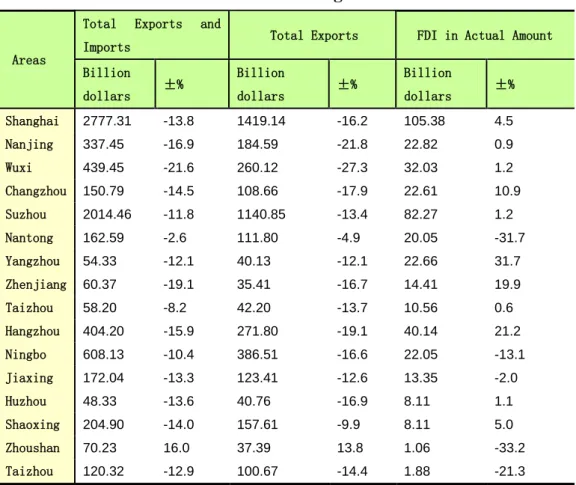
face with crisis management, and especially Zhejiang province, which has the highest proportion of private entrepreneur, would suffer most. Yangtze River Delta was put to the test in the latest economic crisis. Official statistics⑤ show that since October 2008, Shanghai has witnessed negative export trade; and in November, it had a negative fiscal revenue growth. Also, the industry experienced a recession in November and in December even a double-digit decrease occurred. It was the first time when Shanghai economy experienced a negative growth since the development of Pudong in 1990. Although the situation has been better since 2009, the total imports and exports in Yangtze River Delta still tend to be downward.
Table 1 Main Economic Indicators of Yangtze River Delta in 2009
Areas
Total Exports and
Imports Total Exports FDI in Actual Amount
Billion dollars ±% Billion dollars ±% Billion dollars ±% Shanghai 2777.31 -13.8 1419.14 -16.2 105.38 4.5 Nanjing 337.45 -16.9 184.59 -21.8 22.82 0.9 Wuxi 439.45 -21.6 260.12 -27.3 32.03 1.2 Changzhou 150.79 -14.5 108.66 -17.9 22.61 10.9 Suzhou 2014.46 -11.8 1140.85 -13.4 82.27 1.2 Nantong 162.59 -2.6 111.80 -4.9 20.05 -31.7 Yangzhou 54.33 -12.1 40.13 -12.1 22.66 31.7 Zhenjiang 60.37 -19.1 35.41 -16.7 14.41 19.9 Taizhou 58.20 -8.2 42.20 -13.7 10.56 0.6 Hangzhou 404.20 -15.9 271.80 -19.1 40.14 21.2 Ningbo 608.13 -10.4 386.51 -16.6 22.05 -13.1 Jiaxing 172.04 -13.3 123.41 -12.6 13.35 -2.0 Huzhou 48.33 -13.6 40.76 -16.9 8.11 1.1 Shaoxing 204.90 -14.0 157.61 -9.9 8.11 5.0 Zhoushan 70.23 16.0 37.39 13.8 1.06 -33.2 Taizhou 120.32 -12.9 100.67 -14.4 1.88 -21.3
Data source: http://www.zstj.net/info/ShowArticle.aspx? ArticleID = 4040 From a certain perspective, the crisis is an opportunity for Yangtze River Delta to adjust its development mode. Through the internal adjustment and upgrading industrial structure, a new and more effective export-oriented strategy could be
⑤
6
carried out, and some industries lying in the core area of the Yangtze River Delta should be moved to the surrounding areas which enjoy a relatively low cost. Regional resources can be adjusted so as to make it be more effective. In addition, the regional financial cooperation should be strengthened. As provinces in Yangtze River Delta have their own local banks, serving their own province, cooperation among provinces and cities is limited. During the financial crisis, small and mid-sized enterprises in each area have difficulty borrowing from the banks, even the large private enterprises also face the same problem. Since the second half year of 2008, many large local enterprises with billions of assets such as Zhejiang Nanwang Information Industrial Group, Zhejiang Hualian Sanxin Petrochemical Co., and Zhejiang Jianglong Holding Co. have suffered from capital chain fracture. Meanwhile, local banks began to tighten the loans in order to avoid risk, which made many small and medium-sized enterprises face bankruptcy. Moreover, banks usually refuse to lend to non-local businesses. Such problems would be solved if banks in the whole areas could cooperate.
3. Due to slow urbanization, there exist large gaps between different cities. Cities surrounding Shanghai including the southern region of Jiangsu Province and Hangjiahu area have reached high level of urbanization. City population proportion in this area is relatively high, and these cities have stronger competitiveness. While the northern part of Jiangsu and mid-west of Zhejiang exhibit a low level of urbanization, the number and scale of towns in such areas is decreasing, this is not good for the regional economic internal division and cooperation. Such areas become the obstacle to regional economic integration. During the urbanization emerge ecological environment problems. The rapid development of Yangtze River Delta is now threatened by a downward regional environment. While economy is growing, the ecosystem is becoming worse, in Yangtze River Delta 14 cities are acid rain control areas. However, the local government control has been hampered by the current environmental management system. For instances, the algae outbreaks in Taihu Lake in 2007 reflected the water safety issues. Now cities surrounding the lake
7
need diversion water from outside. Until now algae breaks out every year, the problem on lake pollution has not been solved. It is no doubt that the pollution of Taihu Lake is closely related to the regional industrialization and urbanization, but it is more closely linked with the increasingly area segmentation and management system. Due to the local government regional fragmentation, supply of public goods faces a serious shortage. For the regional environmental management, government either did nothing or adopted a ―taking a free ride‖ mentality, which caused inefficient solution of the problem.
2. Institutional barriers is the Major Obstacle to the Development of Yangtze River Delta Integration
All sorts of problems exist in the process of Yangtze River Delta integration, seriously interfering its development. We observe that Institutional barriers is the major obstacle.
1. Institutional barriers on the coordination of local and regional interests Before the reform and opening up, Yangtze River Delta actually was an integral region to the other areas in raw material supply and products sale under the state planning commission, and played a vital role in industrial development. At that time, due to the planned economy, the administrative driving force was effective. But since 1978, with the reforming of the market economy system, the decentralization granted local government and enterprise greater autonomy. Because of it, their independent decision-making increased. To some extent, China‘s 30 years of reform and opening up is along the path of decentralization, with the local governments‘ role becoming more and more prominent. In seeking regional interests, local governments adopt protectionism, and consider GDP growth as the optimal choice to obtain economic interests. Therefore, local economic interests often conflict with the collective interests of Yangtze River Delta economic development. Local
8
governments rarely pay attention to the development of regional integration. The game among various interest groups can easily be observed from the chaotic competition in attracting business investment which is a typical prisoner‘s dilemma. Investments threshold in each area is lowered and lowered, consuming the vigor of Yangtze River Delta. Take the land transfer for example, in the southern Jiangsu, the land transfer price is only 50,000RMB per mu. However, under the pressure of vicious competition, areas around Wujiang, Ningbo and Hangzhou have also cut the price down to RMB 50,000RMB per mu. Even urban area in Shanghai cannot avoid the fate. However, the normal price level of the mature zone in infrastructure investment should be around 150,000RMB per mu. Thus, the local government subsidies 100,000 RMB for one piece of land.⑥ In addition, vicious competition for the foreign-funded projects is also a huge problem. When one city is bargaining with foreign investors, the other local governments may compete and rob the chance by offering better policies, which often pays no attention to costs and lead to loss of the whole country‘s benefits.
2. Market Segmentation System in the Yangtze River Delta Integration Process Still Exist
Market integration is basic and internal requirement of Yangtze River Delta region economic integration. In the Yangtze River Delta integration process, the local protectionism gives birth to the regional segmentation and repetitive construction. Local market monopoly leads to a trend of serious isomorphism of industrial technology and product grading etc. It is fair to say that local governments support local enterprises, but have natural antipathy toward non-local ones, thus often takes administrative measures to restrict or suppress them. Local government will restrain non-local capital and products from entering the local market, disapprove technical standards of the other local governments. Exemption product in
⑥
Decai Yang. 2009. Yangtze River Delta Development: From Malicious Competition to Integrated Division Development. China Development vol.2.
9
one area would be inspected somewhere else, which increases transaction costs. Thus it would be hard for local specialty to enter into the other markets. Above mentioned slows down the process of Yangtze River Delta regional market integration.
3. Institutional barriers on Local Public Goods Investment Development Planning Competition
As the major investor and manager of public goods in its administrative divisions, local government often focus on more the regional interests during the public goods investment decision-making and planning, and the regional public goods supply is often more consistent with local residents‘ preference. It not only discourages the investment enthusiasm on cross-administrative areas public goods, but also increases the cost and difficulty of local public product investments consultation, having negative impact on the optimization of regional public goods investment in space. Compared with other public products, regional public products are featured with diverse supply and demand. The government performance evaluation which reflects the regional public interest can promote public cooperation. So far, regional public management, public product, and public cooperation have not been added into the local government performance evaluation index system, and independent evaluation units have not taken effect in Yangtze River Delta. The most typical example is the deep-water berth competition, which fully reveals the disorder public product investment planning in Yangtze River Delta. Cities along the Yangtze River have repeatedly invested a large amount of container terminal. Along with the 60 km from Jiangyin into Nantong, there exist 68 DWT coastal garages, meaning there is a DWT coastal garage on average of 0.9 km. Meanwhile, the excellent deep-water berth, Ningbo Beilun port, lacking goods supply ability, has not been fully utilized to its capacity. It is in a ―do-not-have-enough-to -eat‖ state, which is a tremendous waste.
10
4. Institutional barriers in Labor Movements of Yangtze River Delta
The institutional barrier in labor movement is serious in the process of Yangtze River Delta integration, although The Development of Talent Integration
Declaration aiming to build an integrated talent free flow structure was proposed in
2003. It has been in a deadlock state. The talent integration has remained at the level of recruitment in different areas, talent dispatch cooperation and mutual personnel qualification recognition. By 2010, social security problem of the migrant population, the main reason that restricts talent integration, is still unsolved. Take Shanghai, Ningbo and Nanjing for examples. Social policies cover different kinds of personnel. In Shanghai, it only covers people who work or do business in Shanghai without permanent local residential registrations. In Ningbo it covers people who are employed locally, without permanent local residential registrations. In Nanjing, it covers employees of agricultural registered permanent residence. The insurance coverage varies as well. In Shanghai, it includes industrial injury insurance (or accidental injury), medical treatment of in-hospital insurance and pension insurance. In Ningbo it includes industrial injury insurance, medical treatment of a serious illness insurance, pension insurance, unemployment insurance and maternity insurance, while in Nanjing, it mainly refers to the pension insurance. The social security of migrant population is of great difference. And the industrial injury insurance and medical insurance i.e. which migrant population has paid cannot be transferred; people should apply for another social security when moving to another city. Migrant population is therefore constrained by social security system, seriously restricting the progress of Yangtze River Delta integration.
3. The Deep Reason Analysis on Institutional barriers of Yangtze River Delta Integration Development
The Yangtze River Delta integration has made some progress during these years. However, new problems come up with the development of cooperation, for
11
instance, the position and division of regional cities, advantages of regional integration play, the industrial isomorphism, the market segmentation, free flow of product factors, the allocation of resources, the infrastructure convergence, the environment protection, and the comprehensive management of population, etc.. None of these serious problems can be smoothly solved by depending on factors cooperation or enterprise operation. They are problems that call for a higher level institutional coordination among governments. To some extent, the Yangtze River Delta regional cooperation comes to an institutional cooperation stage in which the government plays the main role. Unless the Institutional barriers on local governmental level is solved, the Yangtze River Delta economic integration can not achieve any real objectives.
The regional economic integration process is the process of regional economic interests adjustment, which starts from the parts with the least conflicts and ends with the parts with the most conflicts. In China, local government is both the leader and estimator of the regional economic integration. Local government has well-defined border and is highly interested in local economic development performance, and faces severe competition with the other governments. For local governments in the Yangtze River Delta, the regional transportation network cooperation, the information cooperation, and the customs cooperation is the field with less interest conflicts, thus can be smoothly integrated while the conflicts between regional industrial division of labor and cooperation is more fundamental, so regional integration can not proceed smoothly. In the Yangtze River Delta region, following reasons restrict the government‘s behavior.
Firstly, the regional GDP and industrial development level are the absolute indicators estimating government officials‘ performance. Zhou Li‘an, etc. (2005)⑦ adopted provincial data since China‘s reform and systematically verified significant relations between the local officials‘ promotion and the economic performance, and provided some empirical evidence to the existence of promotion stimulation. They
⑦
Li‘an Zhou, Hongbing Li & Ye Chen. 2005. Relative Performance Appraisal: An Expired Research on Chinese Local Official Promotion. Economic Journal 1: vol. 1.
12
found that the probability of provincial officials‘ promotion has a significant positive correlation with the provincial GDP growth.
Secondly, the ranking compared with the surrounding cities (usually within the integrated region). The central government rationally uses relative performance evaluation method when making the local government officials‘ performance appraisal decision, so this index for each session of local government officials is more significant than the absolute level index mentioned above, as this indicator can reflect the governing capability of the local government officials.
Thirdly, due to a scattered and crossed administrative structure, the local governments have to choose their own management mode. For example, the customs is managed vertically. Its administration structure is like the bureaucracy pyramid vertical structure, while its functional organization is longitudinal and transverse segmentation type belonging to each province and region. The power of the slope and function division affect customs clearance efficiency, meanwhile, due to the presence of the budget management mode of the central government, customs fight for the business for a better performance appraisal, and local governments exercise their customs affair management, thereby each local customs will go its own way.
In China, the central government has absolute power in official appointment, so as to stimulate the local economic development and select effective officials. Selection standards consist of concrete and comparable index. Due to the pyramid administrative structure and a trend toward a younger local official team, local officials don‘t have much room to get promoted, making the regional competitions extremely competitive. In the local development process, government has great power and influence, and controls important resources such as land, loans, tax etc., making it possible to compete for a higher GDP growth among local governments. So, the long-standing problem about industrial isomorphism and local protection in Yangtze River Delta is not only a simple result caused by enterprises‘ seeking for profit, but also the part of government officials‘ implementation of regional development strategy and policy, which obviously contains a part of political interest
13
considerations.⑧ Officials of different levels face both economic and political competition, therefore when making decisions, they not only consider the economic factors, but also the political interest.
In this case, the local government will try its best to prevent regional benefit from ―spilling over‖, on the other hand, they will transfer development costs outside, thus the so-called ―administrative region economy‖ phenomenon appears. Such government behaviors are like: (1) From the industrial development direction aspect, they do not have an overall vision of regional development and ignore the importance of regional industrial planning, which directly causes repeated construction. Even when faced with the central government‘s guiding principles, they will come up with the ways to ―play the edge ball‖ by changing the project names. Since the central government puts economic development as its priority, it rarely punishes transgression, thus local government often plays ―game‖ with the central government. (2) They only pay attention to the GDP growth and industrial development level in their own area, but indifferent toward the impacts (especially on environmental impacts) on the surrounding areas. And they lack the motivation to cooperate. For significant problems such as cross-city infrastructure building, important strategic resource development, ecological environment protection and construction, and the flow of production factors, there exists no effective system to guarantee its implementation. (3) To develop their own economy, they often take protectionism. Local government behavior have spillover effect on the surrounding cities, so they might initiatively do something that are good for their own economic growth and something that are bad for the other regions, and be promoted by suppressing others, for instance preventing non-local products from entering, and maliciously competing for foreign investments. (4)In Yangtze River Delta, the policies and regulations are not coordinated or united. Local policies and regulations are just based on the local interests while it considers less on the common interests of surrounding areas, for example, information sharing issue,
⑧
Jin‘an Zhou. 2004. Motivation and Cooperation of Government Officials in the Promotion Game— Analysis on the Long-standing Problems of Local Protectionism and Repetitive Construction. Economic Research vol.6.
14
entrance qualifications, and the cross-region service function is very weak. In some places, the local taxes, and the limits on funds, personnel, and technical flows, etc. still exist. (5) When government officials face retirement or are less likely to get promoted, their motivation to develop local economy will be lost, let alone do their best to stimulate the regional economic development. Therefore, we consider the system reason as the main cause for the slow development of Yangtze River Delta integration.
4. Overcome Institutional Barriers and Promote Yangtze River Delta Integration Development
The above analysis points out that overcoming institutional barrier are the major measures than can be adopted for Yangtze River Delta integration development. And the recommend suggestions are listed as follows.
Firstly, appoint officials to implement off-site and reduce the ―localism‖ trend. We notice that although officials can solve some problems relying on local relation of their last term, the enthusiasm of the current term would be affected due to the turnover. To prevent problems caused by officials‘ turnover, and avoid negative influence of pursuing short-term effect, local people‘s congress can make development policy into laws, thus reducing the impact in the long-term.
Secondly, strengthen regional cooperation between governments by means of holding regular meetings among local leaders. Use the form of inter-regional cooperation agreements to show the results of regional cooperation. But such kind of cooperation includes a relatively low-level of institutionalization. To be more accurate, it is just an advocate, not an institutional cooperative and coordinated mechanism. Agreements between governments are just like leader‘s commitments, lack of legal effect or stability, and thereby they can be easily put aside once the leader is transferred.
Thirdly, improve official selection and appointment system. The decision –making on the resources of local economic development is controlled by local
15
government, and the main official selection indicators are based on the regional economic development level. All these lead to the malicious financial competition between local governments. Thus, if the data index on politics and economy be separated, a more reasonable official evaluation system with long-term view will be built up, reputation mechanism will be displayed. At the same time, public satisfaction degree will be put into government‘s political evaluation category, and the influence of NPC(National People's Congress)and CPPCC(Chinese People's Political Consultative Conference)in supervision and accountability of government officials will be further expanded, more attention to the social and economic sustainable development will be paid by local government officials.
Fourthly, enhance coordination from upper government, and improve the coordination between central government and provinces or municipalities, between provincial government and its jurisdiction of cities. When faced with trans-regional issues which call for province (or municipalities) cooperation, the central coordination will be particularly important. Once the business involves interests of various provinces, the provincial level coordination would often float on the surface. Therefore, only the central government can really affect or correct the distorted local government competition behavior.⑨ Of course, coordination is just a kind of solution. More needs to be done in regulating regional economic competition order, reconstructing a new market-unit-helped legislation and enforcement system, especially clearly writing the rule of uniting a domestic market into law, constructing principles of economic integrated competition order, straightening out rights and relations between the central and local government, accurately positioning the authority and power of local government, putting provincial economic and trade issues into central jurisdiction, etc. Compared with regular coordination, establishing legislation and judicial system would be more effective and helpful in regulating regional even national product and factor markets, coordinating regional integrated economic competition and cooperation, and constructing a united economic
⑨
Ye‘an Zhou, Xingyuan Feng & Jianyi Zhao. 2004. Local Government Competition and Market Order Re-contribution. China Social Science vol.1.
16
resources market. These call for the central government to adjust policy in right time. We also need to play the positive role of the regional competition, form a scientific incentive and restraint mechanisms on system aspect, guide local government‘s behavior to safeguard free flow of elements, build up a common market and fair competitive platform in Yangtze River Delta to realize a maximum regional benefit,⑤ ⑩
and finally to promote the Yangtze River Delta integration process.
Reference
[1] Decai Yang. 2009. “Changsanjiao Chanye Fazhan: Cong Exingjingzheng Dao Yitihua Fengong Fazhan ” [Yangtze River Delta Development: From Malicious Competition to Integrated Division Development]. China Development vol.2. [2] Li‘an Zhou, Hongbing Li & Ye Chen. 2005. ―Xiangdui Jixiao Kaohe: Guanyu
Zhongguo Difang Guanyuan Jinsheng De Yixiang Jingyan Yanjiu‖[Relative Performance Appraisal: An Expired Research on Chinese Local Official Promotion]. Economic Journal 1: vol. 1.
[3] Jin‘an Zhou. 2004. ―Jinsheng Boyi Zhong Zhengfu Guanyuan De Jili Yu Hezuo—— Jianlun Woguo Difang Baohuzhuyi He Chongfujianshe Wenti Changqi Cunzai De Yuanyin‖[Motivation and Cooperation of Government Officials in the Promotion Game— Analysis on the Long-standing Problems of Local Protectionism and Repetitive Construction]. Economic Research vol.6.
[4] Ye‘an Zhou, Xingyuan Feng & Jianyi Zhao. 2004.“Difang Zhengfu Jingzheng Yu Shichang Zhixu Chonggou”[Local Government Competition and Market Order Re-contribution]. China Social Science vol.1.
[5] Zhang xinsheng, Wang zhaojia.2010“Zhongguo Quji Chanye Zhuanyi Beijing Xia De Dongbudiqu Chanyefazhan Lujing ” [The Industrial Development Path of the Eastern China in the Interregional Industrial Transfer].Wuhan University of
Technology(Social Science Edition)Vol.23
[6] Zhibiao Liu, Jianghuai Zhen. 2010.“Chongtu Yu Hexie: Changsanjiao Jingji Fazhan
⑩
Zhibiao Liu, Jianghuai Zhen. 2010. Conflict and Harmony: Yangtze River Delta Economic Development
17
Jingyan” [Conflict and Harmony: Yangtze River Delta Economic Development Experience]. China Renmin University Press.
[7] http://www.stats-sh.gov.cn/
[8] China Statistical Yearbook 1979. China Statistics Press.