Religion and polygamy : evidence from the
livingstonia mission in Malawi
著者
Kudo Yuya
権利
Copyrights 日本貿易振興機構(ジェトロ)アジア
経済研究所 / Institute of Developing
Economies, Japan External Trade Organization
(IDE-JETRO) http://www.ide.go.jp
journal or
publication title
IDE Discussion Paper
volume
477
year
2014-09-01
INSTITUTE OF DEVELOPING ECONOMIES
IDE Discussion Papers are preliminary materials circulated
to stimulate discussions and critical comments
Keywords:
Christianity, Culture, Gender, Mission, Polygyny, ReligionJEL classification:
J12, N37, Z12, Z13* Research Fellow, Microeconomic Analysis Studies Group, Development Studies
IDE DISCUSSION PAPER No. 477
Religion and Polygamy: Evidence
from the Livingstonia Mission in
Malawi
Yuya KUDO*
September 2014
Abstract
In contrast to the prevailing preconception, Christian females engage in polygyny in most of sub-Saharan Africa. Based on individual-level data provided by the Demographic and Health Survey (2000, 2004, 2010) in Malawi, this study explores whether Christian identity reduces the likelihood that females enter into polygyny. To address the endogeneity associated with this identity, the analysis adopts an instrumental variable (IV) approach by exploiting the unique setting of a Christian mission dating back to the late 19th century. Exposure to the mission, measured by geographical distance to the influential mission station, Livingstonia, enabled the indigenous population to gradually convert to Christianity. This is particularly true for the local population not belonging to the Yao, an ethnic group that was largely proselytized into Islam because of their historical connection with the Arabs. Using the distance-ethnicity (non-Yao) interaction as an IV for women's Christian identity, with numerous historical, geographic, and climate controls, this study discovers that compared to those practicing other religions (Islam and other) or no religion, Christian females are indeed less likely to form polygynous unions. This study also provides some evidence suggesting that the Christianity effects are more evident in a society at a more primitive stage of development.
The Institute of Developing Economies (IDE) is a semigovernmental,
nonpartisan, nonprofit research institute, founded in 1958. The Institute
merged with the Japan External Trade Organization (JETRO) on July 1, 1998.
The Institute conducts basic and comprehensive studies on economic and
related affairs in all developing countries and regions, including Asia, the
Middle East, Africa, Latin America, Oceania, and Eastern Europe.
The views expressed in this publication are those of the author(s). Publication does
not imply endorsement by the Institute of Developing Economies of any of the views
expressed within.
I
NSTITUTE OFD
EVELOPINGE
CONOMIES(IDE), JETRO
3-2-2, W
AKABA,
M
IHAMA-
KU,
C
HIBA-
SHIC
HIBA261-8545, JAPAN
©2014 by Institute of Developing Economies, JETRO
No part of this publication may be reproduced without the prior permission of the
IDE-JETRO.
Religion and Polygamy: Evidence from the Livingstonia
Mission in Malawi
∗
Yuya Kudo
†September, 2014
Abstract
In contrast to the prevailing preconception, Christian females engage in polygyny in most of sub-Saharan Africa. Based on individual-level data provided by the Demographic and Health Survey (2000, 2004, 2010) in Malawi, this study explores whether Christian identity reduces the likelihood that females enter into polygyny. To address the endogeneity associated with this identity, the analysis adopts an instrumental variable (IV) approach by exploiting the unique setting of a Christian mission dating back to the late 19th century. Exposure to the mission, measured by geographical distance to the influential mission station, Livingstonia, enabled the indigenous population to gradually convert to Christianity. This is particularly true for the local population not belonging to the Yao, an ethnic group that was largely proselytized into Islam because of their historical connection with the Arabs. Using the distance-ethnicity (non-Yao) interaction as an IV for women’s Christian identity, with numerous historical, geographic, and climate controls, this study discovers that compared to those practicing other religions (Islam and other) or no religion, Christian females are indeed less likely to form polygynous unions. This study also provides some evidence suggesting that the Christianity effects are more evident in a society at a more primitive stage of development.
Keywords: Christianity, Culture, Gender, Mission, Polygyny, Religion JEL classification: J12, N37, Z12, Z13
∗I thank Marc Bellemare, James Fenske, Yoshihiro Hashiguchi, Assi Kimou, Katsuo Kogure, Tomohiro Machikita,
Momoe Makino, Dorothy Nampota, Gil Shapira, Abu Shonchoy, Tsutomu Takane, Shinichi Takeuchi, Selma Telalagi´c, and participants at the NEUDC Conference (Harvard, 2013) and the CSAE Conference (Oxford, 2014), and seminars/workshops at GRIPS, Hitotsubashi, and IDE-JETRO for insightful comments and suggestions. Finan-cial support from the IDE-JETRO for my field trip to Machinga, Mulanje, and Zomba is gratefully acknowledged. My great thanks in the field trip go to McDonald Chitekwe, James Mkandawire (Invest in Knowledge Initiative), and rural respondents in the survey. The findings, interpretations, and conclusions expressed in this paper are entirely those of the author and do not represent the views of the IDE-JETRO. All errors are my own.
†Institute of Developing Economies, JETRO, 3-2-2 Wakaba, Mihama-ku, Chiba-shi, Chiba 261-8545, Japan,
1
Introduction
In the developing world, marriage is an event of significant consequence for economic growth, as the formation of a joint production and consumption unit affects a household’s investment in capital resources (Fafchamps and Quisumbing (2008)) and often supplements welfare services insufficiently provided by formal institutional mechanisms (e.g., health insurance) (Weiss (1997)).
While both rigorous empirical and theoretical research remains scarce, several novel contri-butions have just recently been made to the knowledge and understanding of economic impacts of polygyny (e.g., Tertilt (2005, 2006); Schoellman and Tertilt (2006); Bove and Valeggia (2009); Edlund and Lagerl¨of (2012)). For example, Tertilt (2005) quantitatively demonstrated that legally prohibiting polygyny resulted in a considerable increase in savings and a decrease in fertility in sub-Saharan Africa, which had a high incidence of polygyny.1 Edlund and Lagerl¨of (2012) also the-oretically argued that monogamy boosted human capital investment by encouraging young males to spend more time educating their children in their married life rather than pursuing leisure as they did during bachelorhood. Despite its evident significance, however, there is a marked paucity of empirical studies that have explored issues affecting women’s engagement in polygyny (e.g., Ja-coby (1995); Fenske (2013a); Dalton and Leung (2014)). Generally, factors of economic reasoning and cultural elements, or the interplay between the two, may justify the prevalence of polygyny. By focusing on cultural influences, which appear to be less sufficiently explored than economic motives, this study attempts to fill the knowledge gap in the context of sub-Saharan Africa and improve the understanding of factors contributing to Africa’s economic performance, which has been one of the central subjects in the development community.
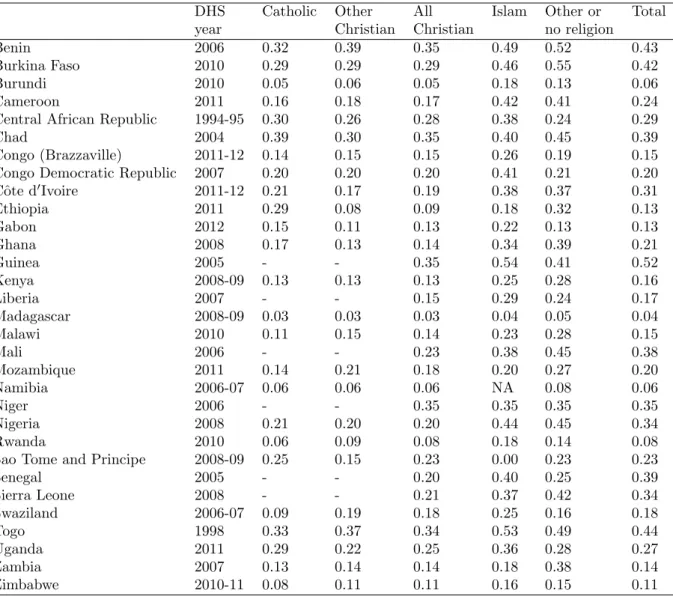
Apparently for cultural factors, it is common knowledge that unlike Islam, Christianity prohibits polygamy.23 However, such a dichotomous view may be misleading. Based on data drawn from the Demographic and Health Survey of 31 sub-Saharan African countries, Table 1 presents the proportion of females in a polygynous union relative to the total number of married females aged 15 to 49 years by religious identity. It is evident from the table that polygyny is more common among non-Christian females than among Christians. However, a certain proportion of Christian females are also engaged in polygynous marriages. While it is relatively difficult to obtain precise
1Based on Tertilt (2005), enforcing monogamy reduces the return on raising daughters by generating negative
bride prices at equilibrium. In a monogamous society, as having children becomes less profitable, investment in physical assets becomes more important for security in old age. Similar effects are obtained by transferring the right to choose a husband from fathers to daughters (Tertilt (2006)).
2This study interchangeably uses polygamy and polygyny, since polyandry is rarely observed in societies. 3As explained in more detail in footnote 13, the author conducted a short questionnaire-based survey in three
districts (Machinga, Mulanje, and Zomba) in southern Malawi in 2013. Whether the respondents were Christians or Muslims, they usually perceived that Christianity prohibited polygyny unlike Islam.
estimates, moreover, the absolute number of Christian females entering into polygyny is likely to be much larger than that of Muslim females in this region. This is because the Christian population in sub-Saharan Africa is almost twice as that of Muslims (Pew Forum on Religion & Public Life (2010), p. ii), and the majority of the population is affiliated with either religion. This picture questions the causal interpretation of the relationship between Christianity and the likelihood of polygamy. The uncertainty about the causal inference may also arise from syncretism, which often abounds in Africa, whereby people tend to venerate both, their ancestors and religious authorities. Marginally related to this point, Lewis (1955) also noted that people are prone to ignoring religious precepts that conflict with their economic interest, and that religious doctrines are continuously adjusted to new social conditions (pp. 103-104; p. 106).4 Given these pieces of consideration, this study formally tests whether Christianity reduces the incidence of polygyny.
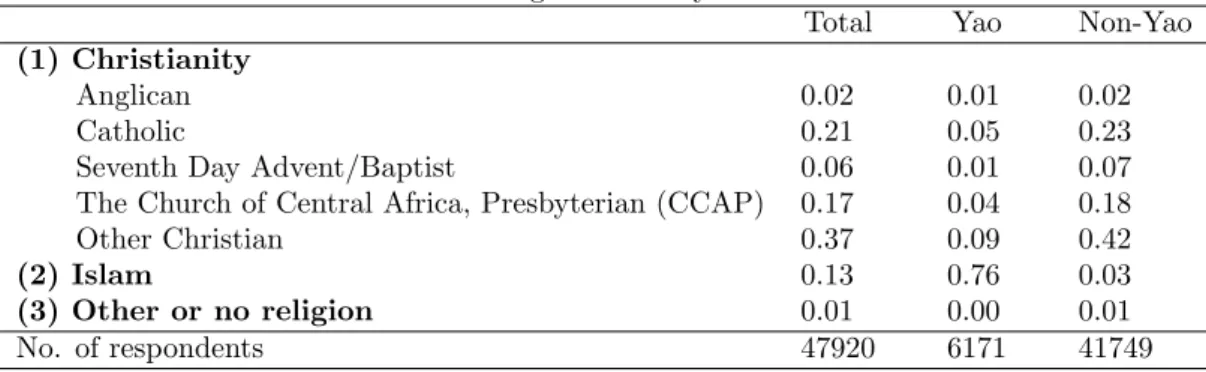
To estimate Christianity effects on the practice of polygynous marriage, this study uses repeated cross-sectional data drawn from the Malawi Demographic and Health Surveys (MDHS) 2000, 2004, and 2010. The data contains a variety of information pertaining to marriage, fertility, family planning, reproductive health, child health, and HIV/AIDS at the individual level, and therefore it is a highly valuable resource for an empirical study. The country selected suits the purpose of the current study for the following three reasons. First, Malawi is one of the highly polygynous countries in (particularly eastern) sub-Saharan Africa, with more than 10% of married men having multiple wives. Second, the MDHS data set contains a reasonable range of females practicing Christianity, Islam, other, or no religions, which is useful in an empirical analysis. As reported in Table 2, in the data set, approximately 85.9% of the females in the sample practiced some form of Christianity, whereas about 13.0% and 1.0% of them practiced Islam and other/no religions, respectively.5 Third, this country’s experience with the Christian mission (Livingstonia Mission) provides a unique setting that facilitates identification of the causal Christianity effects.
The descriptive analysis presented in this study reveal that Christian females are indeed less likely to be in polygynous unions. However, this observation may not be interpreted as evidence supporting the causal influence of Christianity for a few reasons. For example, the present preva-lence of Christianity in this country originates from European contacts, such as the Christian
4For instance, given potential adherents’ strategic choice of religion, it is possible that each denomination may
modify the codes to entice them in a competitive religious market. In addition, priests may also differently (re-)interpret religious doctrines from their conviction, frustration, or ambition.
5In Table 2, the proportion is unweighted. To calculate the true proportion of the entire population from
the sample data, appropriate sample weights are required. However, the weighting may not significantly affect the overall picture. For example, based on the recent estimate in 2010, provided by Pew Forum on Religion & Public Life (http://features.pewforum.org/global-christianity/total-population-percentage.php), approxi-mately 82.7% of the total population in Malawi was Christian, which is very close to the unweighted proportion observed in the MDHS data.
missions of the 19th and 20th centuries, followed by colonial administration. If such European influence has a long-term independent influence on the incidence of polygamy, then the simple cross-sectional comparison results in a biased estimate of interest.
To address a few potential endogeneity issues, this study adopts two strategies. First, this study attempts to control for pre-determined local conditions that might have affected both the advance-ment of missionary penetration and colonial operation. Hence, a great number of geographic and climate conditions surrounding the surveyed communities (e.g., climatology, landscape typology, soil and terrain, and crop season parameters) are exploited as controls in the estimations. In addi-tion, the regressors include historical information on travel routes of European explorers, railway lines in the 20th century, and the volume of slave export in the 19th century. All these pieces of information, which cannot not be discerned from the MDHS, will be taken from other data sets of the third Integrated Household Survey (IHS) 2010-2011 and Nunn and Wantchekon (2011).
The second approach addresses the endogeneity problems by adopting an instrumental variable (IV) strategy. This study notes that Christianity was less appealing to the Yao, an ethnic group that was largely proselytized into Islam, because of their ivory and slave trade with the Arabs, which existed before the arrival of the Christian mission. Thereafter, the interaction of an MDHS community’s distance to the mission’s influential station, Livingstonia, with an indicator variable for non-Yao ethnic groups will be used as an instrument for an individual’s Christian identity. By performing three independent falsification tests, the exclusion restriction of the instrument is also carefully discussed.
This study contributes to many strands of the extant literature. First, this study can be seen as one of the few empirical studies exploring the determinants of polygamy in the developing world. For instance, Jacoby (1995) examined Cˆote d’voire to argue that women’s high marginal contribution to agricultural production lowered the cost that males incurred to have an additional wife (i.e., the shadow price of wives), and therefore prompted the incidence of polygyny. Dalton and Leung (2014) provided empirical evidence suggesting that in western Africa, polygyny emerged as an institution that has persisted to the present as a result of the transatlantic slave trades that generated a great shortage of males in marriage markets during that time. In the context of sub-Saharan Africa, Fenske (2013a) also tested a variety of influential hypotheses that may explain polygyny, such as inequality in male resources (Becker (1981)), colonial schooling, economic growth, rainfall, political shocks, and a desire to acquire many (possibly male) offsprings (Grossbard-Shechtman (1986); Milazzo (2014)), and the aspects investigated by Jacoby (1995) and Dalton
and Leung (2014).67 The current study underscores the contribution of one factor perceived to be cultural, i.e., religion, to this practice.
Second, within the field of economics, empirical studies exploring the impacts of religion on economic outcomes are scarce (see Iannaccone (1998) and Aldashev and Platteau (2014) for a brief review on the literature), and the causal relationship is not always explicit. As indicated in the previous literature (de Jong (2011); Aldashev and Platteau (2014)), this ambiguity is, in part, attributed to difficulty in establishing a solid empirical strategy to identify the causal effects. In addition, previous studies were typically based on cross-country comparisons or analyses at a sub-national level (e.g., Guiso et al. (2003); Barro and McCleary (2005); Noland (2005); McCleary and Barro (2006)) and consequently, micro-evidence from within (particularly low-income) countries is extremely scarce (e.g., Clingingsmith et al. (2009); Chen (2010)). In contrast to those studies, by using large-scale micro-level data collected in Malawi, this study attempts to identify the causal effects of religious identity in a rigorous manner. The use of an individual as a unit of observations may allow this study to discuss the role of religious values internal to individuals as a mechanism behind the identified impacts. The in-depth within-country nature of the analysis also helps disentangle the complexity between religion and the socio-economic environment, which is usually difficult in macro-level studies.
Third, there has been a recent effort by economists to better understand the role played by culture, norms, and beliefs in an individual’s decision making and the intergenerational transmis-sion of such cultural values (For example, see Fern´andez (2011) and Alesina and Giuliano (2013) for a brief review on the literature). By adding a new piece of empirical evidence from a religious perspective, the current study will also contribute to this rapidly growing body of research.
Finally, a growing body of research has demonstrated the long-term impacts of historic events and the associated social institutions on development (e.g., Acemoglu et al. (2001); Acemoglu et al. (2002); Nunn (2008)). In the context of the current study, for example, with a thorough 6For example, several sources of male inequality, such as income and the number of sisters (Bergstrom (1994)) as
well as differences in technological efficiency of human capital creation between young and old generations (Edlund and Lagerl¨of (2012)), are also analyzed in the previous theoretical studies.
7Regarding the inequality of male endowments, Becker (1981) theoretically demonstrated that even when the
numbers of males and females are equal, polygyny emerges because “superior” males endowed with resources hav-ing high complementarity with women’s marginal contribution to the marital output (e.g., land-rich males) can expel from the marriage market “inferior” males endowed with resources having low complementarity with women’s marginal productivity (e.g., resource-poor peasants). This situation may be relatively true for less-developed soci-eties. As the economy grows, however, the marital output depends more on children’s human capital rather than their quantity, increasing the value of women’s ability to produce offspring of good quality over their fecundity in a marriage market. The child quality is raised when mothers have plentiful human capital in high complementarity with that of their husbands. In modern economies, it is difficult for a husband to afford multiple wives of high quality due to an increase in their shadow prices. Consequently, the growth of the economy makes the marital in-stitution less polygynous, until skill-based assortative monogamous mating emerges as an equilibrium (Gould et al. (2008)). This mechanism is also compatible with the theoretical framework provided by Becker (1981), suggesting that inequality in female resources generates polyandry, or at least reduces polygyny.
focus on the endogeneity, Gallego and Woodberry (2010) and Nunn (2014), by using regional-and individual-level data sets, respectively, estimated the lasting impacts of the Protestant regional-and Catholic missions on the promotion of education in colonial Africa. In addition to the reduced-form effects of the Livingstonia Mission on the reduced-formation of women’s polygynous relationships, the IV approach used in the current study also reveals the influence of religious conversion prompted by the mission. However, due to an insufficient number of good instruments, this study does not disentangle the Christianity effects, although the previous studies often highlighted the differing influences of the Protestant and Catholic missions on present-day economic development levels (e.g., Weber (1958); Becker and Woessmann (2009); Arru˜nada (2010)).8
This study is organized into six sections. Section 2 discusses an empirical strategy, followed by a data overview in Section 3. Historical background relevant to the identification strategy is provided in more detail in the Appendix A. The main findings of this paper are presented in Section 4. Section 5 presents an interpretation of the findings. The heterogeneity of Christianity effects is also explored in Section 5, with concluding remarks presented in Section 6.
2
Empirical Strategy
2.1
Specification
As explained in Section 3, the primary data used in this study is from three rounds (2000, 2004, 2010) of the Malawi Demographic and Health Survey (MDHS) that aimed to collect representative data on population, health, and nutrition of females of reproductive age (15-49).
For a female i living in a community j that were married when the surveys were conducted, this study estimates
yij = α1+ α2cij+ α3eij+ α4xij+ ϵij, (1)
whereby yij is an indicator, equal to one if the marriage-type was polygyny and zero otherwise; 8For example, using province-level data covering 17 sub-Saharan African countries, Gallego and Woodberry
(2010) found that Protestant missionary activities had greater long-term impacts on educational attainment than the Catholic missions, which contributed less to increasing the present-day level of schooling. They also extended the analysis to argue that the Protestant missionary effects were mainly observed in Catholic areas, whereby Catholic missionaries occupied a sort of “monopolistic position” in the religious market due to the protection provided by former colonial governments. Therefore, to gain converts, the Protestant missionaries had to exercise efficiency to overcome their institutional disadvantage. In addition, using 2005 Afrobarometer data covering 17 sub-Saharan African countries, Nunn (2014) also found a long-term positive influence of both Catholic and Protestant missions on present education levels and also found that the Protestant missions reduced the gender gap, whereas the Catholic missions increased it.
cij takes the value of one if she was Christian and zero otherwise; a dummy variable for non-Yao ethnic groups are measured by eij, which will be discussed in detail in subsection 2.3; the vector
xijcontains other determinants of polygamy specific to her, her original household, and her natal
community, in addition to birth-cohort-fixed effects (classified into five groups: born in the 1950s, 60s, 70s, 80s, and 90s) and survey-round-fixed effects; and ϵij represents a stochastic error. In this study, married females include both those currently in a marital union and those living with a partner. Approximately 92% of all “married” females apply to the former case. It is preferred that the xij is evaluated at the point when she entered into a marriage market. Hence, to capture
the levels of wealth at a household’s disposal at that point, in addition to her birth order and other standard controls such as age and (arguably pre-determined) education, the xijincluded the
number of both younger and older siblings that had passed away as well as the number of siblings living when she was 15 years old, based on recall information provided by the survey responses.9 The number of deceased siblings is included in the xij, presuming that the mortality information
may positively correlate with her original household’s poverty status. Conditional on the mortality information, the number of existing siblings may reflect a household’s financial capacity to raise children. Moreover, Malawi has one of the highest HIV prevalence rates in the world, which may also affect the marital practice as shown by Ueyama and Yamauchi (2009), for example.10 To control for the influence of HIV, this study also included in xij a community’s distance to the
origin of the HIV virus in the Democratic Republic of the Congo (latitude, -6.31; longitude, 23.59), as indicated by Oster (2012).1112
Notably, modeling women’s entry into a polygynous union given the available data poses one limitation. While the specification (1) apparently attempts to relate women’s own religion to
9In the marriage equation, the level of education is assumed to be pre-determined, although it may still be
possible that both the marital and schooling decisions are simultaneously made. Nevertheless, excluding educational attainment from regressors did not alter the implications obtained from the analysis including it.
10They showed that an increase in mortality among prime-age adult population lowered women’s marriageable age
in Malawi, and they interpreted this finding as women’s attempts to avoid HIV infection associated with pre-marital sexual intercourse.
11The 2004 and 2010 MDHS collected blood for HIV testing from sample respondents who volunteered for the
test. Thus, as Oster (2012) demonstrated, the analysis could also have collapsed the HIV data to the cluster level. However, this method results in excluding the entire observations of the 2000 MDHS from the analysis. It might also have been possible to estimate past HIV prevalence by using the current information (e.g., Oster (2010)). However, the implementation of such a task requires additional pieces of information that may not be available. As a result, this study decided to use the distance rather than the actual prevalence, which would also help avoid controlling for the endogeneity associated with the latter as well as simplify the analysis.
12Using the DHS data drawn from 14 African countries including Malawi, Oster (2012) showed that a community’s
distance to the origin of the HIV virus had a significantly negative association with the rate of HIV prevalence in a community. To examine this negative association in the current context, this study related a community’s HIV prevalence, measured by the proportion of HIV positive respondents (both male and female) among those who tested for HIV in each community, to the community’s distance to the origin point, with a control for an urban dummy, latitude/longitude, geography and climate, as well as district- and survey-round-fixed effects. The analysis using the community-level observations validated the negative relationship between the distance to the virus origin and HIV prevalence at a coefficient of -0.607 with 5% significance, suggesting that in Malawi, HIV prevalence was less in areas far from the virus’ origin in the Democratic Republic of the Congo.
polygamy, in reality, it may result in exploring the influence of parents’ religious identity on their daughters’ marriage. This case is likely if parents and their daughters share the same religious faith when the daughters reach the marriageable age determined by society as well as the daughters have less autonomy in spouse selection. As the data do not contain information for who makes the final decision on a marriage, the estimated Christianity effects should be interpreted as referring to the average impacts of Christian identity observed among relevant decision makers on a bride’s side (e.g., whether the bride, her parents, or other relevant parties).
The estimated α2 does not necessarily imply causal Christianity effects on polygynous rela-tionship (if any) for the following reasons. First, as previously noted, the mass conversion of this country’s population to Christianity can be attributed to missionary penetration followed by British colonial administration. If such European influence has directly altered the marital behavior of the present generation, this will bias the Christianity effect.
Second, while inter-faith marriage may typically be less preferred in some African countries (Pew Forum on Religion & Public Life (2010), p. 40), this may not necessarily be true in Malawi. To complement the analysis based on the MDHS data, the author conducted a short questionnaire-based survey in southern region of Malawi in 2013.13 Based on this survey, for example, more than 75% of the respondents answered that inter-religious marriages are common and all mentioned that in such cases, women typically follow their husbands’ religion after marriage.14 In addition, in the MDHS data, approximately 80% of the surveyed couples shared the same religious faith.15 The same religious identity shared by the great proportion of couples observed in the MDHS data may also suggest the conversion of married females to their husband’s religion.
Because the MDHS data contain information only on an individual’s current religion, the mea-sured Christianity used in this study has noise that may lead to relative difficulty in analyzing 13To examine people’s perception of marital and inheritance practices as well as the relationship between these
practices and religious beliefs, the author conducted a short questionnaire-based survey in three districts (Machinga, Mulanje, and Zomba) in southern Malawi in 2013. After obtaining the village list from the respective district council, in this survey, the author randomly selected at least one village from each district, resulting in five villages surveyed in all the three districts. In each village, two to five residents were interviewed, and the duration of each of those interviews was approximately 30-60 minutes. To ensure confidentiality and to increase data reliability, the interviews were conducted in an environment where the respondent was alone with the author and the research assistant (for translation to and from Chewa). Since the interviewed respondents were not randomly selected due to limited resources (i.e., convenience sampling), it is difficult for the current study to generalize the findings from the field interviews. The survey eventually reached eight male and 12 female adult respondents. Among the respondents were members of four ethnic groups (the Lomwe, Ngoni, Nyanja, and Yao); 11 respondents were Muslim and nine were Christian.
14In addition to the religious dimension, in the short-questionnaire based survey, the author also asked the
respon-dents if inter-ethnic marriages were common. Approximately 90% of the responrespon-dents agreed on its commonness, and approximately 33% of marriage cases observed in the couple-level data of the MDHS were inter-ethnic.
15A partner’s religion and ethnicity were not indicated by questionnaire responses from the surveyed females.
However, the MDHS, while emphasizing data collection from females, also surveyed males between the ages of 15 and 54 in one-third (one-fourth in 2000) of the selected households, resulting in information on 7,287 couples in the data set used in the current research. This feature allows this study to analyze the data from the perspective of couples.
the influence of Christian identity during the formation of a marital relationship.16 In addition, considering that Islamic law does not prohibit polygyny, Christian females may allow their Chris-tian husbands, willing to have multiple wives, to convert to Islam. As females usually follow their husband’s religion, in this case, these married Christian females may also convert to Islam (reverse causality).17
2.2
Controlling for Pre-determined Conditions
To address the endogeneity issues, first, this study attempted to control for pre-determined local conditions that characterized the entry and explosion of the missionary venture as well as colonial administration.
2.2.1 Geographic and Climate Controls
The settlement pattern of the missionaries was influenced by a number of factors. As indicated by Johnson (1967) and elsewhere (e.g., Nunn (2010); Nunn (2014)), the key elements generally included health-related items such as the availability of clean water and malaria-preventing ge-ographic and climatic conditions (e.g., low temperature, high altitude); economic considerations such as access to trade routes from/to Europe (which might have been affected by railway networks in colonial periods) and the availability of fertile land needed for the creation of a cash crop econ-omy; and the mission’s benevolent nature to eradicate slave trades. All these points are indicated in the Livingstonia Mission as described in Appendix A.1.
To attenuate the possibility that these factors confound causal inference of the religious effects, an attempt was made to control for the large number of geographic and climate conditions that must have been encountered by the missionaries. However, apparently no suitable pre-missionary data exist for an empirical analysis. Thus, given the assumption that those conditions have not noticeably changed over the last century, the current study alternatively decided to use such information collected in the recent past. In the subsequent analysis, this information was provided by another survey of the third Integrated Household Survey (IHS) 2010-2011, since this information was not included in the MDHS data.
With technical assistance offered by the World Bank Living Standards Measurement Study-Integrated Surveys on Agriculture (LSMS-ISA) team, the National Statistical Office (NSO) in 16In addition to inter-religious marriages, the author’s field survey also identified respondents that converted to
another religion to avoid a large amount of donation paid to their previously affiliated religious authority.
17In this case, the relationship between Christianity and polygamy identified in the ordinary least square (OLS)
Malawi implemented the IHS in the period from March 2010 to March 2011. With stratifica-tion based on geography, respondents belonging to 12,271 households in 768 enumerastratifica-tion areas (communities) were randomly contacted through the IHS, which provided information on various aspects of welfare and socio-economic status of the population.1819 The IHS data also contained abundant information on geography and climate surrounding the surveyed communities, such as climatology, landscape typology, soil and terrain, and crop season parameters (see Appendix B for details).
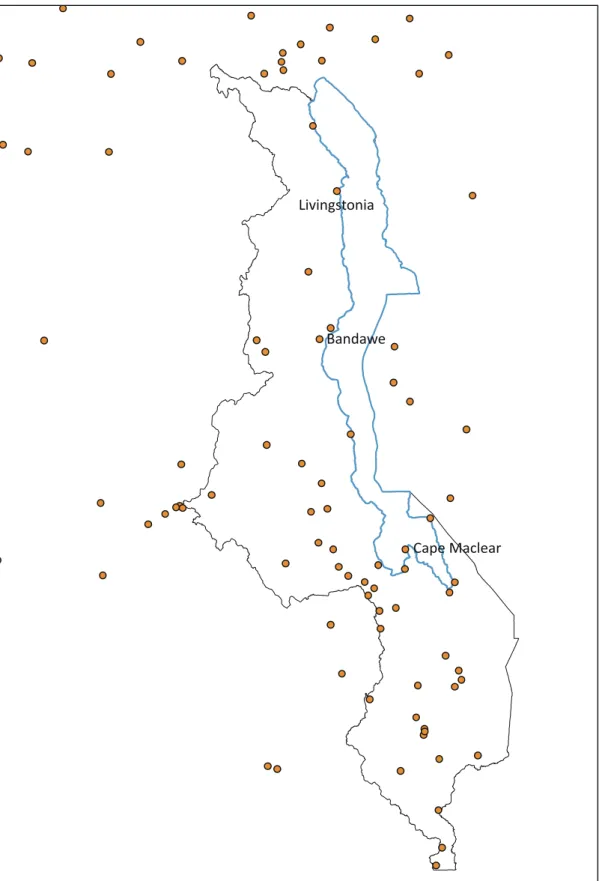
Both the MDHS and IHS projects published the GPS-based coordinates of the surveyed com-munities after displacing the coordinates by applying a random offset within a specified range to the positions (see Appendix C.1 for details). This was to maintain the confidentiality of the surveyed respondents, while still partially satisfying the public demand for the positional infor-mation. The GPS latitude and longitude position allowed this study to calculate the great-circle distance (GCD) between the MDHS and IHS communities, i.e., the shortest distance between any two points on the surface of a sphere measured along a path on the surface of the sphere (as opposed to going through the sphere’s interior). Figure A.1 marked the sample communities in both the MDHS and IHS (for ease of visual identification, only the 2010 MDHS communities were compared to the IHS ones in the figure). Because both the MDHS and IHS communities were spread spatially across the country, it was convenient to identify the IHS community located clos-est to a community surveyed in the MDHS (see Appendix C.2 for the details of the identification process). In fact, approximately 95% (99%) of the MDHS communities corresponded with the nearest IHS community situated less than 10 (15) kilometers away from them. Consequently, for the geographic and climate information of the MDHS communities, the analysis used the data from the nearest corresponding IHS communities. In Appendix C.3, goodness of the fit of the IHS community characteristics to that of the MDHS data was informally checked by performing a few exercises. Those exercises simplified the subsequent analysis by using community-level information sourced from the IHS.
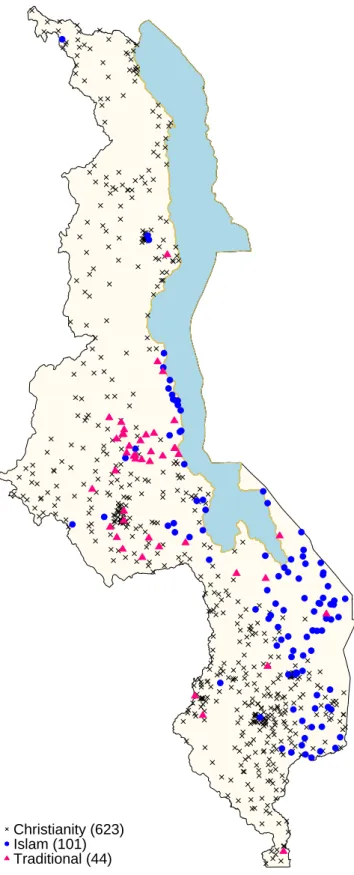
In addition to the geography and climate for each sample community, the IHS also provided information on a community’s descent rule (i.e., matrilineal, patrilineal or dual descent), the most common religion practiced in a community (i.e., Christianity, Islam, or African traditional faiths. See Figure A.2 for the distribution), the number of churches and mosques in a community, the
18This study uses “enumeration areas” and “communities” interchangeably.
19For the details on sampling design, see “T hird Integrated Household Survey (IHS3) 2010-2011
Basic Inf ormation Document, M arch 2012” at http://siteresources.worldbank.org/INTLSMS/Resources/
number of primary and secondary schools operated by religious organizations in a community, and whether the nearest doctor in a community is found at the respective religious facility. The analysis also included the controls needed for the discussion to follow.
2.2.2 Historical Controls
The detailed information on geography and climate in a community is primarily intended to control for the missionaries’ considerations of health-related factors and land productivity in selecting their settlement. While this information (e.g., elevation, slope, terrain roughness) may also be associated with the administration of trade routes from/to the coast and the intensity of slave trades, it may still be effective to consider these additional factors. Thus, to reinforce the primary instruments of the geography and climate, an empirical analysis also exploited additional covariates measuring European influence during colonial periods as well as the severity of slavery during the 19th century. All these pieces of information were taken from data used by Nunn and Wantchekon (2011) that contained (i) an indicator that takes one if a European explorer traveled through land historically inhabited by an ethnic group, (ii) a dummy variable equal to one if any part of railway lines in the first decade of the 20th century drawn from Century Company (1911) passed through land historically occupied by an ethnic group, and (iii) the total number of slaves taken from an ethnic group that was normalized by the area of land inhabited by the ethnic group during the 19th century (log of one plus the normalized slave export measure). Unlike the aforementioned geographic and climatic controls measured at the community level, these items were evaluated at the ethnicity level. Thus, the information was appended to the MDHS data using the names of ethnic groups provided by the two independent data sets. Consequently, only the few ethnic groups in the MDHS not identified in the study by Nunn and Wantchekon (2011) data were excluded from the subsequent regression analysis.20 These omitted groups represent approximately 5% of all the females in the sample.
Two limitations to using both the aforementioned community characteristics and ethnicity-level historical controls should be recognized. First, the information on the current residential location may not be sufficient to control for issues arising in cases involving women married to spouses living far away from their natal homes. Such cases may typically apply to females coming from ethnic groups that traces their descent through fathers, i.e., patrilineal ethnic groups.21 This is 20The following ethnic groups were identified in both the MDHS and Nunn and Wantchekon (2011) data sets:
the Chewa, Lomwe, Ngoni, Lambya, Manga’nja, Nkhonde, Sena, Tonga, Tumbuka, and Yao.
21While a patrilineal descent system is quite common in many sub-Saharan African countries, matriliny is also
commonly observed in Malawi. For example, the Chewa, Lomwe, and Yao are typically referred to as matrilineal ethnic groups.
because in such an ethnic group, when a rural woman marries, she usually leaves her kin to reside with her husband living outside her original village (i.e., patrilocal marriage). However, using a community’s descent rule sourced from the IHS as a regressor may partly control for this influence, as the descent rule is likely to correlate with the residential rule associated with marriage. The other issue is that the historical information is specific to the location historically inhabited by each ethnic group, not to the ethnic group’s present area of residence. For ethnic groups that migrated into their present residential spaces far from their original settlements, it would also have been preferable to control for the pre-colonial and/or colonial controls associated with their present settlement.
2.3
Instrumental Variable Approach
These community- and ethnicity-level controls may mitigate the concern of omitted-variable bias attributable to European influence, but not the other concerns. Consequently, the current research also exploits an instrumental variable approach.
To identify a reasonable instrument correlated with Christian identity but uncorrelated with other omitted factors determining polygamy, this study notes that the present popularity of Chris-tianity can be attributed to the Christian mission dating back to the late 19th century. More precisely, it is presumed that the prevalence of Christian beliefs is determined by two factors: (i) the date on which Christian ideas were introduced to a community and (ii) the speed at which the doctrine spread through the society, which in turn was governed by the frequency of social interac-tions among members as well as the rate of transmission of the religious values.22 As the frequency of the transmission of religious faith could not be discerned from available data, to find an adequate instrument, this study focuses on the date Christianity was introduced; in particular, the date on which the missionaries had a contact with members in a community. The earlier they preached the Gospel in a community, the earlier the community’s members converted to Christianity, and consequently the more likely their descendants are to be Christian.
The information on the date of the first missionary contact is neither contained in the data used in this study nor probably available elsewhere, however.23 Nevertheless, it appears that the introduction date is closely related to a community’s distance to the mission’s station, since those living in the close proximity to the station might have had earlier opportunities to encounter the 22Discussions made in this paragraph refer to Oster (2012), who exploited a community’s distance to the origin
of the virus in the Democratic Republic of the Congo as an instrumental variable for the rate of HIV prevalence in the community to estimate the causal effects of the prevalence on an individual’s sexual behavior.
23A parish register might have been used to identify the introduction date if this study had surveyed churches
missionaries.
While the historical background is provided in more detail in Appendix A.1, one of the most important missions that introduced Christianity into Malawi is the Livingstonia Mission of the Free Church of Scotland, which was founded in 1875. Although the picture should not be over-simplified, it is presumed that Christianity exploded from the northern areas in this country, where the Mission’s influential station, Livingstonia (also known as Khondowe), was erected (See Figure 1 for the position). Consequently, this study uses a community’s distance to Livingstonia (latitude, -10.36; longitude, 34.06) as an instrumental variable for an individual’s current Christian identity. The distance was based on the GPS-based coordinates provided by the MDHS and the analysis calculated the great-circle distance dj between the MDHS communities and Livingstonia. In practice, the distance interacts with an indicator variable for non-Yao ethnic groups, as described in Appendix A.2, as the Yao largely converted to Islam in the late 19th century because of their ancestors’ strong alliances with the Arabs present prior to the arrival of the mission.
In sum, the assumption eventually made to exploit the instrument is that since the non-Yao residing far away from Livingstonia in the late 19th or early 20th century were expected to have been less exposed to the missionary contacts as well as parents have passed their religious beliefs over to their children (Nunn (2010)); therefore, a community’s distance to Livingstonia multiplied by the non-Yao dummy is likely to explain the probability of the current generation being Christian. This statement can be checked by estimating the following first-stage equation as well as testing that β2= 0 and β3< 0:
cij = β1+ β2dj+ β3djeij+ β4eij+ β5xij+ uij. (2)
Apparently, the argument for instrument relevance can be made by implicitly assuming that the spatial mobility of the population has been completely limited at the ethnicity level. However, it might have been possible that the mission’s involvement in political disputes among indigenous leaders, which were sometimes observed in the early periods of the missionary penetration, altered the spatial distribution of ethnic groups to a certain degree.24 Thus, the assumption made here actually allows for the spatial mobility of the ethnic groups that might have existed, but might not have been strong enough to invalidate the instrument relevance. Another issue to be recognized is that once the propagation of Christianity reached a steady state, the date of the first missionary
24For example, see the relationship of the mission with the lakeside Tonga and the northern Ngoni in the early
contact, and thus the distance to Livingstonia, may no longer be able to explain the present-day distribution of Christianity. Thus, the distance could be used as a valid instrument only when the study used data drawn from periods during which the mission’s arrival date was still relevant. The first-stage estimation results reported below provide strong support for the arguments of instrument relevance, which makes these concerns less critical.
Using the interaction term between the community-level distance and an individual’s ethnicity (a dummy for the non-Yao) as an instrumental variable has two merits for the analysis. First, it allows the analysis to test whether the pre-determined community-level variables explained in subsection 2.2 sufficiently controlled for all time-invariant community-level characteristics affecting the likelihood of polygamy, because one could instead estimate equations (1) and (2) by replacing those community characteristics with community-level fixed effects.25 Second, it is possible to perform a falsification test of used by Nunn and Wantchekon (2011) that will be conducted to check if the instrument can be excluded from the second-stage estimations.
The exclusion restriction is always a matter of concern for researchers using the instrumen-tal variable approach. In the current context, a community’s distance to Livingstonia may also be correlated with its distances to other locations important for the missionaries as well as to the British Government maintaining the colonial state, for example. If such distances had an in-dependent influence on present-day polygamy, the excludability of the instrument would not be supported. In addition, one may also doubt that the ethnicity eij characterizes the marital prac-tices only through its influence on women’s religious identity (even if the ethnicity information interacts with the distance to Livingstonia and the level effect is already controlled for). Thus, to check the exclusion restriction of the instrument, this study conducts three falsification tests (including a Nunn-Wantchekon-type test), which is explained in subsection 4.4 after presenting the main estimation results.
Finally, while this study regards Livingstonia as an important Christian center, the author neither implies that the site was the only place of importance in the north nor intends to disregard the importance of other missions active in the central and southern regions (e.g., Nkhoma Synod of the CCAP, Blantyre Mission, or the Zambezi Industrial Mission). To control for the influence of other missions, this study also includes among the regressors a number of early mission stations situated within 25 kilometers radius from each MDHS community. The measure is created based on the positional information of the early mission stations shown in Figure 1, which is taken from
25In this case, the distance itself (d
j) will also be removed from the regressors in estimating the equations (1) and
Nunn (2010).26
3
Data
This study primarily uses repeated cross-sectional data drawn from the MDHS (2000, 2004, and 2010) implemented by the NSO from July to November 2000, October 2004 to January 2005, and from June to November 2010, respectively. The MDHS is a nationally-representative household survey providing information in the areas of population, health, and nutrition such as marriage, fertility, family planning, reproductive health, child health, and HIV/AIDS. Because of these areas of interest, women of reproductive age are the main target of this survey. In the 2010 MDHS, 23,020 females aged 15 to 49 years old residing in 24,825 households located in 849 enumeration areas (communities) were interviewed in total, with 11,698 and 13,220 resident females of 13,664 and 14,213 households situated in 521 and 559 communities in the 2000 and 2004 MDHS, respectively.27 The MDHS households are stratified random samples based on a study domain and urban/rural considerations.28 Although the MDHS has been conducted multiple times, there has been no panel element in terms of either the clusters or households. As explained in subsection 2.2, this study also uses community-level variables sourced from the third IHS 2010-2011 and ethnicity-level historical controls taken from Nunn and Wantchekon (2011), to complement the limited information discerned from the MDHS.
Table 2 reports the distribution of religious identity among the respondent females. As men-tioned in subsection 2.3, the Yao are predominantly Muslim. On the other hand, approximately a mere 4% of the non-Yao population is Muslim. Given the observation that there is not much data variation in religion within the non-Yao ethnic groups, one may argue that it is difficult to identify impacts of interest by adopting the IV approach. However, this is not necessarily the case because the analysis also uses Christianity-Islam variation within the Yao. It is evident from Table 2 that approximately 25% of the Yao are Christian.29
26However, it should be noted that excluding this control from the analysis yields almost the same results as those
obtained from the analysis including it.
27In the survey, all females between the ages of 15 and 49 in the selected households and all males between 15
and 54 in one-third (one -fourth in 2000) of the selected households were eligible for the interviews.
28Similar sampling exercises were implemented in all the surveys. For example, the 2010 MDHS sample households
were selected in two stages. By separating the 27 study domains (districts) into urban and rural areas, the nation was first stratified into 54 sampling strata consisting of the 9,144 enumeration areas established in the 2008 Malawi Population and Housing Census (PHC). The selection of 849 clusters from those enumeration areas was made in the first stage, with 158 urban and 691 rural ones. In the second stage, it was designed to select 20 households in an urban cluster and 35 households in a rural cluster, which generated the target sample size of 27,345 households at the national level. See “M alawi DHS F inal Report” (2000, 2004, 2010) for details of the sampling framework.
29Moreover, also note that the absolute number of the non-Yao Christians is still large, as the sample size used
Table 3 provides summary statistics of selected variables of self-identifying Christian females who were in marital relationships, with a check of the equality of the mean between these two groups. First of all, panel B (see “the most common religion”) indicates that Christian females more evidently resided in communities primarily settled by Christians than their non-Christian counterparts. This observation establishes one of several checks performed in Appendix C.3 to verify goodness of the fit of community-level characteristics sourced from the IHS to individual characteristics of the MDHS females. Similarly, it also shows that Christian females lived in communities that had a larger (smaller) number of churches (mosques), than did non-Christian females.
Second, Christian and non-Christian females were found to be significantly different in an observable way in many individual- (panel A), community- (panels B and C), and ethnicity-level characteristics (panel D). For example, compared to non-Christian females, Christian females obtained more education and (with marginal significance) had fewer siblings who had passed away by the time these females reached the age of 15 years. As often indicated by relevant historical research, both the greater educational achievement and lower level of sibling mortality among Christian females may suggest that the Christian mission has made a significant contribution to economic development over the last century by creating a legal, institutional, and economic basis for a modern market economy as well as by offering both educational and health-related facilities.30 The significant differences in observed traits between Christian and non-Christian females in-deed underscore the importance of controlling for unobserved (as well as observed) factors asso-ciated with an individual’s religious faith for potential causal inference in the subsequent empir-ical analysis. In particular, given the presumption that polygamy is less common in advanced economies, the association of Christianity with modernity (in terms of educational attainment and health endowment) may suggest that the estimated Christianity effect involves downward bias, unless the unobserved characteristics correlated with religious faith are appropriately controlled for. On the other hand, the potential noise contained in the measured Christianity explained in subsection 2.1 may also attenuate the impact. Consequently, the direction of bias may not be explicitly established from the descriptive analysis.
30As reported in many literature sources, one of the most important services provided by missionaries in colonial
Africa was European education (e.g., Woodberry (2004); Woodberry and Shah (2004); Gallego and Woodberry (2010); Nunn (2014)). Education was primarily provided to lure Africans into the Christian domain. As also discussed in previous studies, the missionary activities have had a long-term influence on educational advancement through two channels: First, their activities altered people’s perceptions of the values and beliefs attached to educational investment that might have been transmitted from parents to children. It is certainly possible that this change in perception encouraged descendants of those in contact with the mission to demand high-quality education. Second, the missionaries made a long-term investment in the educational infrastructure. The establishment of educational facilities must have contributed to satisfying the demand for better education from the public, raising the equilibrium level of education.
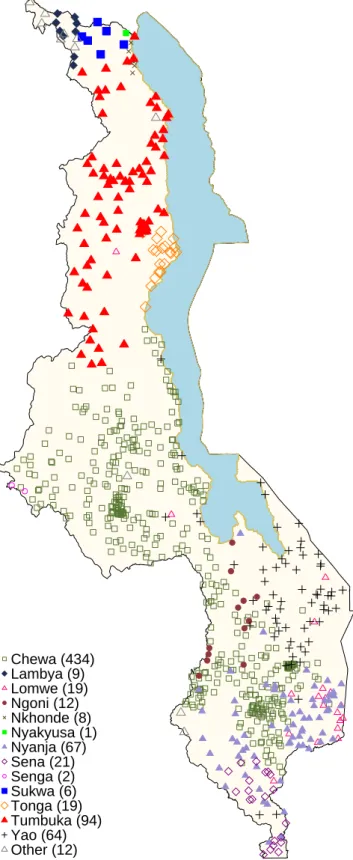
While not a sufficient condition, successful implementation of the instrumental variable proce-dure requires a strongly negative association between a community’s distance to Livingstonia and the prevalence of Christianity in non-Yao ethnic groups. Although the summary statistics do not provide a formal assessment of the negative relationship, the observation that Christian females lived largely in communities closer to Livingstonia than their non-Christian counterparts, and that Christians came primarily from non-Yao groups may support the validity of the instrument’s rel-evance. In addition, the near-absence of the Yao among Christian females is also consistent with the historic account that the Yao were less amenable to Christianity than other ethnic groups because of their strong socio-economic ties with Arab Muslims, which existed before the advent of the Christian mission and, possibly because of their matrilineal descent custom, which is explained below. Related to this, the Yao have historically inhabited the southeast areas of a thin strip of land of the country, while Christian females were more likely to be located in the northwest of this country than non-Christians (See also Figure A.3).
Following these observations, the descriptive statistics also provide several other findings po-tentially compatible with historical records on the advancement of the mission. For example, the smaller number of matrilineal communities among Christian females relative to non-Christians may be explained by Christianity’s mythical view of the origin of gender relationships. As this view might have violated the beliefs of matrilineal ethnic groups such as the Chewa and Yao, which held that the original human being was female and the blood line flows from a mother to a daughter and/or a son, local inhabitants in those communities may not have felt inclined toward complete submission to the mission (Davison (1997), p. 101). In addition, as explained in Appendix A.1, in its pioneering years, the Livingstonia Mission moved and established a settlement in the Northern Province partly to evade the unhealthful climate conditions in the south (e.g., Cape Maclear), which harbored malaria. This resulted in the subsequent establishment of the mission’s main work centers in the northern highlands. Consistent with this view, it is shown that in contrast to non-Christians, Christian females were largely distributed in northern areas characterized by low temperatures and high altitudes as well as steep ascents.
Panel D also shows that Christian females belonged to ethnic groups that had historically inhabited areas where fewer European explores traveled, more railway networks were built, and slavery was less intense. It may be difficult to obtain a coherent picture from these observations, partly because these pieces of information were evaluated in terms of the historical settlement of ethnic groups, rather than an individual’s present residential space. Nevertheless, at least, the third of these features may indicate that slave labor was a fundamental feature of the Yao society,
which was largely proselytized into Islam.
Finally, the panel A shows that Christian females engaged less in polygynous relationships than did non-Christians. The goal of this study is to investigate if this is a consequence of Christianity.
4
Estimation Results
4.1
OLS Estimates
The OLS estimation results for equation (1) are reported in columns (a) to (d) in Table 4, in which all the reported standard errors are robust to heteroskedasticity as well as clustered residuals within a community. In addition to the covariates whose estimates are reported, the community-level geographic and climatic controls of each surveyed community (i.e., climatology, landscape typology, soil and terrain, crop season parameters) (see Appendix B for the details) were included in the xij
in column (a), together with birth-cohort-, district- and survey-round-fixed effects. The estimation in column (b) additionally included ethnicity-level historical controls. Both the historical controls and the non-Yao dummy were replaced by ethnicity-fixed effects (with the Yao as a reference group) in column (c). The analysis in column (d) replaced all the community-level variables with community-fixed effects.
With strong significance, the estimated religious effects revealed a relatively stable pattern across the columns. Compared to those practicing other religions and no religion, Christianity was negatively associated with the likelihood of engaging in polygyny by 8-9 percentage points. Moreover, note that using the ethnicity-fixed effects in column (c) and the community-fixed effects in column (d) almost unaffected the estimated Christianity effect reported in column (b). This fact may indicate that the geographic, climatic, and historical controls exploited in the current study adequately controlled for all the time-invariant determinants of polygamy that those fixed effects are supposed to.
4.2
IV Estimates: Second-stage Estimation Results
Columns (e) to (n) in Tables 4 present the two-stage least-squares (2SLS) estimation results of equation (1). In the columns (e) to (g), Christian identity was instrumented with both the distance to Livingstonia, which interacted with a dummy variable for non-Yao ethnic groups. On the other hand, only the interaction term was exploited as the excluded instrument in all the remaining columns, while maintaining the distance in the second stage in columns (h) to (j) and not doing
so in columns (k) to (n). As in the OLS estimation results, a different set of controls included in each estimation is explained at the bottom of the table. Again, the standard errors were corrected to allow for intra-community correlation in all the 2SLS estimations but those of column (n), which involved computational difficulty for the calculation due to a considerably large number of community-fixed effects. Throughout the paper, both the F-statistics of the first-stage estimations and p-values of the over-identification test are reported at the bottom of the tables if available.
As before, all those 2SLS estimations maintained a remarkably steady pattern for the estimated religious effects across the columns, keeping the implications obtained from the OLS estimates unchanged. However, the magnitude of the impacts was markedly altered by the IV approach. Now, the results suggest that Christian females are approximately 20-30 percent less likely to engage in polygynous relationships than non-Christians. Considering the proportion of polygynous marriages among all (current) marriages, and the 16 percent that were discerned from the MDHS, these impacts are truly remarkable.
Given the presumption that the 2SLS estimations yielded more reliable point estimates, a comparison between the OLS and 2SLS estimation results suggests that the OLS estimations generated a considerably large upward bias on the negative Christianity effects on polygyny. Section 3 argued that the religious effects estimated by the OLS might involve (if any) any direction of bias. Nevertheless, the difference between the OLS and 2SLS estimates may be explained by the observed Christian identity measured with classical errors.31
4.3
Robustness Checks
4.3.1 Measurement Noise in the Geographic and Climatic Conditions
While the informal analysis correspondence in Appendix C.3 provides some support for the quality of the correlation between the MDHS and IHS data sets, the current study cannot exclude the existence of measurement noise in evaluating geographic and climatic conditions of the MDHS communities. Two factors may account for the potential noise, one of which stems from the adjustment of the GPS-based coordinates made in both the surveys for the public use before the dissemination. However, the random offset applied to the coordinate values to displace the
31Alternatively, the pattern of bias demonstrated in the current estimations may also provide an indication that
the possible omitted regressors might have been related to the pre-missionary level of economic prosperity. This consideration results from the observation that the pioneering missionaries were willing to preach the word of Jesus Christ in the north, which was estimated to be less-densely populated in the late 19th century, as seen from Figure 3. Intuitively, in advanced areas with dense populations, it is likely that women are unlikely to select polygynous relationships. If the pre-missionary level of economic development is negatively correlated with Christianity, the correlation is also likely to generate exactly the bias observed in the current estimations.
community-level positions may render the potential causal effects of religious identity unaffected by this measurement noise; because of its random nature, the noise that may be contained in the error terms of the equation (1) is unlikely to correlate with the religious beliefs. The other concern is solely based on the likelihood that irrespective of the displacement of the GPS-based coordinates, the IHS communities positioned the closest to MDHS communities may not have similar local characteristics. While the similarity in the estimates between the analysis using these spatial attributes and that exploiting community-fixed effects may mitigate this concern, the estimation in column (a) in Table 5 also limited its focus to data on females living in the MDHS communities located under 10 kilometers from the nearest IHS communities. The obtained implications remained unchanged.
4.3.2 Multicollinearity
One potential concern for the remarkably large impacts of Christianity identified in the second-stage estimations is the high correlation between the estimated Christianity obtained from the first-stage regressions and the non-Yao dummy. While the bivariate correlation between the original
cij and eij is not extremely high, with a coefficient of 0.68, the corresponding coefficient between the estimated Christianity and eij is 0.92 in the analysis in column (f) in Table 4, for example. While by design, the high correlation between the instrumented variable and the other regressors is typically observed in the second-stage estimations of 2SLS, this issue may deserve more discussion. From a theoretical standpoint, exploiting an additional variable with a high correlation with an exogenous covariate already included among the regressors reduces the precision of point estimates (unless the additional inclusion increases explanatory power of the empirical model) without alter-ing their consistency. However, the informal statistical guidelines also indicate that exploitalter-ing two highly and positively correlated variables in the same estimation tends to result in overestimating one parameter as well as underestimating the other (Williams (2013)).
In fact, while they do not necessarily seem to be robust, the 2SLS estimation results in Table 4 suggest that the Yao females tend to avoid polygyny, which is not indicated by the OLS estimates reported in columns (a) to (d) in the table. The interpretation of the 2SLS estimates is still possible. For example, before the arrival of the mission, the Yao enjoyed prosperity because of the fortune they had amassed through trading ivory and slaves to the Arabs. As the findings were obtained conditional on the Christianity effects, they may indicate the long-lasting impacts of the wealth accumulated by the Yao in the 18th and 19th centuries (although the sign may not necessarily be explicit). Alternately, the non-Yao ethnic population contains both the matrilineal
groups that have started to adopt patrilineal practices (e.g., the Chewa) and patrilineal groups, as opposed to the Yao, who strictly adhere to matrilineal custom (Mtika and Doctor (2002)). The oft-cited positive correlation between polygamy and patriliny may explain the association between the non-Yao dummy and polygamy (although a community’s descent rule is already included among the regressors) (e.g, Jones (2011)). Nevertheless, the fact that the instrumental variable approach changed the ethnicity effects may still provide the indication that the remarkably great impacts of Christianity may be driven by the issue of multicollinearity.
While there seems to be no irrefutable test showing whether multicollinearity is a problem, in the presence of this issue, coefficients tend to dramatically change when different samples, specifi-cations, and estimation techniques are exploited. Accordingly, several exercises were additionally conducted in columns (b) to (m) in Table 5.
First, the analysis in column (b) focused on females in their first marital union, in contrast to previous estimations that used data pertaining to all females who were married at the point of the survey. This exercise may allow this study to analyze more directly women’s entry into their first marriage. In columns (c) and (d), based on the survey rounds, data on all married females were split into two groups (2000/2004 and 2010). The results left the implications obtained from the preceding analysis almost unaffected.
To alleviate the correlation between the estimated Christianity and eijin the second stage, this study appended the DHS data drawn from neighboring countries of Zambia (2007) and Zimbabwe (2010) to the Malawian data. These three countries, which constituted the Federation of Rhodesia and Nyasaland between 1953 and 1963, were historically under the influence of the British admin-istration. While the geographic, climatic, and historical controls were not exploited due to the limitations of the data, using this extended data set did not change the implications obtained from the previous analysis, as seen from the estimates in column (e) in Table 5.32 However, given the case that as fewer as less than 1% of the females in the sample are Muslim in both the Zambia and Zimbabwe DHS, this exercise might not have mitigated the concern of multicollinearity. Therefore, the analysis in column (f) additionally exploited the DHS data of Mozambique (2011).33 While Mozambique was not under the British control, approximately 15% of the females in the sample from the Mozambique DHS were Muslim. Unlike the previous estimates, the result now reports a positive correlation between the Christianity and polygamy. Given the p-values of the Hansen
32The ethnicity information was not available in the DHS data of Zimbabwe. Thus, all females in the Zimbabwe
DHS were assumed to be non-Yao in the estimation.
33The author also attempted to use the DHS data drawn from Tanzania. However, as no information on religion