Exploring the sources of China's challenge to
Japan : models of industrial organisation in
the motorcycle industry
著者
Fujita Mai
権利
Copyrights 日本貿易振興機構(ジェトロ)アジア
経済研究所 / Institute of Developing
Economies, Japan External Trade Organization
(IDE-JETRO) http://www.ide.go.jp
journal or
publication title
IDE Discussion Paper
volume
419
year
2013-06-01
INSTITUTE OF DEVELOPING ECONOMIES
IDE Discussion Papers are preliminary materials circulated to stimulate discussions and critical comments
Keywords: industrial organisation, model, China, Japan, motorcycle industry JEL classification: L10, L22, L62
* Deputy Director, Southeast Asian Studies Group II, Area Studies Center, IDE ([email protected])
IDE DISCUSSION PAPER No. 419
Exploring the Sources of China’s
Challenge to Japan: Models of Industrial
Organisation in the Motorcycle Industry
Mai Fujita*
June 2013
Abstract
In view of the recent rise of China, this paper looks into one of the most important yet relatively overlooked ingredients of the Chinese success: industrial organisation. It will examine the case of the motorcycle industry, in which the rise of Chinese manufacturers even disrupted the established dominance of Japanese industry leaders. Adopting the modified version of the global value chain governance framework, this paper shows that the rise of China has been driven by a distinctive arm’s-length model of industrial organisation, which is in sharp contrast to the conventional captive model that has sustained the Japanese leadership.
The Institute of Developing Economies (IDE) is a semigovernmental, nonpartisan, nonprofit research institute, founded in 1958. The Institute merged with the Japan External Trade Organization (JETRO) on July 1, 1998. The Institute conducts basic and comprehensive studies on economic and related affairs in all developing countries and regions, including Asia, the Middle East, Africa, Latin America, Oceania, and Eastern Europe.
The views expressed in this publication are those of the author(s). Publication does not imply endorsement by the Institute of Developing Economies of any of the views expressed within.
INSTITUTE OF DEVELOPING ECONOMIES (IDE), JETRO 3-2-2, WAKABA,MIHAMA-KU,CHIBA-SHI
CHIBA 261-8545, JAPAN
©2013 by Institute of Developing Economies, JETRO
No part of this publication may be reproduced without the prior permission of the IDE-JETRO.
1
Exploring the Sources of China’s Challenge to Japan:
Models of Industrial Organisation in the Motorcycle Industry
Mai Fujita
1. Introduction
The rise of the Japanese motorcycle industry after World War II was truly remarkable. Starting almost from scratch and fuelled by the growing demand for an inexpensive means of transport, and the engagement of a few hundred manufacturers, motorcycle production expanded rapidly in the 1950s (Alexander 2008). This was followed by the consolidation of manufacturers into four major companies: with the launch of the highly acclaimed Super Cub, Honda rapidly emerged as a global industry leader; and three other firms – namely Yamaha, Suzuki, and Kawasaki – successfully followed suit (Otahara 2000a). As early as 1965, Japan emerged as the world’s largest producer and exporter of motorcycles, virtually driving previous industry leaders in Great Britain, Germany, and France out of business (Smith 1981; Wezel and Lomi 2009). Following expansion of exports and foreign direct investment (FDI), the four Japanese companies accounted for as much as 70% of global production in 1996.1
However, as so often happens, history repeated itself: by the end of the 1990s, Japanese dominance was being challenged by the rise of China. In 1993, its motorcycle
production surpassed that of Japan, the former emerging as the world’s largest
motorcycle producer. By 2006, China accounted for as much as 33% and 49% of global motorcycle sales and production respectively.2 The huge Chinese market was dominated by copies or slightly modified imitations of popular Japanese models that were
produced by local manufacturers and sold at approximately 30% to 70% of the price of the originals (Ohara 2005a: 69). Meanwhile, Japanese manufacturers – for virtually the first time in the long history of their overseas operations – only managed to capture a minimal share in the Chinese market. As of the end of the 1990s, about twenty foreign joint venture firms in China, ten of which were established by the four Japanese
motorcycle manufacturers, together accounted for just 5% of the market (Ohara 2006a: 21). Moreover, China’s challenge was not limited to the domestic market, as it expanded
1
Inclusive of production by foreign firms in receipt of technology transfer from the four Japanese companies (Otahara 2000a: 2–3).
2
2
exports to Southeast Asia, Africa and Latin America from the late 1990s onwards.3
This paper addresses one of the critical factors that have sustained the prolonged dominance of Japanese manufacturers in the global motorcycle industry: industrial organisation. The substantial body of research on the Japanese automobile industry has shown how a distinctive model of industrial organisation characterised by long-term, trust-based supplier relationships has sustained product development and manufacturing performance (Smitka 1991; Clark and Fujimoto 1991; Nishiguchi 1994; Dyer 1996; Fujimoto 1999). Emerging research into the Japanese motorcycle industry suggests that a similar form of industrial organisation has contributed to the high level of
manufacturing performance of this sector (Boston Consulting Group 1975; Ohara 2001, 2006a; Otahara 2006).
The phenomenal rise of the Chinese motorcycle industry since the 1990s raises a series of questions. How did it manage to challenge the established position of Japanese motorcycle manufacturers, which once seemed so unshakable? What form of industrial organisation enabled the Chinese to achieve their remarkable levels of price-based competitiveness? Did they emulate the Japanese model of industrial organisation but apply it in a better way, or did they develop a distinctive model of their own?
Specifically, this paper addresses the following research question: What form of industrial organisation enabled Chinese motorcycle manufacturers to challenge Japanese motorcycle manufacturers? It argues that rather than emulating the conventional Japanese model, Chinese motorcycle manufacturers developed a completely different form of industrial organisation. The resultant distinctive model enabled them to realise types of competiveness that differed significantly from those of the Japanese industry leaders, and allowed Chinese firms to thrive in a low-income portion of the global motorcycle market that was largely unexploited by the Japanese. The paper teases out the essence of the two contrasting models of industrial organisation that have emerged in Japan and China, and discusses their respective strengths and weaknesses, as well as trajectories of change, in an explicitly comparative manner.
Primarily, the paper builds on existing empirical research into the Japanese and Chinese motorcycle industries. Conducted mostly by Japanese and Chinese academics, the bulk
3
China’s top ten motorcycle export destinations from 1998 to 2008 were Nigeria, the United States, Vietnam, Indonesia, Argentina, Japan, Turkey, Mexico, Germany and Brazil (the author’s calculation based on Global Trade Information Services, Inc. 2012).
3
of such research has focussed on describing in depth the emerging patterns of industrial development, product development practices, and/or supplier systems in either or both of the two countries under study.4 Indeed, very few of the existing works systematically compared the emerging organisational patterns in Japan and China on the basis of a common theoretical framework, or explained why contrasting patterns have emerged in the two countries. One of the major obstacles in this regard has been the lack of a conceptual devise for systematically describing and explaining the patterns of industrial organisation, which are shaped by a myriad of factors – technological, strategic,
institutional and social. Nevertheless, recent theoretical development in the field of global value chain (GVC) governance perhaps offers a way forward (Gereffi et al. 2005). The present paper utilises a modified version of Gereffi et al.’s (2005) framework of GVC governance to conceptualise the two models of industrial organisation, adopting a common theoretical framework and an explicitly comparative mode of analysis.
Given that both models have evolved, the focus is on each of their conventional forms: the Japanese model in the 1970s up to the early 1990s, and the Chinese model in the 1990s. Nevertheless, the paper also examines their respective transformations in the 2000s on the basis of the literature as well as the author’s fieldwork in 2004, covering Honda’s major motorcycle component suppliers.
The remainder of the paper is structured as follows. Section 2 provides the theoretical framework. Sections 3 and 4 respectively conceptualise Japanese and Chinese models of industrial organisation in their conventional forms. Section 5 compares the two models and discusses trajectories of change. Section 6 concludes the paper by summarising its main findings, and identifies and discusses areas for future research.
2. Theoretical Framework
This section develops a theoretical framework for describing and explaining different forms of industrial organisation, which is based on a revised version of Gereffi et al.’s (2005) theory of GVC governance. The section begins by introducing the concept of value chain governance, followed by a consideration of five dominant governance types. It then discusses the two key variables that determine value chain governance. The
4
Existing empirical studies include Ohara (2001, 2004a, 2006b, 2006d), Otahara (2000a, 2000b, 2005, 2006, 2007, 2009a, 2009b), Hashino (2007), Demizu (1991, 2005), Tomizuka (2001), Otahara and Sugiyama (2005), and Alexander (2008) on Japan; and Ohara (2001, 2004a, 2004b, 2005a, 2005b, 2006a, 2006b, 2006c), Ge and Fujimoto (2004, 2005), Matsuoka (2002), Sugiyama and Otahara (2002), and Otahara and Sugiyama (2005) on China.
4
section concludes by presenting a revised framework that uses these two variables to explain the emergence of the five aforementioned types of value chain governance.
2.1 Industrial Organisation: Meaning and Type
An industry comprises (groups of) firms engaged in one or more value-adding function that is required to bring products to market – typically referred to as a value chain (Sturgeon 2001). The literature on industrial organisation has evolved around the broad question of how the upstream to downstream functions surrounding a product are aligned to different (groups of) firms, and how relations between these firms are coordinated. Starting with the literature on large integrated corporations (Chandler 1977) and transaction cost economics (Williamson 1979), through to theories on network forms of organisation (Powell 1990) and the GVC approach (Gereffi et al. 2001; Schmitz 2004; Gereffi et al. 2005; Sturgeon 2008), the resultant large body of work has demonstrated the range of market and non-market mechanisms through which inter-firm relations are coordinated. These mechanisms – referred to by the GVC approach as types of value chain governance – are important because they influence competitive performance of industries and development prospects for local firms participating in value chains (Sturgeon 2002; Schmitz 2004).
While there are myriad patterns of value chain governance, Gereffi et al. (2005)
classified value chain governance into five dominant types, which were mapped onto a spectrum running from low to high levels of explicit coordination (Figure 1). At one end of the spectrum is the arm’s-length market in which transactions are mediated by market forces. At the other end of the spectrum there is a hierarchy in which coordination takes the form of an internal command structure within a vertically integrated corporation. In between these two extremes, there are intermediate or network forms of organisation that are neither based on markets nor a hierarchy (Powell 1990; Jones et al. 1997). In ascending order of explicit transactional governance, these are:
Modular chains, in which product standardisation reduces the frequency and intensity of interaction, as well as the level of mutual dependence between a lead firm and its suppliers
Relational chains, which are characterised by complex and intense interaction between mutually dependent parties
Captive chains, in which a powerful lead firm makes extensive intervention and exercises control over smaller and dependent suppliers
5
Figure 1. Types of Value Chain Governance
Degree of Explicit
Coordination Type Description
Low
Market Arm’s-length transactions mediated by market forces
Network
Modular
Product standardisation enables firms to exchange complex information without intense interaction or mutual dependence
Types Relational Intense two-way interaction and mutual dependence
Captive Lead firms make extensive intervention and exercise control over dependent suppliers
High Hierarchy Vertically-integrated organisation Source: The author, based on Gereffi et al. (2005).
2.2 Determinants of Value Chain Governance
Why do different forms of governance such as those discussed above exist? And under what circumstances do particular governance forms emerge? The strength of Gereffi et al.’s (2005) formulation of GVC governance theory is that it provides a simple and systematic device for answering these questions. Specifically, they seek to explain the dynamics of value chain governance in terms of three variables: (1) the complexity of information exchanged in a transaction; (2) the degree to which such information can be codified; and (3) the supplier’s capability level relative to the requirements of a
transaction.
However, the other side of the coin is that simplicity poses constraints on the explanatory power of the framework. Indeed, the limited number of the explanatory variables and the simple ways in which they are formulated limit the framework’s capacity to identify the defining features of organisational patterns emerging in Japan and China, and to explain their transformation over time. This study therefore follows the overall structure of Gereffi et al.’s framework, but makes the following adaptations.
First, the present study’s framework incorporates lead firm capability in addition to supplier capability. Because the primary focus of Gereffi et al. (2005) is on the global value chains that are coordinated by major transnational corporations (TNCs), they implicitly assume that lead firms possess the sophisticated capability necessary to coordinate value chains. On the contrary, the present study does not take lead firm
6
capability as a given in view of the fact that it addresses the organisational model emerging in a developing country context. Rather, it acknowledges that a lead firm may be constrained by a shortage of capability in its attempt to establish certain types of chain governance.
Second, rather than narrowly focussing on relative levels of capability, that is, whether or not supplier capability meets the level required by lead firms, the present study highlights the various types of capability that different governance mechanism models impose on both lead firms and suppliers. This modification makes it possible to examine fundamental differences in lead firm and supplier capabilities required by various
governance mechanisms.
Third, whereas Gereffi et al. (2005) concentrate on the codifiability of parameters exchanged in transactions, this study focuses on the degree to which these parameters are standardised, a related yet distinct concept. This is because degrees of product and process standardisation constitute one of the essential factors that differentiate the Japanese and Chinese models of industrial organisation in the motorcycle industry.5
Fourth, for the sake of simplicity, the first two variables are grouped into one broader category: the nature of product and process parameters exchanged in transactions.
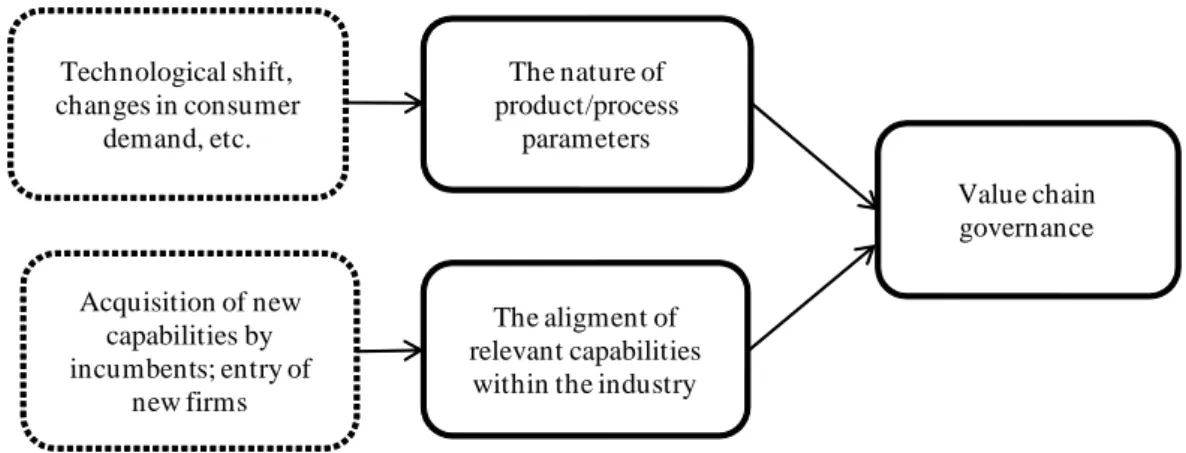
The basic structure of this adapted framework is shown in Figure 2, in which value chain governance is determined by two variables: the nature of product and process parameters communicated in transactions; and the alignment of relevant capabilities within the industry. The following subsections examine the two variables individually.
5
This adaptation becomes critical in formulating the conditions under which captive chains emerge. Whereas Gereffi et al. (2005) focus on the codifiability of parameters in the form of lead firm instructions, the non-standard nature of product and process parameters turned out to be critical in explaining why Japanese motorcycle manufacturers had instituted explicit governance mechanisms in coordinating transactions with their suppliers.
7
Figure 2. Value Chain Governance: An Explanatory Framework
Source: The author, adapted from Gereffi et al. (2005) and Langlois and Robertson (1995).
2.2.1 The Nature of Product and Process Parameters
The nature of product and process parameters determines the need for transactional governance. It is not the case that every transaction requires explicit coordination; the extent to which transactional governance is required depends primarily on the type of product being traded (in this case, motorcycle components). The specific focus will be on levels of complexity and degree of standardisation, both of which are influenced by factors such as technological innovation and changes in consumer demand.
In respect of simple products, which also tend to be standardised, there is limited need for instituting explicit transactional governance: if components are simple and
standardised, product/process parameters can be specified and communicated with ease. Supplier performance is easily observable in the form of delivered outputs and thus detailed monitoring mechanisms are not required. Moreover, as standard products do not require transaction-specific investment, there is no need to implement safeguards against the risks of opportunism (Williamson 1979). Standard products can also be produced by a range of suppliers, sold to a variety of lead firms, or produced for stock and supplied as necessary (Gereffi et al. 2005).
The need for coordination increases as products become complex and differentiated, that is, as they start to take on new demands beyond price level (Schmitz 2006; Humphrey and Schmitz 2008). Examples include differentiated components that are more difficult to design and/or manufacture; higher quality levels; tighter delivery requirements in terms of either frequency or punctuality; and additional functional
The nature of product/process
parameters
The aligment of relevant capabilities within the industry
Value chain governance Technological shift, changes in consumer demand, etc. Acquisition of new capabilities by incumbents; entry of new firms
8
requirements (e.g. suppliers take on design responsibilities in addition to
manufacturing). Implementing new requirements such as these often constitutes an additional burden with regard to the communication of product and/or process parameters between the lead firm and its suppliers. It also necessitates additional mechanisms to ensure that parameters are adhered to, for example, detailed monitoring (Schmitz 2006).
The need for explicit governance also depends on the extent to which parameters are standardised. On the one hand, non-standard parameters require explicit coordination because they incur additional coordination costs and transaction-specific investment in physical and/or human resources (Williamson 1979). This is particularly the case for products with integral design architecture. Because such products are characterised by complex mapping from functional elements to physical components and tightly coupled interfaces among interacting physical components, they call for fine-tuning between the whole product and its component parts if overall product performance is to be
maximised (Ulrich 1995; Baldwin and Clark 2000). Designing these products requires the coordination of detailed design tasks (Ulrich 1995), and their manufacture
necessitates transaction-specific investment, both of which call for explicit governance mechanisms to be in place.
On the other hand, even when the product is complex, industry-wide product and/or process standards may reduce the need for explicit governance (Gereffi et al. 2005). In industries that produce products with modular architecture, standards make it possible to communicate product and/or process parameters without intense interaction, which releases firms from being locked into particular trading relationships (Langlois and Robertson 1992, 1995).
2.2.2 The Alignment of Relevant Capabilities
The need for transactional governance, however, does not mean that such mechanisms can necessarily be implemented in practice. This is where the second variable of the alignment of relevant capabilities within the industry comes into play. Governance means that a given firm enforces parameters over other firms, a dynamic that demands the ability to wield power (Schmitz 2006; Sturgeon 2008). The relative power relations between a lead firm and its suppliers, in turn, are determined primarily by the types and levels of capability enjoyed by the respective parties (Sturgeon 2008; Schmitz 2006; Palpacuer 2000).
9
A lead firm’s capacity to impose parameters on its suppliers usually stems from their core competencies in strategic value chain functions (Palpacuer 2000; Schmitz 2006). In capital-intensive sectors such as the automotive industry, such strategic functions
typically include product development, marketing, and manufacturing of core
components. These functions often constitute the key sources of competitive advantage enjoyed by the lead firm because they require knowledge- and experienced-based assets that are difficult for others to imitate, and because they provide economies of scale for the firms that control these functions (Palpacuer 2000: 378).
A lead firm’s control over strategic value chain functions matters because it tends to create two types of dependence on the part of the suppliers. First, lead firm control over strategic functions leaves suppliers with non-core functions (Palpacuer 2000), rendering them functionally dependent on the lead firm in marketing their products. Second, because dominance in respect of product, marketing, and/or branding often enables lead firms to gain a high degree of control over the market (Gereffi 1999; Kaplinsky and Morris 2000), they often overwhelm suppliers with huge purchasing power (Sturgeon 2008), rendering them financially dependent.
The size of orders takes on particular importance in industries in which product and process parameters are non-standard. Because non-standard products often impose the additional cost of product-specific investment in physical and human resources, a lead firm will face difficulty enforcing non-standard parameters on its suppliers unless orders are large enough to make production economically viable.6
However, it is necessary to analyse lead firm competency in relative terms. Because power is relational, suppliers may also acquire it by building core competencies, that is, technical or service capabilities that are difficult to replace and become indispensable to the lead firm (Schmitz 2006; Sturgeon 2008; Palpacuer 2000). Suppliers can also gain the generic capability to assume responsibility for a bundle of functions, such as product design, process development, purchasing, and production, which enables them to serve a diverse pool of customers and switch customers if necessary (Sturgeon 2008). In contrast, where suppliers only possess capabilities that are easily substituted and/or are embedded in relations with specific customers, the lead firm retains the capacity to choose and replace suppliers, thus keeping supplier power under control (ibid.).
6
Sturgeon et al. (2008) corroborate this point in arguing that the concentrated structure of the car manufacturing industry helps each firm to impose its own idiosyncratic standards on suppliers.
10
2.3 The Revised Framework
Table 1 shows how the five governance types mentioned in Section 2.1 can be explained in terms of different combinations of the two variables outlined in the previous
subsection. When product and process parameters are simple and standardised, market-based chains emerge. This type of chain makes limited capability demand of lead firm and suppliers alike, the minimum requirements being that they possess routine assembly capability and routine component manufacturing capability respectively.
When industry-wide standards of compatibility enable complex parameters to be exchanged without explicit coordination, modular chains emerge whereby suppliers acquire generic manufacturing capacity and related service capabilities that enable them to serve multiple lead firms simultaneously. On the other hand, while the minimum requirement of the lead firm is routine assembly capability using mutually compatible components sourced from suppliers, modular chains enable it to focus on creation, penetration and defence of markets for its end products (Sturgeon 2002).
As product and process parameters become complex and non-standard, three types of chain governance may emerge depending on the alignment of relevant capabilities. The first case is one in which the lead firm and its suppliers are equipped with
complementary competencies that cannot easily be sourced elsewhere. Such a situation gives rise to a relational chain whereby the lead firm and its suppliers are engaged in intense two-way interaction; the two parties are mutually dependent and the power relation is symmetrical (Gereffi et al. 2005).
The second case is characterised by substantial asymmetry in capability levels between a large, competent lead firm and smaller, less competent suppliers. Competence and power asymmetry lead to a captive chain whereby the lead firm engages in extensive intervention, such as active monitoring and technical assistance; while suppliers develop their capabilities – typically, in a narrow range of tasks – under the lead firm’s guidance (Schmitz 2004, 2006).
The last case is one in which limited available external capability makes outsourcing unfeasible, meaning that the lead firm is compelled to conduct the required function(s) in-house, that is, to create a hierarchy. A hierarchy may also result from cases of substantial asymmetry in competence levels (i.e. the second case discussed above) but where the lead firm is either unwilling or unable to engage in extensive intervention.
11
Table 1. Types of Chain Governance and their Determinants
Product/ Process Parameters
Lead Firm Capability Supplier Capability
Market Simple No specific requirements beyond routine manufacturing/assembly capabilities
Modular Complex/ Standard
A minimum of routine assembly capability suffices.
Lead firms usually focus on creation, penetration and maintenance of markets for end products.
Generic manufacturing and related service capabilities.
Relational
Complex/ Non-standard
Lead firms and suppliers possess complementary competencies that are hard to substitute.
Captive
Capacity to exercise dominance over suppliers, which usually stems from control over strategic chain functions.
A minimum of the basic ability to engage in a narrow range of simple tasks is required. Suppliers develop capabilities in accordance with the lead firm’s interventions.
Hierarchical
Capability to conduct the value-adding functions in question.
Supplier capability is withheld.
Source: Adapted from Gereffi et al. (2005), Sturgeon (2002), Langlois and Robertson (1995), Sturgeon et al. (2008), Schmitz (2006), Sturgeon (2008), and Palpacuer (2000).
3. The Captive Japanese Model
The captive model of industrial organisation has been one of the key factors behind the prolonged leadership of Japanese motorcycle manufacturers since the 1960s. This section discusses the origins and distinguishing features of this model in accordance with the framework introduced in Section 2.
3.1 Complex and Non-standard Parameters
In the Japanese motorcycle industry, lead firms have traditionally organised relations with suppliers that reflected the nature of the product and process parameters they sought to enforce. Critical in this regard was the nature of the dominant design – the old yet highly successful Super Cub model. Over the five decades following its launch in 1958, this model shaped product and process parameters in the industry.
12
Up to the mid-1950s, two types of product prevailed in the Japanese motorcycle market, both of which were characterised by simple and standardised product parameters.7 One was represented by poor quality imitations of imported British and German models. Leading experts on the history of the Japanese motorcycle industry note that
domestically manufactured models of the period were mediocre in terms of engineering precision, quality and product performance, all aspects that largely failed to compete with foreign-made vehicles (Demizu 1991: 67; Tomizuka 2001: 100).
The other type of product was the motorised bicycle, which, again, imitated models imported from Europe. Since such vehicles could be produced by simply attaching an external two-stroke engine to a bicycle (Otaraha 2000a), which itself had modular design architecture (Galvin and Morkel 2001), fine-tuning in terms of component integration was not required. Both types of product were produced by a large number of assemblers and suppliers that operated on an arm’s-length transaction basis (Demizu 1991; Alexander 2008).
Honda’s launch of the Super Cub in 1958 marked a major technological breakthrough. Unlike the copies of imported European motorcycles or motorised bicycles that had preceded it, the Super Cub was conceived and designed by Honda exclusively to meet the demand of small Japanese businesses to deliver goods (Pascale 1984; Otahara 2000b). Featuring landmark technological innovations such as a four-stroke engine, overhead valves, an automatic centrifugal clutch, and an electric starter, the model recorded remarkable levels of capacity, speed and fuel efficiency that substantially exceeded world standard levels of the period (Demizu 1991). The safe and user-friendly appearance of the model, together with its affordable price also appealed strongly to Japanese consumers (Pascale 1984). Most notably, Honda designed the Super Cub by means of integral architecture so that all its components were customised to this
particular model. Not a single Super Cub component was used in common with Honda’s other models (Otahara and Sugiyama 2005).
This highly successful model not only led to the closure of nearly two hundred Japanese firms engaged in the production of imitation motorcycles, but also enabled Honda to infiltrate and eventually dominate the North American and European markets
7
Debate around the Japanese motorcycle industry up to the mid-1950s is based on the
commentaries of Tomizuka (2001), Demizu (1991), and Alexander (2008). As Alexander (2008) points out, the nature of the product, mode of production, and form of industrial organisation at this time was surprisingly similar to the situation in the Chinese motorcycle industry in the 1990s.
13
(Christensen 2002; Demizu 2005). Fifty years on, the basic production technology remains unchanged (Ohara 2006b). Technological shifts observed in the automobile industry, such as standardisation of vehicle platforms and modularisation (Humphrey 2000; Sako 2005; Takeishi and Fujimoto 2005), have so far not been implemented in the motorcycle industry (Ohara 2006b: 70). The Super Cub continues to be one of Honda’s most popular models produced globally8 and is used by other motorcycle manufacturers as a benchmark for the development of new products (Ohara 2006b). Considering the exceptionally high market shares this model has maintained in Japan and abroad over an extended period, the Super Cub may be seen as a typical example of a dominant design (Abernathy and Utterback 1978; Abernathy and Clark 1985; Teece 1986).
The emergence of the Super Cub as a dominant model significantly transformed the nature of innovation in the industry. Subsequently, Honda and the three other companies that successfully followed suit – namely, Yamaha, Suzuki and Kawasaki – opted to launch proprietary models incorporating new component technology, changes in specifications, and/or design modifications, aimed at improved product performance and/or adaptation to meet the consumer demand of Japanese and overseas markets (Demizu 1991; Otahara and Sugiyama 2005; Ohara 2006b). Every time new models were launched, motorcycle manufacturers renewed the designs of the whole vehicle as well as those of individual components (Otahara and Sugiyama 2005). Given the integral product architecture, incremental product innovations of this sort called for intricate fine-tuning between components (Ohara 2006d; Otahara 2009a). Thus, product parameters became complex and non-standard.
The emergence of the dominant design also lent increasing importance to process innovation for incremental improvements in productivity (Abernathy and Utterback 1978). Reflecting the integral design architecture, Japanese motorcycle manufacturers made themselves liable for provision to their consumers of a quality guarantee for the product system as a whole (Otahara 2009a, 2009b). Therefore, they took the lead in instituting their own engineering standards9 and ensuring that common targets for the achievement of high levels of quality, costs and delivery (QCD) were pursued
simultaneously for all of the components of a product. Accordingly, process requirements also became complex and non-standard.
8
Honda’s cumulative production of the Cub series reached 60 million units by 2008
(http://world.honda.com/news/2008/c080521Cub-Series/, accessed 16 September 2010), which was roughly one-third of the company’s cumulative global production of motorcycles.
9
For example, the Honda Engineering Standard (HES) includes component dimensions, material specifications, and details of the requisite processing.
14
3.2 Lead Firm Concentration of Capabilities
The second key variable that determines the pattern of industrial organisation is the structure of relevant capabilities. With the closure of the hitherto numerous assemblers of imitation motorcycles and motorised bicycles, the Japanese motorcycle industry grew highly concentrated. By the 1970s, the four emergent major motorcycle manufacturers had gained dominance of the growing domestic market and, subsequently, global sales via exports and FDI (Otahara 2000a).
Each of these four motorcycle manufacturers developed a pyramidal, hierarchical network of suppliers with the lead firm at the top of the pyramid (Figure 3). As was the case in the car industry (Sturgeon et al. 2008), the need for customised components led each manufacturer to develop supply networks of its own and to enforce its
idiosyncratic product standards on the suppliers. Large market shares meant that manufacturers were able to place orders that were sufficiently large to sustain small suppliers.10
Figure 3. Hierarchical Organisational Model in the Japanese Motorcycle Industry
Source: The author.
These four powerful motorcycle manufacturers virtually monopolised capabilities in the
10
In 1981, production volumes of Honda, Yamaha, Suzuki and Kawasaki in Japan were 2.9, 2.5, 1.5 and 0.5 million units, respectively (Honda Motor Co., Ltd. 1996).
Product concept, design, manufacturing, assembly, and marketing Supply of components supplier Supply of subcomponents Lead Firm Supplier Supplier Supplier Supplier Supplier Supplier
15
industry. Equipped as they were with thorough knowledge of product development, production and marketing, they had the capability to conduct most core value chain functions in-house (Ohara 2006b). Particularly in the domain of product development and manufacturing, capabilities possessed by Japanese motorcycle manufacturers extended from the whole vehicle to most individual parts, even those outsourced to external suppliers.11 The only exceptions were a limited number of components requiring specialised product and production technologies that the motorcycle
manufacturers did not possess, for example, clutches, carburettors, and tyres (Otahara 2006).
Moreover, the intrinsic core of the capability possessed by Japanese motorcycle
manufacturers was not confined to capability to conduct individual functions along the motorcycle value chain; even more important was their capability to integrate various value chain functions from product development to manufacturing and marketing. Indeed, effective use of market information for coordinated improvement in product and process engineering acted as an important channel for Japanese motorcycle
manufacturers to achieve incremental innovations that helped them to realise high quality, better manufacturability, and improved productivity.12
The sophisticated capabilities possessed by Japanese motorcycle manufacturers meant that a relatively narrow range of tasks had to be outsourced. Value chains included two types of supplier with different capability requirements. At the heart of this supply network were suppliers that had acquired proprietary component technologies that lead firms did not possess. As discussed above, lead firms’ control over much of the
component technology meant that such suppliers were extremely limited. These
suppliers collaborated closely with the lead firm in the process of product development by undertaking detailed design of core components (Otahara 2006). The remaining suppliers, which were in the majority, were in the peripheral position of providers of non-core components. These firms were expected to provide external manufacturing capacity rather than complementary competencies, that is, the manufacture of
11
As Japanese manufacturers imitated European motorcycle designs in the early years of their development, they sought to absorb both the overall product design and individual component technologies (Otahara and Sugiyama 2005).
12
Ohara (2006d). Also corroborated by lecture by a former engineer of Honda Motor Co., Ltd. for the Asian Motorcycle Industry research project organised by the Institute of Developing Economies, 6 August 2004.
16
components in accordance with drawings developed and supplied by a lead firm.13
Most suppliers were closely aligned to one of the four major motorcycle
manufacturers.14 Suppliers of core components in particular developed capital and personnel ties with manufacturers and constituted key members of their corporate groups referred to as keiretsu.15 Japanese motorcycle manufactures, with the exception of Kawasaki, also established supplier associations (kyoryokukai). For example, Honda developed supplier associations in two locations where its motorcycle factories were located.16 By organising suppliers located in these areas, including those of non-core components, Honda provided technical and managerial guidance in order to bring their competence up to the required levels (Otahara 2007).
In short, the industry adopted a highly concentrated structure, with lead firms dominating core capabilities.
3.3 Captive Governance
The need for suppliers dedicated to providing a stable supply of large quantities of high-quality, customised components, combined with asymmetrical alignment of capabilities, resulted in captive governance. Under this form of organisation, the lead firm practiced a high degree of control and intervention over smaller and dependent suppliers in order to encourage them to develop lead firm-specific competencies.
For the suppliers’ part, entering into Japanese chain meant guaranteed long-term business. Suppliers could expect large orders over the long term because, once
cemented, lead firm–supplier relations were maintained indefinitely other than in truly exceptional circumstances.17 Where supplier capabilities fell short of the required levels,
13
In the early years of its motorcycle operations, Honda was known for its dependence on in-house manufacturing of components as this tended to be more efficient than outsourcing to external suppliers (Otahara 2000b). As the company expanded production in Japan and overseas, it developed its supplier networks and expanded outsourcing. As of the 2000s, Japanese motorcycle
manufacturers outsourced 80% of components in terms of cost (Otahara 2006).
14
There were also independent suppliers not affiliated to specific motorcycle manufacturers (Ohara 2006b).
15
For example, the Honda Group consisted of 57 member companies, including 23 component suppliers, sales firms, engineering firms, and a research and development (R&D) unit (IRC 2009).
16
Interestingly, Honda is known for not having established a supplier association for its car business (Sako 1996); however, the company has two supplier associations in respect of motorcycle
production: Yurin-kai in Kumamoto and Satsuki-kai in Hamamatsu (IRC 2009).
17
17
lead firms provided various forms of assistance to bring them up to standard. This was particularly necessary in the early stages of industrial development when lead firms faced a shortage of suppliers with the ability to meet their requirements (Hashino 2007).
Lead firms also provided enabling conditions for suppliers by mitigating and absorbing the risks of customer-specific investment associated with designing and manufacturing customised components. Such risk was mitigated as competencies possessed by lead firms significantly reduced the failure rate of new product development projects (Ohara 2004a). Risks were also absorbed because lead firms fully or partially bore the cost of customer-specific investment in developing prototypes, and manufacturing dies and moulds (Ohara 2001).
The other side of the coin, however, was that suppliers were virtually locked into relations with particular customers and were under pressure to reach the goals and specifications set by lead firms. The lead firm typically informed suppliers of its business plans, as well as detailed instructions and specifications based on its own idiosyncratic product and process standards. Suppliers were even advised of the lead firm’s future product strategy at an early stage (Ohara 2001). Accordingly, suppliers were expected to invest in locations, machinery and human resources specific to their customer’s requirements; devote most of their resources and efforts to achieve goals and fulfil plans set by the former; and submit to close monitoring of their performance against lead firm requirements.
Suppliers were also required to disclose detailed information to lead firms on their internal operations, extending to detailed cost data as the basis for joint problem-solving exercises in the quest for possible ways of reducing costs at source (Ohara 2001,
2004a).18 Gains made from such joint efforts were in principle divided between the lead firm and the supplier in accordance with the rules of reasonable profit sharing (Ohara 2001), as was the case in the Japanese car industry (Nishiguchi and Brookfield 1997). However, in effect, suppliers ceded their autonomy to independently negotiate the proportion of rent that had accrued from their own incremental process innovation, and sacrificed their ability to search for new customers.
Over time, suppliers developed the narrow range of manufacturing capabilities necessary to process the components in accordance with lead firm specifications and requirements (Otahara 2006). Where suppliers acquired complementary competencies
18
18
in component technology that the lead firm had to depend on, they began to collaborate closely with their customers in the development of new product designs. In such cases, lead firm–supplier relationships exhibited features of relational governance, that is, intense two-way information flow. Yet, the lead firm’s control over product and production technology in this industry meant that such instances were extremely rare; even in comparison with the country’s car industry (Otahara 2006) – a classic example of captive organisation (Sturgeon et al. 2008). The majority of the suppliers were in subordinate positions as suppliers of non-core components.19
The captive model of industrial organisation was indeed one of the key factors behind the success of Japanese motorcycle manufacturers in launching proprietary models and manufacturing them to high standards. The model served Japanese motorcycle
manufacturers well in their attempts to conquer the world market – but only until the early 1990s; by then, they faced new challenges arising in the developing world (Ohara 2006b). The details of these challenges and the subsequent trajectories of organisational change are discussed in detail in Section 5.
4. The Market-based Chinese Model
In the Chinese motorcycle industry, there has emerged a form of industrial organisation strikingly different from the conventional Japanese model discussed in the previous section. The present section conceptualises the Chinese model as it emerged in the 1990s – the industry’s initial fast-growth phase.While the Chinese motorcycle industry consists of diverse players who cater for different sections of a huge market, the focus is on large indigenous manufacturers,20 both state-owned and private, which, at the end of the 1990s, accounted for roughly 60-70% of the market (Ohara 2006a: 27).
19
According to the survey of motorcycle component manufacturers in Hamamatsu – one of Japan’s two main centres of motorcycle production along with Kumamoto – conducted jointly by
Hamamatsu Credit Association and the Research Institute for Shinkin Central Bank in 2003, 68.1% of the 119 respondents considered their bargaining power vis-à-vis their largest customers to be weak (Otahara 2006: 112).
20
According to Ohara (2004a), these firms correspond to the second of the three categories of motorcycle manufacturer in China. The first consists of foreign-invested manufacturers that produce expensive proprietary models; and the third comprises indigenous small-size manufacturers that focus almost exclusively on assembling low-priced copies of foreign models by externally sourcing standardised components. Ohara (2004a: 27) notes that over time, the patterns of competition observed among motorcycle manufacturers in the first and third categories have tended to converge towards those that are evident among manufacturers in the second category.
19
4.1 Low-Quality and De Facto Standardisation
As the discussion in the previous section demonstrated, a centralised form of industrial organisation long persisted in the Japanese motorcycle industry primarily because of integral product architecture. The Chinese succeeded in developing a new organisational model precisely because they succeeded in breaking such a constraint. However, this process did not follow the common route of industry standards being established by dominant firms or international organisations (Gereffi et al 2005; Galvin and Morkel 2001). As will be explained in detail below, de facto standards of component
compatibility emerged in the Chinese motorcycle industry endogenously as a result of uncoordinated actions by numerous firms within the sector.
Unlike manufacturers’ proprietary models that prevailed in the Japanese motorcycle industry, those produced by Chinese companies in the 1990s were mainly low-quality and low-priced copies, or slightly modified imitations of a limited number of popular Japanese models. The designs of roughly a dozen of the latter, which had been introduced into a number of Chinese state-owned motorcycle manufacturers under technological licensing agreements in the 1980s, were widely shared and replicated by numerous newly emerging private manufacturers by the 1990s (Ohara 2001; Ge and Fujimoto 2004). Among such Japanese models, the most popular was again Honda’s highly renowned Super Cub, this and several other models becoming de facto standards in the Chinese industry. While the number of models registered with the Chinese
authorities increased rapidly, reaching 18,000 by the end of 2000 (Ohara 2005b: 58), those marketed under either Chinese or imitated Japanese brands were mainly copies of a dozen most popular Japanese models, sometimes incorporating minor functional and/or cosmetic modifications.
Clearly, de facto standardisation of this sort occurred due to demand-side conditions specific to the Chinese market. First, it took place under weak protection of intellectual property rights (Ohara 2006a). Second, Chinese consumers prioritised low prices over quality.21 The fact that the Chinese authorities prohibited the use of motorcycles in large cities and on highways (ibid.) further reinforced this tendency.
De facto standardisation and low quality requirements brought about corresponding changes in the nature of innovations, which were now limited in both degree and scope. As duplicative imitation of Japanese models became widespread, product development
21
20
and marketing – which formed the intrinsic core of lead firm activity in the Japanese motorcycle industry – assumed little significance. In terms of product development, Chinese lead firms did not generally opt for the kind of whole product system renewal that had occurred in the Japanese motorcycle industry. Although many of the large manufacturers did engage in modifications to Japanese base models, these tended to be minor, usually consisting of changes in only one or two components or varying
combinations of existing components (Ohara 2004a: 49). It also made little sense for firms to engage in extensive marketing or branding activities for products that were essentially imitations. In the domain of production, the low expectations of Chinese consumers meant that lead firms faced limited pressure to engage in quality
improvement.
The above changes in the nature of innovation substantially reduced the need for explicit coordination between the lead firm and its suppliers, although – as will be argued below – the need for coordination was not eliminated completely. Lead firm requirements on suppliers focussed predominantly on low prices; and because products basically followed de facto standard designs, limited fine-tuning between component specifications was called for. The lead firm and its suppliers could therefore engage in motorcycle assembly and component manufacturing respectively largely (but, as we shall, see not completely) without intense interaction.
It should be noted that de facto standardisation must be distinguished from
modularisation, their apparent similarity notwithstanding.22 Since the Chinese did not change the design architecture of motorcycles, full compatibility of components could only be guaranteed insofar as they were manufactured precisely in accordance with the original drawings of the Japanese base models. However, this has not been the case: as will be discussed in depth in Section 4.3, uncoordinated duplicative imitation in China has frequently produced components that are not strictly compatible. De facto
standardisation in the absence of a shift in design architecture therefore needs to be differentiated from product modularity, which ensures full compatibility between the component modules comprising the product.
22
The apparent resemblance has led several authors to describe on-going practices in the Chinese motorcycle industry as modular production (Matsuoka 2002; Pham Truong Hoang 2007). See Paper II for detailed discussion on this issue.
21
4.2 Wide Distribution of Basic Manufacturing and Reverse Engineering Capabilities
Up to the early 1990s, the Chinese motorcycle industry was dominated by a small number of large state-owned manufacturers such as Jialing and Qingqi, which until then had been consistently ranked as the largest in the country (Ohara 2006a). After the launching of market-oriented economic reforms in China in 1979, these state-owned manufacturers shifted their production from military armaments to motorcycles with the introduction of Japanese technology under formalised licensing agreements (ibid.). They subsequently laid the foundations of the industry by developing integrated production systems and supply networks, and training a large pool of engineers and managers (ibid.).
De facto standardisation radically transformed the landscape of the Chinese motorcycle industry by significantly lowering the entry barrier for both manufacturers and suppliers. Instead of playing the role of integrators of various value chain functions (as was the case with their Japanese counterparts) lead firms could now purchase and assemble standard components readily available on the market. This meant that the minimum requirement of them was the capacity to assemble components. Likewise, suppliers no longer had to invest in equipment, human resources, or skills specific to individual customers; in order to operate as a motorcycle component supplier, simple reverse engineering capabilities in terms of reproducing existing components and routine manufacturing now sufficed.
As a result of the engagement of a large number of companies – including many private firms that had hitherto operated in unrelated fields – in assembly and component
production, the structure of the Chinese motorcycle industry became highly fragmented. The number of motorcycle manufacturers increased in the 1980s and 1990s, reaching 140 in 1997 (Ohara 2001: 7). In 1999, the market shares of the largest 10 and 20 manufacturers were 53.1% and 68.0% respectively (ibid.). The industrial structure was also fluid, as demonstrated by recurrent changes in the names of top companies (Ohara 2006c). Jialing saw its market share decline throughout the 1990s until it accounted for only 6.7% of the total number of motorcycles produced in China in 2001 (Ohara 2004a). Meanwhile, newly emerging manufacturers rapidly expanded their production. From the mid-1990 onwards, numerous private firms also entered into the manufacturing of motorcycle components, absorbing a large number of engineers, technicians and
22 steel or chemical industries (Ohara 2004b).
However, both motorcycle manufacturers and suppliers only possessed basic levels of technological capability. Many of the newly emerging private motorcycle manufacturers in particular had limited knowledge of overall product systems or individual component technology, and thus started operations by purchasing and assembling components available in the market (Ohara 2004b). For example, Zongshen, one of the three major private local motorcycle manufacturers based in the southwestern city of Chongqing – the main centre of motorcycle production in China, was established in 1992 by a ceramic engineer (ibid.).
Whereas large state-owned motorcycle manufacturers had opted to develop supply networks of their own in the 1980s, lead firms and suppliers grew increasingly independent of each other in the 1990s, a tendency that led to the emergence of
dispersed supply networks, meaning that suppliers were no longer tied to particular lead firms (Figure 4). Ohara’s (2001: 17) interviews with eighteen suppliers of core
components to the three major motorcycle manufacturers at the end of 1990s found that suppliers on average traded with 14.9 customers; and the largest customer on average accounted for just 40.5% of the sales of suppliers’ main products.23 Lead firms were not dependent on particular suppliers either, manufacturers normally maintaining multiple – usually three or more – suppliers of each type of component (Ohara 2001: 18).
Figure 4. Dispersed Organisational Model in the Chinese Motorcycle Industry
Source: The author, with reference to Ohara (2001, 2006c).
23
Since this figure only represents suppliers’ main products, their overall dependence on the main customer was most probably much lower.
23
4.3 Arm’s-Length Transactions Mediated by Market Forces
De facto standardisation and low quality requirements combined with the wide distribution of basic reverse engineering and manufacturing capabilities led Chinese motorcycle manufacturers to make extensive use of market forces in doing business with their suppliers. Many lead firms as well as suppliers engaged in arm’s-length transactions characterised by intense competition, frequent switching of partners on the basis of price, and low levels of explicit coordination. Specific patterns of transactional governance, however, varied according to the type of transaction. In this subsection, we examine how transactional governance worked in practice.
Let us start with the simplest case, namely, instances in which Chinese firms simply replicated existing Japanese models. While such practice was typically seen among small- and medium-size manufacturers, large manufacturers often adopted this approach for a certain range of their products (Ohara 2005b). In these instances, de facto
standardisation virtually eliminated the need for explicit coordination. Suppliers
engaged in duplicative imitation of components independently of the manufacturer, who, in turn, purchased standard components readily available on the market. The resulting pattern of transactional governance assumed an arm’s-length form in which many lead firms and suppliers competed intensely on the basis of price.
However, as discussed in Section 4.1, de facto standardisation did not completely eliminate the need for lead firm–supplier coordination. The fact that integral design architecture was maintained meant that full compatibility of components could only be ensured insofar as they were manufactured precisely in accordance with the original drawings of the dominant models, which was frequently not the case. Since suppliers adopted different measuring methods and varying degrees of precision in reproducing design drawings of components available on the market, repeated duplicative imitation of a given dominant model often gave rise to components that were not compatible with each other (Ge and Fujimoto 2004). Non-compatibility problems were typically
addressed in an ad hoc manner by making ex post adjustments (ibid.). Even such adjustments did not render components strictly compatible but was sufficient to make them assemblable. This means that Chinese firms compromised on product quality for the sake of reducing the need for explicit inter-firm coordination.
Let us proceed to cases in which modifications were made to Japanese models – a practice typically observed among larger Chinese motorcycle manufacturers. Where
24
changes were made to parts that functionally interact little with other components (such as plastic covers, tyres, speedometers, and shock absorbers), the story was essentially the same as the instances of duplicative imitation referred to above. Since the absence of coordination between adjacent components did not substantially affect the overall performance of a product, arm’s-length transaction with little explicit coordination prevailed, although ad hoc ex post adjustments were often necessary. Suppliers prepared modified designs independent of their customers, intentionally keeping the interface with other components standardised so that they could be sold to a large number of unspecified customers (Sugiyama and Otahara 2002). In turn, manufacturers sought to purchase and assemble varieties of components that were available on the market instead of generating own-product concepts and basic product design (Otahara and Sugiyama 2005).
Where modifications were made to core functional components that required coordination with related parts in order to yield superior product performance (e.g. engine components, carburettors, and silencers), the story was more complicated. In theory, such transactions required a flow of tacit information to facilitate fine-tuning between components as well as reconciliation of competing incentives to overcome the risks of customer-specific investment (Williamson 1979). However, in practice, the realities of market conditions in China, the limited capabilities of lead firms, and the lack of safeguards against the risks of opportunism prevented both lead firms and suppliers from committing themselves to the development of non-standard designs that adopted customised components.
On the one hand, in a market where few consumers were willing to pay a high premium for sophisticated designs, consumer demand changed rapidly, and intellectual property rights were only weakly protected, lead firms investing in non-standard designs faced substantial risks. Instead of mitigating and absorbing the risks of model-specific investments, as had been the case with Japanese motorcycle manufacturers, they switched the risks to their suppliers by outsourcing the design and manufacture of mutually interacting components to more than one supplier without making a
commitment to bear the cost of developing prototypes or investing in dies and moulds (Ohara 2001).
On the other hand, suppliers receiving orders for developing modified component designs faced the following two types of risk(Ohara 2001, 2004a). One was the
25
before the new model was launched, or if it was launched but production fell short of the minimum efficient scale).Given the volatile nature of the Chinese market and the weak sales capabilities of motorcycle manufacturers, such risks were substantial.24 The other type of risk to suppliers concerned the possibility that the manufacturer might adopt a competitor’s component design, a real possibility insofar as many lead firms engaged in the multiple sourcing of components (Ohara 2001).
Faced with considerable risks, suppliers naturally avoided making customer-specific investment wherever possible. Instead of investing in customised dies and moulds, they often sought to utilise existing equipment to develop prototypes for modified
component designs (Ohara 2001). While this served as a safeguard against the risks of non-purchase by the lead firm, the scope of the adjustments that could be made to existing component designs became increasingly limited.
Suppliers also intentionally kept the shapes of interfaces between components standardised so that they would at least be assembled together with other standard components on the market (Ohara 2004a). This was intended to ensure that suppliers would be able to find alternative customers in cases of non-purchase, even if such usage failed to maximise overall product performance. Overall, even in terms of mutually interacting components, the degree of coordination remained generally limited and component designs were not necessarily bespoke to specific customers.
In summary, arm’s-length, adversarial transactional relations largely mediated by market forces came to the aid of the Chinese motorcycle industry in its realisation of
remarkable levels of price-based competitiveness. The organisational model, however, reached a turning point in the 2000s. Its background and ensuing transformation are discussed in the next section.
5. Comparison of Models and Trajectories
This section compares the two models presented in sections 3 and 4 respectively, and discusses the strengths and weaknesses as well as trajectories of change of each.
24
According to Ohara’s (2004a) interviews with 17 Chinese suppliers, 12 admitted that they faced substantial risk concerning the possible failure of product development projects. One of them described that only about two of the ten product development assignments it had secured from manufacturers had succeeded and generated profits while the remaining eight had failed.
26
5.1 Comparison of the Two Models
Table 2 compares the two organisational models. Under the conventional Japanese model, the lead firm engaged in centralised control and extensive intervention in governing its relationships with dependent suppliers. In turn, the suppliers were expected to endeavour to achieve the targets set, often by ceding autonomy.
The strength of the Japanese organisational model lay in its capacity to develop
proprietary products and manufacture them to a high quality standard. In the domain of product development, intense interaction involving extensive information sharing with a limited number of core component suppliers enabled the lead firm to develop
proprietary models that were internally and externally coherent (Clark and Fujimoto 1990). In terms of manufacture, the combination of tight control and generous assistance practiced by powerful lead firms helped to extract superior productive performance from suppliers that were specialised in narrow manufacturing tasks. High-grade supplier performance in manufacturing (and design, for suppliers of core components) helped lead firms to launch proprietary models and manufacture them to high standards – a key source of their competitiveness.
Table 2. Comparison of Japanese and Chinese Models
Feature Japanese Chinese
Nature of product/
process parameters Non-standard and complex Simple
Product standards Idiosyncratic: determined by the lead firm
Endogenously emergent as a result of de facto standardisation
Overall industrial
structure Concentrated and stable Dispersed and fluid
Capability distribution Monopolised by the lead firm Basic capabilities widely distributed
Degree and mechanism of coordination
High: based on lead firm control
and assistance Low: based on market forces
Advantages
High quality and incremental cost reduction
Proprietary product designs with high levels of novelty
Low prices
Flexibility and speed in launching new products
Disadvantages Rigidity (possible high costs)
Long product development cycle Difficulty in product differentiation
27
However, the Japanese model also suffered from inherent weaknesses. High quality often came at the expense of high costs, as long-term transactions tended to create rigidity in lead firm–supplier relationships.25 Even though incremental cost reduction via process improvement was an integral element of lead firm requirements of suppliers, limited competition between them and the high priority attached to quality standards meant that radical price reduction was not possible. This was particularly evident in the case of keiretsu suppliers of core components, whereby manufacturers had close
relations with suppliers via capital and personnel ties.
The regular renewal of the whole vehicle – the Japanese approach to product development – also resulted in extended product development cycles and limited flexibility. As of the end of the 1990s to the early 2000s, it generally took a year for Japanese motorcycle manufacturers to develop new models and the development cycles were virtually fixed (Ohara 2001). While the Japanese policy of launching a limited number of highly sophisticated models generally worked well in a mature, less volatile market, its inability to promptly and flexibly make adjustments to product designs inhibited the adaptation of this model to a growing, volatile Chinese market in which consumer demand was in a constant state of rapid change.
Above all, the strength of the arm’s-length model of Chinese industrial organisation lay in its capacity to achieve low prices. Low entry barriers for both manufacturers and suppliers assisted by de facto standardisation enabled a large number of firms to enter into production of motorcycles and components, spurring intense competition. The benefits of the arm’s-length model also extended to its speed in launching new models, typically ranging between two to three months as of the end of the 1990s (Ohara 2001). De facto standardisation of Japanese base models enabled independent suppliers to concentrate on design modifications and manufacturing without having to get locked into relations or interact intensely with specific customers. In turn, lead firms could experiment flexibly with different minor improvements by purchasing and assembling various components available in the market.
However, the Chinese model suffered from limited capacity to achieve differentiation in product design and quality, the use of standard components resulting in a proliferation
25
According to a survey of motorcycle component manufacturers in Hamamatsu in 2003 (see footnote 19 for details), 52.5% of the 122 respondents had traded with their largest customers since establishment and another 44.4% had traded with their largest customers for a considerable length of time (Otahara 2006: 112).
28
of largely homogeneous products. To the extent that integral product architecture was maintained, repeated duplicative imitation adopting different measuring methods and varying degree of precision in reproducing design drawings of the Japanese models available in the market meant making compromises in respect of component
compatibility and precision, while the ad hoc approach to dealing with
non-compatibility problems only provided partial solutions. At the same time, given intense price-based competition and the difficulty of devising measures for monitoring product quality, suppliers had little incentive to improve product quality.
5.2 Trajectories of Change
While the discussion so far has focussed on the two organisational models in their conventional forms, the ways in which they were implemented evolved over time. This subsection considers trajectories of change, focussing on recent developments in the respective models.
The two models generally converged in the 2000s, yet fundamental differences still remain. In terms of the Japanese system, changes occurred in the degree to which lead firms and suppliers were tied into particular relations. During the emergence of
Japanese supply networks in the 1960s through to the mid-1990s, this organisational model was characterised by high levels of lead firm–supplier dependence. Because they required competent suppliers, lead firms explicitly sought to develop exclusive ties with them by organising supplier associations and providing technical, financial and
managerial assistance to nurture small, less competent suppliers (Ohtahara 2007; Hashino 2007). As supplier competence increased over time, lead firm assistance gradually diminished. However, up to the 1990s, lead firms maintained tightly
organised value chains with exclusive membership, and suppliers became increasingly dependent on large, regular orders placed by their main customers (Otahara 2007).
The Japanese model encountered a turning point around the end of the 1990s. The impetus for change came from a sharp decline in motorcycle production in Japan from over 7 million units in the early 1980s to 2.3 million – a level at which manufacturers found it difficult to place orders that were sufficiently large to sustain their suppliers26 – in 1999 (Honda Motor Co., Ltd. 1986, 2006). The declining production in Japan
26
1999 was the first year when the domestic production of Honda, the largest among the four Japanese motorcycle manufacturers, fell below one million to 846,000 units (Honda Motor Co., Ltd. 2006).