The future impact of TPP's rule-making
achievements : the case study of e-commerce
著者
Hamanaka Shintaro
権利
Copyrights 日本貿易振興機構(ジェトロ)アジア
経済研究所 / Institute of Developing
Economies, Japan External Trade Organization
(IDE-JETRO) http://www.ide.go.jp
journal or
publication title
IDE Discussion Paper
volume
675
year
2017-07
INSTITUTE OF DEVELOPING ECONOMIES
IDE Discussion Papers are preliminary materials circulated
to stimulate discussions and critical comments
Keywords: TPP, Rule-making, E-commerce, FTAs
JEL classification: F15, F53, F55
* Research Fellow, Institute of Developing Economies (IDE-JETRO). Corresponding author ([email protected]).
IDE DISCUSSION PAPER No. 675
The Future Impact of TPP’s
Rule-making Achievements
The Case Study of E-commerce
Shintaro Hamanaka*
July 2017
Abstract
While policy-makers and scholars often emphasize the significance of the rule-making
aspect when they discuss the benefits of negotiating FTAs, we know little about the
ways in which rules are actually made. We need impartial assessment of the status of
rule-making to draw any concrete policy implications. By using the case study of
e-commerce chapters, this paper will examine (i) whether rule-making achievements
of TPP are substantial and (ii) whether rule-making achievements of TPP, if any, have
some impact on future FTAs.
The Institute of Developing Economies (IDE) is a semigovernmental,
nonpartisan, nonprofit research institute, founded in 1958. The Institute
merged with the Japan External Trade Organization (JETRO) on July 1, 1998.
The Institute conducts basic and comprehensive studies on economic and
related affairs in all developing countries and regions, including Asia, the
Middle East, Africa, Latin America, Oceania, and Eastern Europe.
The views expressed in this publication are those of the author(s). Publication does not imply endorsement by the Institute of Developing Economies of any of the views expressed within.
INSTITUTE OF DEVELOPING ECONOMIES (IDE), JETRO 3-2-2, WAKABA,MIHAMA-KU,CHIBA-SHI
CHIBA 261-8545, JAPAN
©2017 by Institute of Developing Economies, JETRO
No part of this publication may be reproduced without the prior permission of the IDE-JETRO.
The Future Impact of TPP’s Rule-making Achievements
The Case Study of E-commerce
Abstract
While policy-makers and scholars often emphasize the significance of the rule-making aspect when they discuss the benefits of negotiating FTAs, we know little about the ways in which rules are actually made. We need impartial assessment of the status of rule-making to draw any concrete policy implications. By using the case study of e-commerce chapters, this paper will examine (i) whether rule-making achievements of TPP are substantial and (ii) whether rule-making achievements of TPP, if any, have some impact on future FTAs.
1
The Future Impact of TPP’s Rule-making Achievements The Case Study of E-commerce
America should write the rules… Other countries should play by the rules that America and our partners set, and not the other way around… The United States, not countries like China, should write them. Let’s seize this opportunity, pass the Trans-Pacific Partnership and make sure America isn’t holding the bag, but holding the pen.
Barack Obama (2013)
1. Introduction
There is a commonplace view that modern Free Trade Agreements (FTAs)1 not only
contribute to economic liberalization but also to international economic rule-making
(Mercuro 2014). Such a view is widely shared among statesmen and policy-makers. Former President Barack Obama’s words above well illustrate the then US administration’s motivation to pursue the Trans-Pacific Partnership (TPP).2
However, sound empirical analysis of the actual rule-making under FTAs have been limited. Horn, Mavroidis and Sapir (2010) made a very important contribution to this problem by assessing the “legal enforceability” of provisions, going beyond existing studies’ binary analysis whether or not certain issues are covered (or not covered) by FTAs. Their influential distinction between WTO-plus and WTO-extra areas is also useful in examining the “additional” rules made by FTAs, on top of WTO rules. This short policy essay analyzes the evolution of rule-making across FTAs, extending the methodology employed by their study. While their study shows an excellent macro-picture of FTA rule-making, this study presents a micro-picture of rule-making achieved by specific provisions in FTAs (e.g. paperless trade provisions in e-commerce chapter in various FTAs). Based on the theoretical literature on the legal languages in treaties (Abbott et al 2000; Linos and Pegram 2016), we will show how legal enforceability is actually enhanced through series of FTAs.
This essay will use the case study of e-commerce chapters in assessing the significance of rule-making under FTAs, especially TPP, mainly for three reasons. First, e-commerce is an area that is getting more and more important in terms of international trade. While it is difficult to accurately measure the contribution of e-commerce on the economic growth, as a matter of fact, e-commerce “goods” and “services” are already a huge market worldwide (Elms 2016). Second, e-commerce is no longer a marginal chapter in FTAs (Mavroidis 2017). It is often said that one of the major contributions of TPP is its inclusion of e-commerce (Gao 2016). Third, in terms of methodology, e-commerce is a good case to examine the rule-making outcome brought about by each FTA, because rule-rule-making in this field is mainly conducted by FTAs, unlike intellectual property and investment where agreements other than FTAs play critical roles.3
There are two criteria by which the rule-making achievements of FTAs are assessed. The first criterion is the distinction is hard and soft obligations. Obligations are hard when they satisfy two conditions. The absence of flexibility language (e.g. “to the extent possible”) is important for obligations to be hard (Linos and Pegram 2016). The other important factor is whether or not obligation can be used for dispute settlement. In fact, obligations without
1 In this paper, all agreements are called as FTA. We use Singapore-New Zealand FTA for Singapore-New
Zealand Closer economic Partnership.
2 Pascal Lamy, the former EU Trade Commissioner, who later held the Director-General position of World Trade
Organization, also expressed the view that the growing trend towards regionalism is partially explained by countries’ desire to set international trade rules (Lamy 2002).
3 In the case of intellectual property, the rule established by ACTA is important (Sell, 2010). In the case of
2
flexibility languages are sometimes outside the scope of dispute settlement (Horn, Mavroidis and Sapir 2010). Only when obligations without flexibility languages are subject to dispute settlement, we can call them as hard obligations. The second criterion is the specificity or precision of languages (Abbott et al 2000). When provisions require specific actions (e.g. “shall adopt of legislations”), then, those can be said to be more substantial than ambiguous requirements (e.g. “shall take necessary measures”).
The next section reviews the rule-making achievements under TPP in comparison with earlier FTAs. TPP is not the first FTA that has e-commerce chapter, and as we will see later, many FTAs signed by Australia and Singapore have substantial e-commerce chapters, which paved the way to the TPP negotiations. By comparing against FTAs that made pioneer4 and landmark5 effort in e-commerce rule-making, we will examine whether TPP
achievements in this field are substantial. Then, the paper will assess e-commerce chapters in recently signed FTAs between TPP party and non-party to examine whether rule-making achievements of TPP, if any, are reflected in them. There is a possibility that TPP has and will have impact on future FTAs in terms of rules, even if it will not enter into force.
2. Rule-making Achievements of TPP
Because e-commerce cover a wide range of issues it would be useful to make a distinction between WTO-plus and WTO-extra issues, the latter being classified into three sub-categories. WTO-extra innovative area are related to the rules regarding prohibition of performance requirements in e-commerce. While WTO-extra institution building rules are to be implemented mainly by developing members, WTO-extra capacity building are to be delivered by developed members.
(i) WTO-plus rules (duty on digital products; treatment of digital products; paperless trade);
(ii) WTO-extra innovative rules (the location of computing facilities; source code; cross-border information flow);
(iii) WTO-extra institution building rules (electronic transaction legislation; e-signature legislation; electronic authentication legislations; online consumer protection legislation; personal data protection legislation);
(iv) WTO-extra capacity building rules
US-Jordan FTA is the very first FTA that has e-commerce chapter, though it does not contain any hard obligations. Representative FTAs that have e-commerce related provisions to be examined in this paper are follows (Table 1).
Table 1: Major FTAs with E-commerce Chapter
FTAs Signed US-Jordan October 2000 Singapore-NZ November 2000 Singapore-Australia February 2003 US-Singapore May 2003 US-Australia May 2004 Australia-Thailand July 2004 US-Korea June 2007 ASEAN-Australia-NZ February 2009 EU-Korea October 2010 Australia-Korea April 2014 Japan-Mongolia February 2015 China-Australia June 2015 TPP February 2016
Source: Author’s compilation
Note: Singapore-NZ FTA includes chapter on paperless trade, but not e-commerce.
4 A pioneer FTA means an FTA that made an entrepreneur effort in making new rules in e-commerce. 5 A landmark FTA means an FTA that made significant rule-making contribution, before TPP.
3
2.1. WTO-plus Rules
The Declaration on Global Electronic Commerce was adopted at the second WTO Ministerial Conference in 1998. WTO Members agreed to continue their practice of not imposing customs duties on electronic transmissions. However, the declaration uses weak languages that “Members will continue their current practice of not imposing customs duties on electronic transmissions”. Moreover, the term “electronic transmissions” has been undefined. Singapore-Australia FTA (Article 3) includes hard obligation on customs duties (“Each Party shall maintain its current practice”), while electronic transmission continues to be undefined. US-Korea FTA (Article 15.3) is the first FTA that decided not to use unclear term “electronic transmission” and makes it clear that both digital products fixed on a carrier medium and digital products transmitted electronically shall be duty free. However, the scope of TPP (Article 14.3) regarding duty exemption is narrower than US-Korea FTA, because it states that only “electronic transmission, including content transmitted electronically” shall be duty free. In other words, TPP is silent about the duty on digital products fixed on carrier medium.
Regarding non-discrimination principle of digital products, the US prefers “extensive” approach, namely, even digital products originating from non-party (or a third party) is covered by this principle. US-Singapore FTA (Article 14.3) and US-Australia FTA (Article 16.4) follow such a principle. However, TPP (Article 14.4) follows the narrow approach to non-discrimination; only digital products originating from another TPP Party is covered by the non-discrimination principle.
Singapore-NZ FTA is the first FTA that has provisions on paperless trade6, but its
requirements are not specific because what is expected is to create “electronic environment” for customs clearance. Singapore-Australia FTA (Article 8) is the only FTA that includes hard obligations on electronic publication of forms and documents as well as acceptance of electronic submission of forms and documents. Interestingly, all US FTAs only have soft obligations on electronic publication and submission. Meanwhile, WTO Trade Facilitation Agreement (TFA) adopted in 2013 does not include the term paperless trade, but includes several measures to achieve less-paper trade. TFA (Article 1.2.1.b) sets hard obligation for electronic publication7, but does not set any obligation regarding acceptance of electronic
submission of documents or forms8. Because the paperless trade provisions in TPP (Article
14.9) only set soft obligation on electronic publication (and acceptance), it is less ambitious than TFA.
2.2. WTO-extra Innovative Rules
The location of computing facilities is one of the areas that TPP was able to achieve substantial rule-making outcome. No past FTA has provisions on location of computing facilities. TPP (Article 14.13) prohibits the performance requirement regarding the location of computing facilities in conducting business in the territory. It says “No Party shall require a covered person to use or locate computing facilities in that Party’s territory as a condition for conducting business in that territory.”
Source code is another area where TPP made significance progress. No Past FTA has provisions on source code, either. TPP (Article 14.17) states that “No Party shall require the transfer of, or access to, source code of software owned by a person of another Party, as a condition for the import, distribution, sale or use of such software, or of products containing such software, in its territory.” Together with Article on location of facilities, this is a kind of
6 Singapore-NZ FTA does not have e-commerce chapter. An article on paperless trade is included in section on
customs procedures (Part 4, Article 12).
7 TFA Article 1.2.1.b: “Members shall make available through internet the forms and documents required for
importation and exportation”.
4
prohibition of performance requirement in the field of e-commerce.
Cross-border information flow is an area that TPP negotiators made effort in establishing hard obligations, going beyond existing US FTAs, with limited success. In the case of US-Korea FTA (Article 15.8), the scope of information flow is not limited to those related to the conduct of business, while it has flexibility languages: “Parties shall endeavor to refrain from imposing or maintaining unnecessary barriers to electronic information flows”. TPP (Article 14.11) stipulates that “Each Party shall allow the cross-border transfer of information by electronic means, including personal information, when this activity is for the conduct of the business of a covered person”. Hence, under the TPP, freedom of information flows is guaranteed only for the conduct of business. Thus, we can say that TPP has narrow hard obligations on information flow, while US-Korea FTA has broader but soft obligations. In addition, the scope is limited to “cross-border” information flows.
2.3. WTO-extra Institution Building Rules
The majority of Australian FTAs have provisions on legal framework governing electronic transactions, with a notable exception of US-Australia FTA. Singapore-Australia FTA (Chapter 14 Article 4) states that “Each Party shall maintain domestic legal frameworks governing electronic transactions based on the UNCITRAL Model Law on Electronic Commerce”. However, this obligation is soft because it is outside the scope of dispute settlement. Australia-Korea FTA (Article 15.4) is the first FTA that has hard and specific obligation on this matter. TPP (Article 14.5) also include hard and specific obligation. Regarding electronic authentication, Singapore-Australia FTA (Chapter 14 Article 5) has
positive obligation, because it states “Each Party shall maintain domestic legislation … that
…permits parties to an electronic transaction to determine the appropriate authentication technologies and implementation models for their electronic transaction”. Note that this is soft obligation, because dispute settlement is not applicable to this particular article. Meanwhile, US-Australia FTA (Article 16.5) follows a negative approach because what is regarded problematic is the adoption of legislation … that would prohibit parties to an electronic transaction form mutually determining the appropriate authentication method (hard obligation). TPP (Article 14.6) also follows negative obligation approach just like other US FTAs.9
Consumer protection is the area wherein step-by-step rule-making was culminated with TPP. The critical question is whether provisions specifically mention online protection laws. Singapore-Australia FTA (Chapter 14 Article 6) states “provide protection for consumers”, which is non-specific and soft obligation (dispute settlement not applicable).10 The
consumer protection obligation under Australia-Thailand FTA (Article 1105) is soft, but it becomes specific by mentioning the “laws”. In contrast, Australia-Korea FTA (Article 15.6) sets, for the first time, hard obligation, but it is non-specific (“measures”, not laws). Finally, TPP (Article 14.7) includes specific and hard obligation by stating that “each Party shall adopt or maintain consumer protection laws to proscribe fraudulent and deceptive commercial activities that cause harm or potential harm to consumers engaged in online commercial activities.”
The majority of Australian FTAs have provisions on personal data protection, with a notable exception of US-Australia FTA. The critical point is whether provisions specifically mention legislation for personal data protection. Singapore-Australia FTA (Chapter 14 Article 7) includes non-specific, soft obligation because it simply states that “each Party shall take … measures as it considers appropriate and necessary to protect the personal data of users
9 TPP (Article 14.6): “no Party shall adopt or maintain measures for electronic authentication that would prohibit
parties to an electronic transaction from mutually determining the appropriate authentication methods for that transaction”.
10 Singapore-Australia FTA (Chapter 14 Article 6): “Each Party shall, to the extent possible and in a manner
5
of electronic commerce.” Australia-Korea FTA (Article 15.8) is the first FTA that include hard obligation (but not specific because of the use of the term “measures”). TPP made one more step, because it has specific and hard obligation. TPP (Article 14.8) states that each Party shall adopt or maintain a legal framework that provides for the protection of the personal information of the users of electronic commerce.
Interestingly, the term unsolicited message first appeared in ASEAN Australia New Zealand FTA (AANZFTA), but it is not mentioned in the context of setting obligations, but as an area of cooperation (Chapter 10 Article 9) (see below). Australia-Korea FTA is the first FTA that touches upon unsolicited message as an obligation, though it was soft (Article 15.9). TPP (Article 14.14) made it binding by stipulating that each Party shall adopt or maintain measures to overcome the problems associated with unsolicited commercial electronic messages.
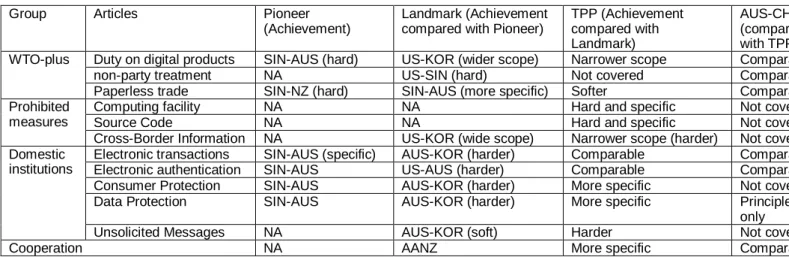
Table 2 summarizes the findings. TPP e-commerce rule-making achievements are compared against those in previous FTAs. A landmark FTA means an FTA that made significant rule-making contribution, before TPP. If TPP is the first FTA that made significant contribution, there is no landmark FTA. A pioneer FTA means an FTA that made an entrepreneur effort in making new rules in e-commerce. There is no pioneer FTA when the landmark FTA is pioneer or when there is no landmark FTA11.
11 When there is only one FTA before TPP that delivered some rule-making outcome, such is classified as
5
Table 2: Achievements of TPP Rule-making
Group Articles Pioneer
(Achievement)
Landmark (Achievement compared with Pioneer)
TPP (Achievement compared with Landmark) AUS-CHN (comparison with TPP) JPN-MNG (comparison with TPP) WTO-plus Duty on digital products SIN-AUS (hard) US-KOR (wider scope) Narrower scope Comparable Comparable
non-party treatment NA US-SIN (hard) Not covered Comparable Comparable
Paperless trade SIN-NZ (hard) SIN-AUS (more specific) Softer Comparable Comparable
Prohibited measures
Computing facility NA NA Hard and specific Not covered Comparable
Source Code NA NA Hard and specific Not covered Comparable
Cross-Border Information NA US-KOR (wide scope) Narrower scope (harder) Not covered Not covered Domestic
institutions
Electronic transactions SIN-AUS (specific) AUS-KOR (harder) Comparable Comparable Comparable
Electronic authentication SIN-AUS US-AUS (harder) Comparable Comparable Comparable
Consumer Protection SIN-AUS AUS-KOR (harder) More specific Not covered Comparable
Data Protection SIN-AUS AUS-KOR (harder) More specific Principle
only
Not covered
Unsolicited Messages NA AUS-KOR (soft) Harder Not covered Softer
Cooperation NA AANZ More specific Comparable Comparable
Source: Author’s compilation
Note: Unless “hard” / “specific” is inscribed, obligations firstly included in FTAs are soft and non-specific. After them, only changes (“harder” / “more specific”) are explained in the columns. For example, regarding paperless trade, SIN-NZ includes hard (and non-specific) obligation, while SIN-AUS has more specific (and hard) obligation than SIN-NZ. TPP has softer (but specific) obligation in paperless trade than SIN-AUS.
6
2.4 WTO-extra Capacity Building Rules
Cooperation provisions usually set only soft obligation, which is natural given the nature of required actions. E-commerce chapter in US FTAs do not have cooperation provisions that ensure the provision of technical assistance in the field of e-commerce. As Malkawi (2007) argues, there is no mechanism to ensure the benefits from e-commerce will be equally distributed between parties under US FTAs.
AANZFTA is the first FTA that has specific cooperation provisions included in e-commerce chapter (not general cooperation chapter in FTA). Its Chapter 10 Article 9 lists the areas wherein cooperation activities may be organized. TPP E-commerce chapter’s inclusion of cooperation provision is a significant step because members decide to cooperate in the area wherein institution building obligations are set. More specifically, TPP (Article 14.15) lists areas for cooperation such as: (i) personal information protection; (ii) online consumer protection; (iii) unsolicited message; (iv) (electronic) authentication. The basic idea is that specific technical assistance program is necessary to develop domestic institutions. The same Article also mentions the cooperation regarding the assistance to SMEs.
3. Beyond TPP: Australia-China FTA, Japan-Mongolia FTA and EU FTAs
Now that the TPP is unlikely to enter into force as it was signed in 2016. However, as we saw, rule-making under FTAs is evolutionary and such a process may continue with or without TPP enforcement. Therefore, it is worth examining recently signed FTAs already reflect the achievement made by TPP. We will analyze rule-making under recent FTAs signed between TPP party and non-party. This is because, with the involvement of TPP parties, there is a large probability that TPP achievements are “transplanted” into their FTAs. We will examine Australia-China FTA and Japan-Mongolia FTA.
Australia-China FTA took ten years to conclude the negotiation. When the negotiation started in 2005, only a limited number of FTAs had e-commerce chapter. However, thanks to the prolonged negotiation, it eventually has more substantial e-commerce chapter than earlier FTA such as AANZFTA. Note that Australia-China FTA is China’s first FTA that has e-commerce chapter. The critically important feature of e-commerce chapter in Australia-China FTA is that dispute settlement is not applicable (Article 12.11). Thus any obligation in this chapter is soft obligation without strong enforcement mechanism. In the WTO-plus area, Australia-China FTA is almost comparable to TPP, such as soft obligation on paperless trade, including acceptance of electronic submission (note, however, that TPP is not comparable to the most ambitious FTA such as Singapore-Australia FTA in this regard). However, all provisions on prohibition of measures, items firstly covered by TPP, are excluded from Australia-China FTA. TPP were able to achieve new rule-making on prohibited measures partly because parties had China in mind as a shadow negotiator. This implies a very simple but important fact that the rule-making sensitive to China can be achieved without the involvement of China, but such is not transplanted into Chinese FTAs. In contrast, many provisions on institution building are included in Australia-China FTA and the contents are almost comparable to TPP, except the fact that they are outside the scope of dispute settlement.
Japan-Mongolia EPA signed in 2015 is Mongolia’s very first FTA. Regarding WTO-plus issues, they are comparable to TPP, including soft obligation of paperless trade and non-extension of non-discrimination principle to non-party. Japan-Mongolia FTA also follows TPP with respect to prohibited measures, unlike Chinese FTAs. Articles that prohibit the requirement of location of computing facilities and access to source code are included as hard obligations.12 Japan-Mongolia FTA includes hard obligation on institution building for
electronic transaction, electronic authentication and online consumer protection, just like
7
TPP13. Unsolicited message is also coved, but it is a soft obligation.
It is very interesting to see the e-commerce rule-making status of EU FTAs, in comparison with Asia-Pacific. EU-Korea FTA, which is EU’s first FTA with Asia Pacific countries, follows the EU template wherein e-commerce is covered in the section of services and investment. It has two articles: objectives and principles (Article 7.48) and Cooperation and regulatory issues (Article 7.49).14 TTIP is currently being negotiated between the EU and the US.
According to the EU proposal tabled in November 201515, TTIP would include e-commerce
issues in the Chapter on trade in services, investment and e-commerce, not as a standalone chapter. Although the European draft includes unsolicited message, the scope e-commerce section is much more limited than TPP. TTIP would also have a separate chapter on customs and trade facilitation16, which states that Each Party shall make customs
declaration available by electronic means and allow a customs declaration to be submitted in electronic format.
4. Policy Implications
There are three important findings from which some policy implications can be drawn. First, regarding WTO-plus areas, rules set by TPP is less ambitious than some earlier FTAs signed by Australia and Singapore, and even than TFA in some areas. This is because TPP needed to strike a balance of interests between its developed and developing members. In this regard, TPP rule-making seems to anticipate what can be agreed at WTO. In fact, some rules of TPP are acceptable to non-TPP parties such as China and those are already included in their recent FTAs. Therefore, WTO-plus area rule-making in TPP, which is not so ambitious, is likely to be the legacy of TPP, even if it would not enter into force.
Second, TPP was able to deliver some rule-making outcome in WTO-extra area, e.g. the prohibition of imposing performance requirement in e-commerce business. This was possible partly because the TPP parties had China in mind as a shadow negotiator. Therefore, it is only natural to see Chinese FTAs include none of prohibition of imposition of performance requirement such as location of computing facilities. It is unclear at this stage whether rules achieved by TPP parties with China in mind as a shadow negotiator, will have extra-regional effect beyond the TPP region.
Third, regarding institution and capacity building, TPP’s achievements are almost comparable to earlier FTAs signed by Australia and Singapore, by combining institution building to be achieved by developing countries and capacity building support to be delivered by developed countries. Because substantial rule-making under FTAs is sometimes difficult dues to lack capacity, the inclusion of strong capacity building is necessary to include strong rules on institution building. The advantage of FTAs vis-à-vis WTO is that they can have tailor-made capacity building programs to unlock capacity constraint. The combination of capacity building and strong rules on regulatory framework in e-commerce was firstly employed by Australian FTAs, which were followed by TPP, and then even Chinese FTAs. The problem of WTO negotiations is that developing countries undertook to implement bound commitments in exchange for unbound commitments for assistance by developed countries (Finger and Winters 2002). This problem is overcome in the case of TPP e-commerce chapter.
13 Japan-Mongolia FTA does not cover personal data protection, unlike TPP, however.
14 EU-Canada FTA also covers only objectives and cope, duties on electronic delivery, trust and confidence,
general provision, and dialogue.
15 Available at: http://trade.ec.europa.eu/doclib/docs/2015/november/tradoc_153955.pdf (access on 17
February, 2017).
16 Available at: http://trade.ec.europa.eu/doclib/docs/2015/january/tradoc_153027.pdf (access on 17 February
8
References
Abbott, K. W., Keohane, R. O., Moravcsik, A., Slaughter, A. M., and Snidal, D. (2000), The concept of legalization. International Organization, 54(3), 401-419.
Elms, D. (2016), Evolving Digital and E-Commerce Trade Rules for Northeast Asia, KIEP
Research Paper, Studies in Comprehensive Regional Strategies 16-09.
Finger, M. and Winters, A. (2002), Reciprocity in the WTO in Hoekman, B., Mattoo A. and English, P. (eds) Development, Trade, and The WTO: A Handbook, World Bank, Washington DC.
Gao, H. (2016), From Trade Regulation to Digital Regulation: The Regulation of Digita Trade in the TPP, a paper presented at Harvard Law School, 27 April 2016.
Horn H., Mavroidis P. C. and Sapir A. (2010), Beyond the WTO? An anatomy of EU and US preferential trade agreements. The World Economy, 33(11), 1565-1588.
Lamy P. (2002), Stepping stones or stumbling blocks? The EU’s approach towards the problem of multilateralism vs regionalism in trade policy. The World Economy, 25(10), 1399-1413.
Linos, K. and Pegram, T. (2016). “The Language of Compromise in International Agreements.” International Organization 70 (3): 587–621.
Malkawi B.H. (2007). E-commerce in light of international trade agreements: The WTO and the United States-Jordan Free Trade Agreement. International Journal of Law and
Information Technology, 15(2), 153-169.
Mavroidis P.C. (2017), Trade Regulation, and Digital Trade, paper presented at the 2017 Global Digital Futures Forum, 5 May, 2017.
Obama, B. (2013), Opinions, President Obama: The TPP would let America, not China, lead the way on global trade, Washington Post, 2 May 2013. Available at: https://www.washingtonpost.com/opinions/president-obama-the-tpp-would-let-america-
not-china-lead-the-way-on-global-trade/2016/05/02/680540e4-0fd0-11e6-93ae-50921721165d_story.html?utm_term=.bc1c67440b1d (Last access on 15 February 2017).
Sell S. K. (2010), TRIPS was never enough: Vertical forum shifting, FTAs, ACTA, and TPP.