Incorporating Biodiversity in the Japanese
Private Sector : An analysis of a preliminary
survey conducted on the Nippon
Keidanren Business Association
Ryo Kohsaka
Mitsue Tokuyama
SummaryThis article summarizes an empirical study based on the perceptions of the Japanese private sector regarding issues related to biodiversity. Questionnaires were sent to 350 companies of the Nippon Keidanren business association and 145 responses were obtained. A range of topics were explored, including, organizational structure, current activities, and potential risks from biodiversity degradation. From this data, specific trends concerning risk percep-tion and future activities for different sectors were identified. These trends have global implications for international discussions on biodiversity processes.
Keywords : Biodiversity, Corporate Activities, Private Sectors, Risks
1 Introduction
The relationship between the private sector and the environment has been a challenging one. On the one hand certain economic activities, in particular technological innovations, have decreased environmental degradation. For example, during the oil shock of the late 1970s, several Japanese industries were highlighted as success stories due to their energy saving measures resulting from infrastructure changes. This transition, from destructive to more environmentally friendly measures that Japanese industries underwent has been termed as “ecological modernization” by authors such as Hajor (1995). Japan, together with Germany, has often been referred to as a success story for ecological modernization ─ that is simul-taneously attaining economic growth and improved environmental performance ─ particular-ly during the oil shock. On the other hand however the success has not been as straightfor-ward as it is sometimes narrated as conflicts between different social groups,have often
arisen. Activities by companies have often been regarded as being in opposition to environ-mental conservation and the sustainable use of natural resources. There have been iconic cases related to the destruction of rainforest, oil spills and transboundary air pollution ― where the private sector has been heavily criticized as a result of their actions or inaction in the face of environmental concerns.
The debate on environment issues has become increasingly multi-disciplinary and is linked to highly complex and uncertain area in natural science, such as biodiversity. As the impact of industry and corporate activities has caused notable declines in both the quality and quantity of biodiversity, more integrated approaches are needed. A global review of ecosystems, titled the Millennium Ecosystem Assessment, concluded that changes in land use (particularly those related to the agriculture) are one of the underlining causes of biodiversity loss globally (MEA, 2005). However, in the Statement of the Board, the MEA suggested that though the private sector is a part of the “biodiversity problem”, it will increasingly need to be part of the solution. As a result of such observations issues of Corporate Social Responsibility (CSR) and Sustainable Development are increasingly linked. The private sector is part of sustainable development and the sector has an obligation as part of society, to commit to sustainable activities (Loew, et al., 2004).
The unsustainable use of natural resources by the private sector and industries has been recognized at the international level. At the 8th meeting of the Conference of the Parties to the Convention on Biological Diversity (CBD), the Parties stated that the “private sector is arguably the least engaged of all stakeholders in the implementation of the Convention, yet the daily activities of business and industry have major impacts on biodiversity” (decision VIII/17). Thus as a means of reconciling nature and industry, the CBD called upon the private sector to be actively involved in the conservation and sustainable use of biodiversity. As Japan is hosting the 10th Conference of the Parties to the CBD in 2010 in Aichi Nagoya, issues related to biodiversity and ecosystem health are becoming increasingly important and timely for Japan. One such issue is how Japanese industries are integrating biodiversity and other environmental concerns into their daily operations. This issue is explored in a question-naire developed and conducted by an industry association called Nippon Keidanren, which has wide membership across different industries and sectors in Japan. The questionnaire was sent to its selected member companies. The responses received from the Keidanren survey have implications for the operations of member companies as well as trading partners. This paper explores the ways in which the Nippon Keidanren association integrates environmental action into its operations as it is an indication of how Japanese corporate governance can
become more sustainable.
2 Existing Literature
The English language literature on Japanese experiences with corporate social responsibil-ity and its implications for environmental issues is limited. The existing international litera-ture can be categorized into two groups according to their focus and their scale. The studies in the first category look into large scale datasets of companies, often exploring financial and social performances (including environmental reporting). The second group focuses on the sites and communities on more individual projects basis.
In the first category, one of the main foci of existing research is the relationship between social behavior and (long-term) financial returns. In other words, a large number of studies examined whether social activities, including CSR activities are translated into better financial performances, benched marked in stock prices (Brammer et al., 2006b ; Orlitzky et al. 2003), reactions by shareholders (Falck and Heblich, 2007) or earning forecasts (Aerts, et al. 2008). Not surprisingly, such relationships are difficult to prove and “the empirical research has not arrived at a consensus” (Scholtens, 2008 : 46).
In a similar vein, rich literature exists on the drivers for disclosure of environmental information particularly in North America and Europe. Relationships between environmental disclosure and profitability, media exposures are examined in large scale projects (Aerts et al. 2008). In the European context, other elements are analyzed such as the industry member-ship and propriety and information costs as factors for environmental information disclosure (Cormier and Magnan, 2003). Similar results are indicated by Brammer et al. (2006) for geographically dispersed international firms. Scholtens (2008 : 52) demonstrated that finan-cial returns appear to precede or lead sofinan-cial strength, indicating that companies with good financial condition are likely to perform socially and not necessarily the other way around.
In the second category, there are analysis of business cases of individual companies and projects. For example, Snep et al. (2009) have analyzed stakeholder preferences, including those of employees, for enhancing biodiversity with different options and scenarios of urban greens in the Netherlands. They found that business sites have importance as ; (i) urban-rural gradient linking ecological corridors (ii) buildings, roofs in particular, have potential for biotope (iii) exra-lands that are not in use provide opportunities for pioneer vegetation (iv) they are relatively undisturbed twilights which are important for nocturnal species. As a concrete recommendation, Snep et al. (2009) point out that “the greening of flat roofs has a
huge potential” for existing business sites. This has a co-benefit for the so-called “heat islands” effects for many Japanese large scale cities. Other suggested measures are ; (i) integration of biodiversity considerations at the early stages of design and development of business sites and (ii) allowances for temporary biodiversity providing pioneer situations for species. In a similar vein, the companies can identify the values attached to their business sites by the surrounding communities.
In Finnish contexts, forests owned by a certain corporation were evaluated by using maps that identify the various social values attached by the local residents (Donoghue et. al, 2007). Donoghue et al. (2007) have distinguished foundational assets and mobilizing assets in analyz-ing the adaptability of the community to changes. The former are comprised of physical, financial, natural, social, human and political capital and the latter with social, human and political capital that leads to action and outcomes. The lessons learned from the existing reviews are that qualitative aspects of human and social capital are essential for collective actions such as the leadership and organizational coherence in addition to skills and budgets. As we have seen, most of the existing literature on corporate social responsibility (CSR) focuses on North American and European experiences. To help address this information gap, this paper provides a brief summary of various Japanese industries’ environmental activities, their purpose, and relevant environmental activities. This information is compared to trends from the Anglo-Saxon and European contexts to provide perspective.
The purpose here is to identify the national trends and to capture the status quo of large-scale Japanese corporate perceptions on biodiversity and nature conservation, in general. Further study will be necessary to link these rather large scale international studies on CSR activities and the national trends discussed in this study.
3 Research Framework
3-1 Background of Nippon Keidanren
A key actor throughout numerous Japanese industries, Nippon Keidanren’s (a Japanese business federation : hereafter Keidanren) whose main objective is to address the challenges of integrating the sustainable use of natural resources into industries’ daily operations.
Keidanren, an umbrella organization with a membership of 1,662 entities, comprised of 1,343 companies and corporations, 130 industrial associations, 47 regional economic organiza-tions and other entities (as of June 22, 2007), is one of the largest economic organizaorganiza-tions in
Japan. Its Global Environment Charter was drafted in 1991 and under this charter a con-servation fund titled the “Keidanren Nature Concon-servation Fund” (KNCF) was established. The drafting of the charter and establishment of the KNCF and the Committee was announced at the United Nations Conference on Environment and Development (UNCED) held in Rio de Janeiro in 1992. This announcement came after a thorny period with civil society in the 1980s. According to the meeting records, the mission realized that “corporate governance that does not reflect environmental consideration can no longer exist” (Tani-guchi, 2008). Essentially, the association recognized environmental pressures from domestic and international sources as well as a wide spectrum of society and formed the charter as a means of addressing environmental challenges. As stated in the Global Environmental Char-ter, Keidanran calls for collaboration “to create new social and economic systems that allow the advancement of the welfare of all human beings and the conservation of the whole world’s environment.”
It is important to note that the establishment of the KNCF in 1991 was timely as it coincided with the emergence of civil society in Japan. The Kobe Earthquake that struck east Japan in 1995 marks the incident in Japanese history that highlighted the importance of civil society. The number of volunteers that helped during the tragic incident was regarded as a defining moment for civil society groups. As a result the year is referred to as the beginning of volunteerism in Japan (Kohsaka, 2000 ; Kawamura 2008). KNCF was established with the purpose of supporting international civil societies in the field of environmental issues. At the later stage, support for Japanese NGOs was added to it objectives. Since 1993, KNCF has donated 2.7 billion yen (225 million Euro) to over 800 projects. Although the amount donated has increased over time, the number of projects has remained comparable over the past 8 years.
3-2 Procedure and purpose of the study
This study was conducted with the purpose of capturing information related to biodiversi-ty activities and the institutional setting of the various Keidanren members. The study is based on a questionnaire conducted as part of the process of creating the Declaration of Biodiversity by Nippon Keidanren. The questionnaire was developed by the staff members of the KNCF by modifying the standard formats of a general questionnaire. The authors’ involvement in this design process of the questionnaire was limited.
2008 was set. The questionnaire was sent to 350 of the 1,343 Keidanren members which were selected based on the following criteria :
●the company is a member of the Nature Protection Committee ; and
●the company is considered major organization in Keidaren (i.e. the company occupies
managerial posts at Keidaren)
In total 145 companies responded to the questionnaire by the deadline.
3-3 Methodology
The responses by the Japanese private sector are analyzed in two steps. First, the overall trends were captured by aggregating the responses ─ following which a cluster analysis was applied to the responses. Cluster analysis is a form of multivariate analysis which helps to identify the meaningful groups or “clusters” in the dataset. In this paper, we clustered companies according to three types of project activities : nature conservation, education and biodiversity related. The analysis is based on multi-dimensional data that maps the different data elements and relationships onto graphs. Due to the limited numbers of respondents in certain sectors, companies were categorized into different clusters. Key finding of this study are presented in the format of mapping.
4 Responses in the Questionnaire 4-1 Overview
A brief explanation is given here as to the profiles of the responding companies. The number of respondents for the different sectors is shown in the figure below.
The categorization was done using Kaisha Shikiho, the Toyo Keizai’s flagship data book, which is one of the most common categorizations used in Japan. As indicated in the table the sectors with the largest numbers of respondents are : Electric Appliance, Construction, Transportation Equipment, Chemicals, Electric Power and Gas, Wholesale Trade, Food, Machinery, and Insurance. In this study, we have grouped some of the different sectors together in order to be able to make meaningful analysis. We have re-categorization the grouped sectors, which allowed us to see clearer trends. The re-categorized groups are “material,” which includes companies from the Chemicals and Oil & Coal Products sectors ; “daily life” which is composed of textile and Apparel, Food, Pharmaceutical and Pulp & Paper ;
and “assembly and process” which includes Electric Appliance, Transportation Equipment, and Machinery. The finance related companies, such as Insurance, Other Finance Business, Banks and Securities were also clustered together into “Finance.” Two of the original groups, the Construction (17 companies) and services (37), were retained.
4-2 Organizational Structure and Interests
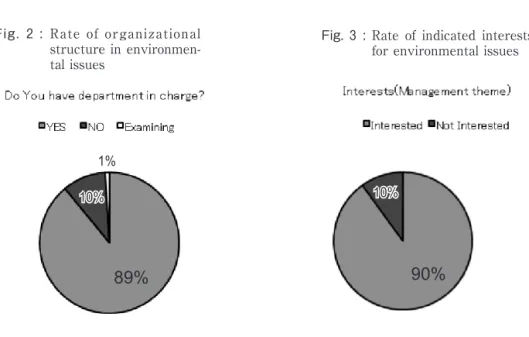
Nearly 90% of the companies surveyed have an organizational unit or division in charge of nature protection, biodiversity conservation, or environmental education. Further a large majority of the companies (90%) surveyed responded that their company considers
biodiv-Pharmaceutical
ersity as a topic which needs to be constantly taken into consideration in management deci-sions. These figures reflect that the responding companies were large in size and mostly listed companies and corporations.
4-3 Current Activities 4-3-1 Overall trends
Companies were asked in the questionnaire what kind of activities and projects they conduct in the environmental field. The possible answers were : “nature protection and biodiversity conservation” or “nature education”.
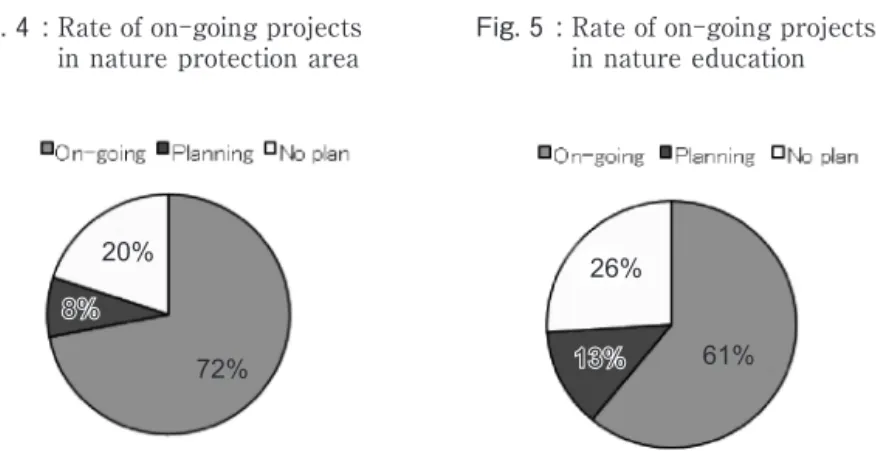
72% of the companies responded that they had on-going projects on nature protection and biodiversity conservation. A further 8% of companies are in the project planning phase for such projects. Therefore 80% of the respondents are involved in the field of nature protection. As for nature education projects, 61% of the respondents indicated that they are im-plementing projects and an additional 13% responded that they are at the planning phase.
The majority of activities implemented by companies surveyed are conducted in collabora-tion with external bodies. However for internal project, such as educacollabora-tion program for staff members, companies collaborated less with external partners.
4-3-2 Breakdown of the Projects
The table below presents activities and on-going projects of the different companies 10%
10% Fig. 2 : Rate of organizational
structure in environmen-tal issues
Fig. 3 : Rate of indicated interests for environmental issues
89%
10% 10% 10% 1%90%
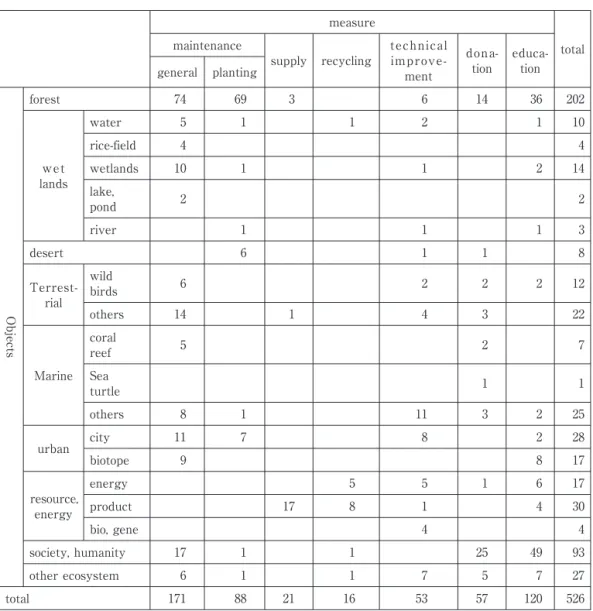
10% 10% 10%(Table 1). The column lists different types of ecosystems (forests, marine and other ecosy-stem types). The category “terrestrial ecosyecosy-stem” includes those ecosyecosy-stems on land that were not categorized as forests or paddy fields. The category “bio” projects indicate those related to the management of the genetic resources and biomimicry (development of pro-ducts that are modeled after natural objects). The rows of the table list the conservation measures taken in these categories.
Out of 526 projects reported by respondents, 202 were related to forests. This was the largest project group by far. The second largest project type was society and human well-being ― of which 93 projects were reported. The next largest group of projects was related to resource and energy (third), followed by urban (fourth), terrestrial ecosystems (fifth). In reviewing the breakdown of the projects, we realize that projects related to forests, capacity building and terrestrial ecosystems occupy a large portion of the projects. As for the mea-sures and activity types, reforestation projects are high. Concrete projects focused on the protection of rare species in high mountains, fresh water and birds. In addition, projects related to development and construction sites, ecosystem conservations within the factory, greening and facilities for birds at business sites, were also undertaken as projects of the company.
4-3-3 Prioritized Areas for conservation
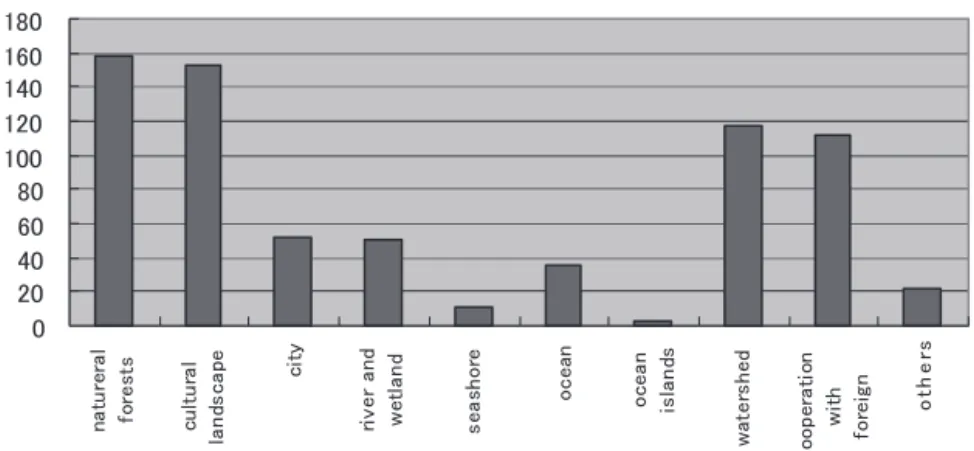
Other questions in the survey were designed to determine priority sites for conservation. A larger number of responses were on “natural forests,” “cultural landscape and Satoyama” and collaboration with international partners. These responses were in line with the projects conducted by the responding companies. There are less on-going projects related to “water-sheds”. As we have seen in the trends of actual projects, fewer responses were given for
72% 20% 8% 8% 8% 61% 26% 13% 13% 13%
Fig. 5 : Rate of on-going projects in nature education Fig. 4 : Rate of on-going projects
marine projects. One possible explanation for this is that access to project sites the imple-mentation of project is difficult in the marine environment.
It is clear from the questionnaire that a wide range of projects are conducted by Keidanren members. As we have seen, a large proportion of the projects are devoted to reforestation and plantation activities. Challenges that lie ahead are to not only increase the covered areas or number of planted trees, but also to improve the quality of the activities. In other words, the plantation activities need to reflect the demands and needs of local communities in order to become truly sustainable.
Table 1 : Project Types
measure
total maintenance
supply recycling technical improve-ment
dona-tion educa-tion general planting O b j e c t s forest 74 69 3 6 14 36 202 wet lands water 5 1 1 2 1 10 rice-field 4 4 wetlands 10 1 1 2 14 lake, pond 2 2 river 1 1 1 3 desert 6 1 1 8 Terrest-rial wild birds 6 2 2 2 12 others 14 1 4 3 22 Marine coral reef 5 2 7 Sea turtle 1 1 others 8 1 11 3 2 25 urban city 11 7 8 2 28 biotope 9 8 17 resource, energy energy 5 5 1 6 17 product 17 8 1 4 30 bio, gene 4 4 society, humanity 17 1 1 25 49 93 other ecosystem 6 1 1 7 5 7 27 total 171 88 21 16 53 57 120 526
4-4 Implementing Agencies
There were two questions regarding the main implementing agencies for the conservation and public awareness activities. The responses indicate how the Japanese private sector prefers to share the responsibility in implementing the tasks. The responses to the two issues are illustrated below.
4-4-1 Who should implement the tasks ?
The first question related to implementation was the questions regarding the main actor or agency that should implement the tasks. The majority of the companies responded that the
Fig. 6 : Priority area for Conservation
Fig. 7 : Main actors for implementation
Scale : Frequency of aggregated responses Scale : Frequency of aggregated responses
central government is the main actor in spearheading activities for the conservation of biodiv-ersity. The municipalities and local governments ranked second. Third are non-governmental organizations (NGOs) and the fourth is the private sector. The majority of companies look to the central and local governments to play the leading role in creating and implementing biodiversity conservation policies.
4-4-2 Outreach activities
Another relevant question was related to needs in conducting the awareness raising activities. The question covered the ways and means that companies need for raising aware-ness among citizens about biodiversity conservation and environmental issues. Overall, there was a greater need for guidebooks and best-practices compilations.
The third highest demand was the creation of incentive mechanisms and a clear system which showed the contributions of companies, especially the activities they had undertaken to improve the environment and biodiversity conservation.
The demand for guidelines could be partially fulfilled by the guidelines and examples included in the Keidanren Biodiversity Declaration.
5 Results
5-1 Inter-linkage with Policy and Projects based on Cluster Analysis
The data on on-going projects were crossed-checked whether they were any literlinkages
Scale : Frequency of aggregated responses
with the companies’ policy and notion.
As concrete analysis, another dataset on the integration of the environmental elements into the principles and aims of the company were compared against the on-going projects. Cluster analysis was conducted to cross check whether such “conceptual references” were related with project implementation on the ground. In other words, it was examined if the notions and words were accompanied with the deeds in projects.
In the other data set, the companies were asked whether concepts of environmental protection, biodiversity conservation, or environmental education were referred to in the corporate policy or management policies. The orders were nature protection (74%), nature education (56%) and biodiversity conservation (38% : the percentage of positive responses). Roughly the same percentage of the companies (37%) responded that they do not or are not currently reviewing to refer to the term biodiversity conservation. The companies that are under review to integrate the term into the policy is 25% which is higher than the other two concepts (7%) and nature education (12%). The biodiversity element is not as frequently referred to as the other two concepts. Yet larger numbers of companies are currently under review to integrate the term in their ideas and policies.
The results of references indicated four clusters : the active group where companies have the all three concepts written into their policies (47 companies in total) ; the semi-active group where companies have two concepts “nature protection” and “nature education” written into their policies (35 companies) ; the no-reference group where companies have no mention of these concepts (46 companies) ; and a group of companies that are under the process of reviewing their policies (17). It was clear that the active group had a higher rate of environmental involvement with independent environmental divisions and on-going projects. Interestingly, the group with no references in their policies actually have relevant divisions (76% of companies) and roughly half of these companies (46%) were engaged in awareness activities or projects. Therefore just because companies do not have references to any concepts in their environmental policies does not necessarily mean that the companies con-duct less environmental activities or that they do not consider the environment as a priority. Having said this, the reference to biodiversity conservation in a corporate environment or management policies often have strong implications for the operations and activities and therefore remain important tools in mainstreaming biodiversity into daily operations.
The number of companies that refer to biodiversity was modest. The results indicate that there is further room to raise awareness and mainstream these issues into different sectors.
5-2 Future Activities 5-2-1 Overview
The companies were asked to report on their future activities for the conservation of biodiversity in the questionnaire.
The highest ranked activity was option (b), circulation of resources with 19.8%, The second most common answer was (a), secure and safe supply chain and procurement of ingredients with 16.6%. The third highest option was (g), is the development and innovation for the low impact environmental technology with 15.3%. It is interesting to note that two most commons answers relate to technology and procedure. The large number of manufac-turing companies that responded may explain why future tasks are skewed towards technolo-gical issues. On the opposite end, activities related to the fair and equitable sharing of genetic resources, biosafety and the exclusion of invasive species were the topics with relatively low interest.
a. Secure and safe supply chain and procurement of ingredients
b. Circulation of resources : 3R (Recycle, Reuse, Reduce) c. Preventative and conservation measures for
assessments and feasibility studies d. Conservation of endangered species e. Exclusion of invasive alien species
f. Damage control and prevention of natural disasters (flood, wind, etc.)
g. Development and innovation for low impact environmental technology
h. Nature restoration and conservation in line with natural mechanism
i. Equitable Sharing of Benefits arising from Utilization of Genetic Resources
j. Biosafety
k. Preservation of Local and Diverse Cultures, Habits and Resources
l. Promotion of Ecotourism
m. Selective Investment (reflecting biodiversity elements)
n. Credit or Offsets (as in Climate Change and Trading)
5-2-2 Trends in individual sectors
As we have seen in 2-1, there are sectors with a larger number of members such as Electronic & Machinery, Automobile, Wholesale, Constructions, Chemicals, Electricity & Gas, Machinery, Insurance and Food & Beverages.
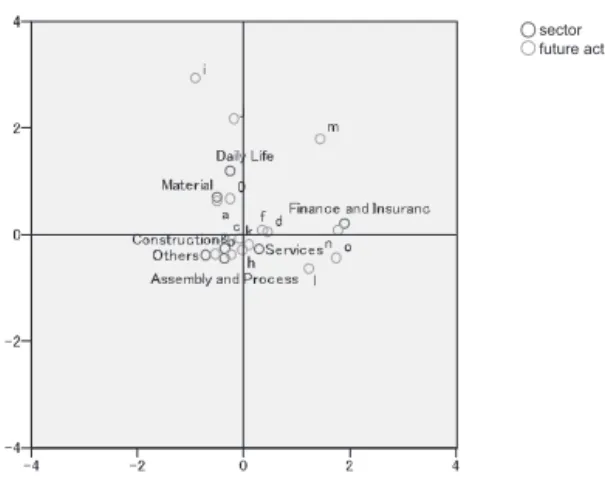
In question 7, the trends of individual sectors were identified. From the mapping of the responses it is clear that the sectors related to manufacturing, such as Assembly and Proces-sing, are similar to Construction and other sectors. The finance related sectors such as insurance are distanced from other sectors. Sector specific trends are visible in the responses of these companies.
Those companies in the Assembly and Processing category tended to choose (b) recycling of resources and (g) development of low impact technology and innovation. The finance sector tended to choose (m) selective investment and (n) offsets. Interestingly, the sector Assembly and Processing tended not to choose (a) procurement of ingredients ─ option (g). Companies in the Daily Life sector tended to choose (a) procurement of ingredient and (m) selective investment. Although it was not a large group, the Daily Life sector tended to choose (i) ABS and (j) biosafety.
It is clear from the responses that the companies are opting for activities that are close to their operations. This was especially visible for the finance sector which chose to offset and selective investment. Alternatively, fewer companies chose issues related to ABS and biosafe-ty. The Daily Life sector was the single sector to choose these issues. The fact that the international regime on ABS is under negotiation could partially explain this trend.
sector future activities
Fig. 10 : Future activities and differences amongst the sectors
5-3 Risk Perception
The companies were asked what the (potential) risks are arising from their operations. Overall, all sectors reported that “reputational” risks posed the greatest threat to their operations. Option (a) was by far the most frequent answer (31.9%). The second option was (b) lower brand image (18.6%) followed by (c) boycotts by consumers (14.7%). The fourth option was the (h) difficulty in product supply followed by (i) difficulty in operations of factories and operation units. These two options were followed by (e) exclusion from the SRI (SRI : Socially Responsible Investment), which is related to financial operations of the unit. In summary, the risks currently perceived are mainly related to reputation and brand image. The second most frequent answer was related to daily operations of supply-chains and
financ-sector risk perception
Fig 12 : Risk perceptions amongst different sectors
a. lower reputation of CSR b. lower brand image c. boycotts by consumers d. lower rating at financial market e. Exclusion from the SRI
f. Worse relationships with trading partners
g. Disorder in Supply Chain h. Difficulty in products supply and
ingredients procurements i. Difficulty in operations of factories
and operation units j. Lower morale k. Others
ing capitals.
More trends for specific sectors were noted. For the Assembly & Process sector, answers related to internal affairs, such as (j) lower morale, was chosen. The sector Daily Life tended to choose (h) disorder in supply chain and procurement. This implies that biodiversity is related to the daily operations of this sector. Interestingly, companies of the Finance sector tended not to respond the same. Therefore, it is less recognized that their investments are linked to the supply chains and procurements of necessary ingredients. Responses related to ABS and biosafety risks were few. The responding companies were all in the sector of Daily Life. Generally speaking, the reputation risks are gaining more attention than the physical risks in supply chains and procurement of ingredients or the regulation risks by the govern-ments and international laws.
6 Concluding Remarks
The authors were asked a number of times by the Japanese business people who re-sponded to the survey, “What are concrete actions that we can take for biodiversity ? It is much harder than reducing green house gas emission.” Clearly there are no “one-size-fit all” solution for companies and sectors. However the findings of this report begins to shed some light on what types of actions Japanese companies can, and in some cases already have, implemented.
The actions can be taken at various scales from manufacturing, construction of business sites, supply chains to voluntary activities such as plantations. As in the current review, one contribution is to review on-going CSR activities reflecting the results in this study. The activity areas are somewhat congested (i.e. forestry or plantations) and areas that are less active (marine and coastal conservation).
The other obvious contribution are to utilize business sites (i.e. building of working facili-ties but excluding shopping malls or storages). In other words, physical existence of the companies are incorporated into the ecological integrity of the area through improvements in the buildings, integration into the ecological corridors, and provision of recreational opportuni-ties as we have seen in the literature review (Snep et al., 2009).
Besides, these on-sites responses, other possible measures could include the review of supply chains. Procurements of the materials are generally critical phase for the impact of the
biodiversity, in particular if the land uses are changing (alternating natural status to agri-cultural or construction purposes).
In certain sectors, Japanese companies tend not to own or operate in natural resource sites. For example, Japanese paper and pulp industries own less forestlands than their American or Swedish counterparts (Lönnstedt and Nrodvall, 2007) . Similar situations apply to the Japanese energy sectors in that business entities are the wholesaler and not directly involved in extraction activities. This fact is often used to claim that the companies have limited opportunities to consider biodiversity in their activites. However reputational risks are intert-wined within the supply chains of the materials and these companies can take more proactive actions in partnerships with their counterparts that own or operate extraction sites. By doing accountability for the procurements of ingredients and materials are more secure. The physical risks by the operators are obscured in the supply chains but are linked with the contracting counterparts of Japanese companies and accountability and risk will not evapo-rate.
The challenges for Japanese private sector are multi-faceted. The focus and interest of the public attention, including those of media, differ by domestic and international contexts. The international audience will be more focused on global responsibility of the Japanese companies in implementing the Keidanren declaration while the public and media at home are often more focused on the activities at the community level.
In environmental survey research, this questionnaire is one of the first to consider the relationship between the private sector and biodiversity in Japan. In addition, it is the first one to consider the implications of integrating the sustainable goals of the CBD in industries (especially after the decision to host COP10). The information provided by respondents is considered baseline data (of environmental activities by Japanese companies). As COP10 is expected to bring about changes, a second survey, or follow-up questionnaire, will be sent to measure these changes in corporate activities. In addition, the framework of this survey are to be used for comparisons in international comparisons, possibly after refining certain ques-tions and answer opques-tions.
The data collected about the activities the Keidanren members provided us with unique insight into areas for capacity building, investments and resource mobilizations in the future. The suggested steps here for the companies are to review and revisit their in-house resources. These include human, social and financial capital. For example, Donoghue et al. (2007) in the literature, have emphasized the role of leadership and organizational coherence in addition to skills and budgets for collective actions. It is important to keep these social
acceptability and values in consideration in addition to the considerations to ecological ele-ments.
From this study, there are a few suggested actions for the Japanese private sectors ;
●Strengthen social needs and values into biodiversity conservations projects
This is particularly important for the large number of on-going projects in the field of plantations and ecological networking. The social values particularly from local and indige-nous communities are key elements.
●Mainstreaming biodiversity in the production sector
From the review, limited commitment to biodiversity issues has been seen in the produc-tion sector (i.e. agriculture, fisher and forestry).
Mainstreaming biodiversity in the production sector has been identified as priority for international organizations, including the Global Environment Facility (Petersen, and Huntley, 2005) and as such it should become a priority for the Japanese production sector as well. Acknowledgement : This project was partly funded by Grant-in-Aid for Research in Nagoya City University. Thanks are extended to Ms. Leah Mohammed and Mr. Kieran Mooney for their comments and advice.
References
Aerts W., Cormier, D. Magnan, M. (2007) Corporate environmental disclosure, financial markets and the media : An international perspective. Ecolo-gical Economics 64 : 643-659
Cormier, D. and Magnan, M. (2003) Environmental reporting management : a European perspec-tive. Journal of Accounting and Public Policy 22 : 43-62
Donoghue, Ellen M. ; Sturtevant, Victoria E. (2007) Social science constructs in ecosystem assess-ments : revisiting community capacity and com-munity resiliency. Society and Natural Re-sources 20 : 899-912
Hajer, Maarten A., 1995 The Politics of Environmen-tal Discourse : Ecological Modernization and the Policy Process, Clarendon Press, London. Petersen, C. and Huntley, B (2005) Mainstreaming
Biodiversity in Production Landscape. Global
Environment Facility (GEF), Washington. Millennium Ecosystem Assessment (2005)
Ecosy-stems and Human Well-Being (Millennium Ecosystem Assessment) Synthesis Report. Is-land Press, Washington.
Kangas, A., Ruut H. & Liisa Tyrväinen. (2008) Integ-rating place-specific social values into forest planning ― Case of UPM-Kymmene forests in Hyrynsalmi, Finland Silva Fennica 42 (5) : 773-790
Lönnstedt, L. & Nordvall, H. O. (2007) The Japanese pulp and paper industry : an analysis of financial performance from 1991 to 2001 Journal of Forest Research, 12(4) : 278-288
Loew T., Ankele, K., Braun, S., & Clausen, J. (2004) Bedeutung der CSR-Diskussion für Nachhaltig-keit und die Anforderungen an Unternehmen (Significance of the CSR Debate for
Sustainabil-ity and the Requirements for Corporations) , Berlin : IÖW 126pp
Kohsaka, R. (2000) Gift und Tabu. Bemerkungen zur japanischen Tropenwalddebatte. In Flitner, M (ed.) Der deutsche Tropenwald. Bilder, Mythen, Politik. Campus, Frankfurt a. M. pp. 214-223 Snep, R., Van I., Ekko, & Opdam, P. (2009)
Enhanc-ing biodiversity at business sites : What are the options, and which of these do stakeholders pre-fer ? Landscape and Urban Planning, 91 (1) :
1-35
Taniguchi, Y. (2008) Design of Keidanren for promo-tion of collaborapromo-tion in environmental conserva-tion. In Nippon Keidanren Committee on Nature Conservation (eds) Environmental CSR Dec-laration : Corporation and NGO : 97-116. Doubunkan, Tokyo
Turner, R. K., Pearce, D. W. and I. Bateman (1994), Environmental economics : an elementary intro-duction, Johns Hopkins Univ. Press.