Nagoya City University Academic Repository
学 位 の 種 類 博士 (薬科学) 報 告 番 号 乙第1905号 学 位 記 番 号 論 第203号 氏 名 原田 一人 授 与 年 月 日 令和 2 年 6 月 30 日 学位論文の題名 シクロヘキサン含有スピロ環を有する新規 GPR119 アゴニストの探索合成研究 論文審査担当者 主査: 樋口 恒彦 副査: 中村 精一, 中川 秀彦, 山村 寿男
名古屋市立大学学位論文
シクロヘキサン含有スピロ環を有する
新規
GPR119アゴニストの探索合成研究
令和
2 年度(2020 年 6 月)
[1]. 本論文は、2020 年 6 月に名古屋市立大学大学院薬学研究科において審査されたもの である。 主査 樋口 恒彦 教授 副査 中川 秀彦 教授 副査 山村 寿男 教授 副査 中村 精一 教授 [2]. 本論文は、学術情報雑誌に収載された次の報文を基礎とするものである。
1. K. Harada, J. Mizukami, S. Kadowaki, I. Matsuda, T. Watanabe, Y. Oe, Y. Kodama, K. Aoki, K. Suwa, S. Fukuda, S. Yata, T. Inaba
Design and synthesis of novel and potent GPR119 agonists with a spirocyclic structure
Bioorg. Med. Chem. Lett. 2018, 28, 1228.
2. K. Harada, J. Mizukami, T. Watanabe, G. Mori, M. Ubukata, K. Suwa, S. Fukuda, T. Negoro, M. Sato, T. Inaba
Lead generation and optimization of novel GPR119 agonists with a spirocyclic cyclohexane structure
Bioorg. Med. Chem. Lett. 2019, 29, 373.
3. K. Harada, J. Mizukami, T. Watanabe, G. Mori, M. Ubukata, K. Suwa, S. Fukuda, T. Negoro, M. Sato, T. Inaba
Optimization of oxadiazole derivatives with a spirocyclic cyclohexane structure as novel GPR119 agonists
Bioorg. Med. Chem. Lett. 2019, 29, 2100.
[3]. 本論文の基礎となる研究は、日本たばこ産業株式会社において稲葉隆之博士および佐 藤元秀博士の指導の下に行われた。
略語表
Ac Acetyl アセチル
AUC Area under the curve 曲線下面積
AZADO 2-Azaadamantane N-oxyl 2-アザアダマンタン-N-オキシル
BA Bioavailability 生物学的利用能 BINAP 2,2'-Bis(diphenylphosphino)-1,1'-bin aphthyl 2,2'-ビス(ジフェニルホスフィノ)-1,1'-ビナフチル Bn Benzyl ベンジル
Boc tert-Butoxycarbonyl tert-ブトキシカルボニル
Bu Butyl ブチル
cAMP Cyclic adenosine monophosphate 環状アデノシン一リン酸
CDI 1,1’-carbonyldiimidazole 1,1’-カルボニルジイミダゾール
CL Clearance クリアランス
CSA 10-Camphorsulfonic acid 10-カンファースルホン酸
CYP Cytochrome P450 シトクロムP450 DavePhos 2-Dicyclohexylphosphino-2’-(N,N-di methylamino)biphenyl 2- ジ シ ク ロ ヘ キ シ ル ホ ス フ ィ ノ -2’-(N,N-ジメチルアミノ)ビフェニル DHP 3,4-Dihydro-2H-pyran 3,4-ジヒドロ-2H-ピラン DMAD N,N,N',N'-tetramethylazodicarboxami de N,N,N',N'-テトラメチルアゾジカルボ キサミド DMF Dimethylformamide ジメチルホルムアミド
DMSO Dimethyl sulfoxide ジメチルスルホキシド
DPPA Diphenylphosphoryl azide ジフェニルリン酸アジド
EC50 Half-maximal effective concentration 50%効果濃度
ESI Electrospray ionization エレクトロスプレーイオン化
Et Ethyl エチル
FeSSIF Fed state simulated intestinal fluid 摂食時における人工腸液
Fsp3 Fraction of sp3 化合物中の全炭素に占める sp3炭素の
割合
gem- Geminal ジェミナル
HEK293 Human embryonic kidney cells 293 ヒト胎児腎細胞293
HOBt 1-Hydroxybenzotriazole 1-ヒドロキシベンゾトリアゾール
HRMS High resolution mass spectrometer 高分解能質量分析
fluorescence IA Inherent activity 固有活性 IC50 Half-maximal inhibitory concentration 50%阻害濃度 iv Intravenous 静脈内の
JP1 Japanese Pharmacopoeia 1st fluid for a dissolution test adjusted to pH 1.2
pH 1.2 の日本薬局方溶出試験第 1 液
LDA Lithium diisopropylamide リチウムジイソプロピルアミド
LiHMDS Lithium bis(trimethylsilyl)amide リチウム(ビストリメチルシリル)ア ミド
LLE Ligand-lipophilicity efficiency リガンド脂溶性効率
LogP Partition coefficient 分配係数
Me Methyl メチル
mp Melting point 融点
MRT Mean residence time 平均滞留時間
Ms Microsomes ミクロソーム
NBS N-Bromosuccinimide N-ブロモスクシンイミド
NMP N-Methylpyrrolidone N-メチルピロリドン
NMR Nuclear magnetic resonance spectroscopy 核磁気共鳴スペクトル Ph Phenyl フェニル PK Pharmacokinetics 薬物動態 po Per os 経口投与 PPTS Pyridinium p-toluenesulfonate パラトルエンスルホン酸ピリジニウム Pr Propyl プロピル rac Racemic ラセミの
TBAF Tetrabutylammonium fluoride テトラブチルアンモニウムフルオリド
TBDMS tert-butyldimethylsilyl tert-ブチルジメチルシリル
THF Tetrahydrofuran テトラヒドロフラン
THP Tetrahydropyran テトラヒドロピラン
Ts p-Toluenesulfonyl パラトルエンスルホニル
Vdss Volume of distribution at steady state 定常状態における分布容積 WSC 1-(3-Dimethylaminopropyl)-3-ethylc
arbodiimide hydrochloride
1-エチル-3-(3-ジメチルアミノプロピ ル)カルボジイミド塩酸塩
理論の部
第1章 緒言 第1節 糖尿病 ... 1 第2節 糖尿病治療薬(血糖低下薬) ... 2 第3節 インクレチン関連薬 ... 4 第4節 GPR119 アゴニスト ... 5 第5節 研究方針と論文の概要 ... 7 第2章 シクロヘキサン含有スピロ環を有する新規GPR119 アゴニストの創出 第1節 背景と戦略 ... 8 第2節 合成 ... 9 第3節 化合物の評価と考察 ... 14 第4節 小括 ... 19 第3章 シクロヘキサン含有スピロ環を有する新規リード化合物の創出と最適化 第1節 背景と戦略 ... 20 第2節 合成 ... 21 第3節 結果と考察 ... 25 第4節 小括 ... 30 第4章 in vivo ポテンシー向上を目指したシクロヘキサン含有スピロ環を有するオキサ ジアゾール誘導体の最適化 第1節 背景と戦略 ... 32 第2節 合成 ... 33 第3節 結果と考察 ... 38 第4節 小括 ... 43 第5章 総括 ... 45 謝辞 ... 46実験の部
General ... 47Experiments concerning Chapter 2 ... 48
Experiments concerning Chapter 3 ... 65
Experiments concerning Chapter 4 ... 80
Experiments concerning biological activities and physicochemical properties ... 101
引用文献
References ... 1041
第1章 緒言
第1節 糖尿病
糖尿病は,血糖低下作用を有する唯一のホルモンであるインスリンの分泌低下・不全ま たは作用不足のため高血糖状態が持続する疾患である。国際糖尿病連合(International Diabetes Federation: IDF)が発行した「糖尿病アトラス第9版2019」によると,世界の糖尿病
患者数は4億6300万人に達し,2045年には約7億人にまで増加すると予測されている1。なお, 日本,中国,東南アジア諸国,オーストラリアを含む西太平洋地域は,世界最多の糖尿病 患者(約1億6000万人)を有する地域であり,その理由として,遺伝要因(インスリン分泌 量が少ない人種)と環境要因(経済発展による食の欧米化)が考えられる2。日本において は,厚生労働省が実施した「2016年国民健康・栄養調査」によると,糖尿病患者が約1000 万人いるとされ,糖尿病の可能性を否定できない者(糖尿病予備群)の約1000万人を含め ると,全人口の約6人に1人が糖尿病患者またはその予備群と推定される3。 糖尿病の病態は,その初期では無自覚・無症状で進行することが多いが,慢性的な高血 糖状態により糖尿病合併症として細小血管合併症(網膜症,腎症,神経障害)や大血管合 併症(虚血性心疾患,脳血管障害,閉塞性動脈硬化症)を発症及び進展する4,5。糖尿病性網 膜症では,網膜に変化をきたし,視力低下を認め,最悪の場合失明に至る。糖尿病性腎症 では,腎臓の糸球体に傷害を受け,腎機能障害や腎不全を発症し,腎不全の場合には人工 透析が必要となる。糖尿病性神経障害では,神経細胞の代謝障害や毛細血管の循環障害に よる壊疽を発症し,四肢の切断に至る場合がある。 糖尿病の病型は,1型糖尿病と2型糖尿病に大別される5。1型糖尿病は,主に自己免疫の作 用により膵臓のインスリン産生細胞である膵ランゲルハンス島内β細胞が破壊され,インス リンの分泌が不全となり発症する。1型糖尿病患者数は糖尿病全体の約1%であり,日本で の年間発症率は10万人につき1~2人とされる。なお,発症時期は幼少時が多い。一方,2型 糖尿病は,様々な遺伝因子や環境因子(過食,ストレス,肥満,加齢など)によってイン スリンの分泌能の低下やインスリン抵抗性が惹起され,インスリンの作用が不足し発症す る。2型糖尿病患者数は糖尿病全体の9割以上を占め,40歳以上での発症が多いとされるが, 近年若年層の発症が増加している。
糖尿病の診断には,血液検査と75 g経口ブドウ糖負荷試験(oral glucose tolerance test:OGTT)
が用いられる5。早朝空腹時血糖値が126 mg/dL以上または75 g OGTTにおける2時間血糖値が 200 mg/dL以上に加えて,慢性的な高血糖状態を表す指標として用いられるヘモグロビン A1c(HbA1c)が6.5%以上の場合,糖尿病と診断される。 糖尿病の治療では,適切な血糖値コントロールが基本方針となる5。HbA1C 6.0%未満を血 糖正常化として目指す目標,7.0%未満を合併症予防のための目標としてそれぞれ設定され ている。糖尿病の治療方法として,食事療法,運動療法,薬物療法が挙げられる。食事療
2
法では,性,年齢,体重,肥満度,身体活動量,血糖値,合併症の有無などを考慮し,エ
ネルギー摂取量が決定される(Figure 1)5。
Figure 1. Calculation of recommended energy intake.
運動療法では,できれば毎日,少なくとも週3~5回,強度が中等度の有酸素運動を20~ 60分間を含め,計150分以上の運動が推奨される5。食事療法,運動療法を2~3カ月継続し, 目標の血糖値コントロールを達成できない場合,薬物療法の開始が検討される。 第2節 糖尿病治療薬(血糖低下薬) 薬物療法に用いられる主な糖尿病治療薬(血糖低下薬)として,①インスリン,②イン スリン分泌促進薬(スルホニルウレア(sulfonylurea : SU)薬,速攻型インスリン分泌促進 薬(グリニド薬)),③インスリン抵抗性改善薬(ビグアナイド薬,チアゾリジン(thiazolidines : TZD)薬),④α-グルコシダーゼ阻害薬,⑤ナトリウム/グルコース共輸送体2(sodium-glucose cotransporter 2 : SGLT2)阻害薬,⑥インクレチン関連薬(グルカゴン様ペプチド -1 (glucagon-like peptide 1 : GLP-1)アゴニスト,ジペプチジルペプチダーゼ-4(dipeptidyl peptidase-4 : DPP-4)阻害薬)が知られている5。 ①インスリン インスリンは,膵臓に存在するランゲルハンス島のβ細胞から分泌されるペプチドホルモ ンの一種であり,血糖を下げる唯一のホルモンである。インスリン療法では,インスリン を体外から皮下注射により補充し,インスリン分泌を司る膵臓の負担を減らし,その機能 回復を図る。副作用として,低血糖と体重増加が挙げられる。 ②インスリン分泌促進薬 ・SU薬 膵臓β細胞のSU受容体に結合し,膵臓からのインスリン分泌を促進する作用を有する。副 作用として,低血糖が挙げられる。 ・速攻型インスリン分泌促進薬(グリニド薬)
3 SU薬と同様,膵臓β細胞のSU受容体に結合し,膵臓からのインスリン分泌を促進する作 用を有し,SU薬よりも素早くその薬効を示す特徴がある。副作用として,SU薬と同様,低 血糖が挙げられる。 ③インスリン抵抗性改善薬 ・ビグアナイド薬 主に肝臓からの糖の放出を抑える作用を示す他,インスリン抵抗性改善により筋肉や脂 肪組織における糖の取り込みを促進させる作用、腸管(小腸)からの糖吸収を抑える作用 を有し、これらの複数の作用によって血糖値を是正する効果を示す。副作用として,乳酸 アシドーシスが挙げられる。 ・TZD薬 インスリン抵抗性を改善し,組織(筋肉,脂肪)での糖取り込み,糖利用の改善や肝臓 での糖放出を抑えることで血糖値を改善する作用を有する。副作用として,体重増加,浮 腫が挙げられる。 ④α-グルコシダーゼ阻害薬 α-グルコシダーゼは,ショ糖(砂糖)等二糖類をブドウ糖(グルコース)に変換する酵素 である。α-グルコシダーゼ阻害薬は,食後の急激な血糖値の上昇を抑制する。副作用として, 低血糖,消化器症状(下痢・放屁)が挙げられる。 ⑤SGLT2阻害薬 SGLTは,細胞内外のナトリウムイオンの濃度差を駆動力として,糖を細胞内に取り込む 能動輸送を担うトランスポーターである。SGLTには,SGLT1とSGLT2の2種類のサブタイプ が知られ,腎臓の近位尿細管に存在するSGLT2は,腎臓の糸球体でろ過されたグルコースを 再吸収する機能を有する。SGLT2阻害薬は,近位尿細管においてグルコースの再吸収を阻害 して尿糖排泄量を増加させることで,インスリン非依存的血糖低下作用を有する。副作用 として,脱水,尿路・性器感染症が知られている。 ⑥インクレチン関連薬 ・DPP-4阻害薬 DPP-4は,体内に食物が入った後にグルコース濃度依存的なインスリン分泌を促す作用を 示すGLP-1,GIPなどインクレチン(後述)を分解し,不活性化する酵素である。DPP-4阻 害薬は,DPP-4によるインクレチンの分解を阻害し,インクレチンの作用に則したグルコー ス濃度依存的なインスリン分泌を促すことで,血糖低下作用を示す。単独投与では低血糖 を起こす頻度は低いとされるが,SU薬との併用投与時には低血糖に注意が必要である。 ・GLP-1アゴニスト(受容体作動薬)
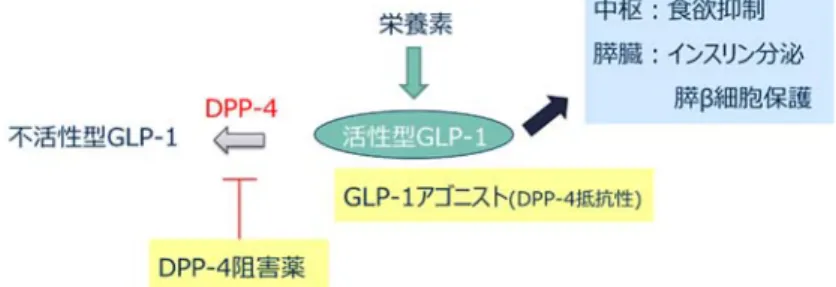
4 GLP-1アゴニストは,DPP-4による分解を受け難い(DPP-4抵抗性)ヒトGLP-1アナログで あり,長時間にわたりGLP-1の作用が継続することで血糖低下作用を示す。副作用として, DPP-4阻害薬と同様,SU薬との併用投与での低血糖が知られている。これまでに上市されて いるGLP-1アゴニストでは皮下注射が必要であったが,2019年に世界初の経口GLP-1アゴニ ストであるセマグルチドが米国および日本で承認申請された。 以上,主な糖尿病治療薬について簡潔に紹介した。その中で,単剤での低血糖と体重増 加リスクが低い糖尿病治療薬であるインクレチン関連薬6について,次節で詳しく述べる。 第3節 インクレチン関連薬 インクレチン(incretin)とは,体内に食物など栄養素が入った後にグルコース濃度依存 的なインスリン分泌を促す消化管ホルモンの総称である7。インクレチンは,グルコースを 経口投与した際に経静脈投与に比べてより多くのインスリン分泌が促進される現象(イン クレチン効果)が観られたことを契機に発見された。インクレチンとして,グルコース依 存性インスリン分泌刺激ポリペプチド(glucose-dependent insulinotropic polypeptide:GIP)と GLP-1 が知られる。GIP は小腸上部の K 細胞において, GLP-1 は小腸下部および大腸の L 細胞において,それぞれ分泌される。消化管で分泌されたGIP と GLP-1 は,膵臓に発現す るそれぞれの受容体に作用し,膵 β 細胞でのインスリン分泌を促進すると共に,膵 α 細胞 でのグルカゴン(肝臓での糖新生を促進するホルモン)分泌を抑制することで血糖を低下 させる作用を有する。また,インクレチンの膵保護作用として,膵 β 細胞の分化誘導,ア ポトーシス抑制,膵β 細胞重量の増加効果が知られている。また,GLP-1 受容体は膵臓のみ ならず脳,心臓,消化管,肝臓にも発現し,GLP-1 の膵外作用として食欲抑制作用,胃排出 遅延作用等が知られている。ただし,これらインクレチンは血中で DPP-4 により速やかに 分解され,血中半減期はGLP-1 では 2 分,GIP では 5 分と短い。 DPP-4阻害薬は,GLP-1などインクレチンを分解するDPP-4を阻害することで,活性型 GLP-1濃度を維持し,血糖低下作用を示すと考えられる(Figure 2)。また,活性型GLP-1の アミノ酸配列の一部が変換されDPP-4抵抗性が付与されたGLP-1アゴニストは,長時間作用 型の活性型GLP-1として薬理作用を示すと考えられる。
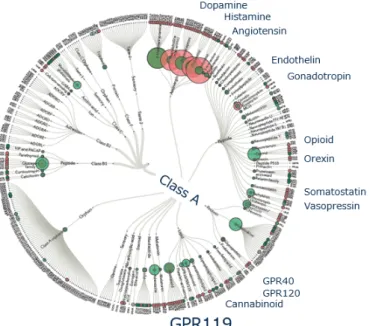
5 第4節 GPR119 アゴニスト DPP-4やGLP-1受容体以外に,GLP-1などインクレチンに関連するターゲットとして,Gタ ンパク質共役型受容体119(GPR119)が知られている。GPR119は,創薬ターゲットとして 知られているアンジオテンシン受容体,ドーパミン受容体,エンドセリン受容体等を含む クラスA (ロドプシン様)Gタンパク質共役型受容体の一つである(Figure 3)8。 Figure 3. GPCR Tree. GPR119は,ヒトおよび齧歯類の消化管L細胞および膵β細胞に高発現しており,ラットで は脳での発現が報告されている(Figure 4)9, 10。
Figure 4. Expression overview of GPR119.
6 オレイン酸リゾホスファチジルコリン(oleoyl-lysophosphatidylcholine:oleoyl-LPC)などが 知られている(Figure 5)11。 Oleoyl-LPC O O O PO O O NMe3 OEA O HN OH
Figure 5. Endogenous GPR119 agonists.
GPR119アゴニストは,Gαsと共役するGPR119に結合して細胞内のアデニル酸シクラーゼ を活性化し,サイクリックAMP(cAMP)の上昇を介して腸管でのGLP-1等インクレチンお よび膵β細胞での糖濃度依存的インスリン分泌促進作用を示すことが報告されている (Figure 6)11。
Figure 6. Proposed mechanisms of GPR119 agonist action.
以上のことから,GPR119アゴニストは,DPP-4阻害薬やGLP-1アゴニストと同様,低血糖 と体重増加リスクが低い新規メカニズムの糖尿病治療薬として期待されるi。なお,臨床試 験に移行したGPR119アゴニストが複数報告されている(Figure 7)6。 N N N S N O N N N N MBX-2982 N N N O O N S O O GSK1292263 N O APD668 N N N N S O O F O O N O APD597 N N S O O F O O N H O N O BMS-903452 N N N Cl O S F O O Cl
Figure 7. Clinical GPR119 agonists with disclosed structures.
7 第5節 研究方針と論文の概要 GPR119アゴニストは,低血糖と体重増加リスクが低い新規メカニズムの糖尿病治療薬と して注目され,数多くの製薬企業により研究開発が為されてきた。実際,GPR119アゴニス トとして様々なケモタイプの化合物が報告され,複数の化合物は臨床試験に移行していた。 こうした背景の下,筆者は強力な薬効と高い安全性を有する新規GPR119アゴニストの創出 に着手した。 本論文では,筆者が日本たばこ産業株式会社において取り組んだ探索合成研究について 論じる。第2章では,既知GPR119アゴニストに多くみられるN-置換ピペリジン環の代替構 造としてシクロヘキサン含有スピロ環を有する,新規GPR119アゴニストの創出について論 じる。第3章では,シクロヘキサン含有スピロ環を有し,脂溶性が低減した新規GPR119ア ゴニストの創出について論じる。第4章では,in vivoポテンシー向上を目指したシクロヘキ サン含有スピロ環を有するオキサジアゾール誘導体の最適化について論じる。
15 ト活性に対する効果を調べた結果,5炭素ユニットのリンカーを有する化合物3は,異なる 鎖長の化合物1,2,4と比べて最も強いアゴニスト活性(EC50 = 14 nM)を示すことがわか った。また,6炭素ユニットのリンカーを有する化合物4については,その固有活性は72%に 留まり,パーシャルアゴニスト様であった。以上のことから,リンカーの全長は,フルア ゴニストとして強いアゴニスト活性を示す上で重要であることが示唆された。 最も強いアゴニスト活性を示した3の溶解性について評価したところ,摂食時における人 工腸液(FeSSIF)に対する溶解性が低い(15.9 μM in FeSSIF) ことが明らかとなった。そこ で,左側ベンゼン環上4位置換基の効果を調べたところ,メチルスルホニル基の代わりに, N,N-ジメチルカルバモイル基20を有する化合物5は,3と比べて強いアゴニスト活性および FeSSIFに対する高い溶解性を示した(EC50 = 5 nM,74.2 μM in FeSSIF)。次に,脂溶性低減 による溶解性の向上と酸に対する安定性を考慮して合成した,5の右側ピペリジン環上Boc 基の代わりにイソプロポキシカルボニル基を有する化合物6は強いアゴニスト活性および5 より良好な溶解性(EC50 = 10 nM,221.8 μM in FeSSIF)を示すことがわかった。 以上の結果から,右側のN-置換ピペリジン環に代わる新規構造のテンプレートとして,5 や6が有する5炭素ユニットのリンカーと,4位にN,N-ジメチルカルバモイル基で置換された 左側ベンゼン環を選抜した。 このように,6は強いアゴニスト活性と良好な溶解性を示したが,後述するようにCYP 2C8, 2C9,2C19に対して阻害活性を示すことが明らかとなった(いずれもIC50 < 10 μM,Table 3)。 一般に,三次元性の高い化合物は,ターゲットタンパク質への特異性が高く,CYPなどオフ ターゲットに作用するリスクが低いと考えられている。 そこで,筆者は化合物6 の右側の N-カルバモイルピペリジン環を,シクロヘキサンおよ び飽和ヘテロ環から構成される各種スピロ環に置換した各種誘導体7–17 のアゴニスト活性 を評価した(Table 2)。
18
に対して阻害活性を示した6(Fsp3 = 0.65)より三次元性が高い 17 (Fsp3 = 0.72)では,阻
害活性は認められなかった(いずれもIC50 > 10 μM)。
Table 3. Inhibitory activity of 6 and 17 against seven CYP isoforms.
Compound IC50 (μM )
(% inhibition of 10µM test compound) CYP
isoforms 1A2 2C8 2D6 2C9 2C19 3A4(M) 3A4(T)
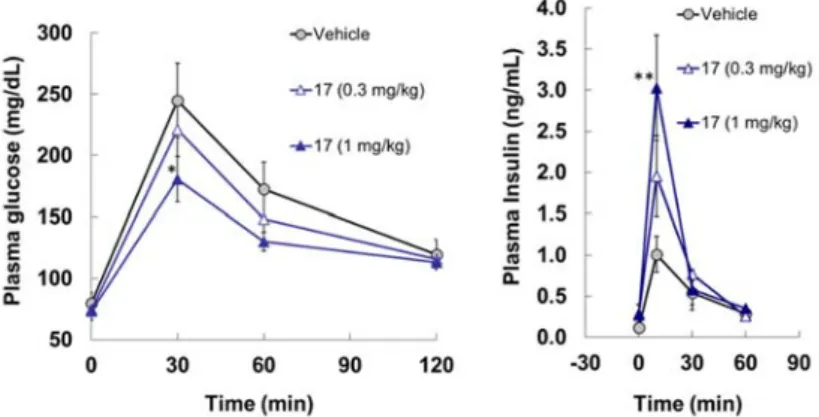
6 >10 (8%) 8.8 (53%) >10 (11%) 5.0 (69%) 6.7 (69%) >10 (8%) >10 (8%) 17 >10 (7%) >10 (30%) >10 (18%) >10 (38%) >10 (30%) >10 (0%) >10 (17%) 次に,GPR119 アゴニストとしてのコンセプト確認を目的に,Sprague-Dawley(SD)ラッ トを用いた腹腔内グルコース負荷による耐糖能試験(ipGTT)を実施した(n = 5)(Figure 11)。 17 を経口投与した 30 分後にグルコースを腹腔内に投与した。グルコース投与後,血漿中グ ルコース濃度を 2 時間,インスリン濃度を 1 時間まで測定した。その結果,グルコース負 荷前である0 分の時点では,17 投与群の血糖値およびインスリン値は,媒体(Vehicle)群 のそれらと差異はなかった。また,グルコース負荷後,17 の 0.3 mg/kg,1 mg/kg 投与群の 血糖値は,Vehicle 群と比べてそれぞれ 14%,33%低下し,インスリン値は上昇した。以上, 17 の糖濃度依存的なインスリン分泌を伴う血糖上昇抑制作用が確認されたii。
Figure 11. Results of an intraperitoneal glucose tolerance test model of compound 17 (dosed at 0.3 and 1 mg/kg, respectively) in Sprague-Dawley rats. Each data represents mean ± S.D. (n = 5). *: p < 0.05 vs. Vehicle, **: p < 0.01 vs. Vehicle (Dunnett’s test).
ii 17 の代謝物 gem-ジメチル基の一つのメチル基がヒドロキシルメチル基およびカルボキシ
19 第4節 小括 新規GPR119 アゴニストの創出を目指し,既知 GPR119 アゴニストの多くに共通する右側 の N-置換ピペリジン環に代わる構造として,シクロヘキサン含有スピロ環を見出した。右 側にシクロヘキサン含有スピロ環を有する誘導体を合成した結果,代表化合物17 の創出に 成功した。17 は,ピペリジン誘導体 6 より強力なアゴニスト活性(EC50 = 4 nM)を示した。 また, 6 より三次元性の高い 17 は,6 で認められた CYP 阻害活性を示さなかった。さらに, ラットを用いた耐糖能試験において,想定したコンセプトに則した17 の糖濃度依存的なイ ンスリン分泌を伴う血糖上昇抑制作用が確認された。
28 リティの高いリンカーを有する5 と異なり,ピリミジンリンカーを有する 52 では,左側ベ ンゼン環上置換基が適切な位置に配置されなかったためと考察した。 次に,溶解性に影響する因子の一つとして,化合物の平面性に着目した。化合物の平面 性は結晶パッキングに影響すると考えられることから,化合物の平面性を崩すと結晶パッ キングが弱まり化合物の溶解性が向上することが期待される 25。52 では,ピリミジン環お よび左側ベンゼン環が同一平面上にあるコンホメーションが低溶解性の原因と推察した。 そこで,コンホメーションに影響すると考えられるピリミジン環と左側ベンゼン環の連 結原子や環上置換基について,溶解性およびアゴニスト活性に対する効果を調べた。ピリ ミジン環と左側ベンゼン環を連結する窒素原子(NH)の代わりに酸素原子を有する化合物 54 や,左側ベンゼン環上にフルオロ基を有さない化合物 55 では,溶解性の変化は小さく, アゴニスト活性は52 と比べて減弱した。また,N-メチル体 56 では,52 と比べて溶解性が 若干改善されたものの,アゴニスト活性は著しく弱かった(EC50 > 1000 nM)。以上の結果 から,ベンゼン環とピリミジン環が同一平面上にあるコンホメーション,すなわち共平面 性が高活性を発現する上で重要なことが示唆された。特に,56 では,窒素原子上メチル基 とピリミジン環上 5 位メチル基との立体反発により,共平面性が崩れ,アゴニスト活性が 大きく減弱したものと推察した。 この立体反発を解消するために合成した環化体57 では,強いアゴニスト活性(EC50 = 5 nM) が認められた 26。また,52 の窒素原子上水素原子とベンゼン環上フルオロ基との間で形成 すると考えられた分子内水素結合iiiに発想を得て合成したインドリン誘導体 58 では,アゴ ニスト活性が著しく弱かったのに対して,ピリミジン環上 5 位メチル基を有さない化合物 59 には,52 と同程度のアゴニスト活性が確認された27。 52 のピリミジン環上 5 位メチル基の代わりに,より嵩高い置換基(エチル基,イソプロ ピル基)を有する化合物の場合,ベンゼン環とピリミジン環の共平面性を維持しつつ結晶 パッキングは弱まることが期待される。しかし,エチル基(60)への変換では,FeSSIF に 対する溶解性は向上したが,アゴニスト活性は 3 倍程度減弱した。また,イソプロピル基 (61)への変換では,脂溶性の増大のためか溶解性の改善は認められず,アゴニスト活性 はさらに減弱した。 次に,溶解性向上の別のアプローチとして,塩基性官能基の導入を検討した。その結果, 52 のピリミジン環とシクロヘキサン環を連結する酸素原子の代わりに,メチル化された窒 素原子を有する化合物62 は,酸性の JP1 に対して良好な溶解性を示すことが明らかとなっ た。ただし,62 のアゴニスト活性は 52 と比べて 3 倍程度弱かった。 ここで,比較的高い溶解性と中程度のアゴニスト活性を示した 53 と 62 について,ヒト およびラット肝ミクロソーム(Ms)を用いて代謝安定性を評価した。その結果,53 では肝 Ms 中インキュベーション後 1 時間での残存率が 77%(ヒト)および 44%(ラット)であっ iii 52 および 55 が非極性溶媒に難溶であったため,分子内水素結合の形成について NMR により確認できなかった。
30 比較的強いアゴニスト活性を示したエーテル57 および 59(Table 5)に対応する N-メチル 体63 および 64 は,良好な溶解性と代謝安定性を示し,特に,インドリン誘導体 64 は 62 と比較して3 倍強いアゴニスト活性を示した。64 は 59 と同程度のアゴニスト活性を示した のに対して,63 のアゴニスト活性は 57 と比べて 8 倍程度弱かった。この結果から,ピリミ ジン5 位の置換基と N-メチル基との立体反発によりコンホメーションが変化し,アゴニス ト活性が低下したものと推察した。予想通り,62 に対するピリミジン 5 位無置換体 65 は, 62 と同様良好な溶解性および代謝安定性を示すとともに,62 と比べて 2 倍程度強いアゴニ スト活性を示した。また,65 の脂溶性(CLogP = 3.7)は,第 2 章で見出した化合物 17(CLogP = 5.1)と比べて低く,高い LLE 値(4.0)を示した。 以上,化合物 17 より低脂溶性の新規 GPR119 アゴニストとして,ピリミジン誘導体 65 を見出すことに成功した。
Table 7. Phamacokinetic profiles of 65 in Sprague-Dawley rats (n = 2).
次に,SD ラットを用い て,化合物65 の PK プロ フ ァ イ ル を 確 認 し た (Table 7)。その結果,65 は長時間作用型の薬効が 期待できる持続性と,高 い経口吸収性を示すこと がわかった。 65 について,SD ラットを用いた腹腔内グルコース負荷による耐糖能試験(ipGTT)を実 施した(n = 5)。65(10 mg/kg)を経口投与した 16 時間後にグルコースを腹腔内投与し,グ ルコース投与0 分,30 分,60 分後にそれぞれ血漿中グルコース濃度を測定した。その結果, グルコース負荷直後のグルコース濃度は,媒体群と 65 投与群の間でほぼ差異がなかった。 また,65 投与群のグルコース投与 30 分,60 分後のグルコース濃度(mean ± S.D.)は,媒体 群と比べてそれぞれ14%(p < 0.01(Student’s t-test)),11%低かった。以上,化合物 65 の 持続的な血糖上昇抑制作用が確認された。 第4節 小括 化合物 17 より低脂溶性の新規 GPR119 アゴニストを創出するため, 17 より低脂溶性が 期待できるリンカーと左側パートを有するMBX-2982,PSN119-2,Arena’s compound(第 2 章中Figure 8)と 17 の右側パートであるシクロヘキサン含有スピロ環を組み合わせた化合 iv (1 mg/kg) po (3 mg/kg) t1/2β (h) CL (L/h/kg) Vdss (L/kg) MRT (h) BA (%) 3.7 0.8 4.0 5.1 99
31 物50–52 を合成した。合成した 3 化合物にアゴニスト活性が認められたことから,17 のシ クロヘキサン含有スピロ環は種々の既知GPR119 アゴニストの N-置換ピペリジン環に代替 可能であることが示唆された。LLE 値を指標に,アゴニスト活性と脂溶性の良好なバラン スを示したピリミジン誘導体52 をリード化合物として選抜した。アゴニスト活性と脂溶性 を維持しつつ溶解性の向上を目指して最適化を行った結果,17 より低脂溶性の代表化合物 65 を見出した。65 は,高い経口吸収性と持続的な PK プロファイルに基づいた長時間作用 型の薬効(血糖上昇抑制作用)を示すことが確認された。
40 フルオロ基を有しない103 では,100 と比べて 10 倍程度アゴニスト活性が弱かったこと から,3 位フルオロ基はアゴニスト活性発現に重要なことが示唆された。そこで,3 位を含 む2 つのフルオロ基を有する光学活性な化合物群を評価した。3 位の他に 2 位または 6 位に フルオロ基を有する化合物 104,105 のアゴニスト活性は 102 と比べて弱かった。一方,3 位および5 位にフルオロ基を有する化合物 106 は,強いアゴニスト活性(EC50 = 5 nM)を 示した。なお,106 の脂溶性(CLogP = 3.4)およびヒト血漿タンパク結合率(ヒト血漿タン
パク結合率(plasma protein binding in human : hPPB)= 96.5%, ラット血漿タンパク結合率 (plasma protein binding in rat : rPPB)= 94.0%)は,リード化合物 51 と同程度であった。
次に,106 の代謝安定性を評価した結果,ヒト肝 Ms に対する代謝安定性はラット肝 Ms
と比べて低いことがわかった(インキュベーション後1 時間での残存率が 65%(ヒト),83%
(ラット))。第2 章で見出した 17 のシクロヘキサン含有スピロ環上 gem-ジメチル基が代謝
部位であったこともあり,100 を基にシクロヘキサン含有スピロ環部の代謝安定性に対する
43 た。
Table 12. Phamacokinetic profiles of 114 in Sprague-Dawley rats (n = 2).
次に,114のPKプロフ ァイルを評価した(Table 12)。その結果,114は65 と同様,長時間作用型の 薬効が期待できるプロフ ァイルを示した。 65 より低用量での長時間作用型の薬効が期待された 114 について,Sprague-Dawley ラッ トを用いた腹腔内グルコース負荷による耐糖能試験(ipGTT)を実施した(n = 6)(Figure 16)。 化合物114 を経口投与した 16 時間後にグルコースを腹腔内投与した。グルコース投与後, 血漿中グルコース濃度を2 時間,インスリン濃度を 1 時間測定した。その結果,化合物 114 は,糖濃度依存的なインスリン分泌を伴う強力な血糖上昇抑制作用を示した。化合物 114 の1 mg/kg,3 mg/kg 投与時,グルコースの AUC は Vehicle 群と比べて,それぞれ 10%,12% 低下した。
Figure 16. Effect of 114 on plasma glucose and insulin levels in ipGTT in rats. Each data represents mean ± S.D. (n = 6). *: p < 0.05 vs. Vehicle, **: p < 0.01 vs. Vehicle (Dunnett’s test).
第4節 小括 シクロヘキサン含有スピロ環を有するリード候補化合物 50–52 のうち,血漿タンパク結 合性が低いオキサジアゾール誘導体51 を新規リード化合物として選抜した。51 の構造変換 iv (1 mg/kg) po (3 mg/kg) t1/2β (h) CL (L/h/kg) Vdss (L/kg) MRT (h) BA (%) 5.1 0.5 3.5 6.4 43
44 の結果,強力なアゴニスト活性と低い血漿タンパク結合性を示す代表化合物114 を見出した。 持続的なPK プロファイルを示した 114 は,化合物投与 16 時間後のラット ipGTT において, 第3 章で見出したピリミジン誘導体 65 と比べて低い投与量(1 または 3 mg/kg)で血糖上昇 抑制作用を示した。なお,114 の投与量は,臨床試験に移行した MBX-2982 の投与量と比べ て少なかった。さらに,第2 章で見出した 17 とは異なり,114 にはラットを用いた探索的 毒性試験において重篤な毒性は認められなかった。
46
謝辞
本論文の執筆に際し,名古屋市立大学大学院薬学研究科教授 中村精一先生には終始懇篤 なご指導、ご高配を賜りました。ここに厚く御礼申し上げます。また,主査および副査と して有益なご指導およびご助言を賜りました,名古屋市立大学大学院薬学研究科教授 樋口 恒彦先生,名古屋市立大学大学院薬学研究科教授 中川秀彦先生,名古屋市立大学大学院薬 学研究科教授 山村寿男先生に心より感謝申し上げます。 本研究の機会を与えてくださいました,日本たばこ産業株式会社 前執行役員医薬総合 研究所長 春田純一博士,元化学研究所長 新海久博士,執行役員医薬総合研究所長 大川 滋紀博士に深謝いたします。 本研究は終始,日本たばこ産業株式会社 生産技術研究所アドバイザー 稲葉隆之博士, 化学研究所長 佐藤元秀博士のご指導のもとに行われました。ここに心から感謝申し上げ ます。 本研究の化合物デザインおよび合成において多大な協力と有益なご助言を頂きました, 日本たばこ産業株式会社 研究管理部長 矢田伸二氏,医薬総合研究所調査役 大江康弘氏, 化学研究所研究員 松田勇氏,化学研究所研究員 児玉叔功博士,生産技術研究所研究員 渡 辺隆博士,化学研究所研究員 生方実氏,化学研究所研究員 青木健太氏,化学研究所研究 員 水上旬氏,研究管理部研究員 門脇詳博士,化学研究所研究員 諏訪勝紀博士,化学研究 所研究員 森元気氏に深謝いたします。また,本研究の薬理試験を実施して頂きました,日 本たばこ産業株式会社 生物研究所グループリーダー 福田純明博士,生物研究所研究員 佐野龍平氏に深謝いたします。また,本研究の薬物動態試験を実施して頂きました,日本 たばこ産業株式会社 薬物動態研究所グループリーダー 根来有氏,研究企画部調査役 朝比奈幸太博士,薬物動態研究所研究員 堀義和氏に深謝いたします。また,本研究の構 造解析や分析を実施して頂きました,日本たばこ産業株式会社 生産技術研究所研究員 大野靖氏,生産技術研究所研究員 高橋光政氏,生産技術研究所研究員 永尾英太氏,生 産技術研究所研究員 久保直毅氏,生産技術研究所研究員 岩井隆宏氏,生産技術研究所 石倉恭子氏,生産技術研究所 山田淑美氏,生産技術研究所 奥山直子氏に深謝いたしま す。また,本論文の作成を進めるにあたり有益なアドバイスを頂きました,前化学研究所 長 橋本宏正博士,化学研究所副所長 宮崎将博士,化学研究所副所長 塩崎真博士に深 謝いたします。 最後に,本研究の遂行および本論文の執筆に関して終始支えてくれました,妻 原田弥恵, 温かく応援してくれました 父 原田善道,母 原田恵美子,義父 西谷國蔵,義母 西谷サト ミ,長女 原田麻菜,長男 原田卓人に感謝いたします。47
Experimental section
General
Solvents and reagents were obtained from commercial suppliers and used as received. Flash column chromatography was performed using Merck 230–400 mesh silica gel 60. Melting points were determined using a Büchi 535 melting point apparatus or a Stanford Research Systems MPA100 OptiMelt melting point apparatus. 1H NMR and 13C NMR spectra were recorded on JEOL
RESONANCE Inc. JNM-AL400, JEOL ALPHA300W, Varian MERCURY plus-AS400, Bruker BioSpin K.K. AV400, AMX-300, AVANCE III 400, or Agilent Technologies Inc. 400-MR spectrometer in the indicated solvent. Chemical shifts () are reported in parts per million relative to internal standard tetramethylsilane. Optical rotation was measured using a Rudolph Autopol V automatic polarimeter at a wavelength of 589 nm. IR spectra were recorded on a Perkin-Elmer Inc. Spectrum One FT-IR spectromer. Combustion analyses were performed with an elementar vario EL III, and all values were within ±0.4% of the calculated values. High-resolution mass spectra (HRMS) analyses were performed on a Thermo Fisher Scientific LTQ Orbitrap Velos mass spectrometer, which is equipped with Agilent 1290 Infinity LC. Low-resolution mass spectra (MS) analyses were performed on either a Finnigan TSQ-700 mass spectrometer in FAB ionization mode or an Agilent 1100 series LC/MSD mass spectrometer in ESI ionization mode.
48
Experiments concerning Chapter 2
tert-Butyl 4-{3-[4-(methylsulfonyl)phenoxy]propyl}piperidine-1-carboxylate (1)
To a solution of tert-butyl 4-(3-hydroxypropyl)piperidine-1-carboxylate 18 (200 mg, 0.82 mmol) in CHCl3 (2 ml) were added triethylamine (0.137 ml, 0.99 mmol) and methanesulfonyl chloride (0.07
ml, 0.90 mmol) at 0 °C. After stirring at room temperature for 1 h, the reaction mixture was washed with H2O (1 ml). The organic layer was dried over Na2SO4, filtered, and concentrated in vacuo to
give crude tert-butyl 4-{3-[(methylsulfonyl)oxy]propyl}piperidine-1-carboxylate (270 mg) as a colorless oil. The crude material was used without purification in the next step.
A suspension of crude tert-butyl 4-{3-[(methylsulfonyl)oxy]propyl}piperidine-1-carboxylate (270 mg), 4-(methylsulfonyl)phenol (141 mg, 0.82 mmol), and cesium carbonate (323 mg, 0.99 mmol) in DMF (3 ml) was stirred at 80 °C for 3 h. After cooling to room temperature, the reaction mixture was quenched with H2O (1 ml). The precipitate was filtered off and recrystallized from
n-hexane/EtOAc to give compound 1 (293 mg, 90%) as white crystals; mp 129–130 °C. IR (neat)
1692, 1593, 1398, 1364, 1314, 1294, 1275, 1260, 1234, 1167, 1138, 1094, 1003, 972, 964, 837, 772, 554, 490 cm-1. 1H NMR (CDCl 3) δ: 7.91–7.81 (m, 2H), 7.05–6.95 (m, 2H), 4.20–4.06 (m, 2H), 4.06– 3.97 (m, 2H), 3.02 (s, 3H), 2.75–2.62 (m, 2H), 1.89–1.77 (m, 2H), 1.74–1.64 (m, 2H), 1.46 (s, 9H), 1.46–1.38 (m, 3H), 1.19–1.06 (m, 2H). 13C NMR (DMSO-d 6) δ: 162.3, 153.7, 132.3, 129.1, 114.8,
78.3, 68.2, 43.8, 43.4, 34.8, 32.1, 31.6, 28.0, 25.5. Anal. Calcd for C20H31NO5S: C, 60.43; H, 7.86; N,
3.52. Found: C, 60.44; H, 7.92; N, 3.53.
tert-Butyl 4-{4-[4-(methylsulfonyl)phenoxy]butyl}piperidine-1-carboxylate (2)
Compound 2 was prepared from tert-butyl 4-(4-hydroxybutyl)piperidine-1-carboxylate 19 and 4-( methylsulfonyl)phenol in a manner similar to that described for compound 1. White crystals (65%); mp 97–99 °C. IR (neat) 1690, 1593, 1420, 1364, 1312, 1294, 1275, 1261, 1244, 1227, 1167, 1138, 1092, 1034, 1001, 968, 941, 833, 768, 548, 534, 488 cm-1. 1H NMR (CDCl 3) δ: 7.91–7.81 (m, 2H), 7.05–6.96 (m, 2H), 4.14–4.05 (m, 2H), 4.05–3.98 (m, 2H), 3.02 (s, 3H), 2.74–2.58 (m, 2H), 1.86– 1.75 (m, 2H), 1.71–1.61 (m, 2H), 1.54–1.36 (m, 12H), 1.35–1.27 (m, 2H), 1.16–1.00 (m, 2H). 13C NMR (DMSO-d6) δ: 162.3, 153.5, 132.3, 129.1, 114.7, 78.2, 67.9, 44.0, 35.4, 35.0, 31.6, 28.5, 28.0,
22.3. Anal. Calcd for C21H33NO5S: C, 61.29; H, 8.08; N, 3.40. Found: C, 61.35; H, 8.09; N, 3.36.
tert-Butyl 4-{5-[4-(methylsulfonyl)phenoxy]pentyl}piperidine-1-carboxylate (3)
Compound 3 was prepared from tert-butyl 4-(4-hydroxypentyl)piperidine-1-carboxylate 20 and 4-( methylsulfonyl)phenol in a manner similar to that described for compound 1. White crystals (54%); mp 122–123 °C. IR (neat) 1690, 1593, 1400, 1364, 1312, 1294, 1275, 1256, 1244, 1165, 1138, 1092, 1003, 970, 964, 835, 770, 550, 538, 509, 490 cm-1. 1H NMR (CDCl 3) δ: 7.98–7.72 (m, 2H), 7.09– 6.92 (m, 2H), 4.13–3.99 (m, 4H), 3.03 (s, 3H), 2.73–2.61 (m, 2H), 1.86–1.76 (m, 2H), 1.69–1.60 (m, 2H), 1.51–1.32 (m, 14H), 1.31–1.22 (m, 2H), 1.14–1.01 (m, 2H). 13C NMR (DMSO-d 6) δ: 162.8,
49
154.0, 132.6, 129.3, 115.1, 78.5, 68.2, 44.2, 36.1, 35.3, 32.0, 28.6, 28.2, 25.9, 25.7. Anal. Calcd for C22H35NO5S: C, 62.09; H, 8.29; N, 3.29. Found: C, 62.03; H, 8.24; N, 3.15.
tert-Butyl 4-{6-[4-(methylsulfonyl)phenoxy]hexyl}piperidine-1-carboxylate (4)
Compound 4 was prepared from tert-butyl 4-(4-hydroxyhexyl)piperidine-1-carboxylate 21 and 4-( methylsulfonyl)phenol in a manner similar to that described for compound 1. White crystals (78%); mp 83–87 °C. 1H NMR (DMSO-d
6) δ: 7.84–7.79 (m, 2H), 7.16–7.10 (m, 2H), 4.09–4.01 (m, 2H),
3.96–3.81 (m, 2H), 3.14 (s, 3H), 2.74–2.56 (m, 2H), 1.77–1.67 (m, 2H), 1.64–1.56 (m, 2H), 1.44– 1.23 (m, 16H), 1.23–1.14 (m, 2H), 0.98–0.84 (m, 2H). Anal. Calcd for C23H37NO5S: C, 62.84; H,
8.48; N, 3.19. Found: C, 62.64; H, 8.43; N, 3.15.
tert-Butyl 4-{5-[4-(dimethylcarbamoyl)phenoxy]pentyl}piperidine-1-carboxylate (5)
Compound 5 was prepared from tert-butyl (hydroxypentyl)piperidine-1-carboxylate and 4-hydroxy-N,N-dimethylbenzamide in a manner similar to that described for compound 1. White crystals (86%); mp 77–78 °C. IR (neat) 1690, 1622, 1605, 1491, 1450, 1393, 1364, 1275, 1240, 1217, 1179, 1167, 1146, 1121, 1099, 1084, 1059, 1047, 1036, 1020, 1009, 961, 866, 841, 820, 779, 762, 725, 621, 484 cm-1. 1H NMR (DMSO-d 6) δ: 7.41–7.26 (m, 2H), 7.06–6.81 (m, 2H), 4.80–4.68 (m, 1H), 4.02–3.86 (m, 4H), 2.93 (s, 6H), 2.79–2.61 (m, 2H), 1.76–1.67 (m, 2H), 1.67–1.57 (m, 2H), 1.46–1.27 (m, 5H), 1.26–1.19 (m, 2H), 1.18–1.14 (m, 6H), 1.02–0.88 (m, 2H). 13C NMR (DMSO-d6) δ: 180.1, 169.6, 164.0, 139.2, 138.4, 124.1, 88.5, 77.7, 53.7, 46.1, 45.3, 42.0, 38.7, 38.3,
35.9, 35.8. Anal. Calcd for C24H38N2O4: C, 68.87; H, 9.15; N, 6.69; N, 3.19. Found: C, 68.78; H,
9.05; N, 6.56.
Isopropyl 4-{5-[4-(dimethylcarbamoyl)phenoxy]pentyl}piperidine-1-carboxylate (6)
To a solution of compound 5 (88 mg, 0.22 mmol) and 1,4-dioxane (1 ml) was added 4N HCl 1,4-dioxane solution (1.00 ml, 4.00 mmol) at room temperature. After stirring at room temperature, the reaction mixture was concentrated in vacuo. The resulting precipitate was suspended in CHCl3 (2
ml). To the suspension were added triethylamine (0.10 ml, 0.75 mmol) and isopropyl chloroformate (0.037 ml, 0.33 mmol) at 0 °C. After stirring at room temperature, the reaction mixture was concentrated in vacuo. The residue was purified by column chromatography on silica gel (n-hexane/EtOAc) to give compound 6 (80 mg, 94%) as white crystals; mp 67–68 °C. IR (neat) 1686, 1624, 1387, 1236, 1215, 1107, 1082, 843, 621 cm-1. 1H NMR (DMSO-d 6) δ: 7.41–7.26 (m, 2H), 7.06–6.81 (m, 2H), 4.80–4.68 (m, 1H), 4.02–3.86 (m, 4H), 2.93 (s, 6H), 2.79–2.61 (m, 2H), 1.76– 1.67 (m, 2H), 1.67–1.57 (m, 2H), 1.46–1.27 (m, 5H), 1.26–1.19 (m, 2H), 1.18–1.14 (m, 6H), 1.02– 0.88 (m, 2H). 13C NMR (DMSO-d 6) δ: 169.8, 159.4, 154.1, 128.9, 128.2, 113.8, 67.4, 43.4, 35.7,
35.0, 31.6, 28.5, 25.6, 21.9. Anal. Calcd for C23H36N2O4: C, 68.29; H, 8.97; N, 6.92. Found: C,
68.26; H, 8.95; N, 6.99.
4-{[5-(Spiro[5.5]undecan-3-yl)pentyl]oxy}benzoic acid (24)
50
triphenylphosphine (5.51 g, 21.0 mmol) in toluene (28 ml) was stirred at 130 °C for 9 h. After cooling to room temperature, the resulting precipitate was filtered off and washed with toluene to give crude [5-(4-carboxyphenoxy)pentyl]triphenylphosphonium bromide 23 (4.93 g) as a white solid. The crude material was used without purification in the next step.
To a suspension of crude [5-(4-carboxyphenoxy)pentyl]triphenylphosphonium bromide 23 (833 mg) and potassium tert-butoxide (171 mg, 1.52 mmol) in THF (5.0 ml) was added dropwise a solution of spiro[5.5]undecan-3-one (210 mg, 1.26 mmol) in THF (2.1 ml) at 0 °C. After stirring to room temperature for 2 h, the reaction mixture was quenched with 2N HCl aqueous solution (4 ml, 8.00 mmol). The resulting mixture was extracted with EtOAc. The combined organic layer was washed with H2Oand brine. The organic layer was dried over MgSO4, filtered, and concentrated in
vacuo to give crude 4-{[5-(spiro[5.5]undecan-3-ylidene)pentyl]oxy}benzoic acid (450 mg) as a
white solid. The crude material was used without purification in the next step.
To a solution of crude 4-{[5-(spiro[5.5]undecan-3-ylidene)pentyl]oxy}benzoic acid (40 mg) in MeOH (1.0 ml) was added 10% Pd-carbon (50% wet). The reaction mixture was hydrogenated (60 psi) at room temperature overnight. The reaction mixture was filtered through a celite pad and concentrated in vacuo to give compound 24 (34.1 mg, 14% for 3 steps) as a white soild. 1H NMR
(DMSO-d6) δ: 7.92–7.82 (m, 2H), 7.03–6.94 (m, 2H), 4.03 (t, J = 6.2 Hz, 2H), 1.79–1.67 (m, 2H),
1.62–1.53 (m, 2H), 1.50–1.27 (m, 14H), 1.20–1.16 (m, 5H), 1.08–0.91 (m, 3H). N,N-Dimethyl-4-{[5-(spiro[5.5]undecan-3-yl)pentyl]oxy}benzamide (7)
A suspension of compound 24 (34 mg, 0.095 mmol), 1-hydroxybenzotriazole monohydrate (22 mg, 0.143 mmol), 1-ethyl-3-(3-dimethylaminopropyl)carbodiimide hydrochloride (27 mg, 0.143 mmol), dimethylamine hydrochloride (16 mg, 0.190 mmol) and triethylamine (0.027 ml, 0.190 ml) in DMF (1 ml) was stirred at room temperature overnight. The reaction mixture was quenched with saturated NaHCO3 aqueous solution (1 ml) and H2O (4 ml). The resulting precipitate was washed with H2O to
give compound 7 (30 mg, 82%) as white crystals; mp 80–83 °C. 1H NMR (CDCl
3) δ: 7.40–7.37 (m,
2H), 6.89–6.87 (m, 2H), 3.97–3.93 (m, 4H), 3.87 (t, 2H, J = 5.6 Hz), 3.07 (br s, 6H), 2.25–2.22 (m, 2H), 1.82–1.68 (m, 4H), 1.63–1.56 (m, 3H), 1.53–1.07 (m, 10H). HRMS (ESI) Calcd for C25H40NO2
(M+H)+ m/z 386.3054, Found m/z 386.3044.
5-(1,4-Dioxaspiro[4.5]decan-8-yl)pentan-1-ol (26)
To a suspension of (4-carboxybutyl)triphenylphosphonium bromide (2.83 g, 6.40 mmol) and potassium tert-butoxide (1.50 g, 13.44 mmol) in THF (10 ml) was added dropwise a solution of 1,4-dioxaspiro[4.5]decan-8-one 25 (1.00 g, 6.40 mmol) in THF (5 ml) at 0 °C. After stirring at room temperature overnight, the reaction mixture was concentrated in vacuo. To the resulting precipitate, 1N HCl aqueous solution (10 ml, 10 mmol) was added. The aqueous layer was extracted with EtOAc. The combined organic layer was washed with H2O, dried over MgSO4, filtered, and concentrated in
51
oil. The crude material was used without purification in the next step.
To a solution of crude 5-(1,4-dioxaspiro[4.5]decan-8-ylidene)pentanoic acid (1.65 g) in MeOH (10 ml) was added 1-ethyl-3-(3-dimethylaminopropyl)carbodiimide hydrochloride (1.59 g, 8.32 mmol) at room temperature. After stirring at room temperature, the reaction mixture was concentrated in
vacuo. The residue was diluted with EtOAc (15 ml). The organic layer was washed with saturated
NaHCO3 aqueous solution and H2O, dried over MgSO4, filtered, and concentrated in vacuo. The
residue was purified by column chromatography on silica gel (n-hexane/EtOAc) to give methyl 5-(1,4-dioxaspiro[4.5]decan-8-ylidene)pentanoate (820 mg, 50 % for 2 steps) as a colorless oil. 1H
NMR (CDCl3) δ: 5.16–5.08 (m, 1H), 3.97 (s, 4H), 3.67 (s, 3H), 2.35–2.18 (m, 6H), 2.10–2.00 (m,
2H), 1.72–1.61 (m, 6H).
To a solution of methyl 5-(1,4-dioxaspiro[4.5]decan-8-ylidene)pentanoate (820 mg, 3.22 mmol) in MeOH (8 ml) was added 10% Pd-carbon (50% wet). The reaction mixture was hydrogenated (60 psi) at room temperature overnight. The reaction mixture was filtered through a celite pad and concentrated in vacuo. The residue was purified by column chromatography on silica gel (n-hexane/EtOAc) to give methyl 5-(1,4-dioxaspiro[4.5]decan-8-yl)pentanoate (512 mg, 62%) as a colorless oil. 1H NMR (CDCl
3) δ: 3.94 (s, 4H), 3.66 (s, 3H), 2.30 (t, J = 7.6 Hz, 2H), 1.77–1.66 (m,
4H), 1.65–1.45 (m, 4H), 1.38–1.12 (m, 7H).
To a suspension of LiAlH4 (90 mg, 2.39 mmol) in THF (1 ml) was added dropwise a solution of
methyl 5-(1,4-dioxaspiro[4.5]decan-8-yl)pentanoate (512 mg, 1.99 mmol) in THF (1 ml) at 0 °C. After stirring at room temperature for 1 h, the reaction mixture was quenched carefully with H2O
(0.09 ml), 4N NaOH aqueous solution (0.09 ml), and H2O (0.27 ml) at 0 °C. The reaction mixture
was stirred at room temperature for 1h, filtered through a celite pad and concentrated in vacuo to give compound 26 (446 mg, 98%) as a colorless oil. 1H NMR (CDCl
3) δ: 3.95 (s, 4H), 3.70–3.57 (m,
2H), 1.83–1.66 (m, 4H), 1.66–1.45 (m, 4H), 1.42–1.12 (m, 9H).
4-{[5-(1,4-Dioxaspiro[4.5]decan-8-yl)pentyl]oxy}-N,N-dimethylbenzamide (9)
To a solution of compound 26 (446 mg, 1.95 mmol) in CHCl3 (5 ml) were added triethylamine
(0.33 ml, 2.34 mmol) and methanesulfonyl chloride (0.17 ml, 2.15 mmol) at 0 °C. After stirring at room temperature for 1 h, the reaction mixture was concentrated in vacuo. The residue was diluted with EtOAc (5 ml). The organic layer was washed with H2O, dried over MgSO4, filtered, and
concentrated in vacuo to give crude 5-(1,4-dioxaspiro[4.5]decan-8-yl)pentyl methanesulfonate (580 mg) as a colorless oil. The crude material was used without purification in the next step.
A suspension of crude 5-(1,dioxaspiro[4.5]decan-8-yl)pentyl methanesulfonate (487 mg), 4-hydroxy-N,N-dimethylbenzamide (289 mg, 1.75 mmol), and cesium carbonate (673 mg, 2.07 mmol) in DMF (2 ml) was stirred at 80 °C for 3 h. After cooling to room temperature, the reaction mixture was quenched with H2O (5 ml). The aqueous layer was extracted with EtOAc. The organic layer was
52
by column chromatography on silica gel (CHCl3/acetone) to give compound 9 (538 mg, 90 % for 2
steps) as white crystals; mp 80–81 °C. 1H NMR (DMSO-d
6) δ: 7.37–7.33 (m, 2H), 6.96–6.92 (m,
2H), 3.99 (t, 2H, J = 6.9 Hz), 3.82 (s, 4H), 2.94 (s, 6H), 1.75–1.60 (m, 6H), 1.45–1.07 (m, 11H). HRMS (ESI) Calcd for C22H34NO4 (M+H)+ m/z 376.2482, Found m/z 376.2478.
4-{[5-(1,5-Dioxaspiro[5.5]undecan-9-yl)pentyl]oxy}-N,N-dimethylbenzamide (8)
A solution of compound 9 (538 mg, 1.43 mmol) in AcOH (2 ml) and H2O (1 ml) was stirred at
100 °C overnight. After cooling to room temperature, the reaction mixture was diluted with H2O (5
ml). The aqueous layer was extracted with EtOAc. The combined organic layer was washed with saturated NaHCO3 aqueous solution and H2O, dried over MgSO4, filtered, and concentrated in vacuo
to give crude N,N-dimethyl-4-{[5-(4-oxocyclohexyl)pentyl]oxy}benzamide (452 mg) as a white solid. The crude material was used without purification in the next step.
A suspension of crude N,N-dimethyl-4-{[5-(4-oxocyclohexyl)pentyl]oxy}benzamide (70 mg), 1,3-propanediol (0.02 ml, 0.275 mmol) and pyridinium p-toluenesulfonate (3 mg, 0.011 mmol) in toluene (2 ml) was stirred at 140 °C overnight. After cooling to room temperature, the reaction mixture was diluted with EtOAc (5 ml). The organic layer was washed with saturated NaHCO3
aqueous solution and H2O, dried over MgSO4, filtered, and concentrated in vacuo. The residue was
purified by column chromatography on silica gel (n-hexane/EtOAc) to give compound 8 (74 mg, 86% for 2 steps) as white crystals; mp 72–75 °C. IR (neat) 2932, 2857, 1622, 1609, 1574, 1489, 1474, 1449, 1404, 1385, 1379, 1366, 1309, 1254, 1246, 1213, 1175, 1153, 1144, 1105, 1074, 1049, 1036, 1026, 999, 968, 943, 928, 914, 893, 862, 845, 816, 764, 723, 692, 642, 623, 554, 515, 507, 490, 463, 447, 430 cm-1. 1H NMR (CDCl 3) δ: 7.40–7.37 (m, 2H), 6.89–6.87 (m, 2H), 3.97–3.93 (m, 4H), 3.87 (t, 2H, J = 5.6 Hz), 3.07 (br s, 6H), 2.25–2.22 (m, 2H), 1.82–1.68 (m, 4H), 1.63–1.56 (m, 3H), 1.53–1.07 (m, 10H). 13C NMR (DMSO-d 6) δ: 169.8, 159.3, 128.9, 128.1, 113.8, 97.1, 67.4,
58.3, 58.1, 36.1, 35.8, 31.9, 28.5, 28.2, 26.2, 25.7, 25.2. Anal. Calcd for C23H35NO4: C, 70.92; H,
9.06; N, 3.60. Found: C, 70.69; H, 9.12; N, 3.60. 4-[5-(Benzyloxy)pentyl]cyclohexan-1-one (27)
A suspension of 5-(1,4-dioxaspiro[4.5]decan-8-yl)pentan-1-ol 26 (57.9 g, 253 mmol), benzyl bromide (45.1 ml, 380 mmol) and NaH (60% oil dispersion, 13.2 g, 329 mmol) in DMF (500 ml) was heated at 50 °C for 3 h. After cooling to room temperature, the reaction mixture was carefully poured into ice-water. The aqueous layer was extracted with EtOAc. The combined organic layer was washed with H2O, dried over MgSO4, filtered, and concentrated in vacuo to give crude
8-[5-(benzyloxy)pentyl]-1,4-dioxaspiro[4.5]decane (65.2 g) as a colorless oil. The crude material was used without purification in the next step.
A solution of crude 8-[5-(benzyloxy)pentyl]-1,4-dioxaspiro[4.5]decane (65.2 g) and 2N HCl aqueous solution (100 ml, 200 mmol) in acetone (500 ml) was stirred at room temperature overnight. The reaction mixture was quenched with 4N NaOH aqueous solution (50 ml, 200 mmol). The
53
aqueous layer was extracted with EtOAc. The combined organic layer was washed with H2O, dried
over MgSO4, filtered, and concentrated in vacuo. The residue was purified by column
chromatography on silica gel (n-hexane/EtOAc) to give compound 27 (48.9 g, 70% for 2 steps) as a colorless oil. 1H NMR (CDCl
3) δ: 7.39–7.24 (m, 5H), 4.51 (s, 2H), 3.51–3.44 (m, 2H), 2.42–2.26 (m,
4H), 2.09–1.99 (m, 2H), 1.76–1.59 (m, 3H), 1.46–1.27 (m, 8H). 4-{4-[5-(Benzyloxy)pentyl]cyclohexylidene}butan-1-ol (28)
To a suspension of 3-(ethoxycarbonyl)propyl triphenylphosphonium bromide (10.0 g, 21.9 mmol) in THF (100 ml) was added potassium tert-butoxide (2.46 g, 21.9 mmol) at 0 °C under an argon atmosphere. After stirring at 0 °C for 30 min, a solution of compound 27 (3.00 g, 10.9 mmol) in THF (20 ml) was added to the reaction mixture at 0 °C. After stirring at room temperature for 1.5 h, the reaction mixture was quenched with saturated NH4Cl aqueous solution (20 ml). The aqueous layer
was extracted with EtOAc. The combined organic layer was washed with H2O, dried over MgSO4,
filtered, and concentrated in vacuo to give crude ethyl
4-{4-[5-(benzyloxy)pentyl]cyclohexylidene}butanoate (3.56 g) as a colorless oil. The crude material was used without purification in the next step.
To a suspension of LiAlH4 (360 mg, 9.48 mmol) in THF (5 ml) was added dropwise a solution of
crude ethyl 4-{4-[5-(benzyloxy)pentyl]cyclohexylidene}butanoate (3.53 g) in THF (15 ml) at 0 °C under an argon atmosphere. After stirring at 0 °C for 3 h, the reaction mixture was quenched carefully with H2O (0.36 ml), 4N NaOH aqueous solution (0.36 ml), and H2O (1.08 ml) at 0 °C. The
reaction mixture was stirred at room temperature for 1h, filtered through a celite pad and concentrated in vacuo to give compound 28 (3.12 g, 86% for 2 steps) as a colorless oil. 1H NMR
(CDCl3) δ: 7.38–7.25 (m, 5H), 5.13–5.05 (m, 1H), 3.68–3.59 (m, 2H), 3.50–3.42 (m, 2H), 2.20–1.94
(m, 4H), 1.89–1.83 (m, 2H), 1.83–1.67 (m, 2H), 1.66–1.58 (m, 3H), 1.42–1.13 (m, 8H), 1.01–0.81 (m, 2H).
9-[5-(Benzyloxy)pentyl]-1-oxaspiro[5.5]undecane (29, 30)
To a solution of compound 28 (3.12 g, 9.44 mmol) in CHCl3 (30 ml) was added dropwise boron
trifluoride diethyl ether complex (1.41 g, 9.91 mmol) at 0 °C. After stirring at room temperature overnight, the reaction mixture was quenched with saturated NaHCO3 aqueous solution (10 ml) at
0 °C. The aqueous layer was extracted with CHCl3. The combined organic layer was washed with
saturated NaHCO3 aqueous solution and H2O, dried over MgSO4, filtered, and concentrated in vacuo.
The residue was purified by column chromatography on silica gel (n-hexane/EtOAc) to give compound 29 (cis-isomer, less polar, 707 mg, 22%) and compound 30 (trans-isomer, more polar, 834 mg, 26%) as colorless oils. compound 29: 1H NMR (CDCl 3) δ: 7.38–7.25 (m, 5H), 4.50 (s, 2H), 3.63–3.56 (m, 2H), 3.50–3.42 (m, 2H), 2.03–1.93 (m, 2H), 1.66–1.57 (m, 4H), 1.54–1.41 (m, 4H), 1.41–1.02 (m, 13H). compound 30: 1H NMR (CDCl 3) δ: 7.40–7.23 (m, 5H), 4.51 (s, 2H), 3.74–3.65 (m, 2H), 3.51–3.42
54
(m, 2H), 1.94–1.84 (m, 2H), 1.72–1.47 (m, 10H), 1.40–1.14 (m, 9H), 1.04–0.91 (m, 2H). 3-{4-[5-(Benzyloxy)pentyl]cyclohexylidene}propan-1-ol (31)
To a suspension of {3-[(tert-butyldimethylsilyl)oxy]propyl}triphenylphosphonium bromide (3.54 g, 6.34 mmol), which was readily prepared from (3-bromopropoxy)-tert-butyldimethylsilane, in THF (50 ml) was added potassium tert-butoxide (771 mg, 6.87 mmol) at 0 °C under an argon atmosphere. After stirring at 0 °C for 30 min, a solution of compound 27 (1.45 g, 5.28 mmol) in THF (10 ml) was added to the reaction mixture at 0 °C. After stirring at room temperature overnight, the reaction mixture was quenched with saturated NH4Cl aqueous solution (20 ml). The aqueous layer was
extracted with EtOAc. The combined organic layer was washed with H2O, dried over MgSO4,
filtered, and concentrated in vacuo to give crude
(3-{4-[5-(benzyloxy)pentyl]cyclohexylidene}propoxy)-tert-butyldimethylsilane (1.47 g) as a colorless oil. The crude material was used without purification in the next step.
To a solution of crude
(3-{4-[5-(benzyloxy)pentyl]cyclohexylidene}propoxy)-tert-butyldimethylsilane (1.47 g) in THF (10 ml) was added 1M tetrabutylammonium fluoride solution in THF (4.70 ml, 4.70 mmol) at room temperature. After stirring at room temperature overnight, the reaction mixture was concentrated in
vacuo. The residue was diluted with EtOAc (20 ml). The organic layer was washed with H2O,
saturated NaHCO3 aqueous solution, and brine. The organic layer was dried over MgSO4, filtered,
and concentrated in vacuo to give crude compound 31 (982 mg) as a pale yellow oil. The crude material was used without purification in the next step.
8-[5-(Benzyloxy)pentyl]-1-oxaspiro[4.5]decane (32, 33)
A mixture of crude compound 31 (400 mg) and Amberlyst 15 (100 mg) in toluene (5 ml) was heated at 80 °C for 2 h. The reaction mixture was filtered through a celite pad and concentrated in
vacuo. The residue was purified by column chromatography on silica gel (n-hexane/EtOAc) to give
compound 32 (cis-isomer, less polar, 180 mg, 26% for 3 steps) and compound 33 (trans-isomer, more polar, 158 mg, 23% for 3 steps) as colorless oils.
compound 32: 1H NMR (CDCl 3) δ: 7.37–7.23 (m, 5H), 4.50 (s, 2H), 3.84–3.77 (m, 2H), 3.49–3.43 (m, 2H), 1.92–1.83 (m, 2H), 1.74–1.48 (m, 8H), 1.40–1.11 (m, 10H). compound 33: 1H NMR (CDCl 3) δ: 7.38–7.25 (m, 5H), 4.50 (s, 2H), 3.85–3.79 (m, 2H), 3.50–3.43 (m, 2H), 1.94–1.84 (m, 2H), 1.80–1.57 (m, 8H), 1.51–1.40 (m, 2H), 1.40–1.14 (m, 2H), 0.99–0.85 (m, 2H). cis-6-[5-(Benzyloxy)pentyl]-1-oxaspiro[2.5]octane (34)
To a suspension of trimethylsulfoxonium iodide (6.28 g, 28.5 mmol) in DMSO (60 ml) was added potassium tert-butoxide (2.95 g, 26.3 mmol) at room temperature under an argon atmosphere. After stirring at 50 °C for 30 min, a solution of compound 27 (6.02 g, 21.9 mmol) in DMSO (40 ml) was added to the reaction mixture at 50 °C. After stirring at room temperature for 1.5 h, the reaction