On the Effects of Emission Standards as
Technical Barriers to Trade : A Foreign
Duopoly Case
journal or
publication title
Discussion paper series
number
34
page range
1-31
year
2007-06
DISCUSSION
PAPER SERIES
Discussion paper No. 34
On the Effects of Emission Standards
as Technical Barriers to Trade: A Foreign Duopoly Case
Tsuyoshi Toshimitsu
Kwansei Gakuin University
June 2007
SCHOOL OF ECONOMICS
KWANSEI
GAKUIN UNIVERSITY
1-155 Uegahara Ichiban-cho
Nishinomiya 662-8501, Japan
On the Effects of Emission Standards in an
Importing Country: A Foreign Duopoly Case
∗
Tsuyoshi TOSHIMITSU
☆Kwansei Gakuin University
Abstract
Employing an environmentally differentiated duopoly model, we analyze how emission standards affect imports, the environment, and social welfare. We show that a strict emission standard is not necessarily import-restrictive, whereas it may possibly degrade the environment. Furthermore, we present evidence that the effect of emission standards on net social surplus depends on the mode of market competition and the degree of marginal social valuation of environmental damage.
JEL classification: D43; F12; F13; L52; Q28
Key words: emission standards; environmentally differentiated duopoly; green market
∗
An earlier version of this paper was presented in the following seminars and conferences. I would like to acknowledge helpful comments from Katsuhiko Suzuki (Kwansei Gakuin University, Eremites Professor) in the KG Lunch Workshop, Jinji Naoto (Okayama
University) and Shoji Haruna (Okayama University) in the Gendaikeizai Seminar, Keisaku Higashida (Yokohama City University) in the Japanese Economic Association Meeting, Spring 2007, and Takeshi Ikeda (Kobe International University) in the Japanese Association for Applied Economics Meeting, Spring 2007.
☆ School of Economics, Kwansei Gakuin University, 1-155, Nishinomiya, 662-8501, Japan Tel: +81 798 54 6440, Fax: +81 798 51 0944, E-mail: [email protected]
1. Introduction
A government often restricts imports from foreign countries for reasons of environmental
protection, public health, social security, and others. For example, regulations on emissions and
noise of imported vehicles are classified as types of non-tariff barriers, i.e., technical barriers to
trade (hereafter, TBT), under the GATT/WTO system. Accordingly, the government, if it is a
member of the GATT/WTO, should set technical regulations and standards in accordance with
the GATT/WTO agreement on TBT without unnecessarily increasing barriers to foreign trade.
Hence, the following questions are important. Is an emission standard policy
trade-restrictive? Can an emission standard policy improve the environment? Furthermore, how does
an emission standard policy affect social welfare? We develop answers to these questions, using
a model of environmentally differentiated products. That is, the purpose of this paper is to
analyze how an emission standard such as a TBT affects imports, the environment, and the social surplus of an importing country.
Many studies analyze the effect of environmental policy in the context of the global
economy. That is, there are effects from environmental policies such as emission taxes, emission
standards, and eco-labeling on the structure of international trade, production and consumption,
and social welfare. For example, some important studies are those of Conrad (1993), Barrett
(1994), Kennedy (1994), Mani (1996), Ulph (1996, 1999), Rauscher (1997), Copeland and
Taylor (2003), and Neary (2006). They argue that polluting waste and environmental effluent
are by-products of production processes in manufacturing industries, and assume that consumers
are homogenous.
As mentioned in Valentini (2005), however, we have been observing a growing demand for
environmental care. That is, consumers will purchase products that are more
environment-friendly or that are produced with more environment-environment-friendly techniques. This implies that
the domestic country. Also, there is enough evidence that firms are aware of the consumers’
behavior.
We deal with products associated with environmental characteristics in a green market
where effluents and noises are by-products of consumption by heterogeneous consumers, who
differ in terms of their willingness to pay for the products according to the product’s
environmental quality. In fact, the environmental damage caused by the polluting wastes and
effluents associated with the consumption of these products may be external for individual consumers. However, consumers who are very conscious of destruction of the environment
would purchase an environment-friendly product even if its price was higher than that of an
environmentally unfriendly product. Furthermore, consumers who are not concerned about the
environment purchase a lower-priced product. That is, consumers differ in their degree of
consciousness about the environment (Scherhorn, 1993). For example, in the context of car
exhaust fumes, the emission level of a car with a hybrid engine is much lower than that of a car
with a diesel engine. Hence, consumers who care about global warming and air pollution prefer
the hybrid car, whereas other consumers do not. Furthermore, more extreme environmentalists
may not purchase any type of car, but instead ride a bicycle.
Valentini (2005), which is related to our paper, surveys environmental quality provision and
eco-labeling based on product differentiation models. He considers eco-labeling, but does not
examine the effect of an emission standard policy. Furthermore, Jayadevappa and Chhatre
(2000) discuss issues such as establishing the effects of international trade on environmental
quality in a comprehensive literature review.
Because a unit emission level of products in a green market is similar to environmental
quality, our paper is closely related to the literature on minimum quality standards (Ronnen,
1991; Valletti, 2000) and on minimum environmental standards (Motta and Thisse, 1999). In
particular, Motta and Thisse (1999) analyze the impact of environmental quality standards on
involved in the consumption decisions, but what matters from an individual consumer’s
perspective is the environmental quality of the product personally purchased. Accordingly, they
do not consider the impact of an environmental quality standard on totally accumulated
pollutants. This implies that the welfare function does not include a term accounting for the
social cost of pollution. However, in this paper, we show that aggregate emissions, which are
by-products of the consumption of imported products, increase environmental damage of the
importing country, and thereby decrease social welfare. Thus, the importing government would develop an emission standard policy, taking the negative environmental externalities into
account. Furthermore, Motta and Thisse (1999) deal with the Bertrand duopoly case; however,
we address the Cournot duopoly case as well as the Bertrand duopoly case.
In this paper, incorporating the preference behavior of heterogeneous consumers presented
by Moraga-González and Padrón-Fumero (2002), we examine the effect of an emission standard
on imports, the environment, and social surplus. Here, we recall that the effect of a policy may
depend on the mode of market competition. For example, as shown in Eaton and Grossman
(1986), in the Cournot (Bertrand) duopoly case, the optimal strategic export policy is a subsidy
(tax, respectively). As shown below, we present evidence that the effects of an emission
standard depend on the mode of market competition and the degree of marginal social valuation
of environmental damage. Specifically, we present evidence for the following conclusions:
When a foreign Bertrand duopoly prevails in the green market of an importing country, a strict
emission standard on a dirtier product worsens the environment, whereas it increases the total
consumer surplus. Thus, if the importing government is significantly concerned about the
environment, the emission standard reduces the net social surplus included in the social
valuation of environmental damage. On the other hand, when a foreign Cournot duopoly
prevails in the green market, a strict emission standard improves the environment and thus
increases the net social surplus.
polluting products or lower environmental quality products, such as a minimum quality
requirement. However, from a theoretical viewpoint, to compare the results derived in the case
of an emission standard policy for the dirtier product, we assume that the importing government
can regulate the unit emission level of the cleaner product. That is, the importing government
can force the exporting foreign firms to adopt a green strategy policy. In this case, we present
the following conclusions: When a foreign Bertrand duopoly prevails in the green market of an
importing country, a strict emission control on the cleaner product improves the environment and thus increases the net social surplus included in the social valuation of environmental
damage. On the other hand, when a foreign Cournot duopoly prevails in the market, because a
strict emission control worsens the environment, it reduces the net social surplus if the
importing government is significantly concerned about the environment.
The remainder of the paper is structured as follows. Section 2 presents the model. Section 3
first shows the free trade equilibrium, and then examines the effects of emission standard on
imports, the environment, and social welfare in the case of a foreign Bertrand duopoly. Similarly,
Section 4 analyzes the case of a foreign Cournot duopoly. Finally, Section 5 summarizes our
results and raises other issues.
2. The Model
We suppose that consumers in a green market of an importing country purchase products
imported from foreign countries. That is, there are no domestic firms producing relevant
products. First, let us describe the structure of the green market, applying a vertical product
differentiation model. There exists a continuum of heterogeneous consumers who differ in their
consumer-matching value is uniformly distributed in the market,
θ
∈[
0,1]
. A consumer for whomθ
is close to unity (zero) is conscious (not conscious) of the environment. Let e denote the observable unit level of polluting emissions associated with the product. Each consumerpurchases either one or no units of the product. The net surplus of consumer
θ
who acquires the variant e at a price ofp
isu
=
max{
v
−
e
θ
−
p
,
0
},
e∈(
0,∞)
, where v is the utility obtained from consuming a single unit of the product irrespective of the variant’s unit emission level. A consumer who does not buy any product is assumed to have a net surplus of zero.There are two kinds of products in the market, which are respectively associated with a
higher and a lower level of the unit of emission (hereafter, a dirtier and a cleaner product).
Without loss of generality, we assume that foreign firm D (C) supplies a product with a unit
emission level eD (
e
C, respectively) at price pD (p
C, respectively), ande
D≥
e
C.
We derive demand functions for environmentally differentiated products. Let us first
consider the marginal consumer who is indifferent between the net surplus given by purchasing
the dirtier and the cleaner product. This is characterized by
~
.
C D D C
e
e
p
p
−
−
=
θ
Furthermore, theindex of the marginal consumer who is indifferent between the net surplus given by purchasing
the cleaner product and nothing is characterized by
D C
e
p
v
−
=
θ
ˆ
. Thus, consumerθ
falling intoθ
θ
~0≤ <
(
θ
~
<
θ
<
θ
ˆ
)
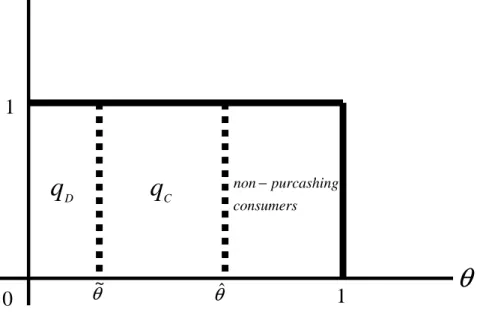
purchases the dirtier (cleaner, respectively) product. In addition, consumerθ
falling intoθ
ˆ<θ
≤1 purchases nothing in the market. This implies that the green market is not completely covered by all consumers. See Figure 1.Let qD
(
q
C)
represent the quantity demanded for the dirtier (cleaner, respectively) product. Given the assumption of a uniform distribution, the demand functions are expressed by:,
~
C D D C De
e
p
p
q
−
−
=
=
θ
(1.1).
)
(
)
(
)
(
~
ˆ
C D C D C C D Ce
e
e
p
v
e
p
v
e
q
−
−
−
−
=
−
=
θ
θ
(1.2)From (1.1) and (1.2), we derive the corresponding inverse demand functions:
,
C C D D Dv
e
q
e
q
p
=
−
−
(2.1)).
(
C D C Cv
e
q
q
p
=
−
+
(2.2) Second, let us present the characteristics of foreign firms exporting the products associatedwith environmental qualities. The cost function of a unit emission level of the product can be
generally represented by: Fi =Fi(ei),Fi′<0,Fi″>0,i=C,D. Following Moraga-González and Padrón-Fumero (2002, Assumption 2), we assume that the cost function is a homogeneous
function of degree
ε
≥2.,
εα
−=
D De
F
(3.1) . ε − = C C e F (3.2) To avoid multiple equilibria in the decision game of the unit emission levels, we assume that thecost functions are sufficiently asymmetric among the firms:
α
>1. Furthermore, to simplify, we assume that marginal costs of production are independent of the unit emission level and are zero.Thus, the profit function of foreign firm i is given by
π
i=
p
iq
i−
F
i,
i
=
C
,
D
.
Third, we assume that the importing country’s government maximizes social welfare
including the social valuation of environmental damage. Hence, aggregate emissions, which
erode the environment of the importing country, are expressed by:
.
C C D Dq
e
q
e
E
=
+
(4) Furthermore, as mentioned above, because there are three types of consumers purchasing thedirtier product, those purchasing the cleaner product, and those never purchasing any products
in the market, total consumer surplus can be represented by:
.
0
)
(
)
(
ˆ ~ ~ 0−
−
+
−
−
+
=
∫
v
e
Dd
p
Dq
D∫
v
e
Cd
p
Cq
CCS
θ
θ
θθ
θ
θ θ (5)Thus, because there is not producer surplus, net social surplus included in the social
valuation of the environmental damage is defined by:
E
CS
W
≡
−
γ
(6) whereγ
(
≥
0
)
is the marginal social valuation of environmental damage.In what follows, we consider a three-stage game: in the first stage, the government
determines an emission standard; in the second stage, foreign firms determine the unit emission
levels, given the emission standard; and in the final stage, they compete on price or quantity in the market of the importing country. We derive a subgame perfect Nash equilibrium by
backward induction.
3. Emission Standards in the Foreign Bertrand Duopoly Case
3.1 Free trade equilibrium
As the derivation of the Bertrand-Nash equilibrium in the final stage is straightforward, the
procedure of the derivation is omitted. The equilibrium quantities in the final stage are given by:
,
4
1
v
e
e
q
C D B D−
=
(7.1).
)
4
(
2
v
e
e
e
e
q
C D C D B C−
=
(7.2)Hence, the revenue functions in the second stage are expressed by:
,
)
4
(
2 2v
e
e
e
e
R
C D C D B D−
−
=
(8.1).
)
4
(
)
(
4
2 2v
e
e
e
e
e
e
R
C D C C D D B C−
−
=
(8.2)with respect to the unit emission level of each firm are given by: , 0 ) 4 ( ) 7 4 ( 2 3 = ′ − − − − D C D C D v F e e e e (9.1) . 0 ) 4 ( ) 2 3 4 ( 4 2 3 2 2 2 = ′ − − + − − C C D C C C D D D v F e e e e e e e e (9.2)
Based on the properties of the revenue functions, (8.1) and (8.2), as in Appendix 1, we derive
the reaction function of the unit emission level of foreign firm i as:
.
,
,
,
,
0
),
(
e
i
j
C
D
i
j
e
i=
β
i jβ
i′
>
=
≠
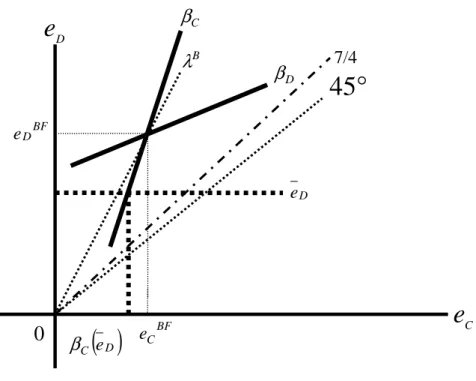
That is, the unit emission levels of the products are strategic complements for both firms in the
Bertrand duopoly case. Furthermore, we can show that there is a unique and stable Nash
equilibrium, {eDBF,eCBF}, under the free trade case (see Appendix 2, and Moraga-González and Padrón-Fumero, 2002, Proposition 3). See Figure 2.
3.2 Emission standard, imports, environment, and welfare
We deal with an emission standard on the dirtier product. Suppose that the government chooses
an emission standard lower than or equal to the level in the free trade case: eDBF ≥eD. Hence,
foreign firm D would choose the unit emission level of the dirtier product equal to the emission
standard for profit maximization.
For the analysis below, we begin by considering the effect on the ratio of emission levels of
the products, which is given by
).
4
7
(
>
=
C D Be
e
λ
The effect is expressed as:C C B D B
e
d
d
η
β
λ
λ
≥
(
<
)
0
⇔
1
≥
(
<
)
′
⇔
2
≤
(
>
)
(10) where.
C D D C C Be
e
e
e
∂
∂
=
′
β
λ
Because it holds that1
2
,
i
C
,
D
,
F
F
e
i i i i′
=
+
>
=
″
−
≡
ε
η
given (3.1)and (3.2), a strict emission standard reduces the ratio of emission levels of the products (see
Appendix 3). Because this result means a reduction of the difference in environmental qualities
between both products, it, in turn, substantially enhances price competition.
Let us show the effect of an emission standard on the dirtier and the cleaner products,
respectively. Taking (7.1) and (7.2) into account, we derive:
,
4
)
(
0
)
(
B C D D C D C C B D D B D D B De
e
e
e
e
e
e
q
e
q
e
d
dq
λ
<
≥
∂
∂
⇔
<
≥
∂
∂
∂
∂
+
∂
∂
=
(11.1).
0
<
∂
∂
∂
∂
+
∂
∂
=
D C C B C D B C D B Ce
e
e
q
e
q
e
d
dq
(11.2)Given the expression of the right-hand side of (11.1), because
<
1
∂
∂
C D D Ce
e
e
e
and4
λ
B>
1
,
we have <0. D B D e d dqThus, a strict emission standard increases imports of both products, compared
with the free trade case. That is, a strict emission standard improves the environmental qualities
of both products. This, in turn, increases the proportion of consumers in the market because the
environmental quality improvement not only raises the valuation of the products by consumers,
but also lowers prices. Thus, emission standards on the dirtier product are not necessarily
import-restrictive. However, does this imply that the emission standards policy increases
aggregate emissions, and thereby deteriorates the environment?
Substituting (7.1) and (7.2) into (4), we have
v
e
e
e
E
C D D B−
=
4
3
where it holds that
0
)
4
(
3
2<
−
−
=
∂
∂
v
e
e
e
e
E
C D C D B and0
.
)
4
(
3
2>
−
=
∂
∂
v
e
e
e
e
E
C D D C BGiven (4) and (7.1), we have
.
3 D DB
B
q e
E = Hence, the magnitude of the reduction of the quantity demanded is larger than that of the increase in the unit emission level. Thus, an increase in the unit emission level of the
unit emission level of the cleaner product, the opposite events occur.
The effect of an emission standard on aggregate emissions is represented by:
.
D C C B D B D Be
e
e
E
e
E
e
d
dE
∂
∂
∂
∂
+
∂
∂
=
(12)Given (12), we derive the following relationships:
.
)
(
2
1
)
(
0
)
(
B C C D Be
d
dE
η
β
λ
′
≥
<
⇔
≥
<
⇔
<
≥
Because
η
C>
2
,
a strict emission standard increases aggregate emissions, and thereby worsens the environment, compared with the free trade case.Furthermore, substituting (7.1) and (7.2) into (5), consumer surplus is generally given by:
2 2 2 2 ) 4 ( 2 4 v e e e e e e e CS C D C C C D D B − − + =
where it holds that
<
0
∂
∂
D Be
CS
and<
0
.
∂
∂
C Be
CS
Hence, the effect on consumer surplus is:
.
0
<
∂
∂
∂
∂
+
∂
∂
=
D C C B D B D Be
e
e
CS
e
CS
e
d
dCS
(13)Thus, a strict emission standard increases consumer surplus.
Finally, the effect on net social surplus is expressed by
.
D B D B D Be
d
dE
e
d
dCS
e
d
dW
γ
−
=
Based on(12) and (13), we summarize the result as follows.
Proposition 1 (Moraga-González and Padrón-Fumero, 2002, Proposition 6)
When a foreign Bertrand duopoly prevails in the market, a strict emission standard on the
dirtier product reduces (increases) net social surplus if the marginal social valuation of
environmental damage is larger (smaller) than a certain value:
(
)
ˆ
.
D B D B Be
d
dE
e
d
dCS
≡
<
>
γ
γ
If the government substantially gives weight to concerns about the environment,
γ
>
γ
ˆ
B,
astrict emission standard further increases aggregate emissions rather than consumer surplus.
Thus, paradoxically, the government should mitigate the emission standard on the dirtier
product. Otherwise, i.e.,
γ
<
γ
ˆ
B,
the government should impose a strict emission standardpolicy on imports of the dirtier product.
3.3 Emission regulation of a cleaner product
Secondly, following the same procedure as in 3.2, we examine the effects of emission regulation
of the cleaner product:
e
CF≥
e
C>
0
.
We begin by showing the effect on the ratio of unit emission levels as follows.D B D C B
e
d
d
η
λ
β
λ
≥
(
<
)
0
⇔
′
≥
(
<
)
1
⇔
2
≥
(
<
)
(14) where.
D C C D B De
e
e
e
∂
∂
=
′
λ
β
Because >2, Dη
a strict emission regulation increases the ratio ofemission levels of the products. This implies an increase in the difference in environmental
qualities between both products. This, in turn, mitigates price competition.
Let us analyze the effect of the emission regulation policy on imports of the dirtier and the
cleaner product, respectively. We easily derive the following expressions:
,
4
1
)
(
0
)
(
B D C C D C D D B D C B D C B De
e
e
e
e
e
e
q
e
q
e
d
dq
λ
>
≤
∂
∂
⇔
<
≥
∂
∂
∂
∂
+
∂
∂
=
(15.1).
0
<
∂
∂
∂
∂
+
∂
∂
=
C D D B C C B C C B Ce
e
e
q
e
q
e
d
dq
(15.2)unidirectional as
<
1
∂
∂
D C C De
e
e
e
and 1.4
λ
1 <B That is, a decrease in the unit emission level of thecleaner product directly transfers the demand for the dirtier product to the cleaner product. On
the other hand, a decrease in the unit emission level of the cleaner product increases the demand
for that product because it induces a decrease in the unit emission level of the dirtier product
because of a strategic complements effect. As the former negatively affects imports, but the
latter positively affects imports, the total effect on imports is consequently ambiguous. On the
other hand, a strict emission regulation increases imports of the cleaner product, compared with
the free trade case.
The effect of emission regulation of the cleaner product on aggregate emissions is expressed
by
.
C D D B C B C Be
e
e
E
e
E
e
d
dE
∂
∂
∂
∂
+
∂
∂
=
Hence, we obtain the following relationships:.
)
(
2
1
)
(
0
)
(
DB D C Be
d
dE
η
λ
β
′
≤
>
⇔
≤
>
⇔
<
≥
Because
η
D >2, a strict emission regulation reduces aggregate emissions,>
0
,
C Be
d
dE
andthereby improves the environment, compared with the free trade case. This result is opposite to
that of the case of an emission standard on the dirtier product. In other words, the government
should convey a strict emission regulation not for the dirtier product, but for the cleaner product,
to protect the environment.
Furthermore, with respect to the effect on consumer surplus, we easily obtain
<
0
.
CB
e
d
dCS
Therefore, it holds that
=
−
<
0
.
C B C B C Be
d
dE
e
d
dCS
e
d
dW
γ
We summarize the result as follows.Proposition 2
cleaner product increases net social surplus.
Proposition 2 suggests that the importing country’s government should choose a unit
emission level of the cleaner product such as to allow the profit of the foreign firm supplying
the product to be approximately equal to the reservation profit, e.g., zero profit.
4. Cournot Duopoly Case
In this section, following the same procedure as in Section 3, we examine the Cournot duopoly
case. Then, comparing the results of the Bertrand and Cournot duopoly cases, we present
evidence such that the effects of an emission standard depends on the mode of market
competition and the degree of marginal social valuation of environmental damage.
4.1 Free trade equilibrium
The quantities in the Cournot–Nash equilibrium of the final stage are given by:
,
4
1
v
e
e
q
C D C D=
−
(16.1).
)
4
(
2
v
e
e
e
e
e
q
C D C C D C C−
−
=
(16.2)where
e
D≥
e
C and superscript C denotes Cournot competition. Hence, the equilibrium revenue functions in the second stage are expressed by:, ) 4 ( 2 2 v e e e R C D D C D − = (17.1) . ) 4 ( ) 2 ( 2 2 2 v e e e e e R C D C C D C C − − = (17.2)
Note that if
e
C=
e
D=
e
,
then,
3e
v
q
q
CC=
CD=
and.
9
2e
v
R
R
CC=
DC=
Given the assumptionof asymmetric cost functions as in (3.1) and (3.2), it holds that
π
CC >π
DC. This means that the profit of a firm with an efficient technology, i.e., foreign firm C, is higher than that of one withan inefficient technology, i.e., foreign firm D, in the homogeneous product market.
Taking (17.1) and (17.2) into account, the first-order conditions for profit maximization of
the firms in the second stage are given by:
, 0 ) 4 ( 4 2 3 = ′ − − + − D C D C D v F e e e e (18.1) . 0 ) 4 ( ) 2 8 )( 2 ( 2 3 2 2 2 = ′ − − + − − − C C D C C C D D C D v F e e e e e e e e e (18.2)
As shown in Appendix 4, based on (18.1) and (18.2), we derive the reaction functions of
the unit emission levels in the Cournot duopoly case as follows:
. 0 ), ( ′ > = C D C C e e
φ
φ
(19.1) , 0 ), ( ′ < = D C D D e eφ
φ
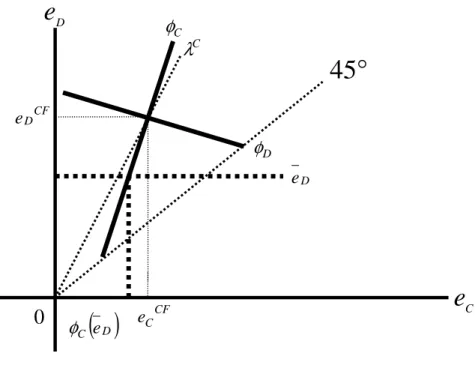
(19.2) In view of (19.1) and (19.2), the unit emission levels of the products are strategiccomplements (substitutes) with respect to foreign firm C (D) in the Cournot duopoly case. A
decrease in the unit emission level of the dirtier product reduces the market share and revenue
of foreign firm C. So, foreign firm C has an incentive to improve the environmental quality to
increase market share. On the other hand, a decrease in the unit emission level of the cleaner
product similarly reduces the market share and revenue of foreign firm D. Hence, to increase
the market share and thus the revenue, foreign firm D has to reduce the unit emission level of
the dirtier product, even though the cost increases.
Here, we note that there is a strategically complementary relationship with respect to the
market competition. Accordingly, as shown below, a strict emission standard on the dirtier
product always improves the environmental quality of the cleaner product. However, foreign
firm C has an incentive to reduce the unit emission level of the cleaner product to mitigate
competitiveness in the Bertrand duopoly case. On the other hand, foreign firm C has an
incentive to reduce that level to extend its market share in the Cournot duopoly case.
Based on (19.1) and (19.2), there is a unique and stable Nash equilibrium in the stage in
which the unit emission levels are determined under free trade, i.e., {eCCF,eCFD }. See Appendix 2. Hereafter, for simplicity of expression, we do not use superscript C of the unit emission level in the Cournot duopoly case. See Figure 3.
4.2 Effect of an emission standard on imports, environment, and welfare
We examine how an emission standard on the dirtier product, i.e.,
e
CFD≥
e
D,
affects imports, the environment, and net social surplus in the case of a foreign Cournot duopoly. Because wehave shown the equilibrium in the final stage in section 4.1, we present the effect of an emission
standard on the ratio of the unit emission levels of the products, i.e.,
=
≥
1
:
C D Ce
e
λ
C C C D Ce
d
d
η
φ
λ
λ
≥
(
<
)
0
⇔
1
≥
(
<
)
′
⇔
2
≤
(
>
)
(20) where.
C D D C C Ce
e
e
e
∂
∂
=
′
φ
λ
See also Appendix 2. Givenη
C>
2
,
a strict emission standardreduces the ratio of the emission levels of the products.
Following a similar derivation in 3.2, we derive the effect on imports as follows.
,
4
)
(
0
)
(
C C D D C D C C C D D C D D C De
e
e
e
e
e
e
q
e
q
e
d
dq
λ
<
≥
∂
∂
⇔
<
≥
∂
∂
∂
∂
+
∂
∂
=
(21.1) . ) ( 4 8 2 ) ( 2 2 C D D C C C D D C D D C C C C D C C D C C e e e e e e e e e e e e e q e q e d dq ∂ ∂ < ≥ + − ⇔ < ≥ ∂ ∂ ∂ ∂ + ∂ ∂ = (21.2)Given the expression on the right-hand side of (21.1), because
<
1
∂
∂
C D D Ce
e
e
e
and4
λ
C>
1
,
we have <0. D C D e d dqThus, a strict emission standard increases imports of the dirtier products, in
contrast to the free trade case, as the valuation by consumers increases because of the emission
standard policy. On the other hand, the effect on imports of the cleaner product is not
unidirectional because
1
4
8
2
2 2<
+
−
D C C D C De
e
e
e
e
e
and<
1
.
∂
∂
C D D Ce
e
e
e
That is, a strict emission
standard on the dirtier product directly reduces the market share of the cleaner product, whereas
it indirectly increases the market share as the unit emission level of the cleaner product is
reduced through the effect of strategic complements. Thus, as a result, the effect on imports of
the cleaner product is ambiguous.
Substituting (17.1) and (17.2) into (4), we have
v
e
e
e
e
E
C D C D C−
−
=
4
3
where it holds that
0
)
4
(
−
2>
=
∂
∂
v
e
e
e
e
E
C D C D C and0
.
)
4
(
−
2<
−
=
∂
∂
v
e
e
e
e
E
C D D C CAlthough an increase in the unit
emission level of the dirtier product reduces the quantity, it sufficiently increases the unit
emission level and the quantity of the cleaner product. Accordingly, an increase in the unit
emission level of the dirtier product increases aggregate emissions. On the other hand, an
increase in the unit emission level of the cleaner product reduces its quantity, but increases the
quantity of the dirtier product. However, it also reduces the unit emission level of the dirtier
product. In this case, the strategic substitute effect ensures that an increase in the unit emission
level of the cleaner product reduces aggregate emissions.
We derive the effect of an emission standard on aggregate emissions as follows.
.
)
(
2
)
(
1
0
)
(
C C C D Ce
d
dE
η
φ
λ
′
⇔
≤
>
<
≥
⇔
<
≥
Because
η
C>
2
,
a strict emission standard reduces aggregate emissions, i.e.,>
0
,
D Ce
d
dE
andthereby improves the environment.
Furthermore, given (19.2), and taking
<
0
∂
∂
D Ce
CS
and<
0
∂
∂
C Ce
CS
into account, the effect
on consumer surplus under the Cournot duopoly case is given by
<
0
.
DC
e
d
dCS
Thus, the effect
of an emission standard on net social surplus is given by:
=
−
<
0
.
D C D C D Ce
d
dE
e
d
dCS
e
d
dW
γ
Wesummarize the result as follows.
Proposition 3
When a foreign Cournot duopoly prevails in the market, a strict emission standard on imports of
the dirtier product always increases net social surplus.
Proposition 3 implies that a difference in the unit emission levels of the imported products is
not allowed, i.e., eD =eC. In other words, we may interpret that the government only admits
quantity competition by foreign firms in a homogenous product market. Furthermore,
Proposition 1 states that a strict emission standard on the dirtier product is not the preferable
policy in the Bertrand duopoly case, if the government substantially gives weight to concerns
about the environment. The difference in these results is because of the difference in the effect
on the environment. That is, in the Bertrand (Cournot) duopoly case, a decrease in the unit
emission level of the dirtier product degrades (improves, respectively) the environment.
4.3 Emission regulation of a cleaner product
affects imports, the environment, and net social surplus. Because equation (19.2) shows
strategic substitutes relationships between the unit emission levels of the products, we easily
derive the following expressions:
,
0
>
∂
∂
∂
∂
+
∂
∂
=
C D D C D C C D C C De
e
e
q
e
q
e
d
dq
(22.1).
0
<
∂
∂
∂
∂
+
∂
∂
=
C D D C C C C C C C Ce
e
e
q
e
q
e
d
dq
(22.2)Thus, a strict emission regulation reduces imports of the dirtier product, whereas it increases
imports of the cleaner product. Hence, the emission regulation on the cleaner product is an import barrier for the dirtier product, whereas it promotes imports of the cleaner product. Do
these results mean that the emission control policy improves the environment and net social
surplus?
Using (19.2), we directly obtain the following:
,
0
<
∂
∂
∂
∂
+
∂
∂
=
C D D C C C C Ce
e
e
E
e
E
e
d
dE
(23).
0
<
∂
∂
∂
∂
+
∂
∂
=
C D D C C C C Ce
e
e
CS
e
CS
e
d
dCS
(24)Paradoxically, a strict emission regulation increases aggregate emissions and thereby degrades
the environment, although it increases consumer surplus.
Therefore, taking (23) and (24) into account, with respect to the effect on net social surplus,
we summarize our findings in the following proposition.
Proposition 4
When a foreign Cournot duopoly prevails in the market, a strict emission regulation on the
environmental damage is larger (smaller) than a certain level: ( )ˆ . C C C C C e d dE e d dCS ≡ < >
γ
γ
A decrease in the unit emission level of the cleaner product increases environmental damage,
although it increases consumer surplus. If the government values the domestic environment
significantly, i.e.,
γ
>
γ
ˆ
C,
the emission regulation policy in the foreign Cournot duopoly case is not desirable. Furthermore, as shown in Proposition 2, a strict emission regulation on thecleaner product is preferable in the Bertrand duopoly case. The difference in these results
corresponds to the difference in the effect on the environment. That is, in a foreign Bertrand
(Cournot) duopoly, the effect of an increase in the emission level of the cleaner product on the
environment is positive (negative, respectively).
5. Concluding Remarks
We have examined the impact of emission standards as TBT on imports, the environment, and
social welfare, based on the green market model presented by Moraga-González and
Padrón-Fumero (2002). The main conclusions of this paper state that an emission standard policy for
polluting products does not necessarily restrict imports of the product, whereas it may worsen
the environment and social welfare. That is, we have shown that the effects of an emission
standard policy on the environment and net social surplus depend on the mode of competition
and the degree of social marginal valuation of environmental damage.
There are some remaining issues as follows. First, because we have dealt with an emission
standard policy as a TBT or NTB in the paper, it might not be natural to assume that domestic
firm produces the product, we can derive the same results as those in the paper.
Second, we have assumed that the importing government can commit to the emission
standard policy before the firms decide the investment or product line associated with
environmental qualities of the products. However, we should consider the timing of an emission
standard policy because the government may have an incentive to change the emission standard
after firms have invested. Related to the first issue, for example, we can consider that after a
domestic firm decides to investment to produce a cleaner product, the government may choose a prohibitive level of an emission standard to restrict imports of a dirtier product. In this case, the
domestic firm can be a monopolistic producer to provide the cleaner product to domestic
consumers in the green market of the importing country. So, we should analyze the effect of the
prohibitive emission standard policy on social welfare.
Third, we have supposed that the firms do not bear the burden of production costs. However,
in the context of endogenous quality choice and strategic R&D policy (Jinji and Toshimitsu,
2007), we examined that the nature of reaction functions with respect to qualities and the
first-order properties of revenue functions depend on the degree of marginal production costs. Thus,
with nonzero production costs, our conclusions may be revised.
Fourth, we have analyzed the effect of environmental policy on imports, the environment,
and social welfare. However, we need to address the effect of traditional trade policies, i.e.,
tariff and import quota, on them. On the effect of tariffs, see Toshimitsu (2006a). Furthermore,
by the classification of Besanko (1987), our model is in line to the analysis of design or
technological standards of pollution. In this paper, we have discussed the effect of an emission
standard that responds to a design standard policy for environmental quality of the products. He
also analyzes performance standards of pollution. If we can interpret import quotas as
performance standards, we should analyze the effect of import quotas as performance standards
on the environment and social welfare (Toshimitsu, 2006b).
pollution is a by-product of consumption of the products. However, recently, it is clear that the
environment and nature in a worldwide context is actually damaged by the production of
environmental-friendly goods such as bio-gasoline. This implies that a cleaner product in the
consumption process is a dirtier product in the production process, based on the terms of our
paper. Thus, we should analyze the effects of environmental policy, considering environmental
Appendix 1
We obtain the nature of the revenue functions in (8.1) and (8.2) as follows. The first-order
properties are:
,
)
(
4
7
0
)
(
C D D B De
e
e
R
<
≥
⇔
<
≥
∂
∂
,
0
<
∂
∂
C B Ce
R
,
0
<
∂
∂
C B De
R
and>
0
.
∂
∂
D B Ce
R
(A.1)Given the first expression, the effect on the revenue of foreign firm D is not unidirectional.
However, to warrant the existence of an interior solution, we assume such that
.
4
7
D C
e
e
<
Thesecond expression shows that a decrease in the unit emission level of the cleaner product
increases its firm’s revenue. Furthermore, the third (fourth) expression shows that a decrease in
the unit emission level of the cleaner (dirtier, respectively) product increases (reduces,
respectively) the revenue of foreign firm D (C). That is, a decrease in the unit emission level of
the cleaner product increases the difference in environmental qualities of the products. This, in
turn, mitigates competitiveness. On the other hand, a decrease in the unit emission level of the
dirtier product enhances price competition as it reduces the difference in the environmental
qualities of the products.
The second-order properties are:
,
2
5
)
(
0
)
(
2 2 C D D B De
e
e
R
<
≥
⇔
<
≥
∂
∂
, 0 2 2 > ∂ ∂ C B C e R and0
,
,
,
,
.
2j
i
D
C
j
i
e
e
R
j i B i>
=
≠
∂
∂
∂
(A.2)Because the revenue functions are not necessarily concave, the cost functions should be
sufficiently convex to ensure that the second-order conditions hold.
Furthermore, the positive cross partial derivative in the third expression implies that the unit
emission levels of the products are strategic complements in the Bertrand duopoly case. That is,
the prices of both products fall because of a decrease in the unit emission level of the dirtier
product, as the difference in environmental qualities of the products is likely to vanish. Thus,
other hand, prices and revenues of both foreign firms increase by a decrease in the unit emission
level of the cleaner product, as the environmental quality difference between both products
widens. Hence, there are two effects of a decrease in the unit emission level by foreign firm D
on its revenue: a negative effect because of strict price competition, and a positive effect
because of an increase in the valuation by consumers. As the latter effect is greater than the
former, foreign firm D has an incentive to improve the environmental quality by less than the
degree of improvement in the cleaner product, even though the cost increases.
Appendix 2
The determinant of the matrix can be generally expressed as:
. , , 2 2 2 2 2 2 C B k e e e e e e C D k C C D k D D k C D k D k = ∂ ∂ ∂ ∂ ∂ ∂ − ∂ ∂ ∂ ∂ = Δ
π
π
π
π
(A.3) Furthermore, the following equations hold:.
,
,
,
,
,
,
2
2 2 2C
B
k
j
i
D
C
j
i
F
e
e
R
e
e
R
e
i j i k i j i k i i∂
∂
=
−
′
=
≠
=
∂
+
∂
∂
(A.4)Given (A.4), the determinant in (A.3) can be rewritten as:
(
)
(
)
(
2
)
(
2
)
,
2
2
2 2−
⎟
⎟
⎠
⎞
⎜
⎜
⎝
⎛
′
−
−
⎟
⎟
⎠
⎞
⎜
⎜
⎝
⎛
′
−
+
−
⎟
⎟
⎠
⎞
⎜
⎜
⎝
⎛
′
−
∂
∂
∂
+
−
⎟
⎟
⎠
⎞
⎜
⎜
⎝
⎛
′
−
∂
∂
∂
=
Δ
C C C D D D C C C D C k C D C D D D C D k D C D ke
F
e
F
e
F
e
e
R
e
e
e
F
e
e
R
e
e
η
η
η
η
(A.5) where1
2
,
i
C
,
D
,
F
F
e
i i i i′
=
+
>
=
″
−
≡
ε
η
holds, given (3.1) and (3.2).In the Bertrand duopoly case,
k
=
B
,
taking into account the positive cross partial derivatives, the sign of the determinant is positive. Thus, the stability condition is satisfied. Onderivatives are different, the sign of the determinant is not necessarily positive. Thus, it is
assumed that ΔC >0.
Appendix 3
In what follows, as we have the same results regardless of the model of competition, we omit
superscript
k
=
B
, C
.
In general, it holds that:. , , , , 2 2 2 j i D C j i e e e e e e e e e i i i j j i i i j j i = ≠ ∂ ∂ ∂ ∂ ∂ − = ∂ ∂
π
π
(A.6)Hence, taking (A.4) into account, we derive:
. , , , , ) ( 2 1 ) ( i j C D i j e e e e i i j j i ≥ < ⇔ ≥ < = ≠ ∂ ∂
η
(A.7)Given
η
i>
2
,
it holds that 1,i, j C,D,i j.e e e e i j j i < = ≠ ∂ ∂
Appendix 4
Given (17.1) and (17.2), the first-order properties are given by:
0
<
∂
∂
i C ie
R
and0
,
i
,
j
C
,
D
,
i
j
.
e
R
j C i>
=
≠
∂
∂
(A.8)The second expression of these properties implies that an increase in the unit emission level of
foreign firm j increases the revenue of foreign firm i. That is, an increase in the unit emission
level implies that environmental quality of the product deteriorates. This in turn reduces the
market share of foreign firm j, allowing foreign firm i to increase its market share and thus its
revenue.
, , , 0 2 2 D C i e R i C i > = ∂ ∂
,
0
2<
∂
∂
∂
C D C De
e
R
and0
.
2>
∂
∂
∂
D C C Ce
e
R
(A.9)As the sign of the first expression is positive, the cost function of a unit emission level is
assumed sufficiently convex, so that the second-order condition for profit maximization holds.
In addition, the second expression indicates the followings. An increase in the unit emission
level of the cleaner product reduces the difference in environmental qualities between the
products. As the difference becomes small, a competition among the firms intensifies. Accordingly, the marginal revenue of foreign firm D declines. On the other hand, the third
expression indicates that an increase in the unit emission level of the dirtier product increases
the quality difference, and thus increases the marginal revenue of foreign firm C. The signs of
the cross partial derivatives of the second and the third equations mean that the unit emission
levels of the products are strategic complements (substitutes) for foreign firm C (D) in the
References
Barrett, S., 1994, Strategic Environmental Policy and International Trade, Journal of Public
Economy, 54, 325–338.
Besanko, D., 1987, Performance versus Design Standards in the Regulation of Pollution,
Journal of Public Economics 34, 19–44.
Conrad, K., 1993, Taxes and Subsidies for Polluting-intensive Industries as Trade Policy,
Journal of Environmental Economics and Management, 25, 121–135.
Copeland, B. R., and M. S. Taylor, 2003, Trade and the Environment: Theory and Evidence, Princeton University Press, Princeton.
Eaton, J. and G. M. Grossman, 1986, Optimal Trade and Industrial Policy under Oligopoly,
Quarterly Journal of Economics, 101, 383–406.
Jayadevappa, R. and S. Chhatre, 2000, International Trade and Environmental Quality: A Survey,
Ecological Economics, 32, 175–194.
Jinji, N. and T. Toshimitsu, 2007, A Note on Strategic Trade Policy with Endogenous Choice of Quality, Review of International Economics, forthcoming.
Kennedy, P. W., 1994, Equilibrium Pollution Taxes in Open Economies with Imperfect Competition, Journal of Environmental Economics and Management, 27, 49–63.
Mani, M. S., 1996, Environmental Tariffs on Polluting Imports: An Empirical Study,
Environmental and Resource Economics, 7, 391–411.
Moraga-González, J. L. and N. Padrón-Fumero, 2002, Environmental Policy in a Green Market,
Environmental and Resource Economics, 22, 419–447.
Motta, M. and J. F. Thisse, 1999, Minimum Quality Standard as Environmental Policy: Domestic and International Effects, Petrakis E. et al, (eds.) Environmental Regulation and
Market Power, Edward Elgar, Massachusetts.
Neary, J. P., 2006, International Trade and the Environment: Theoretical and Policy Linkages,
Environmental and Resource Economics, 33, 95–118.
Rauscher, M., 1997, International Trade, Factor Movements, and the Environment, Clarendon Press, Oxford.
Ronnen, U., 1991, Minimum Quality Standards, Fixed Costs, and Competition, RAND Journal
of Economics, 22, 490–504.
Scherhorn, G., 1993, Consumers’ Concern about the Environment and Its Impact on Business,
Journal of Consumer Policy, 16, 171–191.
Toshimitsu, T., 2006a, Effect of a Tariff on the Environment and Welfare: The Case of an Environmental Differentiated Duopoly in a Green Market, Japan and the World Economy,
forthcoming.
Toshimitsu, T., 2006b, Do Import Quotas Damage the Environment? (in Japanese), Kwansei Gakuin University, School of Economics, Keizaigaku Ronkyu, 60, 133–148.
Ulph, A. M., 1996, Environmental Policy Instruments and Imperfectly Competitive International Trade, Environmental and Resource Economics, 7, 333–355.
Ulph, A. M., 1999, Trade and the Environment, Edward Elgar, Massachusetts.
Valentini, L., 2005, Environmental Quality Provision and Eco-labelling: Some Issues, WTO Working Paper ERSD-2005-02.
Valletti, T. M., 2000, Minimum Quality Standards under Cournot Competition, Journal of