Introduction of New Satellite Observation
Techniques for Sea Ice Growth and Transport in
the Arctic (Extended Abstract)
著者
Enomoto Hiroyuki, Tateyama Kazutaka, Nakayama
Masashige, Kimura Noriaki
journal or
publication title
The science reports of the Tohoku University.
Fifth series, Tohoku geophysical journal
volume
36
number
4
page range
443-447
year
2003-05
Introductions
Sea Ice
of New Satellite Observation
Techniques
Growth and Transport
in the Arctic
(Extended A bstract)
for
HIROYUKI ENOMOTO1'2, KAZUTAKA TATEYAMA3,
MASASHIGE NAKAYAMA4 and NORIAKI KIMURA4 'Frontier Observational Research System for Global Change
, 3173-25,
Showa-machi, Kanazawa-ku, Yokohama 236-0001
'Department of Civil Engineering
, Kitami Institute of Technology, 165, Koen-cho, Kitami 090-8507
'Sea Ice Research Laboratory
, Institute of Low Temperature Science,
Hokkaido University, 6-4-10, Minamigaoka, Mombetsu 094-0013 'Earth Observation Research Center
, National Space Development Agency of Japan, Triton Square X23, 1-8-10, Harumi, Minatoku, Tokyo 104-6023
(Received December 22, 2002)
Abstract : This study presents some results on sea ice changes in the Arctic and surrounding seas by archiving new data set and applying new approach of analyses. Sea ice motion, sea ice type or ice thickness data were obtained by the satellite remote sensing. Combinations of satellite observations of ice thickness and ice motion enable estimation of ice volume transport, which is important for investigating energy transport , salinity anomaly due to ice formation and melting.
1. Introduction
Recently, thinning of sea ice in the Arctic became great concern and many attempts
have been done to investigate it. Although cryosphere can indicate significantly the
environmental changes, observations in the remote and cold area are difficult. Sea ice
has important roles for atmosphere-ocean interaction as sea ice controls heat and
material exchanges.
There are still lack of data and observation systems in the higher latitudes. One of
the useful techniques is the satellite remote sensing.
Approach of sea ice research
This report introduces combined analysis of new algorithms for sea ice
investiga-tion.
Available algorithms are observing ice thickness, ice motion and under-ice oceanic
444 AM?, AVILRI4 &aril UMW), SAR Arctic Ocean Procedure - Objective and automatic detection of thin - Freezing detection Development of technique 3 for ice thickness estimation
AVIVIR, AM!?, SSMT (ABI.616 Data product - Okhotsk - Bering - Arctic Ocean
ice motion analysis • Relevant scale
improving techniques
Ice transport Ice mass transport
Heat advection by sea ice
Approach of climatic research using satellite data
Data arrangement (analyths and model validation)
Data fusion and cooperative study with modeling
Fig. 1. Flow of possible thickness data. analysis combining gRafil gigs' AMU' SAE RADAR
- Cryos pheric research from energy and mass evaluation - Detection of ch ange - Interaction study - Forecasting possible changes
sea ice motion, sea ice type or ice
•
ti
Fig. 2.
.71
Thick (red) and thin (blue) ice distributions (Nakayama et al., 2002)
Examples of ice thickness estimation
For the studying ice growth and decay, ice thickness change is important
informa-tion (Enomoto, 1996). Time series of large scale data is useful for analysis.
New satellite observation techniques for estimating sea ice growth in the seasonal
sea ice area have been developed. Figure 2 shows an example of ice thickness variation
in the Northern Hemisphere (Nakayama et al., 2002).
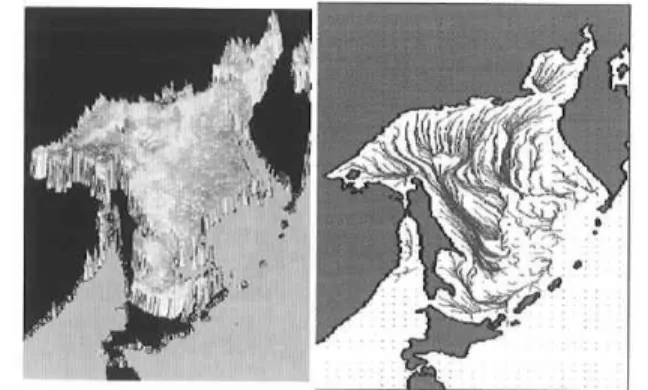
Figure 3 shows an example of ice thickness indication in the Sea of Okhotsk
Fig. 3. Sea ice thickness variations in Mar . 2001 (right) and mean ice flow pattern (left) in the Sea of Okhotsk.
Fig. 4.
cm 90
50
10
Ice thickness distribution in the seasonal sea ice area .
Tateyama et al. (2002). Mean ice flow was also indicated in Figure 3. Sea of Okhotsk
is covered by thin ice and sensitive for climatic conditions . Seasonal sea ice area in the
Arctic can be investigated from a point of ice growth characteristics , by using these
techniques.
Figure 4 shows an example of distinguishment of thin ice region and then ices
thickness estimation to focus detail of regional ice thickness distribution .
Ice motion and Oceanic Current
One of the characteristics of sea ice compared to the other cryospheric components
is its movement. Ice replacement is important information to study sea ice fluctuations .
Interactions among the ice motion-wind-oceanic current will be investigated by new
approaches of ice motion analysis (Kimura and Wakatsuchi , 2000).
446 _law. 01 2
rZ.-...
_ ...
....NV irr:
.
4:K.. I. .... IL.11,4
fi
Fig. 5. Ice drift, wind component and Oceanic current based on the algorithm of Kimura and Wakatsuchi (2000).
from the ice drift were introduced in Figure 5. This shows the mean pattern of winter
circulation. A clockwise circulation off Canada can be observed (Beaufort Gyre) .
Transpolar drift stream is visible as a stream to Atlantic Ocean through the North Polar
region.
Ice motion analysis and ice thickness estimation provides ice advection data , thus
the cause of ice condition changes will be analyzed from the thermal condition and
dynamics of sea ice.
Summary
Newly developed sea ice observation techniques by satellite were introduced:
—Sea ice motion , sea ice type or ice thickness data can be obtained by the satellite remote sensing.
--Combinations of satellite observations of ice thickness and ice motion en
estimation of port, salinity
—These analysis.
ice volume transport, which
anomaly due to ice formation
analyses enable monitoring of
is important for investigating energy
and melting.
sea ice from the point of energy and
trans-mass
References
Enomoto, H., 1996 : Observation of thin ice area in the Okhotsk Sea and impacts for climatological
study, Jour. Remote Sensing Society of Japan, 16(2), 14-25.
Kimura, N. and M, Wakatsuchi, 2000 : Relationship between sea-ice motion and geostrophic wind in the Northern Hemisphere, Geophy. Res. Lett., 27, 3735-3738.
Nakayama, M., K. Cho, II. Shimoda, T. Sakata, T. Tanikawa and F. Nishio, 2002 : A technique for
mapping of thin sea ice areas in freezing season with satellite passive microwave, Jour.
Remote Sensing Soc. of Japan, 22, No. 2,175-188.
Tateyama K. and H. Enomoto, 2001 : Observation of sea ice thickness fluctuation in the seasonal ice covered area during 1992-1999 winters, Annals of Glaciology, 33, 449-456.
Tateyama K. and H. Enomoto,Y. Toyota, S. Uto, 2002 : Sea ice thickness estimated from passive
microwave radiometers, Polar meteorology and Glaciology, 16, 15-31.