著者
PEREIRA Ernei Ribeiro
journal or
publication title
Journal of International Cultural Studies
volume
27
page range
63-78
year
2021-03-31
1 .Introduction
Many authors (Dixon 1994; Falk 1999; Croft 2001; 2003; Primus 2011; Creissels 2009) assume that in nominative-accusative case systems there is a tendency for the nominative to be morphologically unmarked, while in ergative-absolutive case systems there is a tendency for the absolutive to be morphologically unmarked. This tendency is generally accounted for by the Case Hierarchy in (1), which predicts that if there is overt marking of the nominative/ absolutive, then there is overt marking of the accusative/ergative. The Case Hierarchy reflects the fact that the accusative/ergative presupposes the nominative/absolutive, but not vice-versa; the dative presupposes the accusative/ergative, but not vice-versa, and so on.
(1) nominative/absolutive > accusative/ergative > dative > other oblique cases less likely to be marked ←――――――――――→ more likely to be marked
In the present paper I verify this tendency against a genealogically and geographically diverse sample of 123 languages with core case marking on full noun phrases. Section 2 introduces the basic notions of alignment typology and case marking, as well as the previous large-scale cross-linguistic investigations on unmarked core case. Section 3 discusses some
The Case Hierarchy and Unmarked Case
Ernei Ribeiro PEREIRA
Abstract
It has often been claimed that there are two major patterns of core case marking: a nominative-accusative system in which only the accusative is overtly marked, and an ergative-absolutive system in which only the ergative is overtly marked. This tendency is presumed to be constrained by the Case Hierarchy. The present investigation, based on a sample of 123 languages manifesting core case marking on full noun phrases, provides typological evidence that this tendency is not universal. Possible explanations besides the Case Hierarchy for the results are suggested (e.g., geographical/genealogical characteristics and the development of overt case markers from other markers).
[Keywords: marked and unmarked case / case hierarchy / typology / cross-linguistic research]
methodological considerations. Section 4 presents the results and discussion. Section 5 concludes the paper and suggests future research.
2 .Alignment typology and unmarked case
The term “alignment” denotes how core syntactic functions are organized relative to each other. The single argument of an intransitive verb is symbolized by S. The agentive argument of a transitive verb and the patient argument of a transitive verb are symbolized respectively by A and P1. In the neutral case marking system, S, A, and P are all marked in the same way.
This can be illustrated by the Portuguese examples in (2), where neither the S (‘the teacher’), nor the A (‘John)’, nor the P (‘Peter’) receives any case marking.
(2) Portuguese
a. O professor chegou the teacher arrived ‘The teacher arrived.’
b. O João viu o Pedro the John saw the Peter ‘John saw Peter.’
In the nominative-accusative case marking system, S and A are marked in the same way, while P is marked differently. The form used to encode S and A is referred to as the “nominative” and the form used to encode P as the “accusative”, as illustrated by the Turkish examples in (3). In Turkish, the nominative is unmarked and the accusative is marked by the suffix -yi. In the present paper, languages where the nominative is unmarked and the accusative is marked will be referred to as “marked accusative” languages.
(3) Turkish (Kornfilt 1997:213, 94) a. Hasan uyan -di Hasan wake up past ‘Hasan woke up.’
b. Hasan Ali-yi kiskan -iyor
Hasan Ali-ACC envy present progressive ‘Hasan envies Ali.’
In Korean, both the nominative and accusative have overt markers. The nominative is marked by the particle ka and the accusative by the particle ul, as shown by the examples in (4). (4) Korean (Chang 1996:58, 77)
a. Mia-ka wasseyo Mia-NOM came ‘Mia came.’
b. Mia-ka Yong-ul salanghanta Mia-NOM Yong-ACC love ‘Mia loves Yong.’
In Maricopa, a Cochimi-Yuman language spoken in Arizona, the nominative has an overt marker (the suffix -sh), while the accusative is unmarked, as illustrated in (5). This type of alignment is known as “marked nominative” and is considered rare from a worldwide perspective (Handschuh 2014).
(5) Maricopa (Gordon 1986:37, 41) a. Snyʔak-sh ashvar-k woman-NOM sing-RLS ‘The/a woman sang.’
b. Bonnie-sh ʔiipaa-ny-a mhan-k Bonnie-NOM man-DEM-VAUG like-RLS ‘Bonnie likes that man.’
In the ergative-absolutive system, S and P are encoded in the same way, and A is encoded differently. The case that encodes S and P is referred to as the absolutive, the case that encodes A as the ergative. The ergative-absolutive system is illustrated in (6) by Ngarla, an extinct Pama-Nyungan language from Australia. In Ngarla, the absolutive is unmarked and the ergative is marked by the suffix -lu. In the the present paper, languages where the absolutive is unmarked and the ergative is marked will be referred to as “marked ergative” languages.
(6) Ngarla (Westerlund 2015:88, 90) a. Jilya-karrangu milpa-nyu-ya child-PL come-PAST-3PL ‘Kids came.’
b. Yukurru-lu paji-rnu ngarta dog-ERG bite-PAST man ‘The dog bit the man.’
In the Austronesian language Tongan, both the ergative and the absolutive are overtly marked. The ergative is indicated by the preposition ‘e and the absolutive by the preposition ‘a, as shown by the examples in (7).
(7) Tongan (Churchward 1953:67, 68)
a. Na‘e tāmate-‘i ‘e Tēvita ‘a Kōlaiate. PAST kill-transitive ERG David ABS Goliath ‘David killed Goliath.’
b. Na‘e lea ‘a Tolu PAST speak ABS Tolu ‘Tolu spoke.’
In the “marked absolutive” system, only the absolutive is overtly marked. This system is extremely rare and has only been attested in Nias, an Austronesian language spoken on Nias Island and the Batu Islands off the west coast of Sumatra in Indonesia. Nouns in Nias have two forms, a “mutated” form and an “unmutated” form. The unmutated form of a noun is usually its citation form. The mutated form differs from the citation form in its initial segment, in accordance with a set of regular morphophonemic alternations (Brown 2001:69). The unmutated form marks the ergative and the mutated form marks the absolutive, as illustrated by the examples in (8).
(8) Nias (Brown 2001:538, 559)
a. I-rino vakhe ina-gu
3SG-cook rice.MUT mother-1SG.POSS ‘My mother cooked rice.’
b. Mate zibaya-nia meneʋi die uncle.MUT-3SG.POSS yesterday ‘His uncle died yesterday.’
In the tripartite system, all of S, A, and P are marked differently. This system is seen in Yakima Ichishkíin, a Sahaptian language spoken in Washington State. S in (9a) is unmarked, while A and P in (9b) are marked.
(9) Yakima Ichishkíin (Jansen 2010:297, 127) a. Ikwíitana spilyáy
go.along coyote ‘Coyote was travelling along.’
b. Pák’ínush Máaliy-in Sáam-nan
see Mary-ERG Sam-ACC
‘Mary sees Sam.’
In the active-inactive case marking system, the S is split between more agent-like and more patient-like instances, which are symbolized as Sa and Sp respectively. On the basis of semantic
similarity, Sa then groups with A, while Sp groups with P. Therefore, the Sa in (10a) receives
the ergative marker, while the Sp in (10b) is unmarked, i.e., indicates the absolutive case.
(10) Basque (Hualde and Orbina 2003:364) a. Jon-ek saltatu du
Jon-ERG jump AUX
‘Jon jumped.’
b. Jon etorri da
Jon come AUX
‘Jon came.’
There have been very few investigations on zero case marking of full noun phrases from a broad cross-linguistic perspective. Comrie (2013), based on a sample of 190 languages, distinguishes the types in (11). The group “standard nominative-accusative” lumps together marked accusative languages and languages where both the nominative and accusative are
marked. The group “ergative-absolutive” lumps together marked ergative languages and languages where both the ergative and absolutive are marked. Hence, it is not possible to verify if marked accusative and marked ergative languages are more frequent than languages with other case marking systems.
(11) a. Neutral (98 languages) b. Standard nominative-accusative (46) c. Marked nominative (6) d. Ergative-absolutive (32) e. Tripartite (4) f. Active-inactive (4)
The work of König (2006; 2008a; 2008b; 2009) is aimed at describing the case marking systems of African languages. König argues that marked nominative systems are rarely found among the world’s languages, while in Eastern Africa they are extremely common, and in Africa they are by far the most prominent case pattern (2009:547). König also indicates that marked nominative systems in Africa are genealogically motivated. They appear in certain branches of the Afroasiatic, Nilo-Saharan, and Niger-Congo phyla (2009:544). Handschuh (2014:13) claims that marked nominative languages are geographically highly skewed. According to Handschuh, apart from the cluster in Africa, the pattern is also found in the Cochimi-Yuman languages of Southwestern North America and a few other languages of that region, as well in some languages of the Pacific Region.
Siewierska (1997), based on a sample of 237 languages, aims at verifying if arguments that tend to favour case marking tend not to display agreement and vice versa. Siewierska presents the data in Table 1, which shows the number of languages with overt case marking of S, A, and P. The “split” group refers to languages in which the case marking system differs according to semantic and pragmatic factors such as tense/aspect, mood and polarity, humanness/animacy and/or definiteness, word order, etc. As can be seen from Table 1, the nominative is frequently unmarked in nominative-accusative systems, while the absolutive is frequently unmarked in ergative-absolutive systems. However, Siewierska does not make clear whether these languages are areally and genealogically widespread. In this investigation, I will attempt to solve this problem.
Table 1 . Number of languages with overt marking of S, A, and P on full noun phrases, from Siewierska (1997:193)
A P S Nominative-accusative alignment N=60 22 51 22 Ergative-absolutive alignment N=41 39 6 6 Active-inactive alignment N=1 1 1 1 Tripartite alignment N=10 10 10 2 Split alignment N=4 4 2 1 3 .Methodology
In typology, a cross-linguistic tendency is normally deemed universal if two criteria are met: (i) the tendency is independent of geographical and genealogical factors, and (ii) it is statistically significant (Dryer 2003; Bickel 2008).
To address the first criterion, it is necessary to assure genealogical diversity. Hence, I attempted to analyze languages from as many families and subfamilies as possible. The sample has 123 languages with core case marking on full noun phrases. The data was taken from reference grammars (e.g., Wegener 2012) and specialized studies on case marking (e.g., Andersen 1995). The genealogical classification follows Hammarström et al. (2020). In order to control for geographical bias, the languages were divided into the six macro-areas proposed by Hammarström and Donohue (2014) and Hammarström et al. (2020): Africa, Eurasia, Papunesia2, Australia, North America3, and South America. The areal distribution
of the languages in the sample is shown in Table 2. I attempted to include more or less the same number of languages in each macro-area. These 123 languages are listed in the appendix according to their genealogical and areal distribution. The areal distribution of the families in the sample is shown in Table 3. The families in the sample which are present in more than one macro-area are Afro-Asiatic (observed both in Africa and Eurasia) and Chibchan (observed both in North and South America).
Table 2 . The areal distribution of the languages in the sample (N=123) Africa Eurasia Papunesia Australia North America South America
21 21 21 20 20 20
Table 3. The areal distribution of the families in the sample (N=97) Africa Eurasia Papunesia Australia North America South America
15 21 12 15 17 19
To address the second criterion, the languages in the sample were divided into two types: (i) marked accusative/marked ergative languages, and (ii) languages with other case marking
systems (marked nominative, marked absolutive, and languages where both nominative/ accusative and ergative/absolutive are marked). In order to control for genetic bias, the number of families in each macro-area was determined. Each language isolate was counted as a language family with a single language member. A typological generalization was considered valid if it was reflected independently in all six macro-areas. If one type had a higher number of families than the other in each of the six macro-areas, then the difference was taken to be statistically significant. The logic of this statistical test is very simple: it is a binomial sign test, and is analogous to flipping a coin six times. The chance of flipping an unbiased coin six times and getting six heads is one in sixty-four. Therefore, there is only one chance in sixty-four (i.e., 26) that all six macro-areas would exhibit the given property if there were no cross-linguistic
tendency for the type that occurs more frequently (Dryer 1989; 1992; 2003).
Languages that belong to both types (i) and (ii) mentioned in the previous paragraph are rare and were not included in this investigation. For example, Päri, a Nilotic language spoken in South Sudan, has only one case marker: the suffix -i. This suffix in some contexts behaves like an ergative case marker, encoding A; in other contexts it behaves like a nominative, encoding S and A (König 2008a:96). A similar phenomenon is seen in other Nilotic languages, such as Anywa (König 2008a:105-106) and Jur-Luwo (König 2008a:114).
Following Comrie (2013), I adopted the policy of maximizing the occurrence of overt case marking. Therefore, if a language has an optional case marker, or one that occurs only under certain specified circumstances, then this was given priority in determining if the language has overt case marking. For example, in Korku, an Austroasiatic language spoken in central India, the accusative marker -k(h)e/ken is obligatory in the case of animate nouns and optional in the case of inanimate nouns (Nagaraja 1999:46).
The tripartite case marking system will be disregarded in the present investigation, as the case hierarchy does not cover tripartite systems. I will also disregard the active-inactive system. As Bickel and Nichols (2009:318) indicate, there are several respects in which active-inactive is not a satisfactory alignment type. One reason mentioned by the authors is that nearly every language has at least some verbs with atypically coded S; the difference between Sa and Sp is one of degree. Therefore, although Comrie (2013) classifies Basque as having an
active-inactive system, the present study classifies Basque as having an ergative-absolutive system.
4 .Results and discussion
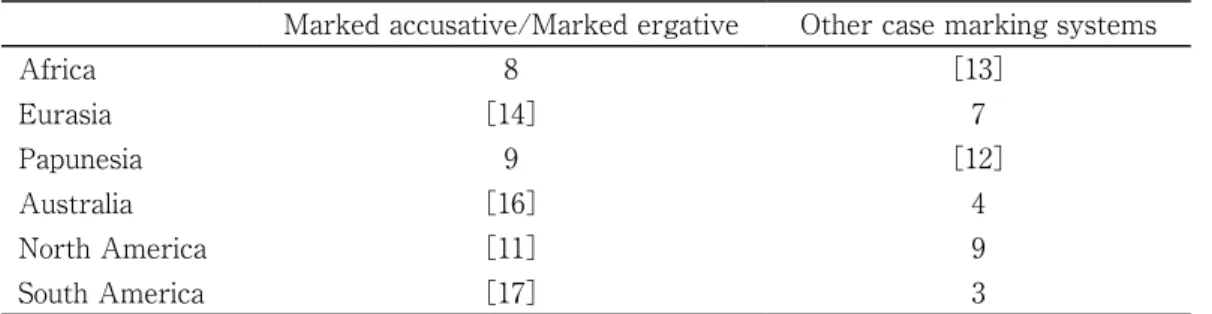
Table 4 shows the number of marked accusative/marked ergative languages compared to languages with other case marking systems, broken up by macro-area. The most frequent type
in each macro-area is enclosed in square brackets. As can be seen, languages with marked accusative/marked ergative systems are less frequent than languages with other case marking systems in the macro-areas of Africa and Papunesia.
Table 4 . Number of languages, broken up by macro-area
Marked accusative/Marked ergative Other case marking systems
Africa 8 [13] Eurasia [14] 7 Papunesia 9 [12] Australia [16] 4 North America [11] 9 South America [17] 3
Table 5 shows the number of families with marked accusative/marked ergative languages compared to families with other case marking systems. As can be seen, the families with marked accusative/marked ergative systems are not more frequent than families with other case marking systems in the macro-areas of Africa and Papunesia. Hence, marked accusative/ marked ergative languages are not more genealogically widespread than languages with other case marking systems in the macro-areas of Africa and Papunesia.
Table 5 . Number of families, broken up by macro-area
Marked accusative/Marked ergative Other case marking systems
Africa 8 [10] Eurasia [14] 7 Papunesia 7 7 Australia [11] 4 North America [10] 7 South America [16] 3
Some families have marked accusative/marked ergative languages and languages with other case marking systems. For example, within the Austronesian languages, Tongan in (7) has both the ergative and absolutive overtly marked, while Maori is a marked accusative language (Bauer 1993:261-263).
The languages in the sample that have split alignment are Paumarí, an Arawan language spoken in the state of Amazonas in Brazil, and Georgian. In Paumarí, the basic word order is SVO. When this basic pattern is used, the ergative is marked by the enclitic -a and the absolutive is unmarked (Chapmand and Derbyshire 1991:164). There are two other constituent orders that frequently occur in transitive clauses: OVS and SOV. In both, the accusative
is marked by the enclitic -ra and the nominative is unmarked. The nominative-accusative system is mutually exclusive with the ergative-absolutive system (Chapmand and Derbyshire 1991:165). In Georgian, the alignment may be nominative-accusative or ergative-absolutive, depending on the verb conjugation class in interaction with tense/aspect/mood properties. The nominative is marked by -i, the ergative by -ma, and the dative (which can also be used for core cases) by -s (Harris 1981:1-2). Georgian is classified in the present paper as not being a marked accusative/marked ergative language.
The only marked absolutive language in the sample is Nias, previously mentioned in (8). The marked nominative languages in the sample are attested in the macro-areas of Africa, Papunesia, North America, and Australia. The marked nominative languages in Africa are Berta, a language isolate spoken in Ethiopia (Andersen 1995:39), Kabyle, an Afro-Asiatic language from Algeria (König 2008a:180-184; Aikhenvald 1995:45), Murle, a Surmic language spoken in Sudan (Arensen 1982:48-49), Ngangela, an Atlantic-Congo language of Angola (Maniacky 2002:68), Harar Oromo, an Afro-Asiatic language from Ethiopia (Owens 1985:98, 100), and Turkana, a Nilotic language of Kenya (Dimmendaal 1982:259). The marked nominative languages in Papunesia are Kunimaipa, a Goilalan language spoken in Papua New Guinea (Geary 1977:74), Makalero, a Timor-Alor-Pantar language from East Timor (Huber 2011:389), Savosavo, a language isolate of the Solomon Islands (Wegener 2012:134, 136), Eipo, a Nuclear Trans New Guinea language spoken in the West Papua province in Indonesia (Heeschen 1998:168-169), Ma Manda (Pennington 2016:223, 225) and Waskia (Ross and Paol 1978:36-37), two Nuclear Trans New Guinea language from Papua New Guinea. The marked nominative languages in North America are Maidu, a Maiduan language from Northern California (Dixon 1911:711-712), Wappo, an Yuki-Wappo language of Northern California (Thompson et al. 2006:10), and Maricopa, previously mentioned in (5). The only marked nominative language in Australia is MalakMalak, a Northern Daly language (Birk 1976:112). Comrie (2013) classifies Aymara, an Aymaran language spoken in Peru, as a marked nominative language based on the fact that the accusative is formed by deleting the final vowel of the nominative. Coler (2014:204, 248) argues that all Aymaran languages have this morphosyntactic rule and indicates that the nominative is the unmarked form/bare nominal stem. Hence, Muylaq’ Aymara, the Aymaran language in the sample of the present investigation, is classified as a marked accusative language.
A possible explanation for the existence of marked nominative languages is the extension of A marking to S (Dixon 1979). Li et al. (1977:98) suggest that the Wappo nominative marker -i developed from an ergative marker. König (2008a:178) proposes a passive agent marker as a possible source for a marked nominative marker. She suggests that this is the case in the
Nilotic languages Maa and Dinka. König (2008a:179) also proposes that a marked nominative system can originate from a definiteness marker. She claims that this occurred in the Nilotic languages Anywa, Päri, and Jur-Luwo. Tosco (1994) suggests that, in the Cushitic branch of the Afro-Asiatic languages, the marked nominative systems developed from a topic marker. Tosco notes that subject marking in these languages only occurs with definite subjects, a feature the author associates with topicality. Handschuh (2014:238) claims that the languages of the Pacific area exhibit the marked nominative system only in certain discourse contexts, mostly associated with constituent focus. Handschuh suggests that the marked nominative markers originated from the discourse structure of these languages. For example, Ross and Paol (1978:36) point out that in Waskia the nominative marker ke is intimately related to topicalisation. In (12a), the answer to a question constitutes new information and is thus focalized by ke, while (12b) is a non-emphatic context where there is no nominative marking.
(12) Waskia (Ross and Paol 1978:37, 31)
a. Aweri ke bambam tagiram? - Gagi ke
who NOM fish caught Gagi NOM
‘Who caught the fish? - Gagi (did)’ b. Gagi kasili arigam
Gagi snake saw
‘Gagi saw the snake.’
The previous investigations mention some languages of Africa and Papunesia which are not included in my sample. However, the inclusion of these languages would not alter the results of Table 5, since the families of these languages are already represented in Table 5. For example, König (2008a:181) mentions several Afro-Asiatic marked nominative languages besides the aforesaid Kabyle. Handschuh (2014:225) indicates that Nabak, a Nuclear Trans New Guinea language spoken in Papua New Guinea, and Ajië, an Austronesian language from New Caledonia, are marked nominative languages. These two languages are not in the sample, but the sample already has Nuclear Trans New Guinea and Austronesian marked nominative/ absolutive languages.
The Case Hierarchy predicts that an element that is semantically more marked is also formally more marked (Mayerthaler 1981). This explains the fact that elements higher in the hierarchy are unmarked, while elements lower in the hierarchy are overtly marked. There is also the traditional explanation that the main function of overt case marking is to distinguish
syntactic functions and semantic roles (Comrie 1981:124; Siewierska 2004:56). Since the unmarked form is also the quotation/designation form of nouns, overt case marking can disambiguate syntactic functions and semantic roles more clearly than unmarked forms.
Another factor that must be taken into account is the specific histories of each family. For example, König (2008a:196-197) argues that it is plausible that Afro-Asiatic languages transmitted the marked nominative system to East and South Nilotic languages, and not the other way round. Some reasons mentioned by König are lexical and other kinds of borrowing, as well as the fact that Afro-Asiatic languages encode the marked nominative by much more diverse means (accent shift, suffix, tone, or some combination of these) than Nilotic languages. Handschuh (2014:238) suggests that the similarity of the marked nominative in the Cochimi-Yuman languages and the unrelated language Wappo could hypothetically be the traces of a prior, and supposedly larger, areal marked nominative pattern in North America.
5 .Conclusion
This investigation aimed at verifying, based on a sample of 123 languages, the frequently made claim that in nominative-accusative systems there is a tendency for the nominative to be unmarked, while in ergative-absolutive systems there is a tendency for the absolutive to be unmarked. The results have shown that the families with marked accusative/marked ergative systems are more frequent than the families with other case marking systems in the macro-areas of Eurasia, Australia, and North and South America. On the other hand, the families with marked accusative/marked ergative systems are not more frequent than the families with other case marking systems in the macro-areas of Africa and Papunesia. Therefore, the Case Hierarchy cannot be considered a universal principle that determines the distribution of unmarked case in nominative-accusative and ergative-absolutive systems. If there were a universal principle, we would expect it to be reflected independently in all six macro-areas.
The distribution of marked and unmarked case depends not only on the Case Hierarchy, but also on other factors. For example, Africa, Southwestern North America, and the Pacific Region show geographical/genealogical characteristics. Overt case markers might develop from other markers (e.g., topic markers, definiteness markers, and passive agent markers). Future research might shed more light on the functionally-based motivations and historical development of the tendencies presented in this work.
Abbreviations
AUX auxiliary ABS absolutive ACC accusative DEM demonstrative ERG ergative MUT mutated form NOM nominative PAST past PL plural POSS possessive RLS realis mood SG singular SPL split TRI tripartite
VAUG augment vowel on nouns Appendix
The following is a list of the 123 languages in the sample, organized by family (shown in parentheses) and macro-area. The classification of overt case marking is provided in square brackets after the language name: acc = marked accusative, erg = marked ergative, nom = marked nominative, abs = marked absolutive, nom/acc = both nominative and accusative are marked, erg/abs = both ergative and absolutive are marked. Paumarí and Georgian are not classified in this list (see details in Section 4).
AFRICA: Amharic [acc], Kabyle [nom], Kemantney [nom/acc], Harar Oromo [nom] (Afro-Asiatic); Berta [nom], Kunama [nom/acc] (isolates); Borna [nom/acc], Haro [nom/acc] (Ta-Ne-Omotic); Dime [acc] (South Omotic); Fur [acc] (Furan); Ik [nom/acc] (Kuliak); Kanuri [nom/acc] (Saharan); Khoekhoe [acc], Ts’ixa [nom/acc] (Khoe-Kwadi); Masalit [acc] (Maban); Murle [nom] (Surmic); Ngangela [nom] (Atlantic-Congo); Kunuz Nubian [acc] (Nubian); Shilluk [erg], Turkana [nom] (Nilotic); Tima [erg] (Katla-Tima).
EURASIA: Basque [erg], Kusunda [acc], Burushaski [erg], Nihali [acc], Sumerian [erg] (isolates); Burmese [nom/acc] (Sino-Tibetan); Chukchi [erg/abs] (Chukotko-Kamchatkan); Korku [acc] (Autroasiatic); Evenki [acc] (Tungusic); Georgian (Kartvelian); Modern Hebrew [acc] (Afro-Asiatic); Hungarian [acc] (Uralic); Japanese [nom/acc] (Japonic); Kabardian [erg/abs] (Abkhaz-Adyge); Kannada [acc] (Dravidian); Korean [nom/acc] (Koreanic); Lezgian [erg] (Nakh-Daghestania); Mongolian [acc] (Mongolic-Khitan); Russian [acc] (Indo-European); Turkish [acc] (Turkic); Kolyma Yukaghir [nom/acc] (Yukaghir).
PAPUNESIA: Amanab [acc] (Border); Cebuano [erg/abs], Tongan [erg/abs], Maori [acc], Nias [abs] (Austronesian); Duna [erg], Kaki Ae [erg], Savosavo [nom] (isolates); Aghu [nom/acc], Western Dani [erg], Eipo [nom], Hua [erg], Ku Waru [erg], Ma Manda [nom], Waskia [nom] (Nuclear Trans New Guinea); Edolo [erg] (Bosavi); Great Andamanese [erg/abs] (Great Andamanese); Iatmul [acc] (Ndu);
Komnzo [erg/abs] (Morehead-Wasur); Kunimaipa [nom] (Goilalan); Makalero [nom] (Timor-Alor-Pantar). AUSTRALIA: Bachamal [erg], Wagiman [erg] (isolates); Bunuba [erg] (Bunaban); Enindhilyakwa [acc]
(Gunwinyguan); Garrwa [erg] (Garrwan); Kamu [erg] (Eastern Daly); Kayardild [nom/acc] (Tangkic); MalakMalak [nom] (Northern Daly); Mangarayi [nom/acc] (Mangarrayi-Maran); Marrithiyel [erg] (Western Daly); Murinypata [erg] (Southern Daly); Ngarla [erg], Wangkajunga [erg], Yuwaalaraay [erg], Wirangu [erg], Yidiɲ [erg] (Pama-Nyungan); Nyigina [erg], Nyulnyul [erg] (Nyunyulan); Wambaya [erg] (Mirndi); Wardaman [erg/abs] (Yangmanic).
NORTH AMERICA: Alsea [erg], Karok [erg], Natchez [erg/abs] (isolates); Chemehuevi [acc], Yaqui [acc] (Uto-Aztecan); Choctaw [nom/acc], Koasati [nom/acc] (Muskogean); Coos [erg] (Coosan); Maidu [nom] (Maiduan); Maricopa [nom] (Cochimi-Yuman); Miskito [acc] (Misumalpan); Mutsun [acc]
(Miwok-Costanoan); Pech [nom/acc] (Chibchan); Southern Pomo [nom/acc], Southeastern Pomo [nom/acc] (Pomoan); Tlingit [erg] (Athabaskan-Eyak-Tlingit); Tol [acc] (Jicaquean); Coast Tsimshian [erg/abs] (Tsimshian); Wappo [nom] (Yuki-Wappo); Central Alaskan Yupik [erg] (Eskimo-Aleut).
SOUTH AMERICA: Aguaruna [acc] (Chicham); Awa Pit [acc] (Barbacoan); Muylaq’ Aymara [acc] (Aymaran); Bora [acc] (Boran); Cavineña [erg], Shipibo-Konibo [erg] (Pano-Tacanan); Epena Pedee [erg] (Chocoan); Hup [acc] (Nadahup); Ika [erg] (Chibchan); Kwaza [acc], Nasa Yuwe [acc], Puinave [erg], Trumai [erg] (isolates); Paumarí (Arawan); Imbabura Quechua [acc] (Quechuan); Sabanê [erg/abs] (Nambiquaran); Sanuma [erg] (Yanomamic); Ecuadorian Siona [nom/acc] (Tucanoan); Tariana [nom/
acc] (Arawakan); Urubu-Kaapor [acc] (Tupian).
References
Aikhenvald, Alexandra Y. 1995. Split ergativity in Berber languages. St. Petersburg Journal of African Studies
4:39–68.
Andersen, Torben. 1995. Absolutive and nominative in Berta. In Nicolai, Robert and Rottland, Franz (eds.),
Proceedings of the 5th Nilo-Saharan Linguistics Colloquium. Cologne: Rüdiger Köppe, 39–69. Arensen, Jonathan. Murle Grammar. 1982. Summer Institute of Linguistics and University of Juba. Bauer, Winifred. 1993. Maori (Descriptive Grammars Series). London and New York: Routledge.
Bickel, Balthasar. 2008. A refined sampling procedure for genealogical control. Language Typology and Universals 61:221-233.
Bickel, Balthasar and Nichols, Johanna. 2009. Case marking and alignment. In Malchukov, Andrej and Spencer, Andrew (eds.), The Oxford Handbook of Case. Oxford: Oxford University Press.
Birk, D. B. W. 1976. The MalakMalak language, Daly River (Western Arnhem Land). (Pacific Linguistics: Series B, 45.) Canberra: Research School of Pacific and Asian Studies, Australian National University.
Brown, Lea. 2001. A grammar of Nias Selatan. Ph.D. dissertation, University of Sydney. Chang, Suk-Jin. 1996. Korean. Amsterdam: John Benjamins.
Chapman, Shirley and Derbyshire, Desmond C. 1991. Paumarí. In Derbyshire, Desmond C. and Pullum, Geoffrey K (eds.), Handbook of Amazonian Languages, vol. 3. Berlin: Mouton de Gruyter, 161-352.
Churchward, Maxwell C. 1953. Tongan Grammar. Nuku‘alofa: Vava'u Press.
Coler, Matt. 2014. A Grammar of Muylaq’ Aymara: Aymara as Spoken in Southern Peru. Leiden: Brill.
Phenomenology of Language. Austin: University of Texas Press, 329-394.
Comrie, Bernard. 1981. Language Universals and Linguistic Typology. Chicago: University of Chicago Press. Comrie, Bernard. 2013. Alignment of case marking of full noun phrases.In Dryer, Matthew S. and Haspelmath,
Martin (eds.) The World Atlas of Language Structures Online. Leipzig: Max Planck Institute for Evolutionary Anthropology. (Available online at http://wals.info/chapter/98, Accessed on 2020-09-27.) Creissels, Dennis. 2009. Uncommon patterns of core term marking and case terminology. Lingua 119.3: 445-459. Croft, William. 2001. Radical Construction Grammar: Syntactic Theory in Typological Perspective. Oxford: Oxford
University Press.
Croft, William. 2003. Typology and Universals. Cambridge: Cambridge University Press. Dimmendaal, Gerrit Jan. 1982. The Turkana language. Ph.D. dissertation, Rijksuniversiteit Leiden.
Dixon, Roland B. 1911. Maidu. In Boas, Franz (ed.), Handbook of American Indian Languages, Volume 1, 679-734. Washington: Government Printing Office.
Dixon, R. M. W. 1972. The Dyirbal Language of North Queensland. Cambridge: Cambridge University Press. Dixon, R. M. W. 1979. Ergativity. Language 55.1:59–138.
Dixon, R. M. W. 1994. Ergativity. Cambridge: Cambridge University Press.
Dryer, Matthew S. 1989. Large linguistic areas and language sampling. Studies in Language 13.2: 257-292. Dryer, Matthew S. 1992. The greenbergian word order correlations. Language 68.1:81-138.
Dryer, Matthew S. 2003. Significant and non-significant implicational universals. Linguistic Typology 7.1:108-128. Falk, Yehuda. 1999. Unmarked case. Ms, Hebrew University of Jerusalem.
Geary, Elaine. 1977. Kunimaipa Grammar: Morphophonemics to Discourse. (Workpapers in Papua New Guinea Languages, 23.) Ukarumpa: Summer Institute of Linguistics.
Gordon, Lynn. 1986. Maricopa Morphology and Syntax. (University of California Publications in Linguistics, 108.) Berkeley, California: University of California Press.
Hammarström, Harald and Donohue, Mark. 2014. Some principles on the use of macro-areas in typological comparison. Language Dynamics and Change 4.1: 167-187.
Hammarström, Harald, Forkel, Robert, Haspelmath, Martin and Bank, Sebastian. 2020. Glottolog 4.2.1. Jena: Max Planck Institute for the Science of Human History. (Available online at http://glottolog.org, Accessed on 2020-09-17.)
Handschuh, Corinna. 2014. A Typology of Marked-S Languages. Berlin: Language Science Press.
Harris, Alice. 1981. Georgian Syntax: A Study in Relational Grammar. Cambridge: Cambridge University Press. Heeschen, Volker. 1998. An Ethnographic Grammar of the Eipo Language. (Mensch, Kultur und Umwelt im
Zentralen Bergland von West-Neuguinea, 23.) Berlin: Dietrich Reimer.
Hualde, José Ignacio, and Urbina, Jon Ortiz de (eds.) 2003. A Grammar of Basque. Berlin: Mouton de Gruyter. Huber, Juliette. 2011. A grammar of Makalero: a Papuan language of East Timor. Ph.D. dissertation, Vrije
Universiteit Amsterdam.
Jansen, Joana Worth. 2010. A grammar of Yakima Ichishkíin/Sahaptin. Ph.D. dissertation, University of Oregon. König, Christa. 2006. Marked nominative in Africa. Studies in Language 30:655-732.
König, Christa. 2008a. Case in Africa. Oxford: Oxford University Press.
König, Christa. 2008b. The marked-nominative languages of Eastern Africa. In Heine, Bernd and Nurse, Derek.
A Linguistic Geography of Africa. Cambridge: Cambridge University Press, 251-71.
König, Christa. 2009. Marked nominatives. In Malchukov, Andrej and Spencer, Andrew (eds.), The Oxford Handbook of Case. Oxford: Oxford University Press, 535-548.
Kornfilt, Jaklin. 1997. Turkish. London: Routledge.
Li, Charles N., Thompson, Sandra A., and Sawyer, Jesse O. 1977. Subject and word order in Wappo. International Journal of American Linguistics 43:85–100.
Maniacky, Jacky. 2002. Tonologie du ngangela: variété de Menongue (Angola). Ph.D. dissertation, L’Inalco University.
Mayerthaler, Willi. 1981. Morphologische Natürlichkeit. Wiesbaden: Athenaion.
Nagaraja, K. S. 1999. Korku Language: Grammar, Texts and Vocabulary. Tokyo: Institute for the Study of Languages and Cultures of Asia and Africa, Tokyo University of Foreign Studies.
Owens, Jonathan. 1985. A Grammar of Harar Oromo (Northeastern Ethiopia). (Kuschitische Sprachstudien 4, 4.) Hamburg: Helmut Buske.
Pennington, Ryan. 2016. Ma Manda: A Papuan language of Morobe Province, Papua New Guinea. Ph.D. dissertation, James Cook University.
Primus, Beatrice. 2011. Case-marking typology. In Song, Jae Jung (ed.), The Oxford Handbook of Linguistic Typology. Oxford: Oxford University Press, 303-321.
Ross, Malcolm and Paol, John Natu. 1978. A Waskia Grammar Sketch and Vocabulary. (Pacific Linguistics: Series B, 56.) Canberra: Research School of Pacific and Asian Studies, Australian National University.
Siewierska, Anna. 1997. The formal realization of case and agreement marking: a functional perspective. In Vandenbergen, Anne-Marie, Davidse, Simon and Noël, Dirk (eds.), Reconnecting Language: Morphology and Syntax in Functional Perspectives. Amsterdam: John Benjamins, 181-210.
Siewierska, Anna. 2004. Person. Cambridge: Cambridge University Press.
Thompson, Sandra A., Park, Sung-Yul, Joseph, and Li, Charles N. 2006. A Reference Grammar of Wappo.
(University of California Publications in Linguistics, 138.) Berkeley and Los Angeles: University of California Press
Tosco, Mauro. 1994. On case marking in the Ethiopian language area (with special reference to subject marking in East Cushitic). In Brugnatelli, Vermondo (ed.), Sem, Cam, Iafet Atti della 7 a Giornata di Studi Camito-Semitica e Indeuropei. Milano: Centro studi camito-semitici, 225–244.
Wegener, Claudia. 2012. A Grammar of Savosavo. Berlin: Mouton de Gruyter.
Westerlund, Torbjörn. 2015. A Grammatical Sketch of Ngarla (Ngayarta, Pama-Nyungan). Canberra: Asia-Pacific Linguistics.
注
1 The labels S, A, and P were introduced by Dixon (1972) and Comrie (1978).
2 Papunesia encompasses insular Southeast Asia and all islands between Sumatra and the Americas, excluding Japan, islands to the north of Japan, and islands off Australia.
3 North America includes Central America and Greenland.