Hisano et al. 1
Virus Research
A neo-virus-lifestyle exhibited by a (+)ssRNA virus hosted in an unrelated dsRNA
virus: taxonomic and evolutionary considerations.
Sakae Hisanoa, Rui Zhanga,b, Md. Iqbal Faruka, c, Hideki Kondoa, and Nobuhiro Suzukia, *
a Institute of Plant Science and Resources (IPSR), Okayama University, Chuou 2-20-1, Kurashiki
Okayama 710-0046, JAPAN
*
Correspondence may be sent to N. Suzuki ([email protected]) Dr. Nobuhiro SUZUKIInstitute of Plant Science and Resources (IPSR) Okayama University
Chuou 2-20-1, Kurashiki Okayama 710-0046, JAPAN Email: [email protected]
URL: http://www.rib.okayama-u.ac.jp/pmi/index.html
Present address: bState Key Laboratory of Plant Cell and Chromosome Engineering, Institute of
Genetics and Developmental Biology, Chinese Academy of Sciences, West Beichen Road 1, Chaoyang District Beijing 100101, China; cPlant Pathology Division, Bangladesh Agricultural
Research Institute, Joydebpur, Gazipur-1701, Bangladesh
Email Addresses: Sakae Hisano <[email protected]>; Rui Zhang <[email protected]>; Md. Iqbal Faruk <[email protected]>; Hideki Kondo <[email protected]>
Abstract
The past few decades showed that fungi as virus hosts provide unique platform for hunting viruses and exploring virus/virus and virus/host interactions. Such studies revealed a number of as-yet-unreported viruses and virus/virus interactions. Among them is a unique intimate relationship between a (+)ssRNA virus, Yado-kari virus (YkV1) and an unrelated double-stranded RNA virus, Yado-nushi virus (YnV1). YkV1 dsRNA, a replicated form of YkV1, and RNA dependent RNA polymerase (RdRp), are trans-encapsidated by the capsid protein of YnV1. While YnV1 can complete its replication cycle, YkV1 relies on YnV1 for its viability. We previously proposed a model in which YkV1 diverts YnV1 capsids as the replication sites. YkV1 is neither satellite virus nor satellite RNA, because YkV1 appears to encode functional RdRp and enhance YnV1 accumulation. This represents a unique mutualistic virus/virus interplay and possible similar relations in other virus/host systems are detectable. This article overviews what is known and unknown about the YkV1/YnV1 interactions. We propose the family Yadokariviridae that accommodates YkV1 and recently discovered viruses to related YkV1. Also discussed are the YnV1 Phytoreo_S7 and YkV1 2A-like domains that may have captured via horizontal transfer during the course of evolution and are conserved across extant diverse RNA viruses. Lastly, evolutionary scenarios are envisioned for YkV1 and YnV1.
Keywords:
Yado-nushi virus, yado-karivirus, mutualism, fungal virus, mycovirus, dsRNA, evolution
1. Introduction
Next generation sequencing approaches with environmental materials and/or purely isolated or cultured materials revolutionalised many areas of virology in the past few decades. They revealed the great diversity of viruses and provided interesting evolutionary insights (Marzano and Domier, 2016; Marzano et al., 2016; Shi et al., 2016). Such research led to discoveries of many as-yet-unseen interesting viruses across eukaryotes, particularly from lower eukaryotes. Some of them challenge the “virus rules or concept.” For examples giant DNA viruses represented by mimiviruses and pandraviruses are greater in particle size and genome size than some bacteria (Abergel et al., 2015; Colson et al., 2013), while fungal (+)ssRNA viruses such as narnaviruses, and hypoviruses are capsidless (Hillman and Suzuki, 2004; Wickner et al., 2013). Capsidless viruses are likely more prevailing in fungi, plants and insect than previously thought (Fukuhara, 2015; Roossinck et al., 2011; Sabanadzovic et al., 2009; Spear et al., 2010). These capsidless
viruses are hypothesized to have originated from fully-fledged capsid-encoding RNA viruses (Koonin and Dolja, 2014).
Virus hunting has been extensively carried out in several culturable fungi such as the chestnut blight fungus (Cryphonectria parasitica) (Liu et al., 2007; Peever et al., 1998), rapeseed rot fungus (Sclerotinia sclerotiorum) (Xie and Jiang, 2014), white root rot fungus (Rosellinia necatrix) (Kondo et al., 2013), and Heterobasidion spp. some of which are conifer pathogens (Vainio and Hantula, 2016). Similar projects have been expanded to other pathogenic filamentous fungi that include Fusarium spp. and Aspergillus spp. (Hillman et al., 2017). Some of these studies revealed very unusual viruses that challenge “virus rules” with respect to virus replication cycles and/or virus morphology, different aspects from the one aforementioned. For example, Aspergillus fumigatus tetramycovirus-1 (AfuTmV1) with a 4-segmented dsRNA genome (Kanhayuwa et al., 2015) does not form typical virus particles, rather is associated with one of the virally encoded proteins (colloidal form) as an infectious entity. Another dsRNA virus, Colletotrichum camelliae filamentous virus 1 (CcFV1) (Xu et al.), which is closely related to AfuTmV1 though different in genome segment number: 8 vs. 4, appears to form filamentous particles. There are no other reported examples of dsRNA viruses able to form filamentous particles. The discrepancy in virus morphology needs to be examined further. However, the two viruses commonly can be transfected into their host protoplasts in the form of purified dsRNA.
Rosellinia necatrix is an important pathogen destructive to many crops particularly perennial fruit trees (Kondo et al., 2013; Pliego et al., 2012). This fungus also provides a system for studying virus/host and virus/virus interactions. A virus hunting project has been carried out on this fungus since late 1990’s by a Japanese group led by Dr. Naoyuki Matsumoto (Arakawa et al., 2002; Ikeda et al., 2004; Matsumoto, 1998). This consequently revealed approximately 20% virus incidence rate in field isolates. A large number of new viruses which were later classified into new virus families such as Megabirnaviridae and Quadriviridae (Chiba et al., 2009)(Lin et al., 2012) (dsRNA viruses) were discovered. Among these, Yado-nushi virus 1 (YnV1, a toti-like dsRNA virus) and Yado-kari virus 1 (YkV1, a calici-like ssRNA virus) were isolated from a single R. necatrix hypovirulent field strain W1032 (Yaegashi et al., 2013). The two viruses show unique mutualistic interactions in which YkV1 highjacks the capsid of YnV1 for tans-encapsidation of YkV1 RNA and RNA-dependent RNA polymerase (RdRp) (Zhang et al., 2016). Both viruses are phylogenetically placed into an expanded picorna-like supergroup
accommodating (+)ssRNA viruses such as members of the order Picornavirales and dsRNA viruses including totiviruses and many unclassified fungal viruses (Koonin et al., 2015). Here in this article we focus on these rules-breaking viruses and their interactions, and discuss what are known and unknown about this system. Also discussed is the taxonomy and evolutionary scenarios of YkV1 and YnV1. Readers are referred to other more general review articles on fungal host/virus, and fungal virus/virus interactions (Ghabrial et al., 2015; Hillman et al., 2017).
2. Inter-and intra-strain sequence variability of coinfecting YnV1 strains and implication of RNA polymerase slippage for dsRNA viruses.
As stated in our previous paper about YkV1 and YnV1 (Zhang et al., 2016), multiple, at least three variantes and one defective virus (YnV1D) lacking the RdRp domain, coinfected
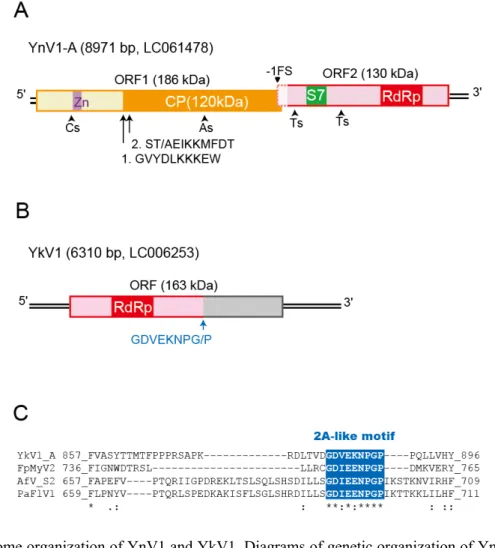
W1032. Although YkV1 is invariant in genome sequence, YnV1 shows inter- and intra-strain sequence variability. We first isolated the three strains from transfectants with W1032 virions and were designated as YnV1-A, B, and C. While the entire sequence of YnV1-A was reported earlier (Zhang et al., 2016) (Fig. 1), the complete sequences of the other two variantes, B (8951 bp) and C (8952 bp), deposited in DDBJ with accession numbers LC006254 and LC006256, respectively, are described here. Their sequences were obtained by sequencing RT-PCR clones obtained with strain-specific primers, the sequences of which are available upon request. Pairwise comparison showed approximately 8 to 10% amino acid sequence divergence in the ORF1-encoded protein (CP) among the three YnV1 strains, while that for ORF2-encoded protein (RdRp) is 6 to 7% (Fig, S1A). Notable interesting nucleotide sequence heterogeneity was observed at the 5’-terminal portion (500–1000 nt, see Fig. S1B) and several other map positions (75, 899, 3523, 5476 and 6380 nt on strain A) (Fig. 1A). For example, different numbers of A residues were commonly detected at position 3526 (on strain A) in strains A and C in RT-PCR clones; the ratio of (A)7: (A)8: (A)9 stretches were 1:3:1, while (A)7: (A)8 were 2:4. Similar sequence heterogeneity resulting in frame-shifting was detected at the C and U stretches at positions 899, 5476 and 6380 (on strain A) (Fig. 1A and data not shown). Uninterrupted ORFs shown in Fig. 1A can be detected only when genome sequences are assembled at the homopolymeric stretches with those exhibited by major RT-PCR clones. Recently, RdRps of members of the expanded picorna-like superfamily (plant potyviruses) were shown to slip during polymerization at a specific sequence motif GA6,
resulting in production of nascent RNA with an additional A there at an approximately 2% of the whole transcripts (Olspert et al., 2015; Rodamilans et al., 2015; Untiveros et al., 2016). We failed to detect GA6 motif at the variable sites in YnV1. However, some of the regions such as that at
position ??? conform to the motifs that are believed to enhance polymerase slippage in ebolaviruses (A7) and paramyxoviruses (A2-6G3-6) (Atkins et al. 2016). Also strain-specific
nucleotide substitutions were found (Table S?). Therefore the three YnV1 strains co-infect the W1032 fungal strain and each may exist as a mutant cloud (quasispeies) or a mixed population of genomes (Domingo et al., 2012).
2. Molecular signatures, Phytoreo_S7 and 2A-like domains, on YnV1 and YkV1.
YnV1 ORF1 encodes a zinc-finger like motif, while YnV1 ORF2 a Phytoreo_S7 (pfam07236) and an RdRp domain (Fig. 1A). The N terminus of YnV1 CP was mapped to positions 580–589 aa (GVYDLKKKEW), 632–641 aa (S[T/A]EIKKMFDT) that are 42 amino acids apart. The threonine and alanine at position 581 were considered to be from YnV1 strain A, and strains B and C, respectively. There may be self-cleavage activity residing at the N-terminal portion of ORF1. Alternatively, host fungus-derived protease may be involved in YnV1 CP processing.
The Phytoreo_S7 domain detectable at the N terminal portion is conserved across different virus families such as Reoviridae, Chrysoviridae (dsRNA viruses), and Endornaviridae ((+)ssRNA viruses), which was hypothesized to have been horizontally transferred among fungal and plant viruses during the course of evolution (Koonin and Dolja, 2012; Liu et al., 2012). Note that the domain is sporadically found in only some members of the families. In fungal viruses, this domain-coding sequence is often found in the RdRp-encoding segments (Liu et al., 2012) (Fig. 2A). Interestingly, the Phytoreo_S7 domain resides upstream of the RdRp in YnV1 as in the case for chrysoviruses and Phlebiopsis gigantea large virus 1 (PgLV1), while it is found downstream of RdRp in unclassified fungal dsRNA viruses such as Fusarium graminearum dsRNA mycovirus 3 (Cho et al., 2013), Sclerotinia sclerotiorum nonsegmented virus L (SsNsV-L) (Liu et al., 2012). Little is known about the functional role of the Phytoreo_S7 domain. It was previously shown by ultra-violet cross linking and elctrophretic mobility shift assay showed a minor inner core protein, P7, of a phytoreovirus (rice dwarf reovirus), to be able to bind dsRNA (Suzuki, 1995; Suzuki, 1997). This RNA binding ability possibly is associated with RNA synthesis occurring in inner core particles. However, whether its binding capability is associated with the Phytoreo_S7 domain remains to be elucidated. The three motifs, zinc finger, RdRp and Phytoreo_S7, identified previously on YnV1 A, are conserved in the other two viral strains mentioned above.
YkV1 possibly encodes a single polyportein carrying a 2A-like domain in addition to an RdRp, hall mark of RNA viruses (Fig. 1B). The 2A self-processing peptide (a conserved C-terminal motif, DxExNPG P-, where ’x’=any amino acid) was first identified in foot-and-mouse disease virus (FMDV, GDVESNPGP) and other many picornaviruses (family Picornaviridae, order Picornavirales) (Palmenberg et al., 1992; Ryan et al., 1991) (Fig. 2B), which separates structural and replication-associated proteins, and later also found in relatively diverse animal dsRNA viruses such as a toti-like virus (Penaeid shrimp infectious myonecrosis virus) and reoviruses (rota- and cypoviruses) (Donnelly et al., 2001; Nibert, 2007) and retrotransposons as well (Heras et al., 2006). The 2A-like sequence motif was first noted for fungal dsRNA viruses and (+)ssRNA viruses such as hypoviruses and YkV1 by Petrzik et al. (Petrzik et al., 2016). We further demonstrated the presence of this motif in fungal (+)ssRNA viruses related YkV1 (see below). The nona-amino acid
GDVEKNPGP (881–889 aa) is
found in YkV1 and a tetravirus (Providence virus, 2A3), while GDIEENPGP is
conserved in three YkV1-like and a dicistrovirus (Israel acute paralysis virus)
(Fig. 1C).
The conservation of this motif in diverse viruses may support its horizontal structures and modular structures of virus genomes (Koonin and Dolja, 2012). However, it should be noted that most viruses with the 2A-like motif, whether dsRNA or (+)ssRNA viruses, are members of the expanded picorna-like super-family. The 2A- or 2A-like peptide is considered to be involved in “ribosome skip” at the G (Gly) residue resulting from the failure of the G–P (Gly–Pro) peptide bond formation (Roulston et al., 2016) This “ribosome skip” raises a possibility of three translational products of 1) upstream of and including the 2A-like sequence, 2) downstream of the 2A-like sequence, and 3) the entire “full-length” protein in which the Gly–Pro peptide bond is formed, depending on the efficiency of “ribosome skip.” Whether the 2A-like motif including the one of YkV1 is functional in fugal cells remain to be determined.
3. Intimate interplay between coinfecting viruses: Yado-nushi and Yado-kari viruses.
Based upon combined immunological and molecular techniques, we demonstrated heteroencapsidation of YkV1 dsRNA and RdRp by the CP of YnV1-A (Zhang et al., 2016). We proposed a model for their intimate relation in which YkV1 highjacks the YnV1 capsids as its replication sites, while YnV1, as an independent virus, completes its replication cycle like other encapsidated dsRNA viruses. According to this model, YkV1 behaves or replicates as if it were a dsRNA virus with respect to the encasement of RdRp into and RNA synthesis within particles. The dependence of YkV1 on YnV1 was clearly proved by using an infectious cDNA clone of
YkV1 and virion transfection assay. That is, transfection of virus-free standard strain, W97, of R. necatrix resulted in four different types of dsRNA detection patterns: YkV1; YnV1 + YnV1D;
YnV1 + YkV1; and YnV1 + YnV1D + YkV1. Importantly, no single infection of W97 by YkV1
was observed. Furthermore, the YkV1 cDNA can launch autonomous YkV1 replication only in the presence of YnV1 that was provided via horizontal transfer as a result of hyphal anastomosis or pre-existed in spheroplasts used for transformation. It is of interest to note that the other two YnV1 strains B and C are also able to help YkV1 (Fig. 1). However, validation of the model must await addressing key questions such as 1) whether YkV1 uses its own RdRp, 2) whether purified heterocapsids is competent of YkV1 RNA synthesis, and 3) transgenic supply of YnV1 CP can support YkV1 replication.
The interplay between the two viruses is mutualistic rather than commensal. YnV1 also benefits from YkV1. As reported by Zhang et al. (2106), coinfection of the W97 strain by YnV1 and YkV1 resulted in enhancement of YnV1 accumulation compared to YnV1 single infection. Although how YkV1 enhances YnV1 accumulation is an open, interesting question, there are some possible explanations. YkV1 may suppress antiviral RNA silencing working at the cellular level (Nuss, 2011). It is also possible that YkV1-derived siRNAs compete YnV1-derived siRNAs over loading into the Argonaute (AGO) effector proteins.
There are several commensal or mutualistic interactions in plant viruses. Rice tungro bacilliform virus (RTBV, a dsDNA badnavirus, a plant-infecting pararetrovirus) and rice tungro spherical virus (RTSV, a (+)ssRNA secovirus, order Picornavirales) in combination, cause a serious rice tungro disease in South and Southeast Asia. RTBV is largely responsible for induction of the disease symptoms, while its transmission in a semi-persistent manner by leafhopper depend on RTSV (Hibino, 1996). RTSV alone can be transmitted by leafhoppers independently. A similar mutualisitic interplays are found between umbraviruses and luteoviruses, both of which have (+)ssRNA genomes, as discussed below.
4. Are there any other combinations showing similar mutualistic interplays?
A blast search with the YkV1 RdRp sequences returned with RdRps from several (+)ssRNA viruses. Table S2 lists four viruses infecting filamentous fungi: Rhizoctonia solani mycovirus 1 (RsMV1) (Bartholomaus et al., 2016), Penicillium aurantiogriseum foetidus-like virus 1 (PaFlV1) (Nerva et al., 2016), Aspergillus foetidus slow virus S2 (AfV-S2) (Kozlakidis et al., 2013b). Fusarium poae mycovirus 2 (FpMyV2) (Osaki et al., 2016). All of theses viruses possess single ORFs encoding the RdRP and 2A-like motifs at the relatively similar positions: RdRp at the
central region and 2A-like at the C-proximal portion (Fig. 1C and S2B). It is of great interest to note that these viruses were reported to co-infect with toti- or toti-like viruses with a two-ORF genome arrangement (see Table 1), suggesting that there is a relationship between the (+)ssRNA and dsRNA viruses which is similar to the YkV1 and YnV1 relation. For example, a strain of Aspergillus foetidus was reported to be coinfected by three viruses: Aspergillus foetidus virus (AfV) F (unclassified quadripartite virus) (Kozlakidis et al., 2013c), S1 (victorivirus, family Totivirdae) (Kozlakidis et al., 2013a) and S2 (yado-kari-like virus) (Kozlakidis et al., 2013b). A non-coding satellite RNA is associated with AfV-S2, which shares the terminal sequences with the helper virus. Defective RNAs of YkV1 also appear during maintenance of YkV1-infected cultures (R. Zhang and N. Suzuki, unpublished results). AfV-S2 encoded protein shows overall 45% amino acid sequence identity to YkV1 RdRp (Table S2).
Table 1 shows presumable partnership between YkV1-related viruses and YnV1 equivalents in the respective host strains and their genome size variation. Because of the unavailability of full-genome sequences of RsMV1 and 3, these viruses were excluded from a comparative analysis below. If the partnership really exists, there appear to be a rule between the two viruses. First, YkV1-like viruses (AfV-S2, PaFlV1 and FpMyV2) are always smaller in genome size than their partner candidates (AfV-S1, PaTV1 and FpVV1). Second, the ratio of the genome sizes of YkV1-like to those of the YnV1-like partners appears to be constant, not so variable. The ratios varied only slightly from 1.43 for the YnV1/YkV1 to 1.21 for FpVV1/FpMyV1. In other words, their sizes of the two associated viruses are proportional. Given that the reported sequences of FpVV1/FpMyV2 are not complete, its actual ratio may be much closer to 1.42. This observation may be related to the capacity of the CP interior of YnV1-like partner candidates, which primarily determined by the CP size. Overall, YkV1-related fungal viruses appear to have a similar lifestyle to YkV1 whose viability depends on partner dsRNA viruses. Importantly, the corresponding partner viruses are not necessarily closely related to YnV1 (Fig. 2A), although they have similar genome arrangements with two ORFs. Also the anticipated partnerships have yet to be substantiated.
5. Taxonomic proposal
Fungal viruses are now classified into at least 16 families, six of which are families that accommodate (+)ssRNA viruses: Barnaviridae, Alphaflexiviridae, Gammaflexiviridae, Narnaviridae, Hypoviridae and Endornaviridae. However, there are unclassified (+)ssRNA
viruses like Rosellinia necatrix fusarivirus 1 (Zhang et al., 2014), Fusarium graminearum virus 1 (Kwon et al., 2007), Sclerophthora macrospora virus A and B (Yokoi et al., 1999; Yokoi et al., 2003). Some fungal (+)ssRNA viruses show phylogenetic affinity to plant and/or animal viruses, for example, flexiviruses (Howitt et al., 2006; Howitt et al., 2001; Xie et al., 2006), tombus-like viruses (Ai et al., 2016; Preisig et al., 2000), and rubi-like virus (Liu et al., 2009), while others constitute their own families or groups (Marzano et al., 2015; Zhang et al., 2014). However, YkV1 does not cluster together with these fungal (+)ssRNA viruses. Rather, YkV1 is related, though distantly, to caliciviruses such as noro- and sapoviruses (family Caliciviridae), and more closely related to the aforementioned four fungal viruses, PaFlV1, FpMyV2, and AfV-S2. PaFlV1, YkV1, and AfV-S2 appear to be phylogenetically more closely related to one another than FpMyV2 is related to each of them (Fig. 2B). This can be seen in the amino acid sequence identity detected in homologous regions of the ORF-encoded protein. We propose that these viruses belong to a new virus family designated as “Yadokariviridae” that accommodates the four related viruses.
The taxonomy of Yado-nushi virus and related viruses is not well-established, because of their taxonomically and phylogenetically complex nature. The family Totivirdae consists five genera; Totivirus, Victorivirus, Leishmavirus, Giardiavirus, and Tricomonasvirus. The family accommodates phylogenetically diverse members infecting fungi and protozoa, while most of them have undivided dsRNA genomes with two ORFs, except for Ustilago maydis virus H1 (UmV-H1) that encodes a single large polyprotein (CP-RdRp fusion). UmV-H1 is currently classified into the genus Totivirus, however its RdRp shows closer phylogenetic affinity to insect dsRNA viruses, Circulifer tenellus virus 1 (CiTV1) and Spissistilus festinus virus 1, and fungal bi-segmented botybirnaviruses (floating genus Botybirnavirus) than to other totiviruses (Fig. 2A). In addition, there are many viruses with similar genome organization, i.e., undivided genome with two ORFs, and often termed “toti-like.” Jiang and co-workers classified these viruses into the CiTV1-like, SsNsV-L-like, AaRV-like and PgV1-like groups (Liu et al., 2012). Yado-nushi-like viruses form a group distinct from these. No genome sequences of viruses belonging to the Yado-nushi-like group have been reported except the one from a phytopathogenic basidiomycete, Sclerotium rolfsii (DDBJ/GenBank/EMBL accession no: ????). Taxonomical reorganization of totiviruses and “toti-like” virurses is definitely necessary.
The YkV1/YnV1 is reminiscent of other subviral or viral molecular entities listed in Table 2 show similar helper/dependent relations. However, these listed cases are distinct from the interplay between a (+)ssRNA virus, YkV1 and a dsRNA virus, YnV1. Satellite viruses usually encode capsid protein that encase their own RNAs. Subviral molecules, i.e., satellite RNAs and defective RNAs, are associated with helper or parental viruses. While satellite RNAs generally show little sequence similarity to their helper virus genomic RNAs, defective RNAs usually do show it and could occasionally encode proteins (Simon et al., 2004). Unlike YkV1, all of these molecules do not encode their replicase. For example, there is a relationship similar between a reverse transcribing dsDNA pararetrovirus, hepatitis B virus (HBV, hepadnavirus), and a satellite virus with a circular (-)ssRNA genome, hepatitis D virus (HDV, deltavirus) well-known for its ribozyme and pathogenicity (Taylor, 2006). HDV relies on HBV for its virion assembly, cell to cell spread, and transmission, thus being a defective virus and a satellite virus of HBV. In both combinations one virus (YkV1 and HDV) depends on the other for encapsidation (YnV1 and HBV). However, HDV encodes a delta antigen (HDAg), which may have been captured from its host genome (Littlejohn et al., 2016), but not RdRp responsible for HDV replication. HDV RNA replication (amplification of genomic RNA) and transcription (synthesis for HDAg mRNA) are catalyzed by the host RNA polymerase II together with viral ribozyme by a dual rolling-circle mechanism. Thus, HDV replicates like plant-infecting non-coding RNAs, viroids (Flores et al., 2015). In contrast YkV1 possibly uses its own RdRp, which however needs to be substantiated (see below), but uses YnV1 capsids as replication sites.
Plant umbraviruses are trans-encapsidated by helper luteoviruses which allow for their plant-to-plant transmission by aphids (Taliansky and Robinson, 2003). Both viruses have (+)ssRNA genomes, and they belong to the families Tombusviridae (flavi-like superfamily) and Luteoviridae (picorna-like superfamily), respectively. In addition to RNA polymerase and helicase, umbraviruses encode two functional proteins that facilitate cell-to-cell and long-distance movement in plant (Taliansky and Robinson, 2003). Umbraviruses are similar to YkV1 and other satellite viruses with respect to their dependence for encapsidation. However, unlike YkV1, umbraviruses can infect host plants systemically without helper luteoviruses, while less efficiently than in co-infected plants. Importantly, umbraviruses are assumed to be replicated in cellular membranes like other (+)ssRNA viruses, not in the hetrocapsids.
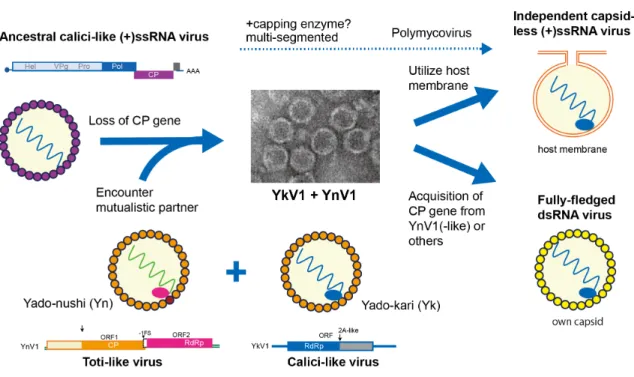
The viability of YkV1 depends on YnV1 that can complete on its own replication, suggesting interesting evolutionary placement of YkV1, i.e., possibly an intermediate evolutionary form of this virus. There are a few evolutionary scenarios for YkV1. As proposed by Kupovic and Koonin for other capsidless RNA viruses (Krupovic and Koonin, 2017), YkV1’s progenitor might have been a calici-like virus and had its own CP gene in the genome (Fig. 3). The ancestral virus then might have lost its CP gene and simultaneously started hijacking the CP of another co-infecting fully-fledged dsRNA virus. Encounter of the progenitor with co-infecting toti-like viruses would not have been implausible, given their prevalence and high incidence rate of mixed infections in fungi (Hillman et al., 2017). There must have been compatible association between hijacked capsid and partner (+)ssRNA virus for heteroencapsidation to occur. Under the premise that YkV1 will be an independent virus capable of autonomous replication, YkV1 will need to acquire a CP gene and become a dsRNA utilizing the replication strategy of typical dsRNA viruses. Alternatively, YkV1 may employ vesicles or rearranged membrane (spherule) (Ahlquist, 2006; Nagy et al., 2016) as the replication sites like hypovirus and possibly other fungal capsidless RNA viruses. In this case, YkV1 will remain one of the most simple genome architecture with one single ORF, as in the case of capsidless narnaviruses (Hillman and Cai, 2013).
Multi-segmented dsRNA viruses tentatively termed polymycoviruses, AfuTmV1 and related viruses, were reported from filamentous fungi (Kotta-Loizou and Coutts, 2017). There is no consensus about their virion morphology, but they commonly appear to be infectious as naked dsRNA when host protoplasts are transfected (Kanhayuwa et al., 2015). Interesting parallelism found between these viruses and YkV1 is that both show phylogenetic affinity to caliciviruses with respect to RdRp (Fig. S2A). However, of note are that AfuTmV1’s RdRp has “GDNQ” in motif C as catalytic site, typical of mononegaviruses (Fig. S2B) and that AfuTmV1 possesses a dsRNA genomic segment encoding methyltransferase like reoviruses (Kotta-Loizou and Coutts, 2017). It seems that polymycoviruses evolved into more independent viruses than YkV1 relying on another dsRNA virus.
DsRNA viruses are diverse and polyphyletic. Reoviruses are assumed to have originated from prokaryotic dsRNA viruses, cystoviruses, while many other eukaryotic dsRNA viruses may have been derived from ancestral picornaviruses with (+)ssRNA genomes (Koonin et al., 2015). The phylogenetic tree with alignable regions of RdRps of YnV1-related dsRNA viruses reveal two large groups (Fig. 2A) each containing several lineages: one accommodating families Totiviridae, Chrysoviridae, Megabirnaviridae, and Quadriviridae, the genus Botybirnavirus, PgV-like and SsNsVL-like, and the other group encompassing AaRTV-like, the genus
Giardiavirus within the Totiviridae, proposed genus Artivirus and the Yadonushi-like virus group.. Hosts of both groups are largely fungi in addition to protozoans, plants, insects, while the latter group has additionally fish and marine eukaryotic organisms as hosts. Interestingly, both groups have members with different genome segment numbers as described by Liu et al. (Liu et al., 2012), suggesting the occurrence of segmentation, capture and loss of dsRNA genome segments during the course of evolution. In this regards, it should be noted that some fungal lose dsRNA genome segments during maintenance under laboratory conditions and possibly in nature (Kanematsu et al., 2010; Urayama et al., 2014). Acquisition of some dsRNA genome segments has not yet been substantiated, but likely occurs, although it may be infrequent.
The two domains Phytoreo_S7 and 2A-like, discussed above, may represent good examples of multiple independent horizontally transfer events, rather than vertical inheritance, that may have occurred during their evolution. It is noteworthy that these domains are not always present in the entire virus family, rather conserved in a limited number of family or genus members. Liu and others indicated multiple independent horizontal transfer of the Phytoreo_S7 domain based on a few observations. Those include 1) Phytoreo_S7 is conserved in diverse RNA viruses belonging to different families or groups but only in some viruses of a given family, 2) Phytoreo_S7-based trees are not congruent with those based on RdRps, and 3) the domain of non-phytoreoviruses are shorter than those of phytoreoviruses and juxtaposed differently in their genomes. These convincingly show that Phytoreo_S7 of diverse dsRNA viruses may have been acquired from ancestral phytoreoviruses and spread via horizontal transfer among them. A similar logic may be applicable to demonstrate horizontal transfer of the 2A-like motif. However, the 2A-like motif is very short, composed of eight amino acids, and lack sequence similarity at their flanking regions. This makes it difficult to phylogentically analyze the 2A-like sequences conserved in diverse RNA viruses.
8. Conclusions and perspectives.
This article largely focuses on properties of two viruses YnV1 and YkV1 with a novel lifestyle, unique mutual interplay between them, and touched their taxonomical and evolutionary considerations. The nature of YnV1/YkV1 neo-lifestyle was discovered in 2016 (Zhang et al., 2016), almost two years ago, and therefore there are many unknowns. For example, it is still unknown whether single particles encapsidate both of the two virus genomes or either one of them. Excepting reovirus particles (monopartite particles) which encase a set of genomic
segments 9 to 12, other segmented dsRNA viruses are most likely to multipartite, each segment encapsidates separately in a single particle (Ref, Liu et al., 2014?). The size of capsids is generally proportional to their genome sizes, and is primarily determined by the size of capsid protein, as summarized in the Louke et al. (Luque et al., 2016). Based on these points, it is anticipated that YnV1 CP encapsidates either one single YkV1 or YnV1 RNA molecule, but not both. Assuming that the capsid is composed of 60 asynmetrical dimers in the T=1 lattice as for other dsRNA viruses (Luque et al., 2016; Miyazaki et al., 2015), the masses were approximately calculated to be 20.3 MDa for YnV1 capsid and 18.5 MDa for the YkV1 heterocapsid (N. Suzuki, unpublished results?). This issue should be addressed by high-resolution equilibrium density gradient centrifugation if applicable or other appropriate methods.
Another related question is whether heterocapsids really serve as the replication sites, or whether YkV1 RdRp catalyzes synthesis of YkV1 RNA. Taking advantage of the infectious cDNA clone of YkV1, experiments to address this question 1 is underway by introducing mutations into the GDD hallmark motif of YkV1 RdRp. Preliminary results suggest that mutations at the GDD motif result in abolishment of YkV1 viability even the presence of YnV1, strongly supporting the model proposed by Zhang et al. (A. M. Mahfuz, R. Zhang, S. Hisano, and N. Suzuki, published elsewhere). Other interesting open questions regarding the YkV1/YnV1 include: 1) how YnV1 trans-encapsidates efficiently YkV1 RNA and RdRp, 2) where the YkV1 assembly origin reside on the sequence, 3) how YkV1 enhances YnV1 replication, and 4) whether there are any other similar viral mutualistic interplays in other eukaryotic organisms than fungi.
Acknowledgements
This study was supported in part by Yomogi Inc. and Grants−in-Aid for Scientific Research (A) and on Innovative Areas from the Japanese Ministry of Education, Culture, Sports, Science, and Technology (MEXT) (KAKENHI 25252011 and 16H06436, 16H06429, and 16K21723 to N.S. and H. K.). M.I.F. was a visiting scientist supported by the Japan Student Services Organization (JASSO) and MEXT (16H06436).
Hisano et al. 14
References
Abergel, C., Legendre, M., Claverie, J.M., 2015. The rapidly expanding universe of giant viruses: Mimivirus, Pandoravirus, Pithovirus and Mollivirus. FEMS Microbiol Rev 39(6), 779-796.
Ahlquist, P., 2006. Parallels among positive-strand RNA viruses, reverse-transcribing viruses and double-stranded RNA viruses. Nat Rev Microbiol 4(5), 371-382.
Ai, Y.P., Zhong, J., Chen, C.Y., Zhu, H.J., Gao, B.D., 2016. A novel single-stranded RNA virus isolated from the rice-pathogenic fungus Magnaporthe oryzae with similarity to members of the family Tombusviridae. Arch Virol 161(3), 725-729.
Anisimova, M., Gascuel, O., 2006. Approximate likelihood-ratio test for branches: A fast, accurate, and powerful alternative. Syst Biol 55(4), 539-552.
Arakawa, M., Nakamura, H., Uetake, Y., Matsumoto, N., 2002. Presence and distribution of double-stranded RNA elements in the white root rot fungus Rosellinia necatrix. Mycoscience 43, 21-26.
Bartholomaus, A., Wibberg, D., Winkler, A., Puhler, A., Schluter, A., Varrelmann, M., 2016. Deep Sequencing Analysis Reveals the Mycoviral Diversity of the Virome of an Avirulent Isolate of Rhizoctonia solani AG-2-2 IV. PLoS One 11(11), e0165965.
Chiba, S., Salaipeth, L., Lin, Y.H., Sasaki, A., Kanematsu, S., Suzuki, N., 2009. A novel bipartite double-stranded RNA mycovirus from the white root rot fungus Rosellinia necatrix: molecular and biological characterization, taxonomic considerations, and potential for biological control. J Virol 83, 12801-12812.
Cho, W.K., Lee, K.M., Yu, J., Son, M., Kim, K.H., 2013. Insight into mycoviruses infecting Fusarium species. Adv Virus Res 86, 273-288.
Colson, P., De Lamballerie, X., Yutin, N., Asgari, S., Bigot, Y., Bideshi, D.K., Cheng, X.W., Federici, B.A., Van Etten, J.L., Koonin, E.V., La Scola, B., Raoult, D., 2013. "Megavirales", a proposed new order for eukaryotic nucleocytoplasmic large DNA viruses. Arch Virol 158(12), 2517-2521.
Domingo, E., Sheldon, J., Perales, C., 2012. Viral quasispecies evolution. Microbiology and molecular biology reviews : MMBR 76(2), 159-216.
Donnelly, M.L.L., Hughes, L.E., Luke, G., Mendoza, H., ten Dam, E., Gani, D., Ryan, M.D., 2001. The 'cleavage' activities of foot-and-mouth disease virus 2A site-directed mutants and naturally occurring '2A-like' sequences. Journal of General Virology 82, 1027-1041.
Flores, R., Minoia, S., Carbonell, A., Gisel, A., Delgado, S., Lopez-Carrasco, A., Navarro, B., Di Serio, F., 2015. Viroids, the simplest RNA replicons: How they manipulate
their hosts for being propagated and how their hosts react for containing the infection. Virus Res 209, 136-145.
Fukuhara, T., 2015. Unique symbiotic viruses in plants: Endornaviruses. Uirusu 65(2), 209-218.
Ghabrial, S.A., Caston, J.R., Jiang, D., Nibert, M.L., Suzuki, N., 2015. 50-plus years of fungal viruses. Virology 479-480, 356-368.
Guindon, S., Dufayard, J.F., Lefort, V., Anisimova, M., Hordijk, W., Gascuel, O., 2010. New algorithms and methods to estimate maximum-likelihood phylogenies: assessing the performance of PhyML 3.0. Syst Biol 59(3), 307-321.
Heras, S.R., Thomas, M.C., Garcia-Canadas, M., de Felipe, P., Garcia-Perez, J.L., Ryan, M.D., Lopez, M.C., 2006. L1Tc non-LTR retrotransposons from Trypanosoma cruzi contain a functional viral-like self-cleaving 2A sequence in frame with the active proteins they encode. Cell Mol Life Sci 63(12), 1449-1460.
Hibino, H., 1996. Biology and epidemiology of rice viruses. Annu Rev Phytopathol 34, 249-274.
Hillman, B.I., Aulia, A., Suzuki, N., 2017. Viruses of plant-interacting fungi. Adv Virus Res 100, in press.
Hillman, B.I., Cai, G., 2013. The family Narnaviridae: simplest of RNA viruses. Adv Virus Res 86, 149-176.
Hillman, B.I., Suzuki, N., 2004. Viruses of the chestnut blight fungus, Cryphonectria parasitica. Adv Virus Res 63, 423-472.
Howitt, R.L., Beever, R.E., Pearson, M.N., Forster, R.L., 2006. Genome characterization of a flexuous rod-shaped mycovirus, Botrytis virus X, reveals high amino acid identity to genes from plant 'potex-like' viruses. Arch Virol 151(3), 563-579.
Howitt, R.L.J., Beever, R.E., Pearson, M.N., Forster, R.L., 2001. Genome characterization of Botrytis virus F, a flexuous rod-shaped mycovirus resembling plant `potex-like` viruses. Journal of General Virology 82, 67-78.
Ikeda, K., Nakamura, H., Arakawa, M., Matsumoto, N., 2004. Diversity and vertical transmission of double-stranded RNA elements in root rot pathogens of trees, Helicobasidium mompa and Rosellinia necatrix. Mycol Res 108, 626-634. Kanematsu, S., Sasaki, A., Onoue, M., Oikawa, Y., Ito, T., 2010. Extending the fungal host
range of a partitivirus and a mycoreovirus from Rosellinia necatrix by inoculation of protoplasts with virus particles. Phytopathology 100, 922-930.
Kanhayuwa, L., Kotta-Loizou, I., Ozkan, S., Gunning, A.P., Coutts, R.H., 2015. A novel mycovirus from Aspergillus fumigatus contains four unique dsRNAs as its
genome and is infectious as dsRNA. Proc Natl Acad Sci U S A 112(29), 9100-9105.
Kondo, H., Kanematsu, S., Suzuki, N., 2013. Viruses of the white root rot fungus, Rosellinia necatrix. Adv Virus Res 86, 177-214.
Koonin, E.V., Dolja, V.V., 2012. Expanding networks of RNA virus evolution. BMC Biol 10, 54.
Koonin, E.V., Dolja, V.V., 2014. Virus world as an evolutionary network of viruses and capsidless selfish elements. Microbiology and molecular biology reviews : MMBR 78(2), 278-303.
Koonin, E.V., Dolja, V.V., Krupovic, M., 2015. Origins and evolution of viruses of eukaryotes: The ultimate modularity. Virology 479-480, 2-25.
Kotta-Loizou, I., Coutts, R.H.A., 2017. Studies on the Virome of the Entomopathogenic Fungus Beauveria bassiana Reveal Novel dsRNA Elements and Mild Hypervirulence. Plos Pathogens 13(1).
Kozlakidis, Z., Herrero, N., Coutts, R.H., 2013a. The complete nucleotide sequence of a totivirus from Aspergillus foetidus. Arch Virol 158(1), 263-266.
Kozlakidis, Z., Herrero, N., Ozkan, S., Bhatti, M.F., Coutts, R.H., 2013b. A novel dsRNA element isolated from the Aspergillus foetidus mycovirus complex. Arch Virol 158(12), 2625-2628.
Kozlakidis, Z., Herrero, N., Ozkan, S., Kanhayuwa, L., Jamal, A., Bhatti, M.F., Coutts, R.H., 2013c. Sequence determination of a quadripartite dsRNA virus isolated from Aspergillus foetidus. Arch Virol 158(1), 267-272.
Krupovic, M., Koonin, E.V., 2017. Homologous capsid proteins testify to the common ancestry of retroviruses, caulimoviruses, pseudoviruses, and metaviruses. J Virol 91(12), e00210-00217.
Kwon, S.J., Lim, W.S., Park, S.H., Park, M.R., Kim, K.H., 2007. Molecular characterization of a dsRNA mycovirus, Fusarium graminearum virus-DK21, which is phylogenetically related to hypoviruses but has a genome organization and gene expression strategy resembling those of plant potex-like viruses. Mol Cells 23, 304-315.
Lin, Y.H., Chiba, S., Tani, A., Kondo, H., Sasaki, A., Kanematsu, S., Suzuki, N., 2012. A novel quadripartite dsRNA virus isolated from a phytopathogenic filamentous fungus, Rosellinia necatrix. Virology 426, 42-50.
Littlejohn, M., Locarnini, S., Yuen, L., 2016. Origins and Evolution of Hepatitis B Virus and Hepatitis D Virus. Cold Spring Harb Perspect Med 6(1), a021360.
Liu, H., Fu, Y., Jiang, D., Li, G., Xie, J., Peng, Y., Yi, X., Ghabrial, S.A., 2009. A novel mycovirus that is related to the human pathogen hepatitis E virus and rubi-like viruses. J Virol 83, 1981-1991.
Liu, H., Fu, Y., Xie, J., Cheng, J., Ghabrial, S.A., Li, G., Peng, Y., Yi, X., Jiang, D., 2012. Evolutionary genomics of mycovirus-related dsRNA viruses reveals cross-family horizontal gene transfer and evolution of diverse viral lineages. BMC Evol Biol 12, 91.
Liu, Y.C., Dynek, J.N., Hillman, B.I., Milgroom, M.G., 2007. Diversity of viruses in Cryphonectria parasitica and C. nitschkei in Japan and China, and partial characterization of a new chrysovirus species. Mycol Res 111, 433-442.
Lole, K.S., Bollinger, R.C., Paranjape, R.S., Gadkari, D., Kulkarni, S.S., Novak, N.G., Ingersoll, R., Sheppard, H.W., Ray, S.C., 1999. Full-length human immunodeficiency virus type 1 genomes from subtype C-infected seroconverters in India, with evidence of intersubtype recombination. J Virol 73(1), 152-160.
Luque, D., Mata, C.P., Gonzalez-Camacho, F., Gonzalez, J.M., Gomez-Blanco, J., Alfonso, C., Rivas, G., Havens, W.M., Kanematsu, S., Suzuki, N., Ghabrial, S.A., Trus, B.L., Caston, J.R., 2016. Heterodimers as the Structural Unit of the T=1 Capsid of the Fungal Double-Stranded RNA Rosellinia necatrix Quadrivirus 1. J Virol 90(24), 11220-11230.
Marzano, S.Y.L., Domier, L.L., 2016. Novel mycoviruses discovered from metatranscriptomics survey of soybean phyllosphere phytobiomes. Virus Research 213, 332-342.
Marzano, S.Y.L., Hobbs, H.A., Nelson, B.D., Hartman, G.L., Eastburn, D.M., McCoppin, N.K., Domier, L.L., 2015. Transfection of Sclerotinia sclerotiorum with in vitro transcripts of a naturally occurring interspecific recombinant of Sclerotinia sclerotiorum hypovirus 2 significantly reduces virulence of the fungus. Journal of Virology 89(9), 5060-5071.
Marzano, S.Y.L., Nelson, B.D., Ajayi-Oyetunde, O., Bradley, C.A., Hughes, T.J., Hartman, G.L., Eastburn, D.M., Domier, L.L., 2016. Identification of diverse mycoviruses through metatranscriptomics characterization of the viromes of five major fungal plant pathogens. Journal of Virology 90(15), 6846-6863.
Matsumoto, N., 1998. Biological control of root diseases with dsRNA based on population structure of pathogenes. JARQ 32, 31-35.
Miyazaki, N., Salaipeth, L., Kanematsu, S., Iwasaki, K., Suzuki, N., 2015. Megabirnavirus structure reveals a putative 120-subunit capsid formed by asymmetrical dimers with distinctive large protrusions. J Gen Virol 96(8), 2435-2441.
Nagy, P.D., Pogany, J., Xu, K., 2016. Cell-Free and Cell-Based Approaches to Explore the Roles of Host Membranes and Lipids in the Formation of Viral Replication Compartment Induced by Tombusviruses. Viruses 8(3), 68.
Nerva, L., Ciuffo, M., Vallino, M., Margaria, P., Varese, G.C., Gnavi, G., Turina, M., 2016. Multiple approaches for the detection and characterization of viral and plasmid symbionts from a collection of marine fungi. Virus Research 219, 22-38.
Nibert, M.L., 2007. '2A-like' and 'shifty heptamer' motifs in penaeid shrimp infectious myonecrosis virus, a monosegmented double-stranded RNA virus. J Gen Virol 88(Pt 4), 1315-1318.
Nuss, D.L., 2011. Mycoviruses, RNA silencing, and viral RNA recombination. Adv Virus Res 80, 25-48.
Olspert, A., Chung, B.Y., Atkins, J.F., Carr, J.P., Firth, A.E., 2015. Transcriptional slippage in the positive-sense RNA virus family Potyviridae. EMBO Rep 16(8), 995-1004.
Osaki, H., Sasaki, A., Nomiyama, K., Tomioka, K., 2016. Multiple virus infection in a single strain of Fusarium poae shown by deep sequencing. Virus Genes 52(6), 835-847.
Palmenberg, A.C., Parks, G.D., Hall, D.J., Ingraham, R.H., Seng, T.W., Pallai, P.V., 1992. Proteolytic processing of the cardioviral P2 region: primary 2A/2B cleavage in clone-derived precursors. Virology 190(2), 754-762.
Peever, T.L., Liu, Y.C., Wang, K.R., Hillman, B.I., Foglia, R., Milgroom, M.G., 1998. Incidence and diversity of double-stranded RNAs occurring in the chestnut blight fungus, Cryphonectria parasitica, in China and Japan. Phytopathology 88(8), 811-817.
Petrzik, K., Sarkisova, T., Stary, J., Koloniuk, I., Hrabakova, L., Kubesova, O., 2016. Molecular characterization of a new monopartite dsRNA mycovirus from mycorrhizal Thelephora terrestris (Ehrh.) and its detection in soil oribatid mites (Acari: Oribatida). Virology 489, 12-19.
Pliego, C., Lopez-Herrera, C., Ramos, C., Cazorla, F.M., 2012. Developing tools to unravel the biological secrets of Rosellinia necatrix, an emergent threat to woody crops. Mol Plant Pathol 13, 226-239.
Preisig, O., Moleleki, N., Smit, W.A., Wingfield, B.D., Wingfield, M.J., 2000. A novel RNA mycovirus in a hypovirulent isolate of the plant pathogen Diaporthe ambigua. J Gen Virol 81(Pt 12), 3107-3114.
Rodamilans, B., Valli, A., Mingot, A., San León, D., Baulcombe, D., López-Moya, J.J., García, J.A., 2015. RNA polymerase slippage as a mechanism for the production of frameshift gene products in plant viruses of the potyviridae family. J. Virol 89, 6965-6967.
Roossinck, M.J., Sabanadzovic, S., Okada, R., Valverde, R.A., 2011. The remarkable evolutionary history of endornaviruses. J Gen Virol 92(Pt 11), 2674-2678.
Roulston, C., Luke, G.A., de Felipe, P., Ruan, L., Cope, J., Nicholson, J., Sukhodub, A., Tilsner, J., Ryan, M.D., 2016. '2A-like' signal sequences mediating translational recoding: A novel form of dual protein targeting. Traffic 17(8), 923-939.
Ryan, M.D., King, A.M., Thomas, G.P., 1991. Cleavage of foot-and-mouth disease virus polyprotein is mediated by residues located within a 19 amino acid sequence. J Gen Virol 72 ( Pt 11), 2727-2732.
Sabanadzovic, S., Valverde, R.A., Brown, J.K., Martin, R.R., Tzanetakis, I.E., 2009. Southern tomato virus: The link between the families Totiviridae and Partitiviridae. Virus Res 140(1-2), 130-137.
Shi, M., Lin, X.D., Tian, J.H., Chen, L.J., Chen, X., Li, C.X., Qin, X.C., Li, J., Cao, J.P., Eden, J.S., Buchmann, J., Wang, W., Xu, J., Holmes, E.C., Zhang, Y.Z., 2016. Redefining the invertebrate RNA virosphere. Nature 540-543.
Simon, A.E., Roossinck, M.J., Havelda, Z., 2004. Plant virus satellite and defective interfering RNAs: new paradigms for a new century. Annu Rev Phytopathol 42, 415-437.
Spear, A., Sisterson, M.S., Yokomi, R., Stenger, D.C., 2010. Plant-feeding insects harbor double-stranded RNA viruses encoding a novel proline-alanine rich protein and a polymerase distantly related to that of fungal viruses. Virology 404, 304-311.
Suzuki, N., 1995. MOLECULAR ANALYSIS OF THE RICE DWARF VIRUS GENOME. Seminars in Virology 6, 89-95.
Suzuki, N., 1997. Structure/function analyses of rice dwarf phytoreovirus genome and its proteins. Uirusu 47, 145-154 (in Japanese).
Taliansky, M.E., Robinson, D.J., 2003. Molecular biology of umbraviruses: phantom warriors. J Gen Virol 84(Pt 8), 1951-1960.
Taylor, J.M., 2006. Structure and replication of hepatitis delta virus RNA. Curr Top Microbiol Immunol 307, 1-23.
Untiveros, M., Olspert, A., Artola, K., Firth, A.E., Kreuze, J.F., Valkonen, J.P., 2016. A novel sweet potato potyvirus open reading frame (ORF) is expressed via polymerase slippage and suppresses RNA silencing. Mol Plant Pathol 17(7), 1111-1123.
Urayama, S., Sakoda, H., Takai, R., Katoh, Y., Minh Le, T., Fukuhara, T., Arie, T., Teraoka, T., Moriyama, H., 2014. A dsRNA mycovirus, Magnaporthe oryzae chrysovirus 1-B, suppresses vegetative growth and development of the rice blast fungus. Virology 448, 265-273.
Vainio, E.J., Hantula, J., 2016. Taxonomy, biogeography and importance of Heterobasidion viruses. Virus Res 219, 2-10.
Wickner, R.B., Fujimura, T., Esteban, R., 2013. Viruses and prions of Saccharomyces cerevisiae. Adv Virus Res 86, 1-36.
Xie, J., Jiang, D., 2014. New insights into mycoviruses and exploration for the biological control of crop fungal diseases. Annu Rev Phytopathol 52, 45-68.
Xie, J., Wei, D., Jiang, D., Fu, Y., Li, G., Ghabrial, S., Peng, Y., 2006. Characterization of debilitation-associated mycovirus infecting the plant-pathogenic fungus Sclerotinia sclerotiorum. J Gen Virol 87(Pt 1), 241-249.
Yaegashi, H., Nakamura, H., Sawahata, T., Sasaki, A., Iwanami, Y., Ito, T., Kanematsu, S., 2013. Appearance of mycovirus-like double-stranded RNAs in the white root rot fungus, Rosellinia necatrix, in an apple orchard. FEMS Microbiol Ecol 83, 49-62.
Yokoi, T., Takemoto, Y., Suzuki, M., Yamashita, S., Hibi, T., 1999. The nucleotide sequence and genome organization of Sclerophthora macrospora virus B. Virology 264(2), 344-349.
Yokoi, T., Yamashita, S., Hibi, T., 2003. The nucleotide sequence and genome organization of Sclerophthora macrospora virus A. Virology 311(2), 394-399.
Zhang, R., Hisano, S., Tani, A., Kondo, H., Kanematsu, S., Suzuki, N., 2016. A capsidless ssRNA virus hosted by an unrelated dsRNA virus. Nat Microbiol, 10.1038/NMICROBIOL.2015.1031.
Zhang, R., Liu, S., Chiba, S., Kondo, H., Kanematsu, S., Suzuki, N., 2014. A novel single-stranded RNA virus isolated from a phytopathogenic filamentous fungus, Rosellinia necatrix, with similarity to hypo-like viruses. Frontiers in microbiology 5, 360.
Figure legends
Fig. 1. Genome organization of YnV1 and YkV1. Diagrams of genetic organization of YnV1 (A) and
YkV1 (B). YnV1 and YkV1 are 8971 nt and 6310 nt in length that possesses two (ORF1 and ORF2) and one ORF, respectively. Open boxes illustrated using solid lines denote ORFs, while that drawn by dashed lines denotes a possible extension of YnV1 ORF2 by -1 frameshifting (-1FS). RdRp domains
highlighted in red are found in YnV1 ORF2 and the YkV1 ORF (Fig. S2). Regions highlighted in
purple and green refer to a zinc-finger motif (smart00356) and a Phytoreo_S7 motif (Fig. S1). Two
versions of the capsid proteins were detected in purified virion fractions. The arrows in A indicate positions of the amino-terminal of the 120-kDa CP with its amino acid sequences. Arrows head shows the position of sequence heterogeneity along with a frame-shifting of each ORF. A possible cleavage site of the YnV1 protein in B is indicated by the arrow with 2A-like amino acid sequences. C, Comparison of the 2A-like nona-amino acid sequences among YnV1 and other related fungal viruses.
Fig. 2. A, B. Maximum likelihood phylogenetic trees of YnV1, YkV1 and their related virus
sequences.Two trees were constructed based on the multiple amino acid sequence alignment of the
RNA-dependent RNA polymerase (RdRp) or its precursor using PhyML 3.0 (Guindon et al., 2010)
with the best-fit model “LG+I+G” (A) or “LG+G” model (B). Related dsRNA viruses and (+)ssRNA
viruses were included, respectively, whose sequence information are shown in Table S1. Different
host groups of the analyzed viruses are differentiated by circles filled with different colors. The segmented viruses are labeled with segment numbers below the family or tentative group name. Phylogenetic placements of YnV1 and YkV1 are highlighted in red. The branch support values were estimated by the approximate likelihood ratio test (aLRT) with a SH-like algorithm (Anisimova and Gascuel, 2006) (only values greater than 0.9 are shown). Viruses with two asterisks are expected to have yadokari-like partners listed in the Table 1.
Fig. 3. Evolutionary considerations of the past, present and future forms of YkV1. See text for
Table 1.
Possible interplays similar to the YnV1/YkV1.
Host Strain Virus / Genome size (kbp)
a Ratio
(Yn-like/Yk-like) Reference
Yado-nushi like Yado-kari like
Rosellinia necatrix W1032 YnV1 9.0 YkV1 6.3 1.43 Zhang et al. (2016)
Fusarium poae MAFF 240374 FpVV1 >5.1 FpMyV1 >4.2 1.21 Osaki et al. (2016)
Penicillium aurantiogriseum MUT433 PaTV1 5.2 PaFlV1 >3.7 <1.41 Nerva et al. (2016)
Aspergillus foetidus IMI 41871 AfV-S1 5.2 AfV-S2 3.6 1.44 Kozlakidis et al. (2013b)
Rhizoctonia solani AG 2-2IV/DC17 RsMV-3 N.A. RsMV-1 N.A – Bartholomaeus et al. (2016)
a GenBank accession no, YnV1: LC061478; YkV1: LC006253; FpVV1: LC150610; FpMyV2: LC150617; PaTV1: KT592305; PaFlV1: KT601100;
AfV-S1: HE588147; AfV-S2: HE588148; Rhizoctonia solani mycovirus 3 (RsMV-3, PgV-1 like, partial CDS): KX349070; RsMV-1: KX349063 (partial CDS). N.A.: not available.
Table 2.
Comparison of YkV1 with other unusual viruses or subviral agents.
Viruses Sub-viral agents a
YkV1 Umbraviruses Capsidless
RNA viruses
Satellite viruses Satellite
nucleic acids
HDV b STNV c Virophages
Genome (+)ssRNA (+)ssRNA (+)ssRNA Circular
(-)ssRNA (+)ssRNA Circular dsDNA ssDNA (+)ss- d or dsRNA Encoding capsid protein NO: Trans- encapsidated NO: Trans-
encapsidated NO: Capsidless
NO: Trans-
encapsidated b YES YES
NO: Trans- encapsidated Encoding RNA or
DNA polymerase YES YES YES NO NO YES NO
Independent auto-
nomous replication NO e YES f YES f NO NO NO NO
Partner or helper
virus YnV1 Luteoviruses Not required
hepatitis B virus
tobacco
necrosis virus
Giant viruses Various viruses aClassification for sub-viral agents have been proposed (Krupovic et al., 2016).
b
Hepatitis delta virus: categorized as a satellite virus in this table. HDV encodes the hepatitis delta antigen that constitutes the inner
nucleocapsid, but not outer capsid.
c
Satellite tobacco necrosis virus.
d Subgroups 1: large satellite RNAs, 2: small linear satellite RNAs, 3: circular satellite RNAs or virusoids (see Palukaitis, 2016). e Genome replication probably occurs inside the trans-encapsidated particles.
Fig. S1. A, Pairwise comparisons of nucleotide and amino acid sequence identity among three YnV1
varians. B, Nucleotide sequence similarities of the entire genome length of the YnV1-A (top row)
Fig. S2. A, Comparison of the conserved motifs of the RdRP in YnV1, YnV1-like viruses,
polymymoviruses and caliciviruses. B, Phylogenetic relationships of the RdRps of YnV1 and its
related viruses. The ML tree was constructed using PhyML 3.0 with a best fit model “Blosum62 +G+I”. GenBank/Refseq accession numbers of the RdRp sequences are listed in Table S1 with the addition of four polymymoviruses: Aspergillus fumigatus tetramycovirus-1 (AfTmV-1), CDP74618; Botryosphaeria dothidea virus 1 (BdV-1), YP_009342446; Aspergillus fumigatus tetramycovirus-1 (AfTmV-1), CDP74618; Cladosporium cladosporioides virus 1 (CcV-1), YP_009052470. Two picornaviruses used as an out group.
Table S2.
Summary of protein blast search with YkV1 polyprotein (1430 aa).
a Query coverage
Viruses Protein name Length Overlap QCa E value Identity Accession no.
Penicillium aurantiogriseum foetidus-like virus115 kDa protein 975 aa 346/710 49% 0.0 49% YP_009182156
Aspergillus foetidus slow virus 2 RdRp 962 aa 337/659 45% 0.0 51% CCD33025
Rhizoctonia solani mycovirus 1 RdRp, partial (311 aa) 163/319 22% 1e-91 51% ANR02697
Fusarium poae mycovirus 2 RdRp 1107 aa 120/381 25% 1e-29 31% YP_009272910
Sapovirus Hu/GII/JP/2010/Kashiwa1 ORF1 polyprotein 2279 aa 62/234 15% 0.011 26% BAX24515
Norovirus isolates RdRp, partial (149 aa) 40/130 8% 0.022 31% AAB81329
Sapovirus SaKaeo-15/Thailand polyprotein 2281 aa 62/242 16% 0.023 26% AAV69574
Sapovirus Hu/GII/Hokkaido/Nay1/2005/JPN polyprotein, partial (393 aa) 51/181 12% 0.025 28% ABO20832
Sapovirus C12 ORF1 protein 2281 aa 62/242 16% 0.038 26% YP_164336
Sapporo virus-London/29845 polyprotein, partial (849 aa) 49/181 12% 0.039 27% AAC40584.1