IS Management Issues within the New ERP Life
Cycle towards the Final Decision-making
著者
HUANG TINGTING
学位授与機関
Tohoku University
学位授与番号
11301甲第17689号
1 / 16
Name: Huang Tingting (コウ テイテイ)
Student ID: B5ED1005
Date of start of Ph.D.: April 2015
Title: IS Management Issues within the New ERP Life Cycle
towards the Final Decision-making
Supervisor: Prof. Suzuki Kenichi
Word account: 4122
2 / 16
1. Research Background
The term of Enterprise Resource Planning (ERP) consists of two meanings—a concept of business management and a package application of Information System (IS), in which the latter one is used more commonly. ERP system usually refers to a software architecture that facilitates information flow between all business functions and manages business activities. As one of the most rapid spreading terms, ERP has gotten various definitions in which three common factors—integration, packages, and best practices—are usually included (Alwabel et al. 2006). With the development of information technology (IT) and the demands of organizations, ERP system which originated from manufacturing cores has been able to cover nearly all essential processes and functions of organizations during two decades.
The roots of ERP system may go back to half a century ago. The evolution of ERP was arranged into different versions in prior literature. In general, the Materials Requirements Planning (MRP) system appeared in the mid-1960s was considered as the common origin of ERP system, which was defined as ‘a computer based planning, scheduling, and control system that gives management a tool to plan and control its manufacturing activities and supporting operations obtaining a higher level of customer service while reducing costs’ (Alwabel et al. 2006). In the next decade, a system—Manufacturing Resource Planning (MRP II) system—for the effective planning of all the resources of a manufacturing business, according to the American Production and Inventory Control Society (APICS), had caused lots of attention. In the early 1990s, SAP (Systemanalyse und Programmentwicklung) has taken the ERP market by storm only in the last two or three years, due to the client/server-based product—R/3 (Bancroft 1996). Along with the SAP, the Oracle Corp, PeopleSoft, J.D. Edwards, the
3 / 16
Baan Co., etc.—the whole ERP software vendor market has experienced rapid growth since then.
The development of the concept of ERP in every ten years did not stop as well. Many concepts, such as Extended ERP, ERP II, EAI (enterprise application integration), etc., have emerged quickly. The Gather group—the world’s leading information technology research and advisory company—invented the term of ERP had again proposed the term of ERP II and defined it as ‘a business strategy and a set of industry-domain-specific applications that build customer and shareholder value by enabling and optimizing enterprise and inter-enterprise, collaborative operational and financial processes’ (Bond et al. 2000). In brief, the scope of ERP system is increasing continuously. Recently, some concepts, such as Cloud ERP, Mobile ERP, etc., are not so unfamiliar to us.
On the other hand, the industry of ERP which consists of vendors, users, and consultants has been experiencing huge changes as well. It is proved to be true that ERP systems have entered an era of ‘easy configuration’ with a shorter time period, a low cost, and a relatively low risk as Jacobs and ‘Ted’ Weston Jr (2007) have predicted. Although some shifts happened during these years, according to Columbus (2013), in spite of the worldwide ERP software market share in 2012 shows that the SAP is still leading the worldwide market with 24.6% market share, new ERP vendors with tremendous growth indeed pose a potential threat. Meantime, the worldwide ERP market experienced slow growth of 2.2%, yet quoted from Columbus (2013) ‘Software-as-a-Service (SaaS), financial management and Human Capital Management (HCM) applications showed potential for breakout growth.’ The ERP report of Panorama Consulting Solutions (2013) pointed out that the traditional ERP software was chosen by the majority of 61% with an increase of 3% over 2012, and 26% of respondents selected
4 / 16
software as a SaaS and cloud ERP. To put it bluntly, the traditional ERP industry is shifting. The various demands of organizations are accelerating the diversity of ERP software. Apparently, the survival in natural selection will lead the next generation.
According to the newest market report of Allied Market Research, the global ERP software market is expected to research $ 41.69 billion by 2020 (Correa 2015). Meanwhile, new types of ERP products that can be easily accessed via mobile devices are being launched by global ERP vendors, which also are designed to be able to be delivered from third-party vendor’s platform (Correa 2015). Recently, traditional ERP in organizations, such as on-Premise ERP, has already been increasingly impacted by emerging information technology, such as cloud services and social media technologies. A recent survey conducted by Gartner group in 2013 reveals that 47% of the organizations planned to move to cloud-based systems within the next five years (Rayner 2014). They also made some ERP predictions in 2014 (Rivera and Meulen 2014) to highlight that a shift towards SaaS model to be unstoppable. Although the majority in the above corporate-wide system adoption future were Small and Medium Enterprises (SMEs), we can still feel the changing of technology even from our personal behavior on storing or transferring digital data—replacing flash drive with cloud storage services. However, the on-Premise ERP software and the current ERP implementations in organizations will not vanish overnight. In order to adapt the changes, appropriate decision-making on how to deal with the current ERP system might be inevitable.
2. Motivation and Focus
Nevertheless, merely academic research focuses on the above issues of ERP switching. In general, ERP implementation project contains three
5 / 16
major phases—the pre-implementation phase, the implementation phase, and the post-implementation phase. The post-implementation phase, in which ERP is operating in the organization, can be divided into four stages: the Diffusion stage, the Utilization stage, the Enhancement stage, and the Decline stage (Huang and Yasuda 2016). The post-implementation phase had been identified but very little attention had been paid on the real return on investment of such big projects (Botta-Genoulaz et al. 2005). Problems associated with ERP implementations become more rampant during the post-implementation phase (Musaji 2005). As Chang (2004) pointed out, the ongoing management and support of the ERP system remain a challenge beyond “go live”. According to Huang and Yasuda (2014), there are only four original ERP models that contented the Decline stage. The most quoted one is the “Retirement” stage of Esteves and Pastor (1999). Klee (2005) called this stage “Declining Value”, and so as Bento and Costa (2013); Ahituv et al. (2002) did not name this stage separately, but put it into the Operation stage. With the questioning of the existence of the Decline stage, research focused on it is rare. Hence, a huge gap in ERP Life Cycle theory, the ending stage, remains. Not only limited empirical evidence is found to support this stage, but also the existence of this stage is not acknowledged by the majority. Almost every scholar that studied the literature of ERP along with the ERP Life Cycle has stressed the fact that there is no research in the last stage of ERP Life Cycle.
As far as I’m concerned, there may be two reasons lead to this result. First, there are not enough organizations that reach this stage. It is hard to get the data since organizations tend to deny any negative information about them. There is also no standard for estimation. Second, there are bigger issues in other stages. Admittedly, the Implementation phase has been the center of worldwide researchers’ attention since two decades
6 / 16
ago. As many researchers stressed repeatedly, the post-Implementation phase, the longest period, is considered to accompany the organization for more than twenty years. It is impossible that the issues in this phase are less or less important than other phases. Moreover, since the last stage of the ERP Life Cycle is still short of theory support and data support, organizations which are or will be at this stage may have bad little help to deal with what is going to happen soon. If decade ago was not the time to care about the last stage, it will be the right time to think about it now. During the last stage of ERP Life Cycle, organizations will face many issues and at least one big event about how to deal with the current ERP system. In this regard, it is worth efforts to focus on the transformation that both ERP software and the organizations are going to go through. Hence, the major goal of this dissertation is to reveal the missing period in the ERP Life Cycle—the Decline stage—from the theoretical and practical perspective. As long as we focus on this stage, the following questions should be solved eventually.
RQ1: What is the status of ERP research in the organizational context? RQ2: What are the critical issues in the Decline stage of ERP life cycle? RQ3: What is the reality in the Decline stage in organizations?
RQ4: How to make decisions during the Decline stage?
3. Thesis Outline
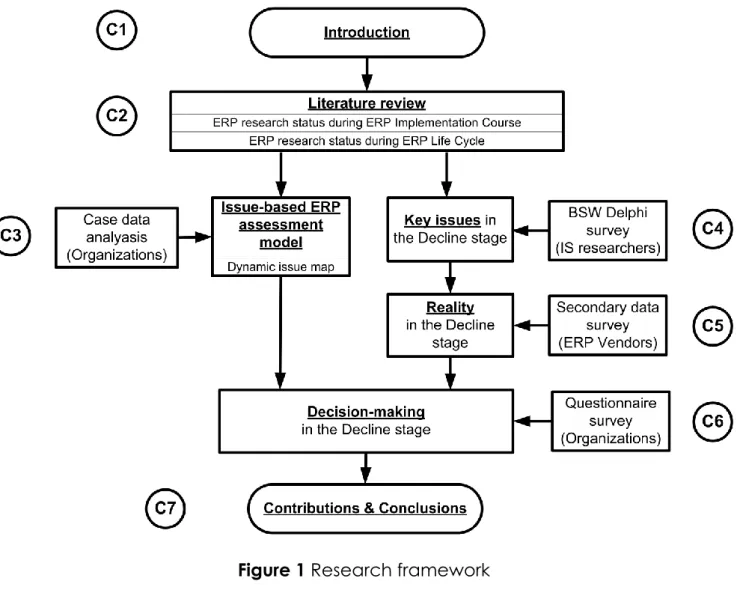
This dissertation adopts multiple research methods which consist of literature review, case data analysis, Delphi survey, secondary data survey, and questionnaire survey. Each method will be introduced specifically in each corresponding chapter. The outline of this dissertation is illustrated in Figure 1, which is structured to guide the reader through the different phases of the doctoral project.
7 / 16
which aim to provide an overall perspective to observe the development of ERP research field and to build the foundation of the following studies. First, a comprehensive literature survey on extensive literature reviews of ERP system in organizational contexts is conducted and maps all the existing research topics that have been mentioned in ERP research filed. Then, a systemic literature review method is adopted on locating and classifying ERP research topics from a large scope of prior literature in ERP Life Cycle. An annotated bibliography is provided as well as narrative analysis.
Figure 1 Research framework
Chapter 3 serves as the extension contents of the former chapter. Based on the findings of chapter 2 and empirical case data from three
8 / 16
Japanese companies, an Issue-based ERP assessment model is invented and introduced. It provides an approach for assessing the status of the alignment between organizations and ERP systems quantitatively and also forming a research issue map to get an intuitive understanding of the ERP research status during the ERP Life Cycle.
Chapter 4 serves as the complement contents of chapter 2. In order to fulfill the missing key issues in the Decline stage which is one conclusion in the former chapter, a new Delphi method is invented and adopted to identify and organize the current critical issues of ERP system in the Decline stage of ERP life cycle in the organizational context.
Chapter 5 provides some empirical supports on the existence of the Decline stage. Forty case studies in Japan related to ERP switching/reversion are located and analyzed. The prior studies explore the ERP failure cases which usually happen soon after the kickoff. This research finds empirical evidence that both Large Enterprises (LEs) and SMEs have experienced some kinds of declining in system performance and business performance, and had the urges and needs to retire or upgrade the current ERP system. Based on the findings, the causes of ERP termination, the two strategies which organizations adopted to deal with the current ERP systems, and the five events after the decision-making point are summarized and discussed.
Chapter 6 explores one essential event in the Decline stage—the decision-making event. In this chapter, we are going to talk about what to do after organizations find out they are in the Decline stage. Based on the previous decision models and the questionnaire survey results from eighteen experienced organizations, a descriptive model with rational process—A2O model—is proposed. The A2O decision model covers all the main actions, objects, and outcomes during a decision-making of ERP switching/reversion
9 / 16
in the Decline stage, and indicates the logic interaction among them. The survey results also provide empirical complement contents to the key issue study and reality study as well.
Chapter 7 revisits the initial research questions and summarizes and discusses the research findings and some future research directions are recommended. The theoretical contributions, practical implications, and limitations are listed in detail.
4. Summary of Results and Contributions
Based on the systematically overviewing the relevant literatures in the ERP research field and conducting rational surveys to form grounded models, the results of this dissertation have successfully fulfilled the blanks in the ERP Life Cycle theory. The Decline stage is proved to be existed and to be indispensable in the circle of ERP adoption. From the practitioners’ perspective, the dissertation reveals the realities and the key issues of organizations facing the ERP switching/upgrading in this stage and generates the decision-making process model—the most essential event—from both the organizations’ experiences and the prior studies. It also provides a useful self-evaluation tool, the issue-based ERP assessment model to aware the status of Business-IT alignment and to catch the right timing of final decision-making. From the academic perspective, the IS management issues lacked in the Decline stage before have been well conducted from the IS professionals’ and managers’ point of view. Meanwhile the IS management issues in the four stages of ERP Life Cycle are also well organized. This dissertation also can be served as an index for other researchers interested in this field due to the comprehensive literature review in the whole ERP implementation course. The specific contributions are: It provides the first comprehensive research that aims to analyze all the
10 / 16
literature reviews in ERP field and a thorough literature review specific on ERP research related to the post-implementation phase which can provide a comprehensive map of ERP research issues in the ERP Life Cycle.
An Issue-based ERP assessment model is proposed for self-evaluation in the organizational context. It is also adopted to form a dynamic issue map in the ERP research field.
A new Ranking-type Delphi method with three rounds to identify and organize the current critical issues of ERP system in the Decline stage of ERP life cycle in the organizational context is invented. Thirty-seven critical issues of seven categories in the Decline stage have been identified and discussed.
A thorough survey of secondary case studies in ERP vendors’ database locates forty organizations in Japan experienced the ERP switching/reversion. It provides specific issues, causes, activities, and events in the Decline stage.
The first practical decision model—A2O decision model—is proposed to assist organizations making decisions to deal with the current ERP systems during the Decline stage. The A2O decision model is based on the prior theatrical decision model and the empirical experiences of organizations that have already gone through the whole process of ERP switching/reversion.
5. Implications
From the academic perspective, the following implications can be addressed. In this dissertation, several comprehensive literature surveys cover the target research objects perfectly. The first literature survey targeted the literature review articles in the ERP field not only organizes the research topics in the ERP research field but also points out the status and
11 / 16
some issues in constructing literature review itself. The second literature survey targeted the studies related to the ERP post-implementation phase provides constructive and distensible taxonomy framework of ERP research issues in the post-implementation phase, which embodies an overall perspective to observe the development of ERP research field in the post-implementation phase and pinpoints many research gaps and opportunities for future research. As the first comprehensive literature review in ERP post-implementation phase, it can also assistant other researchers to find their potential research directions and associated literatures.
Based on prior research and above literature reviews, the proposed Issue-based ERP assessment model provides a new approach to understand the ERP Life Cycle theory and to evaluate the assimilation of organizations and ERP systems. As base models, the SAM (Henderson and Venkatraman 1990) pointed out the critical factors which are essential for business-IT alignment; the business-IT alignment maturity assessment model (Luftman 2000) is able to set five qualitative levels to each critical factor for measurements. This model also contains considerable assessment criteria and assessment levels. Comparing to the model of Luftman (2000) which has six criteria, this model seems only to only have two criteria—the issues and the maintenance activities. However, the corresponding issues that cause those maintenance activities have covered sixteen criteria of six areas, which make sure to provide a grounded foundation to evaluate. Additionally, the results of another literature review target the ERP research in the post-implementation phase within the high-quality peer-reviewed journals are analyzed through the Issue-based ERP assessment model to form the current ERP issue map in the post-implementation phase. This conceptual model is the first model that may provide a graphical way to reveal the dynamic variation of ERP system in organizations and a
12 / 16
quantitative way to assess the system from a life cycle perspective. The issues map will not only address the current research status but can be enriched and updated along with time.
As the first study focused on the key issues in the Decline stage, the Best-Worst Scaling (BWS) Delphi survey tends to offer potential benefits to researchers and practitioners by developing useful insights and deeper understanding of these issues. The first approach for researchers would be to examine some of the top critical issues which have not be seen in other prior IS issue studies. On the other hand, the BWS Delphi method which is a new designed Ranking-type Delphi method contains many implications as well. One distinctive feature is that the BWS Delphi provides not only an overall issue ranking list but also categorical issue ranking list from every perspective. By adopting the BWS Delphi method, issues are ranked in each category for pursuing more reasonable rating process. The results of the case show the other features of the BWS Delphi, such as time-saving, high retention rate, easy-to-choose, etc. BWS Delphi is also good at locating controversial issues than traditional ranking-type Delphi.
It is considered by some IS professionals that the ERP system will continuously transform, not been retired, in organizations. However, the located organizations which have experienced ERP switching prove the above opinion to be untrue. Based on the findings of a thorough case survey, the Decline stage which is the end stage of the long period of ERP Life Cycle, also referred as retirement/declining stage, is proved to exist empirically and is happening more frequently than one decade before. One considerable reason is that new IT such as cloud service starts to show great benefits and smartphones are replacing personal computers in many areas. The ERP industry and organizations are evolving at the same time. Meanwhile, not only the blank in the ERP Life Cycle theory is filled up, but also the reality
13 / 16
occurs in organizations in the Decline stage is revealed.
Finally, the A2O decision model based on the prior decision model and the organizational empirical experiences concentrates the procedures of decision-making and enriches the process decision theory in ERP field. The questionnaire survey explores the detailed activities and events during the Decline stage, which not only helps to construct the decision model but also helps to detail the reality in the Decline stage. As the first example, this research explores one side of this period and builds a certain theoretical and practical foundation for other researchers who may interest into this topic.
For practitioners, the key issues research that conducted both by literature survey and BWS Delphi survey can provide some ideas from the theoretical perspective. The Issue-based ERP assessment model and the A2O decision model also have many implications for organizations, ERP vendors, and consultants. One distinctive feature of the Issue-based ERP assessment model is that it is proved to be able to assess the alignment status of ERP and business quantitatively, and the result of the assessment is easier to be recognized through graphs. This easy assessment method might encourage organizations to do evaluations regularly. It can be adopted not only in the whole system but also in one department or business unit. The information accumulated by regular assessment can further pinpoint the perfect time to make decisions and provide essential evidence for decision-makings, such as when to expand or retire the current system. This approach might also be adopted in the evaluation of the other type of information systems. As a process model, organizations and consultants can easily adopt the A2O model in practice or for reference. It also points some common problems that the organizations went through, such as the inexact self-evaluation process, the lack of definite decision-making strategy, etc.
14 / 16
The survey formed the decision models also tells other practitioners more details when organizations face the decision-making points. For instance, the findings summary the reasons of ERP switching/reversion, the key issues during this period, the average duration of the implementation process, the potential varies between SMEs and LEs, the critical factors for the new ERP choice, etc. Those realities in the Decline stage might enlighten ERP vendors on product development and customer service. For consultants, it is more helpful to know the real needs of organizations for suggesting suitable products. For the organizations that have not introduced any ERP system yet, realize the experiences of other organizations can also help to conduct a rational plan.
This research is the only first step in exploring the Decline stage of ERP Life Cycle. Contrary to the number of organizations adopted ERP system for the first time, the sample is relatively small, and only in one country. Is there any difference in the Decline stage in English-speaking countries or between developing and developed countries? Are there other utility decision-making models? Are there other critical issues in this period and how they vary with time, region, or industry? What are the critical factors that lead to the ERP switching/reversion? What about the third time? Does the Decline stage exist in the SaaS? There are still many unsolved research questions might interest other researchers.
6. Reference
Ahituv, N., Neumann, S., and Zviran, M. 2002. "A System Development Methodology for ERP Systems," Journal of Computer Information Systems (43:2), pp. 56-67.
Alwabel, S.A., Zairi, M., and Gunasekaran, A. 2006. "The Evolution of ERP and Its Relationship with E-Business," International Journal of Enterprise Information Systems (2:4), pp. 58-76.
15 / 16
Bento, F., and Costa, C.J. 2013. "ERP Measure Success Model: A New Perspective," in: Proceedings of the International Conference on Information Systems and Design of Communication. Lisboa, Portugal: ACM, pp. 16-26.
Bond, B., Genovese, Y., Miklovic, D., Wood, N., Zrimsek, B., and Rayner, N. 2000. "ERP Is Dead–Long Live ERP II," GartnerGroup. from:
https://www.gartner.com/doc/314701/erp-dead--long-live
Botta-Genoulaz, V., Millet, P.A., and Grabot, B. 2005. "A Survey on the Recent Research Literature on ERP Systems," Computers in Industry (56:6), pp. 510-522.
Chang, S.-I. 2004. "ERP Life Cycle Implementation, Management and Support Implications for Practice and Research," in: Proceedings of the 37th Annual Hawaii International Conference on System Sciences. Big Island, Hawaii: IEEE, pp. 1-10.
Columbus, L. 2013. "2013 ERP Market Share Update: Sap Solidifies Market Leadership." from
http://www.forbes.com/sites/louiscolumbus/2013/05/12/2013-erp-mar ket-share-update-sap-solidifies-market-leadership/
Correa, D. 2015. "Global ERP Software Market Is Expected to Reach $ 41.69 Billion by 2020." from
http://www.prnewswire.com/news-releases/global-erp-software-mark et-is-expected-to-reach--4169-billion-by-2020-498133891.html
Esteves, J.M., and Pastor, J.A. 1999. "An ERP Life-Cycle-Based Research Agenda," in: Proceedings of the first International workshop in
Enterprise Management and Resource Planning: Methods, Tools and Architectures (EMRPS '99). Venice, Italy, pp. 359-371.
Henderson, J.C., and Venkatraman, N. 1990. Strategic Alignment: A Model for Organizational Transformation through Information Technology. New York: Oxford University Press.
Huang, T., and Yasuda, K. 2014. "ERP Life Cycle Models: An Annotated Bibliographic Review," in: Proceedings of the 15th Asia Pacific
Industrial Engineering and Management Systems Conference, Jeju, Korea, pp. 70-77.
Huang, T., and Yasuda, K. 2016. "Reinventing the ERP Life Cycle Model: From Go-Live to Withdrawal," Journal of Enterprise Resource Planning
Studies (2016:Article ID 331270), pp. 1-21.
Jacobs, R.F., and ‘Ted’ Weston Jr, F.C. 2007. "Enterprise Resource Planning (ERP)—a Brief History," Journal of Operations Management (25:2), pp. 357-363.
16 / 16
Klee, A. 2005. "The ERP Life Cycle from Birth to Death and Birth Again." Retrieved 25, March, 2014, from
http://bbs.vsharing.com/upload-files/90/902677_42114.PDF
Luftman, J. 2000. "Assessing Business-IT Alignment Maturity," Communications of the Association Information Systems (4:14), pp. 1-50.
Musaji, Y. 2005. "ERP Postimplementation Problems," Information Systems Control Journal (4:2005), pp. 1-9.
Panorama Consulting Solutions. 2013. "2013 ERP Report a Panorama Consulting Solutions Research Report," Denver, USA. from
http://go.panorama-consulting.com/rs/panoramaconsulting/images /2013-ERP-Report.pdf
Rayner, N. 2014. "Survey Analysis: Adoption of Cloud ERP, 2013 through 2023." Retrieved 25, March, 2014, from
https://www.gartner.com/doc/2656317/survey-analysis-adoption-clo ud-erp
Rivera, J., and Meulen, R.v.d. 2014. "Gartner Says by 2016, the Impact of Cloud and Emergence of Postmodern ERP Will Relegate Highly
Customized ERP Systems to "Legacy" Status." Retrieved March 10, 2015, from http://www.gartner.com/newsroom/id/2658415