Performance Test of Low-pressure MWDC with
1/3-Cell Staggered Layers
著者
Nishi T., Matsumoto S.Y., Fujioka H.2,
Itahashi K., Kawabata T., Matsuda Y., Miki K.,
Miwa M., Takaki M., Tanaka Y.K., Uesaka T.,
Watanabe Y.N., Yako K., Zenihiro J.
journal or
publication title
CYRIC annual report
volume
2016-2017
page range
31-33
year
2017
31
CYRIC Annual Report 2016-2017
II. 3. Performance Test of Low-pressure MWDC with 1/3-Cell
Staggered Layers
Nishi T.1, Matsumoto S.Y.1,2, Fujioka H.2, Itahashi K.1, Kawabata T.1, Matsuda Y.3, Miki K.4, Miwa M.1,5, Takaki M.6, Tanaka Y.K.7, Uesaka T.1, Watanabe Y.N.8,
Yako K.6, and Zenihiro J.1
1Nishina Center, RIKEN
2Department of Physics, Kyoto University 3Cyclotoron and Radioisotope Center, Tohoku University
4Department of Physics, Tohoku University 5Department of Physics, Toho University 6Center for Nuclear Study, University of Tokyo 7GSI Helmholtzzentrum für Schwerionenforschung GmbH
8Department of Physics, The University of Tokyo
In December 2017, we conducted a performance test for a new low-pressure multi-wire drift chamber (MWDC) using proton beams to evaluate tracking resolution and efficiency, as well as their stability under a high-rate beam condition. In this paper, we report the current status of the analysis.
The MWDC is developed as a tracking detector mainly for two experiments of missing mass spectroscopy: a precise measurement of deeply bound pionic atoms via the (d, 3He) reaction (piAF)1) and a search for double Gamow-Teller giant resonance via the (12C, 12Be) reaction (DGTGR)2). In these experiments, the tracking detector is required (1) to detect light ions under a high-rate background condition (an order of MHz triton in the DGTGR experiment and proton in the piAF experiment) and (2) to achieve high resolution for the precise spectroscopy.
For these purposes, we designed and constructed new MWDCs with two features, use of low-pressure gas and plane configuration of 1/3-cell staggered layers. First, the new MWDCs are operated with low-pressure (~0.1 atm) gas to set in vacuum3). In the preceding experiment of pionic atom spectroscopy4), MWDCs with a gas pressure of 1 atm were operated in air. A vacuum window (50-μm-thick stainless) located up-stream caused multiple scattering. While the intrinsic tracking resolution was found to be ∼0.1 mm (FWHM), the effect of multiple scattering resulted in the deterioration of the position
32
resolution up to 4.1 mm (FWHM) at maximum. This deterioration is suppressed by using the low-pressure MWDC. Another point is a new configuration of planes with sets of 1/3-cell staggered three-layer structures (XX'X''(0°), UU'U''(+30°), VV'V''(-30°)), to obtain a homogeneous position spectrum. A typical MWDC has a set of two layer structures shifted by 1/2 cells and shows a non-negligible inhomogeneity in the spectra originating in an analytic bias in the proximity of both the sense and potential wires. This effect is expected to be exhibited even with an exactly known drift-time to length conversion with a finite resolution, as demonstrated by a simple Monte Carlo simulation5) and becomes prominent in extremely high-statistics data. For each set of 1/3-cell staggered layers in the new MWDCs, we use the drift length information of two of the three layers by neglecting the data of the layer where the trajectory is closest to a wire, to avoid the bias in the proximity of wires.
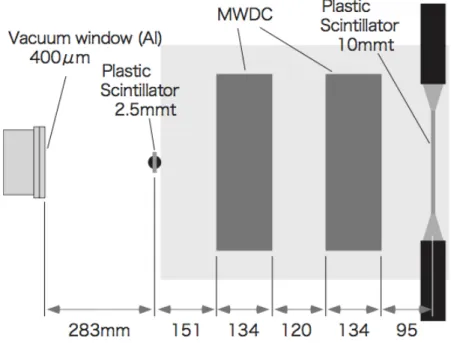
The test experiment was conducted in 1.5 days atthe room TR4 in CYRIC, by using primary proton beams of 30 MeV/u. The beam energy was selected to simulate the energy loss of the signal 3He of 120 MeV/u in the pionic atom experiment. The beam was detected and identified by two plastic scintillators at the upstream and downstream of the MWDCs as shown in Fig. 1. MWDC is operated with pure isobutane gas at 13.3 kPa.
Figure 2 shows the evaluated detection efficiency as a function of the voltage applied to cathode planes and potential wires. The red, blue and magenta color corresponds to the single, double, and more than three hits per plane in one event, respectively. As shown in the figure, the single-plane efficiency is greater than 98% with a voltage of higher than -1300 V. The plane resolution and stability under the high-rate condition are also evaluated with voltage of -1350 V. The plane resolutions are evaluated to be 0.27 ~ 0.35 mm (FWHM), which satisfy the experimental requirement. The stability test of the MWDC was performed with ~100 kHz proton beams. The condition is comparable with the expected high-rate background in terms of the space charge effect. Under this severe condition, we confirmed that the detection efficiency and resolution does not change by more than a few percent. A new tracking method using 1/3-cell staggered layers is also analyzed. Though the analysis is still in progress, the preliminary spectrum obtained with 2 of 3 layers shows better homogeneity compared with that with all layers.
From the above results, we found that the new MWDC shows satisfactory performance for our experiments. The precise analysis is ongoing.
33
References
1) K. Itahashi et al., RIBF Proposal No.135 (2015). 2) T. Uesaka et al., RIBF Proposal No.141 (2015). 3) H. Miya et al., Nucl. Instr. Meth. B 317 (2013) 701. 4) T. Nishi et al., Phys. Rev. Lett. 120 (2018) 152505.
5) Y. K. Tanaka, Ph. D. thesis, Univ. Tokyo (2016) Appendix B.
Figure 1. Detector setup on the beam line at room TR4.
Figure 2. Evaluated detection efficiency of the single plane as a function of voltage for cathode planes and potential wires. The red, blue, and magenta colors correspond to the multiplicity (= number of fired wires par plane) is one, two, and more than three in one event. The black points show the overall efficiency of the plane.