*
**
Determination of Compression Index for Toyoura Sand and Shirasu
by Triaxial Compression Test
Koji MISUMI* and Syohei NOMURA**
The determination procedure of sandy soil’s compression index is proposed in this paper. At first, a series of triaxial compression test datum are obtained under constant mean normal stress condition. Secondly, this method is carried out by fitting some equations to sandy soil’s shearing behaviors (i.e., dilatancy behaviors). Finally, sandy soil’s compression index is obtained by relationship between maximum positive volumetric strains and initial specific volumes. The validity of this method is confirmed by applying to Toyoura sand and local soil Shirasu. And the differences of these soils’ compression index are made clear by comparison with their values.
Keywords : compression index, triaxial compression test, dilatancy, Toyoura sand, Shirasu
*
´
ln p
v
e
v
1
e
p
´
N
v
ln p
´
v
ln p
´
v
ln p
´
´
ln p
v
v
v
v
v
ln p
´
v
v
A
B
v
B
A
´
0p
v
0 0v
v
0v
0ln
p
0´
v v A v Bv
0 Av
0 B´
ln
0 0p
v
Av
0ln
p
0´
B A B B Ap
p
v
v
´
ln
´
ln
0 0 0 0v
Av
Bv
´ ln p´ ln p A p´ lnv
ln p
´
B p´ ln´
0p
'
s v s´
0p
'
s v s'
sp
0´
´
p
'
sp
0´
v sp
0´
´
0p
'
s v s´
0p
'
s v s'
p
´
'
v s s s s s'
'
vv s
p
0´
'
sp
0´
v sp
0´
´
0p
'
s v s´
0p
'
s v s'
sp
0´
v sp
0´
'
sp
0´
v sp
0´
s s s s s s'
'
'
v v v v s0
v
´
0p
´
0p
0v
A 0v
B vv
0´
0p
Bc
vc
a
b
vav
c
b 0´
0p
Ad
a
b
c
d
d
v
0 Av
0 B va
v
d
c
b)
(
0 vv
0 0v
vv
0a
b
c
d
0v
v
v v v 0v
a
b
c
d
´
0p
v
0 0v
1) A. Schofield and P. Wroth, Critical State Soil Mechanics, McGRAW-Hill Publishing Company Limited, pp.124-127 (1968).
J. H. Atkinson and P. L. Bransby, The Mechanics of Soils, An Introduction to Critical State Soil Mechanics, McGRAW-Hill Book Company Limited, pp.235-262 (1978).
*
**
Determination of Compression Index for Local Soil Shirasu
by Box Shear Test
Koji MISUMI* and Taiji FURUKAWA**
The determination procedure of sandy soil’s compression index is proposed in this paper. At first, a series of box shear test datum are obtained under constant perpendicular stress condition. Secondly, this method is carried out by fitting some equations to sandy soil’s shearing behaviors (i.e., dilatancy behaviors). Finally, sandy soil’s compression index is obtained by relationship between maximum compressive displacements and initial specific volumes. The validity of this method is confirmed by applying to local soil Shirasu. And the relation between Shirasu’s compression index and degree of saturation is made clear for the first time.
Keywords : compression index, box shear test, dilatancy, local soil Shirasu, degree of saturation
r
S
v
ln
v
v
1
e
e
v
ln
v
ln
ln
v
v
v
ln
v
v
v
A
B
v
B
A
0 0const
.
v
0 0v
v
0v
0ln
0 maxy
y
max Ay
max B 0v
Av
0 Bv
0 A 0ln
Av
0 Bln
0 B A B B Av
v
0 0 0 0ln
ln
s maxe
mine
rS
rD
0 0P
0A
A
0v
x
x
y
T
A
x
x
y
x
x
y
x
x
S
r yx
S
x
yx
(mm) (mm)x
S
r yx
S
rx
S
rx
S
r yx
S
rx
S
r (mm) (mm) (mm) (mm) (mm) (mm) (mm) (mm) x x x x x x x x y y y yx
S
r yx
S
rx
S
r yx
S
rx
S
r yx
S
r 0v
0 0 0v
ln
v
v
0 Av
0 B 0 A 0 B maxy
v
0 0 A 0 B 0v
Av
0 B (mm) (mm) (mm) (mm) (mm) (mm) (mm)x
x x x x x y y yr
S
y
maxv
0 maxy
c
0 Aa
b
c
av
b vmax 0a
b
c
0 Bd
c
d
v
a
b vmax(
0)
d
d
v
0 Av
0 B rS
y
maxv
0 rS
y
maxv
0 rS
y
maxv
0 rS
rS
S
r rS
S
rS
max y max y max y max y 0v
0 v 0v
0v
r
S
rS
S
r0.3867
+
0013
.
0
S
r rS
maxy
v
0 0 0v
rS
rS
rS
rS
A. Schofield and P. Wroth, Critical State Soil Mechanics, McGRAW-Hill Publishing Company Limited, pp.89-166 (1968).
J. H. Atkinson and P. L. Bransby, The Mechanics of Soils, An Introduction to Critical State Soil Mechanics, McGRAW-Hill Book Company Limited, pp.184-291 (1978). 4) r
S
r S57 2015
* ** *** *** ***
Air Pollution in Kagoshima City (Part 28)
Investigation from April 2014 to March 2015
Tomohiro MOTOMURA*, Haruna TANIGUCHI**, Tsunenori NAKAJIMA***,
Hirokazu TAKANASHI*** and Akira OHKI***
Air pollution in Kagoshima City from April 2014 to March 2015 was investigated with particular emphasis on the dust fall (volcanic ash fall) from Mt. Sakurajima. The dust fall was collected monthly with rainwater at eight locations in Kagoshima City. After the sample had been filtered, the residue was dried and weighed, and the filtrate was analyzed for SO4
2-, Cl-, and water-soluble matter, as well as for pH. The average monthly dust fall at eight locations in Kagoshima City was 55.8 g·m-2·month-1, which was 40% decrease from that observed in the last fiscal year. The concentration of NO2 in the air was
measured by use of the "filter-badge method". The average NO2 concentration at the eight locations was
5.8 ppb, which was somewhat lower than that observed in the last fiscal year. Keywords: air pollution, Kagoshima City, dust fall, NO2
N 5km NO2 mm a) a) a) a) a) ppb 4 8.4 122 3.8 34.2 5.9 40.1 0.7 7.1 0.5 4.4 -5 21.9 318 4.4 44.8 1.7 46.5 0.7 2.1 1.8 5.3 2.3 6 - c) 5.0 396.7 20.1 416.8 2.0 3.0 4.7 7.2 -7 - d) 4.5 17.3 0.9 18.2 1.2 2.7 1.1 2.4 2.2 8 15.8 230 4.5 7.8 0.2 8.0 0.6 2.5 0.5 2.2 -9 20.1 292 4.7 71.3 7.0 78.3 1.0 3.2 2.0 6.5 2.0 10 6.2 90.0 5.2 54.8 2.7 57.5 1.0 12.6 0.3 4.3 -11 10.3 150.0 4.8 190.2 0.3 190.5 0.9 5.8 0.8 5.2 5.3 12 6.8 99.0 4.6 112.1 1.9 114.0 0.8 9.4 0.6 7.5 -1 9.4 137.0 4.7 122.1 0.3 122.4 0.6 3.9 0.5 3.0 2.3 2 7.6 110.0 4.5 195.8 3.1 198.9 0.7 5.5 0.6 4.6 -3 4.9 71.0 4.2 219.1 2.3 221.4 0.6 7.2 0.8 9.0 2.4 Av. 11.1 162 4.6 122.2 3.9 126.1 0.9 5.4 1.2 5.1 2.8 pH Cl -SO4
2-NO2 mm a) a) a) a) a) ppb 4 7.4 106 4.0 5.2 2.5 7.7 0.4 4.9 0.6 6.6 -5 22.4 321 4.3 17.8 5.5 23.3 0.9 2.6 2.6 7.5 2.6 6 - c) 5.3 78.0 13.0 91.0 2.0 3.1 3.1 4.8 -7 - d) 5.0 6.6 5.4 12.0 0.9 2.0 1.0 2.2 2.6 8 20.9 300 4.4 2.9 3.3 6.2 0.7 2.2 0.8 2.6 -9 17.4 249 4.2 38.7 7.2 45.9 0.7 2.6 1.2 4.5 4.6 10 6.3 90 5.5 13.0 1.7 14.7 0.5 6.8 0.3 3.4 -11 8.7 125 4.5 53.4 0.3 53.7 0.4 3.2 0.8 6.5 3.5 12 7.7 110 4.3 20.0 0.9 20.9 1.2 12.8 0.6 5.9 -1 7.5 108 4.6 16.4 0.8 17.2 0.3 2.3 0.3 2.1 2.1 2 6.3 90 4.3 23.1 1.3 24.4 0.5 4.7 0.5 4.3 -3 5.4 77 4.1 33.1 1.2 34.3 0.6 6.5 0.4 4.6 5.2 Av. 11.0 158 4.5 25.7 3.6 29.3 0.8 4.5 1.0 4.6 3.4 pH Cl - SO 4 2-NO2 mm a) a) a) a) a) ppb 4 6.4 92.0 3.9 103.2 8.2 111.4 0.5 6.9 0.5 6.5 -5 23.1 333.0 4.4 63.8 2.5 66.3 0.9 2.5 2.6 7.4 10.9 6 - c) 4.7 155.5 15.9 171.4 2.3 3.5 3.4 5.2 -7 - d) 4.8 28.2 12.1 40.3 2.1 4.6 1.1 2.4 4.7 8 22.1 319.0 4.3 21.7 0.6 22.3 0.8 2.5 0.9 2.7 -9 15.7 227.0 4.5 198.3 4.5 202.8 2.2 9.3 1.9 8.0 13.5 10 4.0 58.0 4.8 218.0 4.5 222.5 1.0 20.4 0.9 17.9 -11 8.6 124.0 4.7 262.1 3.1 265.2 0.5 3.8 2.3 18.2 10.5 12 7.0 101.0 4.5 68.2 1.5 69.7 1.2 14.0 0.6 7.0 -1 9.3 134.0 4.6 46.5 1.0 47.5 0.8 5.6 0.7 5.0 5.1 2 5.9 85.0 4.3 86.8 0.4 87.2 0.7 6.9 0.5 5.3 -3 4.5 65.0 4.2 158.3 3.1 161.4 0.7 8.5 0.8 10.5 12.7 Av. 10.7 154 4.5 117.6 4.8 122.3 1.1 7.4 1.4 8.0 9.6 pH Cl -SO4 2-NO2 mm a) a) a) a) a) ppb 4 5.1 73.0 5.2 23.3 5.1 28.4 0.4 7.0 0.9 15.0 -5 18.7 268.0 5.2 31.1 2.9 34.0 0.8 2.7 4.6 15.9 2.4 6 - c) 5.9 11.5 7.1 18.6 2.0 3.1 3.4 5.2 -7 - d) 6.1 7.1 7.9 15.0 1.8 4.1 1.2 2.8 1.8 8 16.1 231.0 4.9 15.0 9.9 24.9 0.7 2.9 0.8 3.3 -9 16.9 242.0 5.6 111.9 7.0 118.9 0.7 2.9 1.5 5.9 5.3 10 4.0 57.0 4.9 50.5 14.3 64.8 1.0 19.2 0.5 10.8 -11 7.5 108.0 4.9 24.2 0.9 25.1 0.5 4.6 0.6 5.7 6.3 12 7.3 105.0 4.8 33.6 2.7 36.3 1.2 13.2 0.6 6.3 -1 8.0 115.0 4.9 12.0 1.0 13.0 0.5 4.1 0.5 4.0 7.3 2 4.7 67.0 4.1 15.0 0.9 15.9 0.6 8.0 0.5 7.0 -3 4.0 57.0 4.6 27.8 3.1 30.9 0.7 9.8 0.7 9.7 7.4 Av. 9.2 132 5.1 30.3 5.2 35.5 0.9 6.8 1.3 7.6 5.1 pH Cl - SO 4 2-NO2 mm a) a) a) a) a) ppb 4 6.7 97.0 4.1 26.0 4.8 30.8 0.5 6.2 0.6 7.0 -5 22.5 326.0 4.4 26.6 1.4 28.0 0.9 2.6 2.8 7.9 3.3 6 - c) 4.9 36.7 14.9 51.6 1.9 2.9 3.3 5.1 -7 - d) 4.8 5.2 5.8 11.0 1.7 3.8 0.9 2.0 5.1 8 17.3 251.0 4.2 7.2 1.5 8.7 0.8 3.2 0.9 3.6 -9 20.7 300.0 4.0 207.5 8.1 215.6 1.0 3.2 2.4 7.7 10.6 10 4.1 59.0 4.6 107.8 5.7 113.5 1.0 18.2 0.4 8.0 -11 8.2 119.0 4.3 68.3 0.7 69.0 0.6 4.6 0.6 4.5 10.6 12 7.2 104.0 4.4 22.1 2.1 24.2 1.2 13.7 0.4 4.8 -1 10.8 157.0 4.7 13.3 0.9 14.2 0.6 3.6 0.4 2.6 10.8 2 6.7 97.0 4.1 10.2 4.5 14.7 1.9 17.4 0.8 7.0 -3 5.6 81.0 4.2 78.2 3.2 81.4 0.9 9.3 0.9 9.1 11.4 Av. 11.0 159 4.4 50.8 4.5 55.2 1.1 7.4 1.2 5.8 8.6 pH Cl - SO 4 2-NO2 mm a) a) a) a) a) ppb 4 8.3 118.0 6.5 19.1 4.6 23.7 1.1 11.2 1.9 18.8 -5 22.1 315.0 6.0 13.5 0.7 14.2 0.8 2.4 6.6 19.7 2.2 6 - c) 6.0 15.3 6.5 21.8 1.8 2.7 3.6 5.5 -7 - d) 5.9 3.5 2.2 5.7 1.1 2.4 1.2 2.6 1.8 8 14.4 205.0 5.0 2.9 0.6 3.5 0.6 3.0 0.8 3.9 -9 22.7 323.0 6.0 160.1 24.1 184.2 1.2 3.6 2.8 8.3 6.4 10 4.2 60.0 5.5 145.2 6.8 152.0 1.2 23.1 1.1 20.2 -11 9.4 134.0 5.1 36.9 12.7 49.6 1.5 11.0 0.8 6.0 6.5 12 9.6 137.0 5.0 22.6 3.9 26.5 1.8 15.0 0.5 4.6 -1 10.4 148.0 4.8 30.1 4.8 34.9 1.1 6.4 0.6 3.6 9.5 2 5.9 84.0 4.1 21.2 0.9 22.1 1.0 10.7 0.8 8.7 -3 5.9 84.0 5.0 16.2 4.7 20.9 1.6 15.1 1.0 9.2 7.9 Av. 11.3 161 5.4 40.6 6.0 46.6 1.2 8.9 1.8 9.3 5.7 pH Cl - SO 4 2-NO2 mm a) a) a) a) a) ppb 4 7.3 105.0 5.4 3.1 1.2 4.3 0.5 5.8 0.9 10.1 -5 22.3 320.0 5.0 1.5 1.4 2.9 0.7 2.2 3.8 11.0 4.0 6 - c) 5.2 1.2 2.6 3.8 1.5 2.3 3.0 4.5 -7 - d) 5.4 1.9 1.8 3.7 2.0 4.5 0.8 1.7 4.1 8 16.5 237.0 4.4 1.7 3.1 4.8 0.8 3.2 1.0 4.2 -9 21.4 307.0 4.8 148.0 8.6 156.6 2.3 7.2 3.0 9.3 11.0 10 3.6 52.0 5.4 22.2 6.6 28.8 2.1 47.2 0.7 15.8 -11 9.0 129.0 5.3 13.8 0.9 14.7 0.7 5.1 0.2 1.8 7.4 12 7.0 100.0 5.0 8.4 2.8 11.2 2.0 22.8 0.5 5.5 -1 11.3 162.0 5.0 7.1 1.8 8.9 0.7 3.8 0.5 2.8 10.8 2 5.6 80.0 4.2 5.8 0.8 6.6 0.8 8.1 0.6 6.6 -3 4.7 67.0 4.8 7.4 3.5 10.9 0.8 9.8 0.7 8.3 6.9 Av. 10.9 156 5.0 18.5 2.9 21.4 1.2 10.2 1.3 6.8 7.4 pH Cl -SO4 2-NO2 mm a) a) a) a) a) ppb 4 8.5 123.0 4.4 4.4 2.0 6.4 0.5 4.6 0.6 5.4 -5 20.4 294.0 4.6 2.4 0.6 3.0 0.7 2.3 2.0 6.3 2.0 6 - c) 4.6 1.4 1.9 3.3 1.3 2.1 2.4 3.6 -7 - d) 5.2 1.4 1.3 2.7 1.2 2.8 0.7 1.5 0.6 8 14.0 202.0 6.0 0.3 0.6 0.9 1.1 5.2 0.8 3.9 -9 20.9 302.0 4.7 16.8 5.0 21.8 0.9 2.9 1.4 4.4 5.2 10 5.6 81.0 4.4 12.8 7.5 20.3 2.8 38.7 0.6 8.7 -11 8.7 126.0 4.3 3.8 0.9 4.7 0.8 6.2 0.1 1.1 4.1 12 9.8 141.0 4.1 5.1 3.2 8.3 1.9 15.7 0.5 4.5 -1 11.7 169.0 4.5 23.7 0.9 24.6 0.7 3.8 0.4 2.2 4.6 2 5.5 79.0 4.0 17.8 0.3 18.1 0.5 5.2 0.5 6.0 -3 4.8 69.0 5.2 2.2 4.4 6.6 0.8 8.7 0.7 7.8 4.5 Av. 11.0 159 4.7 7.7 2.4 10.1 1.1 8.2 0.9 4.6 3.5 pH Cl - SO 4 2-NO2 mm a) a) a) a) a) ppb 4 7.3 105 4.7 27.3 4.3 31.6 0.6 6.7 0.8 9.2 -5 21.7 312 4.8 25.2 2.1 27.3 0.8 2.4 - - 3.7 6 - c) 5.2 87.0 10.3 97.3 1.9 2.8 3.4 5.1 -7 - d) 5.2 8.9 4.7 13.6 1.5 3.4 1.0 2.2 2.9 8 17.1 247 4.7 7.4 2.5 9.9 0.8 3.1 0.8 3.3 -9 19.5 280 4.8 119.1 8.9 128.0 1.3 4.4 2.0 6.8 7.3 10 4.8 68 5.0 78.0 6.2 84.3 1.3 23.3 0.6 11.1 -11 8.8 127 4.7 81.6 2.5 84.1 0.7 5.5 0.8 6.1 6.8 12 7.8 112 4.6 1.3 2.4 38.9 1.4 14.6 0.5 5.8 -1 9.8 141 4.7 33.9 1.4 35.3 0.7 4.2 0.5 3.2 6.6 2 6.0 87 4.2 47.0 1.5 48.5 0.8 8.3 0.6 6.2 -3 5.0 71 4.5 67.8 3.2 71.0 0.8 9.4 0.8 8.5 7.3 Av. - - 4.8 48.7 4.2 55.8 1.0 7.3 1.1 6.1 5.8 pH Cl - SO 4
2-0 100 200 300 400 500 600 4 5 6 7 8 9 10 11 12 1 2 3 Av. 2014 2013 0 100 200 300 400 500 600 4 5 6 7 8 9 10 11 12 1 2 3 Av. No.1 No.2 0 100 200 300 400 500 600 4 5 6 7 8 9 10 11 12 1 2 3 Av. No.3 No.4 0 50 100 150 200 250 300 350 400 4 5 6 7 8 9 10 11 12 1 2 3 Av. No.5 No.6 0 50 100 150 200 4 5 6 7 8 9 10 11 12 1 2 3 Av. No.7 No.8 0 50 100 150 200 250
No.1 No.2 No.3 No.4 No.5 No.6 No.7 No.8 Av.
2014 2013 0 1000 2000 3000 4000 5000 6000 0 100 200 300 400 500 600 80 82 84 86 88 90 92 94 96 98 0 2 4 6 8 10 12 14 0 500 1000 1500 0 50 100 150 200 250 300 4 5 6 7 8 9 10 11 12 1 2 3 Av.
0 500 1000 1500 2000 2500 3000 4 5 6 7 8 9 10 11 12 1 2 3 Av. 0 1 2 3 4 0 2 4 6 8 10 12 14 4 5 6 7 8 9 101112 1 2 3Av. Cl-s Cl -SO4 2-0 2 4 6 8 10 12
No.1 No.2 No.3 No.4 No.5 No.6 No.7 No.8 -4.9 5.0-5.4 5.5-5.9 6.0-pH
1 , , 56 17 (2014) 2 W. Leithe, , pp. 110-112 (1973) 3 , 21, 140 (1979) 4 , , -pp. 59-62 (1984) 5 HP 2015 7 14 , http://www.data.jma.go.jp/svd/vois/data/tokyo/ST OCK/monthly_v-act_doc/monthly_vact_506.html 6 HP 2015 7 14 , https://www.pref.kagoshima.jp/aj01/bosai/sonae/sa kurajima/sakurajimakouhairyou2.html 0 5 10 15
No.1 No.2 No.3 No.4 No.5 No.6 No.7 No.8 Av. 2014 2013 0 5 10 15 20 25 6/4 8/4 10/1 12/3 2/4 3/26 Av. No.2 No.3 No.5 No.7 0 5 10 15 20 25 6/4 8/4 10/1 12/3 2/4 3/26 Av.
Fundamental Study on Cathodic Protection of RC Structures using Thermal Spray type Galvanic
Anode System and Its Corrosion Protection Design
Makoto Yamamoto 4 5 6 7
Fundamental study on new diagnostic method for gastrointestinal cancer
Takuma Yoshinaga
angiopoietin-like protein 2 (ANGPTL2) ANGPTL2 ANGPTL2 1 2 ANGPTL2 4 HGC-27 ANGPTL2 ANGPTL2 mRNA HGC-27 ANGPTL2 ANGPTL2 ANGPTL2
C-reactive protein (CRP), carcinoembryonic antigen (CEA), carbohydrate antigen 19-9 (CA19-9)
ANGPTL2 3 ANGPTL2 7 Colo320 ANGPTL2 ANGPTL2 ANGPTL2 ANGPTL2 4 (FFPE) FFPE ANGPTL2 mRNA FFPE ANGPTL2
mRNA ANGPTL2 mRNA
FFPE ANGPTL2 mRNA
5
ANGPTL2
The Research Reports of the Faculty of Engineering, Kagoshima University, No.57 (2015)
Doctoral Dissertation, Graduate School of Science and Engineering, Kagoshima University, Doctorate No.408
A Study on Energy Separation Mechanism in Ranque-Hilsch Vortex Tube
MOHD HAZWAN BIN YUSOF
1. Introduction
This thesis describes the experimental and model analysis on the energy separation mechanism in a counter flow Ranque-Hilsch vortex tube (VT). This thesis comprises 6 chapters; 1) Introduction, 2) Experimental Apparatus and Methods, 3) Development of Total Temperature Probe, which explains developed three total temperature probes and measurement accuracy, 4) Flow Measurement at Cold Exit, which reports the results of total temperature/pressure measurements and flow visualization at the cold flow exit (cold exit), 5) Mathematical Model Analysis of Compressible Vortex Flow, which describes a mathematical model analysis of isolated unconfined compressible vortex flow (VAB model) with a review of some literatures, and 6) Conclusions.
2. Results and Discussions
An evaluation experiment is conducted using the
developed total temperature probes which are named as Type 1, 2, and 3 to determine the effects of probe angle along the centerline of a sonic jet nozzle on the measurement accuracy. Results show that the largest measurement error for Type 1, 2, and 3 are 1.3 C, 1.1 C, and 0.7 C, respectively, and the effect of the angle of the thermocouple on the total temperature measurement is negligibly small.
The experiments of the effects of the cold fraction on the measurement were carried out with the Type 3 total temperature probes and Pitot pressure probe. From the results, a negative and positive gauge pressure regions are measured. It implies the possibility of a direct/reversed flow at the cold exit. To clarify the flow
Date of Conferment of the Degree: March 25, 2015 Kagoshima University
direction, two kinds of flow visualization are conducted. From the results, a reversed flow is observed around the center of cold exit at a smaller cold fraction. The length of reversed flow increases as the cold fraction decreases, which implies the decrease in the pressure at the core of the vortex chamber. A lower pressure in the vortex chamber means a lower static/total temperatures at the core of vortex chamber and a higher static/total temperatures at the outer region of the vortex in the vortex chamber. This is the effect of cold fraction on the EMS at an arbitrary inlet pressure.
The VAB model is improved by replacing the laminar Prandtl number with a laminar plus turbulent Prandtl numbers. The analysis results show that a hotter gas in the peripheral region of the vortex is mainly caused by heat generated by viscous dissipation, and colder gas in the vortex core is mainly generated by viscous shear work done on the surface of the fluid element to the surrounding gas.
3. Conclusions
The objective of this study is to clarify the energy separation mechanism of VT. For the purpose of this objective, the experimental and analytical studies were carried out.
From the experimental results, a reversed flow is observed at the cold exit. The length of the reversed flow increases as the cold fraction decreases, which implies the decrease in the pressure and temperature at the core of the vortex chamber. This also leads to a higher static/total temperatures at the outer region of the vortex in the vortex chamber.
From the VAB model analysis results, it is understood that a hotter gas in the peripheral region of the vortex is mainly caused by heat generated by viscous dissipation, and colder gas in the vortex core is mainly generated by viscous shear work done on the surface of the fluid element to the surrounding gas.
A Study on Excited Electron State of Inner-core Electrons of Zinc Films Generated by Surface
Ion-recombination Processes
Li CHEN
A Study of Electrical Erosion of Bearings in Motors Used to Drive Air-Conditioning Fans
The Research Reports of the Faculty of Engineering, Kagoshima University, No.57 (2015)
Doctoral Dissertation, Graduate School of Science and Engineering, Kagoshima University, Doctorate No.409
Research on Facial Visual-Infrared Stereo Vision Fusion Measurement for
Internal State Estimation
Mohd Norzali Bin Haji Mohd
1. Introduction
Our main aim is to propose a vision-based measurement as an alternative to physiological measurement for recognizing mental stress. The development of this emotion recognition system involved three stages: experimental setup for vision and physiological sensing, facial feature extraction in visual-thermal domain, mental stress stimulus experiment and data analysis and classification based on Support Vector Machine. An experiment to measure mental stress by using the proposed system based on Support Vector Machine classification had been proposed and conducted and showed promising results.
2. Background
Various methods for internal state measurement such as mental stress have been previously proposed which utilizes the changes of physiological quantities such as blood pressure, heart rate, salivary amylase and electromyography (EMG). These quantities can be measured invasively by the use of expensive instruments. In this research, we introduce an integrated non-invasive measurement through imaging means.
Fig 1. Overall System
Date of Conferment of the Degree: March 25, 2015 Kagoshima University
3. Experiments
Data from 20 experimental subjects, using 90 mean sample and the labelling was done at three stages based on Salivary amylase level, Non Stress:0-30 [KU/L], Low Stress: 31-59 [KU/L], High Stress: >=60 [KU/L] . The classification performance was evaluated using leave one out-cross validation (LOOCV). 30 samples were pulled out as the test samples, and the remaining samples 60, were used to train as the classifiers. Performance of system is summarized in a confusion matrix which contains information about actual and classified affective states as shown in Table 1, the classification accuracies of 7 features of vision and physiological measurement is 88.9%. The classification using 5 features which is only vision measurement is 74.4%.
Table 1. Experimental Results
4. Conclusions
Three vision-based and two physiological measurements had been proposed and show promising results. This motivates the use of vision-based as it only requires crucial data after pattern recognition and processing of partial image. Our methodology to estimate emotional state from human subjects by extracting facial characteristic shows good performance.
The Research Reports of the Faculty of Engineering, Kagoshima University, No.57 (2015)
Doctoral Dissertation, Graduate School of Science and Engineering, Kagoshima University, Doctorate No.410
Attentive tracking of multiple moving objects in a real 3D environment
Anis Ur REHMAN
1. Introduction
In this study, we investigated multiple object tracking in a real 3D environment. In Experiment 1, we examined whether the targets on different planes could be tracked simultaneously if the moving objects stayed at the same depth throughout a trial. In Experiment 2, we tested whether the targets on different depths could be tracked easily if the depth between them was kept 6 cm. In Experiment 3, targets and distractors were distributed equally over each plane at the beginning of a trial. In Experiments 4 and 5, the targets and distractors were presented on different depth planes separately at the start of the trials. In Experiment 6, the conditions used in Experiments 3 and 4 were intermixed to investigate whether or not the unpredictability of distribution of objects at the beginning affects attentive tracking to a depth-changing target.
2. Results and Discussions
The results of Experiment 1 indicate that tracking was not affected by visual distance (relative to the observer) when all objects were presented on a single plane. Similarly, the results of all-Ts-far and all-Ts-near conditions showed no effects of depth with higher performance levels. However, an increase in depth between the planes hindered attentive tracking when both planes had two targets each (Figure 1).
The results of Experiment 6 suggest that, even when distribution of objects varied at the beginning of each trial, participants can focus their attention on a particular depth or across two depth planes depending on the initial state trial by trial, and they cannot reset their focused attention from a particular plane to two planes during attentive tracking (Figure 2).
Date of Conferment of the Degree: March 25, 2015 Kagoshima University
Fig.1. Results of Experiment 1
Fig.2. Results of Experiment 6 3. Conclusions
In conclusion, our findings suggest that humans can attentively track targets in the same way as if they are on a single plane when in fact the targets are presented on different depth planes in some situations. The efficiency of the attentive tracking in depth is critically dependent not only on the distance but also on an initial state of distribution of the targets. In addition, human have flexible ability to set their attention on a particular depth or across two depths according to the initial position of the objects in a real 3D space.
Study on Kinematics and Movement Accuracy Improvement of Parallel Mechanism
Study on Sugar Chain-Immobilized Fluorescent Nanoparticles
for Functional Analysis and Diagnostic Use
Hiroyuki SHINCHI SFNP SFNP SFNP SFNP 2015 3 25 SFNP SFNP SFNP ELISA SFNP SFNP SFNP
The Research Reports of the Faculty of Engineering, Kagoshima University, No.57 (2015)
Doctoral Dissertation, Graduate School of Science and Engineering, Kagoshima University, Doctorate No.415
Study on the Development of Highly Sensitive Detection Method for Dengue
Virus
Budi Saksono 1. Introduction
Dengue virus infects the cell after the binding to sugar chain present on the cell surface. We utilized the interaction between dengue virion and the sugar chain, and developed highly sensitive dengue virus detection method using nanotechnology and genetically detection technique approaches. Based on the previous research in our laboratory, we first selected appropriate sugar chains which bound strongly to dengue virion, and prepared sugar chain immobilized gold nano particles (SGNPs). The SGNP captured the dengue virion through the specific interaction between sugar chain and spike proteins of the virus, and the SGNP-virus complex was precipitated by the regular centrifugation, which resulted in the concentration of virions. From the precipitate, viral RNA was extracted and quantified by PCR method. After the in vitro experiments, we also performed the clinical study using patients sera in Indonesia.
2. Result and Discussion
First, to develop SGNP, we evaluated the interaction property of 48 kinds of sugar chains using SPR imaging method. The result showed that dengue virion had strong binding capacity to chondroitin sulfate type E (CS-E), heparin and low molecular weight dextran sulfate (DS25). We then used heparin and DS25 to prepare 3 kinds of SGNP, i.e. DS25-GNP, DS25-cGNP and Hep-GNP, respectively.
We then evaluate the SGNPs on their effectiveness to capture and concentrate the virus. As the result, DS25-GNP showed the best effectiveness in capturing and concentrating the dengue virus. The investigation using Dynamic light scattering method showed that DS25-GNP had 17 nm of diameter, the smallest nanoparticle among 3 kinds of SGNP, which suggested that the smaller DGNP is better in capturing and concentrating the virus. Our in vitro studies using DS25-GNP showed that the SGNP was able to capture and concentrate small abundant of the viruses in the presence of 1% of serum.
Next, we used the SGNP method in clinical studies, using sera collected from dengue suspected patients in Indonesia. To evaluate the sensitivity, convenience, and serotyping ability, we compared our SGNP method with Qiagen method. We evaluate 87 specimens in the study. We used only 6 L of serum and finally obtained 20 L PCR sample 3 times dilution in SGNP method. In contrast, in Qiagen method we used 140 L of serum and finally obtained 50 L of PCR sample (3 times concentration) according to the manual of the kit. Both results were compared statistically and concluded that there was no difference, suggesting our SGNP method can overcome the Qiagen method in detecting dengue virus in serum.
3. conclusion
We succeeded to develop a highly sensitive of dengue virus detection method using the interaction between dengue virion and sugar chain.
Date of Conferment of the Degree: March 25, 2015,
Kagoshima University Graduate School of Science and Engineering
International MultiConference of Engineers and Computer Scientists 2015 (IMECS 2015), Hong Kong, 18-20 March, 2015.
Path-overlap Avoidance in Multiple Route Construction
for Mobile Relay on WSN
Yogi Anggun Saloko YUDO
1, Noritaka SHIGEI
1, and Hiromi MIYAJIMA
11
Graduate School of Science and Engineering, Kagoshima University
Abstract
ENERGY is the most important resource in Wireless Sensor Network (WSN) [1], because it determines the lifetime of a sensor node. Since the sensor nodes are usually powered by limited power batteries, low energy consumption is very important, in order to prolong the network lifetime of WSN. In recent years, many researchers designed and developed techniques for prolonging the network lifetime of WSN [1,2]. One of the techniques is mobile relay [3,4,5]. The concept of mobile relay is that some movable nodes change their location so as to minimize the total energy consumed by both wireless transmission and locomotion. Mobile relay needs to determine an initial route, which describes the sequence of nodes used for relaying the data from a source node to a sink node, and then the relaying nodes change their location so as to reduce their energy consumption.
In previous studies, we have already proposed Battery-Aware Initial Route Construction-Dijkstra’s algorithm (BAIR-D) for determining the initial route based on Dijkstra’s algorithm [6]. This method can construct the optimal path in terms of given cost function. Further, the algorithm takes into account nodes’ battery levels and avoids using nodes with low battery levels. However, when applying it to multiple sources, a problem arises. Since BAIR-D constructs the optimal path for each source, the constructed paths are necessarily overlapped with a high probability. The path-overlap increases the energy consumption of the nodes on overlapped paths. This makes the overloaded nodes go quickly down.
In this paper, we propose battery-aware multiple route construction with path-overlap avoidance (BMRC-POA). To overcome the problem in the conventional method, BMRC-POA finds the initial route for mobile relay with path-overlap avoidance. It avoids some nodes to be a relaying node for multiple source nodes. It also avoids the source node to be a relaying node to another source node. Avoiding path-overlap in multiple route construction can save the energy for some sensor nodes. Therefore, it can prolong the lifetime of sensor nodes. This method consists of two steps. First, the initial route construction for every source node is determined without path-overlap. Second, if some source nodes have no route, then the initial route construction is performed with a path-overlap scenario. We compare BMRC-POA and BAIR-D in terms of the number of operating rounds and the successful rate of initial route construction. Further, we compare both of the methods in terms of the total cost. The effectiveness of BMRC-POA is demonstrated by using numerical simulation.
References
1) J. Yick, B. Mukherjee and D. Ghosal, “Wireless Sensor Network Survey”, Computer Networks, Vol. 52, pp. 2292-2330, 2008.
2) C.Hua and T. P. Yum, “Optimal routing and data aggregation for maximing lifetime of wireless sensor networks,” IEEE ACM Trans, Netw., vol.16, no. 4, pp. 892-903, 2008.
3) F. El-Moukaddem,E. Torng, G. Xing and S. Kulkarni, “Mobile Relay Configuration in Data-intensive Wireless Sensor Networks”, Proc. of. Int. Conf. on Mobile Adhoc and Sensor Systems, pp. 80-89, 2009.
4) F. El-Moukaddem, E. Torng, and G.Xing, “Maximing Data Gathering Capacity if Wireless Sensor Networks using Mobile Relays”, Proc. of Int. Conf. on Mobile Adhoc and Sensor Systems, pp.312-321, 2010.
5) N. Shigei, I. Fukuyama, H. Miyajima and Yogi A. Saloko Yudo , “Battery-Aware Algorithm for Mobile Relay and Route Construction on Wireless Sensor Network”, IAENG Int. Journal of Computer Science, vol. 39, no. 3, pp. 321-328, 2012.
6) Yogi A. Saloko Yudo, N. Shigei and H. Miyajima, “Effective Initial Route Construction for Mobile Relay on Wireless Sensor Network”, Proc. of Int. Symposium on Artificial Life and Robotic, pp.311-316, 2014.
International MultiConference of Engineers and Computer Scientists 2015, March 18-20, 2014, Hong Kong
On the Capability of a Fuzzy Inference System
With Improved Interpretability
Hirofumi MIYAJIMA
1, Noritaka SHIGEI
1and Hiromi MIYAJIMA
11Graduate School of Science and Engineering, Kagoshima University
Abstract
Many studies on modeling of fuzzy inference systems have been made. The issue of these studies is to construct automatically fuzzy systems with interpretability and accuracy from learning data based on meta-heuristic methods[1]. Since accuracy and interpretability are contradicting issues, there are some disadvantages for self-tuning method[2]. Obvious drawbacks of the method are lack of interpretability and getting stuck in a shallow local minimum. Therefore, the conventional learning methods with multi-objective fuzzy modeling and fuzzy modeling with constrained
parameters of the ranges have become popular. However, there are little studies on effective learning methods of fuzzy inference systems dealing with interpretability and accuracy. In this paper, we will propose a fuzzy inference system with interpretability. Firstly, it is proved that the proposed model is an universal approximator of continuous
functions[3]. Further, the capability of the proposed model learned by the steepest descend method is compared with the conventional models using function approximation problems. Lastly, the proposed model is applied to obstacle
avoidance and the capability of interpretability is shown[4].
Reference
1) H. Nomura, I. Hayashi and N. Wakami, A Learning Method of Simplified Fuzzy Reasoning by Genetic Algorithm, Proc. of the Int. Fuzzy Systems and Intelligent Control Conference, pp.236-245, 1992.
2) M. J. Gacto, R. Alcala and F. Herrera, Interpretability of Linguistic Fuzzy Rule-based Systems:An Overview of Interpretability Measures, Inf. Sciences 181, pp.4340-4360, 2011.
3) M.M. Gupta, L. Jin and N. Homma, Static and Dynamic Neural Networks, IEEE Press, 2003. 4) H. Miyajima, N. Shigei and H. Miyajima, An Application of Fuzzy
Inference System Composed of Double-Input Rule Modules to Control Problems, Proceedings of the International MultiConference of Engineers and Computer Scientists 2014 Vol I, IMECS 2014, March 12-14, 2014.
SIMULTANEOUS DEBLUR
AND
SUPER-RESOLUTION
TECHNIQUE FOR
VIDEO
SEQUENCE
CAPTURED
BY
HAND-HELD
VIDEO CAMERA
Yuki MATSUSHITA
1, Hiroshi KAWASAKI
1, Shintaro ONO
2and Katsushi IKEUCHI
21
Graduate School of Science and Engineering, Kagoshima University
2
Institute of Industrial Science, University of Tokyo
Abstract
Nowadays, video camera is commonly used everywhere and demand of retrieving a single shot from video sequence is increasing[1][2][3]. Since resolution of video camera is usually lower than that of digital camera, simply cutting out a frame from a video sequence ends up with low quality. Further, because of the necessity of high fps on video camera, video data inevitably contains motion blur and it leads mis-registration between frames which is critical for multi-frame super-resolution. In this paper, we propose a method to restore high-resolution image from a video sequence
considering motion blur. Since the frame-rate of a video camera is high, motion of the object in successive frames is small, and thus, stable feature tracking during short sequences is possible even if there is a blur.[4][5] Thus, we adopt a division/integration approach to realize robust tracking for long sequence. We also propose a simultaneous deblur and super-resolution technique using multiple images based on MAP estimation.
Experimental results are shown to prove the strength of our method. (Figure.1)
(a) Input (b) Deblurring only (c) SR only (d) SR + deblur (proposed) Figure 1. Real scene experimental results.
References
1) Sunghyun Cho, Jue Wang, and Seungyong Lee, “Vdeo deblurring for hand-held cameras using patch-based synthesis,” ACM Transactions on Graphics, vol. 31, no.4, pp. 64:1–64:9, 2012.
2) Yunpeng Li, Sing Bing Kang, Neel Joshi, Steven M.Seitz, and Daniel P. Huttenlocher, “Generating sharp panoramas from motion-blurred videos,” in CVPR,2010, pp. 2424–2431.
3) Tae Hyun Kim, Byeongjoo Ahn, and Kyoung Mu Lee,“Dynamic scene deblurring,” December 2013. 4) Ville Ojansivu and Janne Heikkil¨a, “Image registration using blur-invariant phase correlation,” IEEE Signal
Process. Lett., vol. 14, no. 7, pp. 449–452, 2007.
5) Sei Nagashima, Takafumi Aoki, Tatsuo Higuchi, and Koji Kobayashi, “A subpixel image matching technique using phase-only correlation,” in Intelligent Signal Processing and Communications, 2006. ISPACS’06. International Symposium on. IEEE, 2006, pp. 701–704.
ASME 2014 International Mechanical Engineering Congress & Exposition, IMECE2014 November 14-20, 2014, Montreal, Quebec, Canada
Total Temperature Measurement of Gas Flow in Micro-tube
with Constant Wall Temperature
Seiryu MATSUSHITA
1, Taiki NAKAMURA
1, Chungpyo HONG
1and Yutaka ASAKO
21
Graduate School of Science and Engineering, Kagoshima University
2
Dept. of Mechanical Eng., Tokyo Metropolitan University,
Abstract
This paper describes experimental results on total temperature measurement of nitrogen micro-jet from micro-tubes outlet measured for the wide range from unchoked to choked flow. The experiments were preformed for a stainless micro-tube of 523.2 m in diameter whose temperature difference between the wall and inlet was maintained at 2, 5 and 10 K by circulating water around the micro-tube, respectively (Fig. 1). The gas flows out to the atmospheric condition. A thermally insulated tube of foamed polystyrene with six baffles fabricated by the companion paper where the gas velocity reduces and the kinetic energy is converted into the thermal energy, was attached to the outlet of the micro-tube. The inner diameter of the polystyrene tube is 22 mm. The baffles are equally spaced and the intervals of the baffles tested are 5 and 10 mm to investigate the effect of the interval of the baffle on the reduction of the gas velocity. The gas temperature measured by thermocouples at locations of baffles is considered as total temperature. The measured total temperature is higher than the wall temperature and increases with increasing the stagnation pressure (Reynolds number) for unchoked flow since the additional heat transfer from the wall to the gas near the micro-tube outlet caused by the temperature fall due to the energy conversion into the kinetic energy. It decreases in the insulated tube for chocked flow since Joule-Thomson effect is dominant in the insulated tube. The measured total temperatures are compared with results obtained by numerical computations (Fig. 2 ).
0 0.02 0.04 0.06 0.08 1 0 0.2 0.4 0.6 0.8 1.0 1.2 1.4 1.6
1.8 choked flowunchoked flow
Num. (D=500mm, L=0.1m) T
T Tb,incomp along the tube Re= 8518 11823 15017 18218 Exp. (D=523.2mm, L=0.1m) TT Tb,incomp at exit Tstg=297K Tw=299K 296K 300K 290K 300K X*
The 2014 Asia-Pacific Microwave Conference Sendai International Center, Sendai, Japan
Interference Analysis of Dual-band WiCoPT System
for Wireless Sensor Network in RVT
Ryo TAKAMORI
1, Kenjiro NISHIKAWA
1, Yusuke MARU
2and Shigeo KAWASAKI
21
Graduate School of Science and Engineering, Kagoshima University
2
Japan Aerospace Exploration Agency
Abstract
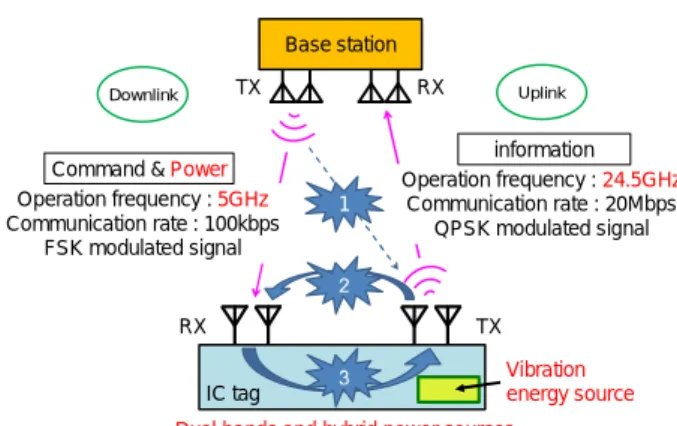
This paper proposes and demonstrates a dual-band Wireless Communication and Power Transmission (WiCoPT) system for a wireless health monitoring sensor network in Reusable Vehicle Test (RVT). Fig. 1 shows the wireless health monitoring system based on the dual-band WiCoPT. The proposed dual-band WiCoPT system employs 25 GHz-band for uplink and data transfer and 5 GHz-band for downlink and power transfer, resulting in an efficient wireless sensor system. The paper also analyzed the interference between uplink signals and downlink signals on the IC tag. When the interference power level from the downlink is less than 0 dBm on the IC tag, the uplink performances are suitable (Fig. 2). While the stable performance of the downlink are achieved when the interference power level from the base station is less than -25 dBm (Fig. 3). Under the above conditions, each EVM value is less than 10%. In addition, the uplink performances slightly depend on the linearity of the output power amplifier. Those results provide us a design guide to realize the WiCoPT health monitoring system in
the RVT. IC tag Uplink Downlink TX RX Vibration energy source TX RX
Dual bands and hybrid power sources
Base station Operation frequency : 24.5GHz Communication rate : 20Mbps QPSK modulated signal information Operation frequency : 5GHz Communication rate : 100kbps FSK modulated signal
Command & Power
IC tag 1
Fig. 1. Dual-band WiCoPT system
0 10 20 30 40 50 60 70 80 90 -50 -40 -30 -20 -10 0 10 20 30 P1dB=30dBm P1dB=10dBm P1dB=0dBm P1dB=-10dBm P1dB=-30dBm QPSK signal intensity (dBm) FSK signal power: -6dBm 0 10 20 30 40 50 -30 -20 -10 0 10 20 30 P1dB=30dBm P1dB=10dBm P1dB=0dBm FSK signal intensity (dBm) E V M o f Q P S K s ig n a l( % ) QPSK signal power: -6dBm
2014 Thailand-Japan MicroWave (TJMW), Mongkut’s Institute of Technology Ladkeabang (KMITL), Bangkok, Thailand, Nov. 26-28, 2014
Performance Analysis of Adjacent Channel Leakage power
Ratio depending on RF Components for Multiband Base Station
Hiroto SAKAKI
1, Masanobu TUSJII
1, Kenjiro NISHIKAWA
1, Kunihiro KAWAI
2,
Hiroshi OKAZAKI
2, and Shoichi NARAHASHI
21
Graduate School of Science and Engineering, Kagoshima University
2
Research Laboratory, NTT DOCOMO
Abstract
Future mobile communication systems demanded a carrier aggregation (CA) techniques and a multi-input multi-output (MIMO) transmission system to increase data traffic[1]-[3]. A high linear multiband low-noise amplifier (LNA) is a key component to realize the future systems. This paper analyzes the relationship between the Adjacent Channel Leakage power Ration (ACLR) and performances of the LNA and band pass-filter in an RF front-end. To achieve -30dBc ACLR, for instance, low linear LNA requires -55 dB out of band suppression BPF to achieve the same ACLR. These results provided a design guidance of the receiver on the mobile base station for system designers.
Reference
1) R. Ratasuk, D. Tolli, A. Ghosh, “Carrier Aggregation in LTE-Advanced,” 2010 IEEE 71st Vehicular Technology Conference, pp. 1-5, May 2010.
2) A. Ghosh, R. Ratasuk, B. Mondal, “LTE- Advanced: next-generation wireless broadband technology,” IEEE Wireless Communications, pp.10-22, Jun. 2010.
3) P.L. Tsai, K.C.J Lin, W.T. Chen, “Downlink radio resource allocation with Carrier aggregation in MIMO LTE-advanced systems,” 2014 IEEE Int. Conf. on Communications (ICC), pp. 10-14, Jun. 2014.
Fig. I System model Fig. II Block diagram of Simulation
(a) 700 MHz (b) 2.1 GHz
The Eighth China-Japan-Korea Joint Symposium on Optimization of Structural and Mechanical Systems Gyeongju, May 25-29, 2014, Korea
Structural Morphogenesis for Grid Shell with Member of Uniform Length
and Cross Section by Genetic Algorithms to Implement Manipulation of
Decent Solutions Search
Yuto NISHIMORI
1, Toshio HONMA
1and Yohei YOKOSUKA
11
Graduate School of Science and Engineering, Kagoshima University
Abstract
In this paper, the structural morphogenesis for a grid shell with the members of uniform length and cross section is indicated. The design of the grid shell structure with free curved surface for a large space became realizable from the confirmation of the structural rationality and the improvement in construction technology. However, the constraint for the productivity and constructability of these structures are produced in the length and cross section of the structural members.
In general, an optimization technique is used to obtain the global optimal solution. One of the authors proposed GA with immune system (ISGA) [1] for the structural optimization procedure that implemented the manipulation of the decent solutions search. The decent solutions have comparatively high evaluation value including the global optimal solution and the local optimal solutions and those neighborhood solutions. The decent solutions obtained by ISGA maintain diversity both in the design variable space and the objective function space. This structural optimization procedure with the manipulation of the decent solutions search is applied to structural morphogenesis for the grid shell [2]. The acquisition of the obtained rational and diversified solution forms will be used to support designer’s idea.
In the numerical examples, the decent solution forms of the analysis model for the symmetric grid shell structure are shown for an in plane rectangular geometry. First, we indicate the geometric relationship and computational procedure for creating curved surface using Bézier when the structural members are set to a uniform length and cross section. Next, we apply this technique to the structural morphogenesis for a grid shell with single-objective optimization problem for the total strain energy minimization or the bending strain energy minimization. Last, the structural properties of these decent solutions obtained by ISGA containing a global optimal solution and local optimal solutions are verified.
Figure below are some numerical examples of the decent solution forms for the grid shell structure with uniform length of all members. The cross section of the member in these forms has been optimized. In the boundary condition of the analysis model, the corner parts are pinned support.
References
1) T. Honma and K. Nozui : Structural Morphogenesis by using Genetic Algorithms with Diversity of Solution, Journal of structural and construction engineering. Transaction of AIJ, 614, 35-43, 2007. 4 (in Japanese)
2) Y. Okita and T. Honma, Structural morphogenesis for free-form grid shell using genetic algorithms with manipulation of decent solution search, Journal of the International Association for Shell and Spatial Structures, 53 (3), 177-184, 2012. 9
form-1 form-2 form-3 form-4
The Eighth China-Japan-Korea Joint Symposium on Optimization of Structural and Mechanical Systems Gyeongju, May 25-29, 2014, Korea
Structural Shape Optimization of Free-Form Surface Shell
and Property of Solution Search Using Firefly Algorithm
Natsuki TANAKA
1, Toshio HONMA
1and Yohei YOKOSUKA
11
Graduate School of Science and Engineering, Kagoshima University
Abstract
In the architecture field, structural shape optimization is needed to obtain form with mechanical rationality, and any of the multiple forms obtained by structural optimization can possibly support ideas of designer. Structural shape optimization has the heuristic optimization procedures such as genetic algorithm (GA) and swarm intelligence (SI) in one of the typical solution search techniques. GA is a scheme based on the mechanism of biological evolution. SI is a scheme that uses patterns found in self-organizing phenomena observed in nature. The well-known SI techniques include the particle swarm optimization (PSO), which is based on group behavior of birds and fish [1], and the artificial bee colony (ABC), which is based on the foraging behavior of a honeybee swarm [2], and are applied to a lot of structural optimization. A lot of SI including PSO and ABC attain a global optimal solution, and diversity on the design variable space of those solutions is low. The firefly algorithm (FA) was developed recently as the optimization computational scheme using a firefly’s ecology [3]. FA can attain both a global optimal solution and local optimal solutions by setting suitable computational parameters. However, the method for setting these parameters is comparatively difficult because the objective function space differs depending on the optimization problem [4]. In order to simplify the setting of these parameters in FA, we implement the computational scheme where the distance between two fireflies in the design variable space is dimensionless.
In this study, FA is applied to the structural shape optimization of a free-form surface shell. The solution forms that are obtained by FA are compared with those obtained by PSO, ABC and differential evolution (DE) [5]. DE is an evolutionary computational scheme, and performs solution search manner in similar to GA. The forms-1-3 and forms-4-6 that obtained by FA show solution forms that obtained by the total strain and bending strain energy minimization of a free-form surface shell structure, respectively. These solutions are applied to the local search [6] as an initial solution form, and it is indicated that the solution obtained by FA is extremal solution of a high estimation. In this paper, the effectiveness and the validity of FA for structural shape optimization are indicated through these numerical results.
References
1) J.Kennedy and R.Eberhart, Particle Swarm Optimization, Proc. of IEEE Inter. Conf. on Neural Network, IV (1995) 1942-1948.
2) D.Karaboga and B.Basturk, A powerful and efficient algorithm for numerical function optimization: artificial bee colony (ABC) algorithm, Journal of Glob Optimization 39 (2007) 459-471.
3) Xin-She Yang, Firefly Algorithms for Multimodal Optimization, Proc. 5th Inter. Conf. on Stochastic Algorithms, Foundations and Applications (2009) 169-178.
4) N.Tanaka and T.Honma, Structural Shape Optimization of Free-Form Surface Shell Using Firefly Algorithm, Proc. of IASS Symposium 2013,“BEYOND THE LIMITS OF MAN”, CD-ROM1226, 1-8
5) R. Storn and K. Price, Differential Evolution - A simple and efficient heauristic fot glopbal optimization over
form-1 form-2 form-3 form-4 form-5 Figure. Example of solution forms of free-form surface shell
2014 IUPAC World Polymer Congress (MACRO 2014), Chiangmai International Convention and Exhibition Centre, 6-11 July 2014, Chiang Mai, Thailand
Preparation of Chitin-based Nanomaterials
by Gas Bubbling-Ultrasonic Treatments
Kohei TANAKA, Kazuya YAMAMOTO, Jun-ichi KADOKAWA
Graduate School of Science and Engineering, Kagoshima University
Abstract
Chitin is one of the most abundant biomass resources. Although the construction of nanostructures is an efficient method for chitin materialization [1], they generally tend to aggregate by drying [2]. In this study, we found that nanowire network structures were constructed from chitin derivatives by gas bubbling-ultrasonic treatments in water. Furthermore, we also have paid attention to an amidine group to develop chitin nanowire network with re-construction property because the group reversibly changes to the amidinium bicarbonate under CO2 atmosphere [3]. When chitin
was first subjected to N2 gas bubbling-ultrasonic treatments in water, the SEM image showed that nanowire network
structure was constructed (Figure 1a). Then, a partially deacetylated chitin (PDA-chitin) was prepared by deacetylation of acetamido groups of the product under alkaline conditions [4]. Amidine groups were introduced by the reaction of primary amines in PDA-chitin with N,N-dimethylacetamide dimethyl acetal. After the amidinated chitin was subjected to CO2 gas bubbling-ultrasonic treatments in water, the SEM image
showed that nanowire network structure was remained. We examined re-nanostructuralization of the aggregated material, which was obtained by drying under reduced pressure. Consequently, the material was re-nanostructured by ultrasonic treatment in water (Figure 1b). This behavior was probably caused by the electrostatic repulsion of amidinium bicarbonates [5].
References
1) Y. Fan, T. Saito, A. Isogai, Biomacromolecules, 2008, 9, 192–198.
2) S. Ifuku, M. Nogi, M. Yoshioka, M. Morimoto, H. Yano, H. Saimoto, Carbohydr. Polym., 2010, 81, 134–139. 3) Q. Zhang, W. Wang, Y. Lu, B. Li, S. Zhu, Macromolecules, 2011, 44, 6539-6545.
4) S. Phougying, S. Aiba, S. Chirachanchai, Polymer, 2007, 48, 393-400. 5) K. Tanaka, K. Yamamoto, J. Kadokawa, Carbohydr. Res., 2014, 398, 25-30.
Figure 1. SEM images of chitin after N2bubbling
and ultrasonic treatments (a) and amidinium chitin after re-nanostructuration (b).
2014 IUPAC World Polymer Congress (MACRO 2014), Chiangmai International Convention and Exhibition Centre, 6-11 July 2014, Chiang Mai, Thailand
Enzymatic Synthesis of Non-natural
-
Glucosamine Chains
by Thermostable Phosphorylase Catalysis
Riko SHIMOHIGOSHI, Kazuya YAMAMOTO and Jun-ichi KADOKAWA
Graduate School of Science and Engineering, Kagoshima University
Abstract
Phosphorylase is the enzyme that catalyzes phosphorolysis of -(1 4)-glucans at a nonreducing end, such as glycogen and amylose, giving -Dglucose 1phosphate (Glc1P). By means of the reversibility of the reaction, -(1 4)-glucans can be prepared by the phosphorylase-catalyzed -glucosylation using Glc-1-P as a glycosyl donor and a maltooligosaccharide as a glycosyl acceptor [1]. Because of loose specifiity for the recognition of substrates [2], phosphorylase recognizes several analogue substrates of Glc-1-P as glycosyl donors in -glycosylations to give non-natural oligosaccharides. For example, we previously reported that -D-glucosamine 1-phosphate (GlcN-1-P) could be used as a glycosyl donor in potato phosphorylase-catalyzed enzymatic -glucosaminylation to give oligosaccharides having a glucosamine (GlcN) residue at a nonreducing end [3]. Because it is known that thermostable phosphorylase differs in recognition ability of substrates from potato phosphorylase, in this study, we have examined the thermostable phosphorylase-catalyzed enzymatic -glucosaminylations using GlcN-1-P (Figure 1). Consequently, we found that successive -glucosaminylations occurred by thermostable phosphorylase catalysis to give non-natural -glucosamine chains. When the enzymatic reaction was conducted in ammonia buffer containing Mg2+ ion, the -glucosaminylations were accelerated owing to the precipitation of inorganic phosphate to produce the high molecular weight products.
References
2014 IUPAC World Polymer Congress (MACRO 2014), Chiangmai International Convention and Exhibition Centre, 6-11 July 2014, Chiang Mai, Thailand
Preparation of Inclusion Supramolecular Polymers
by Vine-twining Polymerization Approach
Shota SASAYAMA
1, Kazuya YAMAMOTO
1, Tomonari TANAKA
2, Yoshiharu KIMURA
2,
Jun-ichi KADOKAWA
11 Graduate School of Science and Engineering, Kagoshima University 2
Graduate School of Science and Technology, Kyoto Institute of Technology
Abstract
Amylose is a polysaccharide with helical conformation linked through (1 4)-glycosidic linkages. It is a well-known host compound that forms inclusion complexes with hydrophobic guest compounds having relatively lower molecular weight. However, little has been reported regarding the formation of inclusion complexes between amylose and polymeric compounds. In the previous studies, we have developed a new methodology for the preparation of inclusion complexes composed of amylose and synthetic polymers such as poly(L-lactide) (PLLA), which was achieved by the phosphorylase-catalyzed enzymatic polymerization of -D-Glucose 1-phosphate salt (G-1-P) using a maltooligosaccharide primer in the presence of guest polymers. The representation of this reaction system is similar to the way that vines of plants grow twining around a rod. Accordingly, we have proposed that this polymerization method for the preparation of amylose-polymer inclusion complexes is named “vine-twining polymerization” [1]-[3]. In this study, we performed vine-twining polymerization using maltooligosaccharide-functionalized poly(L-lactide), which was a primer-guest conjugate (Figure 1). The XRD, 1H NMR, and GPC results of product indicated that the elongated amylose chain included PLLA each other to produce the inclusion supramolecular polymer [4].
References
1) J. Kadokawa, Polymers 2012, 4, 116. 2) Kadokawa, Biomolecules 2013, 3, 369.
3) Y. Kaneko, K. Ueno, T. Yui, K. Nakahara, J. Kadokawa, Macromol. Biosci. 2011, 11, 1407.
4) T. Tanaka, S. Sasayama, S. Nomura, K. Yamamoto, Y. Kimura, J. Kadokawa, Macromol. Chem. Phys. 2013, 214, 2829.
2014 IUPAC World Polymer Congress (MACRO 2014), Chiangmai International Convention and Exhibition Centre, 6-11 July 2014, Chiang Mai, Thailand
Preparation of Carboxymethyl Cellulose/Chitin Nanofiber Composite Films
Daisuke HATANAKA, Kazuya YAMAMOTO, Jun-ichi KADOKAWA
Graduate School of Science and Engineering, Kagoshima University
Abstract
Carboxymethyl cellulose (CMC), an acidic polysaccharide, is one of the widely applied cellulose derivatives. On the other hand, chitin, an aminopolysaccharide, can be considered as a basic polysaccharide because of the presence of amino groups due to deacetylation of a few percents of acetamido groups. We already reported that a dispersion of chitin nanofibers (CNF) was obtained by regeneration technique from a chitin/1-allyl-3-methylimidazolium bromide ion gel using methanol [1-3]. To produce useful composite materials from these acidic and basic polysaccharides, in this study, we performed the preparation of CMC/CNF composite films by electrostatic interaction [4]. A water insoluble CMC film was first prepared by the treatment of a CMC sodium salt aqueous solution with the cation-exchange resin, followed by drying. The preparation of CMC/CNF composite films was performed by immersing the CMC films in the CNF dispersions with different contents. By the weight measurements of the resulting films, it was confirmed that the amounts of the absorbed CNF per unit area on the CMC films increased with increasing the CNF contents. The SEM images showed that CNF were absorbed on the CMC films, giving rise to the composite films (Figure). The composite films exhibited better mechanical property than that of the CMC film.
References
1. K. Prasad, M. Murakami, Y. Kaneko, A. Takada, Y. Nakamura, J. Kadokawa, Int. J. Biol. Macromol., 45, 221 (2009).
2. J. Kadokawa, A. Takegawa, S. Mine, K. Prasad, Carbohydr. Polym., 84, 1408 (2011).
3. R. Tajiri, T. Setoguchi, S. Wakizono, K. Yamamoto, and J. Kadokawa, J. Biobased Mater. Bioenergy, 7, 655 (2013). 4. D. Hatanaka, K. Yamamoto, and J. Kadokawa, Int. J. Biol. Macromol., 69, 35 (2014).
Figure. SEM images of CMC/CNF composite films prepared by using CNF dispersions ((a) 0.75 mg/mL, (b) 1.5 mg/mL, (c) 3.0 mg/mL)
The 17th International Symposium on Silicon Chemistry Technische Universität Berlin Department of Chemistry, Berlin, Germany August 3–8, 2014
Preparation of Imidazolium Group-containing Silsesquioxane
Indicating Ionic Liquid Nature
Takuhiro ISHII,
1Toshiaki ENOKI,
2Tomonobu MIZUMO,
2Joji OHSHITA,
2and
Yoshiro KANEKO
11
Graduate School of Science and Engineering, Kagoshima University
2
Graduate School of Engineering, Hiroshima University
Abstract
Ionic liquids have been widely studied for their remarkable potential. However, little has been reported regarding the preparation of ionic liquids containing inorganic frameworks1). Recently, we successfully prepared a silsesquioxane (SQ) indicating ionic liquid nature by sol-gel reaction of quaternary ammonium group-containing organotrialkoxysilane using aqueous
bis(trifluoromethanesulfonyl)imide (TFSI)2).
In this study, a new SQ ionic liquid (SQ-IL) was prepared by the sol-gel reaction of imidazolium group-containing organotrialkoxysilane monomer (MTICl) in aqueous TFSI. The DSC thermogram of SQ-IL exhibited the endotherm peak at -25 ºC due to Tg and SQ-IL showed fluidity under 0 ºC, i.e. room temperature ionic liquid. We also investigated
the correlation between the structure of silsesquioxane and ionic liquid nature.
References
1) K. Tanaka, F. Ishiguro, and Y. Chujo, J. Am. Chem. Soc., 2010, 132, 17649. 2) T. Ishii, T. Mizumo, and Y. Kaneko, Bull. Chem. Soc. Jpn., 2014, 87, 155.
Scheme 1. Preparation of SQ-IL by hydrolytic condensation (sol-gel reaction) of MTICl using TFSI aq. Si N EtO OEt OEt Cl Si O N OR TFSI In water R = Si or H n SQ-IL (CF3SO2)2NH (CF3SO2)2N N N MTICl
The 17th International Symposium on Silicon Chemistry Technische Universität Berlin Department of Chemistry, Berlin, Germany August 3–8, 2014
Preparation of Hydrophobic Polysilsesquioxanes
and Their Hybridization with Organic Polymers
Hitomi IMAMURA,
1Takuo SUGIOKA,
2Yasutaka SUMIDA,
2and Yoshiro KANEKO
11
Graduate School of Science and Engineering, Kagoshima University
2
Nippon Shokubai
Abstract
Silsesquioxanes (SQs) have attracted much attention in the research fields of
organic-inorganic hybrid materials. However, the soluble polySQs (PSQs) with regular structures have only been obtained in the limited cases. So far, we reported that ammonium group-containing rod-like (ladder-like) PSQs with the hexagonally
stacked structure (PSQ-NH3Cl) was successfully prepared by the sol-gel reaction of 3-aminopropyltrimethoxysilane
(APTMOS) using aqueous strong acid such as HCl 1).
In this study, we synthesized hydrophobic PSQs by the reaction of PSQ-NH3Cl with various hydrophobic carboxylic
acid chlorides in the presence of triethylamine in a mixed solvent of water and DMF (Scheme 1). In addition, we investigated the preparation of the hybrid films of organic polymer, i.e. polystyrene and polymethylmethacrylate, with the resulting hydrophobic PSQs.
Reference
1) Y. Kaneko et al., Chem. Mater. 2004, 16, 3417.; Polymer 2005, 46, 1828.; Z. Kristallogr. 2007, 222, 656.; Kobunshi Ronbunshu (Japanese) 2010, 67, 280.; Int. J. Polym. Sci. 2012, 684278.
The 17th International Symposium on Silicon Chemistry Technische Universität Berlin Department of Chemistry, Berlin, Germany August 3–8, 2014
Preparation of Water-Soluble Chiral Ladder-like Polysilsesquioxanes
and Their Chiral Induction Behavior into Dye Compounds
Shota KINOSHITA,
1Hisako SATO,
2and Yoshiro KANEKO
11
Graduate School of Science and Engineering, Kagoshima University
2
Graduate School of Science and Engineering, Ehime University
Abstract
Hybrids formed by noncovalent interactions between photofunctional compounds and chiral molecules have attracted considerable attention because of their potential application in circularly polarized luminescent materials. However, there have been few reports regarding hybridization using inorganic compounds such as siloxane-based materials as chiral inductors. So far, we have reported the preparation of ladder-like polysilsesquioxanes (PSQs) containing chiral and ammonium side-chain groups and the investigation of their chiral induction behavior into dye compounds1). However, these PSQs were insoluble in water.
In this study, therefore, we prepared water-soluble ladder-like PSQs containing chiral groups by reaction of PSQ containing ammonium groups2) with chiral glycidyl methyl ethers (GMEs). In addition, it was found that the chirality was induced from the chiral PSQs into dye compound in water.
References
1. Y. Kaneko et al., J. Mater. Chem., 2009, 19, 7106.; J. Mater. Chem., 2011, 21, 16638.; J. Nanosci. Nanotechnol., 2013, 13, 3074.
2. Y. Kaneko et al., Chem. Mater., 2004, 16, 3417.; Int. J. Polym. Sci., 2012, 684278.
Si O NH3 Cl O Si O NH3 Cl n Triethylamine In Ethanol R- or S-GME Si O Cl H2N O Si O Cl H2N HO O HO O n Ammonium group-containing PSQ Water-soluble chiral group-containing PSQ (R- or S-PSQ)
Scheme 1. Preparation of water-soluble
ladder-like PSQs containing chiral groups (R-and S-PSQs).
O O