Piloting a Scale to Measure Possible L2 Selves for Japanese University Students:
A Preliminary Analysis
IRIE Kay
日本人大学生を対象とした Possible L2 Selves(言語可能自己)尺度の開発
― 予備調査分析結果 ―
入江恵 桜美林大学 桜美林論考『言語文化研究』第2号 2011年3月 The Journal of J. F. Oberlin UniversityKeywords: L2 motivation, possible selves, scale, correlation, L2 Motivational Self System, proficiency level
要 旨
本研究の目的はドルネイが提唱する比較的新しい言語学習モチベーション理論モデルで ある L2 Motivational Self Systemにおいて核をなしている可能自己(possible selves)を測定 する尺度の開発にある。本稿では、この概念を実際に教育に活かす第一歩として、L2 学習 者自身が考えるL2話者としての現在自己(actual self)と将来における理想自己(ideal self) の差、及び理想自己がモチベーションとして機能するための要素を測定する調査紙の予 備研究の初期分析結果を報告する。分析の目的は主に二つである。(1) 各尺度の信頼性と 一面性の確認、(2)モチベーションや能力レベルとの相関関係。その結果、使用された調 査項目に関し、高い信頼性と一面性が認められ、現在と未来自己がそれぞれモチベーショ ンや能力レベルと有効な相関関係にあった。また、 モチベーションは可能性の認識の高さ (Likelihood)と想像する頻度(Frequency)とは関係が強く、期待されている自己像(ought-to L2 self)を表す義務感(Obligation)との関係が弱いことが示唆された。
1. Introduction
The concept of L2 self, how students envision themselves as L2 users, has been gaining attention recently in L2 motivation research since Dörnyei (2005) outlined the L2 Motivational Self System. The new L2 motivation model is partially a synthesis of two major theoretical concepts: (a) integrativeness originally proposed by Gardner and Lambert in 1972, which has been a focal point in L2 motivation research over 30 years (for comprehensive reviews, see Dörnyei, 2005; MacIntyre, Mackinnon, & Clément, 2009a); and (b) possible selves proposed by Markus and Nurius (1986) in mainstream psychology which has been empirically and theoretically examined in wide-ranging disciplines in the past 20 years (for a collection of empirical studies, see Dunkel & Kerpelman, 2006). The proposal of the new theoretical model was met with great enthusiasm from L2 motivation researchers who had been looking for an alternative concept for integrativeness: this is when learners study a language to identify themselves with the speakers or culture of the language. It was timely, as the interest in learners’ identity in a globalized postmodern world was growing, shown in the increasing number of qualitative studies in SLA research on the topic (e.g. Giddens, 1991; Norton, 2000; Toohey, 2000).
According to Dörnyei (2009), the L2 Motivational Self System is comprised of three components: (a) ideal L2 self, (b) ought-to L2 self, and (c) L2 learning experiences. Ideal L2 self is an ideal image of the future self that includes a successful target language learner and user. The second component, ought-to L2 self, is the future self that the learner believes he or she should become “to meet expectations and avoid possible negative outcomes” (p. 29). Therefore, this deals with motives that are considered to be more extrinsic or instrumental. The third component, L2 learning experience qualitatively differs from the aforementioned two as it is directly connected to the learning environments and experiences that affect the efforts the learner actually exerts to achieve their language-learning goals. This is considered to be conceptually similar to executive motivation in Dörnyei’s (2001) process model of motivation1.
The first two components, ideal L2 self and ought-to L2 self are based on possible selves that Markus and Nurius (1986) proposed as a domain of self-knowledge that pertains to “how individuals think about their potential and about their future” (p. 954). Possible selves contain all imagined future selves including those ideal selves that one wishes to become and those that one is afraid of becoming. One of the important functions of possible selves is that it provides the knowledge of what is possible to achieve, which leads to motivation (Markus & Nurius, 1986). The model focuses not on what kind of motivation or attitudes learners exhibit, but on the discrepancy between their actual self and the ideal self: Dörnyei stated, “ ‘ideal L2 self’ is a powerful motivator to learn the L2 because of the desire to reduce the discrepancy between our actual and ideal selves
[emphasis added]” (2009, p. 29). The core of the model is this discrepancy, which functions as a self-guide.
There is an advantage in employing a model based on possible selves over previously investigated models. The concept of possible selves can encompass a wider range of language learning motives, which have been previously labeled as either integrative (interpersonal/affective) or instrumental (utilitarian/practical). However, the distinction has been problematic as they were found to be not mutually exclusive. For example, a clear distinction between integrative and instrumental orientations did not emerge at junior high school level in Japan (Irie, 2005), and a positive orientation toward foreign travel in foreign language learning contexts can be understood as an extension of either integrative or instrumental depending on the contexts (e.g. Irie, 2003; Lamb, 2004). On the other hand, possible selves are as open and flexible as learners’ imagination: an accepted member of the target language native speakers’ community, a successful business person giving a great presentation in English, or an enthusiastic worker in an international organization working in a developing country can all be treated as possible selves and are potential sources of motivation.
In order to empirically validate the L2 Motivational Self System, a number of quantitative studies have already been carried out in European, Asian and Middle Eastern contexts (see Dörnyei & Ushioda, 2009 for a collection; Henkel, 2009; Csizér & Lukács, 2010). All these studies provided evidence for the construct validity of ideal L2 self with high internal consistency and correlations with the criterion measure (intended effort). It has also been shown that the construct is closely related to Gardner’s concept of integrativeness (Ryan, 2009; MacIntyre, Mackinnon, & Clément, 2009b; Taguchi, Magid, & Papi, 2009).
Yet, most of the previous studies focused on the construct validity of ideal L2 self and not on the discrepancy between actual selves and ideal future selves, despite the fact that Dörnyei claims that the discrepancy is what functions as the self guide and a source of L2 motivation, and, therefore, the bases of the L2 Motivational Self System. One exception to this is a quantitative study carried out by MacIntyre, et al. (2009b) that has specifically dealt with the discrepancy between the actual and the ideal future self. Following the original concept of possible selves constructed by Markus and Nurius (1986), McIntyre et al. piloted a scale that examines “whether a potential personal characteristics is part of the present self (yes or no) and part of possible future self (yes or no)” (p. 197) with female high school students studying French as a second language. In addition to this, they also assessed desirability (how desirable the ideal self is), likelihood (how likely the learner thinks the ideal self to be), and frequency (how often they imagine themselves being the
ideal self). The results of their study provided strong evidence that possible selves do correlate with elements of Gardner’s integrativeness and share conceptual similarities, and that the discrepancy between the present and future states of possible L2 selves can be the source of language learning motivation by predicting students’ intended effort.
Following MacIntyre, et al. (2009b), the present study reports and discusses the results of a preliminary analysis of the data gathered by piloting a questionnaire aimed to measure the discrepancy between actual L2 selves and ideal L2 selves in formal educational contexts. The questionnaire also measured elements that are considered to be part of the conditions in ideal L2 selves that function as self-guides. As the first step towards developing such a scale, the purposes of the present study are: (1) to develop and assess the reliability and dimensionality of a scale measuring present and possible future selves in Japanese university EFL contexts, and (2) to assess the predictive validity of possible selves by examining correlations with motivation and proficiency levels.
2. Method
2.1. Participants
The sample consisted of liberal arts university students (N = 242) in Tokyo (Table 1). The data was collected at the end of the first semester, July 2008 by the researcher and her colleagues teaching compulsory two-semester English courses. The students were placed into three levels, from Level 1 (lowest) to 3 (highest), based on CASEC2 scores taken upon their entry to the university.
Data was collected from three classes at each level, and four special classes of second year students who participated in a short-term study-overseas program in the second semester of the first year (referred to hereafter as OS Returned students). Their level is considered to be similar to that of Level 3 students. They were included in the study for the fact that they have shown their motivation and commitment to study English by choosing to participate in the study-overseas program only a few months after entering the university.
Table 1. Summary of Participants
Level groups n Percent
Level 1 (2 classes) 53 21.9%
Level 2 (2 classes) 58 24.0%
Level 3 (2 classes) 50 20.7%
OS Returned (4 classes) 81 33.5%
Total 242 100.0%
Note. CASEC average score for participating classes: Level 1 = 393.1, Level 2 = 489.9, Level 3 = 595.8, OS Returned CASEC average = 582.1.
2.2. Materials
The following instruments were developed for the present study:
2.2.1. Possible selves: A set of 12 items related to possible L2 selves was created, based on
the items developed by MacIntyre et al. (2009b), by adding selected items from previous studies carried out in similar Japanese formal educational contexts, such as Yashima (2009), Ryan (2009), and Taguchi et al. (2009) (see Appendix 1 for the English translation of the questionnaire, Appendix 2 for the items given in Japanese). Each item generated a response to each of the six possible self scales: Actual Self, Future Self, Desirability, Obligation (ought-to L2 self), Likelihood, and Frequency. The first two items on self are dichotomous items: (1) describes me now (yes/no) and (2) describes my possible future (yes/no). The other four scales assess to what extent learners desire the future self, feel obligated, perceive the possibility, and imagine the future self on a 6-point Likert scale. The reliability and dimensionality of each scale is examined in this paper.
2.2.2. Motivation (α = .85): This is comprised of items adapted from the scales intended to
measure the effort exerted by learners in two previous studies in Japanese formal education contexts (Ryan, 2009; Taguchi et al., 2009). Two original items were created and added to enhance the relevance of the context for the present study (see Table 2).
Table 2. Motivation Scale Items and Sources
Item 1 I am working hard at learning English.
2 If there is a chance for me to take another course in English, I will definitely do it. 3 I can honestly say that I am really doing my best to learn English.
4 I would like to study English even if I were not required.
5 Compared to my classmates, I think I study English relatively hard.
6 When my teacher assigns an optional assignment, I would certainly volunteer to do it.
7 In addition to doing homework, I regularly study English (including preparation and review of the lessons).
8 I have my own way of studying English using the Internet, software, workbooks, English books and so on.
3. Results
3.1. Reliability and dimensionality of the possible selves scale
In order to assess the reliability of the scale, the dimensionality of each scale was analyzed, examining whether each participant responds more or less the same way, for example, to the actual self yes-no question for all the 12 possible selves items. If the participant’ responses to each prompt
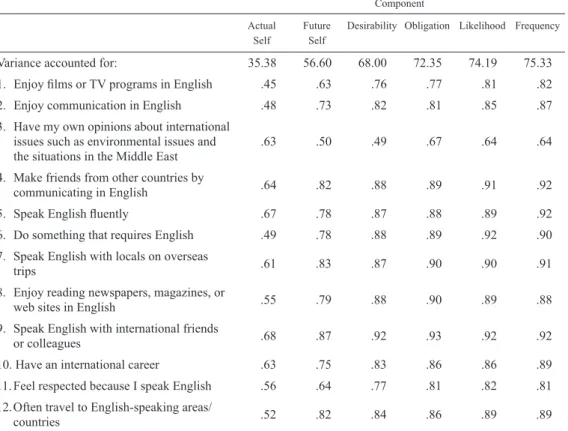
within each scale vary widely, the scale cannot be considered to be measuring the single construct. Following the procedure taken by MacIntyre et al. (2009b), first, the factor structure was examined using the Principal Components Analyses (PCAs). Except for Actual Self, which produced three factors with eigenvalues greater than one, only one factor was extracted from all other five scales (Future Self, Desirability, Obligation, Likelihood, and Frequency). Considering the range of possible L2 selves provided in the questionnaire and the participants’ experiences and abilities, it is understandable that the responses do not correlate in an absolute unitary pattern. However, a clear break was found after the first factor for all six scales (see Figure 1). Therefore, one factor solution was selected for another set of PCAs. As shown in the factor loading matrices presented in Table 3 and the reliabilities for the 12 items in Table 4, on the whole, the six scales including Actual Self and Future Self are internally consistent and unidimensional.
Irie 8
Figure 1. Screeplots from all six scales on the L2 Possible Selves Questionnaire.
3.2. Relationships among Possible Selves, Motivation, and Proficiency Levels
Next, the correlations between the total scores for the 12 items for each of the six possible self scales (Actual Self, Future Self, Desire, Obligation, Likelihood, and Frequency) and Motivation (intended effort) were examined (see Table 5). All correlations were significant at the p = .01 level. A consistent pattern was found: Obligation had the lowest correlations with other scales. Motivation correlated moderately with all possible self scales. When correlations between Motivation and the scales were examined by levels, most correlations were significant at the p = .01 level. However, the lowest level group (L1) and the students that had returned from the overseas programs (OS Returned) had higher correlations (see Table 6).
Table 3. Factor Loadings for All Six Possible Selves Scales (One Factor Solution)
Component
Actual Future Desirability Obligation Likelihood Frequency
Self Self
Variance accounted for: 35.38 56.60 68.00 72.35 74.19 75.33
1. Enjoy films or TV programs in English .45 .63 .76 .77 .81 .82
2. Enjoy communication in English .48 .73 .82 .81 .85 .87
3. Have my own opinions about international issues such as environmental issues and
the situations in the Middle East .63 .50 .49 .67 .64 .64
4. Make friends from other countries by
communicating in English .64 .82 .88 .89 .91 .92
5. Speak English fluently .67 .78 .87 .88 .89 .92
6. Do something that requires English .49 .78 .88 .89 .92 .90
7. Speak English with locals on overseas
trips .61 .83 .87 .90 .90 .91
8. Enjoy reading newspapers, magazines, or
web sites in English .55 .79 .88 .90 .89 .88
9. Speak English with international friends
or colleagues .68 .87 .92 .93 .92 .92
10. Have an international career .63 .75 .83 .86 .86 .89
11. Feel respected because I speak English .56 .64 .77 .81 .82 .81
12. Often travel to English-speaking areas/
countries .52 .82 .84 .86 .89 .89
Table 4. Reliability Coefficents for Possible Selves Questionnaire (N = 242)
Cronbach's Variable
Scale Prompt Alpha* type
Actual Self Describes me now α = .81 Dichotomous
Future Self Describes my possible future α = .93 Dichotomous
Desirability How desirable is this future? α = .95 6-point Likert
Obligation How obligated do you feel to realize this in the future? α = .96 6-point Likert
Likelihood How likely is this future? α = .97 6-point Likert
Frequency How often do you think about this future? α = .97 6-point Likert
Table 5. Correlations Between Possible Selves and Motivation
Motivation Actual Self Future Self Desire Obligation Likelihood Frequency
Motivation 1 Actual Self .47** 1 Future Self .56** .61** 1 Desire .52** .40** .67** 1 Obligation .27** .19** .41** .44** 1 Likelihood .63** .54** .77** .76** .49** 1 Frequency .61** .54** .75** .78** .52** .87** 1
Note. All correlations are significant at p < .01 (2-tallied). Table 6. Correlations with Motivation by Levels
Actual Self Future Self Desire Obligation Likelihood Frequency
L1 .62** .60** .50** .30* .64** .55** L2 .29* .31* .34** .28* .45** .49** L3 .38** .55** .36** .16 .56** .56** OS Returned .44** .60** .60** .26* .66** .63** Note. * p < .01, ** p < .05 4. Discussion
Considering the first aim of the study, the results of the dimensionality and reliability analyses of the possible selves scale were encouraging: strong reliability and a simple unitary factor structure were found for each scale (Actual Self, Future Self, Desire, Obligation, Likelihood, and Frequency). They were similar to those reported by MacIntyre et al. (2009b) in terms of both the range of Cronbach alpha and the structure patterns. With regards to the second aim, some elements of possible selves correlated more highly than others with the criterion measure and suggest possible relationships with proficiency.
On the whole, the unitary factor structure and strong reliability is promising. A slightly different pattern of factor structure and the relatively lower reliability of the actual self scale was expected accounted for by the variety of the 12 items of possible L2 selves. The initial PCA on Actual Self yielded two additional factors. Three items negatively loaded on Factor 2: Speak English fluently (Item5), Have an international career (Item 10), and Feel respected because I speak English (Item 11). This second factor may suggest that these three items form a type of ideal L2 self, perhaps the most distant from the actual selves as they are the least endorsed items. In fact, for Actual Self, only 5% of the participants endorsed Item 5 and Item 10, and 12% Item 11. This is in contrast to the average of all the 12 items, which was 29%. On the other hand, for Future Self, 57% of the
students endorsed Item 5, 46% Item 10, and 41% Item 11 whereas the average of all 12 items was 61%. Factor 3 had only one item loaded on, Item 3, Have my own opinion about international issues such as environmental issues and the situations in the Middle East. This item was expected to behave differently as it originally belonged to a scale to measure international posture proposed by Yashima (2009) as possible selves that may work as self-guides for a certain group of Japanese learners of English in university. Yet when one factor solution was chosen, all scales sufficiently loaded on one factor and the high range of Cronbach alpha between .81 and .97 lends support to the commonality among the items employed to measure possible selves.
As for correlations between the possible selves and motivation, Likelihood and Frequency correlated with Motivation more highly than other scales. This result is in line with some of the conditions under which Ideal L2 Self is said to function as a future self-guide (Dörnyei, 2009): the learner needs to have a desired future self-image which is “perceived as plausible” and “activated regularly” (p. 32). Therefore, one can extrapolate that the higher correlation of Likelihood and Frequency with Motivation highlights the importance for learners of recognizing the possibility of realizing the particular ideal L2 user/learner image and to think about it often.
The comparison of correlations between possible self scales and the criterion scale is not straightforward. Being consistent with the general correlation patterns discussed, scales that most strongly correlated with Motivation are Likelihood or Frequency and the least correlated is Obligation across all levels. On the whole, Level 1 maintains higher correlations across the scales. Level 1 is the only group in which Actual Self also correlates moderately with Motivation at .60, while the correlations range between .29 and .44 for the other scales. Although it is possible that lower level students gain more confidence from what they have achieved up to the point in time, as the correlation for Level 2 is the lowest among the levels, it is difficult to assume such a tendency. A more plausible picture is that the correlation between the possible self scales and motivation strengthen as proficiency develops, suggested by the increasing correlations from Level 2, Level 3, to OS Returned. The OS Returned group has experience of studying English together with learners from other countries as their near-peer role models at various language institutions/programs at universities overseas. Therefore, this group is considered to have more advantage in activating vivid L2 future selves and perceiving a greater possibility in closing the gap between the actual self and the future selves.
As for Obligation, a scale representing ought-to L2 self is on the lower end in the correlation matrix for all levels. The low correlations for this scale may indicate that for these students, expectations from people important in their lives and society is not strongly linked to motivation. This is somewhat surprising considering the importance of English in job hunting and in the formal
education realm endorsed by Monkasho (The Japanese Ministry of Education, Science, and Sports), which aims to cultivate “Japanese with English abilities” and introduced English as a formal subject in elementary schools. From a theoretical point of view, according to Dörnyei, ought-to L2 Self represents the selves that one believes she or he should become to meet expectations and to avoid possible negative consequences. The scale of Obligation was the rating of how obligated do you feel to the possible self. Although this probes into how forced the participants feel about each of the 12 possible selves selected for the scale, it does not specifically present negative consequences associated with failing to obtain the possible selves. In fact, the mean of the students’ rating of Obligation was the lowest among the four scales on a 6-point Likert Scale: Obligation = 3.22, Desire = 4.51, Likelihood = 3.72, and Frequency = 3.83. This might suggest that the participants do not feel obliged to obtain the possible self either because of a weak sense of obligation to meet the expectation or a lack of societal or family expectations in the first place. Infact, parents may not be as expressive in terms of their expectations for their children in response to the general negative perception of hyper-parenting and over expectation3. In fact, in the interviews conducted by the
researcher and a colleague for a qualitative longitudinal study on self-motivation, all six students stated that their parents had not specifically expressed their expectations for their future. Societal pressure may also not be at work for first-year or second-year university students, as they might not have yet developed the sense of urgency regarding their future. In the face of the bleak employment situation for students, there is a tendency for university students to prolong their schooling and postpone their career decisions (Daily Yomiuri, August, 2010). While these reasons are speculative, they suggest threads to follow in articulating the concept of ought-to L2 Self, and how it may be affected by contexts, in future research.
5. Conclusion
The L2 Motivational Self System has brought new perspectives into L2 motivational research. It synthesizes the extensively studied concepts, the integrativeness and possible selves, in a way that is compatible with the emphasis in SLA research on applicability to educational settings and social contexts. In order to develop a possible selves scale that is appropriate for university students in formal EFL instructional settings, 12 items measuring six possible selves scales that are considered to predict motivation were piloted in the present study. The preliminary analysis provided evidence that the set of items share a unitary underlying concept. The overall correlations are encouraging for further analysis and refinement. The correlation analysis also revealed the importance of the perception of likelihood and the frequency of thinking about the future as well as the complex nature of ought-to L2 self. For further elaboration and refinement of the scale, a close examination of each item is in order.
The study is preliminary in nature and has limitations in terms of sample size, context, and statistical procedures employed. The next step in the analysis is obviously to focus on the response patterns of the first two components, Actual Self and Future Self to assess whether the discrepancy actually functions as a future self-guide and understand how the discrepancy between Actual Self and Future affects motivation and proficiency levels. The operationalization of the construct and development of measurement instruments is indispensible to deepen our understanding of the role of the self-concept in developing and maintaining L2 motivation. In order to complement this approach, longitudinal qualitative research should be also conducted, as the concept of possible selves can be fully understood by observing how they operate for an individual in reality.
Notes:
1 A theoretical model outlined the dynamic and cyclic nature of motivation comprised of choice motivation, executive motivation, and retrospective evaluation.
2 CASEC stands for Computerized Assessment System for English Communication, which is an online standardized examination of English proficiency. It is a computer adaptive test applying item response theory. The correlation coefficent between CASEC and TOEIC® is claimed to be .83 (Retrieved from
CASEC homepage by the Japan Institute for Educational Measurement, Inc. http://casec.evidus.com/ english/ex02/equivalency.html).
3 On the Internet, when parental expectation (oya no kitai = 親の期待) is entered in Japanese as a search keyword using Google search engine, the top 50 hits are either directly on or related to negative effects of parental expectations over their children.
References
Csizér, K., & Lukács, G. (2010). The Comparative analysis of motivation, attitudes and selves: The case of English and German in Hungary. System, 38, 1-13.
Dörnyei, Z. (2001). Teaching and researching motivation. London: Pearson Education Ltd.
Dörnyei, Z. (2005). The psychology of the language learner. Mahwah: Lawrence Erlbaum Associates, Inc., Publishers.
Dörnyei, Z. (2009). The L2 motivational self system. In Z. Dörnyei & E. Ushioda (Eds.), Motivation, language identity, and the L2 self, (pp. 9-42). Bristol: Multilingual Matters.
Dörnyei, Z., & Ushioda, E. (Eds). (2009). Motivation, language identity, and the L2 self. Bristol: Multilingual Matters.
Dunkel, C., & Kerpelman, J. (Eds). (2006). Possible Selves: Theory, research and application. New York: Nova Science Publishers.
Giddens, A. (1991). Modernity and self-identity: Self and society in the late Modern Age. Stanford: Stanford University Press.
Henkel, B. (2009). Motivation to learn a second language for minority students, Practice and Theory in Systems of Education, 4, 63-78.
Irie, K. (2003). What do we know about the language learning motivation of university students in Japan? Some patterns in survey studies. JALT Journal, 25(1), 86-100.
Irie, K. (2005). Stability and flexibility of L2 motivation: A multimethod study of Japanese junior high school students. Dissertation: Temple University Japan, Japan. (UMI NO. 3176834)
Irie, K. (2008). L2 Motivation self system and its possible application to university EFL classroom in Japan. Obirin studies in English language and literature, 48, 33-48. Retreived from http://ci.nii. ac.jp/naid/110007138982
Lamb, M. (2004). Integrative motivation in a globalizing world. System, 32, 3-19.
MacIntyre, P., Mackinnon, S., & Clément, R. (2009a). The Baby, the bathwater, and the future of language learning motivation research. In Z. Dörnyei & E. Ushioda (Eds.), Motivation, language identity, and the L2 self (pp. 43-65). Bristol: Multilingual Matters.
MacIntyre, P., Mackinnon, S., & Clément, R. (2009b). Toward the development of a scale to assess possible selves as a source of language learning motivation. In Z. Dörnyei & E. Ushioda (Eds.), Motivation, language identity, and the L2 self (pp. 193-214). Bristol: Multilingual Matters. Markus, H., & Nurius, P. (1986). Possible selves. American Psychologist, 41, 954-969.
Norton, B. (2000). Identity and language learning: Gender, ethnicity, and educational change. New York: Longman.
Taguchi, T., Magid, M., & Papi, M. (2009). The L2 Motivational self system among Japanese, Chinese and Iranian learners of English: A comparative study. In Z. Dörnyei & E. Ushioda (Eds.), Motivation, language identity, and the L2 self (pp. 66-97). Bristol: Multilingual Matters.
Oyserman, D., Terry, K., & Bybee, D. (2002). A possible selves intervention to enhance school involvement. Journal of Adolescence, 25, 313-326.
Ryan, S. (2009). Self and identity in L2 Motivation in Japan: the ideal L2 self and Japanese learners of English. In Z. Dörnyei & E. Ushioda (Eds.), Motivation, language identity, and the L2 self, (pp. 120-143).
Toohey, K. (2000). Learning English in school: Identity, social relations and classroom practice. Clevedon: Multilingual Matters.
Yashima, T. (2009). International posture and the ideal L2 self in the Japanese EFL context. In Z. Dörnyei & E. Ushioda (Eds.), Motivation, language identity, and the L2 self (pp. 144-163).
20% of new university graduates in limbo. (2010, August 7). Daily Yomiuri Online. Retrieved from http://www.yomiuri.co.jp/dy/national/T100806003922.htm
Appendix 1
Possible L2 Selves Questionnaire
Actual Self Future Self Desirability Obligation Likelihood Frequency Describes me now Describes possible future Is this desired or undesirable future? How strongly do you feel that you are obligated to become this in future?
How likely is this in the future? How often have you thought about this future?
(1 = undesired, 6 =strongly desired) (1 = not feeling obligated at all, 6 = strongly feeing that I must)
(1 = not likely at all, 6 = highly likely)
(1 = never
,
6 = all the time)
1 Enjoy films or TV programs in English Yes / No Yes / No 1 2 3 4 5 6 1 2 3 4 5 6 1 2 3 4 5 6 1 2 3 4 5 6 2
Enjoy communication in English
Yes / No Yes / No 1 2 3 4 5 6 1 2 3 4 5 6 1 2 3 4 5 6 1 2 3 4 5 6 3
Have my own opinions about international issues such as environmental issues and the situations in the Middle East
Yes / No Yes / No 1 2 3 4 5 6 1 2 3 4 5 6 1 2 3 4 5 6 1 2 3 4 5 6 4
Have friends from other countries by communicating friends
Yes / No Yes / No 1 2 3 4 5 6 1 2 3 4 5 6 1 2 3 4 5 6 1 2 3 4 5 6 5
Speak English fluently
Yes / No Yes / No 1 2 3 4 5 6 1 2 3 4 5 6 1 2 3 4 5 6 1 2 3 4 5 6 6
Do something that requires English (other than taking classes)
Yes / No Yes / No 1 2 3 4 5 6 1 2 3 4 5 6 1 2 3 4 5 6 1 2 3 4 5 6 7
I speak English with locals on overseas trips
Yes / No Yes / No 1 2 3 4 5 6 1 2 3 4 5 6 1 2 3 4 5 6 1 2 3 4 5 6 8
Enjoy reading newspapers, magazines, or web sites in English
Yes / No Yes / No 1 2 3 4 5 6 1 2 3 4 5 6 1 2 3 4 5 6 1 2 3 4 5 6 9
Speak English with international friends or colleagues
Yes / No Yes / No 1 2 3 4 5 6 1 2 3 4 5 6 1 2 3 4 5 6 1 2 3 4 5 6 10
Have an international career
Yes / No Yes / No 1 2 3 4 5 6 1 2 3 4 5 6 1 2 3 4 5 6 1 2 3 4 5 6 11
Feel respected because I speak English
Yes / No Yes / No 1 2 3 4 5 6 1 2 3 4 5 6 1 2 3 4 5 6 1 2 3 4 5 6 12 Often
Travel to English-speaking areas/
countries Yes / No Yes / No 1 2 3 4 5 6 1 2 3 4 5 6 1 2 3 4 5 6 1 2 3 4 5 6
Appendix 2
Possible L2 Selves Questionnaire in Japanese Possible Selves Items
1. 英語の映画やテレビ番組を楽しんでいる。 2. 英語でのコミュニケーションを楽しんでいる。 3. 環境問題や中東問題などの国際情勢について自分の意見を持っている。 4. 英語を使って様々な国の人と交友関係を広げている。 5. 英語を流暢に話せる。 6. 英語が不可欠な仕事や趣味、社会活動などをしている。 7. 海外旅行で現地の人と英語で会話をしている。 8. 英語の本、新聞・雑誌・インターネットサイトを楽しみながら読んでいる。 9. 外国人の友人や同僚と英語で会話をしている。 10. 国際的なキャリア(仕事)がある。 11. 英語が話せるので一目置かれている。 12. 英語圏の国々や地域を頻繁に訪ずれている。 Scale Prompts Actual Self: 今の自分を表している Future Self: 自分が将来このようになる可能性がある Desirability: 将来自分がこのようになりたいと望んでいますか?(1 = 特に望んでいな い, 6 = とても望んでいる) Obligation: 将来自分がこのようにならなければならないと感じていますか?(1 = 特 に感じていない, 6 = とても感じている) Likelihood: 将来自分がこのようになる可能性はどれぐらいだと思いますか?(1 = 全 くない, 6 = 大いに可能) Frequency: 自分の将来を考えるとき、このようになっている自分を想像しますか? (1 = 全くしない, 6 = いつも必ず)