Students at Kyoei University
−
Department of International Business Management
−Nicholas A. BUFTON & Steven LLOYD
ニコラス
A
バフトン・スティーブン ロイド
Abstract
This paper discusses the decline in the English ability of students entering the International Business Management Department (IBMD) of Kyoei University between 2009 and 2011, and dis-cusses the placement test scores and yearly trends. It also questions the administration’s rationale for administering the current test in the light of recent English curriculum changes, and the pre-as-signing of students to English classes according to demands completely unrelated to their English language educational needs. In addition, the paper discusses the de-motivation, boredom and disil-lusionment that may occur due to class miss-assignment, and its possible links to truancy and drop out rates.
Keywords: placement test, class assignment, miss-assignment, de-motivation, boredom, disillu-sionment, truancy and drop out
概要 本論文は、
2009
∼2011
年に共栄大学国際経営学部(IBMD)
に入学した学生の英語の 能力の低下について述べたものである。本論は、クラス分けテストの得点と毎年の傾向を 議論した上で、英語のカリキュラムが大きく変わっ現在でも、これ迄同様のクラス分けテ ストの存在意義、必要性について述べている。又、クラス分けの不適合は、学生の、(授業 が簡単すぎたり難しすぎたりしての)退屈な授業の受講、学習意欲の消失、幻滅、無断欠 席、と一連の流れに陥り最終的に退学という最悪の結果にもなりかねない事も書き加えて いる。 キーワード:クラス分けテスト.クラス割当て.不適合.意欲消失.退屈.幻滅,無断欠 席と退学.Background
This is a follow up paper to Lloyd, S. & Bufton, N.A. (2011) Kyoei University English Place-ment Test AssessPlace-ment: Journal of Kyoei University Vol. 9, and covers several trends and issues that were not discussed previously. As mentioned in the above paper, the International Business Man-agement Department’s (IBMD) English Program at Kyoei University (KU) has been streaming in-coming students since 2000. This streaming allowed KU to place students in classes best suited to their current level of English proficiency. This was especially important considering the ethnic and academic diversity of the student body and the English proficiency of each new intake.
Until 2010 we used the commercially available General Tests of English Language Proficiency (G-TELP©) Level 3 test at the beginning of each academic year as the main method of assessing new students’ EFL ability. However, from 2005 it was noted that the distribution of test scores were beginning to produce positively skewed distributions. This trend continued until the test could no longer provide reliable data by which we could reliably assess and stream students in order to place them in a class appropriate to their current level of proficiency. Thus in late 2008 work began to de-velop a pilot test that would allow us to (1) gauge the incoming students’ knowledge of what they should have learnt at high school, and (2) more accurately stream and place students according to our curriculum requirements. Then in 2009, in addition to the G-TELP
©
Level 3 test, this new pilot test was administered and the results between the two compared.The G-TELP
©
test showed the majority of students scoring 27% on average, and regardless of the relationship between student ability and item difficulty holding the full length of the ogive, a normal distribution around this point meant these very low scores did not represent any meaningful measurement of student performance. Thus the results were completely unreliable for placing stu-dents in classes according their English ability. The pilot test results showed stustu-dents average scores were 50.38%, while not perfect, these results better indicated the student’s English ability and therefore were a more reliable measure by which to assign classes. This 2009 placement test was the forerunner of the current placement test, and while certain items have been modified or replaced after post-test item analysis (Rasch Modelling and Wright Mapping) of each edition, the test re-mains essentially the same. For a more detailed description of the placement test’s development see Lloyd, S. & Bufton, N.A. (2011) Kyoei University English Placement Test Assessment: Journal of Kyoei University Vol. 9.Placement Test Score Comparison 2009~11
The following analysis of the three placement tests (PT), 2009~2011 has been done by com-paring the frequency of scores as percentages as we are demonstrating a trend, and item by item comparison would not add anything to the utility of the three tests. As the purpose of each test was to stratify examinees so that they can be placed into a class suitable to their current English ability the construct of each test is valid. The research and hence the terminology used in this paper will follow J. D. Brown’s Testing in Language Programs (2005), and was carried out using the Apple Numbers ’09 spreadsheet application.
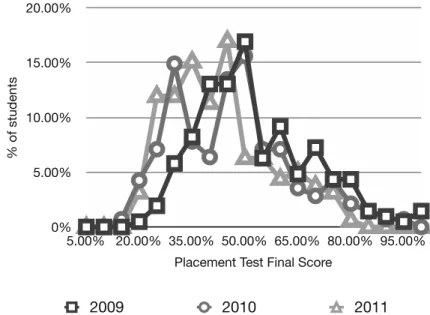
Table 1 below shows the average frequency of placement scores for the years 2009 through 2011, and shows that in comparison with previous years the 2011 cohort average score is down. Taking the 2009 PT as a bench mark one can see that the 2010 PT score is down by 6.14% and the 2011 score is down by 9.64%. The lower standard deviation for the 2011 cohort indicates that there is a smaller range in English language ability compared to previous years.
Table 1 Frequency of Placement Test Scores as percentages
2009 2010 2011 5.00% 0.00% 0.00% 0.00% 10.00% 0.00% 0.00% 0.00% 15.00% 0.00% 0.71% 0.00% 20.00% 0.48% 4.26% 3.14% 25.00% 1.93% 7.09% 11.95% 30.00% 5.80% 14.89% 11.95% 35.00% 8.21% 7.80% 15.09% 40.00% 13.04% 6.38% 11.32% 45.00% 13.04% 13.48% 16.98% 50.00% 16.91% 15.60% 6.29% 55.00% 6.28% 7.09% 6.29% 60.00% 9.18% 7.09% 4.40% 65.00% 4.83% 3.55% 5.03% 70.00% 7.25% 2.84% 3.77% 75.00% 4.35% 4.26% 3.14% 80.00% 4.35% 2.13% 0.63% 85.00% 1.45% 1.42% 0.00% 90.00% 0.97% 0.71% 0.00% 95.00% 0.48% 0.71% 0.00% 100.00% 1.45% 0.00% 0.00% N 207 141 159 average 50.38% 44.24% 40.74% SD 16.37% 16.55% 14.28% high 100.00% 92.22% 80.00% low 18.18% 13.33% 16.25%
The general decline in the English language ability of first year students is also illustrated in Figure 1 which shows the peak of the 2011 cohort curve as several points to the left of the 2009 and 2010 cohorts.
English Class Placement
Prior to 2010 almost all students were assigned to an English class according to how they per-formed on the placement test − with Class 1 being the lowest level and Class 7 the highest. This resulted in the vast majority of students being streamed according to English ability. While there was no significant difference in ability in the midlevel classes there was a large difference between those in the upper and lower level classes. In the 2010 cohort of 225 students 108 (48% of the total) students had their English classes pre-assigned. Of the 108, 75 students were Sports Majors and as-signed to their own English class (Class 1) and therefore did not take the PT (a decision made out-side of the English Language Programme). The other 33 were placed in another class for Interna-tional Business Majors and Accountancy Majors (Class 7); however, unlike the Sports Majors these students took the PT. Out of the 150 students who took the test, 95 (63.33%) were assigned to the correct class according to their PT grade and 36.66%, were assigned to a class within 2 levels of their English ability, and most of these were pre-assigned to Class 7.
In 2011, due to the tragedy of the Tohoku Earthquake, the academic year started in turmoil and it was decided to delay the Placement Test until the end of the first semester and have all first year
English Conversation classes in the second semester (by this time, all English Grammar and Read-ing classes had been removed from the curriculum). This meant that all students - includRead-ing those pre-assigned - were able to take the PT. This has allowed us to have a more accurate understanding of the English ability of our students, and understand better the impact of pre-assignment on the make-up of each class.
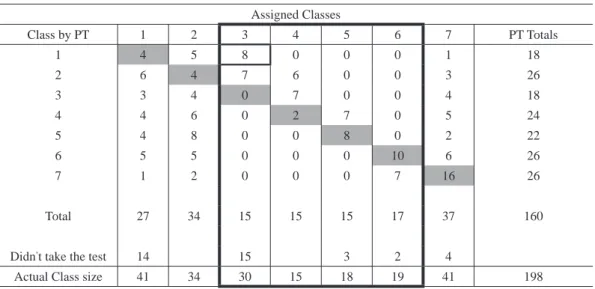
Out of a smaller intake of 198 in 2011, the number of pre-assigned students increased to 116 (58% of the total). As in 2010, the pre-assignments were due to these students having other academic and non-academic commitments such as training and extra classes aimed at their chosen major. A decision that has inevitably made time-tabling more difficult. Sports majors were divided into two classes: 41 were placed into Class 1, the ‘baseball class’, and 34 into Class 2, the ‘sports class’ (foot-ball players, basket(foot-ball players and other athletes with physical training schedules); 41 students were assigned to Class 7, the ‘international business management/accountancy class’. This meant genuine streaming only applied to the remaining 83 students (42%), and the placement test results for the pre-assigned students were effectively completely ignored. This led to some serious anomalies.
Table 2 Class Placement by PT Grade & Pre-assignment (2011)
Assigned Classes Class by PT 1 2 3 4 5 6 7 PT Totals 1 4 5 8 0 0 0 1 18 2 6 4 7 6 0 0 3 26 3 3 4 0 7 0 0 4 18 4 4 6 0 2 7 0 5 24 5 4 8 0 0 8 0 2 22 6 5 5 0 0 0 10 6 26 7 1 2 0 0 0 7 16 26 Total 27 34 15 15 15 17 37 160
Didn t take the test 14 15 3 2 4
Actual Class size 41 34 30 15 18 19 41 198
Table 2 shows the number of students who were placed in a class of a different level from their English ability, as determined by the placement test, and the class that they
would
have been placedinto if the PT was the only criterion used. It is worth noting that in both Classes 1 and 2, there are three students who should be in the top class, and one student in Class 7 who should be in the low-est level class. Class 3 has also effectively become the lowlow-est level class, with eight of the lowlow-est 18 PT-scoring students. Only Classes 5 and 6 are populated by students that match the level the class would ideally be aimed at, and class 4 slightly less so. However, the majority of students are
not in a class commensurate with their PT score.
Also noticeable, is that the pre-assignment has resulted in disproportionately large (and partic-ularly in the case of the two sports classes, unmanageable) student numbers for those classes, and correspondingly smaller class sizes for the other levels. As can be seen in the right-hand column, the distribution by grade would have resulted in a more balanced and manageable number of stu-dents per class - with Class 1 deliberately being made smaller to cope with the lower English level of the students; the resulting anomaly of Class 2 being too big could have been avoided by moving some students into Class 3, if this were the only criterion for placement. The 20 students who didn't take the placement test either declared themselves near or complete beginners (in particular, over-seas students) and so were placed into Class 3, or were placed after an interview by one of the na-tive speaker teachers.
Discussion
The placement test was developed and administered for assigning classes according to each student’s ability for sound pedagogic reasons. The Kyoei University Placement Test not only acts as a measure by which to divide students according to ability, it is also a diagnostic test. It was de-signed to expose each student’s strengths and weaknesses, the gaps in their knowledge and their skill deficiencies (listening, grammar and reading comprehension). These are exceedingly impor-tant because when we the teachers know what the problems are, we can do something about them. In a sense the Placement Test doubles as a ‘Needs Analysis’ similar to that described by Seedhouse, P (1995) and Munby, J (1978). In addition, as the test was re-administered at the end of the first year it also acted as an achievement (progress) test. Again this is important not only for highlighting each student’s progress, but also exposing weaknesses in the syllabus or teaching methodology. Basic English (基礎英語), General English (総合英語) and English Conversation (実用英 会 話 ) examinations were all bench mark tests. Each subject had its own bench mark. That is, a clear set of objectives and levels of English competency were set, and students were required to meet these in to order pass the examinations and earn the subjects a lotted number of credits. The bench mark for Basic English was lower than that for General English as the course was aimed at bringing the lowest level students up to a level equal to that of 3rd year Junior high school. While the bench mark for General English lay between Eiken STEP Test grade three and pre-second grade. The examination for English Conversation was and is the same for all classes. English con-versation is dived into 3 ranks with each rank having its own range and pass mark.
any Basic English (基礎英語), General English (総合英語) classes so they have no opportunity to improve their reading skills and knowledge of English grammar before starting conversation classes. Therefore, any gap between their English skills and the level of the conversation class to which they have been assigned cannot be rectified before taking the class.
With the increasing number of students not being assigned to an English class appropriate to their current level of English a number of problems are beginning to develop. Firstly, students who have been misplaced into a class that is too difficult for them quickly become demotivated as they struggle to keep up. While those who are in a class that is too easy for them become bored and dis-illusioned. In either case students can become unruly leading to disruptions in the flow of the les-son. Although we have no direct-causal evidence to link the frustrations that these students are probably feeling, both authors suspect that this is a factor in the English class drop out rate as poor performance is a documented contributory factor in truancy (Lavy, V. Paserman, D. M. and Schlosser, A. 2008, and Tucker S. 2003).
Secondly, teachers are often too busy to allot sufficient time to lower achieving students in overly large and unmanageable classes thus leading to the neglect of the most needy and vulnerable students.
Given these problems perhaps it would be best to return to either the full streaming of students according their English ability or to allow multiple streaming whereby the general population is di-vided into three sets (low, middle, high); sports majors (2 or 3 classes by ability not sport) and TOEIC/Accountancy majors (into 2 classes mixed with the top students of the general population). Pedagogically speaking it would be unconscionable to abandon all streaming due to the exceedingly wide range of English abilities between the higher level and lower level students. After all, students do have certain expectations and have chosen Kyoei to try and meet them. If we meet those expec-tations they may be more motivated to partake fully in lessons and learn. However, if they feel they are out of their depth or wasting their time they will inevitably become disillusioned.
Conclusion
This paper has documented the declining English level of freshmen entering Kyoei University between 2009 ~ 2011 and described how a policy change in the way students are assigned to Eng-lish classes has lead to an increasing number of students being assigned to classes that are either too low or too high for their abilities. Furthermore, the current assignment policy is also leading lopsid-ed class sizes. These two factors may also be part of the reason why a growing number of miss-as-signed students have become disillusioned or disruptive, leading to a decline in class participation
and concentration. The authors have also suggested that this may be a contributing factor to the stu-dent drop out rate. In response it has been suggested that either full streaming be reintroduced or a new multiple streaming system be introduced.
References
Lloyd, S. & Bufton, N.A. 2011. Kyoei University English Placement Test Assessment: Journal of Kyoei University Vol. 9.
Munby, J. 1978. Communicative syllabus design. London: Cambridge University Press. Seedhouse, P. 1995. Needs analysis and the general English classroom.
ELT Journal, 49/1, pp. 59-65.
Tucker S. 2003. Pastoral Care in Education: The Search for Solutions to Truancy and Other Forms of School Absenteeism. Volume 1, Issue 1. Routledge
Victor Lavy. M. Daniele Paserman. Analia Schlosser. 2008. Inside the Black of Box of Ability Peer Ef-fects: Evidence from Variation in Low Achievers in the Classroom. The Foerder Institute for Eco-nomic Research and The Sackler Institute of EcoEco-nomic Studies. http://econ.tau.ac.il/papers/ foerder/8-2008.pdf