138
厚生労働科学研究費補助金(化学リスク研究事業)
免疫毒性評価試験法Multi-ImmunoTox assayの国際validationへ向けての検討 分担研究報告書
化学物質のMITAによる解析、validation、プロトコール作成
分担研究者 木村 裕 東北大学病院皮膚科
研究要旨
厚生労働科学研究費補助金事業「多色発光細胞を用いたhigh‑throughput免 疫毒性評価試験法の開発」にて開発した新たなin vitro免疫毒性評価試験法
(Multi‑ImmunoTox assay:MITA)について現時点で得られたdata setおよび相 場によるIL‑2転写活性抑制を中心とした免疫毒性AOPをもとに国際バリデーシ ョン用の試験法プロトコール、データシート、記録用紙を作成した。施設間試 験の実施者に対し試験法の説明会を実施し技術移転を図った。国際バリデーシ ョンに先立ち技術移転性を確認するため5物質でのトレーニング(Phase 0)を行 い、そこで明らかになった問題点を検討し試験法プロトコールを改良、データ シート、記録用紙を作成しPhase I試験を行った。
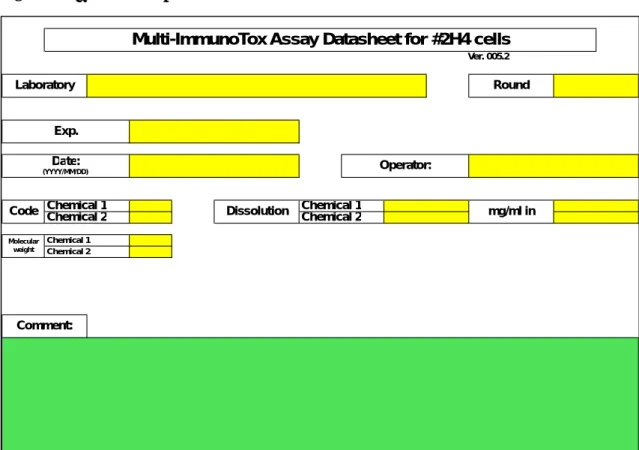
その後の国際VMTミーティング会議(京都)で検討された結果を反映した試 験法プロトコール(Multi‑ImmunoTox Assay protocol ver. 009.1E)およびデー タシート(Multi‑ImmunoTox Assay Datasheet for #2H4 cells Ver. 008.2)を作 成しPhase II試験を行った。その結果について国際VMTミーティング会議(大阪)
での意見、東北大学での解析を参照とし%suppressionの閾値を±35%としたクラ イテリアを設定した。
キーワード:試験法プロトコール、技術移転性、バリデーション
A.研究目的 厚生労働科学研究費補助金事業「多色 発光細胞を用いた high‑throughput 免疫 毒性評価試験法の開発」にて開発した新 た な in vitro 免 疫 毒 性 評 価 試 験 法
(Multi‑ImmunoTox assay:MITA)の OECD
( Organisation for Economic Co‑operation and Development)におけ る試験法ガイドライン(Test Guideline:
TG)化を目的とし、試験法プロトコール を作成し国際バリデーションを行う。
B.研究方法
以下の方法によりIL‑2およびIFN‑プ ロモーター活性の測定を行った。ヒトTリ ンパ芽球性白血病由来細胞株Jurkatに IL‑2プロモーターに制御されたSLGルシ フェラーゼ遺伝子(緑色に発色)、IFN‑
139 ラーゼ遺伝子(橙色に発色)、GAPDHプロ モーターに制御されたSLRルシフェラー ゼ遺伝子(赤色に発色)を導入した#2H4 細胞を1ウェル当たり2×10⁵個、黒色の 96‑well プレート(Greiner bio‑one)に播 種し化学物質を加え、37℃、5%CO2下で1 時間培養した。つづいて25nM PMAと1M Io の混合物(PMA/Io)で刺激し37℃、5%CO2下 で6時間培養した。その後、細胞溶解剤と ルシフェラーゼ反応の基質であるルシフ ェ リ ン の 混 合 剤 で あ る Tripluc luciferase assay reagent (TOYOBO)を混 合し、室温で10分振盪させたのちマルチ プレート対応型ルミノメーターにてルシ フェラーゼ活性を測定した。SLG、SLO、
SLRルシフェラーゼは共通の基質の存在 により同時に発光するが、2枚の光学的フ ィルターにより分離し、各ルシフェラー ゼ の 発 光 量 (SLG‑luciferase activity (SLG‑LA) 、 SLO‑luciferase activity (SLO‑LA) 、 SLR‑luciferase activity (SLR‑LA)) を検出した。また細胞数の違 いや各種刺激後の生存率の違いを勘案し SLG‑LA、SLO‑LAをSLR‑LAで除することに よりそれぞれnormalized SLG‑luciferase activity(nSLG‑LA), normalized SLO‑luciferase activity(nSLO‑LA) を 算 出した。さらに以下の式に%suppression 抑制率を計算した。
% suppression = (1‑ 薬 物 存 在 下 で の nSLG‑LAまたはnSLO‑LA/薬物非存在下で のnSLG‑LAまたはnSLO‑LA) X 100
各実験において得られた結果は、一元 配置分散分析を行い、その後Dunnett検定 により有意な抑制効果,増強効果がある か否かを検討した。しかし、この実験を3
必ずしも一致していない薬剤が存在した。
そこで、一致が見られなかった薬剤に関 しては、3回の繰り返し実験の結果のなか から%suppressionの絶対値(免疫抑制物 質に関しては正の値、増強物質に関して は負の値となる)が最も大きい値を選び Student s t‑testを行い、そこで統計的 有意差の得られた場合、その結果を薬剤 の最終的判定結果とした1。(クライテリア 1)
C.結果
C‑1. 試験法プロトコール、データシート、
記録用紙の作成
現時点で得られたdata setおよび相場 によるIL‑2転写活性抑制を中心とした免 疫毒性AOPを参考とし、IL‑2, IFN‑レポ ーター細胞である#2H4細胞を用いた試験 法プロトコール、Multi‑ImmunoTox Assay protocol ver. 008.1Eを作成し、国際バリ デーションに向け英訳した。データ入力、
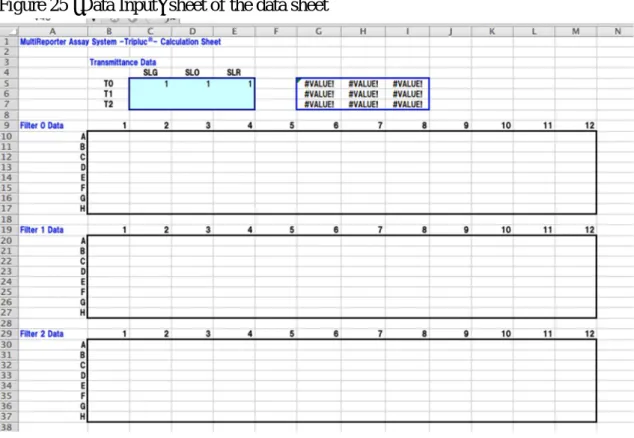
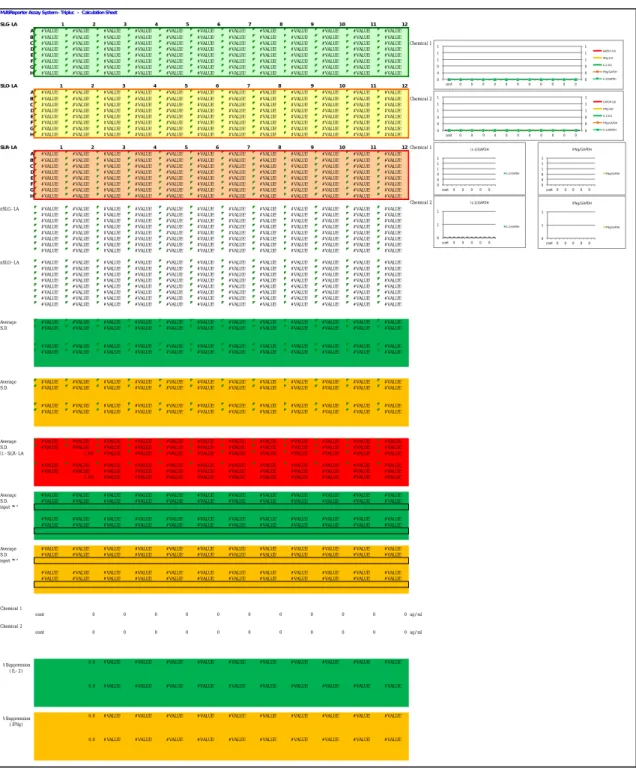
結果表示用にエクセルファイルをベース と し た data sheet 、 Multi‑ImmunoTox Assay Datasheet for #2H4 cells Ver. 006 を作成した。さらに参加施設用の記録用紙 を作成し各施設に配布した。
C‑2. 試験法の説明会を実施
初めて MITA を行う参加施設の実施者を 対象とし当研究室にて説明会を 2015 年 8 月と 2016 年 2 月の計2回開催した。当研 究室において参加者の手技により PMA/Io に対する#2H4 細胞の反応および陽性コン トロール化学物質による抑制が認められ ることを確認した。
140 MITA の国際バリデーション Phase I 試 験に先立ち技術移転性を確認するため Phase 0 試験用に以下の化学物質を参加 3 施 設 に送 付し た。 (2‑Aminoanthracene, CH3HgCl, Chloroquine diphosphate salt, Citral, Dexamethasone)これらの化学物 質を3回ずつアッセイする Phase 0 試験 を実施した。
C‑4. 国際バリデーションPhase I試験用 試験法プロトコール、データシート、記録 用紙の作成
Phase 0試験で明らかになった問題点を 検討しプロトコールを変更した。その変更 を 反 映 し た 試 験 法 プ ロ ト コ ー ル 、 Multi‑Immuno Tox Assay protocol ver.
008.5Eを作成した。データ入力、結果表示 用にエクセルファイルをベースとした data sheet 、 Multi‑ImmunoTox Assay Datasheet for #2H4 cells Ver. 007.2を 作成した。さらに参加施設用の記録用紙を 作成し各施設に配布し、国際バリデーショ ンPhase I試験を行なった。
C‑5. 国際バリデーションPhase II用の試 験法プロトコール、データシート、記録用 紙の作成
平成28年度に実施されたPhase Iバリデ ーション後の国際VMTミーティング会議(H 29.2月、京都)で検討された結果を反映し た国際バリデーションPhase II用の試験 法プロトコール、Multi‑Immuno Tox Assa y protocol ver. 009.1Eを作成した。デー タ入力、結果表示用にエクセルファイルを ベースとしたdata sheet、 Multi‑Immuno Tox Assay Datasheet for #2H4 cells Ve
記録用紙、Multi‑ImmunoTox Assay 記録用 紙 Ver. 003.1を作成した。
C‑6. 国際バリデーションPhase IIの結果 の解析および新クライテリアの設定 国際バリデーションPhase 2の結果につい て国際VMTミーティング会議(大阪)での 意見、東北大学で作成されたMITA data set の各化学物質における%suppressionの最 大値、最小値を参考とし%suppressionの閾 値を±35%と設定したクライテリア(クラ イテリア5)を設定した。クライテリア5 を用いて国際バリデーションPhase 2の結 果を再評価したところ施設間再現性が 80%(16/20)であった。2018年3月29日に開 催された国際スカイプ会議でクライテリ ア5は国際バリデーション実行委員に承 認された。
D. 考察
クライテリア5による評価では、施設内、
施設間再現性についてPhase I、Phase II 共にstudy planに記載された基準を満た した。今後、試験に使用された被験物質 についてin vitro, in vivoのデータを集 積しMITAアッセイの予測性について検討 する。
E.結論
国際バリデーションの実施者に対し試 験法の説明会を実施し技術移転を図った。
Phase 0, 国際バリデーションPhase I、
Phase II用の試験法プロトコール、デー タシート、記録用紙を作成した。
国 際 バ リ デ ー シ ョ ン の 結 果 に 基 づ き%suppressionの閾値を±35%とした新
141
引用文献
1. Kimura, Y., Fujimura, C., Ito, Y., Takahashi, T., Aiba, S., 2014.
Evaluation of the Multi‑ImmunoTox Assay composed of 3 human cytokine reporter cells by examining immunological effects of drugs.
Toxicol In Vitro 28, 759‑768.
F. 添付文書
1) Multi‑Immuno Tox Assay protocol ver. 011E(最終プロトコール案)
2) Multi‑ImmunoTox Assay Datasheet for #2H4 cells Ver. 008.2
3) Multi‑ImmunoTox Assay 記 録 用 紙 Ver. 003.1
G.研究発表 1. 論文発表
1) Watanabe, M., Noma, H., Kurai, J., Sano, H., Kitano, H., Saito, R., Kimura, Y., Aiba, S., Oshimura, M., Shimizu, E. Variation in the Effect of Particulate Matter on Pulmonary Function in Schoolchildren in Western Japan and Its Relation with Interleukin‑8. Int J Environ Res Public Health. 2015; 12, 14229‑14243.
2) Watanabe, M., Noma, H., Kurai, J., Sano, H., Saito, R., Abe, S., Kimura, Y., Aiba, S., Oshimura, M., Yamasaki, A., Shimizu, E.
Decreased pulmonary function in school children in Western Japan after exposures to Asian desert dusts and its association with
2015;583293.
3) Kimura, Y., Fujimura, C., Ito, Y., Takahashi, T., Nakajima, Y., Ohmiya, Y. Aiba, S. Optimization of the IL‑8 Luc assay as an in vitro test for skin sensitization.
Toxicol In Vitro. 2015; 29, 1816‑1830.
4) Kimura Y, Shimada‑Omori R, Takahashi T, Tsuchiyama K, Kusakari Y, Yamasaki K, Nishikawa R, Nishigori C, Aiba S., Therapeutic drug monitoring of patients with psoriasis during tumour necrosis factor (TNF)‑alpha antagonist treatment using a novel interleukin‑8 reporter cell line.
Br J Dermatol 175, 979‑987, 2016.
5) Aiba, S., Kimura, Y. In vitro test methods to evaluate the effects of chemicals on innate and adaptive immune responses. Curr Opin Toxicol 2017 5:6‑12
6) Kimura, Y., Fujimura, C., Ito, Y., Takahashi, T., Terui, H. and Aiba, S. Profiling the immunotoxicity of chemicals based on in vitro evaluation by a combination of the Multi‑ImmunoTox assay and the IL‑8 Luc assay. Arch Toxicol in press.
2.学会発表
1) Kimura, Y., Shimada‑Omori, R., T akahashi, T., Tsuchiyama, K., Ku sakari, Y., Yamasaki, K., Aiba, S. An interleukin‑8 reporter cel l line, THP‑G8, can evaluate ant i‑TNF‑a neutralizing activity of patients sera and predict drug effectiveness during anti‑TNF‑a
142 ngress of Dermatology, (2015, 6) (Vancouver, Canada)
2) 木村裕:IL‑8 Luc assayバリデーシ ョン試験. 日本動物実験代替法学会 第28回大会(横浜)2015年12月 3) 木村裕、相場節也:試験法ワークシ
ョ ッ プ 「 IL‑2 転 写 活 性 抑 制 を key eventとするT細胞分化異常誘導に関 するAOP」第23回日本免疫毒性学会学 術年会(北九州)2016年9月7日 4) Kimura Y. et al. Multi‑ImmunoTox
Assay (MITA): the creation of its data set and the results of validation studies. 10th World Congress Alternatives and Animal Use in the Life Science. Seattle, Washington, USA August 20‑24, 2017 5) Aiba S. et al. A novel in vitro assay for sensitisers in purely aqueous system: the modified IL‑8 Luc assay using X‑VIVOTM 15 as a solvent. 10th World Congress Alternatives and Animal Use in the Life Science. Seattle, Washington, USA August 20‑24, 2017
6) Kimura Y. et al. Dimethyl sulfoxide is not necessary to dissolve most sensitizers for their in vitro stimulation of dendritic cells.
47th Annual European Society for Dermatological Research Meeting.
Salzburg, Austria, September 27‑30, 2017
7) 木 村 裕 他 : Multi‑ImmunoTox Assay (MITA) データセットの作成および バリデーション研究の結果 日本動
京)2017 年 11 月
8) 相 場 節也 他: DMSO を用 い ない in
vitro 感作性試験 日本動物実験代
替法学会 第 30 回大会(東京)2017 年 11 月
H.知的財産権の出願・登録状況 (予定を含む。)
1. 特許取得 なし
2. 実用新案登録 なし
3.その他 なし
143
Multi-ImmunoTox Assay protocol ver. 011E May. 10th, 2018
Department of Dermatology, Tohoku University Graduate School of Medicine Yutaka Kimura, M.D., Ph.D.
Setsuya Aiba, M.D., Ph.D.
144
D. 考察
... 140G.研究発表 ... 141
1. Introduction ... 147
2. Materials ... 148
2-1 Cells ... 148
2-2 Reagents and equipment ... 148
2-2-1 For maintenance of the #2H4 cells ... 148
2-2-2 For chemical exposure, stimulation and solvents ... 148
2-2-3 For measurement of the luciferase activity ... 148
2-2-4 Expendable supplies ... 148
2-2-5 Equipment for measurement of luciferase activity ... 149
2-2-6 Others ... 149
2-3 Cultur e medium ... 150
2-3-1 A medium: for maintenance of #2H4 cells (500 mL, stored at 2-8°C) 150 2-3-2 B medium: for luciferase assay (30 mL, stored at 2-8°C) ... 150
2-3-3 C medium: for thawing #2H4 cells (30 mL, stored at 2-8°C) ... 150
2-4 Prepar ation of the stimulant of #2H4 ... 151
2-4-1 Phorbol 12-myristate 13-acetate (PMA) ... 151
2-4-2 Ionomycin ... 151
3. Cell culture ... 152
3-1 Thawing of #2H4 cells ... 152
3-2 Maintenance of #2H4 cells ... 152
4. Preparation of cells for assay ... 153
5. Preparation of chemicals and cell treatment with chemicals ... 154
5-1 Dissolution by vehicle (cf. Figur e 3) ... 154
145
5-2-1 Arrangement of chemicals and vehicle ... 157
5-2-2 Serial dilution ... 157
5-2-3 2 step dilution ... 158
5-3 When the chemical is pr epar ed as a DMSO solution ... 160
5-3-1 Arrangement of chemicals and vehicle ... 160
5-3-2 Serial dilution ... 160
5-3-3 Dilution of DMSO solution with the B medium ... 161
5-3-4 2 step dilution ... 162
6. Preparation of the stimulant (PMA/ionomycin) and addition to #2H4 164 6-1 Mater ial ... 164
6-2 Prepar ation of 100 M PMA ... 164
6-3 Prepar ation of contr ol and x10 PMA/ionomycin solution ... 164
6-4 Addition of PMA/ionomycin to #2H4 ... 165
7. Control ... 166
7-1 Preparing contr ol chemical (dexamethasone, cyclospor ine A) ... 166
7-1-1 Preparing dexamethasone stock ... 166
7-1-2 Preparing cyclosporine A stock ... 166
7-2 Prepar ation of cells for assay ... 167
7-3 Ar r angement of chemicals and vehicle ... 168
7-4 Dilution with the B medium ... 168
7-5 2 step dilution ... 169
7-6 Addition of PMA/ionomycin to #2H4 ... 171
8. Calculation of the transmittance factors ... 173
8-1 Reagents ... 173
146
8-3 Bioluminescence measur ement ... 174
9. Measurement ... 177
10. Data analysis ... 180
11. Criteria ... 180
11-1 Acceptance cr iteria ... 180
11-2 Criter ion... 180
12. Update record ... 182
Appendix 1 Principle of measurement of luciferase activity ... 184
Appendix 2 Validation of reagents and equipment ... 186
147
1. Introduction
This protocol describes how to maintain the cells, how to prepare the test chemicals, and how to measure the luciferase activity of #2H4 cells transfected with 3 luciferase genes, stable luciferase green (SLG), stable luciferase orange (SLO) and stable luciferase red (SLR), under the control of IL-2, IFN and G3PDH promoters, respectively, for the Multi-Immuno Tox Assay.
(Kimura Y. et al. Evaluation of the Multi-Immuno Tox Assay composed of 3 human cytokine reporter cells by examining immunological effects of drugs Toxicol in Vitro, 28, 759-768, 2014)
Figure 1
flat- bottom
black
1 2 3 4 5 6 7 8 9 10 11 12
A B C D E F G H
PMA/Io or LPS
µg/mlB cont
(distilled water or DMSO)
PMA/I o only
B/29 µg/ml
B/28 µg/ml
B/27 µg/ml
B/26 µg/ml
B/25 µg/ml
B/24 µg/ml
B/23 µg/ml
B/22 µg/ml
B/21 µg/ml
µg/mlA cont
(distilled water or DMSO)
PMA/I o only
A/29 µg/ml
A/28 µg/ml
A/27 µg/ml
A/26 µg/ml
A/25 µg/ml
A/24 µg/ml
A/23 µg/ml
A/22 µg/ml
A/21 µg/ml Assay design (2 chemicals per one plate)
Chemical A(common ratio of 2、10 concentrations、n=4)
Chemical B(common ratio of 2、10 concentrations、n=4)
148
2. Materials 2-1 Cells
・ #2H4 (IL2-SLG、IFN-SLO、G3PDH-SLR)
The human acute T lymphoblastic leukemia cell line Jurkat was obtained from the American Type Culture Collection (Manassas, VA, USA). A Jurkat-derived IL-2 and IFN reporter cell line, #2H4, that harbors the SLG, SLO and SLR luciferase genes under the control of the IL-2, IFN and GAPDH promoters, respectively, was established by Tsuruga Institute of Biotechnology, TOYOBO Co. Ltd.
(Saito R. et al. Nickel differentially regulates NFAT and NF-B activation in T cell signaling Toxicology and Applied Pharmacology, 254, 245–255, 2011)
2-2 Reagents and equipment
2-2-1 For maintenance of the #2H4 cells
・ RPMI-1640 (GIBCO Cat#11875-093, 500 mL)
・ FBS (Biological Industries Cat#04-001-1E Lot: 715004)
・ Antibiotic-Antimycotic (GIBCO Cat#15240-062)
・ HygromycinB (CAS:31282-04-9, Invitrogen Cat#10687-010)
・ G418 (CAS:108321-42-2, Nacalai Tesque Cat#16513-84)
・ Puromycin (CAS:58-58-2, InvivoGen Cat#ant-pr-1)
2-2-2 For chemical exposure, stimulation and solvents・ Ionomycin (CAS:56092-82-1, Sigma Cat#I0634)
・ Phorbol 12-myristate 13-acetate (PMA) (CAS:16561-29-8, Sigma Cat#P8139)
・ Ethanol (e.g., Wako Cat#057-00456)
・ Dimethyl sulfoxide (DMSO) (CAS:67-68-5, Sigma Cat#D5879)
・ Distilled water (GIBCO Cat#10977-015)
2-2-3 For measurement of the luciferase activity・ Tripluc
® Luciferase assay reagent (TOYOBO Cat#MRA-301) 2-2-4 Expendable supplies・
T-75 flask tissue culture treated (e.g., Corning Cat#353136)・
96 wellμclear black plate (flat-bottom, for measurement of the luciferase activity,
e.g. Greiner Bio-one Cat#655090)・
96 well clear plate (round-bottom, for preparation of chemicals and stimulants)149
・
96 well assay block, 2 mL (e.g., Costar Cat#3960)・
Seal for 96 well plate (e.g., Perkin Elmer TopSeal-A PLUS Cat#6050185, EXCEL Scientific SealMate Cat#SM-KIT-SP)・
Reservoir・
Pipette2-2-5 Equipment for measurement of luciferase activity
・
Measuring device: a microplate-type luminometer with a multi-color detection system that can accept two optical filtere.g. Phelios AB-2350 (ATTO), ARVO (PerkinElmer), Tristar LB941 (Berthold)
・
Optical filter: 560 nm long-pass filter and 600 nm long-pass filter・
Measuring time: set at 1〜5 sec/well measuring time 2-2-6 Others・
Pipetman・
8 channel or 12 channel pipetman (optimized for 10~100 L)・
Plate shaker (for 96 well plate)・
CO2 incubator (37°C, 5% CO2)・
Water bath・
Cell counter: hemocytometer, trypan blue150
2-3 Culture medium
2-3-1 A medium: for maintenance of #2H4 cells (500 mL, stored at 2-8°C)
Reagent Company Concentration
Final concentration
in medium
Required amount
RPMI-1640 GIBCO #11875-093 - - 440 mL
FBS Biological Industries
Cat#04-001-1E Lot: 715004
- 10 % 50 mL
Antibiotic-Antimycotic GIBCO #15240-062 100× 1× 5 mL
Puromycin InvivoGen # ant-pr-1 10 mg/mL 0.15 μg/mL 7.5 L
G418 Nacalai Tesque #16513-84 50 mg/mL 300 μg/mL 3 mL
HygromycinB Invitrogen #10687-010 50 mg/mL 200 μg/mL 2 mL
2-3-2 B medium: for luciferase assay (30 mL, stored at 2-8°C)
Reagent Company Concentration
Final concentration
in medium
Required amount
RPMI-1640 GIBCO #11875-093 - - 27 mL
FBS Biological Industries
Cat#04-001-1E Lot: 715004
- 10 % 3 mL
2-3-3 C medium: for thawing #2H4 cells (30 mL, stored at 2-8°C)
Reagent Company Concentration
Final concentration
in medium
Required amount
RPMI-1640 GIBCO #11875-093 - - 26.7 mL
FBS Biological Industries
Cat#04-001-1E Lot: 715004
- 10 % 3 mL
Antibiotic-Antimycotic GIBCO #15240-062 100× 1× 0.3 mL
151
2-4 Preparation of the stimulant of #2H4 2-4-1 Phorbol 12-myristate 13-acetate (PMA)
Reagent Company Concentration of the stock solution
Final concentration Phorbol
12-myristate 13-acetate (PMA)
Sigma #P8139
2 mM 25 nM
DMSO Sigma #D5789
Dissolve 1 mg PMA using DMSO 811 L, dispend at 5 L/tube and store at freezer at -30°C. Use these stocks within 6 month after dissolution.
2-4-2 Ionomycin
Reagent Company
Concentration of
the stock solution Final concentration Ionomycin Sigma # I0634
2 mM 1 M
Ethanol Wako
#057-00456
Dissolve 1mg Ionomycin using ethanol 669.3 L, dispend at 30 L/tube and store at freezer at -30°C. Use these stocks within 6 month after dissolution.
152
3. Cell culture
3-1 Thawing of #2H4 cells
Pre-warm 9 mL of C medium in a 15 mL polypropylene conical tube in a 37°C water bath (for centrifugation) and 15 mL of C medium in a T-75 Flask at 37°C in a 5% CO2 incubator (for culture).
Thaw frozen cells (2x10⁶ cells / 0.5 mL of freezing medium) in a 37°C water bath, then add to a 15 mL polypropylene conical tube containing 9 mL of pre-warmed C medium. Centrifuge the tube at 120-350 x g at room temperature for 5 min, discard the supernatant, and resuspend in 15 mL of pre-warmed C medium in a T-75 Flask.
Cells are incubated at 37°C, 5% CO2. 3-2 Maintenance of #2H4 cells
Pre-warm the A medium in a T-75 Flask at 37°C in a 5% CO2 incubator. The culture medium should be changed to the A medium 3 or 4 days after thawing. At that time, count the number of cells, centrifuge the tube at 120-350 x g at room temperature for 5 min, discard the supernatant, and resuspend in pre-warmed the A medium in a T-75 Flask. Cells are passaged at 3x10⁵/mL and incubated at 37°C, 5% CO2.
The interval between subcultures should be 3~4 days. Cells can be used between one and six weeks after thawing.
153
4. Preparation of cells for assay
A cell passage should be done 2-4 days before the assay.
Use cells between 1 and 6 weeks after thawing.
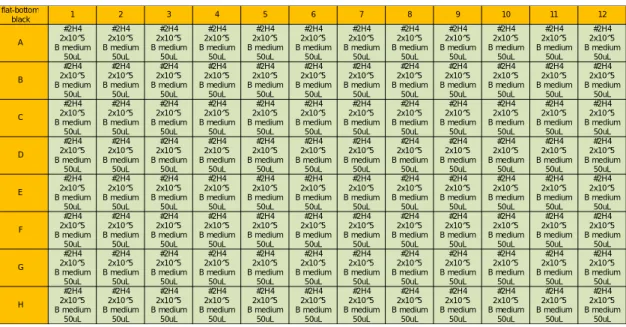
Pre-warm the B medium in a 37°C water bath. Count the number of cells and collect the number of cells needed (2.0 x 10⁷ cells for two chemicals are required, but to have some leeway, 3.0 x 10⁷ cells for two chemicals should be prepared), centrifuge the tube at 120-350 x g, 5 min. Resuspend in pre-warmed the B medium at a cell density of 4×10⁶/mL. Transfer the cell suspension to a reservoir, and add 50 L of cell suspension to each well of a 96 well clear black plate (flat bottom) using an 8 channel or 12 channel pipetman. (cf. Figure 2)
Figure 2
flat-bottom
black 1 2 3 4 5 6 7 8 9 10 11 12
A
#2H4 2x10^5 B medium
50uL
#2H4 2x10^5 B medium
50uL
#2H4 2x10^5 B medium
50uL
#2H4 2x10^5 B medium
50uL
#2H4 2x10^5 B medium
50uL
#2H4 2x10^5 B medium
50uL
#2H4 2x10^5 B medium
50uL
#2H4 2x10^5 B medium
50uL
#2H4 2x10^5 B medium
50uL
#2H4 2x10^5 B medium
50uL
#2H4 2x10^5 B medium
50uL
#2H4 2x10^5 B medium
50uL B
#2H4 2x10^5 B medium
50uL
#2H4 2x10^5 B medium
50uL
#2H4 2x10^5 B medium
50uL
#2H4 2x10^5 B medium
50uL
#2H4 2x10^5 B medium
50uL
#2H4 2x10^5 B medium
50uL
#2H4 2x10^5 B medium
50uL
#2H4 2x10^5 B medium
50uL
#2H4 2x10^5 B medium
50uL
#2H4 2x10^5 B medium
50uL
#2H4 2x10^5 B medium
50uL
#2H4 2x10^5 B medium
50uL C
#2H4 2x10^5 B medium
50uL
#2H4 2x10^5 B medium
50uL
#2H4 2x10^5 B medium
50uL
#2H4 2x10^5 B medium
50uL
#2H4 2x10^5 B medium
50uL
#2H4 2x10^5 B medium
50uL
#2H4 2x10^5 B medium
50uL
#2H4 2x10^5 B medium
50uL
#2H4 2x10^5 B medium
50uL
#2H4 2x10^5 B medium
50uL
#2H4 2x10^5 B medium
50uL
#2H4 2x10^5 B medium
50uL D
#2H4 2x10^5 B medium
50uL
#2H4 2x10^5 B medium
50uL
#2H4 2x10^5 B medium
50uL
#2H4 2x10^5 B medium
50uL
#2H4 2x10^5 B medium
50uL
#2H4 2x10^5 B medium
50uL
#2H4 2x10^5 B medium
50uL
#2H4 2x10^5 B medium
50uL
#2H4 2x10^5 B medium
50uL
#2H4 2x10^5 B medium
50uL
#2H4 2x10^5 B medium
50uL
#2H4 2x10^5 B medium
50uL E
#2H4 2x10^5 B medium
50uL
#2H4 2x10^5 B medium
50uL
#2H4 2x10^5 B medium
50uL
#2H4 2x10^5 B medium
50uL
#2H4 2x10^5 B medium
50uL
#2H4 2x10^5 B medium
50uL
#2H4 2x10^5 B medium
50uL
#2H4 2x10^5 B medium
50uL
#2H4 2x10^5 B medium
50uL
#2H4 2x10^5 B medium
50uL
#2H4 2x10^5 B medium
50uL
#2H4 2x10^5 B medium
50uL F
#2H4 2x10^5 B medium
50uL
#2H4 2x10^5 B medium
50uL
#2H4 2x10^5 B medium
50uL
#2H4 2x10^5 B medium
50uL
#2H4 2x10^5 B medium
50uL
#2H4 2x10^5 B medium
50uL
#2H4 2x10^5 B medium
50uL
#2H4 2x10^5 B medium
50uL
#2H4 2x10^5 B medium
50uL
#2H4 2x10^5 B medium
50uL
#2H4 2x10^5 B medium
50uL
#2H4 2x10^5 B medium
50uL G
#2H4 2x10^5 B medium
50uL
#2H4 2x10^5 B medium
50uL
#2H4 2x10^5 B medium
50uL
#2H4 2x10^5 B medium
50uL
#2H4 2x10^5 B medium
50uL
#2H4 2x10^5 B medium
50uL
#2H4 2x10^5 B medium
50uL
#2H4 2x10^5 B medium
50uL
#2H4 2x10^5 B medium
50uL
#2H4 2x10^5 B medium
50uL
#2H4 2x10^5 B medium
50uL
#2H4 2x10^5 B medium
50uL H
#2H4 2x10^5 B medium
50uL
#2H4 2x10^5 B medium
50uL
#2H4 2x10^5 B medium
50uL
#2H4 2x10^5 B medium
50uL
#2H4 2x10^5 B medium
50uL
#2H4 2x10^5 B medium
50uL
#2H4 2x10^5 B medium
50uL
#2H4 2x10^5 B medium
50uL
#2H4 2x10^5 B medium
50uL
#2H4 2x10^5 B medium
50uL
#2H4 2x10^5 B medium
50uL
#2H4 2x10^5 B medium
50uL
154
5. Preparation of chemicals and cell treatment with chemicals 5-1 Dissolution by vehicle (cf. Figure 3)
Dissolve the chemical first in distilled water. Namely, weigh 0.025 g of the test chemical in a volumetric flask and add distilled water up to 1 mL. If the chemical is soluble at 25 mg/mL, weigh 0.050 g of the test chemical in a volumetric flask and add distilled water up to 1 mL. If the chemical is not soluble at 50 mg/mL, 25 mg/mL is the highest soluble concentration. If the chemical is soluble at 50 mg/mL, weigh 0.100 g of the test chemical in a volumetric flask and add distilled water up to 1 mL. If the chemical is not soluble at 100 mg/mL, 50 mg/mL is the highest soluble concentration. If the chemical is soluble at 100 mg/mL, 100 mg/mL is the highest soluble concentration.
If the chemical is not soluble in water, the chemical should be dissolved in DMSO at 500 mg/mL. Namely, weigh 0.5 g of the test chemical in volumetric flask and add DMSO up to 1 mL.
If the chemical is not soluble at 500 mg/mL, the highest soluble concentration should be determined by diluting the solution from 500 mg/mL at a common ratio of two (250 mg/mL 125 mg/mL continued if needed) with DMSO.
Sonication and vortex may be used if needed,and attempt to dissolve the chemical for at least 5 minutes. Being soluble should be confirmed by centrifugation at 15,000 rpm (≈20,000 x g) for 5 min and absence of precipitation. The chemical should be used within 4 hours after being dissolved in distilled water or DMSO.
155
Figure 3
In the first experiment (1st experiment), when the chemical is prepared in distilled water, conduct 10 serial dilutions at a common ratio of 2 from the highest concentration using distilled water. When the chemical is prepared as a DMSO solution, conduct 10 serial dilutions at a common ratio of 2 from the highest concentration using DMSO.
In the second to fourth experiment (2nd to 4rd experiment), determine the minimum concentration at which I.I.-SLR-LA (mentioned later in 10) became lower than 0.05 in the 1st experiment, use the concentration one step (2-times) higher than this determined concentration as the highest concentration of the chemical to examine, and conduct 10 serial dilutions at a common ratio of 2 from the highest concentration. If I.I.-SLR-LA did not become lower than 0.05 or became lower than 0.05 at the highest concentration in the 1st experiment, conduct 10 serial dilutions at a common ratio of 2 from the highest concentration in the 1st experiment.
For example, in Figure 3 below, the minimum concentration at which I.I.-SLR-LA became lower
156
than 0.05 is 1.95g/ml. The highest concentration of the chemical to examine is the concentration one step (2-times) higher than 1.95g/ml, which is 3.91 g/ml.
In Figure 4 below, I.I.-SLR-LA did not become lower than 0.05. In such a case, the highest concentration of the chemical to examine is the highest concentration in the 1st experiment, namely 125 g/ml.
Figure 3.
Figure 4
0.0 0.2 0.4 0.6 0.8 1.0 1.2
cont
DMSO 0.12 0.24
0.49 0.98
1.95 3.91
7.81 15.6
31.3 62.5
I.I.-SLR-LA
Inhibition index of SLR-LA (I.I.-SLR-LA)
I.I.- SLR- LA 0.05
µg/ml
Final concentration in 2nd and 3rd experiment
0.0 0.2 0.4 0.6 0.8 1.0 1.2
cont
DMSO 0.24 0.49
0.98 1.95
3.91 7.81
15.6 31.3
62.5 125
I.I.-SLR-LA
Inhibition index of SLR-LA (I.I.-SLR-LA)
I.I.- SLR- LA 0.05
µg/ml
Final concentration in 2nd and 3rd experiment
157
5-2 When the chemical is prepared in distilled water
If the chemical is prepared at a lower concentration, use the prepared concentration instead of the 100 mg/mL distilled water solution.
5-2-1 Arrangement of chemicals and vehicle
Add 100 L of the 100 mg/mL distilled water solution of the chemical to well #A12, and 50 L of the distilled water to wells #A1-#A11 of the 96 well clear plate (round bottom).
5-2-2 Serial dilution
Conduct 9 serial dilutions at a common ratio of 2 as indicated in Figure 4 from well
#A11 to well #A3. Transfer 50 L to the next (left) well. (cf. Figure 4) Figure 4
158
5-2-3 2 step dilution
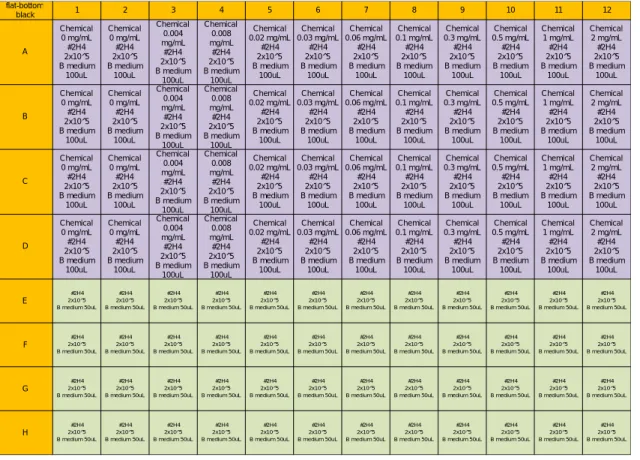
Add 20 L of the diluted chemical to 480 L of the B medium prepared in the assay block. And add 50 L to #2H4 in a 96 well plate using an 8 channel or 12 channel pipetman after pipetting 20 times. Seal the plate, shake the plate with a plateshaker and incubate in a CO2 incubator for 1 hour (37°C, CO2, 5%) (cf. Figure 5-7).
Figure 5
round bottom
clear 1 2 3 4 5 6 7 8 9 10 11 12
A
Distilled water 50uL
Distilled water 50uL
Chemical 0.2 mg/mL in distilled water 100uL
Chemical 0.4 mg/mL in distilled water 50uL
Chemical 0.8 mg/mL in distilled water 50uL
Chemical 1.6 mg/mL in distilled water 50uL
Chemical 3.1 mg/mL in distilled water 50uL
Chemical 6.3 mg/mL in distilled water 50uL
Chemical 13 mg/mL in distilled water 50uL
Chemical 25 mg/mL in distilled water 50uL
Chemical 50 mg/mL in distilled water 50uL
Chemical 100 mg/mL
in distilled water 50uL B
C D E F G H
Assay
Block 1 2 3 4 5 6 7 8 9 10 11 12
A B medium
480uL
B medium 480uL
B medium 480uL
B medium 480uL
B medium 480uL
B medium 480uL
B medium 480uL
B medium 480uL
B medium 480uL
B medium 480uL
B medium 480uL
B medium 480uL B
C D E F G H
20uL
159
Figure 6
Figure 7 Final constituents of each well of the plate
Assay
Block 1 2 3 4 5 6 7 8 9 10 11 12
A B medium
500uL
B medium 500uL
Chemical 0.008 mg/uL in B medium 500uL
Chemical 0.02 mg/mL in B medium 500uL
Chemical 0.03 mg/mL in B medium 500uL
Chemical 0.06 mg/mL in B medium 500uL
Chemical 0.1 mg/mL in
B medium 500uL
Chemical 0.3 mg/mL in
B medium 500uL
Chemical 0.5 mg/mL in
B medium 500uL
Chemical 1 mg/mL in
B medium 500uL
Chemical 2 mg/mL in
B medium 500uL
Chemical 4 mg/mL in
B medium 500uL B
C D E F G H
flat-bottom
black 1 2 3 4 5 6 7 8 9 10 11 12
A
#2H4 2x10^5 B medium 50uL
#2H4 2x10^5 B medium 50uL
#2H4 2x10^5 B medium 50uL
#2H4 2x10^5 B medium 50uL
#2H4 2x10^5 B medium 50uL
#2H4 2x10^5 B medium 50uL
#2H4 2x10^5 B medium 50uL
#2H4 2x10^5 B medium 50uL
#2H4 2x10^5 B medium 50uL
#2H4 2x10^5 B medium 50uL
#2H4 2x10^5 B medium 50uL
#2H4 2x10^5 B medium 50uL
B
#2H4 2x10^5 B medium 50uL
#2H4 2x10^5 B medium 50uL
#2H4 2x10^5 B medium 50uL
#2H4 2x10^5 B medium 50uL
#2H4 2x10^5 B medium 50uL
#2H4 2x10^5 B medium 50uL
#2H4 2x10^5 B medium 50uL
#2H4 2x10^5 B medium 50uL
#2H4 2x10^5 B medium 50uL
#2H4 2x10^5 B medium 50uL
#2H4 2x10^5 B medium 50uL
#2H4 2x10^5 B medium 50uL
C
#2H4 2x10^5 B medium 50uL
#2H4 2x10^5 B medium 50uL
#2H4 2x10^5 B medium 50uL
#2H4 2x10^5 B medium 50uL
#2H4 2x10^5 B medium 50uL
#2H4 2x10^5 B medium 50uL
#2H4 2x10^5 B medium 50uL
#2H4 2x10^5 B medium 50uL
#2H4 2x10^5 B medium 50uL
#2H4 2x10^5 B medium 50uL
#2H4 2x10^5 B medium 50uL
#2H4 2x10^5 B medium 50uL
D
#2H4 2x10^5 B medium 50uL
#2H4 2x10^5 B medium 50uL
#2H4 2x10^5 B medium 50uL
#2H4 2x10^5 B medium 50uL
#2H4 2x10^5 B medium 50uL
#2H4 2x10^5 B medium 50uL
#2H4 2x10^5 B medium 50uL
#2H4 2x10^5 B medium 50uL
#2H4 2x10^5 B medium 50uL
#2H4 2x10^5 B medium 50uL
#2H4 2x10^5 B medium 50uL
#2H4 2x10^5 B medium 50uL
E
#2H4 2x10^5 B medium 50uL
#2H4 2x10^5 B medium 50uL
#2H4 2x10^5 B medium 50uL
#2H4 2x10^5 B medium 50uL
#2H4 2x10^5 B medium 50uL
#2H4 2x10^5 B medium 50uL
#2H4 2x10^5 B medium 50uL
#2H4 2x10^5 B medium 50uL
#2H4 2x10^5 B medium 50uL
#2H4 2x10^5 B medium 50uL
#2H4 2x10^5 B medium 50uL
#2H4 2x10^5 B medium 50uL
F
#2H4 2x10^5 B medium 50uL
#2H4 2x10^5 B medium 50uL
#2H4 2x10^5 B medium 50uL
#2H4 2x10^5 B medium 50uL
#2H4 2x10^5 B medium 50uL
#2H4 2x10^5 B medium 50uL
#2H4 2x10^5 B medium 50uL
#2H4 2x10^5 B medium 50uL
#2H4 2x10^5 B medium 50uL
#2H4 2x10^5 B medium 50uL
#2H4 2x10^5 B medium 50uL
#2H4 2x10^5 B medium 50uL
G
#2H4 2x10^5 B medium 50uL
#2H4 2x10^5 B medium 50uL
#2H4 2x10^5 B medium 50uL
#2H4 2x10^5 B medium 50uL
#2H4 2x10^5 B medium 50uL
#2H4 2x10^5 B medium 50uL
#2H4 2x10^5 B medium 50uL
#2H4 2x10^5 B medium 50uL
#2H4 2x10^5 B medium 50uL
#2H4 2x10^5 B medium 50uL
#2H4 2x10^5 B medium 50uL
#2H4 2x10^5 B medium 50uL
H
#2H4 2x10^5 B medium 50uL
#2H4 2x10^5 B medium 50uL
#2H4 2x10^5 B medium 50uL
#2H4 2x10^5 B medium 50uL
#2H4 2x10^5 B medium 50uL
#2H4 2x10^5 B medium 50uL
#2H4 2x10^5 B medium 50uL
#2H4 2x10^5 B medium 50uL
#2H4 2x10^5 B medium 50uL
#2H4 2x10^5 B medium 50uL
#2H4 2x10^5 B medium 50uL
#2H4 2x10^5 B medium 50uL
50uL
flat-bottom
black 1 2 3 4 5 6 7 8 9 10 11 12
A
Chemical 0 mg/mL
#2H4 2x10^5 B medium
100uL
Chemical 0 mg/mL
#2H4 2x10^5 B medium
100uL
Chemical 0.004 mg/mL
#2H4 2x10^5 B medium
100uL
Chemical 0.008 mg/mL
#2H4 2x10^5 B medium
100uL
Chemical 0.02 mg/mL
#2H4 2x10^5 B medium
100uL
Chemical 0.03 mg/mL
#2H4 2x10^5 B medium
100uL
Chemical 0.06 mg/mL
#2H4 2x10^5 B medium
100uL
Chemical 0.1 mg/mL
#2H4 2x10^5 B medium
100uL
Chemical 0.3 mg/mL
#2H4 2x10^5 B medium
100uL
Chemical 0.5 mg/mL
#2H4 2x10^5 B medium
100uL
Chemical 1 mg/mL
#2H4 2x10^5 B medium
100uL
Chemical 2 mg/mL
#2H4 2x10^5 B medium
100uL
B
Chemical 0 mg/mL
#2H4 2x10^5 B medium
100uL
Chemical 0 mg/mL
#2H4 2x10^5 B medium
100uL
Chemical 0.004 mg/mL
#2H4 2x10^5 B medium
100uL
Chemical 0.008 mg/mL
#2H4 2x10^5 B medium
100uL
Chemical 0.02 mg/mL
#2H4 2x10^5 B medium
100uL
Chemical 0.03 mg/mL
#2H4 2x10^5 B medium
100uL
Chemical 0.06 mg/mL
#2H4 2x10^5 B medium
100uL
Chemical 0.1 mg/mL
#2H4 2x10^5 B medium
100uL
Chemical 0.3 mg/mL
#2H4 2x10^5 B medium
100uL
Chemical 0.5 mg/mL
#2H4 2x10^5 B medium
100uL
Chemical 1 mg/mL
#2H4 2x10^5 B medium
100uL
Chemical 2 mg/mL
#2H4 2x10^5 B medium
100uL
C
Chemical 0 mg/mL
#2H4 2x10^5 B medium
100uL
Chemical 0 mg/mL
#2H4 2x10^5 B medium
100uL
Chemical 0.004 mg/mL
#2H4 2x10^5 B medium
100uL
Chemical 0.008 mg/mL
#2H4 2x10^5 B medium
100uL
Chemical 0.02 mg/mL
#2H4 2x10^5 B medium
100uL
Chemical 0.03 mg/mL
#2H4 2x10^5 B medium
100uL
Chemical 0.06 mg/mL
#2H4 2x10^5 B medium
100uL
Chemical 0.1 mg/mL
#2H4 2x10^5 B medium
100uL
Chemical 0.3 mg/mL
#2H4 2x10^5 B medium
100uL
Chemical 0.5 mg/mL
#2H4 2x10^5 B medium
100uL
Chemical 1 mg/mL
#2H4 2x10^5 B medium
100uL
Chemical 2 mg/mL
#2H4 2x10^5 B medium
100uL
D
Chemical 0 mg/mL
#2H4 2x10^5 B medium
100uL
Chemical 0 mg/mL
#2H4 2x10^5 B medium
100uL
Chemical 0.004 mg/mL
#2H4 2x10^5 B medium
100uL
Chemical 0.008 mg/mL
#2H4 2x10^5 B medium
100uL
Chemical 0.02 mg/mL
#2H4 2x10^5 B medium
100uL
Chemical 0.03 mg/mL
#2H4 2x10^5 B medium
100uL
Chemical 0.06 mg/mL
#2H4 2x10^5 B medium
100uL
Chemical 0.1 mg/mL
#2H4 2x10^5 B medium
100uL
Chemical 0.3 mg/mL
#2H4 2x10^5 B medium
100uL
Chemical 0.5 mg/mL
#2H4 2x10^5 B medium
100uL
Chemical 1 mg/mL
#2H4 2x10^5 B medium
100uL
Chemical 2 mg/mL
#2H4 2x10^5 B medium
100uL
E
#2H4 2x10^5 B medium 50uL
#2H4 2x10^5 B medium 50uL
#2H4 2x10^5 B medium 50uL
#2H4 2x10^5 B medium 50uL
#2H4 2x10^5 B medium 50uL
#2H4 2x10^5 B medium 50uL
#2H4 2x10^5 B medium 50uL
#2H4 2x10^5 B medium 50uL
#2H4 2x10^5 B medium 50uL
#2H4 2x10^5 B medium 50uL
#2H4 2x10^5 B medium 50uL
#2H4 2x10^5 B medium 50uL
F
#2H4 2x10^5 B medium 50uL
#2H4 2x10^5 B medium 50uL
#2H4 2x10^5 B medium 50uL
#2H4 2x10^5 B medium 50uL
#2H4 2x10^5 B medium 50uL
#2H4 2x10^5 B medium 50uL
#2H4 2x10^5 B medium 50uL
#2H4 2x10^5 B medium 50uL
#2H4 2x10^5 B medium 50uL
#2H4 2x10^5 B medium 50uL
#2H4 2x10^5 B medium 50uL
#2H4 2x10^5 B medium 50uL
G
#2H4 2x10^5 B medium 50uL
#2H4 2x10^5 B medium 50uL
#2H4 2x10^5 B medium 50uL
#2H4 2x10^5 B medium 50uL
#2H4 2x10^5 B medium 50uL
#2H4 2x10^5 B medium 50uL
#2H4 2x10^5 B medium 50uL
#2H4 2x10^5 B medium 50uL
#2H4 2x10^5 B medium 50uL
#2H4 2x10^5 B medium 50uL
#2H4 2x10^5 B medium 50uL
#2H4 2x10^5 B medium 50uL
H
#2H4 2x10^5 B medium 50uL
#2H4 2x10^5 B medium 50uL
#2H4 2x10^5 B medium 50uL
#2H4 2x10^5 B medium 50uL
#2H4 2x10^5 B medium 50uL
#2H4 2x10^5 B medium 50uL
#2H4 2x10^5 B medium 50uL
#2H4 2x10^5 B medium 50uL
#2H4 2x10^5 B medium 50uL
#2H4 2x10^5 B medium 50uL
#2H4 2x10^5 B medium 50uL
#2H4 2x10^5 B medium 50uL
160
5-3 When the chemical is prepared as a DMSO solution
If the chemical is prepared at a lower concentration, use the prepared concentration instead of 500 mg/mL DMSO solution.
5-3-1 Arrangement of chemicals and vehicle
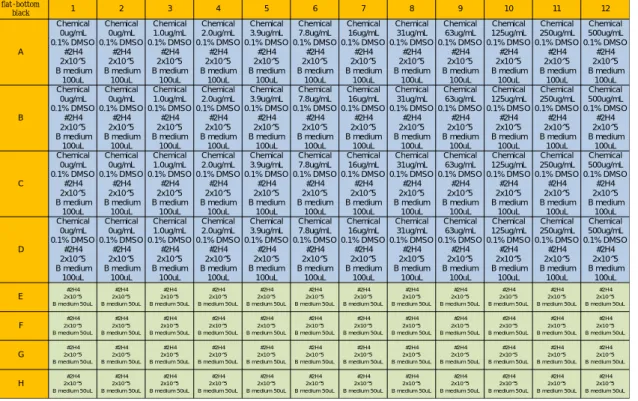
Add 100 L of the 500 mg/mL DMSO solution of the chemical to well #A12, 50 L of DMSO to wells #A1-#A11, and 90 L of the B medium to wells #B1-#B12 of the 96 well clear plate (round bottom)
5-3-2 Serial dilution
Conduct 9 serial dilutions at a common ratio of 2 as indicated in Figure 8 from well
#A11 to well #A3. Transfer 50 L to the next (left) well. (cf. Figure 8) Figure 8