INSTITUTEOFMATHEMATICS
POLISHACADEMYOFSCIENCES
WARSZAWA199*
DIRECTIONAL TRANSITION MATRIX
HIROSHI KOKUBU
Department of Mathematics, Kyoto University Kyoto 606-8502, Japan
E-mail: [email protected] KONSTANTIN MISCHAIKOW
School of Mathematics, Georgia Institute of Technology Atlanta, GA 30332, U.S.A.
E-mail: [email protected] HIROE OKA
Department of Applied Mathematics and Informatics Faculty of Science and Technology, Ryukoku University
Seta Otsu 520-2194, Japan E-mail: [email protected]
Abstract. We present a generalization of topological transition matrices introduced in 6].
1. Introduction.
This paper deals with connecting orbit problems for ows. Namely, given a ow onRnhaving invariant sets called a repellorRand an attractor A, we are interested in the existence of an orbit whose -limit set is contained in R and whose!-limit set is contained in A. Such an orbit, if it exists, is called a connecting orbit from R to A. The Conley index theory 1, 2] provides us with a topological method for the connecting orbit problem. For this theory, one is assumed to have an isolated invariant set which contains the repeller and an attractor. The isolated invariant set S has an attractor-repeller decomposition if the attractorAand the repellerRare isolated invariant subsets in S and moreover it satises the following property: if there is an
x2Sn(RA), the orbit ofxmust be a connecting orbit fromRtoA, namely it holds that
S =RAC(RA)
The second author was partially supported by NSF Grant DMS-9505116. The third author was supported by Ryukoku University for her visit to Georgia Institute of Technology.
1991 Mathematics Subject Classication: Primary 58F25 Secondary 34C37.
The paper is in nal form and no version of it will be published elsewhere.
1]
where C(RA) is the union of all (possible) connecting orbits fromRtoA. Notice that the unions in the above equation are all disjoint. The simplest way of using Conley indices for detecting connecting orbits is in the following observation: suppose there is no connecting orbit fromR to A, thenS is the disjoint union of the attractor and the repeller, and hence, the corresponding Conley indices must be the direct sum:
CH (S)=CH (A)CH (R):
Therefore, if one can show that CH (S) is not the direct sum CH (A)CH (R), it implies that there must exist a connecting orbit from the repeller to the attractor.
This idea has been generalized to the theory of connection matrices 3]. If one has a Morse decomposition 1, 2] of an isolated invariant setS:
M=fM(p)jp2Pg
then the connection matrix is given by the matrix representation of a degree one lower triangular homomorphism from the cohomology group Lp2PCH (M(p)) to itself, such that its square is identically zero, and that, if it has a non-zero (pq)-entry, there exists a sequence of connecting orbits from the Morse component M(p) to M(q). Note that since Conley indices remain the same under suciently small perturbation of the ow, connecting orbits detected by the above methods persist under perturbation. On the other hand, the connection matrix is not in general unique. See 9] for more detail.
Using ideas of Conley, Reineck 10] for the rst time applied the idea of connection matrix to a broader class of connecting orbit problems, namely those of detecting con- necting orbits which are not persistent under perturbation. The basic idea is to put a one-parameter familyof ows into a slow-fast system by introducing an articial slow drift in the parameter space. More precisely, he considered equation of the following form:
_
x = f(xy) _
y = "y(1;y): (1.1) When"= 0, this equation reduces to a one-parameter family of vector elds, whereas for
">0, the parameteryevolves slowly fromy= 0 att=;1toy= 1 att= +1. Suppose the parametrized system at"= 0 has an isolated invariant setSyfor eachy201] which continues over the parameter interval 01], together with its Morse decomposition
M
y =fMy(p)jp2Pg:
One can then consider the entire system with small">0 and show that the connection matrix for (1.1) has the following decomposition:
= 0 0
T 1
where j is the connection matrix for the Morse decompositions aty=j= 01, respec- tively. If one has a nonzero (pq)-entry of the submatrixT above, then the system with
">0 possesses a connecting orbit fromM0(p) to M1(q) for any">0, since it is a part of the connection matrix . Moreover, one can show from this that the connecting orbit even converges to a connected invariant subset in the parametrized system with " = 0 in the Hausdor metric as " !0. This connected invariant subset containsM0(p) and
M
1(q), and hence one concludes that the parametrized system at"= 0 has an increasing sequence of parameter valuesfyigk +1i=0 withy0= 0yk +1= 1, and connecting orbits from
M
yi(pi) to Myi(pi+1) fori = 1:::kwith p1=p pk +1=q, thereby showing the exis- tence of connecting orbits which are not in general persistent under perturbation. This submatrixT is called a (singular)transition matrix.
One disadvantage of this formulation of the transition matrix is that it depends (at least formally) on the form of the slow parameter drift, although in general the slow parameter drift should be irrelevant to the form of connection matrices as well as the existence of connecting orbits which can be detected by these methods. In order to re- move the articial dependence on the slow parameter drift, McCord and Mischaikow 6]
introduced the notion of topological transition matrix. The topological transition matrix can be dened only from the parametrized system at"= 0, and detects the change of the topological nature of connecting orbits among Morse sets when the parameter varies from
y= 0 toy= 1. More precisely, the topological transition matrix is dened as follows:
Since each Morse setMy(p) continues over 01], there are continuation isomorphisms
F
10(p) :CH (M1(p))!CH (M0(p)): Similarly, sinceSy continues over 01] there is an isomorphism
F
10(S) :CH (S1)!CH (S0):
IfSy =Sp2PMy(p), i.e. the set of connecting orbits is empty aty, then there exists an index isomorphism
y:CH (Sy)!M
p2P
CH (My(p)): (1.2)
Suppose there are no connections at either y = 0 or y = 1, then we can construct the following diagram
M
p2P
CH (M1(p))
M
p2P F
10(p)
;!
M
p2P
CH (M0(p))
1 " 0 "
CH (S1) F10(S)
;! CH (S0)
Even though every map is an isomorphism this diagram is not, in general, commu- tative. Furthermore, it is the failure of commutativity that gives information concerning connecting orbits. Thetopological transition matrix
T
10:M
p2P
CH (M1(p))!M
p2P
CH (M0(p)) is dened by
T
10= 0F10(S)(1);1: Note that the diagram
M
p2P
CH (M1(p)) T;1!0 M
p2P
CH (M0(p)) 1 " 0 "
CH (S1) F10(S)
;! CH (S0)
(1.3)
commutes by denition. The topological transition matrix is lower triangular and shares the same property as the singular transition matrix, namely its o diagonal nonzero entry implies the existence of connecting orbits between appropriate Morse sets for various
y2(01). See 6] for more details.
Furthermore McCord and Mischaikow 7] showed the equivalence of the singular and topological transition matrices. It implies that the change of the connecting orbit struc- ture fromy = 1 toy = 0 in the system (1.1) with "<0 is given by the inverse of the singular transition matrix for " > 0. This is proven by going through the topological transition matrix for which the inverse operation is well-dened and makes a good sense, whereas it cannot be directly applied to singular transition matrices since the isolation of the system is completely lost at " = 0. This fact was used to show the existence of innitely many connecting orbits of a slow-fast system. See 5].
In all these cases, the transition matrices provide information about how connecting orbit structure changes as the parameter y moves in one direction, say fromy = 0 to
y= 1. In this paper we want to extend the applicability of the idea of transition matrices to even broader class of problems. We consider the slow-fast systems of the form
_
x = f(xy) _
y = "g(xy) (1.4)
wherex2Rn y2R. Notice that this form of the slow-fast system is more general than (1.1) in that the equation for the slow variableydepends also on the fast variablexand hence, for">0, dierent Morse components may have dierent directions of slow drift.
We assume that when " = 0 the parametrized system has an isolated invariant set Sy for each y that continues over the interval 01] in they-space, together with the Morse decomposition
M
y=fMy(p)jp2Pg
parametrized by y 2 R. We assume that g(My(p)y) 6= 0 for any y 2 (01) and any
p2 P, but do not assume that the slow dynamics introduced when " >0 goes in the same direction for the Morse components, and we dene the notion of box as follows.
Definition 1.1. A setBis aboxif:
(1) There exists an isolating neighborhoodBRn01] for the parameterized ow
B dened by
B :RRn01] ! Rn01]
(txy) 7! (y(tx)y) where y is the ow of _x=f(xy) with xed y.
(2) LetS(B) := Inv(B B). There exists a Morse decomposition
M(S(B)) :=fM(pB)jp= 1:::PBg
with the usual ordering on the integers as the admissible ordering. Let By =
B\(Rnfy g), Sy(B) := Inv(Byy) and let fMy(pB) j p = 1:::PBg be the corresponding Morse decomposition ofSy(B). Then
S
0(B) := PB M0(pB) and S1(B) := PB M1(pB):
(3) There are isolating neighborhoodsV(pB) forM(pB) such that
V(pB)B and V(pB)\V(q B) = forp6=qwithpq= 1:::PB, and for every y201]
V
y(pB)Int(By):
Furthermore, there are (pB)2f1g,p= 1:::PB, such that
(pB)g(xy)>0 for all (xy)2V(pB)
From the last property, one can decompose the nite index set of the Morse decom- position as
P =P+P; where
P
=fp2P j(p)>0g
and accordingly, one can deneMin(pB) andMout(pB) as follows:
M
in(pB) =
M
0(pB) ifp2P+
M
1(pB) ifp2P; (1.5)
M
out(pB) = M1(pB) ifp2P+
M
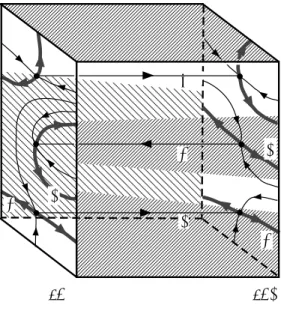
0(pB) ifp2P;: (1.6) Notice that there are no connecting orbits among the Morse sets aty= 0 and aty= 1, and by the construction, the sets S0(B) and S1(B) are related by continuation. A box with bi-directional slow dynamics can naturally occur in various problems, for instance, in the FitzHugh-Nagumo equation. See 4] for more explanation. For this situation, either singular or topological transition matrix is not useful since they are both essentially uni- directional. In order to illustrate the diculty, let us consider a variant of the connecting orbit problem studied in 6]. See Figure 1. Consider a one-parameter family of planar vector elds with three Morse sets indexed by 1,2,3 with the admissible ordering 3>2>
1, which continue over the parameter interval 01]. In transition from y = 0 toy = 1, there is a chance of connections among these Morse components which may be detected by the topological transition matrix. However, if the slow dynamics on each of the Morse sets is as indicated in Figure 1, none of the known transition matrices can provide us with information about orbits connecting, sayM0(3) andM1(1), since the middle Morse component goes in the opposite direction.
The goal of this paper is to set up a version of transition matrix called directional transition matrixgiven as an isomorphism
D:M
p2P
CH (Mout(p))!M
p2P
CH (Min(p))
whose non-zero (pq)-entry implies the existence of connecting orbits fromMin(p) to
M
out(q). In the next section, we give a denition of the directional transition matrix and show that it has the desired property. The essential part of the proof relies on our recent results 4]. In Section 3, we illustrate how the directional transition matrix can be applied to the situation as in Figure 1 and be used to detect connecting orbits.
2. Directional transition matrix.
Recall that the topological transition matrixT :M
p2P
CH (M1(p))!M
p2P
CH (M0(p))
is lower triangular. Namely, if its (pq)-entryT(pq) is nonzero, thenp>qwith respect to an admissible ordering of the index setP for the Morse decomposition of a box in the slow-fast system (1.4). This means that there exist a nite increasing sequence fyigki=1 in 01] and a sequence fpigki=1 inP satisfying
p=p1>p2>:::>pk=q
such that the corresponding parametrized ow at y = yi has a connecting orbit from
M
yi(pi) toMyi(pi+1).
We shall show an analogous but more general statement for the existence of connecting orbits from a nonzero entry of the directional transition matrix. Let us begin by giving a precise denition of the directional transition matrix.
Lemma 2.1. Let VV0 and WW0 are mutually isomorphic nitely generated free Abelian groups, and let
A:V W !V0W0
be an isomorphism. SupposeAis lower triangular with the following block decomposition:
A= X 0
Y Z
whereX :V !V0and Z :W !W0 are isomorphisms, then the following maps are all lower triangular isomorphisms:
A
1= X 0
;Z
;1
Y Z
;1
: V W0!V0W
A
2= X;1 0
YX
;1
Z
: V0W !V W0
A
3= X;1 0
;Z
;1
YX
;1
Z
;1
: V0W0!V W:
The proof is straightforward. Since the topological transition matrixis lower triangular with respect to an admissible ordering, one can repeatedly apply the above lemma and obtain an isomorphism
D:M
p2P
CH (Mout(p))!M
p2P
CH (Min(p)):
The matrix representation of this isomorphism, called the directional transition matrix, has the following property.
Theorem 2.2. LetDbe the directional transition matrix for a box in the slow-fast sys- tem (1.4). If its(pq)-entryD(pq)is nonzero, then there exist a nite sequencefyigk +1i=1 in01]and a sequencefpigki=1 in P satisfying
(pi+1)(yi+1;yi)>0for alli= 1:::k;1 and
p=p1>p2>:::>pk >pk +1=q
such that the corresponding parametrized ow at y = yi has a connecting orbit from
M
yi(pi)toMyi(pi+1).
This theorem is proven by applying the TBC collection theorem in 4, Theorem 1.10].
Let us rst recall some denitions from 4].
Definition 2.3. T is atubeif:
(1) There exists an interval ab] such that T Rnab] and T is an isolating neighborhood for
T :RRnab] ! Rnab] (txy) 7! (y(tx)y): (2) There exists(T)2f1gsuch that for all (xy)2T we have
(T)g(xy)>0:
Definition 2.4. A setC(R) (C(A)) is arepelling (attracting) cap if:
(1) There exists an interval ef] such thatCRnef] andC is an isolating neigh- borhood for
C :RRnef] ! Rnef] (txy) 7! (y(tx)y) (2)
x2C
e(R) ) g(xe)<0
x2C
f(R) ) g(xf)>0
x2C
e(A) ) g(xe)>0
x2C
f(A) ) g(xf)<0 where Cy(R) :=C(R)\fy gandCy(A) :=C(A)\fy g.
The following denition is a special case of the TBC collections dened in 4]. In this paper we only need the case where the number of boxes is one (and hence the number of tubes is two), hence the denition is adapted to such cases for simplicity.
Definition 2.5. Atubes, box and caps collection (TBC collection) is a collection of tubesT(1)T(2), a boxBRn01], and capsC(R) andC(A) such that:
(1) (a) T(1)\(Rn01])V(1B) andT(1)\B) isolates M(1).
(b) T(2)\(Rn01])V(PBB) andT(2)\B isolatesM(PB).
(2) either
(T(2))>0 and (PBB)>0 in which caseb2= 1 or
(T(2))<0 and(PBB)<0 in which casea2= 0 where a,bare as in Denition 2.3.
(3) either
(T(1))>0 and(1B)>0 in which casea1= 0 or
(T(1))<0 and(1B)<0 in which case b1= 1 where a,bare as in Denition 2.3.
(4) C(R)\T(2)6=andC(A)\T(1)6=. Furthermore,
C(R)\T(2)\(Rnfy g)6= ) Cy(R) =Ty(2)
C(A)\T(1)\(Rnfy g)6= ) Cy(A) =Ty(1): Given a TBC collection, let
D(PB1) :CH (Mout(1B))!CH (Min(PBB)) (2.1) denote the (PB1)-entry of the directional transition matrix of the boxB. The following theorem is the special case of Theorem 1.10 in 4]. See 4] for its complete statement as well as the proof.
Theorem 2.6. LetT(1)T(2),C(R)C(A), and B be a TBC collection for the slow- fast system (1.4). Let
N :=BT(1)T(2)C(R)C(A): Then, for">0suciently small,
(1) N is an isolating neighborhood for the ow '" generated by (1.4)
(2) (Inv(C(R)'")Inv(C(A)'"))is an attractor-repeller pair forInv(N'") (3) IfD(PB1)6= 0, then
CH (Inv(N'"))6=CH (Inv(C(A)'"))CH (Inv(C(R)'")):
Therefore, for all suciently small">0there is a connecting orbit fromInv(C(R)'") toInv(C(A)'")inN under the ow'".
In order to prove Theorem 2.2, one can apply the above theorem as follows: Suppose the directional transition matrixDassociated to a boxBhas a nonzero (pq)-entry. Then one can modify the slow-fast system outside the box in such a way that one can attach tubes as well as attracting and repelling caps to Morse componentsMin(p) andMout(q).
Clearly the smallest interval inP that contains pqgives rise to a subbox B0 inB, and together with the attached tubes and caps, they form a TBC collection. Therefore, from Theorem 2.6, one obtains a connecting orbit from Min(p) to Mout(q) for any " > 0.
One can then apply the same reasoning as in 10] to show that the connecting orbit converges to a connected invariant set of the parametrized ow in the Hausdor metric as"tends to 0. This connecting invariant set consists of connecting orbits between some Morse sets Myi(pi) to Myi(pi+1) at y =yi as well as intervals between yi and yi+1 in the slow manifold corresponding to thepi-th Morse component. Clearly the sequencesyi andpi must satisfy the relation as in the assertion of Theorem 2.2, and hence the proof is completed.
3. Example.
We shall illustrate how the directional transition matrix is computed and used in an example. Consider a slow-fast system onR2Rwith a box as in Figure 1. If one attatches a repelling cap with a tube connecting the fy = 0g-side of the top Morse componentM0(3) and an attracting cap with a tube connecting thefy= 1g-side of the bottom Morse componentM1(1), then these caps, tubes and the box will form a TBC collection. Thus the problem is to nd a connecting orbit from the repelling cap to the attracting cap. According to the slow directions along the Morse components in the box, if a connecting orbit exists, it should follow the top Morse component fromy = 0 to some y > 0, then jumps down to the middle Morse component and follow it in the backward direction until it jumps further down to the bottom one and leaves the box throughy= 1. In order to nd such a connecting orbit, we must compute the directional transition matrix and the corresponding (3,1)-entry.
α
α'
γ β
β'
γ' 3
y=0 y=1
2
1
Figure 1: A box with three Morse components. Three horizontal lines represent the slow manifolds corresponding to the three Morse componentsM(p) for p= 123. Slow dy- namics in the slow manifolds are indicated by the arrows. At both sides of the box given byy= 01, the fast dynamics change as indicated, where bold curves represent the un- stable sets of the corresponding Morse components. These unstable sets labeled aty = 0 and 000aty= 1 generate the cohomology Conley indices. Shaded regions in the side boundary of the box exhibit the (immediate) exit sets.
Here the unstable sets of each of the Morse components give the sets of basis for the corresponding Conley indices. To be more specic, let b b bbe the elements in the Z2- coecient cohomology Conley indexCH (S0) aty= 0 corresponding to the unstable sets
of the Morse componentM0(p) forp= 123, respectively. Then they form a basis ofCH (S0)=Lp=123CH (M0(p)). Similarly, the elements b0b0b0in the cohomology Conley indexCH (S1)=Lp=123CH (M1(p)) aty = 1 corresponding to the unstable sets 000 of the Morse componentM1(p) forp= 123 form a basis of it. Figure 1
shows that these basis elements are related as
b
0 = b
b
0 = b+b
b
0 = b+:b
(3.1) Indeed, this follows from the duality between the homology and cohomology groups and a similar relation among homology classes generated by these unstable sets as follows:
0 = ++
0 = +
0 =
which can be easily seen from Figure 1, where the same notation is used to indicate an unstable set and its homology class. From (3.1), one can compute the cohomology transition matrix
T
10: M
p=123
CH (M1(p))! M
p=123
CH (M0(p)) dened inx1 and obtains
T 10=
0
@
1 0 0 1 1 0 0 1 1
1
A
:
Given the direction of the slow dynamics as in Figure 1, we can now compute the corresponding directional transition matrix. In this case, the directional transition matrix
D is given as a homomorphism
D: M
p=123
CH (Mout(p)) =CH (M1(3))CH (M0(2))CH (M1(1))
! M
p=123
CH (Min(p)) =CH (M0(3))CH (M1(2))CH (M0(1)): We rst decompose the index set as
T
10:CH (M1(3))CH (M1(2))CH (M1(1))]
!CH (M0(3))CH (M0(2))CH (M0(1))]
in order to apply Lemma 2.1, and obtain
A
1:CH (M1(3))CH (M0(2))CH (M0(1))]
!CH (M0(3))CH (M1(2))CH (M1(1))]
which is, as a matrix, given by
A
1=
0
@
1 0 0 1 1 0 1 1 1
1
A
:
We then change the decomposition as
A
1: CH (M1(3))CH (M0(2))]CH (M0(1))
!CH (M0(3))CH (M1(2))]CH (M1(1))
and apply Lemma 2.1 again. The resulting matrix
D: CH (M1(3))CH (M0(2))]CH (M1(1))
!CH (M0(3))CH (M1(2))]CH (M0(1))
is the same as the aboveA1, which gives the desired directional transition matrix in this case. Therefore
D=
0
@
1 0 0 1 1 0 1 1 1
1
A
:
In particular, the (3,1)-entry ofDis nonzero, and hence it follows from Theorem 2.2 that there exists a connecting orbit fromM0(3) toM1(1). Similarly,there also exist connecting orbits fromM0(3) toM0(2) and fromM1(2) toM1(1), respectively, since the (3,2) and (2,1)-entries ofD are nonzero.
One can view the above computation of the directional transition matrix as follows.
Observe thatbb0bform a basis ofLp=123CH (Min(p)), whereasb0b b0form a basis of Lp=123CH (Mout(p)). From (3.1), we have a similar relation between these sets of basis, which are expressed as
0
@
1 0 0 1 1 0 1 1 1
1
A 0
@ b
0
b
b 0
1
A=
0
@ b
b
0
b
1
A
:
The matrix corresponding to this change of basis is in fact the directional transition matrixD.
Acknowledgement
This work has been done when the rst and third authors stayed at Center for Dynamical Systems and Nonlinear Studies, Georgia Institute of Technology.They are grateful for its hospitality and support.
References
1] L. Arnold, C. Jones, K. Mischaikow, G. Raugel, Dynamical Systems Montecatini Terme 1994(ed. R. Johnson), Lecture Notes in Math., Vol. 1609, Springer, 1995.
2] C. Conley, Isolated Invariant Sets and the Morse Index, CBMS Reg. Conf. Ser. in Math., 38, AMS, Providence, 1978.
3] R. Franzosa, The connection matrix theory for Morse decompositions, Trans. AMS,311 (1989) 781{803.
4] T. Gedeon, H. Kokubu, K. Mischaikow, H. Oka, and J. Reineck, Conley index theory for fast-slow systems, I: One dimensional slow dynamics, to appear inJ. Dynam. Di. Eq.
5] H. Kokubu, K. Mischaikow, and H. Oka, Existence of innitely many connecting orbits in a singularly perturbed ordinary dierential equations,Nonlinearity,9(1996), 1263{1280.
6] C. McCord and K. Mischaikow, Connected simple systems, transition matrices and hetero- clinic bifurcations,Trans. A.M.S.,333(1992), 397{422.
7] C. McCord and K. Mischaikow, Equivalence of topological and singular transition matrices in the Conley index, Mich. Math. J.,42(1995), 387{414.
8] K. Mischaikow. M. Mrozek and J. Reineck, Singular index pairs, to appear inJ. Dynam.
Di. Eq.
9] J. Reineck, The connection matrix in Morse-Smale ows,Trans. A.M.S.,322(1990), 523{
10] J. Reineck, Connecting orbits in one-parameter families of ows,545. Ergod. Th. & Dynam.
Sys.,8 (1988), 359{374.