• 検索結果がありません。

High Level of Rheumatoid Factor is Associated with Hepatitis B Viremia in Patients with Chronic Hepatitis B

N/A
N/A
Protected

Academic year: 2021

シェア "High Level of Rheumatoid Factor is Associated with Hepatitis B Viremia in Patients with Chronic Hepatitis B"

Copied!
9
0
0

読み込み中.... (全文を見る)

全文

(1)

High Level of Rheumatoid Factor is Associated with Hepatitis B Viremia in Patients with Chronic Hepatitis B

Jun A RAI , Takayoshi I TO , Miyuki M IYASHITA,

Yuu S HIMODUMA , Manabu U CHIKOSHI , Kenichi M ORIKAWA , Junichi E GUCHI , Eiichi H AYASHI , Hisako N OZAWA

and Hitoshi Y OSHIDA

Abstract : Hepatitis viruses are causative agents for chronic hepatitis, liver cirrhosis and hepatocellular carcinoma. However these viruses are also associated with lymphoproliferative disorders (LPDs) , such as essential mixed cryoglobulinemia and B-cell non-Hodgkinʼs lymphoma. Indeed, hepatitis C virus infection has been confirmed to be associated with LPDs, but the pathogenic mechanism remains unclear. In this study, we investigated the relationship between hepatitis B virus

( HBV) infection and LPDs in 84 patients with chronic hepatitis B (CH-B) . LPD markers, such as cryoglobulinemia, high levels of rheumatoid factor (RF) , hypo- complementemia, and B cell clonality, were measured and analyzed along with viral factors. Results showed that high levels of RF were observed in 39.5% of patients with CH-B. These high RF levels were not associated with abnormal levels of other LPD markers, but only with the presence of HBV DNA in the sera of these patients. Undergoing therapy with nucleotide analogues was also associated with high RF. In two patients with CH-B, decreasing levels of RF were observed during antiviral therapy. In conclusion, high RF levels are associated with HBV viremia in patients with CH-B. HBV infection also plays an important role in the genesis of LPDs in patients with viral hepatitis..

Key words : rheumatoid factor (RF) , cryoglobulinemia, hepatitis B virus (HBV) , lymphoproliferative disorders (LPDs) , B cell clonality

Introduction

 Infection with hepatitis viruses causes a variety of extra hepatic manifestations, such as cryoglobulinemia, malignant lymphoma, and glomerulonephritis. In particular, lymphoproliferative disorders (LPDs) and autoimmune diseases are common abnormalities among patients infected with hepatitis virus

1)

. The prevalence of hepatitis C virus (HCV) and hepatitis B virus (HBV)

carrier status has been reported to be 10.1% and 7.3%, respectively, in patients with non- Hodgkinʼs lymphoma

2)

. These rates are around five-fold higher than that of the general Japanese population. Furthermore, these abnormalities are observed not only in patients with active hepatitis but also asymptomatic patients, suggesting that regular examination is necessary for the Original

Division of Gastroenterology, Department of Medicine, Showa University School of Medicine, 1-5-8 Hatanodai,

Shinagawa-ku, Tokyo 142-8666, Japan.

(2)

identification of immunologic disorders especially in patients with asymptomatic viral hepatitis.

 We previously reported a high prevalence of abnormalities in LPD markers are found in patients with chronic hepatitis C (CH-C)

3)

. These abnormalities are associated with HCV infection and/or adsorption with B cells of the patients. Cryoglobulinemia, high levels of rheumatoid factor (RF) , low complement levels and clonal expansion of B cells are frequently observed in patients with CH-C. About 74% of the patients in our previous study were HCV RNA-positive in B cells isolated from the patients studied. These results suggest that HCV infection plays an important role not only in liver disease but also in immunological disorders.

In fact, a recent study also demonstrated that abnormal activation of B cells was observed in patients with both chronic hepatitis B (CH-B) and C

4)

. Therefore in this study, we investigated LPD markers in CH-B patients to determine whether HBV infection also induces LPDs and/or immunologic disorders in patients with CH-B.

Patients and Methods Patients

 From 2002 through 2013, 84 patients with CH-B, who were managed at Showa University Hospital, were enrolled in this retrospective study. Twenty of these patients underwent antiviral therapy using nucleic acid analogues. Diagnosis of HBV infection was based on the detection of hepatitis B surface antigen and HBV DNA in the serum prior to the initiation of therapy.

Viral information (HBV genotype and serum HBV DNA titer) , host factors (age, gender, platelet count, serum alanine transaminase [ALT] and γ -glutamyltranspeptidase [γ -GTP]) , immunological markers (immunoglobulin [Ig] G, IgA and IgM) and markers for LPDs (cryoglobulinemia, high levels of RF, hypocomplementemia, and B cell clonality) were measured and analyzed.

 The study protocol was approved by the Ethics Committee of Showa University School of Medicine, Tokyo, Japan. Informed written consent was obtained from each participant and the study followed the ethical guidelines of the 1975 Declaration of Helsinki.

LPD markers

 Cryoglobulinemia was detected by a semi-quantitative centrifugation method. Briefly, blood samples were centrifuged at 600 xg for 20 min at 37℃. Sera were cooled to 4℃ and left to stand for 48 h, and centrifuged again at 2,500 xg for 10 min at 4℃. The emergence of cryocrit at 4℃ and its disappearance by warming up to 37℃ for 20 min was regarded as positive for cryoglobulin. RF was determined by the latex turbidimetric assay. Complement component 3

(C3) and 4 activity was determined by immune nephelometry, while total hemolytic complement was assayed by the immunoturbidimetric method.

Amplification of Ig-VH region by polymerase chain reaction and B cell clonality assay

 In 63 patients with CH-B, clonal expansion of B cells (B cell clonality) was determined from

the sequence uniformity of the complementarity-determining region 3 of the immunoglobulin

heavy chain (Ig-V

H

; Fig. 1A)

5)

. RNA (1µl) from peripheral blood mononuclear cells derived

(3)

from the patients with CH-B was reverse transcribed into cDNA and amplified using the GeneAmp

EZ rTth RNA polymerase chain reaction kit (Applied Biosystems, Inc., Foster City, CA) , according to the manufacturerʼs instructions. Amplification was carried out with the FW3 primer (5ʼ-CTG AGG ACA CGG CCG TGT ATT ACT G-3ʼ) in the V

H

region and the hM3 primer (5ʼ-GGA AAA GGG TTG GGG CGG AT-3ʼ) located 8 nt downstream from the start of the C

H

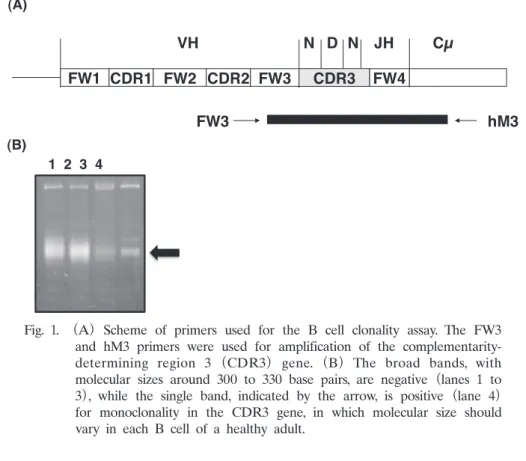
1 exon. The polymerase chain reaction products were visualized by staining with ethidium bromide after they had been electrophoresed on 4% agarose gels. A single band on the agarose gel indicates the presence of clonal expansion of B cells in the patient (Fig. 1B) , while a broad band indicates the absence of clonality.

Statistical Analysis

 The medians of continuous variables, not normally distributed, were compared by the Mann- Whitney U test. Comparison of discontinuous variables was performed by the chi-square test or Fisherʼ s exact test using JMP software (version 10, SAS Institute, Cary, NC) . A P-value <0.05 was considered significant. Values with a normal distribution were expressed as mean SE. Data from variables that were not normally distributed were transformed into log values as required.

Results

High levels of RF were observed in patients with CH-B

 The clinical characteristics of patients with CH-B are shown in Table 1. High levels of RF were

Fig. 1.  (A) Scheme of primers used for the B cell clonality assay. The FW3 and hM3 primers were used for amplification of the complementarity- determining region 3 (CDR3) gene. (B) The broad bands, with molecular sizes around 300 to 330 base pairs, are negative (lanes 1 to 3) , while the single band, indicated by the arrow, is positive (lane 4)

for monoclonality in the CDR3 gene, in which molecular size should

vary in each B cell of a healthy adult.

(4)

observed in patients with CH-B, with 39.5 % of patients having high RF ( ≥10 IU/mL ; Table 1) . Low C3 was also observed in 10.3 % of patients, while B cell clonality was only identified in one patient ( 1.6%) with CH-B. Our results show that 50.0% of these patients with CH-B have at least one abnormal LPD marker.

Abnormal RF was not associated with any other LPD markers but with the presence of HBV DNA in sera

 We tried to determine if any parameters were associated with abnormal levels of RF in patients with CH-B. Table 2 shows that no parameter was identified among the biochemical,

Table 1.   Clinical characteristics of patients with chronic hepatitis B (CH-B)

CH-B patients (n=84)

Age (years) 47.8 13.0

Gender (male/female) 45/39

Platelets (10

4

/ µL) 20.5 5.0 ALT (IU/L) 49.8 79.0 γ GTP (IU/L) 28.2 2.3

IgG (mg/dL) 1276.8 266.4 IgA (mg/dL) 227.0 107.7 IgM (mg/dL) 118.0 84.4

Cryoglobulinemia 3/80 (3.7%)

RF (≥ 10 IU/mL) 32/81 (39.5%)

C3 (<86 mg/dL) 8/78 (10.3%)

C4 (<10 mg/dL) 1/78 (1.3%)

CH50 (<20 U/mL) 0/78 (0.0%)

B cell clonality 1/63 (1.6%)

HBV DNA (log copies/mL) 2.39 0.32 HBs antigen (> 200 IU/mL) 61/81 (75.3%)

HBe antibody-positive 63/69 (91.3%)

HBV genotype (A/B/C/D/ND) 6/17/32/1/38 Values are mean SE or n (%) .

Abbreviations : ALT, alanine transaminase ; γ GTP, γ -gluta-

myl trans peptidase ; RF, rheumatoid factor ; C3, complement

component 3 ; C4, complement component 4 ; CH50, total

hemolytic complement ; HBV, hepatitis B virus ; HBs, hepatitis

B surface ; ND, not done.

(5)

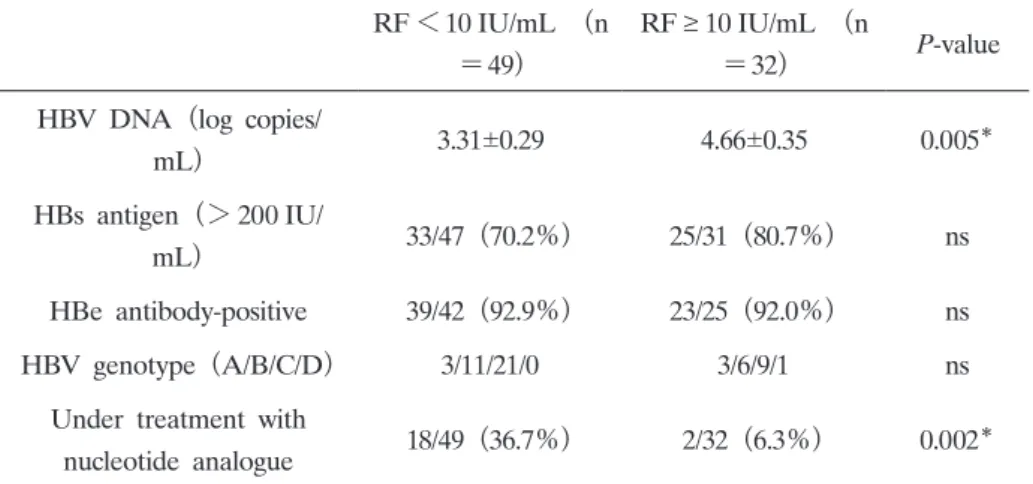
immunologic and LPD markers. However, when we examined viral markers, we found the HBV DNA titers in patients whose RF was more than 10 IU/mL were significantly higher than those in patients whose RF was less than 10 IU/mL (P =0.005 ; Table 3) . We also investigated the effect of antiviral therapy using a nucleotide analogue against abnormal levels of RF. Table 3 shows that in the CH-B patients receiving antiviral therapy, a significantly higher proportion of patients had normal RF levels (< 10 IU/mL) than high RF levels (≥ 10 IU/mL ; P=0.002) .

Relationship between HBV DNA titers and levels of RF in sera of CH-B patients

 We next investigated the relationship between HBV DNA titers and levels of RF. Table 4 shows that in CH-B patients with HBV DNA titers of more than 5.0 log copies/mL, the proportion of patients with high levels of RF (≥ 10 IU/mL) was similar to those patients with normal levels of RF ( < 10 IU/mL) . On the other hand, in CH-B patients with HBV DNA titers less than 3.0 log copies/mL, the proportion of patients with high levels of RF (≥ 10 IU/

mL) was significantly lower than those with normal RF levels (<10 IU/mL ; P <0.001) .

Table 2.   Comparison of LPD markers between patients with and without an abnormally high RF level

RF <10 IU/mL

(n=49)

RF ≥ 10 IU/mL

(n=32) P-value Age (years) 49.5 1.9 45.9 2.3 ns

Gender (male/female) 26/23 17/15 ns

ALT (IU/L) 48.9 11.1 48.7 13.7 ns

Platelets (10

4

/ µL) 20.2 0.7 20.7 0.9 ns

γ GTP (IU/L) 30.1 3.0 26.4 3.9 ns

IgG 1238.6 49.2 1344.7 63.6 ns

IgA 227.1 19.9 236.7 25.7 ns

IgM 117.1 15.7 120.1 20.3 ns

Cryoglobulinemia 3/49 (6.1%) 0/31 (0.0%) ns

C3 (<86 mg/dL) 6/48 (12.5%) 1/28 (3.6%) ns C4 (<10 mg/dL) 0/48 (0.0%) 1/28 (3.6%) ns

CH50 (<20 U/mL) 0/48 (0.0%) 0/28 (0.0%) ns

Values are mean SE or n (%) .

Abbreviations : LPD, lymphoproliferative disorder ; RF, rheumatoid factor ; ALT,

alanine transaminase ; γ GTP, γ -glutamyltranspeptidase ; C3, complement component

3 ; C4, complement component 4 ; CH50, total hemolytic complement ; ns, not

significant.

(6)

Time course of HBV DNA titers and levels of RF in sera of patients during nucleotide analogue therapy

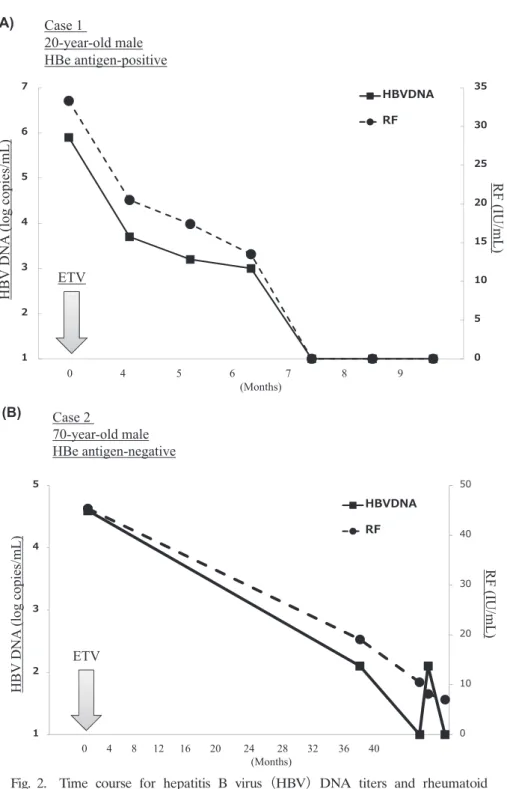
 We further investigated the effects of antiviral therapy on RF levels in two patients with CH-B (Fig. 2) . The two patients (Cases 1 and 2) were treated daily with 0.5 mg of entecavir and HBV DNA titers and RF levels were monitored throughout the therapy. Case 1 is a 20-year-old man who was HBe antigen-positive, while Case 2 is a 70-year-old man who was HBe antigen-negative. Figure 2 shows that the level of RF was 33.3 IU/mL and the HBV DNA titer was 5.9 log copies/mL in Case 1 before therapy. When the HBV DNA titers became undetectable 7 months after the beginning of therapy, the level of RF had dropped to less than 7 IU/mL. In Case 2, the RF level was 45.4 IU/mL and the HBV DNA titer was 4.6 log copies/

mL before therapy. When the HBV DNA titers became undetectable 40 months after the beginning of therapy, the RF level was reduced to 7 IU/mL. These results confirm that a high level of RF factor is associated with viremia of HBV in patients with CH-B.

Table 3.   Comparison of HBV markers between patients with and without an abnormally high RF level

RF <10 IU/mL (n

=49)

RF ≥ 10 IU/mL (n

=32) P-value

HBV DNA(log copies/

mL) 3.31 0.29 4.66 0.35 0.005

HBs antigen(> 200 IU/

mL) 33/47 (70.2%) 25/31 (80.7%) ns

HBe antibody-positive 39/42 (92.9%) 23/25 (92.0%) ns

HBV genotype (A/B/C/D) 3/11/21/0 3/6/9/1 ns

Under treatment with

nucleotide analogue 18/49 (36.7%) 2/32 (6.3%) 0.002

Values are mean SE or n (%) .

Significant difference between the two groups (P

<0.01) by Fisherʼs exact analysis.

Abbreviations : HBV, hepatitis B virus ; RF, rheumatoid factor ; HBs, hepatitis B surface ; ns, not significant.

Table 4.   Relationship between HBV DNA titer and abnormal RF level RF <10 IU/mL

(n=49)

RF ≥ 10 IU/mL

(n=32) P-value HBV DNA <3.0(log copies/mL) 28/49 (57.1%) 5/32 (15.6%) <0.001 HBV DNA ≥ 5.0(log copies/mL) 11/49 (22.5%) 9/32 (28.1%) ns Values are n (%) .

Significant difference between the two groups (P <0.01) by Fisherʼs exact analysis.

Abbreviations : HBV, hepatitis B virus ; RF, rheumatoid factor ; ns, not significant.

(7)

Discussion

 It has been epidemiologically demonstrated that hepatitis viruses, especially HCV, cause a number of extrahepatic manifestations

6,7)

. Among these manifestations, LPDs are most closely related to HCV infection

8)

. Hence, it has been widely accepted that chronic infection

Fig. 2.  Time course for hepatitis B virus (HBV) DNA titers and rheumatoid factor (RF) levels in two patients with chronic hepatitis B, Case 1 (A)

and Case 2 (B) , after the beginning of antiviral therapy using entecavir

(ETV) .

(8)

with HCV leads to a clonal expansion of B cells and that the sustained proliferation of B cells can promote the occurrence of genetic mutations

8)

. HBV also causes a variety of extrahepatic manifestations. The joints, muscle, and skin are the main locations of these clinical manifestations. Autoimmune diseases and LPDs, such as malignant lymphoma and mixed cryoglobulinemia, are also common disorders

9)

. Furthermore, asymptomatic disorders of immunologic and LPD markers have been observed in patients with CH-B, as well as in patients with CH-C. In one study, 15% of CH-B patients had at least one immunologic abnormality, mainly anti-smooth muscle antibodies and anti-nuclear antibodies

10)

. Most of these abnormalities are associated with disorders of B cells.

 The present study has revealed that high levels of RF and low C3 levels are major abnormalities among patients with CH-B. In particular, high levels of RF were observed in 39.5% of patients with CH-B. RF is the antibody against the Fc portion of IgG. High levels of RF are frequently observed not only in patients with rheumatic diseases, but also with non- rheumatic diseases, including mixed cryoglobulinemia, Sjögrenʼ s syndrome, mixed connective tissue disease, and even in healthy subjects

11)

. We have previously reported a small-scale study that found 48% and 41% of patients with CH-C and CH-B, respectively, had abnormally high levels of RF

3)

. Another group has also reported that RF abnormalities are observed in 4% of healthy subjects

12)

. The incidence of abnormal RF levels is reported to be higher in older subjects without rheumatic disease, ranging from 3% to 25%

13,14)

. However, our data show that age had no affect on high levels of RF in our cohort.

 In the present study, we used the latex turbidimetric assay for determination of RF levels.

This method is one of the standard methods, licensed in Japan, to determine RF levels. The reference value for RF was less than 7 IU/mL in our assay. But this reference value has been changed to less than 15 IU/mL in Japan recently. In our previous study, investigating abnormalities of LPD markers in patients with CH-C, we regarded patients with an RF of more than 10 IU/mL as having a high level

3)

. Therefore, in this study we also regarded patients with CH-B whose RF was more than 10 IU/mL to have high levels of RF. The percentage of patients with an RF level of more than 15 IU/mL was 34.6%, which was almost the same percentage of patients whose RF was more than 10 IU/mL.

 Chronic inflammation of the liver by viruses may play an important role in the production of abnormal immunoglobulin, leading to autoimmune diseases and LPDs. Our former report demonstrated that HCV is detected in the B cells of patients with CH-C, and that the presence of HCV in B cells was associated with LPDs

3)

. There is no report about HBV replication in B cells. The detailed mechanism of immune disorders in patients with CH-B is still unknown.

 Next we analyzed the factors associated with abnormal levels of RF, but we could not identify any host factors on univariate analysis. Only HBV DNA titers in sera and treatment with nucleotide analogues were associated with RF levels. After antiviral therapy, HBV DNA titers and levels of RF were both decreased in patients with CH-B. Additionally, in patients whose HBV DNA was less than 3.0 log copies/mL, only 15.6% of patients had high levels of RF.

Figure 2 also directly shows that RF levels reached less than 7 IU/mL when HBV DNA titers

(9)

became undetectable in two patients with CH-B. Altogether, these results strongly suggest that HBV viremia causes high levels of RF in patients. Moreover, a difference in HBV genotype is not related to the high levels of RF. This result is consistent with the previous report that HBV genotypes are not associated with extrahepatic manifestations

10)

.

 The biological significance of high levels of RF in viral hepatitis is hard to explain. Our results do not appear to show any connection between abnormal RF and the presence of B cell clonality. The present study apparently indicates that the link between HBV and immunologic disorders and LPDs is weaker than that for HCV. The difference between these two viruses may be related to racial differences. Further studies are necessary to clarify the molecular mechanisms producing the extrahepatic manifestations, LPDs and abnormal levels of RF, and the association with malignant lymphoma in patients with viral hepatitis.

Conflict of interest

 The authors declare no conflict of interest.

References

1) Zignego AL, Piluso A, Giannini C. HBV and HCV chronic infection: autoimmune manifestations and lymphopro- liferation. Autoimmun Rev. 2008;8:107-111.

2) Takai S, Tsurumi H, Ando K, et al. Prevalence of hepatitis B and C virus infection in haematological malignancies and liver injury following chemotherapy. Eur J Haematol. 2005;74:158-165.

3) Inokuchi M, Ito T, Uchikoshi M, et al. Infection of B cells with hepatitis C virus for the development of lympho- proliferative disorders in patients with chronic hepatitis C. J Med Virol. 2009;81:619-627.

4) Oliviero B, Cerino A, Varchetta S, et al. Enhanced B-cell differentiation and reduced proliferative capacity in chronic hepatitis C and chronic hepatitis B virus infections. J Hepatol. 2011;55:53-60.

5) Inokuchi M, Ito T, Nozawa H, et al. Lymphotropic hepatitis C virus has an interferon-resistant phenotype. J Viral Hepat. 2012;19:254-262.

6) Cacoub P, Poynard T, Ghillani P, et al. Extrahepatic manifestations of chronic hepatitis C. MULTIVIRC Group.

Multidepartment Virus C. Arthritis Rheum. 1999;42:2204-2212.

7) Zignego AL, Brechot C. Extrahepatic manifestations of HCV infection: facts and controversies. J Hepatol.

1999;31:369-376.

8) Zignego AL, Ferri C, Pileri SA, et al. Extrahepatic manifestations of Hepatitis C Virus infection: a general over- view and guidelines for a clinical approach. Dig Liver Dis. 2007;39:2-17.

9) Maya R, Gershwin ME, Shoenfeld Y. Hepatitis B virus (HBV) and autoimmune disease. Clin Rev Allergy Immu- nol. 2008;34:85-102.

10) Cacoub P, Saadoun D, Bourliere M, et al. Hepatitis B virus genotypes and extrahepatic manifestations. J Hepatol.

2005;43:764-770.

11) Shmerling RH, Delbanco TL. The rheumatoid factor: an analysis of clinical utility. Am J Med. 1991;91:528-534.

12) Newkirk MM. Rheumatoid factors: what do they tell us? J Rheumatol. 2002;29:2034-2040.

13) Cammarata RJ, Rodnan GP, Fennell RH. Serum anti-gamma-globulin and antinuclear factors in the aged. JAMA.

1967;199:455-458.

14) Litwin SD, Singer JM. Studies of the incidence and significance of anti-gamma globulin factors in the aging.

Arthritis Rheum. 1965;8:538-550.

[Received January 17, 2014 : Accepted January 29, 2014]

Fig. 1.  (A)   Scheme  of  primers  used  for  the  B  cell  clonality  assay.  The  FW3  and  hM3  primers  were  used  for  amplification  of  the   complementarity-determining  region  3 (CDR3)   gene
Table 1.     Clinical  characteristics  of  patients  with  chronic  hepatitis  B  (CH-B) CH-B  patients  (n=84) Age  (years) 47.8 13.0 Gender  (male/female) 45/39 Platelets  (10 4 / µL) 20.5 5.0 ALT  (IU/L) 49.8 79.0 γ GTP  (IU/L) 28.2 2.3 IgG  (mg/dL) 12
Table 2.     Comparison  of  LPD  markers  between  patients  with  and  without  an  abnormally  high  RF  level
Table 3.     Comparison  of  HBV  markers  between  patients  with  and  without  an  abnormally  high  RF  level
+2

参照

関連したドキュメント

To investigate whether defects in the SPATA17 gene are associated with azoospermia due to meiotic arrest, a mutational analysis was conducted, in which the SPATA17 coding regions

It is shown that plasma endothelial lipase (EL) activity inversely correlated with HDL-C levels, and EL activity in CAD patients was significantly higher than in non CAD

[Journal Article] Two independent regions of human telomerase reverse transcriptase (hTERT) are important for their oligomerization and telomerase 2002.

 Quantitative analysis by real-time Reverse transcription-polymerase chain reaction (RT-PCR) of chronological change in the expression of hepatocyte growth factor (HGF),

The level of IFNc mRNA and the ratio of IFNc/Foxp3 were significantly increased in early stage of PBC and chronic viral hepatitis (CVH) livers, when compared with normal livers

The present study demonstrated a correlation between serum fractalkine levels and response to UDCA; although patients with low fractalkine levels (<3 ng/ml) before

Methods: IgG and IgM anti-cardiolipin antibodies (aCL), IgG anti-cardiolipin-β 2 glycoprotein I complex antibody (aCL/β 2 GPI), and IgG anti-phosphatidylserine-prothrombin complex

We measured blood levels of adiponectin in SeP knockout mice fed a high sucrose, high fat diet to examine whether SeP was related to the development of hypoadiponectinemia induced