lSSN O304−2146
Japanese Joumal of Tropical Medicine and Hygiene
第12巻 第2号 昭和59年6月15日
内 容 原 著
熱帯亜熱帯地方長期滞在日本人の疾病と検査成績一過去3年間における 青年海外協力隊員を対象とした健康調査(英文)
…小原 博,谷 荘吉,大利 昌利,海老沢 功 75−87
ベネズエラにおけるS∫〃!μ1fμ刑醒ε云011∫cμ〃!のOn酌ocεrcロvolvμ1μ5に対する
感受性について(英文)………高岡 宏行,鈴木 博,野田 伸一,多田 功,
Sara Rodulfo,Lucena Pachano,Jacento Convit 89−96 第25回日本熱帯医学会総会講演抄録(1)
目 次…一……… 97−98
シンポジウム 1 国内外におけるマラリアの現状と対策一 99−102 11 毒蛇咬傷における蛇毒の毒性因子の役割… ・103−106 グループ報告 タイ国北部における日本脳炎のウイルス学的疫学的調査・…・ ・107−110
英文抄録……・……・ ・111−127 会 報
昭和58年度第2回幹事会記録・一…一…一 一128−130 昭和58年度評議員会記録・……一 ・・130 第25回総会記録…・…・ 130 昭和57年度会計決算書一 一131 昭和59年度予算書・一 ・131
会則……一一……・………一・……・…………一一・…一…一一 ・・132−135 投稿規定…一・一 一136−137
日熱医会誌
Japan.J・T・M.H、 日 本熱帯医学会
Japan. J. Trop. Med. Hyg., Vol. 12, No. 2, 1984, pp. 75‑87 75
DISEASES AND LABORATORY FINDINGS OF JAPANESE STAYING LONG PERIODS IN TROPICAL AND
SUBTROPICAL COUNTRIES THREE YEAR STUDY ON THE JAPAN OVERSEAS
COOPERATION VOLUNTEERS
HIROSHI OHARAl, SHOKICHI TANll, MASAHISA OWR12 AND ISAO EBISAWA3
Received 5 October 1983/Accepted 20 February 1984
Abstract: With the purpose of investigating the major diseases and the main problems in health management among the Japanese staying for a long period in tropical and subtropical countries, an epidemiological survey was made on the diseases and clinical laboratory data of the Japan Overseas Cooperation Volunteers (JOCV) who lived in and extended technical cooperation to the developing countries. Of the major health problems found in a total of 1,469 subjects ( 1,085 males and 384 females), malaria ( 101 cases), acute hepatitis (94 cases), chronic diarrhea/enteritis (78 cases) and trafB:c accidents (71 cases) ranked high. Suspecting that many cases ofmalaria and dengue fever were not reported, further investigation was carried out and it was revealed that the incidence of clinical malaria ranged from 38.1 to 66.7 per cent in tropical African countries. The incidence of malaria was 36.5 per cent in those who regularly took a combination of sulfamonomethoxine‑pyrimethamine while it was 50.4 per cent in those who took the combination irregularly or not at all. Many cases with intestinal parasites (30.70/0)' eosinophilia (5.90/0)' and abnormal hepatic function (5.40/0) were detected upon their return to Japan. The incidence of mental disorders and venereal diseases was suspected to be considerably higher than the number of cases reported. Among the so‑called
"tropical diseases", a high incidence of malaria and infectious diseases of the digestive organs was observed. Prevention of those diseases is, needless to say, important but in view of the high rates of hepatitis, mental dis.eases, venereal diseases, traffic accidents and aggravation or recurrence of chronic diseases which were present before their overseas assignment, it is also important to take steps to prevent such problems when .Japanese, especially young people, stay in tropical or subtropical countries.
INTRODUCTION
Recently the number ofJapanese staying for long periods in tropical or subtrop‑
ical countries is constantly increasing and the importance o knowledge of tropical diseases and health management for those Japanese staying in such countries has been pointed out (Owri, 1982; Ohara et al., 1982).
l Department ofMedical Zoology, Kanazawa Medical University, Uchinada, Ishikawa, 920‑02, Japan 2 Department of Infectious Diseases, Institute of Medical Science, The University of Tokyo, Tokyo,
l08, Japan 3 Department of Public Health, School of Medicine, Toho University, Tokyo, 143, Japan
76
In tropical and subtropical countries there are diseases which is not in Japan but peculiar to those countries, such as malaria, yellow fever, and cholera or those diseases of bilharziasis, onchocerciasis, and Chagas' disease. These diseases constitute a serious menace to Japanese who stay in those countries. Prevention of these diseases is extremely important when Japanese stay in tropical or subtropical countries: But the diseases which cause problems to Japanese staying in those countries are not limited to the above mentioned tropical diseases. Mental diseases, traffic accidents, although these are not necessarily so‑called tropical diseases, and the system under which health management is carried out seems to be al.so important.
Diseases and laboratory finding's of young Japanese staying in tropical and subtropical countries were studied in the present paper. By collecting data on the diseases the subjects had suffered during their overseas stay, on the results of the health examination they underwent upon their return to Japan, and on health conditions during their stay in those countries, the authors want to make observa‑
tions on the diseases Japanese are apt to suffer and the problems which are important concerning their health management during a long stay in those countries.
MATERIALS AND METHODS
The subjects were members of the Japan Overseas Cooperation Volunteers (JOCV). They were volunteers aged between 2 1 and 35, who had been dispatched to developing countries (27 countries at March of 1 982, Figure I ) with the purpose of contributing to economic and social development. Staying in tropical or subtrop‑
ical countries, they offered a variety of technical cooperation. They lived in many
t?
t'
o
・lb'
c' a
. i ) : F‑
"'
,b
C' ,e
Figure I Countries where the members of the Japan Overseas Cooperation Volunteers are diSPatched (March' 1982).
77 places of each country where the sanitary conditions were extremely poor.
The period for investigation was the three years from April 1 979 to March 1 982.
Based upon the "Report Concerning the Occurrence of Injuries and Diseases" sent to JOCV headquarters in Tokyo from the offices in all the countries concerned, and the results of the health examinations conducted before their departure from Japan and on their return home, statistical analysis was carried out. There were 1,469 subjects ( I ,085 males and 384 females) who lived in those countries for more than three months during the three years under investigation, and 8 1 5 (604 males and 2 1 1 females) who returned to Japan during those three years. The number of JOCV membcrs who stayed in those countries in the middle of 1979, 1980 and 1981 were 706, 840 and 931 respectively.
Concerning malaria and dengue fever, an investigation was carried out sepa‑
rately by means of a questionnaire given to 282 subjects (209 males and 73 females) and 1 22 (94 males and 28 females) respectively among those who returned to Japan from the year of 1 980 to 1 981 . In order to grasp the condition of affliction more pre‑
cisely, the reports available from each country was also used.
Serological testing for total hepatitis A virus antibodies (anti‑HAV) was per‑
formed using commercial radioimmunoassay kits (HAVAB, Abbott Laboratories, North Chicago, U. S. A.). Anti‑HAV was determined positive when the inhibition titer was more than 70 per cent. Serological testing for hepatitis B surface antigen (HBSAg) and antibody for HBsAg (anti‑HBs) both before and after assignment was also performed as one of the routine health examinations.
To investigate the health complaints and venereal diseases incurred during their stay in those countries, we analyzed statistically the data available to us through treating and questioning 96 volunteers (81 males and 1 5 females) in the course of our on‑the‑spot examinations (made from December 1981 to January 1982 in Bangladesh, Ghana, Liberia, Morocco and Tunisia).
Concerning the reports we received from those countries, endeavours were made to cover all the cases without omission, and all the cases requiring medical treatment were included in the reports, but it is supposed that there were many unreported cases of mild diseases not requiring medical treatment (such as cold, mild diarrhea, or low grade pyrexia).
RESULTS
Major diseases : The number of cases of major diseases (excluding those of parasitosis, respiratory infections and dental diseases) which occurred in those three years and the distribution Qf major diseases among the regions are shown in Table l and 2 respectively. Those ranking high are malaria with I O1 cases, acute hepatitis 94, chronic diarrhea/enteritis 78, traffic accidents 7 1 , gastritisjpeptic ulcer 57, dermal diseases 50, trauma excluding traffic accidents 36, followed by lumbago, urinary tract infection/nephritis, ophthalmic diseases, nasal diseases and food poisoning. Other internal diseases include anemia, tuberculous pleulitis, cholelithiasis, cases suggesting nocardiasis and others. In cases of bone fracture and trauma, about 60 per cent were caused by trafnc accidents; but there were also cases of fracture caused by falling
78
Table 1 Major diseases among the members of the Japan Overseas Cooperation Volunteers ( 1979‑1981)
Diseases '79 '80 '8 l To ta l Rate per year per 1,000 Malaria
Acute hepatitis
Chronic diarrhea/enteritis Traffic accidents
Gastritis/peptic ulcer Dermal diseases
Trauma Lumbago
Urinary tract infection/
nephritis
Ophthalmic diseases Nasal diseases Food poisonings
Venereal diseases/urethritis Mental diseases
Appendicitis Dengue fever Typhoid fever
Other internal diseases
17 31 ll
28 14 15 5 6 4 4 4 8 4 5 3 2 lO
20 36 22 19 13 19 15 9 8 9 lO 4 2 4 4 4 2 24
64 27 45 24 30 16 16 10 7 5 4 4 6 4
3 5 2 22
lOl 94 78 71 57 50 36 25 19 18 18 16 13 12 12 12 6 56
40.8 37.9 31.5 28.7 23.0 20.2 14.5
l O. 1
7.7 7.3 7.3 6.5 5.2 4.8 4.8 4.8 2.4 22.6 Total l 76 224 2 94 694 279.4
The number
respectively.
of members in mid 1979, 1980 and 1981 was 706, 840 and 931
Table 2 Distribution of major diseases in each region (o/o ) Diseases Southeast Asia Middle East
North Africa East Africa West Africa South America Hepatitis
Traf fiic
accidents Intestinal infections Malaria Dengue fever
Parasite ( + ) *
46 / 444 2 3 /444
381444 3126 20/122 133/297
( I 0.4)
(5.2)
(8.6)
( I I .5)
(16.4) (44.8)
9/1 15 5jl 15
9/1 15 (7.8) (4.3)
(7.8)
29/96 (30.2)
18/561 29/561
(3.2) (5.2)
10/561 (1.8) 67/1 19 (58.0)
47/267 (17.6)
91110 (8.2) 7/llO (6.4) 15/110 (13.6) 9/20 (45.0) 9/17 (52.9)
121239 7/239 61239
12173 (5.0) (2.9)
(2.5)
(16.4) Numerators indicate frequency of the disease and denomenators the number of people who stayed in each region for more than three months.
* Yamaura et al., 1981.
from a horse and by 1 2 cases given there
pistol‑shots in the as mental diseases
lower were
thigh during an outing at all highly advanced, but it
night. The
is supposed
79
,
that mild mental affections were manifested in a great many members.
Of the 7 1 cases of traflic accidents, collision while riding a motorbike accounted for 65 per cent, and 77 per cent, of them occurred at night. The cases which required treatment in Japan totaled 1 3.
A fairly high number complained of symptoms of diarrhea after their arrival in a tropical or subtropical country. As the cause of diarrhea, mental or physical fatigue resulting from changes in the environment of daily life and simple diarrhea due to a change in water quality were given. Besides these reasons, bacterial diarrhea, amoebic dysentery or giardiasis were frequently observed. There were many cases which turned chronic after frequent repetition of diarrhea following the onset of acute
symptoms.
Malaria : Of the 282 subjects in our investigation on malaria, those who were regarded as having stayed in malaria endemic districts during their duty were 1 65.
Statistical analysis was performed on these 1 65. The results revealed that those whose disease was diagnosed as malaria by physicians or whose disease was strongly suspected of being malaria from their clinical symptoms were found particularly in East and West Africa. The incidence of malaria among those who stayed for two years in the endemic districts was 66.7 per cent in Malawi, 62.5 per cent in Tanzania and 50.0 per cent in Kenya (Table 3). Among the subjects in the investigation, only three cases (in the Philippines) contracted the disease in places other than Africa. A small number of the patients were found in Central and South America, but they were excluded in the present study.
Table 3 Incidence of malaria among the Japan Overseas Cooperation Volunteers Country Total No. of Malaria (+) Incidence (o/o)
volunteers
Malawi Tanzania Kenya Ghana Zambia
Philip pines
48 16 34 20 21 26
32 lO 17 9 8 3
66.7 62.5 50.0
45 . O
38. 1 l 1.5
Total 165* 76 4・6. 1
The diagnosis was made clinically in the majority of the patients.
* Of the 282 patients examined, 165 people were regarded as having stayed in malaria endemic districts.
For prevention of malaria, a weekly dose of two tablets of a combination of sulfamonomethoxine 250 mg and pyrimethamine 1 2.5 mg (MP tablet) was recom‑
mended (chloroquine was not available when they left Japan). The results of our investigation on the effect of the above medication revealed that no outbreak was seen among those who took the combination regularly in countries other than African countries. But in East and West African countries, the numbcr of cases of malaria in
80
spite of regular ingestion was noticeable. The incidence of malaria was 38.2 per cent (13/34) in East Africa, 50.0 per cent (6/12) in West Africa, and 41.3 per cent ( 1 9/46) in Africa as a whole among those who took the agent regularly. Observations
made on subjects divided into those of regular ingestion and of irregular ingestion for comparative study of efficacy, showed that incidence was lower in the group of regular ingesters than among irregular ingesters and non‑ingesters, but the difference was not significant (Table 4) .
Table 4 Preventive effect of sulfamonomethoxine‑pyrimethamine mixture (regular ingestion vs. irregular or none)
Area Africa Africa and Philippines
Ingestion Regular lrregular
or none Total Regular lrregular
or none Total
(+) 19 (41 3) 54 (58 1) 73 (52 5) 19 (36 5) 57 (50 4) 76 (41.3)
Malaria
(‑) 27 (58.7) 39 (41.9) 66 (47.5) 33 (63.5) 56 (49.6) 89 (53.9)
Total 46 93 1 39 52 1 1 3 1 65
X2=3.47 0.10>P>0.05 X2=2.77 0.20>P>0.lO
( ):o/'
Hepatitis : 94 cases of acute hepatitis were reported in the past three years in all the countries and the incidence was 37.9 per year per thousand persons.
Serological studies carried out on 94 cases of acute hepatitis have revealed that 73 cases (77.70/ ) were strongly suspected to be hepatitis A, however there were nine cases of hepatitis B, and two cases of non A non B hepatitis have been confirmed (Table 5). In November 1 980 there was a mass outbreak of hepatitis A in the Philippines caused by ingestion of raw oysters (Ohara et al., 1 983). Hepatitis usually developed from six months to one year after arrival in the country.
Table 5 Types of 94 cases of hepatitis
Types Cases o/o
A
B Non A Non B
Unknown
73 9 2 lO
77.7 9.6
2. l
l0.6
Total 94 l O0.0
Denguefever : 1 2 cases of dengue fever have been reported during the past three years but the actual incidence of the disease among the members stationed in South East Asia and Oceanic countries was estimated to be much higher although the ma‑
jority of the cases might be mild ones. In the present study, those who were diagnosed as having dengue fever by local physicians and whose symptoms strongly suggested
81
Table 6 Incidence of dengue fever among the Japan Overseas Cooperation Volunteers Country Total No. of
volunteers
Dengue
fever (+)
Incidence
(o/o)
W. Samoa
Philippincs
Tonga Malaysia Bangladesh
15 46
4 35 22
4 12
2
26.7
26. l
25.0 5.7 4.5
Total 122 20 16.4
The diagnosis was made clinically in the majority of the patients.
of dengue fever were 20 persons among 122 examinees (16.40/0) (Table 6).
Complaints : Many people have various kinds of complaints during a long stay in tropical and subtropical countries. The investigation was carried out on 96 members of the JOCV who were staying in those countries (the average period of stay was 346 days) by means of personal interview. Results showed that those who complained of easy fatigability accounted for 62.5 per cent, followed by decrease of body weight (34.40/0)' mental fatigue (22.90/0) and loss of appetite (14.60/0)' The worse the climate and sanitary conditions were, the higher was the rate of those who had such complaints (Table 7).
Table 7 Complaints of the members during their stay in tropical countries
Complaints No. o/o
Easy fatigability Decrease of
body weight Mental fatigue Loss of appetite
Amenorrhea Diarrhea Decrease of
visual acuity
Stomachache Toothachc Alopecia
60 33 22 14 2 5 3 2 2
62.5 34.4 22.9 14.6 13.3 5.2
3. l
2. 1 2. l 2. l
96 volunteers were examined (81 males and 15 females).
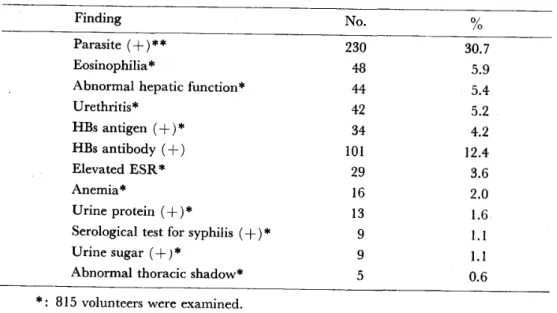
Laborator̲v findings : The results of the health examination carried out by the Institute of Medical Science at the University of Tokyo upon their return to Japan are shown in Table 8 (the stool examination was undert.aken by the Department of Parasitology of Tokyo Women's Medical College) .
Among abnormal findings, parasites were most frequent, seen in 30.7 per cent of all the examinees. When brQken d. owns Giardia lamblia wa tbc mQst cQmm̲ Qn of pro‑
82
Table 8 Abnormal laboratory findings in the returned volunteers
Finding No . o/o
Parasite ( + ) * * Eosinophilia *
Abnormal hepatic function*
Urethritis*
HBS antigen ( + ) *
HBS antibody (+) Elevated ESR*
Anemia *
Urine protein ( + ) *
Serological test for syphilis (+)*
Urine sugar (+ ) *
Abnormal thoracic shadow*
230 48 44 42 34 lOl
29 16 13 9 9
30.7 5.9 5.4 5.2 4.2 12.4 3.6 2.0
l .6
l.1 l.l 0.6
*.
**.
815 volunteers were examined.
750 volunteers were examincd.
tozoal diseases, seen in 1 7.3 per cent of all the examinees, followed by Entamoeba coli 2.1 per cent and Entamoeba histolytica I .6 per cent. Among helminthic diseases Trichuris trichiura formed 9.3 per cent and Ascaris lumbricoides 3.7 per cent (Yamaura et al., 1981). In 1980 a case of bilharziasis was reported in Zambia. Of cases of eosinophilia, those attributable to helminth infection acounted for 88 per cent.
Among 44 c LSes in which abnormal hcpatic function was detected, cases in which apparent symptoms of acute hepatitis were not present and abnormalities were detected for the first t' b he atic function test were eeh in addition to cases in
une y p s ,
which hepatic function had not normalized after the occurrence of acute hepatitis.
The cause is not known in detail, but it is supposedly attributable to drug induced liver injury, dysfunctions ca,used by parasitosis such as Giardia lamblia, or influence of food or drinking water.
Of 815 examinees, there were 34 persons with HBsAg (+) and 101 with anti‑
HBS ( + ) . Out of these 8 1 5 persons 375 could be compared using paired serum and the results are shown in Table 9. Those whose HBsAg and anti‑HBs turned from ( ‑ ) to ( + ) during their stay in each country were three and 1 3 respectively . The
incidence ofpeople whose anti‑HAV was positive also increased after staying in those countries although the antibody titer could not be measured with paired serum.
Complaints of lumbago, dermal diseases and venereal diseases‑like symptoms were found at fairly high rates. As dermal diseases, micotic dermatitis and bites by bloodsucking insects were detected rather frequently.
Comparatively few cases of venereal disease were actually reported but a fairly large number had in fact contracted it or were suspected of co,ntracting it. The survey made by means of questionnaires gives to I OO males disclosed that those who had subjective symptoms suggesting venereal diseases amounted to 28 per cent and those who had ingested antibiotics due to suspicion of venereal diseases 1 8 per cent.
The cause Qf venereal di̲seases‑liike symptoms such as mlicturition pain, exctetion of
83 Table 9 Serological study on hepatitis virus infection of the volunteers
Positive case ( o/o ) Case of
conversion
before after + ‑' F ‑ + * F
HBsAg HBsAb
HAAb
17 32 41
(4.5) * (8.5)*
( 1 1 .O) **
19 (5,1)*
44 (1 1.3)*
79 (29.4)***
1
1
?
3 13
* : 375 persons were examined.
** : 374 persons were examined.
*** : 269 persons were examined.
pus and enlargement of the inguinal lymph nodes, was mostly non‑gonococcal ure‑
thritis, and those presenting such symptoms are increasing. But there were few afflicted with the classical venereal diseases such as syphilis, gonorrhea or chancroid.
Past history and present illness : FollolA'ing up those who had contracted diseases before leaving Japan showed that in their new environment they had a high incidence of diseases obviously related to them. By way of illustration, among the major diseases which developed and required treatment during their stay in the developing countries, diseases contracted in the past were found in 38.5 per cent of the cases of gastritis/peptic ulcer, 31.3 per cent of lumbago, 50.0 per cent of bronchial asthma, 97.6 per cent of dental diseases and 44.4 per cent of nasal diseases; there were many who had no alternative but to return to Japan, as treatment for their diseases was unavailable in those countries (Table I O).
Table 10 Relationship between the past history and the present illness; retrospective study
Present illness Cases
Past history ( + )
Recurrence ( + ) ( /O) Ol Recurrence (‑ ) Dcntal caries
Gastritis, peptic ulcer
Lumbago
Sinusitis Pyelonephritis Hypertention Cholelithiasis Bronchial asthma
84 13 16 9 4 3 2 2
82 5 5 4 2 3
2 (97.6) (38.5) (31.3) (44.4) (50.0)
( I O0.0)
(50.0) (50.0)
1 43
16 12 12 2 2
O l ,469 persons were examined.
Collection diseases which
and had
statistical
occurred
DISCUSSION analysis of the data
in JOCV members
were performed as to the main who stayed long in tropical and
84
subtropical countries in the past three years. Ifwe look at major infectious diseases, a remarkably large numbcr of the members contractcd orally‑infected diseases such as infectious diseases of the digestivc organs caused by various kinds of pathogens, malaria and othcr mosquitoborne diseases; and dermatomycosis. This suggests the extreme importance of measures to prevent such diseases among members when they stay in tropical and subtropical countries.
It is easy to imagine that the poor sanitary environment causes oral infections in many, but above all, hepatitis A is the most serious disease. Recently in Europe and America (Kendrik, 1972; Kendrik, 1974; Skidmore et al., 1982) as well as in Japan (Imai et al., 1 978; Obata et al., 1978), hepatitis A has been regarded as a disease very common among young people who stay in tropical and subtropical countries. Among the JOCV's young members, its incidence tends to rise year by year. Of late the sanitary environment in Japan has improved and at the same time a sharp drop is seen in the number of carriers of antibodies for hepatitis A virus (anti‑HAV) among young people (Ministry of Public Health, Japan, 1979). It i,s, therefore easily imagined that a generation which has grown up in an environment in which hepatitis type A virus (HAV) is not prevalent will very easily be afflicted with hepatitis A when they stay in countries where such virus is prevalent. Most natives, on the other hand, become carriers of antibody in their childhood (Sato, 1981 ; Wankya and Hansel , 1979), and it is supposed that thev. present no symptom or only cold‑1ike symptoms
¥ 'hen they actually contract ,hepatitis A, which is not regarded as a very serious disease among them. As readily available vaccine has not yet been produced, it is neces‑
sary to take preventive measures, by means of gamma‑globulin injections (Trond,
l 963) .
It is reported that there are many chances of contracting hepatitis B during stays in tropical and subtropical countries (Marklein et al., 1980), and in the results of the present investigation, an increase was seen in the rates of harbouring both HBS antigens and antibodies after staying for two years. As the route of infection, filthy medical instruments, sexual intercourse and others are assumed.
Among orally‑infected diseases other than hepatitis A, infectious diseases in the digestive organs caused by various pathogens are seen in many cases, but they are generally mild diseases, mostly being only transient diarrhea or abdominal pain. It is imagined that there are a considerable number of members who experienced so‑
called traveller's diarrhea. Typhoid fever has been reported in six cases in the past three years, but a]1 the patients were cured entirely by the treatment given them in the local hospitals. On their return to Japan, 30.7 per cent were found to have parasite ovas in the stool examination. But helminthicidal procedures were taken in some countries for thosc in whom parasitization was detected during the health examinations carried out twice a year, so the actual rate of parasitic infection must have been higher.
Malaria was detected in countries in West and East Africa, Southeast Asia, and Central and South America. In Africa, above all, it was clear that an extremely high rate of contraction was registered in the present investigation as well as in other reports (WHO, 1979) ; as most ofithe cascs Lre falciparum or malignant malaria, it is a serious problem for those ,wh,o stay in those African countries where malaria is
85 prevalent. Investigation into the preventive effect of ingesting a combination of sulfamonomethoxine and pyrimethamine suggested that the effect could not be regarded as having been satisfactorily confirmed. It is necessary to take proper steps to counter the malaria found in each country, taking into consideration drug tolerence (Ebisawa et al., 1 97,9) , side effects, the prevalence of malaria in each country, the species of malaria and other factors.
Concerning dengue fever, few cases were reported on account of the majority being mild, but it is supposed from the present investigation that there are a con‑
siderable number who had actually been afflicted with this disease in Southeast Asian and Oceanic countries.
Among diseases which many natives are confirmed as suffering from, malaria and relatively mild infectious diseases of the digestive organs are also the disorders which hit many Japanese during their stay there. But the volunteers scarcely suffered from the diseases against which vaccination is enforced (preventive injections are given to JOCV members against yellow fever, cholera, tetanus, rabies, poliomyelitis and Japanese encephalitis). Almost no cases were detected of tropical diseases prevalent only in small limited areas i.e. diseases of endemic nature. It is, therefore, suggested that the contraction of tropical disease is prevented by proper hygienic measures exercised in each country where the disease is prevalent.
On the other hand, as seen in hepatitis A, it is striking to see how frequently Japanese catch diseases for which they have no antibodies when they enter countries where pathogenic organisms are widely prevalent. The high incidence of traffic accidents, mental diseases, venereal diseases, and recurrence or aggravation of diseases contracted previously is also notewdrthy. These may be termed problems which scarcely give rise to public awareness among the natives. They cannot necessarily be called tropical diseascs, but as a matter of fact, they may be said to be very serious for the Japanese staying in tropical or subtropical countries. Proper ways of countering them seem to have been neglected while steps to prevent so‑cal]ed tropical diseases have been taken.
To an unimaginable extent bitter cultural friction is experienced by those who enter countries in which the living environment, climate and customs are all different from those in Japan (Inamura, 1 980), and the greater part of them are said to have been seized with mild neurosis‑like symptoms when they arrived in those countries.
Many of them become adapted to such environments as time goes on, but there are often persons in whom such adaptation cannot be made and various kinds of noticeable mental reactions appear, or schizophrenia becomes manifest. A sharp increase is seen in traffic accidents on account of unfamiliarity with‑ traffic conditions and lack of geographical knowledgc of each place ; in addition there are many cases of drunken driving from a feeling of frecdom or shortagc of amusement facilities.
There are many cases of aggravation or recurrer.ce of diseases acquired. in the past on account of the influences cxerted by various kinds of factors such as harsh climate, work stress, difB:culties in treating chronic diseases in a poor medical care system and others. Also when they are afflicted with diseases in those countries, many are forced to return to Japan due to difficulties in receiving satisfactory treatment resulting from many adverse therapeutic conditions such as poor medical care system,
86
dietary differences and linguistic problems. When we think of those problems, we are made to feel strongly the necessity of examination before their departure from Japan, or of their departure only after receiving complete treatment if any abnor‑
malities are detected in such cxaminations.
SUMMARY
The diseases and accidents which the Japan Overseas Cooperation Volunteers suffered from during their two years of assignment overseas in tropical and sub‑
tropical countries were analyzed and the following conclusions were obtained.
1) Endemic diseases such as malaria, hepatitis, diarrheal diseases, dengue and other arbo‑virus diseases are important and frequent diseases among the Japanese staying in tropical or subtropical countries. Efforts should be made to give the youths instructions in preventing them before their departure to those countries.
2) Knowledge about and ways of preventing traffic accidents, mental health and the r currence of other non‑tropical diseases which the youths had suffered in the past., such as peptic ulcer, dental caries, hypertension, and neurotic diseases should be given equal emphasis.
3) The conclusions and suggestions apply not only to the JOCV but also to other Japanese or subjects in non‑endemic, well developed countries who go to tropical and
subtropical countries and stay there for some time.
ACKNOWLDEGEMENT
The authors would like to express cordial thanks to Miss Mitsuyo Omote, at the Headquarters of the Japan Overseas Cooperation Volunteers, for her efforts in
processing data. '
REFERENCES
l ) Ebisawa, I., Muto, T. and Tanabe, S. ( 1979) : Chemotherapy offalciparum malaria : Regional differences in responsiveness to treatment. Japan. J. Exp. Med., 49 (5), 405‑412
2) Imai, F., Hokari, M. and K meda, H. ( 1978) : Hepatitis A occurred among the Japanese in Cairo city, Acta Hepatol. Jap., 19, 640‑645
3) Inamura, H. ( 1980) : Maladjustment phenomenon among the Japanese who live in foreign
countries. C.ilin. Psychiat., 22 (9), 983‑lOIO
4) Kendrik, M. A. ( 1972): A study of illness among Americans rcturning from international travel, J. Infect. Dis., 126, 684‑687
5) Kendrik, M. A. ( 1974) : Viral hepatitis in American missionaries abroad, J. Infect. Dis., 129, 227‑229
6) Marklein, G., Wolff, H. M. and Baumgarten, H. ( 1980) : Seroepidemiologic investigations of hepatitis in the tropics, Tropenmed. Parasit., 3 1 , 334 338
7) Ministry of Public Health, Japan: ( 1979) Report from hepatitis committee
8) Obata, H., Hisamitsu, T. and Hayashi, N. ( 1978) : Acute hepatitis occurred among residing Japanese in Suez area, Egypt, Acta Hepatol.Jap., 19, 640‑645
9) Ohara, H.? Ebisawa, I.; Tani, S., Owri, M. and Omote; M. (1982): Diseases Qf the young
87 Japanese stationed in tropical countries,J.Kanazawa Med.univ.,7,167−173
10)Ohara,H.,Naruto,H、,Watanabc,M.and Ebisawa,1.(1983):An outbreak of hepatitis A caused by consumption ofraw oysters,J.Hyg,Camb、,91,163−165
11)owri,M.(1982):Medical circumstances oftheJapanesestaying abroad,Japan Med.Journal,
3009,23−29
12) Sato,A(1981): Age specific prevalence of anti−HAV in Nepa1, Actn Hepatol.Jap.,22,
l l8rl20
13) skidmore,sJ.,Bakhshi,S.s、,Beedle,R.and Kimberley,J.(1982):An outbreak of inf在ctious hepatitis using radio−immunoassays fbr hepatitis A virus antibody,J.Hyg.,88,351−354 14)Trond,K.(1963):Gamma−globulin in the prevention of viral hepatitis,Acta Med.Scand.,
174,469−477
15)Wankya,D.P.and Hansen,A、M.(1979):Serocpidemiology ofhepatitis A and B in Kenya.
A rural population survey in Machakos district,East A飢Med.J.,56(3),134−138 16)WHO expert committee on malaria(1979):Wld Hlth Org.techn.Rep.Ser.,640,Geneva l7)Yama皿a,H.,Matsumoto,K.,Wada,Y。,Kobayashi,K、,Okamoto,M.and Shirasaka,R(1981):
Asurvey on intestinal parasite in琵ction among long−term visitors to progressing countries,Japan.
J.Parasitol.,30(1),85−89
熱帯亜熱帯地方長期滞在日本人の疾病と検査成績
一過去3年間における青年海外協力隊員を対象とした健康調査 小原 博1・谷 荘吉1・大利昌久2・海老沢 功3
熱帯亜熱帯地方長期滞在日本人の疾患罹患状況を把握し,健康管理上の重要事項について考察する ために,開発途上国に3カ月以上滞在し技術協力を行う青年海外協力隊員を対象に,.滞在中に発生し た主な疾患と検査成績にっき集計し分析した。調査の対象となったのは総数1,469名(男1,085名,女 384名),調査期間は,1979年4月から1982年3月までの3年間である。
報告された主要疾患の内訳では,マラリア101例,急性肝炎94例,慢性下痢症・腸炎78例,交通事 故71例が上位を占めていた。マラリア,デング熱については未報告例も多いと考えられ,さらに詳細 な調査を実施したところ,流行地では,それぞれ38、1−66.7%,4.5−26,7%の罹患率であることが判 明した。sulfamonomethoxineとpyrimethamineの合剤を規則的に予防内服していた者のマラリア 罹患率36.5%に対し,不規則的及び非服用の者では50.4%であったが,両者に有意差は認められな
かづた。
性病,精神疾患は,それぞれ13例,12例が報告されたが,実際の罹患率はさらに高率であることが 予想された。帰国時検査の異常所見として,糞便検査の結果寄生虫陽性例30.7%(山浦ら,1981),
好酸球増多症5.9%,肝機能異常5、4%などが高率であった。また,現地滞在中に発生した疾患の中に は,出国前に既往歴を有する例の悪化または再発と考えられるものも多く認められた。
日本人が熱帯亜熱帯地方に長期間滞在する際には,いわゆる 熱帯病 といえる疾患の中でも,マ ラリア,デング熱,寄生虫などによる消化器感染症等の罹患率が高いことが明らかにされたが,急性 肝炎,交通事故,精神病,既往歴のある疾患の悪化または再発例も多く,熱帯病同様にこれらの疾患
に関する対策も極めて重要であることが示唆された。
1金沢医科大学医動物学教室 2東京大学医科学研究所感染症研究部 3東邦大学医学部公衆衛生学 教室
Japan. J Trop Med Hyg Vol 12 No. 2, 1 984, pp. 89 96 89
SUSCEPTIBILITY OF SIMULIUM METALLICU'V
TO INFECTION WITH ONCHOCERCA VOLVULUS IN VENEZUELA*
HIROYUKI TAKAOKA2, HIROSHI SUZUK13, SHlN・‑ICHI NoDA4, ISAO TADA5 SARA RODULF06, LUCENA PACHAN07 AND JAClNTO CoNVrr8
Received 26 January 1984/Accepted 10 May 1984
Abstract: The degree of susceptibility of Simulium metallicum to infection with Onchocerca volvulus was studied in Venezuela. Vild flies which had fed on the infected volunteer were maintained at a temperature varying between 22'C and 28'C, and all flies dying every 24 hours were dissected for larval development. Third‑stage larvae were first seen in the head offlies dying between five and six days. Few abnormal and deformed larvae were observed. The larval development was asynchronous; only 41 of I 1 7 Iarvae recovered from 32 flies examined on days 6‑11 were in the third stage, the remaining larvae being still in earlier stages. However, the proportion of third‑stage larvae among all iarvae recovered increased from 6 to 69 per cent, wi th the passage of time from days 6‑8 to 9‑1 1 . Likewise, the pcrcentage of third‑stage larvae found in the head during the same period rose from 25 to 54 per cent. These results indicate that despite the asynchronous and retarded development, many larvae can develop to the infective stage in S. metallictan and the possibility of infective larvae capable of being eventually inoculated into man is high, when flies could survive more. It is suggested that the susceptibility of S. metallicum in Venezuela to the indigenous strain of O. volvulus is relatively high, as compared with that of the same species in Guaternala or Colombia.
INTRODUCTloiv
Pefialver ( 1 96 1 ) regarded for the first time Simulium metallicum Bellardi as the principal vector of onchocerciasis in the northern foci of Venezuela. Lewis and lbafiez de Aldecoa (1962) assessed the vectorial capacity of this species, as well as S. exiguum Roubaud, from their field observations. They concluded that S. metallicum was the only important vector in these regions. Duke ( 1 970) made the experimental infect.ion and compared the developmental potential of Onchocerca volvulus microfllariae
l This study was supported by the grant "Overseas Scientific Research" from the Ministry of Edu‑
cation, Culture and Science, Japan (No. 57041041 and 58043041). 2 Division of Medical Zoology, Medical College of Oita. Oita, 879‑56, Japan 3 Department of Virology. Insitute for Tropical Medicine, Nagasaki University, Nagasaki, 852, Japan 4 Departmcnt of Medical Zoology, Faculty of Medicine, Kagoshima University, Kagoshima, 890, Japan 5 Department of Parasitic Diseases, Kumamoto University School of Medicine, Kumamoto, 860. Japan 6 Monagas Office of Dermatology, National Institute of Dermatology, Maturin, Venezuela 7 Miranda Office of Dermatology, National Institute of Dermatology, Los Teques, Venezuela 8 National Institute of Dermatology, Caracas, Venezuela
eo
ingested by these two blackfly species. Ramirez P6rez et al. ( 1 976) described the morphological features of O. volvulus larvae developing in S. metallicum. However, no data were available on the degree of susceptibility of this blackfly species to infection with O. volvulus in Venezuela. Apparently such information is needed to compare the vectorial capacity of S. metallicum in Venezuela with that of the same species in Guatemala or Colombia, where this species has been reported to be less important as a vector (De Le6n and Duke, 1966; Collins, 1979; Ito et al., 1980; Tidwell et al.,
1 980) .
In the present experiment, the degree of susceptibility of the Venezuelan S.
metallicum to the indigenous strain of O. volvulus was assessed, mainly by means of the proportion of third‑stage larvae among all larvae recovered from the flies which survived beyond the time when larvae became infective, as well as that of surviving flies positive for third‑stage larvae.
MATERIALS AND METl IODS
The experimental infcction was carried out in November 1 982, at Guanaguana in Monagas, one of the onchocerciasis‑endemic foci in the north‑eastern region of Venezuela. The general information on this village or its surrounding areas was previously reported by Lewis and lb fiez de Aldecoa ( 1 962). The predominant man‑biting blackfly species during the present study was S. metallicum, comprising 95 per cent of the total catches.
Wild females of S. metallicum were allowed to feed on the lower half of the legs of a human volunteer with low microfilarial density ‑ two microfilariae per skin snip from a calf, taken with corneoscleral punch (Holth type) . Simultaneously, engorged blackfly females were captured from a control volunteer without microfilariae.
A11 these blood‑fed flies were collected and maintained individually in a polypropylene tube, using a method previously described (Takaoka et al., 1 982). All flies were kept at a temperature varying between 22'C and 28'C, dead flies being removed everyday thereafter and stored in 70 per cent ethanol solution for later dissection.
The number of dead flies was recorded to compare daily probabilities of survival in the groups of flies which had fed on the infected and control persons, respectively.
All preserved specimens were divided into head, thorax and abdomen and dissected in a drop of five per cent Giemsa solution on a glass slide under a binocular stereo‑
scopic microscope. The number of larvae in each part of the body was counted and their stages of development were determined by the size and morphological features, as defined by Duke ( 1 968). To assess microfilarial intake, 20 flies which fed on the infected volunteer were killed immediately after feeding, and dissected using a technique by Nakamura ( 1 964) .
RESULTS
Since wild flies were used in this study, it is possible that natural infections were mixed in the results. According to Lewis and lb fiez de Aldecoa ( 1962), 3.9 per cent of wild‑caught S. metallicum were naturally infected with O. volvulus larvae in the
91
︵8︶
︵8︶
︵O︶
寸卜・一 の寸
︵ooN︶舘
︵O︶め
︵專︶︒o㎝
︵O︒⇒︶
︵ON︶
︵①寸︶
一H個的馴寸
︵一︶一
︵的︶一
︵O︶O
卜=
寸頃 斜O
一90↑
=−O QolO
︒ぎ窃宅覇﹄
脇εの昭8︒の
︒bo碧哲霞
︒bo蕩一眉ご竈o澄Σ obo妥診<
qo508ε
窃︒穿詮o
唱8>圭︵ぷ︶.oZ 扇寧窓o室昭ち8εqε08需筋ε§毛=1︒艮も8
℃︒も彊蓼§§§ミ§ミ§窮屈︒孚室§§︒§ド§暑δも曲霧態5盲3雪ぞ﹄8ε08唱︒9包℃農おρ目⇒Z
斜のヨ邸↑
.=1鴇詮℃目o占一50↑
.︒莞旨=屈墨も惹g馨望o蕊自署8お唱言超昭目gモ︒一強雪婁眉O︒の省﹄
一c『讐普
︵卜−一︶qo.ぴり
︵卜1︻︶︒り.㊦
︵一︶ 一
︵Oゆ︶寸ミト
︵OO︶OミO
︵爲︶寸≧
︵=ー一︶
︵=訊︶
︵一︶
oσ、一αつG刈
︵尊︶9︑ま
︵︒りoo︶警\9
︵O創︶O甦寸
︵①一−一︶
︵望−一︶
︵①マ一︶
︵①め1一︶
︵〇一−一︶
寸.oo 創.寸 鮒.o⇒
oo.①
ゆ.寸
︵R︶
︵お︶
︵oo創︶
︵割︶
冥︵O寸︶
=ミ翻
①︒り︑望 黛︑O創
爲︑︒⇒一
〇製oo
㎝出50卜 =5 竈
め1一 〇
︵obo窓出︶農︒Σ
︵ぷ︶寒>起︒切霧−でお ε馨のo田.oZ︑℃
2︒紀 眉器ヒ≦曲︒s一甲℃南 ε哨き8罎.oZ
︵︒ヒo得函︶§︒Σ ︵ぷ︶器髭αこo
︒boε︒︒詮吋ε峯の︒竈
・︒ζ器>皐︒臨霧−℃お 亮咽き昭頃.o客
︵曲濤出︶農oΣ
台︒>哨壱&ごα
℃邸o調o毛屈o
﹀詩︻
︒bo妥もお.oZ 台︒>還のa
﹄&器ヒ些
obo霧−℃お.oZ む︒>咽崩oα
﹄&o孚慧剛.o之
︵訳︶℃88眉℃のo田
.oζ︒孚駕こo︒bo︒3ぢ
首 毛峯の︒田.o乞
go眉08三
←鼠旨o
O︒︒o﹃爵駕§§§§§選莚湯屈§ミ︒書勧§ミ δ﹂ε5目&でら三孚詩■
⑪葺
↑
92
Guanaguana area. Therefore, the rate of experimental infection shown in Table l was assumed to be slightly overestimated.
Under a temperature varying between 22'C and 28'C, third‑stage larvae were first seen in the head of female S. metallicum dying between 5 and 6 days after ingestion of microfilariae. Few abnormal and deformed larvae were observed. The develop‑
ment of O. volvulus larvae in S. melallicum was asynchronous, as evidenced by the fact that third‑stage larvae were found in 44 per cent ( 14j32) of the flies harboring any stages of larvae examined on days 6‑11 (Table 1). In other words, only 41 of 1 1 7 Iarvae recovered during the same period were in the third stage, while the other larvae remained in earlier stages (Table 2).
However, as shown in Table I , the proportion of flies with third‑stage larvae among all flies positive for any stage of larvae increased from 20 to 83 per cent, with the passage of time elapsing from days 6‑8 to 9‑1 1 . The proportion of third‑stage larvae among all larvae recovered during the same period also increased from 6 to 69 per cent (Table 2).
Likewise, the proportion of flies with third‑stage larvae in the head augmented from 25 to 60 per cent (Table I ) ; and the percentage of third‑stage larvae found in the head rose from 25 to 54 per cent, as the time passed from days 6‑8 to 9‑‑1 1 (Table 3).
Table 3 Distribution of third‑stage larvae of Onchocerca volvulas in the body of Simulium metallicum which died on days 6‑1 1 after ingestion of an infected blood‑meal
Total no.
Days post‑ third‑stage
infection
larvae
No. (o/o) third‑stage larvae found in
Head Thorax Abdomen
6‑8
9‑1 1
Total
4 37 41
1 (25) 20 (54) 21 (51)
3 (75) 17 (46) 20 (49)
o (o) o (O) O (O)
The average length of four third‑stage larvae measured was 474.2 pm (range, 462.7‑498.9 pm), and the width, 18.3pm (range, 16.6‑19.2 pm). The relatively small size of the third‑stagc larvae is probably attributed to the high temperature under which larval development took place, and the fixation ofsamples.
The average number oflarvae per positive fly examined on days 6‑1 1 was 3.4 with the range of 1‑19. And, those of third‑stage larvae in any part of the body and also in the head per positive fly were 2.9 (range, 1‑ll) and 3.3 (range, 1‑7), re‑
spectively (Table I ) . These numbers were slightly smaller than the corresponding one observed for microfilarial intake (average, 4.5 and range, 1‑lO) (Table l).
The daily probabilities of survival in the group of flies which fed on the infected volunteer are shown in Figure I , together with those in the control group. Within 24 hours of feeding, no marked mortality was observed in both groups. This is probably due to the scantiness of ingested microfilariae. Moreover, there was no difference in the daily survival rates during days 2‑11 between the two groups
(Figure I ) .