Studies on Methods for
Mathematical Programs with Equilibrium Constraints
Gui-Hua LIN
Submitted in partial fulfillment of the requirement for the degree of
DOCTOR OF INFORMATICS (Applied Mathematics and Physics)
Kyoto University Kyoto 606-8501, Japan
December, 2003
Preface
Mathematical program with equilibrium constraints, abbreviated as MPEC, is a constrained optimization problem in which the essential constraints are defined by some parametric variational inequalities or a parametric complementarity sys- tem. This problem can be thought as a generalization of the so-called bilevel programming problem that is a mathematical program with optimization con- straints. MPEC is also closely related to the well-known Stackelberg game. As a result, MPEC plays a very important role in many fields such as engineering design, economic equilibrium, multilevel game, and mathematical programming theory itself, and it has been receiving much attention in the recent optimization world.
On the other hand, MPEC is very difficult to deal with because, from the ge- ometric point of view, its feasible region is not convex and not connected even in general, and in theory, its constraints fail to satisfy a standard constraint qualifica- tion such as the linear independence constraint qualification or the Mangasarian- Fromovitz constraint qualification at any feasible point. Therefore, the well- developed nonlinear programming theory cannot be applied to MPECs directly.
There have been proposed several approaches such as sequential quadratic pro- gramming approach, implicit programming approach, penalty function approach, interior point method approach, and reformulation approach in the literature on MPECs.
Our main purpose is to develop more efficient methods for solving MPECs.
Moreover, we notice that, in many practical problems, some elements may involve uncertain data, and hence we also pay great attention to the stochastic mathe- matical programs with equilibrium constraints (SMPECs). Thus, the thesis may be divided into two parts:
The first part consists of Chapters 2 to 5, in which we focus on the study
i
ii
of MPECs, particularly a special and important subclass — the mathematical programs with complementarity constraints (MPCCs). We first give some modi- fied exact penalty results for nonlinear programs and MPECs in Chapter 2 and then, in Chapters 3 and 4, we propose two relaxation methods for MPCCs, one of which uses an expansive simplex instead of the nonnegative orthant involved in the complementarity constraints and the other suggests a scheme with bi- hyperbola approximation strategy. Some convergence results have been given for the proposed methods. In Chapter 5, we consider a hybrid approach with active index set identification for MPCCs. It has been shown that, unlike most existing methods, the hybrid approach may solve an MPCC in a finite number of iterations.
The second part includes Chapters 6–8, in which we deal with the SMPECs.
We discuss two kinds of SMPECs: One is the lower-level wait-and-see model, in which the upper-level decision is made at once and a lower-level decision may be made after a random event is observed, and the other is the here-and-now model that requires us to make all decisions before a random event is observed.
It has been shown that many decision problems can be formulated as SMPECs in practice. Several methods have been proposed in Chapters 6, 7, and 8, respec- tively. In particular, in Chapter 6, we suggest a smoothing implicit programming approach for both the lower-level wait-and-see decision model and the here-and- now decision model. Subsequently, we consider a special here-and-now problem in Chapters 7 and 8. We first give some equivalent reformulations of the problem and then, based on the reformulations, we propose some penalty methods and a regularization method in Chapters 7 and 8, respectively.
The importance of MPECs and SMPECs has been known in the optimization world and, particularly, the study of SMPECs is still in its initial stages. We hope that the results obtained in this thesis will be helpful to advance the study in the field.
Gui-Hua Lin
December, 2003
Contents
Preface i
1 Introduction 1
1.1 Background on MPECs . . . . 1
1.2 Background on SMPECs . . . . 3
1.3 Main Contributions . . . . 4
1.4 Preliminaries . . . . 5
1.4.1 Notations . . . . 5
1.4.2 Terminologies . . . . 6
2 Exact Penalty Results for Nonlinear Programs and MPECs 11 2.1 Preliminaries . . . . 11
2.2 Penalty Results for Nonlinear Programs . . . . 13
2.3 Penalty Results for MPECs . . . . 18
2.4 Some Properties Related to Strong Convexity . . . . 20
3 New Relaxation Method for MPECs 25 3.1 Relaxed Problem . . . . 26
3.2 Convergence Analysis . . . . 31
3.3 Computational Results . . . . 48
3.4 Concluding Remarks . . . . 51
4 A Modified Scheme for MPECs 55 4.1 Some Results on Constraint Qualifications . . . . 56
4.2 Convergence Analysis . . . . 61
iii
iv
4.3 Concluding Remarks . . . . 74
5 Hybrid Approach with Active Set Identification for MPECs 75 5.1 Preliminaries . . . . 76
5.2 A Hybrid Algorithm for MPCC . . . . 78
5.3 Modified Hybrid Method with Index Addition Strategy . . . . 85
5.4 Modified Hybrid Method with Index Subtraction Strategy . . . . 92
5.5 Further Discussions . . . . 94
5.5.1 Remarks on the assumptions . . . . 95
5.5.2 Stopping criteria . . . . 97
5.5.3 Comparison of the algorithms . . . . 98
5.5.4 Extensions . . . . 99
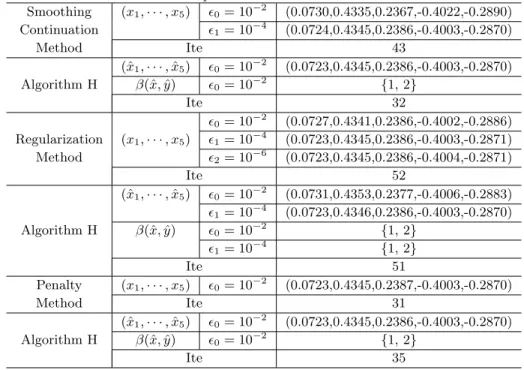
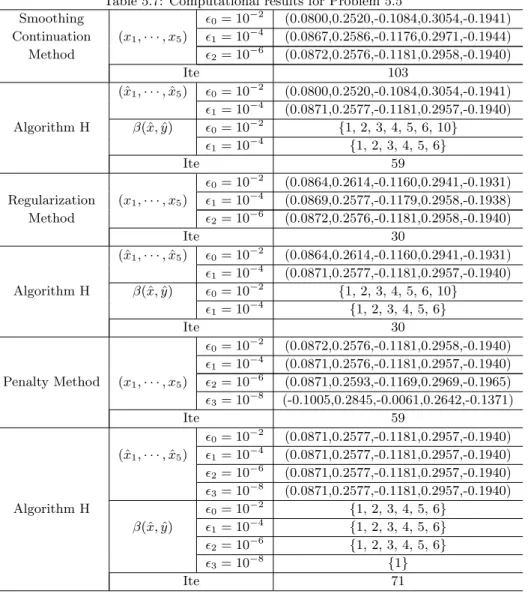
5.6 Computational Results . . . 100
5.6.1 Computational results for Algorithm H . . . 100
5.6.2 Computational results for Algorithms HIA and HIS . . . . 107
6 Smoothing Implicit Programming Approach for SMPECs 113 6.1 Introduction . . . 113
6.2 Smoothing Implicit Programming Method for Lower-Level Wait- And-See Problems . . . 118
6.2.1 Preliminaries . . . 119
6.2.2 Method . . . 122
6.2.3 Limiting behavior of local optimal solutions . . . 122
6.2.4 Limiting behavior of stationary points . . . 129
6.3 Smoothing Implicit Programming Method for Here-And-Now Prob- lems . . . 134
6.4 Conclusions . . . 147
7 Some Reformulations and Algorithms for SMPECs 149 7.1 Examples . . . 149
7.2 Reformulations . . . 150
7.2.1 Properties of the function Q . . . 151
7.2.2 Continuous case . . . 154
7.2.3 Discrete case . . . 156
7.3 Further Discussions on Discrete Problems . . . 157
7.4 Smoothed Penalty Methods for Discrete Problems . . . 167
7.4.1 Smoothed penalty method (I) . . . 168
7.4.2 Smoothed penalty method (II) . . . 176
7.4.3 Numerical results . . . 179
7.5 Conclusions . . . 180
8 Regularization Method for SMPECs 181 8.1 Preliminaries and Regularization Method . . . 182
8.2 Convergence Analysis . . . 186
8.3 Conclusions . . . 193
Bibliography 195
Acknowledgements 203
Chapter 1
Introduction
Mathematical program with equilibrium constraints (MPEC) is a constrained opti- mization problem whose constraints include some parametric variational inequalities or a parametric complementarity system. This problem plays a very important role in many fields such as engineering design, economic equilibrium, multilevel game, and mathematical programming theory itself, and it has been receiving much attention in the recent optimization world. In this chapter, we give a brief overview on MPECs.
We also introduce some knowledge about the stochastic mathematical programs with equilibrium constraints (SMPECs).
1.1 Background on MPECs
MPEC is generally an optimization problem with two types of variables, an upper-level variable x ∈ <
nand a lower-level variable y ∈ <
m:
minimize f (x, y)
subject to (x, y) ∈ Z, (1.1)
y solves VI(F (x, ·), C(x)).
Here, Z is a subset of <
n+m, f : <
n+m→ <, F : <
n+m→ <
m, C : <
n→ 2
<mare mappings, and VI(F(x, ·), C(x)) denotes the variational inequality problem defined by the pair (F (x, ·), C(x)); that is, y solves VI(F (x, ·), C(x)) if and only if y ∈ C(x) and
(v − y)
TF (x, y) ≥ 0, ∀v ∈ C(x).
It is well-known [36] that, for a given variational inequality problem VI(G, Y ), if the function G is the gradient mapping of a differentiable function g : <
m→ < and the
1
set Y is convex in <
m, then VI(G, Y ) is just a restatement of the first-order necessary conditions of optimality for the optimization problem
minimize g(y) subject to y ∈ Y.
Therefore, MPEC (1.1) can be regarded as a generalization of the so-called bilevel programming problem that is a mathematical program with optimization constraints.
Moreover, MPEC is also closely related to the well-known Stackelberg game, see [62, 66].
When C(x) ≡ <
m+for each x in problem (1.1), the parametric variational inequality constraints reduce to a parametric complementarity system and then problem (1.1) is equivalent to the following mathematical program with complementarity constraints (MPCC):
minimize f (x, y)
subject to (x, y) ∈ Z, (1.2)
y ≥ 0, F (x, y) ≥ 0, y
TF(x, y) = 0.
On the other hand, if the set-valued function C in problem (1.1) is defined by C(x) := {y ∈ <
m| c(x, y) ≤ 0},
where c : <
n+m→ <
sis continuously differentiable, then, under some suitable condi- tions, the variational inequality problem VI(F (x, ·), C(x)) has an equivalent Karush- Kuhn-Tucker representation [68]:
F(x, y) + ∇
yc(x, y)λ = 0,
λ ≥ 0, c(x, y) ≤ 0, λ
Tc(x, y) = 0,
where λ is the Lagrange multiplier vector, and hence, problem (1.1) can be reformulated as a program like (1.2) under some conditions, see the monograph [62] for details.
Hence, problem (1.2) constitutes an important subclass of MPECs. In this thesis, we particularly concentrate on this kind of MPECs.
As mentioned above, MPEC plays a very important role in many fields and it has been receiving more and more attention in the optimization world. For more details, we refer to the monographs [62, 66] and the references attached in the end of the thesis.
On the other hand, MPEC is very difficult to deal with because, from the geometric
point of view, its feasible region is not convex and not connected even in general, and
1.2 Background on SMPECs 3 in theory, its constraints fail to satisfy a standard constraint qualification such as the linear independence constraint qualification or the Mangasarian-Fromovitz constraint qualification at any feasible point [17]. Therefore, the developed nonlinear programming theory may not be applied to MPEC class directly. At present, a natural and popular approach is try to find some suitable approximations of an MPEC so that the MPEC can be solved by solving a sequence of subproblems. Along this way, many methods have been proposed in the literature.
One family of the methods employs some kinds of smoothing or relaxation tech- niques. In particular, Facchinei et al. [24] and Fukushima and Pang [31] make use of the Fischer-Burmeister function to generate some smooth approximations of MPECs and subsequently, a similar scheme was presented by Scholtes [76].
Another family of the methods uses a penalty technique. For example, Huang et al [41] utilized the Fischer-Burmeister function to penalize the whole complementarity system, whereas Hu and Ralph [38] suggested a method to penalize the complementarity constraints only. Moreover, the works [39, 40, 63, 77] also belong to this family.
The other methods in the literature on MPECs include the sequential quadratic pro- gramming methods [29, 44, 62], implicit programming methods [12, 62], interior point methods [60, 62], and implementable active-set method [33]. In addition, nonsmooth methods for MPECs can be found in [66]. One purpose of the thesis is to develop more efficient methods for solving MPECs.
1.2 Background on SMPECs
Stochastic mathematical program with equilibrium constraints (SMPEC) can be for- mulated as follows:
minimize E
ω[f (x, y, ω)]
subject to (x, y) ∈ Z, ω ∈ Ω, (1.3)
y solves VI(F (x, ·, ω), C(x, ω)),
where Z is a subset of <
n+m, Ω denotes the underlying sample space, E
ωmeans ex- pectation with respect to the random variable ω ∈ Ω, and f : <
n+m× Ω → <, F :
<
n+m× Ω → <
m, C : <
n× Ω → 2
<mare mappings. Obviously, if Ω is a singleton, then
problem (1.3) reduces to an ordinary MPEC, and so the SMPEC (1.3) can be thought
as a generalization of the MPEC (1.1). Since an MPEC is already very hard to handle,
so SMPECs may be more difficult to deal with because the number of random events
is usually very large in practice.
The SMPEC (1.3) is also closely related to the so-called two-stage stochastic pro- gram with recourse [72]:
minimize p(x) + E
ω[Q(x, ω)]
subject to x ∈ X, (1.4)
where p : <
n→ <, X ⊆ <
n, and Q : <
n× Ω → < is defined by Q(x, ω) := inf
y∈Y(x,ω)
g(y, ω)
with Y : <
n× Ω → 2
<mand g : <
m× Ω → <. Many applications of problem (1.4) can be found in practice, especially in financial planning. For further details, see [3, 11, 15, 16, 79].
SMPEC was first discussed in [72], the main results of which are concerned with the existence of solutions, the convexity and directional differentiability of an implicit objective function, and links between SMPEC and bilevel models. Actually, there has been no effective algorithms suggested for solving SMPECs so far. In the second half of the thesis, we study SMPECs systematically. We discuss two kinds of SMPECs: One is the lower-level wait-and-see model, in which the upper-level decision is made at once and a lower-level decision may be made after a random event is observed, and the other is the here-and-now model that requires us to make all decisions before a random event is observed. See Chapter 6 for details.
1.3 Main Contributions
The purpose of the thesis is to develop efficient methods for solving MPECs and SM- PECs. We may divide the thesis into two parts: The first part includes Chapters 2–5 in which we deal with the MPECs and the second part consists of Chapters 6–8 in which we study the SMPECs. Our main results can be summarized as follows.
In Chapter 2, we give some modified exact penalty results for nonlinear programs and MPECs. In particular, instead of the abstract subanalytic property and error bounds employed in [62], some of our results use a kind of convexity that is discussed in detail as well.
In Chapter 3, we propose a new relaxation method for MPCCs. Our method re-
places the complementarity constraints by a variational inequality defined on an ex-
pansive simplex. It is well known that such a variational inequality problem can be
represented by a finite number of inequalities. We remove some inequalities and obtain
1.4 Preliminaries 5 a standard smooth nonlinear program. We investigate the limiting behavior of the relaxed problems and obtain some exciting convergence results. In particular, some conditions assumed in the convergence theory are new and can be verified easily in practice.
In Chapter 4, we suggest another relaxation method with bi-hyperbola approxima- tion for MPCCs. This method possesses similar properties to the regularization method [76] and the subproblems in the new method have less constraints.
In Chapter 5, we are devoted to develop some methods that enable us to compute a solution or a point with some kind of stationarity by solving a finite number of nonlinear programs. To this end, we apply an active set identification technique to some existing methods and present some hybrid algorithms. We show that, under some suitable assumptions, the algorithms indeed possess a finite termination property, unlike most existing methods that require to solve an infinite sequence of nonlinear programs.
Further discussions and extensions are also included.
We study the SMPECs in the rest of the thesis.
In Chapter 6, we first introduce the problems and then, we show that many decision problems can be formulated as SMPECs in practice. We discuss both the lower-level wait-and-see decision model and the here-and-now decision model. For the lower-level wait-and-see model, we propose a smoothing implicit programming method and es- tablish a comprehensive convergence theory. For the here-and-now decision problem, we apply a penalty technique and suggest a similar method. We show that the two methods possess similar convergence properties.
In Chapters 7 and 8, we consider a special here-and-now problem. We show that the stochastic linear complementarity problem may be formulated as this kind of SMPECs.
We give some equivalent reformulations of the problem and then propose some penalty methods and a regularization method in Chapters 7 and 8, respectively.
1.4 Preliminaries
We will use the following notations and terminologies in this thesis.
1.4.1 Notations
Throughout, all vectors are thought as column vectors and
Tmeans the transpose
operation. For u ∈ <
s, let kuk and kuk
1denote the norms defined by
kuk := ³ X
s i=1u
2i´
1/2and kuk
1:=
X
s i=1|u
i|, respectively. For a nonempty closed set V ⊆ <
s, we denote
dist(u, V ) := min
v∈V
ku − vk and
Π
V(u) := n v ∈ V ¯ ¯ ¯ ku − vk = dist(u, V ) o .
Moreover, B(u, δ) stands for the closed ball {v ∈ <
s| ku − vk ≤ δ} and <
s+denotes the nonnegative orthant in <
s. For a real scalar a, we denote (a)
+:= max{0, a}. For two vectors u and v in <
s, u⊥v means u
Tv = 0 and both min(u, v) and max(u, v) are understood to be taken componentwise, i.e.,
min(u, v) := (min{u
1, v
1}, · · · , min{u
s, v
s})
T, max(u, v) := (max{u
1, v
1}, · · · , max{u
s, v
s})
TFor a given function G : <
s→ <
s0and a vector u ∈ <
s, ∇G(u) is the transposed Jacobian of G at u, whereas for a real valued function g : <
s→ <, ∇g(u) denotes the gradient vector of g at u. Moreover,
I
G(u) := {i | G
i(u) = 0}
stands for the active index set of G at u. In addition, e
idenotes the unit vector with the ith element to be 1; I and O denote the identity matrix and the zero matrix with suitable dimension, respectively.
1.4.2 Terminologies
We first recall some basic concepts for the standard nonlinear programming problem minimize f (z)
subject to c
i(z) ≤ 0, i = 1, · · · , l, (1.5) c
i(z) = 0, i = l + 1, · · · , s,
where f : <
n→ < and c : <
n→ <
sare twice continuously differentiable.
Definition 1.1 The linear independence constraint qualification (LICQ) is said to hold
at a feasible point z of problem (1.5) if the set of vectors {∇c
i(z) | i ∈ I
c(z)} is linearly
independent.
1.4 Preliminaries 7 Definition 1.2 We say z to be a stationary point of problem (1.5) if it is feasible to (1.5) and there exists a Lagrange multiplier vector λ ∈ <
ssuch that
∇f(z) + ∇c(z)λ = 0,
λ
i≥ 0, λ
ic
i(z) = 0, i = 1, · · · , l.
Definition 1.3 Let z be a stationary point of problem (1.5) and λ be a Lagrange multiplier vector corresponding to z. We say the weak second-order necessary condition (WSONC) holds at z if we have
d
T³ ∇
2f(z) + X
s i=1λ
i∇
2c
i(z) ´ d ≥ 0 for any d ∈ T (z) := n d ∈ <
n¯ ¯ ¯ d
T∇c
i(z) = 0, ∀ i ∈ I
c(z) o .
We next consider the mathematical program with complementarity constraints (MPCC)
minimize f(z)
subject to g(z) ≤ 0, h(z) = 0 (1.6)
G(z) ≥ 0, H (z) ≥ 0 G(z)
TH(z) = 0,
where f : <
n→ <, g : <
n→ <
p, h : <
n→ <
q, and G, H : <
n→ <
mare all twice continuously differentiable functions. Let F denote the feasible region of the above problem.
Definition 1.4 The MPEC-linear independence constraint qualification (MPEC-LICQ) is said to hold at ¯ z ∈ F if the set of vectors
n
∇g
l(¯ z), ∇h
r(¯ z), ∇G
i(¯ z), ∇H
j(¯ z) |
l ∈ I
g(¯ z), r = 1, · · · , q, i ∈ I
G(¯ z), j ∈ I
H(¯ z) o is linearly independent.
This condition is not particularly stringent [78] and has been assumed often in the
literature on MPCCs [31, 38, 41, 54, 76]. Note that this definition is different from
the standard definition of LICQ in nonlinear programming theory that would require
the gradient of the function G(z)
TH(z) be linearly independent of the above vectors, which cannot happen in any case actually.
In the study of MPCCs, there are several kinds of stationarity defined for problem (1.6) [75].
Definition 1.5 We say ¯ z ∈ F to be a Bouligand or B-stationary point of problem (1.6) if it satisfies
d
T∇f (¯ z) ≥ 0, ∀d ∈ T (¯ z, F), where
T (¯ z, F) := n d ∈ <
n¯ ¯ ¯ t
k(z
k− z) ¯ → d, z
k→ z, z ¯
k∈ F , t
k≥ 0, k = 1, 2, · · · o stands for the tangent cone of F at ¯ z.
Definition 1.6 (1) ¯ z ∈ F is called weakly stationary to problem (1.6) if there exist multiplier vectors ¯ λ ∈ <
p, µ ¯ ∈ <
q, and ¯ u, v ¯ ∈ <
msuch that
∇f (¯ z) + ∇g(¯ z)¯ λ + ∇h(¯ z)¯ µ − ∇G(¯ z)¯ u − ∇H(¯ z)¯ v = 0, (1.7)
λ ¯ ≥ 0, λ ¯
Tg(¯ z) = 0, (1.8)
¯
u
i= 0, i / ∈ I
G(¯ z), (1.9)
¯
v
i= 0, i / ∈ I
H(¯ z). (1.10)
(2) ¯ z ∈ F is called a Clarke or C-stationary point of problem (1.6) if there exist multiplier vectors ¯ λ ∈ <
p, µ ¯ ∈ <
q, and ¯ u, v ¯ ∈ <
msuch that (1.7)–(1.10) hold with
¯
u
i¯ v
i≥ 0, i ∈ I
G(¯ z) ∩ I
H(¯ z)
and we say ¯ z is Mordukhovich or M-stationary to problem (1.6) if, furthermore, either
¯
u
i> 0, v ¯
i> 0 or ¯ u
iv ¯
i= 0 for all i ∈ I
G(¯ z) ∩ I
H(¯ z).
(3) ¯ z ∈ F is called a strongly or S-stationary point of problem (1.6) if there exist multiplier vectors ¯ λ, µ, ¯ u, and ¯ ¯ v such that (1.7)–(1.10) hold with
¯
u
i≥ 0, ¯ v
i≥ 0, i ∈ I
G(¯ z) ∩ I
H(¯ z).
It is well-known [75] that, if the MPEC-LICQ holds at ¯ z, B-stationarity is equivalent
to S-stationarity.
2.1 Preliminaries 9 Definition 1.7 A weakly stationary point ¯ z ∈ F of problem (1.6) is said to satisfy the upper level strict complementarity (ULSC) condition if there exist multiplier vectors λ, ¯ µ, ¯ u, and ¯ ¯ v satisfying (1.7)–(1.10) and
¯
u
i¯ v
i6= 0, i ∈ I
G(¯ z) ∩ I
H(¯ z).
The ULSC condition is clearly weaker than the so-called lower level strict comple-
mentarity (LLSC) condition (which means I
G(¯ z) ∩ I
H(¯ z) = ∅ and in this case, ¯ z is
also said to be nondegenerate). Moreover, it is obvious that any M-stationary point
of problem (1.6) satisfying the upper level strict complementarity condition must be a
B-stationary point.
Chapter 2
Exact Penalty Results for
Nonlinear Programs and MPECs
Because of the presence of variational inequality or complementarity constraints, MPEC has such an intrinsic feature that its feasible region is nonconvex or nonsmooth in gen- eral and hence it is very difficult to handle. At present, a popular approach is to refor- mulate an MPEC as a standard nonlinear program. In this respect, penalty functions have provided a powerful approach, both as a theoretical tool and as a computational vehicle. Recently, based on the study of subanalytic optimization problems and with the help of the theory of error bounds, some exact penalty results for nonlinear pro- grams and MPECs were proved by Luo, Pang, and Ralph [62]. In this chapter, we will show that those results remain valid under some other mild conditions. In particular, instead of the subanalytic property and error bounds, which are somewhat abstract and difficult to verify in practice, some of our results use a property called strong convexity with order σ, which is a generalization of the ordinary strong convexity [49] and will be discussed in detail.
2.1 Preliminaries
The following definitions will be used later on.
Definition 2.1 (See [62]) A set X ⊆ <
nis said to be subanalytic if for any u ∈ <
n, there exist a neighborhood U of u and a bounded set Z ⊆ <
n+pwith some nonnegative integer p such that
(a) for any v ∈ <
n+p, there exist a neighborhood V of v and a finite family {Z
ij| 1 ≤
11
i ≤ l, 1 ≤ j ≤ q} of sets Z
ij= {z ∈ V | f
ij(z) = 0} or {z ∈ V | f
ij(z) < 0} defined for some real analytic functions f
ijon V such that
Z ∩ V = [
l i=1\
q j=1Z
ij;
(b) X ∩ U = {x ∈ <
n| (x, y) ∈ Z for some y ∈ <
p}.
A function f : <
n→ < is said to be subanalytic if its graph is subanalytic.
The class of subanalytic functions is broader than the class of analytic functions and is employed by many papers, although it is somewhat abstract. For more details, we refer the reader to [2, 20, 61, 62].
Definition 2.2 (See [64]) Let 0 < p ≤ 1 be a constant and G : <
n→ <
mbe a mapping.
We say G to be H¨older continuous with order p on X ⊆ <
n, if there exists a constant L such that
kG(x) − G(y)k ≤ Lkx − yk
p, ∀x, y ∈ X. (2.1)
This concept is a generalization of the Lipschitz continuity, which is, by definition, H¨older continuity with order p = 1. Note that H¨older continuity makes sense only when 0 < p ≤ 1. In fact, when p > 1, condition (2.1) implies that all directional derivatives of G at any interior point are zero and so G is quite trivial. In addition, for 0 < p 6= p
0≤ 1, H¨older continuous functions with order p and those with order p
0constitute different classes of functions. For example, the function
G(x) := kxk
12, ∀x ∈ <
nis H¨older continuous with order p =
12on <
nand not Lipschitz continuous on <
n. Definition 2.3 A function f : <
n→ < is said to be strongly convex with order σ > 0 on a convex set X ⊆ <
n, if there exists a constant c > 0 such that
f(tx + (1 − t)y) ≤ tf(x) + (1 − t)f (y) − ct(1 − t)kx − yk
σ(2.2) for any x, y ∈ X and any t ∈ [0, 1].
When σ = 2, this property reduces to the strong convexity in the ordinary sense
[49]. But if σ 6= 2, they are different. For example, we can see from the results given
in Section 2.4 that the function f (x) = x
4is strongly convex with order 4 and not
strongly convex (with order 2) on <.
2.2 Penalty Results for NLP 13
2.2 Penalty Results for Nonlinear Programs
Consider the following nonlinear program:
minimize θ(x)
subject to x ∈ X, (2.3)
g(x) ≤ 0, h(x) = 0,
where θ : <
n→ <, g : <
n→ <
m, and h : <
n→ <
lare all continuous functions and X ⊆ <
nis a nonempty closed set. Let W denote the feasible region of (2.3) and
r(x) :=
X
m i=1(g
i(x))
++ X
l j=1|h
j(x)|
be the residual for the constraints in (2.3) at x ∈ X. Then the function r may be used as a penalty function for problem (2.3). The following theorem is shown in [62]:
Theorem 2.1 Let X ⊆ <
nbe a compact subanalytic set, θ be Lipschitz continuous on X, and g
i, h
jbe continuous subanalytic. Suppose problem (2.3) is feasible. Then there exist positive constants α
∗and γ
∗such that for α ≥ α
∗and γ ≥ γ
∗, problem (2.3) is equivalent to
minimize θ(x) + αr(x)
1/γ(2.4)
subject to x ∈ X
in the sense that x
∗solves (2.3) if and only if it solves (2.4).
Moreover, the following result will be used:
Theorem 2.2 (Lojasiewicz Inequality [2]) Let φ, ψ : S → < be continuous subanalytic and S ⊆ <
nbe compact subanalytic. If φ
−1(0) ⊆ ψ
−1(0), then there exist constants ρ > 0 and N
∗> 0 such that
ρ|ψ(x)|
N∗≤ |φ(x)|, ∀x ∈ S. (2.5)
Now we give our penalty results for problem (2.3). First of all, we define a new function. Suppose that problem (2.3) is feasible, i.e., W 6= ∅. Then we can take a vector d ∈ W and define a function θ
don X by
θ
d(x) := θ(x
d), ∀x ∈ X,
where x
d:= (1−t
d)x+t
dd and t
dis the smallest number t ∈ [0, 1] such that (1−t)x+td ∈
W.
Theorem 2.3 Suppose that X, g, h are the same as in Theorem 2.1, problem (2.3) is feasible, and the function (θ − θ
d) is continuous subanalytic for some d ∈ W . Then the conclusion of Theorem 2.1 remains valid.
Proof: Let r|
Xdenote the restriction of r on X. Noticing that both r and (θ − θ
d) are continuous subanalytic and
(r|
X)
−1(0) = W ⊆ (θ − θ
d)
−1(0),
we have from Theorem 2.2 that there exist constants ρ > 0 and N
∗> 0 such that ρ|θ(x) − θ(x
d)|
N∗≤ r(x), ∀x ∈ X. (2.6) Let
µ = max{1, max
x∈X
r(x)}, α
∗> (µ/ρ)
1/N∗, γ
∗= N
∗, and
α ≥ α
∗, γ ≥ γ
∗.
(a) Assume that ¯ x solves problem (2.3). Then for any x ∈ X, we have θ(x) + αr(x)
1/γ= θ(x
d) + (θ(x) − θ(x
d)) + αr(x)
1/N∗r(x)
1/γ−1/N∗≥ θ(¯ x) − |θ(x) − θ(x
d)| + αρ
1/N∗|θ(x) − θ(x
d)|µ
1/γ−1/N∗≥ θ(¯ x) + (αρ
1/N∗µ
−1/N∗− 1)|θ(x) − θ(x
d)|
≥ θ(¯ x)
= θ(¯ x) + αr(¯ x)
1/γ.
Therefore, ¯ x is a global optimal solution of problem (2.4).
(b) If ¯ x solves (2.4), we can claim that ¯ x is an optimal solution of problem (2.3).
In fact, since W is compact and problem (2.3) is feasible, it has an optimal solution, denoted by ˜ x. In a way similar to (a), we have
θ(˜ x) = θ(˜ x) + αr(˜ x)
1/γ≥ θ(¯ x) + αr(¯ x)
1/γ≥ θ(˜ x) + (αρ
1/N∗µ
−1/N∗− 1)|θ(¯ x) − θ(¯ x
d)|
≥ θ(˜ x).
This implies θ(¯ x) = θ(¯ x
d) and then
θ(¯ x) = θ(¯ x
d) ≥ θ(˜ x) ≥ θ(¯ x) + αr(¯ x)
1/γ,
2.2 Penalty Results for NLP 15 where the first inequality holds because ˜ x solves (2.3) and ¯ x
dis feasible to (2.3). Hence, we have r(¯ x) = 0 and θ(¯ x) = θ(˜ x). The former implies ¯ x ∈ W and so ¯ x is an optimal solution to problem (2.3). This completes the proof.
The new condition given in Theorem 2.3 may be satisfied by choosing d appropri- ately even if W is not convex and θ is not Lipschitz continuous, as the next example shows.
Example 2.1 Consider the following problem:
minimize θ(x) := sin
2(3x
13)
subject to x ∈ [0, π
3], cos(3x
13) ≤ 0.
Then the feasible region is given by W =
· π
3216 , π
38
¸ [ · 125π
3216 , π
3¸ ,
which is nonconvex. We note that θ is not Lipschitz continuous on [0, π
3], which means the conditions of Theorem 2.1 are not satisfied for this problem. However, we can show that the assumptions of Theorem 2.3 hold. In fact, for d =
π103, the function
θ
d(x) =
1, x ∈ [0,
216π3) sin
2(3x
13), x ∈ [
216π3,
π83] 1, x ∈ (
π83,
125π2163) sin
2(3x
13), x ∈ [
125π2163, π
3]
is continuous and piecewise smooth and so it is continuous subanalytic on [0, π
3].
We next consider another kind of error bounds for problem (2.3), which is different from (2.6). We say that a function u : X → [0, ∞) provides an error bound of order ν > 0 on W , if there exists a positive constant β such that
u(x) ≥ β ³ dist(x, W ) ´
ν, ∀x ∈ X.
For more details of error bounds, we refer the reader to [64, 69] and the references therein.
Theorem 2.4 Let X be a closed subset of <
n, g and h be continuous on X, and θ be
H¨older continuous with order p > 0 and H¨older constant L on X. Assume that r(x)
provides an error bound of order ν > 0 on W with the corresponding constant β and
suppose that problem (2.3) is feasible. Then problem (2.3) has the same solution set as the problem
minimize θ(x) + αr(x)
N∗(2.7)
subject to x ∈ X, where N
∗:=
νpand α > Lβ
−N∗.
Proof: By the assumption of the theorem, we have
r(x) ≥ β ³ dist(x, W ) ´
ν, ∀x ∈ X. (2.8) (a) If ¯ x solves problem (2.3), then for any x ∈ X, we have from (2.8) and the H¨older continuity of θ that
θ(x) + αr(x)
N∗= θ(z) + (θ(x) − θ(z)) + αr(x)
p/ν≥ θ(¯ x) + (αβ
p/ν− L) ³ dist(x, W ) ´
p≥ θ(¯ x)
= θ(¯ x) + αr(¯ x)
N∗,
where z ∈ Π
W(x). Therefore, ¯ x is a global optimal solution of problem (2.7).
(b) Let ¯ x ∈ X be a solution of problem (2.7). Then for any x ∈ W ,
θ(¯ x) + αr(¯ x)
N∗≤ θ(x) + αr(x)
N∗= θ(x). (2.9) Let t := inf
x∈Wθ(x). Then for any ε > 0, we can find an x
ε∈ W such that θ(x
ε) ≤ t+ε.
By (2.8), (2.9), and the H¨older continuity of θ, we have t + ε ≥ θ(x
ε)
≥ θ(¯ x) + αr(¯ x)
N∗= θ(¯ z) + (θ(¯ x) − θ(¯ z)) + αr(¯ x)
N∗≥ t + (αβ
p/ν− L)k¯ x − zk ¯
p, where ¯ z ∈ Π
W(¯ x). Therefore,
k¯ x − zk ¯
p≤ (αβ
p/ν− L)
−1ε for any ε > 0 and so ¯ x = ¯ z ∈ W . Therefore, (2.9) becomes
θ(¯ x) ≤ θ(x), ∀x ∈ W,
i.e., ¯ x solves problem (2.3). This completes the proof.
2.2 Penalty Results for NLP 17 The set X need not be compact and the functions g and h need not be subanalytic in the last theorem, which are in contrast with Theorems 2.1 and 2.3. If X is compact and g, h are subanalytic, as in Theorems 2.1 and 2.3, the exponent of the penalty term can be chosen elastically. This result is stated in the following theorem, whose proof is omitted here.
Theorem 2.5 Assume that X, g, and h are the same as in Theorem 2.1, θ is H¨older continuous on X, and problem (2.3) is feasible. Then the conclusion of Theorem 2.1 remains true.
Now we consider the special case of problem (2.3):
minimize θ(x)
subject to x ∈ X, (2.10)
g(x) ≤ 0.
We will show some new penalty results for problem (2.10) which will be applied to the mathematical program with a nonlinear complementarity system in the next section.
In the rest of this section, we let ϕ denote the function defined by ϕ(x) := max
1≤i≤m
g
i(x).
In general, condition (2.8) is difficult to verify in practice. The proof of the following theorem indicates that it holds when X is convex and ϕ is strongly convex with order σ on X.
Theorem 2.6 Assume that X ⊆ <
nis a closed convex set, θ is H¨older continuous with order p > 0 and H¨older constant L on X, and ϕ is strongly convex with order σ > 0 and the corresponding constant c on X. Suppose that problem (2.10) is feasible. Then problem (2.10) has the same solution set as problem (2.7) with
r(x) :=
X
m i=1³ g
i(x) ´
+
, N
∗:= p
σ , α > L ³ c 2
´
−N∗.
Proof: By Theorem 2.4 and its proof, it is enough to prove that (2.8) holds with β :=
c2and ν := σ for any x ∈ X. In fact, assume that ϕ(x) > 0 and ϕ(z) = 0, where z ∈ Π
S(x) with S := {x ∈ X | ϕ(x) ≤ 0}. Since ϕ is strongly convex with order σ and constant c on X, it follows from (2.2) that
ϕ ³ x + z 2
´
≤ 1
2 ϕ(x) − c
4 kx − zk
σ.
Note that ϕ(
x+z2) > 0. (Otherwise, since
x+z2∈ X, this will contradict z ∈ Π
S(x).) In consequence,
c
2 kx − zk
σ≤ ϕ(x) = (ϕ(x))
+≤ r(x), i.e., (2.8) holds with β =
c2and ν = σ. This completes the proof.
Note that it is easy to verify that if each g
iis strongly convex with order σ, then the function ϕ is also strongly convex with order σ. We also have the following result.
Theorem 2.7 Assume that X ⊆ <
nis compact and convex and the other conditions are the same as in Theorem 2.6. Let γ ≥
σpand α > L ³
2c´
−p/σ. Then problem (2.10) has the same solution set as the problem
minimize θ(x) + αr(x)
1/γsubject to x ∈ X.
2.3 Penalty Results for MPECs
Consider the following mathematical program with equilibrium constraints (MPEC):
minimize f (x, y)
subject to (x, y) ∈ Z, (2.11)
y solves VI(F (x, ·), C(x)),
where f : <
n+m→ <, F : <
n+m→ <
m, Z ⊆ <
n+m, C : <
n→ 2
<mis defined by a continuously differentiable function g : <
n+m→ <
las
C(x) := {y ∈ <
m| g(x, y) ≤ 0}.
Let F denote the feasible region of problem (2.11), which is assumed to be nonempty.
If F is continuous, g
i(x, ·) is convex for all x ∈ X, where
X := {x ∈ <
n| (x, y) ∈ Z for some y ∈ <
m},
∇
yg
i(x, y) exists and is continuous at every (x, y) in an open set containing F for each
i = 1, · · · , l, Z is compact, and the constraint qualification called SBCQ [62] holds on
2.3 Penalty Results for MPEC 19 F, then problem (11) is equivalent to the following mathematical program for some δ > 0 ([62], Theorem 1.3.5):
minimize f (x, y)
subject to (x, y, λ) ∈ Z × (B(0, δ) ∩ <
l+), (2.12) F (x, y) +
X
l i=1λ
i∇
yg
i(x, y) = 0, g(x, y) ≤ 0, λ
Tg(x, y) = 0.
Roughly speaking, the SBCQ means that for any (x, y) ∈ F, problem (2.12) is feasible and for a bounded subset of F , the corresponding set of Lagrange multipliers is also bounded. Let
W := {(x, y) ∈ <
n+m| (x, y, λ) satisfies the constraints of (2.12) for some λ}.
This set is nonempty if, under the SBCQ, F is nonempty. We choose some d ∈ W and define the function f
din a way similar to the definition of θ
din the previous section.
Then, comparing (2.12) with (2.3) and applying Theorems 2.3 and 2.5, we obtain the following result directly:
Theorem 2.8 Let F, g
i, ∇
yg
ibe continuous subanalytic and Z be compact subanalytic.
Let f be H¨older continuous with order p on Z or (f − f
d) be continuous subanalytic for some d ∈ W . Furthermore, assume that each g
i(x, ·) is convex for all x ∈ X and the SBCQ holds on F . Then there exist constants δ > 0, α
∗> 0, and γ
∗> 0 such that for any α ≥ α
∗and γ ≥ γ
∗, problem (2.11) is equivalent to the problem
minimize f(x, y) + αr(x, y, λ)
1/γ(2.13) subject to (x, y, λ) ∈ Z × (B(0, δ) ∩ <
l+),
where
r(x, y, λ) := kF(x, y) + X
l i=1λ
i∇
yg
i(x, y)k
1+ X
l i=1((g
i(x, y))
++ λ
i|g
i(x, y)|),
in the sense that (x
∗, y
∗) solves (2.11) if and only if (x
∗, y
∗, λ
∗) solves (2.13) for some λ
∗∈ <
l+.
Now we consider a special class of MPECs:
minimize f (x, y)
subject to (x, y) ∈ Z, (2.14)
y ≥ 0, F (x, y) ≥ 0,
y
TF(x, y) = 0,
i.e., the mathematical programs with complementarity constraints. Let S denote the feasible region of problem (2.14), Z
1:= Z ∩ (<
n× <
m+),
r(x, y) :=
X
m i=1(−F
i(x, y))
++ |y
TF(x, y)|, (2.15) and
ψ(x, y) := min n min
1≤i≤m
F
i(x, y), −y
TF (x, y) o .
In a way similar to Theorems 2.4 and 2.6, we can show the following results.
Theorem 2.9 Assume that Z is a closed subset of <
n+m, f is H¨older continuous with order p and H¨older constant L on Z
1, and F is continuous on Z
1. Assume that r(x, y) defined by (2.15) provides an error bound of order ν > 0 with the corresponding constant β on S and problem (2.14) is feasible. Then problem (2.14) has the same solution set as the problem
minimize f(x, y) + αr(x, y)
N∗(2.16) subject to (x, y) ∈ Z
1,
where N
∗:=
νpand α > Lβ
−N∗.
Theorem 2.10 Assume that F, f are the same as in Theorem 2.9 and Z is closed and convex. Suppose that problem (2.14) is feasible. If the function (−ψ) is strongly convex with order σ and the corresponding constant c on Z , then problem (2.14) is equivalent to problem (2.16) with N
∗:=
pσand α > L ³
2c´
−N∗
in the sense that (x
∗, y
∗) solves (2.14) if and only if it solves (2.16).
2.4 Some Properties Related to Strong Convexity
For the strong convexity employed in Theorems 2.6–2.7 and 2.10, we have the following results:
Theorem 2.11 If each f
i, i = 1, · · · , m, is strongly convex with order σ on a convex set X, then P
mi=1t
if
iand max
1≤i≤mf
iare also strongly convex with order σ on X, where t
i> 0, i = 1, · · · , m.
Proof: Immediate from Definition 2.3.
2.4 Strong Convexity 21 Theorem 2.12 Suppose that X ⊆ <
nis convex and f : <
n→ < is continuously differentiable on an open set containing X. Then f is strongly convex with order σ on X if and only if there exists a constant c > 0 such that
f (y) ≥ f (x) + (y − x)
T∇f (x) + ckx − yk
σ, ∀x, y ∈ X. (2.17)
Proof: Assume that f is strongly convex with order σ on X and c is a constant that appears in (2.2). Then for any x, y ∈ X and t ∈ (0, 1), we have
f (y) − f (x) ≥ 1
t (f (ty + (1 − t)x) − f (x)) + c(1 − t)kx − yk
σ= (y − x)
T∇f (x + ξ(y − x)) + c(1 − t)kx − yk
σfor some ξ ∈ (0, t). Letting t → 0, we have (2.17) from the continuity of ∇f .
Conversely, suppose (2.17) holds for some c > 0. For any x, y ∈ X and t ∈ (0, 1), we have
f (x) − f (tx + (1 − t)y) ≥ (1 − t)(x − y)
T∇f (tx + (1 − t)y) + c(1 − t)
σkx − yk
σand
f (y) − f (tx + (1 − t)y) ≥ t(y − x)
T∇f (tx + (1 − t)y) + ct
σkx − yk
σ. In consequence, we have
f(tx + (1 − t)y) ≤ tf(x) + (1 − t)f (x) − ct(1 − t)((1 − t)
σ−1+ t
σ−1)kx − yk
σ. (2.18) If 0 < σ ≤ 2, then
(1 − t)
σ−1+ t
σ−1≥ (1 − t) + t = 1.
If σ > 2, since the real function φ(t) = t
σ−1is convex on (0, 1), then (1 − t)
σ−1+ t
σ−1≥ ³ 1
2
´
σ−2.
It follows from (2.18) that there exists some constant c
0> 0 independent of x, y and t such that
f (tx + (1 − t)y) ≤ tf (x) + (1 − t)f (y) − c
0t(1 − t)kx − yk
σ, i.e., f is strongly convex with order σ on X.
For a given concept of convexity, there usually exists some kind of monotonicity
relevant to it, see [49] and the references therein. Now we define the strong monotonicity
with order σ and discuss its relation to the strong convexity with order σ.
Definition 2.4 A mapping G : <
n→ <
nis said to be strongly monotone with order σ on a convex set X if there exists a constant β > 0 such that
(y − x)
T(G(y) − G(x)) ≥ βky − xk
σ, ∀x, y ∈ X. (2.19)
Theorem 2.13 Let X ⊆ <
nbe convex and f : <
n→ < be continuously differentiable on an open set containing X. Then f is strongly convex with order σ on X if and only if ∇f is strongly monotone with order σ on X.
Proof: Suppose that f is strongly convex with order σ on X. By Theorem 2.12, there exists a constant c > 0 such that (2.17) holds. Then for any x, y ∈ X, one has
f (y) − f (x) ≥ (y − x)
T∇f (x) + ckx − yk
σand
f (x) − f (y) ≥ (x − y)
T∇f (y) + ckx − yk
σ. Therefore,
(y − x)
T(∇f (y) − ∇f(x)) ≥ 2ckx − yk
σ, i.e., ∇f is strongly monotone with order σ on X with β = 2c.
Conversely, assume that (2.19) holds for some β > 0 and F = ∇f . Set t
i:= i
m + 1 , i = 0, 1, · · · , m + 1,
where m is a positive integer. By the mean-value theorem, there exist ξ
i∈ (t
i, t
i+1), 0 ≤ i ≤ m, such that
f (x + t
i+1(y − x)) − f (x + t
i(y − x)) = (t
i+1− t
i)(y − x)
T∇f(x + ξ
i(y − x)).
Hence, it follows from (2.19) that f (y) − f(x) =
X
m i=0(f (x + t
i+1(y − x)) − f (x + t
i(y − x)))
= X
m i=0(t
i+1− t
i)(y − x)
T(∇f (x + ξ
i(y − x)) − ∇f(x)) + (y − x)
T∇f (x)
≥ βky − xk
σX
m i=0ξ
iσ−1(t
i+1− t
i) + (y − x)
T∇f(x).
Letting m → +∞ and noticing that
m→+∞
lim X
m i=0ξ
σ−1i(t
i+1− t
i) = Z
10