Effect of Chaos Noise on City Placement with Local Search Algorithm for TSPs
Yasuyuki Yoshida Shuichi Aono Yoshifumi Nishio (Tokushima University) (SESAME Technology) (Tokushima University)
1 Introduction
Although it would be possible to solve combinatorial op- timization problems with a huge number of elements if we have infinite long time, it does not make any sense for practical problems. In several approximation methods, the solutions are trapped into local minima. Therefore, the so- lutions need to avoid the local minima. It is possible that the solutions become close to a good solution by avoiding the local minima.
In this study, we propose an algorithm that pouring the chaos noise to the city placement. It supports to find good solutions and avoid local minima. In the past study, we investigated the effect of chaos noise poured in the city placement with 2-opt algorithm [1], hence in this study we extend the idea to more strong Or-opt algorithm. By carrying out computer simulations for various problems, we confirm that the chaos noise has a good effect to avoid local minima and achieves a good performance to find a good solution of the TSPs.
2 Proposed method
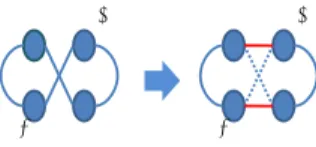
As shown in Fig. 1, the 2-opt algorithm exchanges two paths,i-j andk-l, with the other two paths, i-k andj-l, where j and l are the cities next to i and k. If a trial exchange shortens total tour length, the exchange is really executed.
i
j k
l
i k
j l
Figure 1: Example of 2-opt exchange.
The Or-opt algorithm exchange multiple paths in a sim- ilar way. In this study, after the Or-opt exchanges, the chaos noise is poured in the city placement. Because the city placement is changed by the chaos noise, the Or-opt algorithm finds new candidates for exchange. These pro- cesses are iterated several times.
3 Chaos noise
In this study, we use the time series of the chaos gen- erated by the logistic map as a noise. The logistic map is given as following equation.
xn(t+ 1) =αxn(t)(1−xn(t)) (1) The chaotic sequence is normalized by
ˆ
xn(t) = xn(t)−x¯ σx
(2) where ¯xis the average ofxn andσx is the standard devi- sion ofxn. In this study, we use the bifurcation parameter α= 3.5,3.828,4.0. The bifurcation parameter α= 3.828 is the intermittency chaos near the three-periodic window obtained from the logistic map. It is reported that the in- termittency chaos near the three-periodic window obtained
from the logistic map gains good performance for combi- natorial optimization problems [2].
4 Simulated results
In this study, we use three problems, “bayg29”, “lin105”, and “rat575” from TSPLIB [3]. The results are summa- rized in Table 1. Here, the number of iterations is 100 times. The results are average values of 10 trials. The Table 1 shows the Or-opt algorithm without chaos (con- ventional method), the Or-opt algorithm with chaos noise of the bifurcation parameterα= 3.828 (proposed method 1),α= 3.5 (proposed method 2), andα= 4.0 (proposed mthod 3).
Table 1: The results of conventional method, proposed method 1, proposed method 2 and proposed mthod 3.
Problem bayg29 lin105 rat575 Optimal
solution 9047 14379 6773 Conventional
method 9141 14790 7150
Proposed
method 1 9074 14425 7111
Proposed
method 2 9107 14459 7101
Proposed
method 3 9074 14535 7116
From this table, we can confirm that the proposed al- gorithms with chaos exhibit better performance than the conventional method without chaos. Although the aver- aged values are similar for all three proposed methods, the intermitency chaos seems to be more effective to find the best solution.
5 Conclusions
We have investigated the effect of chaos noise poured in the city placement with Or-opt algorithm for the TSPs. By carrying out computer simulations for various problems, we have confirmed that the chaos noise had a good effect to avoid local minimum problems and achieved a good per- formance to find good solutions of the TSPs.
As the future subject, we will investigate the effect to pour different noises to the city placement.
References
[1] Y. Yoshida, S. Aono and Y. Nishio, “Effect of chaos noise on city placement by using 2-Opt algorithm for TSPs,” Proc. of NCSP’09, pp.357-359, Mar. 2009.
[2] Y. Hayakawa and Y. Sawada, “Effects of the chaotic noise on the performance of a neural network model for optimization problems,” Physical Review E, vol.51, no.4, pp.2693-2696, 1995.
[3] “TSPLIB,” http://www.iwr.uni-heidelberg.de/groups/
comopt/software/TSPLIB95/
平成21年度電気関係学会四国支部連合大会