CITATION
Lamborg, C., K. Bowman, C. Hammerschmidt, C. Gilmour, K. Munson, N. Selin, and C.-M. Tseng. 2014. Mercury in the anthropocene ocean. Oceanography 27(1):76–87, http://dx.doi.org/10.5670/oceanog.2014.11.
DOI
http://dx.doi.org/10.5670/oceanog.2014.11
COPYRIGHT
This article has been published in Oceanography, Volume 27, Number 1, a quarterly journal of The Oceanography Society. Copyright 2014 by The Oceanography Society. All rights reserved.
USAGE
Permission is granted to copy this article for use in teaching and research. Republication, systematic reproduction, or collective redistribution of any portion of this article by photocopy machine, reposting, or other means is permitted only with the approval of The Oceanography Society. Send all correspondence to: [email protected] or The Oceanography Society, PO Box 1931, Rockville, MD 20849-1931, USA.
OceanographyTHE OFFICIAL MAGAZINE OF THE OCEANOGRAPHY SOCIETY
DOWNLOADED FROM HTTP://WWW.TOS.ORG/OCEANOGRAPHY
MERCURY in the Anthropocene Ocean
B Y C A R L L A M B O R G , K AT L I N B O W M A N , C H A D H A M M E R S C H M I D T, C I N D Y G I L M O U R , K AT H L E E N M U N S O N , N O E L L E S E L I N , A N D C H U N - M A O T S E N G
S P E C I A L I S S U E O N C H A N G I N G O C E A N C H E M I S T R Y » A N T H R O P O C E N E : T H E F U T U R E … S O FA R
ABSTR ACT. The toxic metal mercury is present only at trace levels in the ocean, but it accumulates in fish at concentrations high enough to pose a threat to human and environmental health. Human activity has dramatically altered the global mercury cycle, resulting in loadings to the ocean that have increased by at least a factor of three from pre-anthropogenic levels. Loadings are likely to continue to increase as a result of higher atmospheric emissions and other factors related to global environmental change. The impact that these loadings will have on the production of methylated mercury (the form that accumulates in fish) is unclear. In this article, we summarize the biogeochemistry of mercury in the ocean and use this information to examine past impacts that human activity has had on the cycling of this toxic metal.
We also highlight ways in which the mercury cycle may continue to be affected and its potential impact on mercury in fish.
INTRODUCTION
Mercury is a notoriously toxic trace metal that has received global atten- tion since the poisoning of thousands of people in southern Japan (Minamata and Niigata) in the mid-1950s. Ingestion of fish laden with monomethylmercury (CH3Hg+) caused those tragic cir- cumstances and inspired researchers worldwide to examine mercury toxicity to humans and wildlife, measure concen- trations in terrestrial and aquatic biota, and understand the biogeochemical cycling of the element’s multiple forms.
Mercury (Hg) would be of little toxicological concern if it were not for its microbial and abiotic
Oceanography | March 2014 77
transformation to CH3Hg+, which is the form that most readily bioaccumulates and biomagnifies in marine food webs.
These processes result in CH3Hg+ con- centrations in predatory fish and marine mammel species, including many species eaten by humans (e.g., tuna, swordfish, shark, pilot whale) that regularly exceed guidelines for safe consumption. Indeed, 5–10% of US women of childbearing age have blood CH3Hg+ levels that increase the risk of neurodevelopmental problems in their children (Mahaffey et al., 2009), presumably as a result of eating seafood (Selin et al., 2010). While the effects of current mercury exposures may not be as overt as those experienced in Minamata, the size of the worldwide population exposed to potentially harmful levels of CH3Hg+ via seafood consumption is likely in the hundreds of millions.
In addition to the impact on human health, we are just beginning to under- stand how elevated concentrations of mercury can affect the health and sus- tainability of food webs. Several studies document developmental and behavioral effects of CH3Hg+ on fish and other
animals at concentrations commonly found in the environment but at levels well below those that cause acute toxicity (e.g., Scheuhammer et al., 2007). Indeed, some studies suggest that the sustain- ability of some animal populations may already be threatened by impaired repro- ductive success as a result of mercury exposure (e.g., Tartu et al., 2013).
These disturbing ecological findings come in the context of geochemical research that indicates human activi- ties have significantly perturbed the mercury cycle on local, regional, and global scales. Mercury loadings to the atmosphere, for example, have increased at least three-fold since the Industrial Revolution and are expected to continue to rise (e.g., Driscoll et al., 2013). Some research even suggests that anthropo- genic impacts on the mercury cycle extend back well before industrialization, largely as a result of the use of mercury in gold and silver mining.
Here, we review the environmental pathways of mercury from its introduc- tion to the ocean to its accumulation in seafood, focusing on what is known and unknown about key microbial trans-
formations of mercury in the sea, and how this cycle may change
in the future.
MERCURY SPECIES CONCENTR ATIONS AND TR ANSFORMATIONS IN THE OCEAN
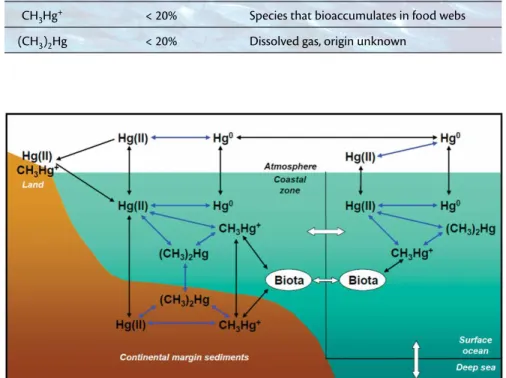
Mercury exists primarily as four chemi- cal species in the ocean: elemental Hg (Hg0), mercuric ion (Hg2+, also writ- ten as Hg(II)) in a variety of inorganic and organic complexes, and methylated forms that include both CH3Hg+ and dimethylmercury ((CH3)2Hg; Table 1;
Figure 1). As with most trace metals, both biological and physical processes govern the distribution of total mercury in the ocean. Combined influences of bioaccumulation and organic mat- ter remineralization, as well as inputs from the atmosphere, scavenging, and horizontal advection, result in mercury displaying nutrient- and scavenged-type profiles with depth in the ocean. At any location, the profile will be dependent upon the relative strength of each of these processes (e.g., Mason et al., 2012).
Figure 2 shows some representative ver- tical profiles of total dissolved mercury and Hg0 concentrations from open- ocean stations that illustrate these behav- iors. Bioaccumulation in surface water and release during remineralization of soft tissues in the thermocline likely cause nutrient-type distributions of mer- cury, as is often observed for trace metals that are biologically essential (e.g., zinc, cobalt, cadmium). Thus, increased con- centrations of total dissolved mercury in the thermocline are a result of vertical
transport from above and a slow rate of removal by either scavenging or
microbial uptake.
Oceanography | March 2014 77
Although distributions of total mer- cury are important to establish, the story of mercury cycling in the ocean is fun- damentally connected to its proclivity to change chemical and physical forms.
Natural and anthropogenic sources emit elemental Hg (as well as a lesser amount of gaseous Hg(II)). Direct atmospheric deposition is presumed to be the princi- pal source of Hg(II) (mercury is oxidized to Hg(II) in the atmosphere) to most of the ocean (e.g., Driscoll et al., 2013), although rivers and groundwater can be more important in nearshore systems
and the confined Arctic Ocean. This flux amounts to about 7 Mmol yr–1 net (Amos et al., 2013). Once in the marine environment, Hg(II) has a complex bio- geochemistry, resulting in one of three fates (Figure 1): (1) reduction to Hg0 and evasion to the atmosphere, (2) methyla- tion to either CH3Hg+ or (CH3)2Hg, and (3) scavenging from the water column.
Reduction
Net reduction of Hg(II) to Hg0 pro- ceeds strongly enough that Hg0 is often supersaturated in seawater with respect
to the atmosphere (Mason et al., 2012).
Subsequent evasion of Hg0 to the atmo- sphere is half of the air-sea cycling loop and is a unique aspect of the biogeo- chemistry of this metal. The reduction and evasion process is a major compo- nent of the marine Hg cycle, with eva- sion fluxes removing 50–80% of gross loadings from the atmosphere. Mercury reduction in seawater is thought to occur rapidly and to include both abiotic (photo chemical) reactions as well as reduction by biota. Most mercury reduc- tion in productive coastal waters is likely accomplished by a biological mecha- nism that is driven by any one of several mercury-reducing bacteria. In contrast, photo chemical reduction is more likely the dominant pathway in the open ocean, where light penetration is deeper and biological productivity less.
Methylation and Demethylation Sediments
External sources of the methylated forms of mercury are too low to explain their concentrations and fluxes in the ocean (e.g., Fitzgerald et al., 2007), suggesting that the primary source is internal production in sediments or the water column.
In nearshore environments and likely for continental shelves, in situ sedi- ment production accounts for most of the CH3Hg+ present. Other significant sources of CH3Hg+ to nearshore systems include tidal marshes, wastewater treat- ment facilities, submarine groundwater discharge, and mangroves that have exceptionally high rates of mercury methylation (e.g., Driscoll et al., 2013).
Principal losses of CH3Hg+ from these waters include sedimentation, photo- chemical decomposition, harvesting of seafood, and export to the wider ocean.
In a recent breakthrough, Parks et al.
Figure 1. Conceptual model of mercury biogeochemical cycling in the ocean. Gaseous elemental mercury (Hg0) is oxidized in the atmosphere to complexes of divalent mercury Hg(II) and deposited to land and the surface ocean. Hg(II) can be either reduced to Hg0 or methylated to form mono- methylmercury (CH3Hg+) and dimethylmercury ((CH3)2Hg). Blue arrows highlight biogeochemical transformations of mercury. Black arrows denote fluxes among the atmosphere, water, sediments, and biota. All of the mercury species can be transported hydrologically between the coastal zone, surface ocean, and deep sea, with bioaccumulative CH3Hg+ also transported by bioadvection (white arrows;
Fitzgerald et al., 2007).
Table 1. Summary of Hg species in the ocean.
Species Typical Concentration/
Percent of Total Note Total Hg < 0.1–10 pM
Hg2+ 50–100% Generally dominant form
Hg0 < 5–50% Majority in atmosphere, dissolved gas in ocean CH3Hg+ < 20% Species that bioaccumulates in food webs (CH3)2Hg < 20% Dissolved gas, origin unknown
Oceanography | March 2014 79 Figure 2. Vertical profiles of filtered total mercury, nutrients, and physicochemical parameters that illustrate different vertical mercury distribu-
tions in the ocean. (a and b) SAFe (Sampling and Analysis of Fe) program site in the North Pacific Ocean (Hammerschmidt and Bowman, 2012).
(c and d) Station 10 (31.8°N, 64.2°W) in the western North Atlantic Ocean sampled during the recent US GEOTRACES zonal section (recent work of author Bowman).
0
1,000
2,000
3,000
4,000
5,000
Depth (m)
Filtered Total Hg (pM) Phosphate (µM)
Total Hg Phosphate Hg0
Salinity Oxygen (µmol kg–1)
Salinity Oxygen (µmol kg–1)
Filtered Total Hg and Hg0 (pM) Phosphate (µM)
Temperature (°C) Temperature (°C)
0.0 0.5 1.0 1.5 0 1 2 3
33.5 34.0 34.5 35.0 0 50 100 150 200
34 35 36 37 100 150 200 250 300
0.0 0.5 1.0 1.5 0.0 0.5 1.0 1.5
0 5 10 15 20 25 0 5 10 15 20 25
(2013) identified two genes (hgcA and hgcB) that are responsible for mercury methylation in some cultured anaerobic bacteria. These genes have also been found to occur in other organisms that were not yet known to be mercury methylators and in a more diverse group of anaerobic bacteria than previously observed (Gilmour et al., 2011; Parks et al., 2013). This finding reveals that the effect of microbial population structure
in methylation is still poorly understood beyond the presence/absence of the gen- eral classes of microbes that contribute to methylation. Moreover, the microbial mechanism of mercury methylation is unknown, although it is thought to be an intracellular process. Examination of the genes in greater detail should reveal much about the biochemistry of mercury methylation and should improve our understanding of its occurrence in the
environment. Sources in Long Island Sound (Figure 3) are greater than sinks, requiring invocation of an “unknown”
sink for the majority (56%) of CH3Hg+ occurring there.
The genetic basis of Hg methylation notwithstanding, net production of CH3Hg+ in coastal sediments appears to be influenced more by Hg(II) bioavail- ability than by the activity of methylating microbes. Supply of electron acceptors
Carl Lamborg ([email protected]) is Associate Scientist, Department of Marine Chemistry and Geochemistry, Woods Hole Oceanographic Institution (WHOI), Woods Hole, MA, USA. Katlin Bowman is a graduate student in the Department of Earth and Environmental Sciences, Wright State University, Dayton, OH, USA. Chad Hammerschmidt is Associate Professor, Department of Earth and Environmental Sciences, Wright State University, Dayton, OH, USA. Cindy Gilmour is Senior Scientist, Smithsonian Environmental Research Center, Edgewater, MD, USA. Kathleen Munson is a Joint Program student, Department of Marine Chemistry and Geochemistry, WHOI, Woods Hole, MA, USA. Noelle Selin is Assistant Professor, Engineering Systems Division and Department of Earth, Atmospheric and Planetary Sciences, Massachusetts Institute of Technology, Cambridge, MA, USA. Chun-Mao Tseng is Associate Professor, Institute of Oceanography, National Taiwan University, Taiwan.
(e.g., SO42– or Fe(III)) as well as labile organic matter appear to be sufficient to fuel organisms’ mercury methylation even in the sandiest of marine deposits.
Accordingly, geochemical factors that influence sediment-water partitioning and the chemical speciation of Hg(II) substrate greatly affect benthic produc- tion of CH3Hg+. Maximum rates of CH3Hg+ production are observed in coastal sediments that have relatively low levels of both solid-phase organic matter and sulfide, which favors par- titioning of Hg(II) species into pore water and therefore uptake by microbes (Fitzgerald et al., 2007). In contrast, CH3Hg+ production can be inhibited in sediments with enhanced levels of either organic matter (greater particle bind- ing) or sulfide, which shifts speciation of dissolved Hg−S species to ionically charged complexes that are less bioavail- able (e.g., Benoit et al., 1999). Therefore, Hg methylation is most effective at redox transition zones, where sulfate-reducing bacteria are present, but their sulfide by- product is not so abundant as to seques- ter Hg in sediments.
Microbial demethylation also
significantly influences net production of CH3Hg+; however, lack of knowledge about the mechanisms and rates of degra- dation remains a large gap in our under- standing of CH3Hg+ biogeochemistry in marine sediments. Multiple functional groups of anaerobic microorganisms have the ability to demethylate CH3Hg+ either by an oxidative process where CO2 and Hg(II) are the end products or by use of the organomercurial lyase pro- tein, MerB, encoded on the mer operon (Barkay et al., 2003). However, microbial demethylation via the mer operon is likely not the dominant mechanism of CH3Hg+ loss in anoxic sediment.
Water Column
Hg(II) also can be methylated to CH3Hg+ and (CH3)2Hg in the marine water column (Figure 1; the sum of the two species denoted as ∑CH3Hg). The most striking feature of the vertical dis- tribution of ∑CH3Hg is the ubiquitous maximum in oxygen minimum zones (OMZs), typically from 500–1,000 m water depth (Figure 4). Maxima of
∑CH3Hg in OMZs have been widely attributed to in situ methylation fueled
by microbial remineralization of organic matter (e.g., Mason and Fitzgerald, 1993), the process that also is partly responsible for the oxygen minimum, in addition to a slow rate of ventilation in the thermocline. Sectional oceano- graphic studies have observed asso- ciations between methylated mercury species and either apparent oxygen utili- zation (AOU) or the rate of organic car- bon remineralization (Sunderland et al., 2009), which suggests that production of methylated mercury in the marine water column is limited by methylation poten- tial more than it is by Hg(II) availability.
Much of the previous research that describes mercury methylation under anoxic conditions may be of little use in understanding CH3Hg+ dynamics in the open ocean. Although strains of iron- and sulfate-reducing bacteria methylate mercury in anoxic sediments (Gilmour et al., 2011), neither functional group is active in the marine water column except under conditions of extreme suboxia associated with some OMZs and micro- environments in sinking particles. The prevalence of CH3Hg+ and (CH3)2Hg throughout the oxic ocean and active rates of mercury methylation in oxic surface waters (Mason et al., 2012) imply that the ability to methylate mercury is widespread among microorganisms, including aerobes.
Burial
On time scales of tens of thousands of years and more, the ultimate sink for mercury is burial in marine sediments (e.g., Fitzgerald et al., 2007; Amos et al., 2013). Unfortunately, there is not a great deal of data regarding the concentration of mercury in deep-sea sediments. As a result, we do not have well-constrained estimates for the rate at which sedi- mentation removes mercury from the
Figure 3. Mass balance (mol yr–1) for monomethylmercury in Long Island Sound, a large coastal embayment in the northeastern United States. Sources are shown in blue, sinks in red.
WPCF = Water Pollution Control Facility. Adapted from Balcom et al. (2004)
Oceanography | March 2014 81
ocean. We can make a first order esti- mate using studies that observed cor- relations between mercury and organic matter in sediments (e.g., Fitzgerald et al., 2007) along with estimates for the amount of organic carbon buried on continental shelves and the abyssal ocean. This approach suggests that about 1 Mmol yr–1 of mercury is buried in global abyssal sediments, while almost 2 Mmol yr–1 are buried on continental shelves. This mercury eventually makes its way back into the global cycle through subduction of marine sediments at active margins, reappearing as mercury vola- tilized from volcanoes and associated deposits. However, it is clear that more Hg is going into the ocean each year (approximately 7 Mmol yr–1 net from atmosphere and rivers; e.g., Amos et al., 2013) than is leaving through burial, leading to inevitable increases.
ANTHROPOGENIC LOAD TIMING AND MAGNITUDE As mentioned earlier, human activity has significantly increased the amount of mercury present in biologically active reservoirs at a variety of scales. At pres- ent, there is conflicting information regarding the amount of pollution mer- cury that has been released, the timing of the releases, and fate of that material. As a result of complex biogeochemistry and resulting mobility, it is clear that, once released, pollution mercury remains active and contributes to the amount found in active environmental reservoirs (e.g., Amos et al., 2013). Thus, there are reservoirs of “legacy” mercury in the ocean, atmosphere, and soils that must be tracked to adequately assess pollution impacts and that will necessarily result in lags between corrective actions (such as reducing emissions) and subsequent
declines in the environment. A criti- cal area of research in environmental mercury biogeochemistry is assessment of the scope of mercury perturbations in time and space and inclusion of such information in models that will allow predictions to be made.
Our recent research as part of the GEOTRACES program (Anderson et al., 2014, in this issue; http://www.
geotraces.org) allows us to estimate the amount of anthropogenic mercury in the ocean from direct oceanographic measurements (Box 1). We compared the concentration of total mercury to that of remineralized phosphate in deep and intermediate waters from around the world, with an emphasis on the North and South Atlantic. Interestingly, mercury concentrations correlate well with remineralized phosphate in all deep waters except the North Atlantic,
0
1,000
2,000
3,000
4,000
5,000
Depth (m)
CH3Hg+ (fM) CH3Hg+ (fM) ∑CH3Hg (fM) ∑CH3Hg (fM) ∑CH3Hg (fM) Oxygen (µmol kg–1) Oxygen (µmol kg–1) Oxygen (µmol kg–1)
0 40 80 120 0 20 40 60 80 100 0 100 200 300 400 0 200 400 600 0 100 200 300 400 0 50 100 150 200 250 0 50 100 150 200 250 0 50 100 150 200 250 300
CH3Hg+
∑CH3Hg Oxygen
Figure 4. Representative profiles of monomethylmercury (CH3Hg+) and total methylated mercury (∑CH3Hg) in seawater, illustrating a connec- tion to dissolved oxygen distributions. Filtered CH3Hg+ in (a) Northeast Atlantic Ocean (recent work of author Bowman), and (b) subtropi- cal North Pacific Ocean (Hammerschmidt and Bowman, 2012). ∑CH3Hgin unfiltered water of the (c) sub-Arctic North Pacific (Sunderland et al., 2009), (d) Southern Ocean (Cossa et al., 2011), and (e) Mediterranean Sea (Cossa et al., 2009). Dashed lines denote the depth of the sediment-water interface.
indicating that mercury under non- pollution conditions behaves much like a macronutrient: it increases in concentration as it is swept along the oceanic conveyor belt through the deep Atlantic, into the deep Southern Ocean, then into the deep Indian, and eventu- ally the deep North Pacific. In contrast, mercury-to-remineralized phosphate ratios were greatly increased in North Atlantic Deep Water and some inter- mediate waters, indicating anthropo- genic impact. The excess anthropogenic mercury accounts for about 300 Mmoles present in the ocean today, denoting increased concentrations in the surface ocean, permanent thermocline, and deep ocean regions of about 250%, 160%, and 10%, respectively.
Our estimate of the amount of anthro- pogenic mercury in the ocean is con- sistent with the amounts predicted by previous modeling efforts, in particular, that of Sunderland and Mason (2007).
Their model is one of the few to explic- itly include deepwater formation when considering the fate of mercury in the ocean. They found about 49% of total anthropogenic mercury resides below 1,500 m water depth, similar to our measurements. The model highlights the importance that deepwater formation plays in the fate of anthropogenic Hg in the short term (century to millennium time scale); if this process were not to occur, our results suggest that almost twice as much mercury would currently reside in the surface ocean. This dynamic also has something to tell us about the future of Hg in the ocean. It is predicted that in the next 50 years, as much Hg could be released from industry as has been released in the previous 150 (Streets et al., 2009). However, of the future Hg added to the ocean, a larger proportion will be found in shallower water and BOX 1. MEASURING MERCURY IN THE OCEAN
As with many trace elements in the ocean, measuring ambient concentrations of mercury (Hg) in seawater can be challenging. One of the first steps in many trace analyses is isolating the analyte from all the potentially complicating salts and pre-concentrating from large volumes to obtain a visible signal. In the case of Hg, we are fortunate that one form, Hg0, is volatile. Thus, if all Hg species could be rendered into this form, it could be stripped from a seawater sample and collected using some variant of purge-and-trap techniques. Generally, this is done through oxidation of Hg species to Hg(II) first, usually using Br2 dissolved in HCl (or BrCl as it is sometimes called) and then reducing the Hg(II) to Hg0 using either NaBH4 or SnCl2. The preconcentration trapping of the purged Hg0 is usually done by exploiting the spontaneous amalgamation of elemental Hg and Au to one another, a procedure pioneered by William F. Fitzgerald and students at the University of Connecticut in the 1970s, 1980s, and 1990s. This key com- ponent of the method, which has been subsequently refined, allows pico- and femtomolar concentrations of mercury to be isolated and determined from seawater. The form of gold (Au) can vary, but it is usually quartz sand with a thin coating of Au0. In a bit of chemical irony, this method represents the converse of the way in which mercury has long been used in gold mining, where mercury is added to a sediment/rock/water slurry, the mixture is agitated, and the gold is allowed to amalgamate to the mercury. Later, the dense mercury is recovered from the slurry through settling and then boiled off to reveal the precious gold.
Thus, today, Hg analysts use essentially the same technology that resulted in con- tamination in the past to study the impact of that contamination. The organo- mercury compounds are determined in a similar process, by derivitization rather than reduction, purge, and trap onto organic-trapping Tenax instead of gold, and separation by gas chromatography prior to analysis to isolate the methylated forms from Hg0 and Hg(II). As part of the US GEOTRACES program, all of these analyses are performed at sea in a self-contained Hg lab (see figure).
A view inside the mercury lab van during the US GEOTRACES eastern tropical South Pacific cruise. Katlin Bowman (left) of Wright State University and Gretchen Swarr of Woods Hole Oceanographic Institution are hard at work.
Oceanography | March 2014 83
will therefore be potentially available for inclusion in the marine food web. In short, not only will Hg concentrations in the surface ocean continue to rise along with emissions, but that rise could be at a faster rate than emissions. Because the residence time of mercury in the mixed layer is only 0.5–1 years, if we reduce atmospheric mercury inputs to the open ocean, there should be a proportional and immediate reduction of mercury concentrations in pelagic food webs.
Historical archives provide compel- ling evidence of mercury concentra- tion increases in biologically important reservoirs in the ocean. They suggest 200–500% increases of CH3Hg+ con- centration in the ocean since industri- alization. Such an increase of CH3Hg+ in seabirds is consistent with the GEOTRACES-based estimate of Hg(II) increases (e.g., Mason et al., 2012). It is possible that changes in the recent past and in some locations may very well be different from global averages. Thus, a conservative description of the state-of- the-science is that many studies support the hypothesis that increased emissions of Hg result in higher Hg concentra- tions in fish in the ocean, but there is still much we do not know.
The response of CH3Hg+ produc- tion in sediments on the continental margin is likely to influence future changes in Hg(II) loadings from either the atmosphere or rivers because sur- face sediments in nearshore and remote continental shelf regions have accumu- lated massive reservoirs of Hg(II) since the beginning of human Hg loadings.
Benthic infauna mix this pool of “legacy”
mercury throughout the upper 10+ cm of surface sediment. Its burial and removal from active zones of methyla- tion (upper few centimeters) will occur only after centimeters of new sediment
are added, which will take decades to centuries in most systems. Future changes in CH3Hg+ production and bioaccumulation in coastal ecosystems are most likely to result from alterations of water quality that is hypothesized to influence Hg(II) bioavailability, benthic
CH3Hg+ flux, and the size and composi- tion of the biological pool into which CH3Hg+ is accumulated, but these effects are poorly constrained (Amos et al., 2013; Driscoll et al., 2013).
GLOBAL CHANGE IMPACT ON THE MERCURY CYCLE
In addition to the possibility of increased mercury loadings to the ocean in the future, other changes in the marine mercury cycle could occur as a result of changes in climate, ocean physics, and productivity, as well as land use and terrestrial mercury cycling. Several studies have contemplated the poten- tial impact that global change might have on the mercury cycle (e.g., AMAP, 2011; Amos et al., 2013; Krabbenhoft and Sunderland, 2013; UNEP, 2013).
However, our current understanding of the dependencies of various aspects of mercury biogeochemistry on these various forcings is too limited to make firm predictions. For example, Table 2 shows a few of the forcings that have been considered, some of which display
competing impacts on the mercury cycle. Thus, as with many aspects of global change science, the impact on the mercury cycle is very uncertain, which complicates the job of planning for or mitigating the impact of future mercury loadings to the ocean.
REGIONAL IMPACT CASE STUDIES
The future of human impacts on the ocean regarding Hg can already be seen in some locations. Below, we highlight two case studies: one in the South China Sea, which is directly downwind and downriver from the region of largest cur- rent anthropogenic Hg emissions, and the other in the Arctic, where a chang- ing climate and unusual atmospheric dynamics combine to threaten people and food webs.
South China Sea
The South China Sea (SCS) receives riverine and atmospheric loadings of Hg from China and surrounding areas, which are among the highest emit- ters of Hg at present. As a result, the concentrations of Hg found in the SCS are unusually high for a large marginal sea, ranging from 3–10 pM (Fu et al., 2010; Tseng et al., 2012). In contrast, the Mediterranean Sea, which is nearly the same size as the SCS, exhibits Hg con- centrations that are about five times less
“…NOT ONLY WILL Hg CONCENTRATIONS IN THE SURFACE OCEAN CONTINUE TO RISE ALONG WITH EMISSIONS, BUT THAT RISE COULD BE AT A
FASTER RATE THAN EMISSIONS.
”
Table 2. Potential responses of the marine mercury cycle to various global change forcings. Suggestions are from Fitzgerald et al. (2007), AMAP (2011), Driscoll et al. (2013), Amos et al. (2013), Dijkstra et al. (2013), Krabbenhoft and Sunderland (2013), Selin (2013), and UNEP (2013).
Global Change Forcing Result Impact on Ocean Hg
ATMOSPHERE-RELATED
Warming atmosphere
Decrease in Br oxidation of Hg0 in atmosphere, longer atmosphere
residence time Decreased evasion as atmospheric concentration increases Increased convection, shorter
atmosphere residence time. Increased evasion as atmospheric concentration decreases Slower circulation, slower wind speeds Decreased evasion
Increased precipitation Increased evasion as atmospheric concentration decreases Increased oxidative
capacity (e.g., ozone) Decrease in Br oxidation of Hg0 in
atmosphere, longer residence time Decreased evasion as atmospheric concentration increases EMISSIONS-RELATED
Warming soil Increased soil evasion rate constant Increased loading to ocean Decreased soil C storage Increased loading to ocean Increased biomass burning Increased emissions Increased loading to ocean OCEAN-RELATED
Increased ocean temperatures
Increased respiration Increased CH3Hg+ production
Stronger stratification Decreased CH3Hg+ production from lower primary production Decreased surface water concentrations due to more sluggish ventilation Increased fish metabolism Increased bioaccumulation/magnification of CH3Hg+
Expansion of oxygen minimum Depends on cause: if organic carbon remineralization rate does not change, no effect
Rising sea level Short-term inundation of coastline Short-term pulse of Hg and CH3Hg+ into coastal zone Coastal eutrophication Increased phytoplankton biomass Decreased CH3Hg+ concentration by biodilution
Increased C flux to sediments Decreased CH3Hg+ production through thinning of suboxic zone and receives a total areal Hg load that
is less than half that of the SCS. Indeed, the SCS is closer in areal loading to urbanized embayments like Long Island Sound than the Mediterranean (Table 3).
So much Hg is in the air over the SCS that in winter, when winds are from the northwest, Hg0 invades the sea in a situation rarely observed anywhere else (evasion is the norm; Tseng et al., 2013).
At most times of the year, the evasional flux of Hg from the SCS is virtually the same as that from the Mediterranean and other ocean regions, implying that evasion may not be proportional to total
Hg, as is frequently assumed (e.g., Amos et al., 2013). If this is the case, then pro- gressively larger percentages of Hg load- ings to the wider ocean can be expected to remain there than current models pre- dict. If the future of most ocean regions is anything like the SCS, the impact of human emissions may be more serious than we currently appreciate.
The Arctic
There are two reasons that the Arctic is of concern with respect to global mer- cury change. First, during springtime, so-called Arctic Mercury Depletion
Events regularly occur, where a large fraction of lower tropospheric Hg is oxidized and deposited to snow and ice. The chemistry behind this process is not perfectly understood, but likely involves reactive halogen species that are generated during polar sunrise. The result is a large deposition of Hg to the surface in a short period of time that, were it to remain, could threaten Arctic ecosystems. However, chemical activity that occurs in snow and ice results in the reduction and evasion of a substantial fraction of this deposited Hg, lower- ing the net effect of Depletion Events.
Oceanography | March 2014 85
The events themselves may not be new phenomena (Drevnick et al., 2012), but with the loss of sea ice in the Arctic, the process of re-emission of Hg deposited by Depletion Events may decrease in the future, dramatically increasing the net load to the Arctic Ocean (assum- ing snow is better at reducing/evading Hg than the ocean).
A second cause for concern is the impact that global change is having on Hg loadings to the Arctic Ocean from rivers. The Arctic Ocean is a uniquely river-influenced basin, and warming appears to have resulted in a dramatic increase in riverine flow into this stretch of ocean. Much of this increased fresh- water is thought to arise from the melt- ing of permafrost that releases a sub- stantial amount of organic carbon in the process. Mercury stored in permafrost soils is also released during this process, and modeling estimates suggest that the result could be a substantial increase in Hg loadings from rivers in the coming years (Fisher et al., 2012). The impact of all these forces might already be hav- ing an effect, as certain populations of
Arctic animals appear to be threatened by Hg-induced loss of fecundity (Tartu et al., 2013), and others are likely to follow (AMAP, 2011). As with global warming, the Arctic may be the “canary in the coal mine” for the impact of our past, present, and future releases of mer- cury to the environment.
WHAT CAN BE DONE?
The future trajectory of ocean mer- cury depends on socioeconomic and technological factors. Historically, dramatic increases in mercury emis- sion associated with industrialization have increased mercury loading to the ocean. While efforts in several developed countries (including the United States and Europe) have resulted in emissions decreases there, rapidly industrializing countries are currently the main source of atmospheric mercury. Depending on how countries industrialize, and what controls are put in place, particularly in Asia, anthropogenic mercury emis- sions in 2050 could increase by 96%, or decrease by 4%, or anything in between, relative to 2006 emissions (Streets et al.,
2009). Under the highest emission scenario, net deposition to the global ocean is projected to increase by 33%
(Corbitt et al., 2011).
As present-day anthropogenic sources represent only a fraction (about one- third) of the global emission of mercury to the atmosphere, quantifying the time scales of legacy emissions is critical to determining the future of ocean mer- cury. Importantly, mercury released now is tomorrow’s legacy mercury. Global simulations show that future increases in legacy mercury substantially add to estimates of changes in atmospheric deposition under policy scenarios (Amos et al., 2013; Sunderland and Selin, 2013).
Thus, controlling emissions today has a long-term benefit.
Policy actions at national, regional, and global scales have addressed mer- cury pollution sources. In the United States, the recent Mercury and Air Toxics Standards mandate mercury emissions reductions for the first time from power generation sources, in par- ticular, coal-fired power plants. Globally, the Minamata Convention is a new,
Table 3. First-order total Hg mass balances for several embayments and marginal seas. Fluxes in nmol m–2 yr–1. Data are from Fitzgerald et al. (2007), Rajar et al. (2007), Fu et al. (2010), and Tseng et al. (2012).
NY/NJ Harbor
(500 km2) San Francisco Bay
(1,236 km2) Long Island Sound
(3,250 km2) Chesapeake Bay
(12,000 km2) Mediterranean Sea
(2,510,000 km2) South China Sea (3,500,000 km2) SOURCES
Atmospheric Deposition 40 16.2 40 108 46 186
River/Watershed 4,500 977 298 177 26 49
Water Treatment Facilities 460 15.4 18.5 n/a 37* n/a
SINKS
Evasion 120 2.4 123 48 99 108
Net Ocean Export 3,460 415 25 90 3 102
Burial 1,420 592 209 158 22 24
Total Load 5,000 1,009 357 300 109 235
*This term includes geological and anthropogenic point sources. n/a = not available.
legally binding international agreement designed to protect human health and the environment from anthropogenic emissions and releases of mercury. The Convention, signed in October 2013, takes a life-cycle approach, addressing mercury production, use, trade, and emissions. Provisions that could have
the largest impact on the global ocean are those on atmospheric emissions, releases to land and water, and artisanal and small-scale gold mining (ASGM).
On emissions, the Convention requires the application of best available tech- niques and best environmental practices (BAT/BEP) for new sources, starting five years after the treaty’s entry into force (which will likely be 2015, at the earliest). The concept of BAT/BEP takes into account both technical and eco- nomic feasibility of controls. For existing sources, parties are required to choose from a variety of measures to control and, where feasible, reduce emissions, starting 10 years after entry into force.
Convention provisions on ASGM could also impact future deposition to the ocean. Though previous mercury emission inventories identified station- ary combustion as the largest global atmospheric emission sector, the most recent inventory by the United Nations Environment Programme estimates that ASGM is the largest (UNEP, 2013).
While there is much uncertainty in the
ASGM inventory and the quantifica- tion of how much mercury enters the global atmosphere where it might affect the open ocean and/or remain in local waterways, reducing this source will have benefits on both local and global scales. Under the Minamata Convention, parties with more than insignificant
ASGM are required to develop a national action plan and take steps to reduce and, where feasible, eliminate the use and release of mercury in these activities.
Taken together, Minamata Convention provisions could, optimistically, result in an emissions trajectory at the low end of those projected for 2050, with imple- mentation of basic emissions controls on a large range of sources (Sunderland and Selin, 2013). These actions would result in avoiding the large increases projected under business-as-usual, but little change from today to 2050 in the amount of mercury in the ocean. This scenario sug- gests that environmental improvements would require more aggressive action in the future, and that the initial importance of the Minamata Convention may be in raising awareness legally and politi- cally about mercury as a global envi- ronmental contaminant.
Moving forward, several lessons emerge for future mercury policy.
Experience with regional mercury management suggests that future policy should take into account transboundary
influences, coordinate across environ- mental media, and better assess human and ecological impacts in regulatory analyses. With the new Minamata Convention, coordinating policies across scales—ensuring that national, regional, and international actions are consistent and reinforcing—will become more important. In addition, because mercury is a legacy pollutant, population risks could be further minimized by improved adaptive measures, such as fish adviso- ries, before the benefits of international policy are fully realized.
ACKNOWLEDGEMENTS
We thank Elsie Sunderland, Rob Mason, Ken Johnson, and Bill Landing for help- ful discussions. The US GEOTRACES research reported herein was supported by the US National Science Foundation Chemical Oceanography program.
National Taiwan University also sup- ported this work through the Drunken Moon Lake Scientific Integrated Scientific Research Platform grant, NTU#102R3252.
REFERENCES
AMAP (Arctic Monitoring and Assessment Programme). 2011. AMAP Assessment 2011:
Mercury in the Arctic. Oslo, Norway, 193 pp. Available online at: http://www.amap.
no/documents/doc/amap-assessment- 2011-mercury-in-the-arctic/90 (accessed December 8, 2013).
Amos, H.M., D.J. Jacob, D.G. Streets, and E.M. Sunderland. 2013. Legacy impacts of all-time anthropogenic emissions on the global mercury cycle. Global Biogeochemical Cycles 27:410–421, http://dx.doi.org/10.1002/
gbc.20040.
Anderson, R.F., E. Mawji, G.A. Cutter, C.I. Measures, and C. Jeandel. 2014.
GEOTRACES: Changing the way we explore ocean chemistry. Oceanography 27(1):50–61, http://dx.doi.org/10.5670/oceanog.2014.07.
Balcom, P.H., W.F. Fitzgerald, G.M. Vandal, C.H. Lamborg, K.R. Rolfhus, C.S. Langer, and C.R. Hammerschmidt. 2004. Mercury sources and cycling in the Connecticut River and Long Island Sound. Marine Chemistry 90:53–74, http://dx.doi.org/10.1016/
j.marchem.2004.02.020.
“…THE ARCTIC MAY BE THE “CANARY IN THE COAL MINE” FOR THE IMPACT OF OUR PAST, PRESENT, AND FUTURE RELEASES OF MERCURY TO THE ENVIRONMENT.
”