The Japanese Society for Plant Systematics
The JapaneseSociety forPlant Systematics
ISSNooOl-6799
Acta
PhytotaxGeobot.44(1):
35-51(1993)
A Study on the Morphological and Cytological Features
ofAster leiophyUus Complex (Compositae) in Kyushu, Japan
AKIKO
SOEJIMAU}iiversity
of
Osaka Ptqfecturq CoUegeof
lhtegratedArtsandSciences,Gakuen-cho, Sakai.Osaka593
Abstract The AsterleiQphylluscomplex istaxonomically complicated and includesmany related
taxarepresenting polyploidseries. Ithasbeenreported thattwotaxaofthis groupare distributedin Kyushu, However,thereare many herbarium specimens collected inKyushuwhich cannot be identifiedtoeitherof them. Inthisstudy, morphological variations were examined inrelation to ploidylevel,and taxonomic consideration was given, As a result, threespecies and one variety are
recognized inKyushu: A. IeiophyUusvar. teiophyUus
(2x,
6x),A. semiamptexicautis (2x),A.ieio- plryllusvar. intermedius(4x)var.nov. and A. satsumensis(2x)
sp, nev, The distributionrange ofdiploidA.teioplp,llusvar. Ieiophyllusislimitedtoasmall areaof Fukuoka,Nagasakiand Miyazaki,
while thehexaploidsoccur widely inand around volcanic regions suchas Mts,Aso-Kujiu,Unzen and Kirishima.A. ieic\u,lliLsvar. intermediusisdistributedinthenorth-eastern part,A.semiamptexi- caulis inOitaand the northern partofMiyazaki,and A. satsumensis mostly inthesouthern part of
Kyushu.
(Received
April10,1993;Accepted May 26,1993)Key words: AsterieiqphyUusmorphological variation, polyploidcomplex, taxonomy.
The Asterageratoides sensu
Kitamura (1937,
1981)comprises a well developedpolyploidcomplex
distributed
widely inEastAsia. Inthistaxon,twodistinctly different karyetypes
are known. One
karyotype is
called asL-type,
which haslongchromosomes only, the otheris
LS-type whichhas long
and short chromosomes halfand halfwithin akaryotype.
Theplants with L-type karyotype are morphologically variable, and regarded as a taxonomic complex. A polyploidseries ranging
from diploid
tononaploid except forheptaploidin Japan (Huziwara, 1953, 1954,
1955, 1956, 1957a, b; Irifune,1990; Irifuneet al.,1985).
Previous
authors called thiscomplex variously;A.
crgeratoides subsp. amplexijblius complex(Irifune,
1990),A. ageratoides subsp.IeiophyUus
group(Matsuda & Shinohara,
1985;Matsuda & Suyama, 1980), A. IeiQpdyllus
complex(Soejima,
1992). Here, Ifollow
mypreviouspaper
(Soejima,
1992)and use thenameA. Ieiophyitus
complex.
The Aster leiopityllus
complex ismorphologically variabie comprising many taxa.Natural
introgression
and!orinter-
andintraspecific hybridization between
thetaxaof the complex arebelieved
tohappen
occasionally(Kitamura,
1937,1981). Thus thetaxonomywithin this complex
is diMcult,
andinterpretations
of theboundaries
and theinterrelationships
among thetaxaare commonly conflicting.InKyushu, two taxa of the Aster leiophyltuscomplex, 'Shiro-yomena'
(A.
ageratoides var. adustus,A.
crgeratoides var.harae f. teucanthus, A.
ageratoides ssp. IeiQphyUus,A.teiopIryllus)and 'Inaka-giku'
(A.
ageratoides ssp. amplexijblius,A.
semiamplexicaulis)have been known
tobe distributed (Amakawa,
1975;Baba ed., 1964;Hara, 1952;Hatusima ed.,1986;Hatusima, 1989;Kitamura, 1937,1981;
Ohwi, 1953;
Toyama,1980; Yamashiro
et al.ed.,
1969). But
among specimensin
theherbaria,
thereare many specimens collected inThe Japanese Society for Plant Systematics
The JapaneseSociety for Plant Systematics
36
Acta Phytotax.Geobot. Vol.44Kyushu
which cannot be identifiedtoeitherof thetwo species nor teother taxa of the A.teiqphyUus
complex.In
general,the existence ofpolyploid
series maybe
one of thefactors
of taxonomical
diMculties.
Althoughdiploid,
tetraploid and hexaploid are reported in Kyushu(Irifune,
l987,1990;Irifuneetal.,1985),therelationshipsbetween
taxaand ploidylevels
were not discussed.The aim of thispaperistorecognize themorphological variation oftheA. leiop1tyllus
compiexin
connectionwith
the ploidyleveland todiscuss
thetaxonomyof the complex inKyushu.
Materials
andMethods
Plantswere collected
from
56populations in
Kyushu(Table
1,Fig.1). The aerial partsof the plantswere
kept
asherbarium
voucher specimensfor
morphological analyses. The subterranean partswere cultivated inpotsat Tokyo Metropolitan Universitytobe used forcytological investigations.The voucher specimens are
kept in MAK.
The three
1argest
leaveswere chosen from each specirnen and examined for eight morphological characters(Fig.
2). The methods of morphological and cytological analysesfollowedare those of Soejima
(1992).
For taxonomical consideration, the specimens inthe herbariaKYO, MAK, TIand TNS
were studied.
Results
I. Cytological
features
1. Ploidylevel
The basicchromosome number of the genusAsterisx=9
(Huziwara,
1953,1954,19S5,1956,
1957a,b). In
thepresent
study,diploid,
tetraploid,pentaploid
andhexaploid
were observed. Pentaploidswere rather few and occurred inpopulationswith diploidsand/orhexaploids. The ploidy
level
observedin
each populationis
shownin
Table 1and Fig.1.
In
theAster leiopityllus
complex, thelength
of chromosomesin
akaryotype is
relatively constant, and ina karyotype,the lengthof the shortest chromosome islongerthan one halfof the lengthof thelongestone. Many observed plantshaveone tofiveB chromosomes
in
akaryotype
which canbe
easilydistinguished
from normal ones bytheirextremely small size.The number of B chromosomes isstable withinan individualplantbutvaries even within a
population
and seems tohave
no taxonomic significance. The numbers of B chromosomes were net taken intoconsiderationin
thisstudy.
Two diploids
areobtainedfrom
apopulation
ofFukuoka Prefecture.Arnong 14plantsfrom
sixpopulations
ofNagasaki Prefecture,
threeplantsfrom the populationsof NS1 & 2 are diploids,while other eleven plantsof NS3rv6 are allhexaploids. Six diploids,
onepentaploid
and sixhexaploids
arefound in
the population of KM2, in Kumamoto Prefecture.Diploids,tetraploids andhexaploids
arefound
in65plantsfrom 14populationsin Oita Prefecture. Nine diploids
arefound
in the populations of OI15 & 16. The populationsOIIN4,
6・v8& 10
consist of tetraploids.Hexaploids occur inOI9, 12-v14.Three pentaploids
arealso found in
the population of OI14. From 12 populations of Miyuzaki Prefecture,44plantswere examined.MZ6"v8
are thepopulations
of hexaploids, and alltheother tenpopulationsconsist of diploids.InKagoshima Prefecture,al1
52plantsexamined from 12
populations
are diploids.During my fieldtrip
in
SagaPref.,thenorthern partofNagasaki Pref.
and thesouthernpart
of Kumamoto Pref., Icould not findthe plantsof thiscomplex except fora populationThe Japanese Society for Plant Systematics
The JapaneseSociety forPlantSystematics
August1993 SOEJIMA: Asterleiophyllus
in Kyushu 37
Table1. Colleetionsitesand ploidylevel Population
ne. Locality Voucher -speclmen Ploidylevel
(No.
of plants) FOIF02 NSI NS2 NS3 NS4 NS5 NS6 NS7KM1KM2
OII OI2 OI3 OI4 OI5 OI6 OI7 OI8
OI9OIIOOIIIOI12OI13OI14OI15OI16MZIMZ2MZ3MZ4MZ5MZ6MZ7MZ8MZ9MZIOMZIIMZ12
KSI KS2 KS3 KS4 KS5 KS6 KS7 KS8
KS9KSIOKSIIKS12KS13 ::::::::::
::::::::
::::
t:
::::;:::::::::::::::::::
Chikushi-gun,Nakagawa T.,Funyduo FukuokaC.,Sawara-ku,Hinatapass HiradoC.,Mt. Shijiki
Oomura C.,Kuroki
Minamitakaki-gun,Kunimi T,,Uematsu Minamitakaki-gun,MizuhoT,,Miyanoji Minamitakaki-gun, AriakeT.,Oona Minamitakaki-gun, NishiarieT.,Tounosaka Minamitakaki-gun, Obama T.,Kitano Aso-gun, Oguni T.,Nishizato Ase-gun, Oguni T.,Kamida
Higashikunisaki-gun,Aki T.,Karami Higashikunisaki-gun,Aki T.,Yurugi Higashikunisaki-gun,KunisakiT,,Inagawa Higashikunisaki-gun,Aki T.,Mt. Futago Bungotakada C,,Hashirimizu pass Bungotakada C,,Tazome
Hayarni-gun,Yamaga T.,Hisashi Usa-gun,Ajimu T.,Higashishiiya Oita-gun,Yufuin T.,Kawakita Kusu-gun, Kokonoe T.,Kabeyu Naoiri-gun,KujiuT,,Kujiu Takeda C.,Ogawa
Takeda C.,Takeda Takeda C.,Takeda OitaC.,Karnihetsugi Usuki C.,Nakausuki Miyazaki C.,Kagarnisu
Higashiusuki-gun,KitagoV,,Yamakariya Higashiusuki-gun,KitagoV,,Motokariya Minaminaka-gun, Nango T.,Yowara Kushima C.,Agebaru
Miyakonojyou C.,Miike
Nishimorokata-gun, TakaharuT.,Hirowara Kobayashi C,,Mizunote
Nishimorokata-gun, NojiriT.,Amagatani Nishimorokata-gun, NojiriT,,Imabyu Higashimorokata-gun, Takaoka T,,Uchiyama Higashimorokata-gun, Aya T.,Minamimata Soo-gun, ShibushiT.
Kanoya C.,Kamitakakuina Kimotsuki-gun,SataT.,Hetsuka Kimotsuki-gun,NejimeT.,Ootakeno Kimotsuki-gun,Nejime T.,Yokobeppu IbusukiC.,Hatakekubo
Kawanabe-gun, ChiTan T.,Higashibeppu
SendaiC.,Aoyama
Hioki-gun,HigashiichikiT.,Yuda Hioki-gun, Higashiichiki T.,Takatsuka Satsuma-gun, Hiwaki T.,Tounohara SendaiC.,Nishikata
Idzumi C.,Kamiookawauchi
Soojima90os61 Soojima 90os62 Soojima90a563 Soojima90a564 Soojima9005as Sony'ima9a0566 Soojima 900567 Soojima 900SciP Soojima90057e Soojima 89IO12 Soojima891013 Soojima 891001 Soojima 89IO{12 SoojimaS910CB Soeg'ima891004 Soojima891005 Soojima891006 Soojima891007 Soojima891008 Soojima891e09 Soojima 891010 Soojima 891016 Soojima S91017 Soojima 891018 Soojima8910i9 Soojima891a20 Soojima891Cl21 Soojima891122 Soojima891123 SeojimaS91124 Soojima 891125 Seojima891126 Soojima891146 Seojima89i147 Soojima89i149 Soojima891150 Soojima 891151 Soojima89J152 Soojima S91153 Soojima89JI3Q Soojima 891I31 Soojima89J132 Soojima891133 Soojima 8Pl134 Soey'ima89JI36 Soojima89J137 Soey'ima891139 Soojima891140 Soey'ima891I42 Soojima 89i143 Soojima 8Pl144 Soq'ima 891145
2x(2)2x(1)2x(2)6x(2)6x(2)6x(4)6x(3)
2x(6),5x(1),6x(6)
4x(2)
4x(11)
4x(7)
4x(7)
4x(4)
4x(4)
4x(5)
6x(1)
4x(5)
6x(3)
6x(3)
5x(3),6x(1)
2x(5)
2x(4)
2x(S)
2x(4)
2x(4)
2x(2)
2x(11)
6x(2)
6x(4)
6x(2)
2x(3)
2x(4)
2x(2)
2x(1)
2x(8)
2x(8)
2x(5)
2x(5)
2x(2)
2x(3)
2x(7)
2x(5)
2x(5)
2x(4)
2x(5)
2x(3) FO:KS:FukuokaPref.,
Kagoshima Pref.NS!
Nagasaki Pref.,KM: KurnarnotoPref., OI:Oita Pref.,MZ:Miyazaki Pref.,
The Japanese Society for Plant Systematics
The JapaneseSociety for PlantSystematics
38
Acta
Phytotax.Geobot. Vol.44of NSI, inHirado
Isl., Nagasaki.
2. Distributionof diploids,tetraploids and hexaploidsinKyushu
(Fig. 1)
The
occurrence ofdiploids is
not uniform inKyushu. Although thediploid
plantsarescattered widely throughout the sampling
localities,
most of them are clusteredin
thesouthern partof
Kyushu. A few diploids
appeardisjunctly in
somepopulations
ofFukuoka,Nagasaki, Kumamoto
and Oita.AIthough therearemany tetraploid
populations in
thenorth-eastern partof Kyushu, notetraploidsare
found
intheother localitiesof Kyushu.Fig.
O A e
t
.
OI4
11
Z12
2
1 Collectionsites and distributionof cytotypes. Open eirclesrepresent diploids,solid triangles tetraploids,solid circles hexaploids,a star pentaploid. Smail closed circles represent populations, the ploidy levelsef which arenot known. Forabbreviations, see Table1,
The Japanese Society for Plant Systematics
The JapaneseSociety forPlant Systematics
August 1993 SOEJIMA: Asterleiophptll"sinKyushu 39
? l
1
,Z8m
43
g RQ g
Fig.2 MeasurFments ofleaf. 1:Ll
aeaf
length),2:L2(length
ofbroad part), 3:Wlaeaf
width), 4:W2(width
at narrowing point),5:W3(width
atthemidd!e point between thenarrowing pointand theleafbase),6:HD (hair densityoftheabaxial surface), 7:GD
(gland
densityof theabaxial surface),8:HDD (hairdensityof theadaxial surface).
The occurrence of
hexaploids
tendstobe
concentratedin
and around thethreevolcanicregions, namely
Unzen (NS3--6),
Aso-Kujiu(KM2, OI9, 12-14)
andKirishima (MZ6--8).
II. Karyotype features
Diploids
have nine pairsof normal chromosomes often with afew B-chromosomes.
Inmost
diploids,
each chromosome of thelongest
pairhas
asatellitelocated
on the short arm, and theothersdo
nothave
a satellite(Fig.
3A). Thediploids
ofthe populationsof southern Kyushu(MZI-5,
KSI, 2,4-13)have different karyotype. They have
one ortwo additionalsatellites on thechromosomes ofthesecond pair. The additional satellites are sometimes on
theend of the longarm
(Fig.
3B) and sometimes on theshort arm. Tetraploids have 18pairs and hexaploids
have 27 pairsof normal chromosomes often
with several B-chromosomes. The karyotypes
of tetraploidsand hexaploids
seem to be
multiple of the
diploid
with two satellitechromosomes. Among the 36 chromosomes oftetraploids,each of the
four longest
oneshas
a satellite on theshort arm, and among the54
chromosomes of
hexaploids,
there are six chromosomes with a satelliteon theshort arm.III. Morphologicalvariations
1. Hair density
Diploidsshow a wide variation range
for hair density. The hair density
isrepresentedby HD (hair
number cQunted within 4mm2 on the abaxial surface of theleaf).
The range ofHD varies
from O
tomore thanthree-hundreds.Figure 4
shows thevariation range of HD ofThe Japanese Society for Plant Systematics
The JapaneseSociety forPlantSystematics
40 Acta Phytotax.Geobot. Vol.44
Fig.3 Somaticmetaphasechremosomes. A: A.semiatmplexicaulis(OIIO,B:A,
rows indicatechromosomes with a satelliteon thedistalend of theshort arm.
chromosome with a satelliteon thedistalend of the longarm.
satsumensis(KS8), Ar- An arrow hcad indicates
fi
350 300 250 200 150 100
50
o
N-a T- c.) so u') co a N- ea N lr) rs NMNeo ocl u'} KD
2ENEEEE:5g ge wa wa ee 65 6- E 6- g
Fig.4 ThevariationefHD. Aboxshowstherangebetweenaverageplus-minusstandarddeviation. Each end ofthe barsmean minimum and maximurn yalue inapopulationrespectively. Allthe individualsof
the populationsNS3 and NS6 have hairlessleaves;HD==O, Forabbreviations and themorphological typesof each population,$eeTables1& 2.
Fig.SHaiTs on theabaxial surface of theleaf.A:OI15
(D-3),
B: OI8(T-1).x150,Bar==20Qum.The Japanese Society for Plant Systematics
The JapaneseSociety for Plant Systematics
August 1993 SOEJiMA, AsterteiophytlusinKyushu 41
Tab]e 2. Themorpliological ty})esot'each population D-1D-2D-3T-lH"iF02, NSI, MZ9.12
NS2,KM2(2x),MZI-5, OJIS, l6
OIi.8,10
NS3-6,KM2(6x), OI9,
KSI.l3
12-14,MZ6-8
some populations.
Although
thevariation seems tobe
centinuous from lowerto higher,itis possibletodividethediploids into
three subgroupsbased
onboth
thehair density
andhair length.
Thelength
of thehair
varies that thelongest hair is
as threetofour
timesas longas the shortest ones(Fig,
5). The shoTtest ones(Fig.
5A) censist of one er two cells, while theSongest
enes(Fig. SB)
of threetofour
cells. 'Iihere isatendency that the planthavingdensehairs has long hairs
andintermingled
short ones, and the densjtyoflong hairs is higher
than thatof short hairs.The plantoflow
hairdensity has
shorthairs
only, The glanddensity
enthe abaxial surface of the
leaves is
alrikostifi
proportionto thehairdensity. But thevariation range of the glanddensity is
narreweT than that ofhair deRsity, Therefore,
thehair density is
used toclassifythiscomplex intesubgroups. 'E'he morphologScally recegnized subgroupsdistinguishedrnainly
based
onhair density
are tentativelynamcd as typesD-1, D-2
andD-3.
'Themorpholegieal featuresof each type are
deseribed
helow(Table
2).Type D-1: HDi=O--・30, hairsshort, The
dipaoids
of this type scarcclyhave hairs
norglands
on the abaxial surface of the leaves. Stem isa2se glabreus. Thc diploidsof thepopaxiationsF02, NSI, MZ9-l2
belong
t.othistype,
Type D-2:
HD =:SO-- 1SO,hairsshort and numerous witha fewlonghairsen the abaxialFig.6 The abaxial surface ofthe leaves.A: OT12
(H-D,
B:OIS<T-l),
C:MZ5 (D-2),D:OII5 (D-3).x5e,Bar=' lmm.
The Japanese Society for Plant Systematics
The JapaneseSociety forPlant Systematics
42
Acta Phytotax.Geobot. Vol.44surface of the leaves
(Fig. 6C).
There aredensely
suppressed shorthairs
on thestem.All
the diploidsobtained from
Kagoshima
andMiyazaki
prefecturesexceptfor
enesfrom
the populationsMZ6-12belong to thistype. Thediploids
of thepopulationsNS2 andKM2
are alsoincluded in
thistype.Type D-3:
HD=i150N300, abaxial surface of theleaves
and stemdensely
pilosewithlong
hairs
andintermingled
short ones(Fig. 6D). There
are alot
of glands on theabaxial surface of theleaves. The diploids
of thepopulationsOI15 & 16 belong
to thistype. Compared with thediploidplants,thetetraploidsand hexaploids
show a rather narrow
variation range ofhair density,
and each of them cannot be divided into
any morphological
subgroups. The
tetraploidsand hexaploidsare tentativelynamed as T-1 and H-1 and the
morphological
features
aredescribed below.
Type T-1:HD=::(5"-)10--50(-s-90),most
hairs
short, with exceptional occurrence oflong
hairs (Fig. 6B). The hair density
ofthis typevaries widelyfrom
ca.10to
near 100inthevalue of HD. Allthetetraploidsobtained
in
thisstudy belong tothistype.Type H-1: HD=Otv5,
rarely more than20, hairs
short. The plant body isalmost glabrous,and thehairs, if
present,are short(Fig. 6A). They have
scarcely glands. Allthehexaploids
obtainedin
thisstudybelong
tothistype. A few pentaploidsare obtained from
two populations,OI14
and KM2. The hair
densityof them is low
;HD
==O--20.
2.
LeafshapeN?E
6
5
4
3
2
11
2 Fig.7 Scatterdiagrams of leafshapes,
Fig. 2.
3
4
MfWl
Each plotrepresents an individualplant.
5 For abbreviations, see
The Japanese Society for Plant Systematics
The JapaneseSociety for Plant Systematics
August 1993 SOEJIMA:
Aster leiophyltus
inKyushu43
Figure7shows the variation
in broad
partof aleaf
of theAster
leiophyUuscomplex inKyushu.
Almost
alltheplantsexaminedhave
oblong-lanceolate orlanceolate leaves;
theratios L2fWl =2.0 --4.0,
WllW2=1.0
--4.0. The graphis
plotted forthe plantsof which the ploidylevels
areknown.
Itseems thatthediploid
plantstendtohave
more elongated, and widerbased
leavesthan those of tetraploidandlorhexaploid.
Discussion
1. Taxonomic treatmentsof theAster
leiQphyllus
complexin
KyushuFive
subgroups are recognized within theAsterleiophyllus
complexin
Kyushu based onthe
ploidy
leveland morphologicalfeatures.
Three of thefive
subgroups arediploid,
one of the othersis
tetraploid and theanotherhexaploid. Gene fiow between
theploidy levels
mustbe greatly
limited.
However, as pointedoutby
Tateoka(1975),
geneflow
may notbe
of.
crucial consequence
for
aspeciesto rnaintainits
unity, thusdifferent
ploidylevels
can coexist within a taxonomic unity.In
conclusion, Irecognize threespecies and one varietyin
Kyushu. The taxonomical treatmentand
its
morphologicalfeatures
aredescribed below.
Aster leiophyllus
Fr.etSav.
var.leiophytlus;
D-1 andH-1
The two subgroups,
D-1
and H-1 resemble each otherhaving
a glabrous or nearly glabrousleaf (Fig. 4)
and stem, and scarcelyhave glands
on the abaxial surface of theleaf.
The hairs,
if
extant, are short, one or two cellslong. It is
noted thatthediploids
of thepopulations NSI and MZ9-12, and the
hexaploids
ofOI14
are alittle
morehairy (HD= 15--30)
than typical plantsof var.IeiQpbyUus.
Aster leiophyllusFr.et Sav.var.
intermedius
Soejima var. nov.;T-1
The subgroup
T-1 has
an intermediatevariation range ofHD between
Asterleiophyltus
var.
Ieiopdyllus
and Le4.semiamplexicaulis.Concerning
thehair density, it
resemblesA.
satsumensis
(D-2),
but A. satsumensis does not seem tobe
thedirect
progenitorof T-1because
of theirkaryotype features.Allthetetraploidsobservedin
this studyhave four
satellite chromosomes. They should have
been derived from diploids
with two satellite chromosomes.On
theother hand, most plantsofA. satsumensis have three orfour
satellitechromosomes inthe
diploid karyotype.
Therefore,T-1shouldbe
treatedasan independent taxon fromA. satsumensis. The hairsofA. ieiqpdyllusvar.leiQphyllus
and T-1are mostlyshort and those of A. semiamplexicautis are mostly long. These cytologieal and morphological
features
show closer resemblance of T-1 to A.Ieiqplryllus
var.leiop]ryllus
than to
A.
satsumensis andlorA. semiatuplexicaulis.I
regard thissubgroup as a variety ofA. leiophyllus
and propose thenew nameAster leiophyllus
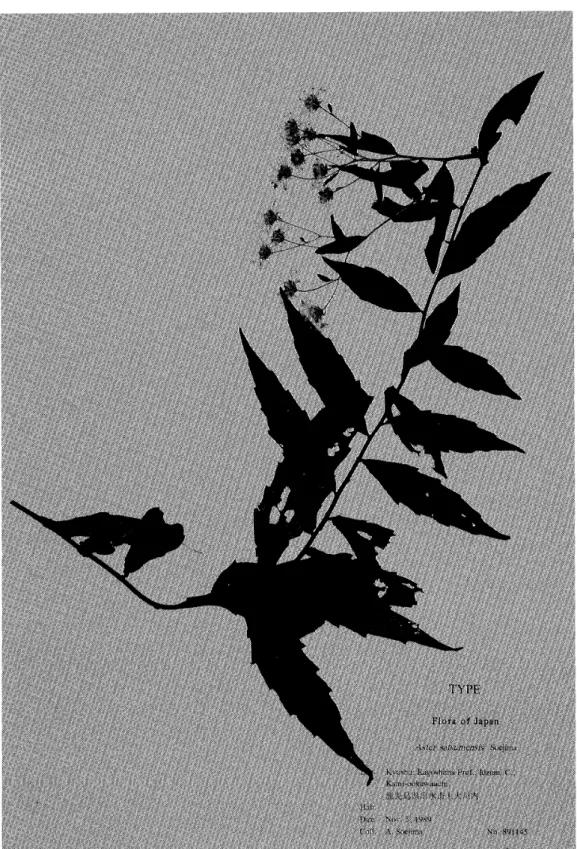
var. intermedius.Aster satsumensis Soejima
sp.
nov.; D-2The plantsof thesubgroup
D-2 have
many longhairs
and glandsbut
not so many as theplants of
D-3.
The variation range of HD of thissubgroup seems to be continuousfrom lower
tohigher,
whichis intermediate
between those of D-1 andD-3 (Fig.
4). D-2 isdistributed
mainly inthe southern partof Kyushu and haswider distributionarea thanD-1and/or D-3
in
Kyushu.Most
plantsof thistaxon have three orfour
satellitechromesornes(Fig. 3B).
Here Ipropose a new speciesAster
satsumensis Soejima sp.nov. forthistaxon.Allthe
diploids
ofA. satsumensisin Miyazaki
andKagoshima
prefectureshave
threeorfour
satellite chromosomes. The diploidsof NS2 and
KM2,
which are morphologically diMcult tobe distinguished from D-2
andbe included
inthistaxon,have
two satellite chromosomes.Irifune (1990)
investigatedthekaryotype
of theAster ieiophylluscomplex inKyushu. He observed seventy-ninediploids
havingthree or foursatellite chromosomes and eightdiploidswith two satellitechromosomes
in Miyazaki
and Kagoshima. According to him, all theThe Japanese Society for Plant Systematics
The Japanese Sooiety for Plant Systematios
44 Acta Phytotax. Geobot .
Vol
.44diploid
plants of the otherlocalities
exceptfor
onedip 且
oidin
the population of Tomari , Notsu T .,Oita
Pref
.,have
only two satellite chromosQmes ..4 .semiamplexicaulis
Makino ;
D −3The
subgroup D −3
is characterizedby
extremely dense, longhairs
and pienty of glandson the abaXial surface of the
且
eaf.This
subgroup is identified to /t
. se〃ziamplexicautisMakino (
Syn
,:・4
. ageratoides ssp . amplextfolius ).2
.Notes
on thedistribution
pattern of the .4ster leiophyllus complexin
Kyushu Usually, the p亘
ants of/Aster leio ρ h ア〃
us complex appear commonly on the road side or
forest
margin .However
,in
Saga Pref., the northem part of Nagasaki Pref. and theAs
A. A. A
2x:★, un Own :
☆
Fig.8
Distribution of the/Aster leiophンllus complex in Kyushu ,
barium is unknown ,
The ploidy level of the specimens of her一
The Japanese Society for Plant Systematics
The JapaneseSociety forPlant Systematics
August 1993
SOEJIMA;
AsterteiQphyilusin
Kyushu45
southern partof Kumamoto
Pref.,
I could notfind
them exceptfor
a population;NSI.
Although 'Shiro-yomena'
(A.
ageratoides ssp.IeiophyUus) is
reported tobe
common inSagaPref.
(Baba,
1964),theoccurrence of the complex inthisprefecturemaybe
rarer thanin
theother prefecturesinKyushu. My investigation
is insuMcient
inFukuoka, northern part ofMiyazaki
and the northern part ofKumamoto
prefectures.For these places,herbarium
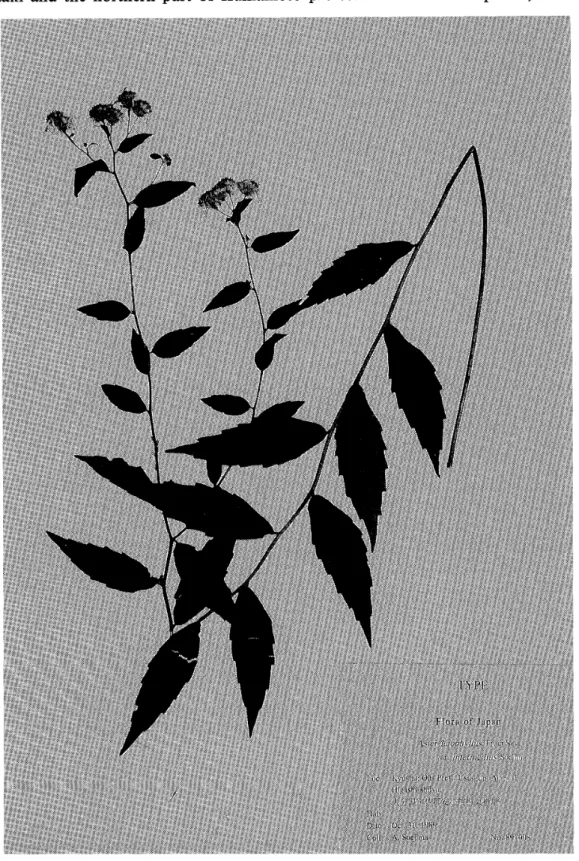
Fig.9 Type specimen ofAster leiophyUusFr,et Sav, var. intermedittsSoejima
The Japanese Society for Plant Systematics
The JapaneseSociety for Plant Systematics
46 Acta Phytotax.Geobot. Vol.44
.specimens
are surveyed
(Fig. 8).
The occurrence of diploidAster leiopltyUusvar.
teiophyUus is
rare inKyushu. In
thisstudy, the
diploids
obtainedfrom
three disjunctlocalities;westernFukuoka (F02),
HiradoIs.,
Nagasaki(NSI)
and southernMiyazaki (MZ9-l2).
The hexaploidsoccur commonlyin
thevolcanic regions, such as
Unzen, Aso-Kujiu
andKirishima.
According to theherbariumspecimens,
A. IeiopiryUus
var.leiopityllus
a]so occurin Kumamoto (Fig. 8).
Aster
leiophyltus
var.inter:medi"s
occur commonlyin
thenorthern part ofOita.
Inthe herbaria,thereare specimens of var.ieiop1tyllus
and var.intermedius
collected inFukuoka, Oitaand thenorthernpart
ofMiyazaki (Fig.
8).Astersemiamplt:xicaulis
is
rarein Kyushu. In
thisstudy, theoccurrence of thistaxon in Kyushuis
restrictedtothesmal1 areain
Oita. Only threeherbarium specimens areidentified
to A. semiamplexicaulis.
Two
of them were collectedin Oita,
and the anotherin
the northernpart
of Miyazaki(Fig.
8). About thedistribution
of thistaxon, see thenote of thedescription
ofA.
satsumensis.Astersatsumensis iscommon
in
thesouthernKyushu;
southern partof Miyazaki andKagoshima. A few
plantsof thistaxon are alsocollectedfrom
thenorthern partofKyushu,
Nagasaki and
Kumamoto.
3.
The taxonomical positionof thepentaploidsofOI14 (Oita Pref.)
andKM2 (Kumamoto
Pref.)
Three pentaploids and a
hexaploid
are obtainedin
the population OI14. The pentaploids resemble tothesympatrichexaploid.
Both have oblong-lanceolate orlanceolate leaves
with a few shorthairs
on theabaxial surface.The hexaploids in
the other region ofKyushu,
such as populations NS3-6, OI12, l3,KM2 and MZ6-8,have
glabrousleaves;
HD=O-5(-10).
The hexaploids
and pentaploidsofOI14 have
morehairs;
HD=15-20(Fig.
4).
Here,both
the pentaploidsand thehexaploid
areidentified
toA. leiqphyllus
var.Ieiop1tyllus,
tentatively.However, it is
possiblethat tetraploidplants
ofA.teiophyllusvar.
intermedius which
also
occur near the populationOI14,
related to the origin of these pentaploidsandlorhexaploid.
In
the populationKM2,
a pentaploid appears sympatric with sorne diploidsandhexaploids. The diploids
of thispopulation areidentified
toA. satsumensis and thehexaploids
to A.leiop]ij,llus
var.leiopdyllus. The
morphological appearance of thepentaploid
resembles thatof the hexaploidsand isidentifiedto var. IeiQpJtyllus.In summary, three species and one variety of the
Aster ieiop1tyllus
complex aredistributed in
Kyushu :A.leiophyUus
var. Ieiophytltdsconsisting of diploidand hexaploid, A. laiopdyllusvar.inter:medius (tetraploid), A.
semiamplexicaulis(diploid)
and A.satsumensis
(diploid).
Descriptions fornew taxa
1. Aster
leiophyllusFr.et Sav.var. intermediusSoejima,var. nov. Fig.9.Aster ageratoides subsp.
IeiQphyUus
x subsp, ovatusKitam. in J. Jpn. Bot. 12: 651 (1936),
pro parte.
Aster
crgeratoidesTurcz.
subsp. amplexijblius(Sieb.
etZucc.) Kitamura,
pro parte.excl. typ.Folia caulina oblongo-lanceolata,
basi
cuneata, sessilia, paginisadaxialibus sparsepilosa,pilisplerumque
brevibus
cum aliquot pilislongis.
Type:
Kyushu: Oita Pref., Usa-gun, Ajimu T., Higashi-shliya, Oct. 31, 1989, Soojima
89IO08
(MAK).
Thisvariety
is distinguished from
var.Ieiophyllus by hair density
on theleaf beneath.
The Japanese Society for Plant Systematics
The JapaneseSociety for Plant Systematics
August 1993
SOEJIMA:
Asterieiqpltyllusin
Kyushu47
In
contrast tothe glabrousleaf
of var.IeiophyUus,
var. intermediushas
much short hairon theleaf beneath.
Perennialsufuutescent rhizomatous herbs. Stems erect ca. 50cm tall,denselypilose.
Leaves
scarcely pubescenton abaxial side ofleaf,
mostly short hairswith afew long
ones.Fig. 10 TypespecimenofAstersatsumensis Soeiima